



Abstract
Intimate partner violence (IPV) is a widespread issue faced by women across the world. While prevalence and epidemiology of IPV has been studied extensively, its association with controlling behavior has been largely ignored. We carried out this study to assess the prevalence of IPV against married women and its association with sociodemographic factors, justification of violence, and controlling behavior by their spouses in Delhi, India. Five hundred women residing in an urban residential area of Delhi, India, responded to a validated questionnaire asking about IPV and controlling behaviors by their husbands. In our study, 30.6% of women had “ever” experienced IPV, and 43.2% women stated that they had experienced controlling behavior by their husbands. Alcohol consumption by the husband, women’s justification of their partner’s violence, and controlling behavior by the husbands were significantly associated with the experience of IPV among study participants. Women with a lower education status, not financially employed, those who justified violence or faced any form of violence in their marital life were at higher risk of experiencing controlling behavior from their spouses.
Introduction
World Health Organization (WHO) acknowledges violence against women as a major public health issue as well as a violation of women’s rights. The United Nations defines violence against women as “any act of gender-based violence that results in, or is likely to result in, physical, sexual, or mental harm or suffering to women, including threats of such acts, coercion or arbitrary deprivation of liberty, whether occurring in public or private life” (WHO, 2017) while intimate partner violence (IPV) is any form of behavior in an intimate relationship where one partner inflicts physical, psychological, or sexual harm on the other partner in the relationship (Krug, Linda, James, Anthony, & Rafael, 2002; WHO, 2012). Global surveys and estimates have assessed the problem to be both widespread and poorly reported. On average, one in three women is believed to face some form of IPV in her lifetime. According to National Family Health Survey-4 (NFHS-4; International Institute for Population Sciences [IIPS] & ICF, 2017), fourth in a series of the large scale, multiround surveys conducted in India, 33% of ever-married women have experienced physical, sexual, or emotional spousal violence. In India, any form of violence has been variously reported as 56% from north-eastern states (Babu & Kar, 2009), 36.9% in Mumbai (Shrivastava & Shrivastava, 2013), 38.4% in Delhi (Mundhra, Singh, Kaushik, & Mendiratta, 2016), and 56.7% in rural southern region (George et al., 2016). In a systematic review of 137 quantitative studies on domestic violence among Indian women, a median of 41% of women reported experiencing domestic violence during their lifetime and 30% in the past year (Kalokhe et al., 2017). The physical, mental, emotional, economic, and intergenerational effects of IPV have been extensively researched and point to wide-ranging effects with enormous repercussions for the women affected, their families, and the society at large.
One of the important risk factors of IPV is controlling behavior exhibited by male perpetrators as suggested from available literature (Aizpurua, Copp, Ricarte, & Vázquez, 2021; Antai, 2011; Stark, 2012). Controlling behavior has been defined as a range of acts designed to make a person subordinate and/or dependent by isolating them from sources of support; exploiting their resources and capacities for personal gain; depriving them of the means needed for independence, resistance, and escape; and regulating their everyday behavior (Home Office, 2015). This form of subjugation or controlling behavior is at times more harmful and intimidating than actual violence. The percentage of women who faced controlling behavior by their male partners was reported as 30% in Malawi (Mandal & Hindin, 2013), 63% in Nigeria (Antai, 2011), 32.1% in rural Vietnam (Krantz & Vung, 2009), and 49% in Nepal (Sapkota, Bhattarai, Baral, & Pokharel, 2016). Prevalence of IPV and associated factors has been widely studied; however, very few studies have explored the association between controlling behavior and IPV (Aizpurua et al., 2021; Babu & Kar, 2009; Johnson, 2000; Krantz & Vung, 2009; Shrivastava & Shrivastava, 2013). In this study, we assessed the prevalence of all forms of IPV against married women, its association with controlling behavior, and also with various sociodemographic factors. We also explored the attributes of controlling behavior exhibited by husbands toward their wives.
Method
Study Settings
This cross-sectional study was conducted among “presently married” women living in an urban residential area of Delhi. The study was conducted from April 2014 to December 2014.
Sample Size
The minimum sample size calculated assuming IPV prevalence of 25%, with 4% absolute error of margin and 95% confidence level, was 450. Five hundred forty married women resided in the study area and all of them were invited to participate in the study, out of which 500 women consented to be a part of the study (Response rate-92.6%).
Data Collection
All the women were invited to a series of health lectures on women’s health and related issues. The questionnaire was then administered to the women and their responses elicited anonymously. We used a pretested structured questionnaire which was adapted from the woman’s questionnaire used in the National Family Health Survey-3 (NFHS-3; IIPS & Macro International, 2007). There were three, seven, and two questions, respectively, on emotional, physical, and sexual violence. Affirmative response to any of these questions was considered an indication of IPV, irrespective of the type of violence. Similarly, women who answered yes to any of the six questions on controlling behavior were presumed to be facing controlling behavior from their spouses. Informed consent was obtained from all women, and the study was approved by the institutional ethics committee.
Statistical Analysis
Statistical analysis was done using R software version 3.1.0. The proportion of women facing any form of IPV and controlling behavior was calculated. Logistic regression was used to assess the association of IPV with various sociodemographic factors and controlling behavior. Those sociodemographic variables that were found to have significant associations with IPV in the bivariable analysis were included in the multivariable analysis. Adjusted odds ratio with 95% confidence interval was calculated. Value of p less than 0.05 was considered to be statistically significant.
Results
Demographic Characteristics
Five hundred women participated in the study. Demographic characteristics of study participants are shown in Table 1. In our study, 32.6% of women were less than 30 years of age, 49.2% were educated above the secondary level, and 60.2% were married for more than 10 years. Among the study participants, 73.8% of the women were not employed, 83.6% had children, while 65.5% of the women had at least one male child. In our study, 66.4% of women belonged to joint families, 26.8% of them reported that their husbands consume alcohol, and 43.2% of women had spouses who exhibited controlling behavior.
Demographic Characteristics of Study Participants.

IPV
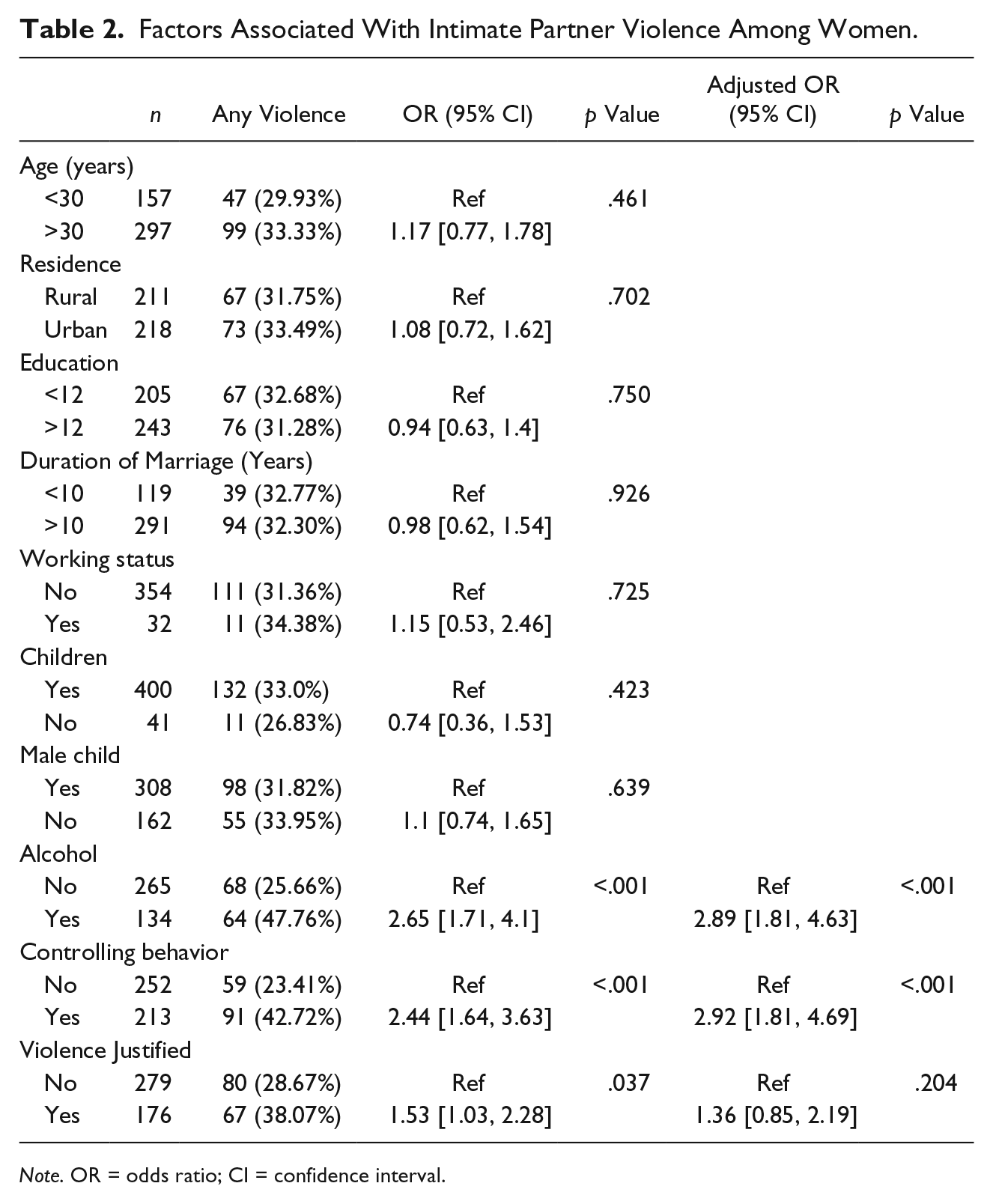
We found that 153 (30.6%) women had faced some form of violence, 317 (63.4%) women had not faced any form of violence, while 30 (6%) women chose to not respond. Furthermore, 18.2% had “ever” faced physical violence, and 19.8% and 10.4% had “ever” faced emotional and sexual violence, respectively. In our study, 22 (4.4%) women faced all three forms of violence. Out of the 153 women who had faced “any” form of violence, 18 (11.7%) experienced it “often” while 135 (88.3%) experienced it “sometimes.” Alcohol consumption by the husband (adjusted odds ratio [aOR] = 2.89 [1.81, 4.63], p < .001) and controlling behavior by the husband (aOR = 2.92 [1.81, 4.69], p < .001) were found to be significantly associated with any form of violence as shown in Table 2. Justification of violence by the women (OR = 1.53 [1.03, 2.28], p = .037) was found to be significantly associated with IPV only in the bivariable analysis. In our study, age of the women, duration of the marriage, employment status, type of family, level of education of the women, or primary place of residence were not found to be significantly associated with any form of violence.
Factors Associated With Intimate Partner Violence Among Women.
Note. OR = odds ratio; CI = confidence interval.
Controlling Behavior
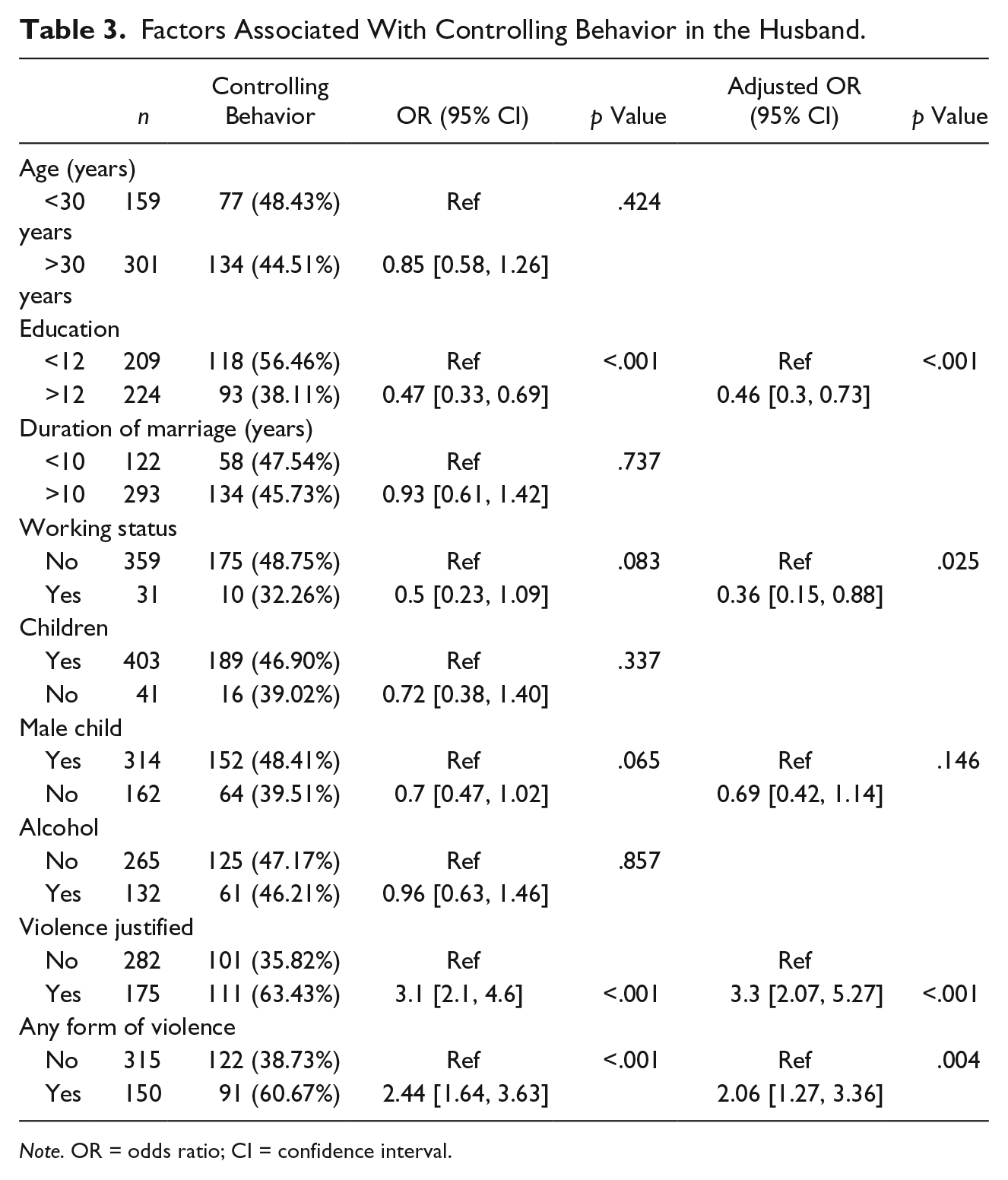
In our study, 216 (43.2%) women reported controlling behavior, while 260 (52%) women denied any form of controlling behavior and 24 (4.8%) women chose to not respond. Seventy-seven (15.4%) women reported that their husbands would get jealous when they speak to other men, 14 (2.8%) were frequently accused of being unfaithful, 79 (15.8%) were not permitted to meet their female friends. Fifty-four (10.8%) women reported that their husbands limited their contact with their family members, 104 (20.8%) had husbands who insisted on knowing their whereabouts always, and 79 (15.8%) were not trusted with money by the spouse. Multivariable analysis revealed that higher education (aOR = 0.46 [0.3, 0.73] p ≤ 0.001) and employment of women (aOR = 0.36 [0.15, 0.88], p = .025) were negatively associated with controlling behavior by husbands while justification of violence by women (aOR = 3.3 [2.07, 5.27], p ≤ 0.001) and experiencing any form of violence by women (aOR = 2.06 [1.27, 3.36], p = .004) were positively associated with controlling behavior by husbands (Table 3).
Factors Associated With Controlling Behavior in the Husband.
Note. OR = odds ratio; CI = confidence interval.
Discussion
In this study, in an urban area of Delhi, 30.6% of married women experienced some form of IPV in their marriages. These findings are similar to NFHS-4 results (IIPS & ICF, 2017), which reported that 30% of married women in Delhi and 33% of married women in India faced spousal violence. A study by Mundhra et al. (2016) reported IPV prevalence of around 40% among women in Delhi, India. It is interesting to note that there is a lot of variation in prevalence estimates of IPV in different parts of India, as reported by NFHS-4 as well as other studies carried out in India (Babu & Kar, 2009; George et al., 2016; Kalokhe et al., 2017; Shrivastava & Shrivastava, 2013). The reason for these variations could be different cultural and social factors prevalent in these regions, which can influence women’s perspective on domestic violence and their acceptance of some forms of IPV as an integral part of married life, therefore leading to underreporting of IPV.
We observed that women whose husbands consumed alcohol or exhibited controlling behavior were at higher risk of domestic violence as compared with women whose husbands had neither of the two attributes. In our study, 26.8% of the women reported alcohol consumption by their husbands and such women had 2.9 times higher odds of experiencing IPV than other women. Alcohol has consistently been associated with domestic violence in studies carried out in different parts of the world. In countries like Uganda, Zimbabwe, and Vietnam, a strong association between alcohol consumption and IPV have been reported (Krantz & Vung, 2009; Tran, Nguyen, & Fisher, 2016). Similarly, a multicentric study in India, Chile, Egypt, and the Philippines identified regular alcohol consumption by the husband or partner as a risk factor for any lifetime physical IPV across all four study countries (WHO, 2012).
In our study, 43% of women experienced controlling behavior by their husbands (jealousy when talking to other men, accusations of infidelity, restriction of movement outside the house, restrictions against allowing the wife to meet her family members, wanting to know where the wife is or distrust with household finances). NFHS-4 also reported controlling and isolating behaviors by significant proportion of husbands in India, wherein 25% of the ever-married women in the age group 15 to 49 years reported that their husbands were jealous or angry if they spoke to other men, and 24% of women reported that their husbands did not trust them with household finances. Furthermore, 20% reported that their husbands insisted on knowing where they were at all times and did not permit them to meet their female friends, 15% reported that their husbands tried to limit their contact with their families, and 8% reported that their spouses frequently accused them of being unfaithful (Kumar, 2018). Other studies (Antai, 2011; Krantz & Vung, 2009; Mandal & Hindin, 2013; Sapkota et al., 2016) carried out in different countries have reported 30% to 63% prevalence of controlling behavior by men, when in a heterosexual relationship.
In our study, controlling behavior by husbands was found to be an important determinant of IPV. Women who faced controlling behavior by their husbands had almost three times higher odds of experiencing IPV over the past 1 year. This finding is consistent with other studies where strong positive associations (between 2 and 5 times) have been found between controlling behavior and risk of domestic violence (Aizpurua et al., 2021; Biswas, Rahman, Kabir, & Raihan, 2017; Dalal & Lindqvist, 2012; Donta, Nair, Begum, & Prakasam, 2016; Gage & Hutchinson, 2006; Krantz & Vung, 2009; Mandal & Hindin, 2013). The probable reason for this association may be that in Indian society, a married woman is expected to always behave in a certain manner to please her husband and his family. A large proportion of Indian males feel that their wives should be subservient and act as per their husbands’ wishes. Hence, husbands try to control finances and interactions of their wives with other members of her family and society and resort to some form of violence when they feel any threat to their dominance over their wives. The socioeconomic status of a woman in the society is an important determinant of her husbands’ behavior toward her. Women who are less educated and financially dependent on their partners are more likely to experience controlling behavior perpetrated by their partners (Jenkins, 2000). In our study also, women who had a lower educational status and who were unemployed were more likely to face controlling behavior from their spouses. Though IPV affects women from all strata of society, previous studies have found certain socioeconomic factors like urban residence, older age, lower educational status, and lower family income in women to be consistently associated with higher risk of domestic violence (Abramsky et al., 2011; Babu & Kar, 2009; Donta et al., 2016). However, in the present study, we did not find any associations between the women’s age, educational status, employment, duration of the marriage, and family size with domestic violence. Male child preference has been considered as a determinant of IPV against women by their husbands in India, given the strong preference for male children in Indian society. However, we did not find any association between IPV against women and the presence or absence of a male child in the family. The possible reasons for this could be the relatively better educational status of both the women and their spouses and the higher socioeconomic status of our study population as compared with the national average.
The strength of this study is that we used the validated NFHS questionnaire on IPV, which thus allows for comparison with other studies. This study also highlights attributes related to controlling behavior by husbands, which has not been studied in India in the past. However, the limitation of underreporting of a sensitive issue like IPV cannot be ruled out, though we hope that self-administration of the questionnaire and ensuring the anonymity of the respondents may have helped reduce this bias. In addition, some women did not respond to certain questions, which could have introduced bias in our study. This study has limited external validity as it was conducted in one urban area in Delhi; hence, its results cannot be generalized to other areas of India.
Conclusion
Around one third of the women in this study had experienced IPV, while 43% of the women were subjected to controlling behavior by their husbands. Because of the higher risk of IPV among women who face controlling behavior, there is a need to study the epidemiology and attributes of controlling behavior faced by women using both qualitative and quantitative research methods. Study findings indicate that public health interventions targeting alcohol consumption and controlling behavior in men are required at the community level.
Supplemental Material
Questionnaire – Supplemental material for Controlling Behavior and Intimate Partner Violence: A Cross-Sectional Study in an Urban Area of Delhi, India
Supplemental material, Questionnaire for Controlling Behavior and Intimate Partner Violence: A Cross-Sectional Study in an Urban Area of Delhi, India by Reema Mukherjee and Rajneesh Kumar Joshi in Journal of Interpersonal Violence
Footnotes
Declaration of Conflicting Interests
The author(s) declared no potential conflicts of interest with respect to the research, authorship, and/or publication of this article.
Funding
The author(s) received no financial support for the research, authorship, and/or publication of this article.

Supplemental Material
Supplemental material for this article is available online.
Author Biographies
References
Supplementary Material
Please find the following supplemental material available below.
For Open Access articles published under a Creative Commons License, all supplemental material carries the same license as the article it is associated with.
For non-Open Access articles published, all supplemental material carries a non-exclusive license, and permission requests for re-use of supplemental material or any part of supplemental material shall be sent directly to the copyright owner as specified in the copyright notice associated with the article.
