



Abstract
The purpose of this study was to examine the role that control occupies in the motivation for, and development of, intimate partner violence (IPV). The research literature often theorizes about the importance of control in gender-based crimes; however, few studies have empirically tested these assumptions. Given the breath of theoretical approaches in examining IPV and the need for individualized explanations, the current study used concepts from Tittle’s control balance theory. This integrated theory accounts for many of the known risk factors, such as self-control and routine activities, while accounting for individual perceptions of control. A college student sample (N = 401) was used, in accordance with the literature that has found this subpopulation to be at high risk for IPV. An online survey was distributed to potential participants to capture self-reported incidents of victimization and perpetration of IPV within the past year. Statistical analysis using segmented nonlinear regression models was estimated to assess sex difference effects. The results showed no difference in control continuums between the sexes but did find significant associations between control deficits and female victimization and perpetration, as well as significant association between control deficits and male perpetration of IPV. These findings have implications beyond the theoretical confirmation that control is key factor to this type of violence. In addition to greater education regarding dating expectations, control deficits may be particularly important for socially marginalized groups, such as those from the lesbian, gay, bisexual, and transgender (LGBT) community. Efforts can then be made to identify issues with control in IPV counseling, victim services, treatments for offenders, and other gender-based crimes, such as rape, sexual assault, and stalking.
Introduction
Intimate partner violence (IPV) is a pervasive social issue, which affects roughly 20% of females and 8% of males in the United States during their lifetime (Tjaden & Thoennes, 2000). Research shows that college students, in particular, are at high risk for victimization (Straus, 2004), where nearly 20% to 35% of college females and 10% to 15% of college males experience some form of IPV during their time in school (Franklin, 2011; Gover, 2004). The increased presence of alcohol and drugs, relationship inexperience of young adults, familial upbringing, Greek affiliation, and adherence to rape myths help to create a unique high-risk environment for the perpetration and victimization of IPV among college populations (Franklin, 2011; Gover, 2004; Gover, Kaukinen, & Fox, 2008; Whitfield, Anda, Dube, & Felitti, 2003). Accurate identification of risk and protective factors for IPV is critical for policy makers and school administrations in creating effective policy that will limit the prevalence of this type of violence on college campuses. However, there is a paucity of knowledge regarding the motivational mechanisms that lead to perpetration and exposure to victimization. This study explores the motivational influence of one cognitive factor, control.
Feminist scholars have described IPV as the influence of power and control on the relationship between perpetrators and victims (Felson & Messner, 2000; Umberson, Anderson, Glick, & Shapiro, 1998). This division in power has been traditionally conceptualized as male entitlement or domination (Campbell et al., 2002; Dutton & Goodman, 2005). Whether control is thought of as a mechanism or as a motivation for violence, there are clear indications that socialization of gender adds to nuance and complexity of IPV and the sex gap in offending. In addition to environmental risk factors, the control differential is a central theme among feminist theories that aim to explain this type of violence through female perspectives.
Traditional criminological theories, such as low self-control and routine activity theory, have been utilized in the past studies to predict specific violent outcomes (Franklin, Franklin, Nobles, & Kercher, 2012; Gover, 2004; Pratt, Turanovic, Fox, & Wright, 2014; Sellers, 1999), but they frequently bypass explicitly accounting for motivation or opt for alternative strategies to operationalize the mechanism by which control influences behavior. Control balance theory, by contrast, was created as an integrative approach to understanding the role that subjective control has on individual behavior. In addition, by integrating aspects of self-control into the theory, control balance may be more apt to explain the variation in behavior observed in both perpetrators and victims of intimate violence.
Literature Review
Globally, the term intimate partner violence refers to behaviors such as rape, sexual assault, battery, and stalking between current or previous romantic partners (Campbell et al., 2002). To this end, IPV encompasses a vast array of psychological, emotional, physical, and sexual abuse behavior that may be as subtle as a verbal insult but frequently includes more serious forms of violence such as battery, rape, or homicide.
One of the defining features of IPV is the power and control differential between the victims and offenders (Felson & Messner, 2000). The ability to emotionally or physically overpower another individual often gives offenders a sense of superiority and control over their partners (Dutton, 1988; Felson & Messner, 2000; Kelly & Johnson, 2008). Although assumed to exist and similarly presumed to impact motivation for perpetration, few studies have directly tested how control may operate to induce violence. In an attempt to understand where the need or expectation of control originates, contemporary research has documented that attitudes, upbringing, and prior experience may be predictive of who is likely to engage in IPV (Gover et al., 2008; Whitfield et al., 2003); thus, these factors may help to explain why certain individuals seek such power differentials in their personal relationships. Studies on entitlement, dominance, traditional heterosexual beliefs, and power have found that attitudes and expectation to maintain a superior status relative to their partners are indicative of those who engage in IPV (Dutton & Goodman, 2005; Santana, Raj, Decker, La Marche, & Silverman, 2006). Such findings support the notion that the need for control, not violence per se, is a major motivation behind perpetration.
Conceptual Explanation of Control Balance Theory
Criminological investigation of IPV historically stems from basic control theories such as social bonds (Hirschi, 1969) or the general theory of crime (Gottfredson & Hirschi, 1990). As a construct, the concept of control is the basis for many criminological theories (self-control, social bonding, and neutralization techniques), providing explanation for both macro- and micro-level deviance. Over the past quarter century, the relationship between low self-control and perpetration of criminal behavior has been well established (Burton, Cullen, Evans, Alarid, & Dunaway, 1998; Gibbs & Giever, 1995; Grasmick, Tittle, Bursik, & Arneklev, 1993); however, other studies have further identified connection between low self-control and general victimization (Pratt et al., 2014; Schreck, 1999; Schreck, Stewart, & Fisher, 2006).
As a central concept to several sociological and criminological theories, control is typically conceptualized as a sum of formal and informal factors (e.g., bonds to peers and family, fear of punishment, and self-regulation) that inhibit or discourage deviance (Cloward & Ohlin, 1960; Gottfredson & Hirschi, 1990; Hirschi, 1969; Merton, 1938). Traditional control theories found some success in predicting IPV victimization and perpetration; however, there are still discrepancies about the applicability of such theories in explaining certain forms of deviance (Tittle, 1995). Acknowledging the importance and relative support for this class of theories in empirical research, Tittle (1995, 2004) blended aspects of various control theories as well as concepts from other theories (i.e., routine activities and general strain) into an integrative theory. Control balance theory, therefore, features four major components: self-control, opportunity, constraint, and the control ratio (amount of imbalance). Working in tandem, each component contributes to the overall picture of deviance, facilitating explanations regarding the form and severity of particular types of deviance. Among other advantages, extracting the most successful aspects of other criminological theories and combining them may also capture a greater amount of explained variance in statistical modeling.
As a racially, sex, and socioeconomically neutral general theory, control balance theory states in part that the proclivity for offending originates not from particular relationships or internal traits but from the perceived imbalance of exerted and subjected controls in one’s environment (Tittle, 1995). This definition of control accounts for the effect of internal processing of external stimuli and relationships. In addition, this theory uniquely purports a parabolic relationship between control imbalance and propensity for deviance. Although linear relationship is easy to test and conceptualize, Tittle (1995) argued that human behavior is rarely linear; thus, to correct for this issue, control balance was created to be nonlinear and parabolic in its explanation of deviance and conformity.
To better explain how control is conceptualized, Tittle (1995) also discussed the idea of a control continuum, on which individuals can be placed to determine their probable level of engagement in deviant behavior. The control continuum can be visualized as a two-tailed distribution where control surpluses (i.e., greater control exerted over control subjected) and control deficits (i.e., greater control subjected over control exerted) are placed on opposite ends of the distribution, and control balance (i.e., equal amount of exerted and subjected controls) lies in the center. Theoretically, control imbalances are related to deviant behavior, while control balances translate into conforming behaviors. This creates a U-shaped distribution in terms of the propensity for deviance. Quantitatively, Tittle (1995, 2004) did not describe how exactly this conceptualization of the control continuum should be created or evaluated, but Piquero, MacIntosh, and Hickman (2001) were able to validate one version of the control ratio through Rasch modeling, making it the standard measure to evaluate control imbalance in the literature. The control ratio is the numerical product that results when one’s control exerted is divided by one’s control subjected. Such a metric would represent whether a control imbalance exists, in what direction, and the magnitude of that imbalance. Similar to how the control continuum moves from control deficit to surplus, the control ratio is a sliding fraction, where the more individual control a person has, the more likely it is that the person will have a control surplus and a control ratio greater than one.
According to Tittle (1995), it is the need for autonomy which motivates conforming and nonconforming behavior. Similar to a hedonic need for more, this may translate into control being a key motivator of IPV and perhaps a reason why violence tends to escalate in these relationships. In this sense, motivation is a constant for all individuals, including victims. The impact of control in IPV relationships may be the context in which motivation is placed. Individuals with a control deficit, few opportunities, and high levels of constraint may not feel as though they are able to fight back or escape an abusive situation. This notion is a common complaint among victims of IPV, who feel that they have little choice or option to leave (Campbell et al., 2002). Conversely, those with a control surplus, low self-control, low constraints, and frequent opportunity may choose to take advantage of their partners to gain more autonomy.
Control Balance Explains the Sex Gap Through Socialized Constraints
Many general theories of crime fail when sex differences are examined because they were not originally designed to understand female offending or female victims. Control balance, though, carefully attends to the sex gap and may be more appropriate for explaining gendered crimes using motivational differences. Although the control ratio is inherently sex neutral, control balance theory accommodates natural population distribution differences between males and females. According to Tittle (1995, 2004), females are socially more likely to have greater constraints placed on them and be subsequently blocked from certain opportunities to attain autonomy. This may ultimately lead to more females disproportionately experiencing a control deficit rather than a control surplus or balance condition. Conversely, males are likely to show a normal bell-curved distribution, where the majority occupy a control balanced state. Sex differences in control ratio distributions may lead to more females feeling helpless and may aid male entitlement. This suggests that in addition to a within-individual imbalance, there is also an imbalance between the sexes/partners that might help to account for the high rates of IPV. Moreover, these individuals and couple imbalances are likely amplified in young adults who may be more likely to adhere to unhealthy attitudes regarding relationship expectations and sex roles.
Empirical Tests of Control Balance
To date, there are only 16 empirical studies of control balance theory and its ability to predict deviance, perpetration, and victimization. The first study, conducted by Wood and Dunaway (1997), found support for control deficits being related to predatory behavior among a sample of sex offenders; however, it was not until 1999 when a more formal test of control balance (Piquero & Hickman, 1999) was conducted. In general, several studies show mixed results for the propositional details of control balance theory but find overall support for control imbalance being related to perpetration (Baron & Forde, 2007; Curry & Piquero, 2003; Delisi & Hochstetler, 2002; Fox, Nobles, & Lane, 2014; Higgins, Lauterbach, & Tewksbury, 2005; Hughes, Antonaccio, & Botchkovar, 2015; Piquero & Hickman, 1999; Williams, 2008) and victimization (Nobles & Fox, 2013). A number of the studies find that deviance associated with deficits differs from deviant acts committed by individuals who have a control surplus (Baron & Forde, 2007; Curry & Piquero, 2003; Fox et al., 2014; Hickman & Piquero, 2001; Nobles & Fox, 2013).
Three studies have specifically examined Tittle’s (1995, 2004) claim about the sex distributions for the control ratio (Fox et al., 2014; Hickman & Piquero, 2001; Nobles & Fox, 2013). In addition, these three studies differ in their significant findings. Testing sex differences in the proclivity for engaging in either exploitative deviance or self-harming deviance, Hickman and Piquero (2001) asked 165 undergraduate students to assess the likelihood of engaging in a behavior after reading two short scenarios. Measuring the control ratio using the established Piquero–Hickman method, they found little difference in the ratio distributions between the sexes but did find sex differences in the likelihood of engaging in the two presented forms of deviance. Females were more likely to engage in the predatory self-harming behavior, whereas males were more likely to engage in the exploitative deviance. This result differs from the first empirical test (Piquero & Hickman, 1999), where males were more likely to report the likelihood of engaging in assaultive predatory violence.
Similarity between males and females were also found in the most recent examination of control balance in a sample of 2,414 jail inmates in Florida (Fox et al., 2014). This study explored whether control imbalance was able to account for offending variety, while controlling for gang membership, collective efficacy, and neighborhood disorder. The results showed that low self-control and control surplus were significantly related to increases in offending variety for both males and females (Fox et al., 2014). Furthermore, magnitude comparison tests revealed that low self-control and control surplus influenced offending equally in strength of effect between males and females. The gender similarity in both the distribution and effect on offending in this study and the Hickman and Piquero (2001) study is in accordance with Tittle’s hypothesis that the control ratio should produce the same outcomes for similarly situated people. Thus, if females and males are experiencing the same levels of control imbalance, self-control, constraints, and opportunity, their engagement in offending should also be similar.
Although these research findings appear to support the gender-neutral influence of the control ratio on offending, a recent study on stalking victimization and perpetration suggests that there might be a more nuanced effect when it comes to crimes of intimate power and control (Nobles & Fox, 2013). Using a large sample of 2,783 college students, this study found sex differences not only in the control ratio distribution but also in victimization and perpetration rates. Females in the sample were more likely to report a control deficit than males and were also more likely to report being a victim of stalking than males. Similarly, males were more likely to report having a control surplus and engaging in stalking perpetration (Nobles & Fox, 2013). Furthermore, control deficit was related to victimization, whereas control surplus was related to perpetration. This study illustrates both the sex distribution differences and predicted difference in behavioral outcomes outlined in Tittle’s (1995) book. As a subform of IPV, stalking involves the monitoring and frightening of previous or current partners through the defining feature of control. The results from this study confirm the unique role control plays in IPV and stalking, and highlights why exploring sex effects with control balance is still an important area of inquiry.
Current Study
The current study aims to expand on recent research and test the applicability of the theory to IPV victimization and perpetration outcomes. Such a test would advance knowledge about how control balance theory may be applied to IPV generally, and may help to affirm conclusions from other studies about the significance of general control imbalance (Baron & Forde, 2007; Curry & Piquero, 2003; Delisi & Hochstetler, 2002; Fox et al., 2014; Hickman & Piquero, 2001; Hughes et al., 2015; Nobles & Fox, 2013; Piquero & Hickman, 1999, 2003). Furthermore, examining crime types where control is an important component of individual motivation or situational factor related to deviance may yield more concrete understanding of control balance, similar to the recent stalking study (Nobles & Fox, 2013). Using a student sample, the current study aims to answer two research questions:
Based on the previous research literature on perpetration and victimization of other forms of deviance, it is likely that control imbalance rather than specific imbalance will be of importance; however, the most recent study on stalking did find that in some cases the specific type of imbalance (surplus or deficit) was critical when examining sex differences (Nobles & Fox, 2013). Tittle (1995, 2004) hypothesized a sex difference in the control ratios and a difference in how deviance is expressed based on levels of conditional factors such as constraints and opportunity. In addition, control balance theory was originally created to assess deviance but has since been revised to explain conformity (Tittle, 2004). Although other studies have expanded the theory to explain victimization, whether or not such an application is appropriate has yet to be conclusively determined. By focusing on a form of violence that tends to disproportionately affect women as victims and feature males as perpetrators, such as IPV, the current study is able to test theoretical questions regarding imbalance and gender differences using a novel outcome.
Method and Design
Sample
The sampling frame for the current study follows both the previous research on IPV that focuses on college samples and on the recognition that college students are a natural high-risk population for this type of offending and victimization. Although the focus on college populations is inherently limiting, there has been some empirical support that suggests results from studies using these samples are indeed generalizable to the general population (Payne & Chappell, 2008; Wiecko, 2010). Given time and resource restrictions, the data set used here is a cross-sectional sample of Introduction to Psychology college students from a large southwest university in the spring of 2013. In addition, the location of the data collection provided us with a predominately Hispanic sample, which allows us to focus on an understudied population in relation to IPV as well as a potentially important extension to the body of literature on control balance theory. All 719 students enrolled in this course were sent an email solicitation for participation with a hyperlink to the online survey. Follow-up solicitations were emailed to students 2 and 4 weeks after initial contact to increase response rates. Only those who indicated their age as being 18 years or older were allowed to participate, and all students were reminded that participation was voluntary and confidential. This process resulted in 435 completed surveys, with a response rate of 60.5%. Although this response rate is not ideal, Dillman (2007) stated that given this common difficulty with noncompensated online surveys, a response rate around 10% should be acceptable. Furthermore, more recent studies that have used similar sample collection methods have found similar response rates (see Fox, Nobles, & Fisher, 2016).
Measures
Dependent Variables
IPV
Respondents were asked whether in the past 12 months they had been the victim of variety of physically abusive behaviors, adapted from the revised Conflict Tactics Scale (Straus, Hamby, Boney-McCoy, & Sugarman, 1996), including nine individual acts perpetrated by an intimate partner (thrown something that could hurt you, twisted your arm or pulled your hair, kicked you, slapped you, pushed or shoved you, punched or hit you with hand or object, choked you, slammed you against the wall, or grabbed you). Response options were dichotomized (no = 0, yes = 1) and summing all of the offenses created a variety index (ranging from 0 to 9) where higher scores indicate greater IPV victimization; resultant scores had good reliability (α = .768). These same items were alternatively presented in the context of the respondent acting violently toward an intimate partner, with a similar coding strategy. The resultant intimate partner perpetration score also demonstrated high reliability (α = .829).
Independent Variables
Control imbalance
Consistent with prior literature on control balance (Nobles & Fox, 2013), we used a reduced control balance scale that specifically identified control in the context of an intimate partner relationship (see also Hickman, Piquero, Lawton, & Greene, 2001; Higgins & Lauterbach, 2004; Piquero et al., 2001; Piquero & Piquero, 2006). 1 The survey contained a set of eight relationship-oriented domains that were first presented by asking respondents to rate the amount of control the respondents had over each domain (i.e., control exerted), and then the same items were presented again with instructions to rate the amount of control that each had over them (i.e., control subjected). The domains captured (a) money/financial matters, (b) decisions on activities with intimate partners, (c) what the intimate partner wears when going out in public, (d) friendships that the intimate partner has, (e) intimate partner’s behavior in public, (f) decisions about intimate activities (i.e., kissing, sexual intercourse, role-playing), (g) decisions to spend time alone from the partner, and (h) overall control over the intimate partner. Response options included no control (1), little control (2), control (3), and total control (4).
Consistent with the literature testing control balance theory, two subscales were created by summing the items corresponding to control exerted (α = .703) and control subjected (α = .832). A ratio of control imbalance was then calculated by dividing control exerted by control subjected (CE / CS); this ratio was further recentered to make a ratio value of zero representative of the “balance” condition. The recentering procedure involved subtracting one from the original balance ratio and mathematically transforming deficit values by multiplying by their inverse (1 / x) to approximate symmetry in the overall imbalance function.
Self-control
Tittle (2004) put specific emphasis on the role of self-control in the broader conceptualization of control balance theory. Thus, we included items representing Tangney, Baumeister, and Boone’s (2004) brief self-control scale, comprised of 13 items. 2 Response options ranged from not at all like me (coded as 1) to very much like me (coded as 5). The items were summed such that scaled scores ranged from 17 (higher self-control) to 54 (lower self-control). The self-control scale yielded good internal reliability (α = .778).
Control Variables
Demographics
The demographic characteristics included age in years (measured continuously), race/ethnicity (non-White = 0, White = 1), foreign status (U.S. citizenship = 0, non-U.S. citizenship = 1); lesbian, gay, bisexual, and transgender (LGBT) status (0 = heterosexual, 1 = nonheterosexual), and relationship status (0 = single, 1 = dating, married, or otherwise attached). Sex (female = 0, male = 1) was included in the full sample, while subsequent analyses estimated split models to illustrate differential effects across categories.
Analytic Strategy
Multivariate models featured in this analysis involve segmented nonlinear regression (Neter, Wasserman, & Kutner, 1985) to estimate the effects of control balance on IPV while controlling for other theoretical and demographic covariates. 3 This approach is consistent with prior literature (Baron & Forde, 2007; Curry & Piquero, 2003; Fox et al., 2014; Hickman & Piquero, 2001; Hickman et al., 2001; Higgins & Lauterbach, 2004; Higgins et al., 2005; Nobles & Fox, 2013; Piquero & Hickman, 1999, 2003; Piquero & Piquero, 2006). The general form of the models was

where Y represents the dependent variable, IPV; self-control indicates respondent score on the Tangney et al. (2004) scale; age indicates respondent age in years; race/ethnicity indicates respondent’s dichotomized race/ethnicity; foreign status indicates whether the individual reported citizenship from a country other than the United States; LGBT status indicates whether the respondent self-classified into a nonheterosexual orientation; and relationship status indicates whether the respondent was dating, married, or otherwise nonsingle at the time of the survey. Estimation of the control balance deficit or surplus parameters was conditional upon the respondent’s recentered control balance ratio (CBR; deficit = CBR < 0, surplus = CBR > 0). Models were initially estimated using the full sample and were then split by sex to assess comparative effects for males and females; in the split models, the sex term was subsequently removed. Cases with missing values were removed from the analyses automatically via listwise deletion.
Results
The analysis began with examination of univariate properties and bivariate relationships, particularly to determine where sex differences were evident (see Table 1). The overall sample featured more females (n = 283, 65.21%) than males (n = 151, 34.79%). Females in the sample had significantly higher mean scores on the IPV perpetration scale (t = 2.529, df = 428; p < .01), although there were no significant differences on the scale for IPV victimization across sex categories. 4 Bivariate tests indicate that males in the sample had significantly lower self-control (t = 2.995, df = 418; p < .01) and were older on average than females (t = 2.384, df = 422; p < .01). There were no statistically significant differences between males and females with respect to CBRs, race/ethnicity, foreign status, LGBT status, or relationship status. Descriptive statistics are presented in Table 1.
Descriptive Statistics for Full Sample and Split by Sex.
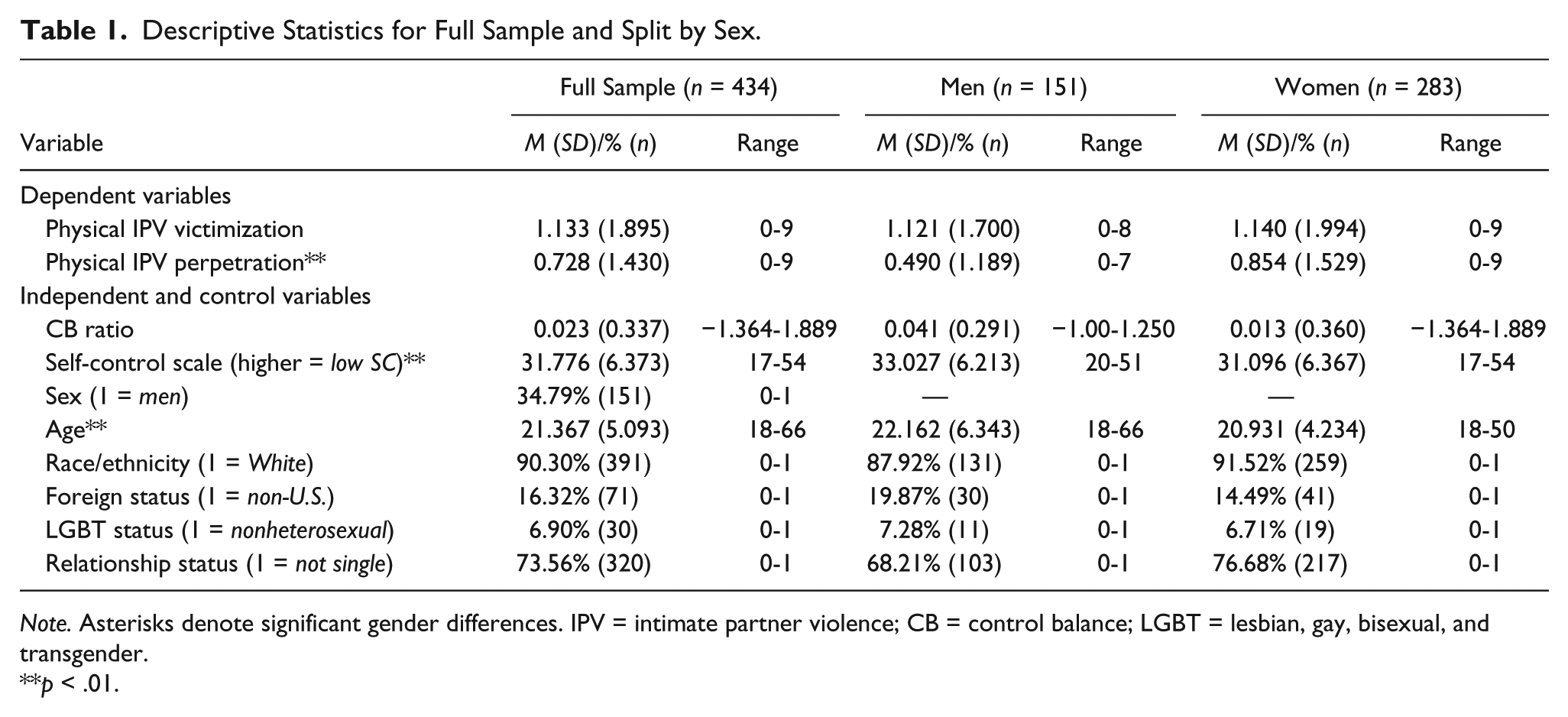
Note. Asterisks denote significant gender differences. IPV = intimate partner violence; CB = control balance; LGBT = lesbian, gay, bisexual, and transgender.
**p < .01.
The primary research question of this study featured a hypothetical relationship between control imbalances and IPV outcomes. Table 2 presents the segmented nonlinear regression models predicting IPV victimization among the full sample, as well as for males and females separately. Results from the full sample show that sex was nonsignificant; also, the control deficit term was negatively and significantly related to IPV victimization in the full sample, while the term for low self-control was positively and significantly related (b = .028, SE = 0.014; p < .05). The association between control deficit (b = −3.713, SE = 0.431; p < .001) and IPV victimization suggests that individuals with more severe imbalances in the deficit direction (i.e., further from balance) experienced more IPV victimization acts. None of the other demographic measures was significantly associated with IPV victimization. The full-sample model featured an R2 value of .192.
Segmented Nonlinear Regression Models Predicting Gendered Physical Intimate Partner Violence Victimization.

Note. No significant results at p < .01 threshold. CB = control balance; LGBT = lesbian, gay, bisexual, and transgender.
p < .05. ***p < .001.
Although sex was not significantly associated with IPV victimization, we proceeded with sex-split models to identify effects of interest within each category. Notably, the only associations between any of the independent or control measures and IPV victimization within subcategories of sex appeared for control deficits, which were negatively and significantly related to IPV victimization for both males (b = −2.321, SE = 0.957; p < .05) and females (b = −3.912, SE = 0.497; p < .001). A subsequent coefficient comparison test (Paternoster et al., 1998) indicated that the difference in magnitude of effects for control deficits for males versus females was not statistically significant (z = −1.476; p > .05). The previously noted association between low self-control and IPV victimization was not evident when the models were split for males and females, and as before, none of the remaining demographic/control variables was significantly associated with IPV victimization acts. The sexed models featured R2 values of .086 for male and .251 for females. In general, these results suggest that control deficits are associated with IPV victimization outcomes and that the effect is consistent for males and females.
In contrast to the prior models featuring IPV victimization as the outcome, results from Table 3 show that sex was significantly associated with IPV perpetration (b = −.351, SE = 0.149; p < .05) in the full sample. As before, the control deficit term was negatively and significantly related to IPV perpetration (b = −.872, SE = 0.341; p < .05), whereas the term for control surplus was positively and significantly related (b = .668, SE = 0.338; p < .05). The associations between both control deficit and surplus and IPV perpetration suggest that individuals with more severe imbalances in both directions (i.e., further from balance) self-reported more IPV perpetration acts. Low self-control was positively and significantly related (b = .046, SE = 0.011; p < .001), consistent with the IPV victimization model, and the measures for both LGBT status (b = .695, SE = 0.281; p < .05) and relationship status (b = .317, SE = 0.161; p < .05) were similarly associated. None of the other demographic measures was significantly associated with IPV perpetration. The full-sample model featured an R2 value of .099.
Segmented Nonlinear Regression Models Predicting Gendered Physical Intimate Partner Violence Perpetration.

Note. CB = control balance; LGBT = lesbian, gay, bisexual, and transgender.
p < .05. **p < .01. ***p < .001.
The sex-split models predicting IPV perpetration offer several notable contrasts. First, the only association between any of the control ratio variables and IPV perpetration within subcategories of sex appeared for control deficits, which were negatively and significantly related to IPV perpetration for females only (b = −1.045, SE = 0.405; p < .01). The full-sample association between control surplus and IPV perpetration was not evident when the models were split for males and females. However, positive and significant effects persisted between low self-control and IPV perpetration for both males (b = .038, SE = 0.017; p < .05) and females (b = .050, SE = 0.014; p < .001). A subsequent coefficient comparison test indicated that the difference in magnitude of effects for self-control for females versus males was not statistically significant (z = −.545; p > .05). Also, LGBT status was positively and significantly associated with IPV perpetration for females only (b = .803, SE = 0.373; p < .05). None of the remaining demographic/control variables was significantly associated with IPV perpetration acts. The sexed IPV perpetration models featured R2 values of .076 for males and .104 for females. In general, these results suggest that control imbalances of both types are associated with IPV perpetration outcomes but that the effect is inconsistent for males and females.
Discussion
The purpose of this study was to examine the role control plays in IPV for both perpetrators and victims. Tittle’s (1995, 2004) control balance theory provided a unique approach to conceptualizing control and how control influences individual behavior. In addition, the conceptual shift toward a theory of conformity allowed for control balance to be applicable to explanations of victimization (Baron & Forde, 2007; Nobles & Fox, 2013; Piquero & Hickman, 2003). Results from the student sample revealed interesting relationships between control imbalance and IPV perpetration, victimization, and sex. Segmented nonlinear regression models showed that for the total sample and the female subsample, control deficits were related to IPV victimization and perpetration, but for the male subsample, deficits were only related to victimization. Control surpluses were also associated with the total sample propensity for IPV perpetration, although this effect was nonsignificant for the sex-split models. These results suggest that overall control deficits are predictive of both perpetration and victimization of IPV among a college student sample. In addition, there appears to be a sexed effect where imbalance is more predictive of female victimization and perpetration than it is for males.
Theoretically, there are several conclusions to be drawn from the current study and its articulation to previous findings. In general, the results support Tittle’s (1995, 2004) hypothesis regarding control ratio effects on deviance between the sexes. The examination of control ratio distribution between the sexes appears to be similar for males and female; however, the relative influence of imbalance is greater for females than males. When examining IPV perpetration, the total sample shows control deficits being a significant factor; however, when the model is divided between the sexes, it becomes clear that this significance is being driven by the effects in the female subsample. The nonsignificant effect of control deficits among males for IPV perpetration solidifies this observation.
In addition, control deficits and surpluses seem to have differential effects on propensities for victimization and perpetration among each sex. Control deficits appear to be consistently associated with female victimization and perpetration, which may ultimately bolster other research findings that examine the motivations and circumstances surrounding defensive violence and IPV among females. For males, the results only show that control imbalance is significant when males are victims of IPV. This disparity in the importance of control imbalance on behavior suggests both a theoretical flaw in the theory as well as a possible hypothesis for explaining the female experience. Most general theories of crime are criticized as being unable to specifically account for female experience; however, it appears that control balance is better at explaining variance in female behaviors in the current sample compared with male behaviors. This adds to other studies that have examined gendered effects of control balance theory (Fox et al., 2014; Hickman & Piquero, 2001; Nobles & Fox, 2013) and suggests that future studies place more focus on how control balance may explain the sex gap in deviance.
Future Research
Based on the previous empirical findings as well as the current study, there are clear areas for future extension and replication to fully investigate parameters and applications of control balance theory. It appears that the control ratio continuum does not operate the way Tittle (1995) proclaimed it does for male and females; however, Tittle (1995) highlighted the relative importance of influence that constraints, self-control, and opportunity may have on the development of these distributions, which appears to be at play here. Due to the need for parsimony as well as limitations of the available data, this study did not examine the unique effects of constraints on perpetration or victimization. Consistent with studies that do account for constraints (Curry, 2005; Curry & Piquero, 2003), informal and formal sanctions can have a mental “blocking” effect on the individual which may influence not just victimization but also willingness to report, which has particular resonance as a policy implication for IPV.
Policy Implications on College Campuses
Going beyond the theoretical expansions of control balance, the results were supportive of the importance of the control ratio but also show that other core factors were also significant predictors, such as low self-control, relationship status, and nonheterosexuality. As one of the four principal components, low self-control was found to have a significant impact on IPV, particularly for perpetration. According to Gottfredson and Hirschi (1990), self-control consists of many individual-level traits such as thrill seeking, impulsivity, and need for instant gratification, all of which can be difficult to curb through policy intervention directly. Indirect measures tailoring campus events toward producing prosocial student participation may be key to providing a relatively controlled, safe, and yet exciting experience for students. Such efforts to quell the number of opportunities where victims are vulnerable and perpetrators are able to take advantage may include the following: quasi-competitive activities that may be individually or team-oriented, such as communal video gaming, an on-campus “poker night,” singing karaoke, laser tag, or quiz-type game show adaptations with nominal prizes. The indirect limitation of opportunities and increased constraints to violence among intimates are two ways in which university polices may have an impact in reducing IPV.
Although polices such as these may be difficult to implement, university administrators could use victim services education as a conduit for suggesting safer recreational scenarios, in tandem with broadening the discussion of IPV to include LGBT-specific issues. In this study, self-classification in the LGBT community was another critical factor for predicting perpetration among females. This finding, in addition to the significance of control deficits, may suggest that the female perpetration captured in our analysis could represent a perceived differential inequality specifically for lesbian and other same-sex female couples. Similarly, this may be the result of added social pressure on lesbian, gay, bisexual, transgender, and queer (LGBTQ) community members from society that increases constraints while limiting opportunity. Education addressing dating/relationship habits, healthy communication, and prosocial conflict resolution may be helpful for young college students, particularly for sexual orientation minorities.
Active counseling and support groups may also help to assuage some of these issues. Relationship conflict is often seen as a private matter where external intervention is not always welcome. Providing couples and individual counseling specifically geared toward relationships may help provide targeted support and education to males and females about healthy relationship behaviors. Counseling or support groups for LGBTQ communities may be of added importance given the societal struggle these individuals generally face. Support groups or student clubs that partner with counseling services may aid these individuals and help them gain more autonomy to achieve and maintain a control balanced state rather than a deficited one.
Limitations
Although the results are overall supportive of control balance theory, there are several limitations that should be accounted for before ultimate conclusions are made. First, the data come from a college sample, making generalizations to other populations difficult. Also, the current sample is predominately Hispanic, thus it may not be representative of all college populations. Second, the items used to measure victimization and perpetration originate from the Conflict Tactics Scale, which has been criticized by feminist scholars for the measure to account for severity, level of injury, or defensive violence. This lack of sensitivity to context generally results in more gender equality in incidents, such as in this study, but any conclusions about this result should be met with caution. It is possible that regardless of the incident equality, females in the sample could be experiencing more injury, or perpetrating in response to provocation. Indeed, given the predictive effect of control deficits on female victimization and perpetration, it is likely that motivation for perpetration may be in self-defense, to stop predation with predation. Third, IPV victimization and perpetration were measured based on the past 12 months, but the control ratio captured the perceived control balance or imbalance at the time of the study. Although, Tittle (1995, 2004) suggest that global control ratios may be relatively stable over the life course, he does admit that specific ratios may vary depending on life circumstances; to date, no published study has attempted to address the extent to which global or situational control ratios are time or state dependent.
Conclusion
The results from this study show support for control balance as a theory predicting IPV victimization, but more general support for self-control and routine activities theories were found. Given the limited ability to account for time, severity, and context, the findings from this study should be seen as a preliminary attempt to expand the theoretical threshold of control balance theory to account for new types of deviance. There is a definite need for further research that tests the most recent version of the theory, as well as replication studies to evaluate the validity of Tittle’s concept of control and the control ratio.
Footnotes
Authors’ Note
An earlier version of this paper was presented at the 2014 annual meeting of the American Society of Criminology in San Francisco, CA.
Declaration of Conflicting Interests
The author(s) declared no potential conflicts of interest with respect to the research, authorship, and/or publication of this article.
Funding
The author(s) received no financial support for the research, authorship, and/or publication of this article.