



Abstract
Limited interpersonal skills and relationship deficits are recognized as risk factors for sexual aggression as committed by convicted sexual offenders. Yet, less severe forms of sexual aggression are frequently perpetrated by nonforensic samples, including highly educated samples. This study was aimed at characterizing a sample of male college students reporting sexually aggressive strategies as a means to initiate sexual intercourse according to a set of interpersonal relationship factors, thus extending the knowledge on the role of interpersonal dimensions to the distinct contexts of sexual violence. Three hundred eight male college students completed a web survey assessing adult attachment styles, intimacy perception, interpersonal style, and psychosocial adjustment. Findings showed that 162 students (>50%) reported to have used some form of sexually aggressive strategy against women to initiate sexual contact. After controlling for the effects of social desirability, participants reporting sexually aggressive strategies presented significantly less confidence trusting others, more lack of perceived personal validation (within relationships), a more aggressive interpersonal style, and higher levels of hostility. Findings suggest that sexual violence, as measured in the context of college samples, may have an interpersonal nature, reflecting deficient social and intimacy skills; preventive programs are thus expected to enhance interpersonal relationship strategies as well as target individuals’ perceived interpersonal vulnerability.
Sexual violence is a complex phenomenon known by its considerable heterogenic presentation. People may be coerced into sex as a result of an extensive range of hands-on and/or hands-off strategies; some of the nonprototypical strategies—usually, the hands-off strategies such as the use of verbal pressure as a means to get sexual intercourse—challenge the social awareness on what constitutes sexual violence. Also, the sexual violence heterogenic presentation can be seen by the multiple individuals who are known to commit sexual offenses. These include the noncriminal samples (i.e., individuals who are not documented as sexual offenders by the justice system). Due to its complex nature, researchers often focus on specific classes of factors predisposing to sexual violence by type of sample. Among these factors, stable dynamic risk factors (i.e., individuals’ persistent/stable psychological features) have been recognized as key elements underpinning the vulnerability for sexual offending. The stable dynamic risk factors encompass a set of risk variables such as interpersonal functioning and social skills, emotional/behavioral regulation, distorted attitudes toward the crime and/or the victim, deviant sexual arousal, among others (e.g., Carvalho & Nobre, 2013; Craig, Thornton, Beech, & Browne, 2007; Hanson & Harris, 2000). Yet, these risk factors have been mostly studied in the context of criminal samples (i.e., convicted sexual offenders). For the matter of this study, we will focus on the interpersonal relationship factors.
Convicted sexual offenders often present a lack of social adjustment. Lee, Pattison, Jackson, and Ward (2001) reported that social incompetence is a common dimension characterizing sex offenders, arguing that sexual aggressors present deficient interpersonal skills characterized by empathy deficits, poor social skills, lack of self-esteem, and inappropriate heterosexual experiences (Lee et al., 2001). With regard to interpersonal skills, a study conducted by Overholser and Beck (1986) indicated that sexual offenders presented deficient social interaction skills, showing strong difficulties in social relationships with women. These individuals also presented a negative self-perception (Bridges, Wilson, & Gacono, 1998; Fisher, Beech, & Browne, 1999; Lyn & Burton, 2004) and marked emotional dependence (Gacono, Meloy, & Bridges, 2000). Freund (1988) described sexual violence and raping as a courtship disorder; as a courtship disorder, sexually aggressive individuals were expected to perform poorly at one of the normative stages through which individuals interact socially and sexually; these stages progress from the searching phase (searching for a sexual partner) to the sexual/genital interaction phase (completing sexual intercourse). In line with this theoretical perspective, sexual violence would be a possible/viable way of getting sexual intercourse as it does not require the interpersonal skills that a normal and consented relationship requires. More recently, a study comparing subtypes of convicted sexual offenders showed that, whereas pedophilic offenders were characterized by anxious adult interpersonal relationships, nonpedophilic child molesters reported low assertiveness; in addition, rapists presented an aggressive interpersonal style (V. Leirós, Carvalho, & Nobre, 2015).
In general, studies on convicted male sexual offenders show that interpersonal relationship factors (e.g., poor social skills, interpersonal maladjustment) possibly underpin the vulnerability for sexual offending. Furthermore, different classes of sex offenders (i.e., rapists, child molesters) are expected to present a deficient interpersonal style as a result of a maladjusted developmental process (cf. Ward, Hudson, & Marshall, 1996). However, and despite interpersonal relationship factors are conventionally considered on the conceptualization of sexual offending as committed by criminal samples, literature on the role of interpersonal relationship factors as predisposition factors for sexual violence in noncriminal samples is absent.
Literature on noncriminal samples committing some form of sexual violence has focused on sexual violence as committed by male college students. Findings have revealed the existence of men committing various forms of sexually aggressive behavior, ranging from touching/kissing nonconsenting women to complete raping (e.g., Swartout, Koss, et al., 2015; Swartout, Swartout, Brennan, & White, 2015). While it is worth noting that the prevalence rates may change dramatically as a function of the methodological strategies being implemented (e.g., the selected measures aimed at assessing sexual violence, whether hands-off or hands-on strategies are being considered, etc.), it should be recognized that any sort of behavior—including behavior that does not fit the concept of complete rape—limiting individuals’ free will should be a matter of interest. Studies on the predisposition factors for sexual violence as committed by male college students showed that these individuals are characterized by some of the previously mentioned stable dynamic risk factors. For example, personality features such as hostile masculinity (i.e., the desire to dominate and control women), sexual promiscuity, and impersonal sex were shown to characterize sexually aggressive male college students (Malamuth & Thornhill, 1994; Martín, Vergeles, Acevedo, Sánchez, & Visa, 2005). More recently, Carvalho and Nobre (2013) found that male students reporting sexual aggression against women presented higher motor and cognitive impulsiveness than their control peers. In addition, these individuals were found to present more sexual difficulties as well as an anxious sexual performance style (i.e., erectile inhibition as a consequence of the fear of failing sexual performance; Carvalho, Quinta-Gomes, & Nobre, 2013; Peterson, Janssen, & Heiman, 2010). Other factors such as permissive attitudes toward sexual aggression (e.g., Abbey, McAuslan, & Ross, 1998; Thompson, Koss, Kingree, Goree, & Rice, 2011), abusive alcohol consumption (e.g., Abbey, 2011; Mohler-Kuo, Dowdall, Koss, & Wechsler, 2004), or the social pressure to have sexual intercourse (Jewkes et al., 2006) have been further related to college students’ sexually aggressive behavior. Interestingly, Briere and Runtz (1989) found that 21% of male college students reported some level of sexual attraction to small children, including fantasies of sexual intercourse (9%) and even masturbation to these fantasies (5%). In all, while some psychosocial factors were studied in the context of sexually abusive students, to our knowledge, the data on the interpersonal relationship factors characterizing individuals using sexually aggressive strategies as a means to get sexual intercourse are incipient; the great focus has been given to the criminal samples. Previous studies have revealed that sexually aggressive students perceived themselves as more incompetent than their peers (V. S. Leirós, Carvalho, & Nobre, 2013) presenting more sexual difficulties as a result of the fear of being sexually judged by women (Carvalho et al., 2013). Also, attachment avoidance has been associated with less severe forms of sexual violence perpetration (Karantzas et al., 2016). So, to a certain degree, existing findings suggest that some sort of social maladjustment may be involved in the predisposition to sexual violence in male college students.
Against this background, the aim of the present study was to characterize the interpersonal relationship style of a sample of male college students reporting sexually aggressive strategies toward women as a means to initiate sexual intercourse. Findings are expected to shed some light on the dynamic risk factors predisposing to sexual aggression as committed by noncriminal samples. Furthermore, data on male college students committing some form of sexual violence will inform existing programs aimed at preventing sexual violence in college campus. Based on the literature of convicted male sexual offenders, we considered that male college students reporting sexually aggressive strategies would present (a) a significantly more dysfunctional attachment style, (b) more intimacy deficits, (c) a more dysfunctional interpersonal style, (d) and a psychopathological style compatible with social impairment, in relation to the nonsexually aggressive peers.
Method
Participants and Procedures
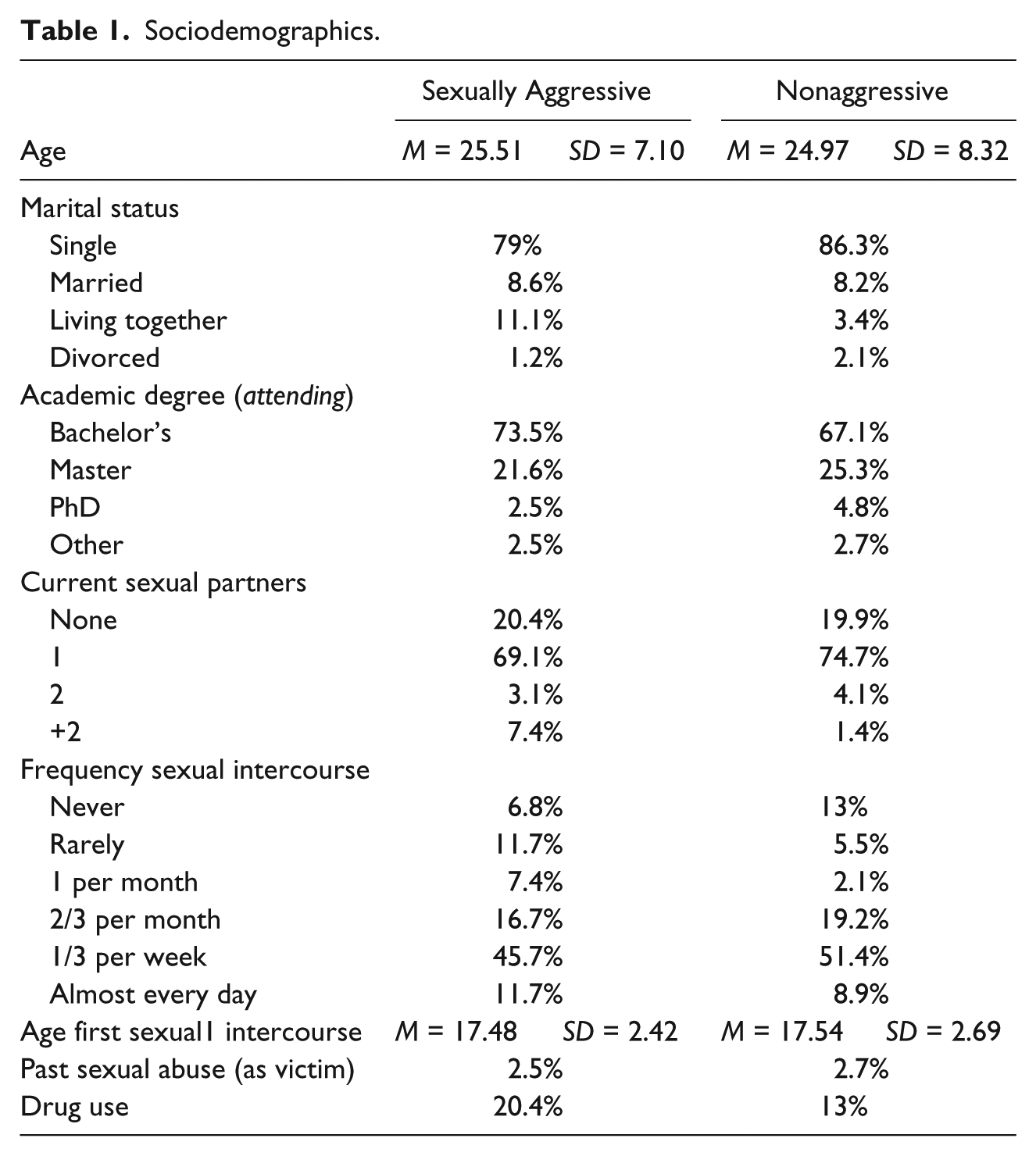
Three hundred eight male college students completed a web survey (responding to every item was set as mandatory); because the topic under consideration is expected to be prone to social desirability, the study was generically advertised—through the institutional students’ mailing list—as a study on relationship factors and male sexuality. Inclusion criteria involved participants ≥18 years old and being heterosexual. Participants gave their written informed consent before initiating the survey; they did not receive any kind of compensation (see Table 1 for sociodemographics). The present study was approved by the Ethics Committee of the Faculty of Psychology and Educational Sciences of Porto University in 2015.
Sociodemographics.
Measures
Adult Attachment Scale (AAS)
The AAS is an 18-item self-report measure aimed at assessing attachment styles in adulthood. Subscales include Anxiety (i.e., fear of abandonment), Comfort (i.e., comfort with proximity/intimacy), and Trust (i.e., capable of trusting others). Both the original version (Collins & Read, 1990) and the Portuguese version (Canavarro, 1999) presented good psychometric properties. In the present sample, Cronbach’s alphas were as follows: Anxiety .86, Comfort .68, and Trust .69.
Personal Assessment of Intimacy Relationships (PAIR)
The PAIR is a 36-item self-report questionnaire aimed at assessing the perception of intimacy. This scale targets key aspects of intimacy, such as emotional intimacy, social intimacy, intellectual intimacy, recreational intimacy, and sexual intimacy (Schaefer & Olson, 1981). The Portuguese version of the PAIR has contradicted the five-dimension scale by showing a three-dimension constellation: personal validation (validation/acceptance by partner), communication (expressing opinions, feelings, and desires within relationship), and openness to outward (sharing time with the outgroup); the psychometric studies supported validity and reliability (Moreira, Amaral, & Canavarro, 2009). In the present sample, the Cronbach alphas were as follows: personal validation .88, communication .90, and openness .66.
Interpersonal Behavior Survey (IBS)
The IBS is a 38-item self-report questionnaire assessing individuals’ interpersonal style (assertive and aggressive style; Mauger & Adkinson, 1980). The Portuguese version of the scale supported reliability, excepting for the “Denial/Social Desirability” subscale (Araújo, 2009); for this reason, the “Denial” subscale was not included. In the present sample, the Cronbach alphas were as follows: assertiveness .68, aggressiveness .69.
Brief Symptom Inventory (BSI)
The BSI is a 53-item self-report questionnaire aimed at assessing psychopathological facets (e.g., depression, anxiety, somatization; Derogatis & Spencer, 1982). For the purpose of this study, only the facets relating to interpersonal functioning were included: interpersonal sensitivity (personal feelings of inadequacy/inferiority), hostility (negative/angry feelings toward others), and psychoticism (social isolation and schizoid lifestyle). The Portuguese version of the BSI presented good psychometric properties (Canavarro, 1999); in the present sample, the Cronbach alphas were as follows: interpersonal sensitivity .79, hostility .77, and psychoticism .75.
Socially Desirable Response Set Measure (SDRS-5)
The SDRS-5 is a five-item self-report scale assessing participants’ social desirability proneness (Hays, Hayashy, & Stewart, 1989). In the present sample, the Cronbach alpha was .73. Scores on social desirability were introduced as covariate.
Sexually Aggressive Behavior Scale (SABS)
The SABS is a 26-item (12 critical items and 14 filling items) self-report scale assessing lifelong frequency of sexual interaction attempted by aggressive means (Anderson, 1998), and is often used with female samples. Because the current study is part of a larger research project including both genders, the items of the SABS were rephrased to be responded by male participants (e.g., female item “How many times have you attempted to have sexual contact with a man by pressuring him with verbal arguments?” male item “How many times have you attempted to have sexual contact with a woman by pressuring her with verbal arguments?”). The SABS encompasses items measuring sexual coercion frequency (i.e., attempting sexual interaction using verbal pressure, blackmailing, or using psychological manipulation), sexual abuse (i.e., using a position of authority—for example, boss, counselor, supervisor—to attempt sexual contact), and physical force (i.e., threatening or effectively using physical force to achieve sexual interaction). In the present sample, the Cronbach alphas were as follows: overall score .75, sexual coercion .73, sexual abuse .75, physical force .68. Scores were computed following Anderson’s (1998) procedures: Items were dichotomously scored (0 = the behavior has never occurred, 1 = the behavior has occurred at least once); participants endorsing one or more of the items were assigned to the corresponding category (sexual coercion, sexual abuse, physical force).
Results
Descriptive Data
Findings on the percentage of participants endorsing critical items revealed that 52.6% of the participants (n = 162) reported to have attempted sexual interaction using aggressive strategies. Among these, 87.7% (n = 142) fell into the category of sexual coercion (see Table 2 for a description of the items), 41.4% (n = 67) fell into the category of sexual abuse, and 7.4% (n = 12) fell into the category of physical force. The percentage of participants endorsing each item is displayed in Table 2. Because most participants fell into more than one category, the three categories were merged into a single group labeled as sexually aggressive males; these individuals will be compared with their counterparts, the nonsexually aggressive males.
Description of the Items and Percentage of Students Endorsing Each Item.
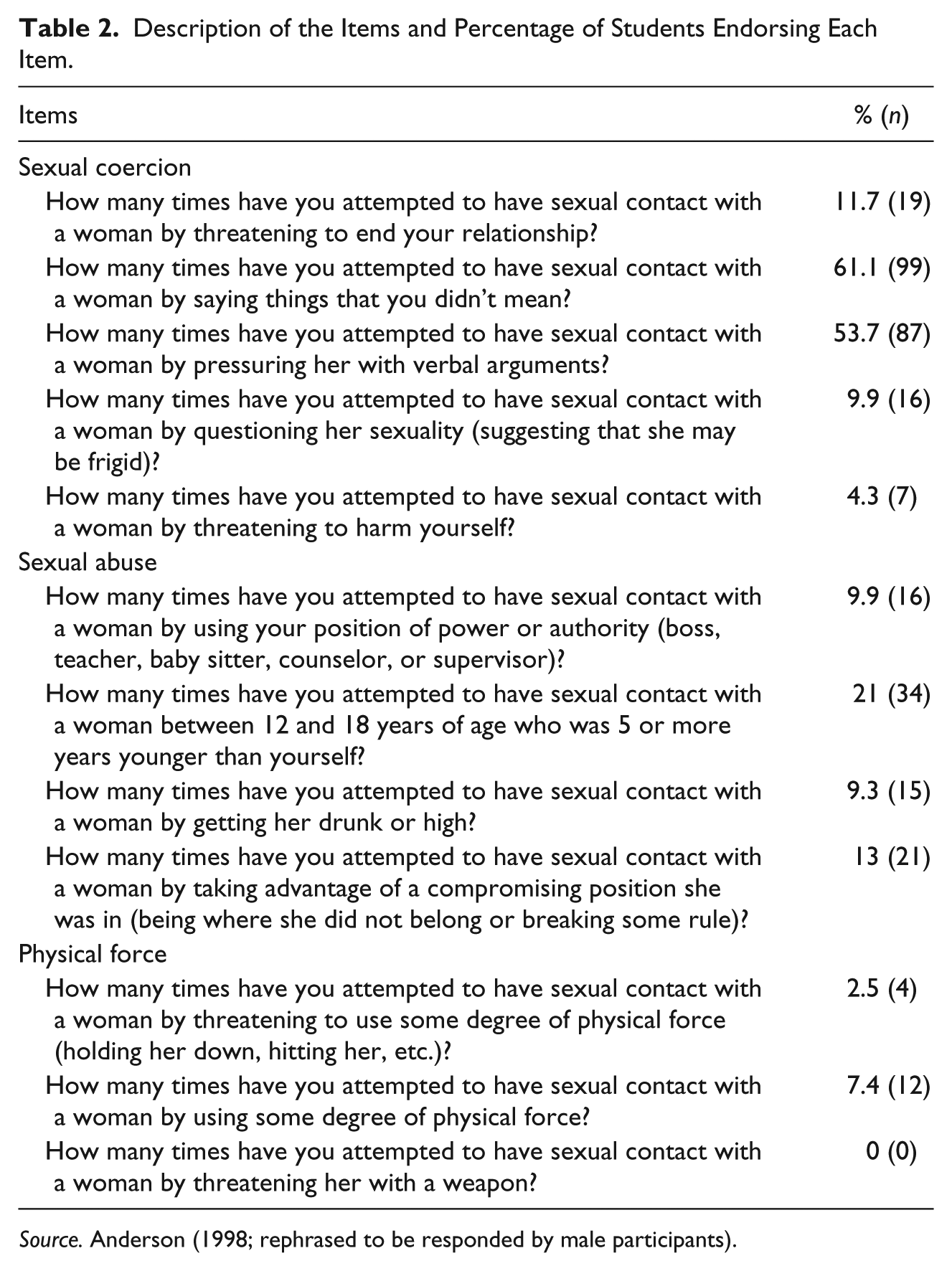
Source. Anderson (1998; rephrased to be responded by male participants).
Differences Between Sexually Aggressive Males Versus Nonsexually Aggressive Males
MANCOVAs were conducted to evaluate the effect of the group condition (Sexually Aggressive × Nonsexually Aggressive) on the measured interpersonal relationship variables; social desirability was introduced as covariate. The individual subscale scores were introduced into the corresponding MANCOVA.
After controlling for social desirability, Wilks’s Λ = .955, F(3, 303) = 4.238, p = .006,
Differences Between Sexually Aggressive and Nonaggressive Students.

Higher scores are indicative of perceiving less validation.
p < .05. **p < .01.
Discussion
Interpersonal relationship factors are documented as vulnerability factors for sexual aggression as committed by forensic samples, and are important clinical targets in the rehabilitation of convicted sexual offenders (e.g., Marshall, Marshall, Serran, & Fernandez, 2006). Yet, sexual aggression includes any sort of behavior aimed at conditioning the target person, making her or him to have sexual contact with the aggressor (Krahé, Waizenhofer, & Moller, 2003). This means that one can use a variety of strategies (including verbal manipulation or unwanted sexual commentaries) with the purpose of having sexual intercourse with someone who is unwilling to have sex at that moment and/or with that person. While this scenario falls out of the mainstream idea of sexual violence (where physical force is expected to be used), it still constitutes a serious constraint to the individual’s sexual self-determination. Against this background, the present study was aimed at characterizing the interpersonal relationship style of male college students reporting sexually aggressive strategies against women as a means to get sexual intercourse, thus extending the conceptual field of the interpersonal factors to the less severe forms of sexual aggression.
Descriptive findings on the percentage of participants endorsing critical items revealed that 52.6% of male students reported to have attempted sexual interaction using aggressive strategies. These results were surprising as more than 50% of the sample stated to have influenced women to have sexual contact by aggressive means. However, it must be acknowledged that these findings do not relate to complete rape or assault; this rate relates to the attempting forms of behavior. Also, the percentage of participants endorsing SABS items was expected to be higher than the percentages described in other studies where self-report measures addressed more severe forms of violence, including complete rape by physical force or intoxication (e.g., Swartout, Koss, et al., 2015). The current findings thus suggest that less severe aggressive strategies aimed at initiating sexual contact 1 are a common phenomenon among young and educated samples. In addition, the ease with which students agreed on having committed this set of behaviors suggests that such strategies are possibly being positively appraised or, at least, judged as normal behavior. Also, among the students reporting sexually aggressive strategies, 87.7% (n = 142) fell into the category of sexual coercion, 41.4% (n = 67) fell into the category of sexual abuse, and 7.4% (n = 12) fell into the category of physical force. Verbal tactics was by far the most used strategy; these include behaviors such as threatening to end the relationship, questioning the woman’s sexuality, or pressuring with verbal arguments. As a hands-off strategy, verbal manipulation is unlikely to be regarded as violence by both the perpetrator and the recipient of the act, which may further contribute to the maintenance and escalating of such conducts.
Findings on the attachment style characterizing the groups showed that students reporting sexually aggressive strategies presented significantly more lack of trust regarding other people, revealing an avoidance style (Collins & Read, 1990). Dysfunctional attachment styles were shown to characterize convicted sexual offenders (e.g., Marsa et al., 2004; McCormack, Hudson, & Ward, 2002; Smallbone & Dadds, 1998) and are involved in less severe forms of sexual violence (Karantzas et al., 2016). Such findings suggest that all forms of sexual violence may be under the influence of relationship deficits. Indeed, subjects with dysfunctional attachment styles are expected to present a myriad of problems in several areas of functioning, including interpersonal relationships (Brennan & Shaver, 1995; Feeney, 2008) and predisposition to risky behavior (Cooper, Shaver, & Collins, 1998).
Also, sexually aggressive students reported less interpersonal validation by partners 2 and a more aggressive style in social interactions. These findings suggest that the sexually aggressive group not only behave more aggressively (endorsing an aggressive role with others) but they also perceived themselves as being dismissed by romantic partners, possibly anticipating the lack of care. So, to a certain degree, students using sexually aggressive strategies may feel some kind of interpersonal vulnerability; the assumption that aggressiveness (including sexually aggressive strategies) is a response to perceived vulnerability is something that deserves further testing. Indeed, past research with male college students reporting sexual aggression showed that the aggressor group presented more sexual anxiety and difficulties, suggesting that sexual aggression may be a response to the anticipated fear of failing sexual performance, and hence a response to perceived personal vulnerability (Carvalho et al., 2013).
Hostility was further shown to characterize the aggressive students. This psychopathological dimension encompasses a set of thoughts, emotions, and behaviors characterizing negative affective states of anger and resentment (e.g., Canavarro, 1999). Previous studies on the psychopathological profile of convicted and nonconvicted sexual offenders showed that convicted rapists and a nonforensic sample of male students reporting sexual aggression (including rape and attempted rape) reported more hostility than convicted child molesters (Carvalho & Nobre, 2019). Indeed, externalization markers—such as hostility—are frequently associated with sexual offenses against adult victims rather than young victims (e.g., Becker & Hunter, 1997; Lussier, Lecrerc, Cale, & Proulx, 2007). So, according to the present findings, it is plausible that hostility still plays a role in the less severe forms of sexual violence against women.
The present study presents some limitations that must be considered. First, it is worth noting that no cause-effects mechanisms can be derived from this study. While this study focused on the interpersonal factors characterizing sexually aggressive students (namely, less severe forms of sexual violence), factors from a different nature (e.g., cultural factors, the dynamics behind today’s college campus culture) are also expected to intervene in this phenomenon. Indeed, despite most of the main effects being statistically significant, the effect sizes were small. One possible explanation relates to the type of samples that were used; community samples are not expected to present clinically relevant scores, thus reducing the magnitude of the differences between the groups. In addition, despite sexually aggressive strategies being labeled as aggressive due to their constraining nature, there is no insight on how women have appraised male students’ sexual approaches. Data on women’s appraisal, as well as the levels of consent that might be involved in this scenario, would be of great interest to a more comprehensive understanding of this phenomenon. Also, future studies are expected to assess the consequences of the less severe forms of sexual violence as these forms seem to be a common practice. Finally, it must be recognized that there has been a great interest in the current topic of research, particularly after U.S. media has brought to light the issue of the recurrent sexual assaults in college campus. However, this interest is not being extended to the sexual minorities, which clearly results in a scientific gap. This bias toward heterosexual samples generates an inequity in knowledge, favoring heterosexual individuals. Studies targeting distinct sexual preferences are thus warranted as these individuals may eventually present a different reality, benefiting from tailored prevention efforts. The same rational applies to the distinct cultural backgrounds. The behaviors that fall under the heading of sexual violence may differ across countries. As a consequence, the current findings may have different implications depending on the specific/local cultural and legal norms. However, and even if the implications of these findings do not apply to all countries, they are among the first data that applies to Portugal, 3 thus breaking with the Anglo-Saxon-centered scientific literature.
In general, the current findings add to the literature by suggesting that interpersonal relationship deficits are common to the different forms of sexual aggression perpetration. These deficits can be seen not only in samples of men convicted for sexual crimes but also in community samples of socially integrated individuals reporting sexually aggressive strategies. Sexual violence thus seems to have an interpersonal nature, and some sexually aggressive acts likely result from a sense of interpersonal inadequacy. Although this assumption deserves further testing, it should have echo on the existing prevention programs; modules targeting the enhancement of interpersonal and social interaction strategies, as well as focusing on the issues of human attachment, should be considered in the distinct intervention protocols.
Footnotes
Declaration of Conflicting Interests
The author(s) declared no potential conflicts of interest with respect to the research, authorship, and/or publication of this article.
Funding
The author(s) received no financial support for the research, authorship, and/or publication of this article.