




Abstract
This study examined putative mediators of the association between sorority membership and sexual victimization among 718 women who were enrolled in their first year of college. Data were collected through anonymous, self-report surveys that assessed sexual victimization in college, two hypothesized mediator variables (i.e., alcohol misuse and number of sexual partners), and four control variables (i.e., minority racial status, residence in a coed dorm, behavioral and psychological problems before college, and sexual victimization before college). Values for both sexual victimization variables were collapsed into one of three categories (i.e., no victimization, moderately severe victimization, severe victimization). Bivariate analyses revealed sorority members had higher levels of alcohol misuse, number of sexual partners, and severe sexual victimization in college than did nonmembers. Multivariate analyses showed number of sexual partners mediated the association between sorority membership and both types of sexual victimization in college, whereas alcohol misuse mediated the association between sorority membership and severe sexual victimization in college only. Implications of the findings for future research and prevention, along with limitations of the study, are discussed.
Sexual victimization (SV) refers to sexual activity that occurs without the consent of the victim. Most research on SV has focused on heterosexual contexts in which perpetrators are typically males and victims are typically females. This article focuses generally on these contexts, and more specifically on alcohol use and number of sexual partners as mediators of the association between sorority membership and SV among females enrolled in their first year of college.
There are multiple types of SV and these are commonly classified according to the degree of violation experienced by the victim. One common classification includes four types: (a) unwanted sexual contact without attempted intercourse; (b) sexual coercion, or intercourse that happens through undue pressure or threats by the perpetrator; (c) attempted rape; and (d) completed rape, which may occur through physical force by the perpetrator or when the victim is too incapacitated to give consent (Koss, Gidycz, & Wisniewski, 1987). Although studies have indicated that victims of all types of SV can experience adverse psychosocial, behavioral, and physical consequences (Yuan, Koss, & Stone, 2006), the severity of consequences of a specific SV incident tends to increase in relation to the degree of violation that takes place (Coid et al., 2003; Siegel, 2009; Ullman, Townsend, Filipas, & Starzynski, 2007).
Research on SV has documented the extent of its occurrence among females. Much of this research has sampled college students, not just as a matter of convenience but also because college-aged females have a higher risk for experiencing SV relative to females of other age groups (Koss et al., 1987; Sinozich & Langton, 2014). The seminal study on incidence of SV among female college students, which included a large sample (N = 3,187) recruited from 32 colleges across the United States, found alarmingly high rates of past year victimization, ranging from 27% for unwanted sexual contact to 6% for completed rape (Koss et al., 1987). Two, subsequently published studies with sizable samples have documented similar incident rates for SV in this population. One of these studies sampled 4,446 women enrolled in 2- and 4-year colleges throughout the country and found that 16% of the participants had been sexually victimized in the prior year (Fisher, Cullen, & Turner, 2000). The second of these studies, which sampled 5,446 respondnets enrolled in one of two large public universitiies in different regions of the country, found 19% of the participants had experienced some type of SV since enrolling in college (Krebs, Lindquist, Warner, Campbell, & Martin, 2007).To inform prevention efforts, many studies have investigated attitudes and behaviors that increase risk for SV. These studies have concentrated more on potential male perpetrators than potential female victims for at least two reasons. First, as perpetrators are ultimately responsible for incidents of SV, interventions that target risky attitudes and behaviors among males can address the root causes of these incidents. Second, prevention efforts aimed at female college students could contribute to perceptions that those who experience an incident of SV are in some way responsible for it, which may serve to exacerbate the adverse consequences that victims suffer. However, the preventive interventions that have targeted potential male perpetrators have not had a very sizable or lasting impact (Banyard, Moynihan, & Plante, 2007; Gidycz, Borchowski, & Berkowitz, 2011; Stephens & George, 2009). It is possible larger and more enduring effects could be achieved by identifying factors that increase risk for SV among potential female victims.
Psychosocial theories provide frameworks for identifying risk factors for adverse health experiences. Lifestyle Exposure Theory is one that is especially relevant for understanding factors associated with incidents of SV (Hindelang, Gottfredson, & Garofalo, 1978; Meier & Miethe, 1993). This theory has been employed by researchers to examine why specific demographic or social groups have relatively high rates of criminal victimization (Miethe, Stafford, & Long, 1989). The theory holds that social groups can shape members’ participation in specific activities that elevate their risk for victimization, primarily through increased exposure to potential perpetrators. Thus, research guided by Lifestyle Exposure Theory can be used to identify at-risk groups as well as the behaviors that can be effectively targeted in preventive interventions.
Within the female college student population, social sororities comprise one collective group that has been shown through survey studies to have relatively high rates of SV. An earlier study with 351 female students from a public university in the Midwest found sorority members had higher rates of SV through physical force than did nonmembers (Tyler, Hoyt, & Whitbeck, 1998). Another study with 779 female students from a public university in the Midwest found sorority members had a rate of SV that was 4 times greater than the rate for nonmembers (Minow & Einolf, 2009).
A third study with 185 female students enrolled in a public university in the Northwest found sorority members were more than 5 times as likely as nonmembers to experience rape. These findings suggest prevention efforts that address risk factors for SV among sorority members may have a relatively large impact.
Research has shown sorority members have high rates of participation in two behaviors that may increase their risk for SV. One of these behaviors is alcohol misuse, which may increase risk for SV in several ways. First, because alcohol misuse among college students typically occurs in social settings (Wechsler, Lee, Nelson, & Kuo, 1995), it can increase exposure to men who may perpetrate SV. Related to this explanation, studies have found attendance at fraternity parties where alcohol is served is positively associated with SV among female college students (Copenhaver & Grauerholz, 1991; Minow & Einolf, 2009). Second, women who misuse alcohol are often perceived as being more interested or willing than other women to engage in sexual activity (George, Gournic, & McAfee, 1988). This perception may contribute to a potential perpetrator initiating sexual activity with an alcohol misuser who does not desire it, and/or continued attempts to engage in sexual activity despite resistance from the alcohol misuser. Third, women may experience some cognitive or physical impairment from alcohol misuse that limits their ability to repel unwanted sexual overtures.
National studies with large samples have found higher rates of alcohol misuse among sorority members than nonmembers (Cashin, Presley, & Meilman, 1998; Wechsler, Kuh, & Davenport, 2009). Notably, prospective studies have found the positive association between sorority membership and alcohol misuse is not due solely to selection effects or a higher likelihood of preexisting propensities for alcohol misuse among women who do join sororities (McCabe et al., 2005; Parks, Hsieh, Bradizza, & Romosz, 2008). Moreover, many studies have found alcohol misuse among female college students is associated with higher rates of SV (e.g., Krebs et al., 2007; Minow & Einolf, 2009; Mohler-Kuo et al., 2004; Tyler et al., 1998).
The second behavior that may increase risk for SV among sorority members is having a relatively high number of sexual partners. Research indicates sorority members have more sexual partners when compared with nonmembers (Aleshire, Lock, & Jensen, 2013; Scott-Sheldon, Carey, & Carey, 2007). It stands to reason that the more sexual partners that a person has, the higher the likelihood that one of them will perpetuate an act of sexual aggression. Consistent with this notion, number of sexual partners among female college students is positively correlated with experiencing SV (Franklin, 2010; Nurius, Norris, Dimeff, & Graham, 1996; Walker, 2011).
It is important to emphasize that these behaviors increase the probability or opportunity, but not the responsibility, for victimization to occur. Just as automobile drivers who travel more miles than others have a relatively high likelihood of experiencing an accident that is not their fault, persons who engage in higher levels of alcohol misuse and those with more sexual partners have a heightened opportunity for being sexually victimized.
Thus, when considering the aggregate research findings, it appears the comparatively high rates of SV among sorority members may be explained at least partly by their relatively high levels of alcohol misuse and sexual partners. The findings that suggest mediating roles for these risk behaviors are practically important. Besides providing potential explanations for the elevated incidence of SV among sorority members, the findings suggest interventions that address risks associated with these behaviors have considerable potential in relation to prevention efforts.
However, before concluding alcohol misuse and number of sexual partners mediate the association between sorority membership and SV, additional research is needed to address several gaps that exist among the published studies on this topic. First, few if any of the previously published studies have controlled for SV prior to college, and thus they have not provided evidence about the directionality of the association between sorority membership and SV. As experiencing SV before college may influence tendencies to join a sorority, to misuse alcohol, or to have more sexual partners, it is important to examine SV before college in relation to these three variables and also to control for such prior experiences when examining potential mediators of the association between sorority membership and SV. Second, a few studies have shown the association between sorority membership and SV is weakened after controlling for alcohol misuse (e.g., Franklin, 2016; Krebs et al., 2007; Minow & Einolf, 2009); nonetheless, these studies have not tested for significant, indirect effects of the predictor variable (i.e., sorority membership) even though this has become the standard for determining if a third variable mediates the association between two other variables (Hayes, 2013). Third, few if any of the prior studies on the topic examined the risk behaviors in relation to different types of SV, and hence whether or not these behaviors mediate the association between sorority membership and specific types of SV remains unknown.
The primary purpose of the current study is to examine alcohol misuse and number of sexual partners as potential mediators of the association between sorority membership and different levels of SV severity. The need to examine different levels of SV severity is evident from prior studies that have found sorority membership and alcohol misuse are more strongly associated with the most severe incidents (Corbin, Bernat, Calhoun, McNair, & Seals, 2001; Minow & Einolf, 2009; Tyler et al., 1998). Based on the prior studies, alcohol misuse is predicted to mediate the association between sorority membership and severe SV only. In contrast, number of sexual partners has been shown to be associated with different types of SV (Franklin, 2010), and therefore is predicted to operate as a mediator of the association between sorority membership and each type of SV severity.
Method
Sample
The sample was recruited mostly by sending an email solicitation to all first-year, female students at a public university in the southeastern United States. The solicitation stated volunteers were being recruited for a study consisting of a short, anonymous survey on women’s health issues; in addition, it specified dates and times the survey could be completed at the university’s student health center and stated participants would receive a US$15 gift card. The information included in the email solicitation also was incorporated in a flyer that was posted in various locations on the university’s campus during the recruitment period.
The survey was completed by 719 participants over a 7-week period. One of the participants was not included in the final sample due to incomplete data. Among the 718 women with complete data, all but four were either 18 or 19 years of age at the time the survey was completed, and therefore age (M = 18.5, SD = 0.61) varied minimally among them. The racial composition of the sample (i.e., n = 607 or 85% Caucasian, n = 82 or 11% African American, n = 10 or 1% Hispanic, and n = 19 or 4% Other with percentages not summing to 100 due to rounding) did not vary significantly from the first-year class of females at the university in the year the study was conducted.
Measures
SV before college and SV in college
The Sexual Experiences Survey (SES; Koss et al., 1987) was used to assess SV before college and SV in college. This survey was comprised of 10, behaviorally specific items, each of which referred to a particular example of SV. Participants responded to each item by specifying whether or not (0 = no, 1 = yes) they had experienced the specific example of SV before enrolling, and/or since enrolling, in college. Participants who had experienced multiple types of SV were placed in a category corresponding to the most severe form of SV they had experienced. For the SV before college variable, participants were initially grouped as follows: ([0 = nonvictim, n = 550 or 77%]; [1 = unwanted sexual contact, n = 84 or 12%]; [2 = coerced intercourse, n = 28 or 4%]; [3 = attempted rape, n = 25 or 3%]; [4 = completed rape, n = 31 or 4%]). For the SV in college variable, participants were initially grouped as follows: ([0 = nonvictim, n = 592 or 82%]; [1 = unwanted sexual contact, n = 58 or 8%]; [2 = coerced intercourse, n = 26 or 4%]; [3 = attempted rape, n = 20 or 3%]; [4 = completed rape, n = 22 or 4%]), with percentiles not summing to 100 due to rounding.
For purposes of parsimony and for ensuring adequate representation in the different levels of the SV variables for inferential analyses, responses to both variables were collapsed subsequently into one of three categories. Participants who did not experience any SV were placed in a nonvictim category, those who experienced unwanted sexual contact were placed in a moderately severe category, and those who experienced coerced intercourse, attempted rape, and rape were placed in a severe SV category. For the SV before college variable, 550 (77%) participants were categorized as nonvictims, 84 (12%) were categorized as victims of moderately severe SV, and 84 (12%) were categorized as victims of severe SV, with the percentiles not summing to 100 due to rounding. For the SV in college variable, 592 (82%) of the participants were categorized as nonvictims, 58 (8%) were categorized as victims of moderately severe SV, and 68 (10%) were categorized as victims of severe SV.
Sorority membership
A single item asked participants if they were members of a social sorority. Responses were coded dichotomously (0 = no, n = 510 or 71%; 1 = yes, n = 208 or 29%).
Minority racial status
A single item asked participants to indicate their racial status. Responses were collapsed into two categories (0 = Caucasian, n = 607 or 85%; 1 = minority, n = 111 or 15%) to reflect whether or not the participants had a minority racial status.
Residence in a coed dorm
As first-year students at the university, all participants were required to live on campus and to choose to reside in a dormitory that was either female only or coed. A single item was used to ask participants if they lived in a coed dorm, with responses coded dichotomously (0 = no, n = 529 or 74%; 1 = yes, n = 189 or 26%).
Psychological and behavioral problems before college
Six items with a no/yes response format assessed the extent to which participants had experienced psychological and behavioral problems before college. These items were taken from a larger set that had been examined in relation to consequences of SV among female employees of a medical center or university (Koss, Figueredo, & Prince, 2002). The items used in the current study assessed the following precollege experiences: (a) seeking help from a mental health specialist, (b) making a plan to commit suicide, (c) taking a prescribed tranquilizer, (d) taking a prescribed antidepressant, (e) seeing a school counselor or psychologist for a disciplinary problem, and (f) running away from home. Responses to the six items were summed and then collapsed into four categories reflecting the number of problems experienced before college (0 = none, n = 505 or 70%; 1 = one, n = 111 or 16%; 2 = two, n = 56 or 8%; 3 = three or more, n = 46 or 6%).
Alcohol misuse
A single item assessed the number of times participants had been drunk since being in college. The item defined being drunk as “having felt unsteady, dizzy or sick to your stomach after drinking.” The measure had seven response options, ranging from 0 (none) to 6 (several times a week). Initial responses (M = 1.17; Mdn = 1, SD = 1.15) were collapsed subsequently into four categories: (0 = none, n = 288 or 40%; 1 = less than once a month, n = 153 or 21%; 2 = monthly, or at least once a month but less than weekly, n = 141 or 20%; 3 = at least once a week, n = 136 or 19%).
Number of sexual partners
A single item with an open-ended response format was used to assess the number of people with whom the participants had any consensual sexual activity since enrolling in college. The item asked participants to specify the total number of partners, and not only partners with whom intercourse occurred, because any sexual activity with additional partners may increase risk for SV. Initial responses (M = 2.24, Mdn = 1.00, SD = 2.56) were collapsed subsequently into one of three categories (0 = no partners, n = 191 or 26%; 1 = one or two partners, n = 292 or 41%; 2 = three or more partners, n = 235 or 33%).
Analytic Approach
Three sets of logistic regression analyses were used to examine if sorority membership and the specific types of SV in college were related bivariately to one another, the control variables (i.e., minority racial status, residence in a coed dorm, psychological and behavioral problems before college, and SV before college), and the risk behaviors or putative mediators (i.e., alcohol misuse, number of sexual partners). These analyses required that one variable be specified as the criterion, which was sorority membership, moderately severe SV in college, and severe SV in college in the first, second, and third sets, respectively. For the binary predictor variables (i.e., minority racial status and residence in a coed dorm in all three sets as well as sorority membership in the second and third sets), the analyses produced odds ratios (ORs) illuminating the magnitude of association between the predictor and criterion variables as well as 95% confidence intervals (CIs) indicating if the association was statistically significant (i.e., did not include 1). For the multicategorical predictor variables (i.e., psychological and behavioral problems before college, SV before college, alcohol misuse, and number of sexual partners), the logistic regression analyses produced an overall Wald value that showed whether or not the bivariate associations were statistically significant. In these cases, post hoc contrasts were then conducted and produced ORs and 95% CIs showing the magnitude of association of the higher level categories (e.g., one, two, or three or more psychological and behavioral problems before college) and the criterion as well as whether each of the higher level categories differed significantly from the lowest level category (e.g., no psychological and behavioral problems before college).
Moreover, two multiple regression models were conducted with the PROCESS macro procedure (Hayes, 2014) to determine if alcohol misuse and number of sexual partners mediated the association between sorority membership and the two types of SV in college. Moderately severe SV in college was the criterion for the first model and severe SV in college was the criterion for the second model. Both models examined the hypothesized mediators simultaneously, specified nonvictims as the referent groups, and included the four control variables. In addition, both models estimated the direct and indirect effects of sorority membership on a specific type of SV in college through each of the hypothesized mediator variables. The indirect effects were estimated using 95% bootstrap CIs based on 1,000 samples. Mediation was demonstrated for each model if sorority membership had a statistically significant, indirect effect on the level of SV that was being examined.
Results
Bivariate Associations Between Sorority Membership and the Other Study Variables
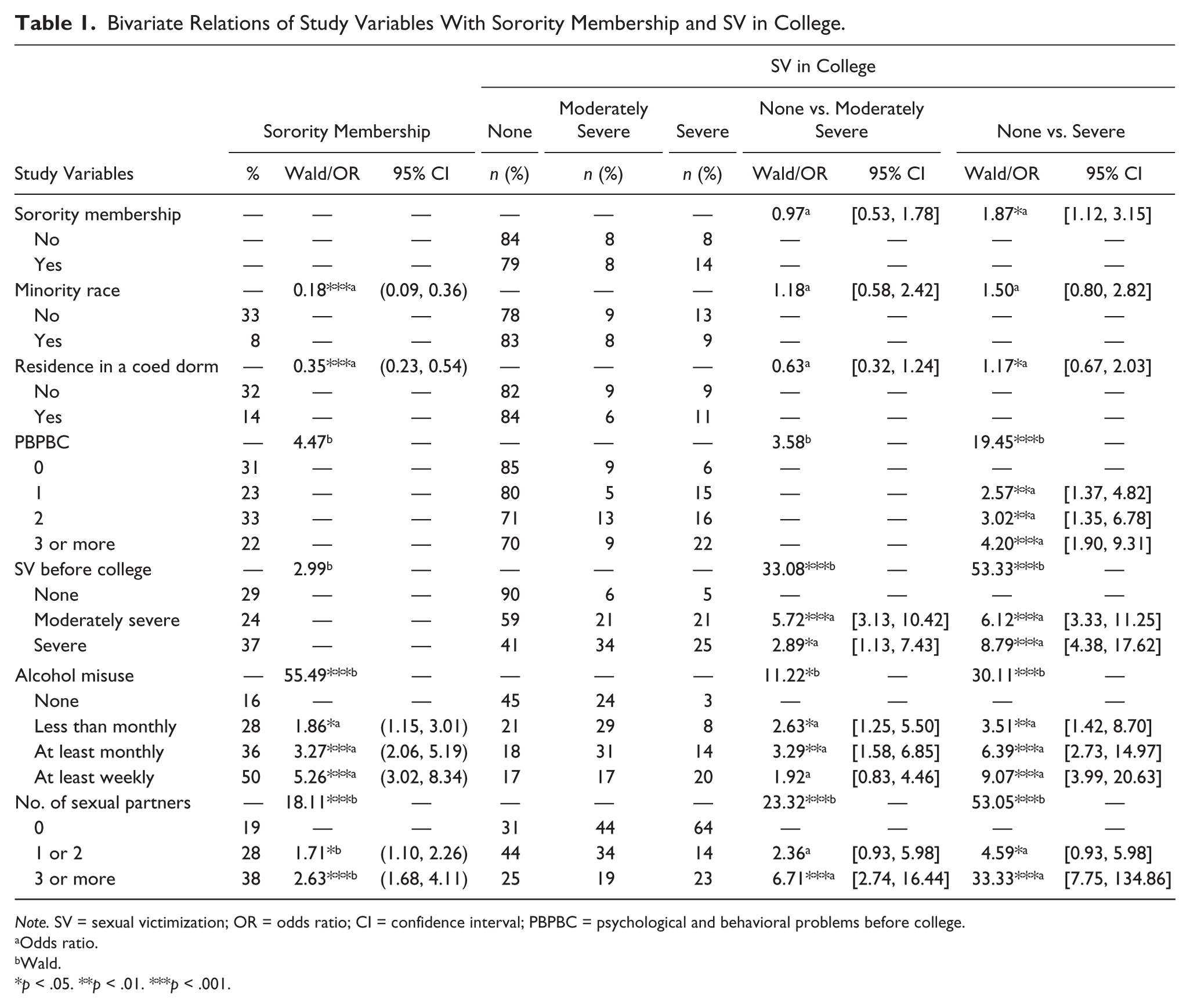
Descriptive and inferential values from the bivariate analyses that regressed sorority membership on the other study variables are presented in the left-hand columns of Table 1. In terms of the control variables, minority racial status and residence in a coed dorm were associated negatively with sorority membership. Participants with a minority race and those residing in a coed dorm were less likely than their counterparts to be sorority members. In terms of the risk behaviors, episodes of alcohol misuse and number of sexual partners were associated positively with sorority membership. Participants who engaged in alcohol misuse less than monthly, at least monthly but less than weekly, or at least weekly were more likely to be sorority members than were those who did not partake in any alcohol misuse. Similarly, participants who had one or two sexual partners, as well as those who had three or more sexual partners, were more likely to be sorority members than were participants with no sexual partners.
Bivariate Relations of Study Variables With Sorority Membership and SV in College.
Note. SV = sexual victimization; OR = odds ratio; CI = confidence interval; PBPBC = psychological and behavioral problems before college.
Odds ratio.
Wald.
p < .05. **p < .01. ***p < .001.
Bivariate Associations Between SV in College and the Other Study Variables
Descriptive and inferential values from the bivariate analyses that regressed moderately severe SV in college and severe SV in college on the other study variables are depicted in the middle and right-hand columns of Table 1, respectively. Sorority membership was associated positively with severe SV in college. Sorority members were more likely than nonmembers to have experienced severe SV in college. In contrast, sorority membership was not associated significantly with moderately severe SV in college.
In terms of the control variables, psychological and behavioral problems before college was associated positively with severe SV in college but not associated significantly with moderately severe SV in college. Post hoc contrasts found the occurrence of severe SV in college was higher among participants who had experienced one, two, or three or more of these problems relative to those who had experienced none. In addition, moderately severe SV before college and severe SV before college were associated positively with moderately severe SV in college and severe SV in college. Post hoc contrasts showed participants who experienced either moderately severe or severe SV before college were more likely to report both types of SV in college as compared with those who did not experience SV before college.
As for the risk behaviors, alcohol misuse was associated positively with both types of SV in college. Post hoc contrasts revealed participants who engaged in alcohol misuse less than monthly and those who engaged in alcohol misuse at least monthly but less than weekly were more likely to experience moderately severe SV in college than were those who did not have any episodes of alcohol misuse. Alcohol misuse was associated with severe SV in a dose–response manner, with each increase in frequency of alcohol misuse associated with a higher likelihood of victimization. Furthermore, number of sexual partners was associated positively with both types of SV in college. Post hoc contrasts showed participants who had three or more sexual partners were more likely than those with no partners to experience one of the two types of SV in college, whereas participants with one to two partners were more likely than those with no partners to experience severe SV in college only.
Multivariate Analyses of Risk Behaviors as Mediators of Associations Between Sorority Membership and SV in College
Figures 1 and 2 depict the primary results of the models that examined whether alcohol misuse and number of sexual partners, respectively, mediated the association between sorority membership and the two forms of SV in college. Minority racial status was associated with alcohol misuse in a negative direction in the models for moderately severe SV (t = −5.14, p < .001) and severe SV (t = −4.84, p < .001), but not with number of sexual partners or either form of SV in college. Residence in a coed dorm was not associated significantly with alcohol misuse, number of sexual partners, or either form of SV in college. In the models for moderately severe SV in college and severe SV in college, psychological and behavioral problems before college was associated positively with alcohol misuse (t = 2.58, p < .05, and t = 2.82, p < .01, respectively) and number of sexual partners (t = 2.45, p < .05, and t = 3.20, p < .01, respectively), but not with either form of SV in college. Moreover, in both the models, SV before college was associated positively with alcohol misuse (t = 3.55, p < .001, and t = 3.60, p < .001, respectively), number of sexual partners (t = 4.16, p < .001, and t = 3.79, p < .001, respectively), and the different forms of SV in college (t = 7.03, p < .001, and 3.68, p < .001, respectively).
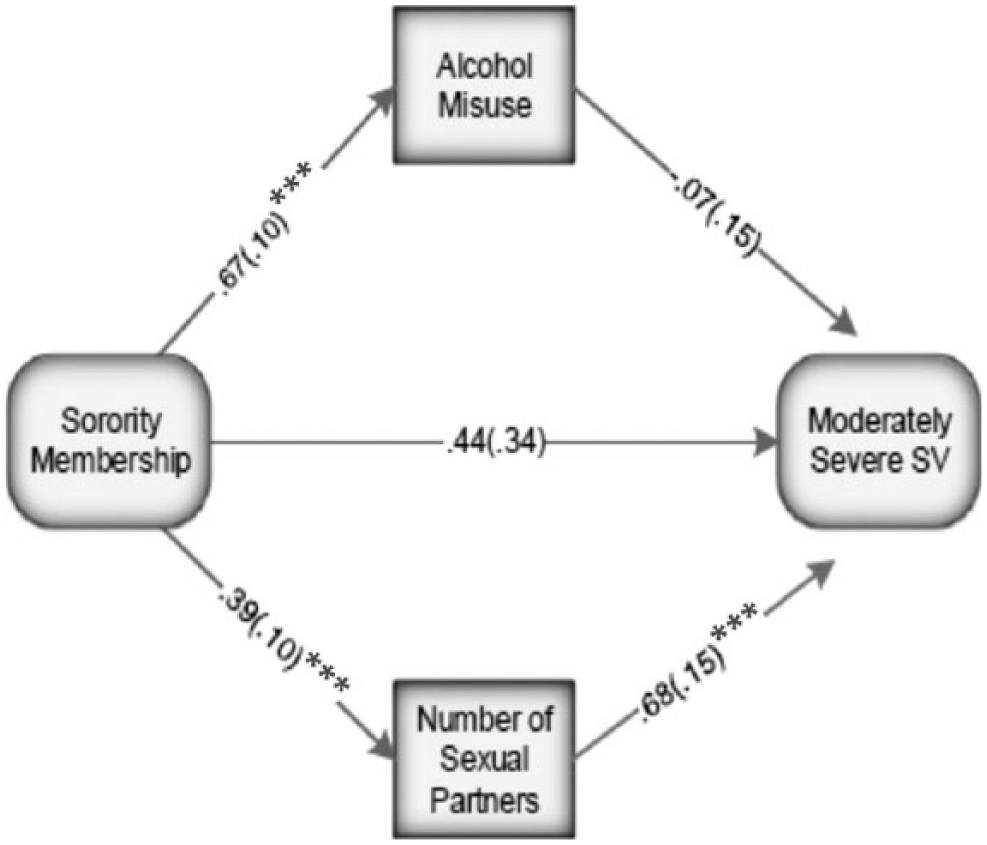
Model examining alcohol misuse and number of sexual partners as mediators of the association between sorority membership and moderately severe SV.

Model examining alcohol misuse and number of sexual partners as mediators of the association between sorority membership and severe SV.
Alcohol use had a direct, positive effect on severe SV in college, but not on moderately severe SV in college. In contrast, number of sexual partners had a direct, positive effect on both forms of SV in college. Sorority membership had a significant, indirect effect on moderately severe SV in college through number of sexual partners (effect = .26 [SE = .08], p < .05) only and had significant, indirect effects on severe SV in college through both alcohol misuse (effect = .21 [SE = .10], p < .05) and number of sexual partners (effect = .43 [SE = .16], p < .05).
Discussion
Much attention has been given to the risk for SV among female college students. Multiple studies on this topic have found sorority members to have a higher risk than nonmembers for experiencing SV in college. Furthermore, some of these studies have suggested the heightened risk for SV among sorority members is at least partly due to their relatively high levels of alcohol misuse and sexual partners. These findings are consistent with the tenets of Lifestyle Exposure Theory (Meier & Miethe, 1993; Meier, Stafford, & Sloane, 1990; Miethe et al., 1989), which generally hold that membership in certain groups can influence participation in risk behaviors that increase susceptibility for victimization.
Guided by these theoretical tenets, the current study investigated sorority membership in relation to alcohol misuse, number of sexual partners, and SV in a sample of first-year, female students. It built on the prior research on this topic by examining sorority membership and the risk behaviors in relation to different types of SV that varied in severity. It also built on prior research by incorporating SV before college as a covariate in multivariate models that analyzed the risk behaviors as mediators of the association between sorority membership and the different types of SV in college. Consistent with prior research cited above, bivariate results from the current study showed sorority members had more alcohol misuse and sexual partners than their nonmember counterparts. Also consistent with prior research cited above, the bivariate results indicated sorority membership was more strongly associated with severe SV than with moderately severe SV. Furthermore, multivariate analyses revealed number of sexual partners mediated the association between sorority membership and both types of SV, whereas alcohol misuse mediated the association between sorority membership and severe SV only.
The inclusion of SV before college as a study variable is an important contribution of the current study. Consistent with prior research findings for correlates of SV history (Desai, Arias, Thompson, & Basile, 2002; Testa, Hoffman, & Livingston, 2010), the results presented here showed SV before college was associated with higher levels of alcohol misuse, number of sexual partners, and SV in college. Moreover, results from the multivariate models showed sorority membership was associated with alcohol misuse, number of sexual partners, and severe SV independent of SV before college, thereby indicating the high levels of risk behaviors and SV among sorority members were not due to these women experiencing more SV before college.
The positive association between sorority membership and severe SV in college highlights an opportunity for more effective prevention efforts among college students. Based on the results of the mediation analyses, it appears these efforts can be enhanced by addressing risks among sorority members that are associated with misusing alcohol and having a relatively high number of sexual partners. Of course, there are challenges associated with addressing these risks. Alcohol consumption and sexual activity are commonly occurring and potentially rewarding behaviors that do not result inexorably in SV. Educational interventions that emphasize the risks associated with these behaviors will likely have limited impact on the occurrence of SV incidents, and may inadvertently result in victim blaming and the exacerbation of psychological consequences among those who experience the incidents. Hence, there is a need to develop novel approaches to address the risks among female college students that are associated with alcohol misuse and having more sexual partners.
The current study has some methodological limitations and these should be considered when interpreting the findings. Although the inclusion of SV before college and the psychological and behavioral problems before college variables allowed for controlling statistically for important precollege experiences, these variables were assessed at the same time as the others. In short, the cross-sectional nature of the research design did not allow for firm conclusions about the causal effects of sorority membership on the risk behaviors and SV. In addition, although 18% of the sample of more than 700 female college students experienced some type of SV during their first year of college, the proportion of participants who experienced each of the more three severe types was not large enough to analyze them separately. This circumstance necessitated grouping victims of coercion, attempted rape, and rape into one category even though their experiences and consequences with SV differed. Moreover, the sample was drawn from a single university located in the southeastern United States, and thus the findings cannot be generalized to all female college students in the country.
The results from the current study point to the need for additional research on the influences of sorority membership and its risk factors. For example, additional research is needed to address or overcome the limitations of the current study. Because it is not practical to examine the effects of sorority membership on SV directly through randomized experimental designs, researchers should strive to increase understanding about relations among these variables with the most rigorous possible alternatives, such as prospective, cohort designs. Prospective studies with assessments of variables occurring both in the high school and college years are needed to strengthen inferences about the effects of sorority membership on alcohol misuse, number of sexual partners, and SV in college. In addition, because Whites or Caucasians have been heavily represented in most studies on sorority membership and SV, there is a need for more racially diverse samples on the topic, especially as the college student population in the United States itself becomes more diverse. Furthermore, given the current study identified alcohol misuse and number of sexual partners as behavioral mediators of the association between sorority membership and SV, future studies should examine if sorority membership is tied to various cognitions that may be antecedents of these behaviors. Finally, investigating factors that may moderate or protect heavy drinking and/or sexually active sorority members from SV also could be fruitful. Studies on each of these topics would inform the development of different intervention approaches for reducing SV among sorority members, which is a need identified at the outset of this article.
In summary, this article has identified alcohol misuse and number of sexual partners as mediators of the association between sorority membership and “severe SV in college.” The findings are practically important as they point to behaviors that can be addressed to reduce SV incidence among sorority members. The findings also can be used to guide observational studies that aim to increase understanding of the influences of these behaviors on SV in this population.
Footnotes
Declaration of Conflicting Interests
The author(s) declared no potential conflicts of interest with respect to the research, authorship, and/or publication of this article.
Funding
The author(s) received no financial support for the research, authorship, and/or publication of this article.