



Abstract
The COVID-19 pandemic created an environment of disruption and adversity for many adolescents. We sought to establish the prevalence of non-dating sexual violence, sexual dating violence, and physical dating violence victimization among adolescents during the COVID-19 pandemic and to investigate whether experiences of disruption and adversity placed adolescents at greater risk for these forms of interpersonal violence. We conducted a secondary analysis of data from the Adolescent Behavior and Experiences Survey, collected January to June 2021 from a nationally representative sample of U.S. high school students (N = 7,705). Exposures included abuse by a parent; economic, housing, and food and nutrition insecurity; interpersonal connectedness; and personal well-being. Among female students, 8.0% experienced non-dating sexual violence; 12.5% experienced sexual dating violence; and 7.7% experienced physical dating violence. Among male students, 2.2% experienced non-dating sexual violence; 2.4% experienced sexual dating violence; and 4.9% experienced physical dating violence. Among female students, both emotional and physical abuse by a parent was related to non-dating sexual violence, emotional abuse was related to sexual dating violence, and physical abuse was related to physical dating violence. Among males, emotional abuse by a parent was related to physical dating violence and physical abuse by a parent was related to sexual dating violence. Hunger was associated with sexual and physical dating violence among female students and homeless was associated with physical dating violence among male students. Although there were differences by sex, abuse by a parent, hunger, and homelessness created precarity that may have increased the likelihood that adolescents would be exposed to risky peer or dating relationships. Adolescents need support that stops and prevents experiences of non-dating sexual and dating violence connected to interventions that address adversities experienced during the COVID-19 pandemic.
Keywords
Sexual violence, perpetrated by anyone, and dating violence (sexual, physical, and psychological) are public health concerns, particularly among adolescents. Sexual violence victimization perpetrated by anyone is associated with suicidal thoughts and behaviors, substance use, depression, and disordered eating (Dworkin et al., 2017). Dating violence victimization is associated with substance use, depression, suicidal ideation, and future risk of interpersonal violence (Exner-Cortens et al., 2013). Healthy People 2030 has objectives to improve adolescent health, including reducing sexual violence (perpetrated by anyone) and sexual and physical dating violence (perpetrated by an intimate partner) (Healthy People 2030, 2022). It is unclear whether progress is being made to reduce these forms of interpersonal violence. Rates of both sexual and physical dating violence among high school students decreased between 2013 and 2019 (Division of Adolescent and School Health, 2020). However, other data suggest that rates of adolescent dating violence (sexual and/or physical) and sexual violence by anyone increased between 2017 and 2019 (Healthy People 2030, 2022). The most recent nationally representative prevalence estimates among adolescents show that 10.8% of U.S. high school students experienced sexual violence perpetrated by anyone, 8.2% experienced sexual dating violence, and 8.2% experienced physical dating violence in the past year (Basile et al., 2020).
Widespread public health response to the COVID-19 pandemic began in March 2020 (World Health Organization, 2020), resulting in disruptions to the lives of high school students. Most schools closed for in-person learning, at least temporarily, to mitigate transmission and infection rates (Centers for Disease Control and Prevention, 2022). Unfortunately, emerging research suggests that virtual instruction was associated with worse mental health among adolescents compared to instruction provided in-person only (Hertz et al., 2022). Recent reports revealed that adolescents drank more alcohol (29.6%), used more drugs (31.4%), and more experienced poor mental health (37.1%) during the pandemic as compared to before it started (Brener et al., 2022; Jones et al., 2022). Experts warned of the heightened risks of violence that the COVID-19 pandemic could present among adolescents due to factors such as experiencing economic insecurity and spending time at home with a violent perpetrator (Ragavan et al., 2020). Here, we examine disruptions and adversities that adolescents experienced during the pandemic that may have increased their risk for experiencing non-dating sexual violence, sexual dating violence, and physical dating violence, including abuse by a parent, economic, housing, and food and nutrition insecurity, decreased personal well-being, and a lack of interpersonal connectedness.
The Adolescent Behaviors and Experiences Survey (ABES) used a multistage probability sampling approach to engage a nationally representative sample of U.S. high school students January to June 2021 to find out about their experiences during the COVID-19 pandemic (Rico et al., 2022). This survey has produced a wealth of knowledge about the challenges that students faced that informs our analysis along with studies from the extant violence literature. During the pandemic, more than half of high school students experienced adversity in the form of emotional abuse by a parent or caregiver (55.1%) and more than 1 in 10 experienced physical abuse (11.3%) (Krause et al., 2022). Scholars have hypothesized that social isolation and economic and psychological stress during the pandemic may have created an increased risk for the perpetration of violence within the family (Pereda & Díaz-Faes, 2020). Previous studies have found that both emotional and physical abuse by a parent or caregiver were associated with experiencing adolescent dating violence (Cascardi & Jouriles, 2018; Li et al., 2019). An adolescent who has experienced abuse by a parent may learn that violent behavior is part of interpersonal relationships and may have an increased tolerance for abuse in other relationships (Ehrensaft et al., 2003).
Students commonly experienced parent job loss (28.5%) and hunger (23.8%) during the pandemic (Krause et al., 2022). Economic insecurity in the form of a high concentration of families with low-income or living in poverty within a school has been found to be associated with sexual violence and physical and sexual dating violence among high school students at that school (Jones et al., 2020). Adolescents who have experienced housing or food insecurity have a greater likelihood of engaging in sex in order to receive food, money, housing or other tangible items compared with adolescents who have not experienced housing or food insecurity (Head et al., 2021). In adult samples, food insecurity was associated with experiencing intimate partner violence (Ricks et al., 2016).
During the pandemic, many students seriously considered (19.9%) or attempted suicide (9.0%) (Jones et al., 2022) and 66% of students had difficulty completing their schoolwork (Krause et al., 2022). Feeling persistently sad or hopeless for 2 weeks or longer in the past year has been found to be associated with sexual and physical adolescent dating violence victimization (Higgins et al., 2018). Depression was also associated with experiencing sexual dating violence among females (Foshee, Bauman, et al., 2004). Furthermore, academic difficulty, operationalized as lower grades, was associated with experiencing emotional dating violence, which in turn was associated with sexual and physical dating violence (Lohman et al., 2013).
Physical and sexual dating violence victimization is negatively associated with school connectedness (Mulla et al., 2020). Fortunately, many students maintained social connections during the pandemic; almost half of students felt close to others at school (46.6%), more than half felt virtually connected to friends, family, or other social groups (71.8%), and students who felt either of these types of connections were less likely to have poor mental health, consider suicide or attempt suicide (Jones et al., 2022). Supportive peer relationships were related to a decreased risk of experiencing dating violence among adolescents (Park & Kim, 2018).
Objective
Within the context of the COVID-19 pandemic, we sought to establish the prevalence of non-dating sexual violence, sexual dating violence, and physical dating violence among high school students and investigate whether experiences of disruption and adversity were associated with a greater risk of experiencing violence.
Methods
Sample and Survey Administration
We performed a secondary data analysis of ABES (N = 7,705), which was conducted by the Centers for Disease Control and Prevention. Data were collected January to June 2021. ABES is a national sample of students in grade 9 to 12 attending public and private schools within the U.S.; a stratified, three-stage cluster sampling approach was utilized to select classrooms of students within selected schools, each within selected primary sampling units (i.e., a county, partial county, or a group of counties). Surveys were web-based and administered to students in either English or Spanish. More information about the survey sample design, questionnaire, and methodology is available elsewhere (Rico et al., 2022).
Measures
ABES includes three questions related to sexual and/or dating violence: sexual violence victimization by anyone (which includes both non-dating sexual violence and dating sexual violence), sexual violence victimization by a dating partner, and physical violence victimization by a dating partner. Because the COVID-19 pandemic altered the typical social and physical interactions of adolescents (and all people), we created mutually exclusive categories to account for potential differences in who perpetrated the sexual violence. The three outcomes of interest were: non-dating sexual violence, sexual dating violence, and physical dating violence victimization.
Non-Dating Sexual Violence
This outcome measure, which assessed sexual violence perpetrated by someone other than a dating partner, was created by combining two questions from the ABES questionnaire. First, we examined the question, During the past 12 months, how many times did anyone force you to do sexual things that you did not want to do? (Count such things as kissing, touching, or being physically forced to have sexual intercourse.) and response options were coded as Yes (≥1 time) versus No (0 times). Second, we examined the question, During the past 12 months, how many times did someone you were dating or going out with force you to do sexual things that you did not want to do? (Count such things as kissing, touching, or being physically forced to have sexual intercourse.) and response options were coded as Yes (≥1 time) versus No (0 times). A student was considered to have experienced non-dating sexual violence victimization if they responded Yes to the first question and No to the second question.
Sexual dating violence
This outcome was assessed with the question, During the past 12 months, how many times did someone you were dating or going out with force you to do sexual things that you did not want to do? (Count such things as kissing, touching, or being physically forced to have sexual intercourse.) with response options Yes (≥1 time) versus No (0 times). Students who responded Yes were considered to have experienced this form of violence.
Physical dating violence
This outcome was assessed with the question, During the past 12 months, how many times did someone you were dating or going out with physically hurt you on purpose? (Count such things as being hit, slammed into something, or injured with an object or weapon.) with response options Yes (≥1 time) versus No (0 times). Students who responded Yes were considered to have experienced this form of violence.
The exposures of interest were experiences of disruption and adversity and included abuse by a parent; economic, housing, and food and nutrition insecurity; personal well-being; and interpersonal connectedness. The exposure questionnaire wording and analytic coding are provided in Table 1.
Measures of Disruptions and Adversities Experienced by Students during the Pandemic—Adolescent Behaviors and Experiences Survey, United States, 2021.

Demographic measures included sex, race/ethnicity, sexual identity, and grade level. Race/ethnicity was measured as a composite of two questions; one about ethnicity (Are you Hispanic or Latino? with response options Yes vs. No) and one about race (What is your race? Select all that apply with response options American Indian or Alaska Native, Asian, Black or African American, Native Hawaiian or Pacific Islander, White). Any student who indicated that they identified as Hispanic or Latino, regardless of their answer to the race question, was coded as Hispanic/Latino. Students identifying as not Hispanic/Latino but as more than one race were coded as Multiracial. All other students identifying as not Hispanic/Latino were coded according to the single racial category with which they identified. Sex was measured with one question (What is your sex? with response options Female vs. Male). Sexual identity was measured with one question (Which of the following best describes you? with response options Gay or Lesbian; Bisexual; I describe my sexual identity in some other way; I am not sure about my sexual identity (questioning); Heterosexual (straight). Students were grouped into two categories: Lesbian, gay, bisexual, other, questioning or Heterosexual.
Analysis
All results were stratified by sex because the prevalence of sexual and dating violence differs significantly between females and males (Basile et al., 2020). We calculated weighted prevalence estimates and 95% confidence intervals for non-dating sexual violence, and sexual and physical dating violence stratified by demographic characteristics and experiences of disruption and adversity. We used paired t-tests to examine the relationship between demographic characteristics and experiences of disruption and adversity with the violence outcomes. We conducted logistic regression models for each outcome of violence with all experiences of disruptions and adversity, controlling for race/ethnicity and sexual identity (grade level was excluded from models due to not having a significant bivariate relationship to the outcomes). We assessed significance through confidence intervals and p < .05. We used SUDAAN (version 11.0.1; RTI International) to account for the complex survey designing and survey weighting. We suppressed results if the unweighted number in a group was lower than 30.
Results
Among female students, sexual dating violence was the most common experience of violence (12.5%), followed by non-dating sexual violence (8.0%), and physical dating violence (7.7%; Table 2). Among male students, physical dating violence was most common (4.9%), followed by sexual dating violence (2.4%), and then non-dating sexual violence (2.2%). Among females, White students had a higher prevalence of non-dating sexual violence compared to all other groups except Multiracial students. White and Hispanic/Latino female students reported higher prevalence of sexual dating and physical dating violence compared to Black female students. Among males, Asian students reported a lower prevalence of non-dating sexual violence than all other groups except American Indian/Alaska Native students. Lesbian, gay, bisexual, other and questioning students experienced higher rates of all forms of violence compared to their heterosexual peers among females and, among males, experienced more non-dating sexual and sexual dating partner violence.
Prevalence of Non-dating Sexual Violence, Sexual Dating Violence, and Physical Dating Violence Among High School Students during the COVID-19 Pandemic by Sex, race/Ethnicity, Sexual Identity, and Grade—Adolescent Behaviors and Experiences Survey, United States, 2021.
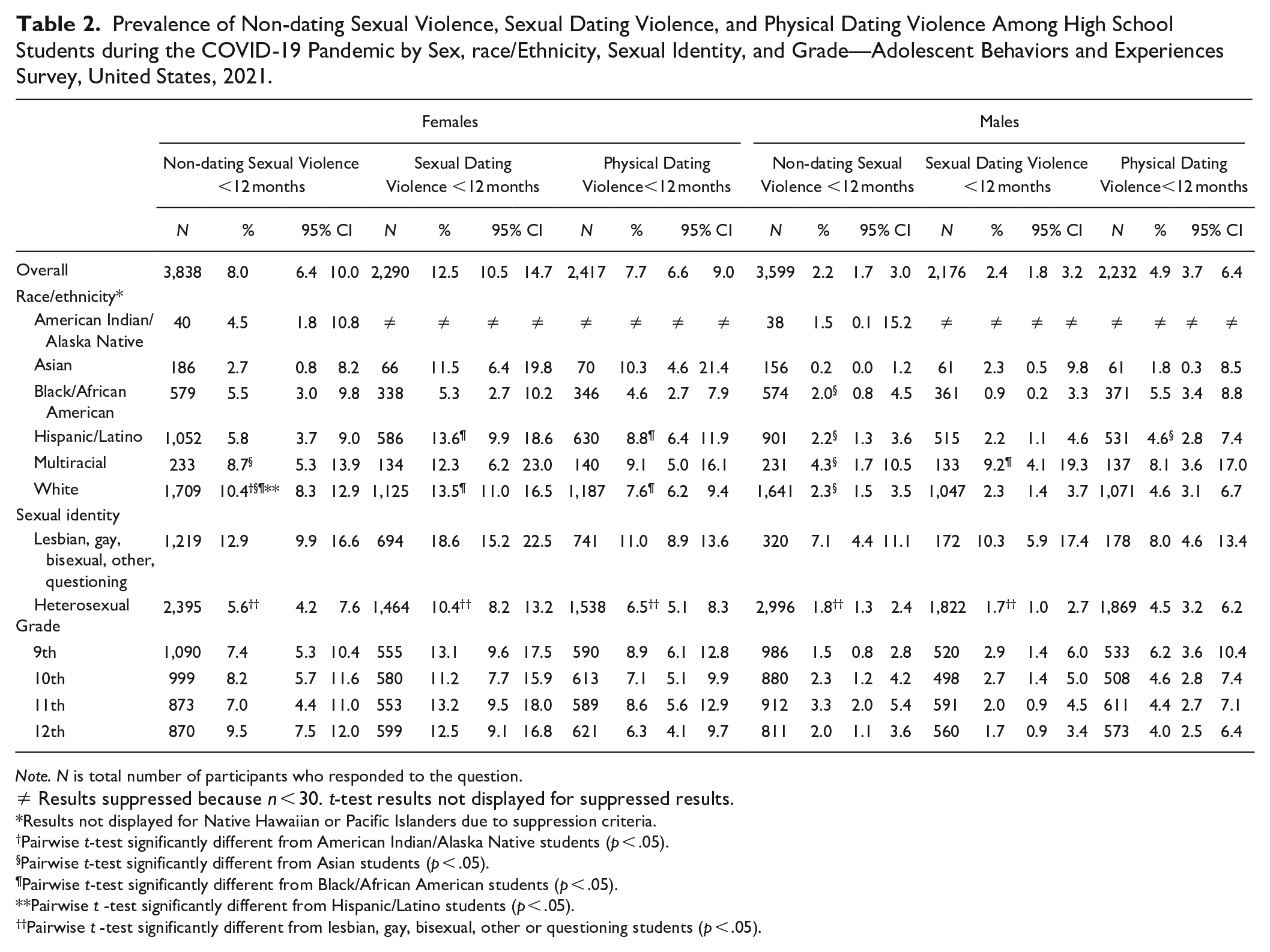
Note. N is total number of participants who responded to the question.
Results suppressed because n < 30. t-test results not displayed for suppressed results.
Results not displayed for Native Hawaiian or Pacific Islanders due to suppression criteria.
Pairwise t-test significantly different from American Indian/Alaska Native students (p < .05).
Pairwise t-test significantly different from Asian students (p < .05).
Pairwise t-test significantly different from Black/African American students (p < .05).
Pairwise t -test significantly different from Hispanic/Latino students (p < .05).
Pairwise t -test significantly different from lesbian, gay, bisexual, other or questioning students (p < .05).
In bivariate models, experiencing emotional or physical abuse by a parent were associated with a higher prevalence of all forms of violence among female and male students (Tables 3(a) and (b)). Parent job loss was associated with non-dating sexual violence among females. Experiencing homelessness was associated with sexual dating and physical dating violence among males. Experiencing hunger was associated with all three forms of violence among female students and with sexual dating violence among males. Persistent feelings of sadness or hopelessness was associated with higher reporting of all forms of violence among females and males. Difficulty completing schoolwork was associated with non-dating sexual violence and sexual dating violence among females. Feeling disconnected from others at school was associated with sexual dating and physical dating violence among female students. Never or rarely spending time with family, friends or others virtually was associated with a higher prevalence of physical dating violence among males.
(a) Prevalence of Non-dating Sexual Violence, Sexual Dating Violence, and Physical Dating Violence Among Female High School Students during COVID-19 Pandemic by Experiences of Disruptions and Adversities—Adolescent Behaviors and Experiences Survey, United States, 2021.

Pairwise t-test significant p < .05 (pairwise comparison is “yes” response to experience of disruption of adversity to “no”).
Prevalence of Non-dating Sexual Violence, Sexual Dating Violence, and Physical Dating Violence Among Male High School Students during COVID-19 Pandemic by Experiences of Disruptions and Adversities—Adolescent Behaviors and Experiences Survey, United States, 2021.
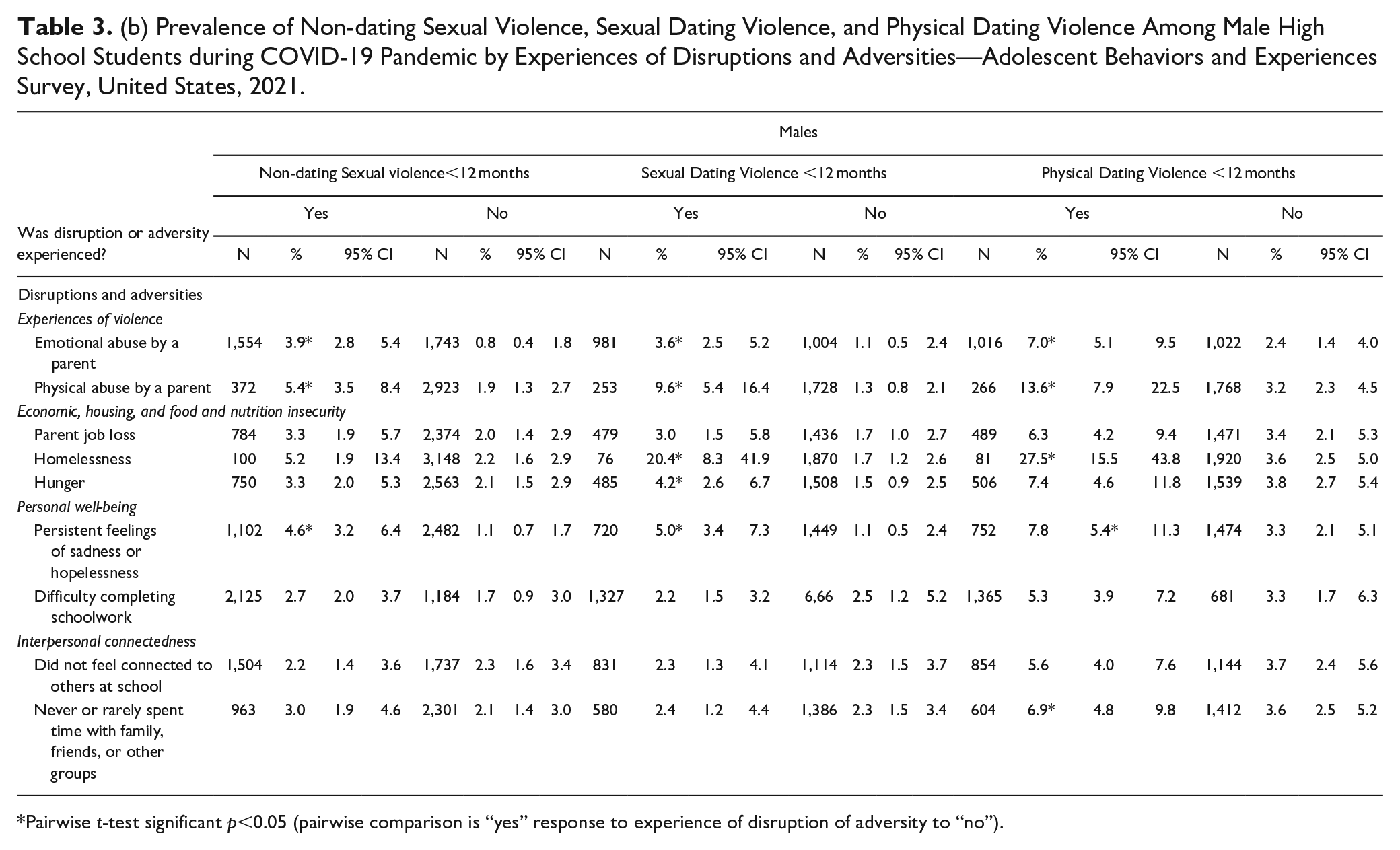
Pairwise t-test significant p<0.05 (pairwise comparison is “yes” response to experience of disruption of adversity to “no”).
In fully adjusted multivariable models for females, emotional abuse by a parent was associated with higher odds of sexual dating violence, while physical abuse by a parent was associated with higher odds of physical dating violence (Table 4). Both forms of abuse by a parent were associated with non-dating sexual violence. Hunger was associated with sexual dating and physical dating violence. Persistent feelings of sadness or hopelessness was associated with all three forms of violence. Difficulty completing schoolwork was associated with sexual dating violence. Compared to White female students, Asian and Hispanic/Latino female students had a lower odds of non-dating sexual violence and Black students had a lower odds of sexual dating violence. Identifying as lesbian, gay, bisexual, other, or questioning was associated with non-dating sexual violence.
Logistic Regression Models of Experiences of Violence with Disruptions to Student Life during the Pandemic—Adolescent Behaviors and Experiences Survey, United States, 2021.
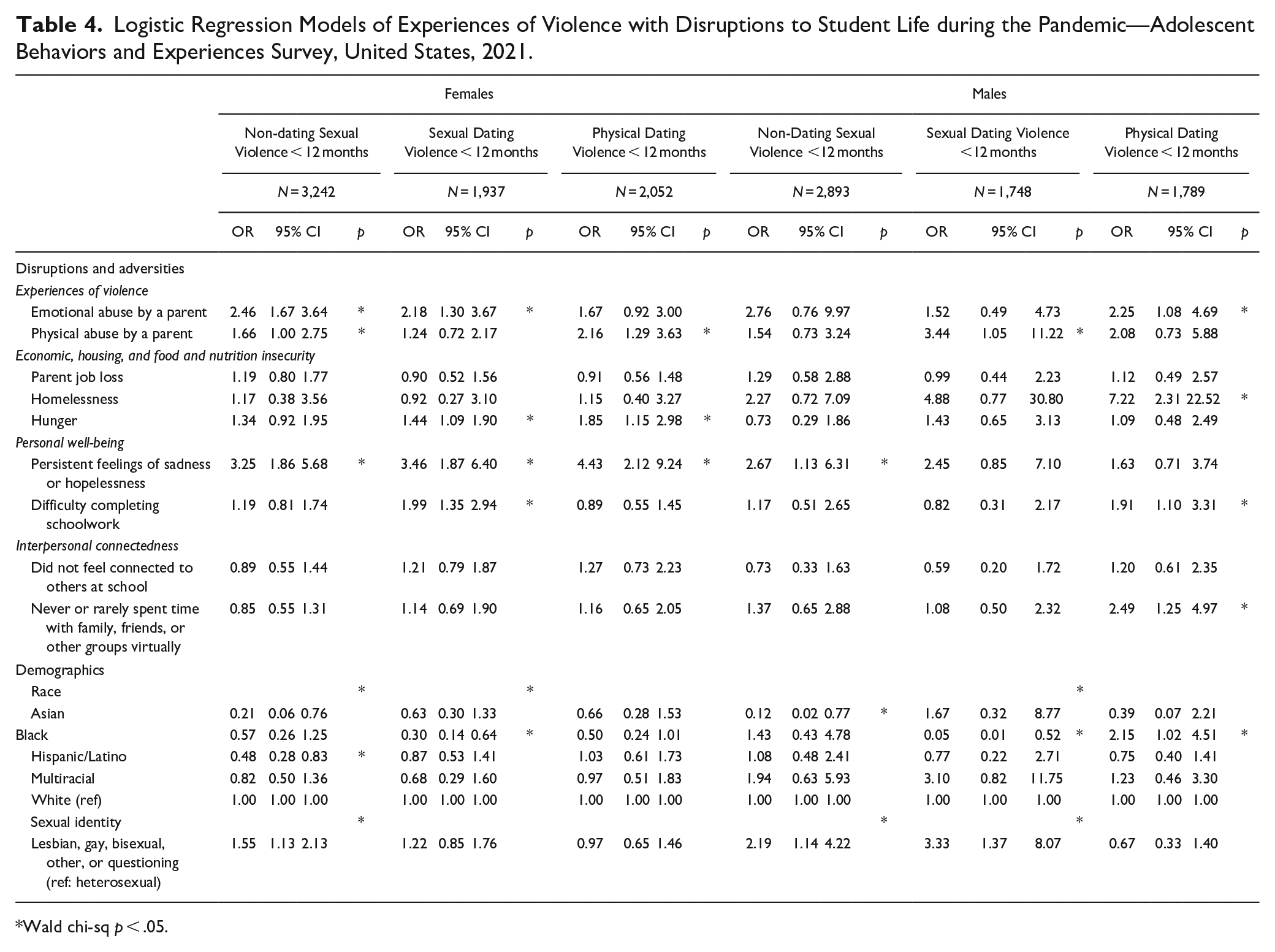
Wald chi-sq p < .05.
In fully adjusted multivariable models for males, emotional abuse by a parent was associated with a higher odds of physical dating violence, while physical abuse by a parent was associated with a higher odds of sexual dating violence. Experiencing homelessness was associated with physical dating violence. Persistent feelings of sadness or hopelessness was associated with non-dating sexual violence. Difficulty completing schoolwork and never or rarely spending time virtually with family or friends was associated with physical dating violence. Compared to White male students, Asian male students had a lower odds of non-dating sexual violence and Black male students had lower odds of sexual dating and physical dating violence. Identifying as lesbian, gay, bisexual, other, or questioning was associated with non-dating and dating sexual violence.
Discussion
Although previous surveillance studies of high school students in the United States used a different sampling scheme and mode of survey administration as compared to this study (Rico et al., 2022), prior national estimates are useful to provide context to the prevalence estimates of non-dating sexual violence, sexual dating violence, and physical dating violence during the pandemic that were established in this study. Among females, the prevalence of sexual dating violence during COVID-19 was similar to rates found in a nationally representative sample of U.S. high school students in 2019, using parallel measures (Basile et al., 2020) (12.5% vs. 12.6%, respectively), while physical dating violence appeared to be lower during the pandemic (7.7% vs. 9.3%). Similarly, among males, the prevalence rates of sexual dating violence (2.4% vs. 3.8%) and physical dating violence (4.9% vs. 7.0%) were both lower in the pandemic period versus pre-pandemic estimates. The prevalence of non-dating sexual violence does not have a direct comparison; however, it was previously reported that when looking at female and male students together, about half of students who experienced sexual violence by anyone also reported sexual violence by a dating partner (Basile et al., 2020), which was also true in our sample. Therefore, it seems that compared to similar pre-pandemic estimates, rates of physical dating violence among female and male students and sexual dating violence among male students were lower during the pandemic while other violence rates were similar. Conversely, there is no indication from these data that rates of adolescent sexual and dating violence, overall, increased during COVID-19.
Although natural disasters and their aftermath are associated with an increased experience of some forms violence including intimate partner and sexual violence (Rezaeian, 2013; Seddighi et al., 2021), the unique nature of this public health emergency, in which many youth spent more time at home and less time with peers in school and the community, may have decreased access to dating partners and the risk of some forms of abuse. In contrast, other research suggests that violence in the home—against partners and children—increased during the pandemic resulting from greater psychosocial and financial stressors and limited access to victim support (McNeil et al., 2022; S. Sharma et al., 2021). Notably, the data for this study were collected during a six-month period in the middle of the pandemic, and although students answered the violence questions about their experiences in the previous year, additional studies are needed to reflect the potentially dynamic experiences during different phases of the pandemic and in the post-pandemic period. Quantitative, qualitative, and mixed-methods studies are needed to further understand the prevalence and precursors to experiencing violence among adolescents during the COVID-19 pandemic.
We found that experiencing emotional or physical abuse by a parent was significantly associated with non-dating sexual, sexual dating, or physical dating violence victimization for both female and male students. Scholars have demonstrated how COVID-19 could act as a mechanism for increasing the risk of domestic violence (A. Sharma & Borah, 2020). For example, being hit by an adult as an adolescent is associated with subsequent experiences of physical dating violence among both females and males (Foshee et al., 2004). However, these effects may not be immediate and could present for the first time in future dating relationships. Given the relatively short time period assessed in the current study, it may be that the full impact of abuse and adversity exposure during COVID-19 for youth may be seen over the coming years. Longitudinal research to examine the longer-term risks to adolescent mental health and behavior could inform direct support and intervention efforts to ameliorate these negative outcomes.
Persistent feelings of sadness or hopelessness were associated with all forms of violence among female students and some forms of violence among male students; additionally, difficulty completing schoolwork was associated with some forms of violence among both female and male students. Although we present these personal well-being factors as potential risk factors for, or precursors to, experiences of violence, it is equally plausible that adolescents who experienced violence were more likely to experience these depressive feelings and have difficulty with schoolwork. Previous research indicates that female and male survivors may experience different impacts from interpersonal violence. Among adults who have experienced sexual violence or intimate partner violence, females were more likely than males to have experienced a negative impact such as experiencing PTSD or missing a day of work or school (Breiding et al., 2014). Additionally, adolescents who experience dating violence are at risk for lower academic achievement (Datta et al., 2020).
Unexpectedly, economic insecurity (parent job loss) and lack of connectedness experienced during the pandemic were not related to experiences of non-dating sexual and sexual dating violence during the same period; however, hunger was associated with physical dating violence among females and homelessness associated with physical dating violence among males. Although research is limited, homelessness and hunger may create reliance on a dating partner for survival needs and exacerbate challenges leaving unhealthy or potentially violent relationships. These adversities may also lead to psychological distress and mental health problems, factors which have been associated with increased risk for sexual and/or physical dating violence victimization (Cascardi, 2016; Foshee, Benefield, et al., 2004; Howard et al., 2008). Adolescents who leave home may also seek shelter in the home of an older partner, making them more vulnerable to dating violence; research demonstrates that youth who experience homelessness are at greater risk for dating violence than youth who are not homeless (Edidin et al., 2012).
We found some significant differences by race/ethnicity in the prevalence of violence victimization and in the models. Additionally, youth identifying as lesbian, gay, bisexual, other or questioning (LGBQ+) as compared with heterosexual youth had higher prevalence of all forms of violence; they had increased odds of non-dating sexual violence among females and non-dating sexual and sexual dating violence among males. It would be fruitful to conduct analyses stratified by race/ethnicity and sexual identity as a complement to this paper, which focused on presenting population averages. Other research has established that experiences of disruption and adversity during the pandemic differed by race/ethnicity and sexual identity (Krause et al., 2022) and that pre-pandemic, there were differences in experiences of teen dating violence by race/ethnicity (Spence et al., 2016) and sexual identity (Martin-Storey et al., 2021).
Limitations
The primary limitations of the Adolescent Behavior and Experiences Survey have been outlined in a report on its methodology (Rico et al., 2022). This specific analysis is subject to at least five limitations. First, because this study presents cross-sectional data, we cannot interpret causality. Relatedly, the selection of covariates and outcomes could be switched, as outlined in the discussion above about the relationship of personal well-being measures to experiences of interpersonal violence. Second, the experiences of violence operationalized as unique outcomes may not be mutually exclusive. For example, one incident of violence perpetrated against an adolescent could lead them to responding “yes” to items asking about sexual and physical dating violence. Additionally, to use mutually exclusive outcomes, we created the outcome of non-dating sexual violence victimization. We assumed that students who answered both “yes” to the question about experiencing sexual violence perpetrated by anyone and “yes” to the question about experiencing sexual violence perpetrated by a dating partner only experienced sexual dating violence by a dating partner. This assumption may not be true and may have underestimated the prevalence of those who experienced non-dating sexual violence. Third, the prevalence estimates and analysis present a snapshot of what adolescents were experiencing as reported during the first 6 months of 2021, while the COVID-19 pandemic began in 2020 and fluctuations may have occurred throughout the pandemic. Fourth, some questions were intentionally worded to ask about experiences “during the COVID-19 pandemic,” to have students share anything that had occurred during that time period; however, the wording is vague in comparison to other questions that used a time period of the previous 30 days, for example, and students may have had differing ideas about when the pandemic began. Fifth, we do not know whether some experiences, such as experiencing emotional or physical abuse from a parent began since the COVID-19 pandemic or began prior to the pandemic and remained ongoing since the questions asked about experiences “during the COVID-19 pandemic.”
Conclusion
Overall, adolescents experienced non-dating sexual, sexual dating, and physical dating violence at rates during COVID-19 that appear similar to, or lower than, pre-pandemic levels. However, some experiences of disruption and adversity during the pandemic were associated with increased risk of violence for affected youth, and the longer-term effects of those disruptions on violence exposure may appear later. For individual youth, precarity in their home life during COVID-19, including emotional and physical abuse by a parent, hunger, or homelessness, may have increased the potential for entry into risky peer or dating relationships and their potential for violence victimization. Adolescents need support to prevent experiences of non-dating sexual and dating violence in connected to supports and interventions to address the adversities that they experienced during the COVID-19 pandemic.
Footnotes
Disclaimer
The findings and conclusions in this report are those of the authors and do not necessarily represent the official position of the Centers for Disease Control and Prevention.
Declaration of Conflicting Interests
The author(s) declared no potential conflicts of interests with respect to the authorship and/or publication of this article.
Funding
The author(s) received no financial support for the research and/or authorship of this article.
