



Abstract
This article examines the difference in blame attribution between men and women, heterosexuals and homosexuals, and heterosexual males, heterosexual females, gay males, and lesbians in response to a vignette depicting the acquaintance rape of a heterosexual female (n = 177). While the levels of empathy for the victim and blaming of the perpetrator were high for every group and blaming of the victim and rape myth acceptance were low for every group, some important trends emerged. Consistent with previous research, women reported higher rates of empathy for the victim, lower rape myth acceptance, and lower victim blaming than did men. Men and homosexuals had higher rates of victim blaming and were more likely to excuse the perpetrator’s behavior than were women and heterosexuals, respectively. Lesbians had various patterns where they were at times more similar to heterosexual males (e.g., how much they blamed the perpetrator) or heterosexual females (e.g. in terms of empathy levels). They were consistently different from gay males. Further, the majority of differences were attributed to gay males, who had the highest levels of victim blaming and empathy for the perpetrator, were the most likely to excuse the perpetrator’s behavior, and had the highest rate of rape myth acceptance of all of the groups. We conclude that sex and sexual identity interact to shape attributions about rape and discuss avenues for future research to explore these patterns.
Sexual assault is an endemic public health issue associated with a wide array of interpersonal problems, mental and physical health issues for victims (e.g., Rees et al., 2011). As a criminal act, it is woefully underreported, under prosecuted, and few rapists spend any meaningful time in prison (Lonsway, Archambault, & Lisak, 2009). There has been extensive research into both the personal costs of sexual assault and the costs to the criminal justice system. One of the common conclusions is that both sets of costs are partially the result of a rape culture that supports endorsement of rape myths and victim blaming tendencies (Burt, 1980; Suarez & Gadalla, 2010).
In terms of personal costs, there is a wealth of evidence about the importance the response of others is to a personal disclosure of sexual assault (e.g., Ahrens, Stansell, & Jennings, 2010). Victims who receive negative reactions, such as victim blaming, are more likely to blame themselves for their own assault (Frazier & Schauben, 1994), which increases likelihood of revictimization (Miller, Markman, & Handley, 2007; Tjaden & Thoennes, 2000). Negative reactions are also associated with higher rates of alcohol and substance abuse, anxiety disorders, depression, posttraumatic stress disorder, suicidal ideation, and revictimization (see Campbell, Dworkin, & Cabral, 2009). Positive reactions can buffer negative outcomes of sexual assault and promote self-efficacy, increase self-worth, and encourage psychological growth (Brewin, Andrews, & Valentine, 2000; Littleton, Horsley, John, & Nelson, 2007; Ozer, Best, Lipsey, & Weiss, 2003; Schumm, Briggs, Phillips, & Hobfoll, 2006).
In terms of costs to the criminal justice system, research estimates that only 63% of sexual assaults are ever reported to the police (Lonsway, Archambault, & Lisak, 2009). A common finding in research is that victims do not report because they are worried they will not be believed (Jordan, 2004; Sable, Danis, Mauzy, & Galagher, 2006). Further, when victims blame themselves for the assault (a factor also attributed to rape culture), they are less likely to seek either medical or legal recourse (Pollard, 1992; Walker, Archer & Davies, 2005). Rape myth acceptance and victim blaming also can influence court decisions in ways that dismiss claims of victims (Stevenson, 2000; Krahé, Temkin, Bieneck, & Berger, 2008). When faced with negative reactions from these institutions, survivors are likely to experience revictimization (Campbell, 1998; Campbell, Wasco, Ahrens, Sefl, & Barnes, 2001; Logan, Evans, Stevenson, & Jordan, 2005).
Negative reactions from disclosure partners and from the criminal justice system are both largely attributable to rape myth acceptance (RMA) and the concomitant victim blaming that is associated with it (Grubb & Turner, 2012). Rape myths have been “defined as prejudicial, stereotyped, or false beliefs about rape, rape victims, and rapists—in creating a climate hostile to rape victims” (Burt, 1980, p. 217). Key to this definition is how endorsement of myths affect attributions toward the victim and the perpetrator. These attributions cause the negative outcomes described above. As such, many researchers have examined factors that influence RMA and victim blaming. The argument is that understanding the underlying phenomenon, which influences negative attributions toward victims (and positive toward perpetrators) provides avenues to intervene in these processes to address the costs to victims and the criminal justice system (e.g., Grubb & Turner, 2012; Suarez & Gadalla, 2011).
Based on this, there has been a great deal of research on how characteristics of individuals affect their endorsement of RMA and how they attribute blame (research is fully reviewed below). As will become apparent, one of the most developed lines of research is the effect of sex. Men have higher rates of RMA (Hammond, Berry, & Rodriguez, 2011; Suarez & Gadalla, 2010), lower levels of empathy for the victim (Osman, 2011), and are more likely to blame the victim and excuse the perpetrator’s behavior (van der Bruggen & Grubb, 2014) than do women.
Indeed, research on RMA and attributions about rape acknowledge that a strong indicator of rape culture acceptance is endorsement of traditional gender roles (see Grubb & Turner, 2012 a review). This makes sense as scholars have long argued that rape myths and the concomitant assignment of blame is developed from patriarchal notions of gender (e.g., Burt, 1980). Schulze and Koon-Magnin (2017) add to this that rape myths are also heteronormative. According to these authors, this makes it important to examine how RMA is affected by sexual identity. Specifically, they argue that sexual identity may have a systematic effect on acceptance of misogynistic and heteronormative assumptions of rape myths, but they are uncertain as to what this effect may be. On one hand, they point out that the lived experience of day-to-day interactions in a heterosexist society may result in higher rates of rejection of rape myths by homosexual individuals. On the other hand, they also recognize that some homosexuals internalize homonegativity, which actually may result in higher RMA. To address this, they examine how sex and sexuality operate separately and together to affect the RMA of sexual minorities.
While their findings will be discussed in detail below, we add to their argument that it is also necessary to understand how sex and sexual identity may operate together or separately to affect feelings of empathy and attributions of blame. Just as there is reason to expect that the lived experience of sexual orientation may result in different patterns of RMA than would be expected by sex alone, other attributions of sexual assault are also likely to be affected (Davies & Hudson, 2011; Davies & McCartney, 2003). As RMA and attributions of blame are both derived from patriarchal notions (e.g., Burt, 1980), the argument Shulze and Koon-Magnin (2017) would also apply. Another reason to expect that sexual identity would have different effects from sex alone is the higher vulnerability to sexual assault that lesbian, gay, and bisexual (LGB) individuals face (Balsam, Rothblum, & Beauchaine, 2005; Rothman, Exner, & Baughman, 2011; Walters, Chen, & Breiding, 2013). As we will discuss below, perception of how likely it is that one will be assaulted affects both levels of empathy and who is blamed more for the assault.
Following Shulze and Koon-Magnin (2017), we provide no specific hypotheses but instead general research questions. We first ask,
Second, we ask,
In particular, we are examining this question in relation to one of the most common types of rape—the rape of a heterosexual female by a male acquaintance (Breiding et al., 2014). To answer these questions, we first review findings from sexual assault vignette research and what these findings would suggest for the effects of sexuality. We then address the few research articles that have been published in relation to sexual identity and attributions of blame.
Sexual Assault Vignette Research
Research on rape myth acceptance and the attribution of blame in rape scenarios can be loosely divided, based on the variables of interest, into three meaningful categories: (a) victim characteristics (e.g., Davies & Rogers, 2006; Grubb & Turner, 2012), (b) perpetrator characteristics (e.g., Bell, Kuriloff, & Lottes, 1994; Clarke & Lawson, 2009), and (c) observer characteristics (e.g., van der Bruggen & Grubb, 2014; White & Kurpius, 2002). We will discuss research regarding each of these categories in turn. We will then discuss what sexual identity research would predict on how sexuality—as an observer characteristic—could affect several important dimensions of attitudes about rape.
First, characteristics of the victim, including gender, adherence to traditional gender roles, alcohol use, and appearance (including weight, attractiveness, and attire), all influence the amount of blame that victim receives (Clarke & Lawson, 2009; Davies & Rogers, 2006; Davies, Rogers, & Whitelegg, 2009; Davies, Smith, & Rogers, 2009; Deitz, Littman, & Bentley, 1984; Grubb & Turner, 2012; Howard, 2003; Kelly, 2009; Maurer & Robinson, 2008; van der Bruggen & Grubb, 2014; Wakelin & Long, 2003; Workman & Freeburg, 1999). Importantly for this project, there is also research on the effect of the victim’s sexuality. In a summary of multiple studies of victim blaming attributions in the rape of a male, Davies and Rodgers (2006) find that “regardless of the assault situation . . . gay victims are judged to be more at fault or more to blame than heterosexual victims are” (p. 371). For example, a vignette study by Davies, Pollard, and Archer (2001) finds that male observers blame gay male victims more than heterosexual male victims, heterosexual female victims, and lesbian victims. When the victim is presented as a minor (15-year-old male), male observers blame the victim more when he is also portrayed as gay, especially when the perpetrator is a man (Davies, Austen, & Rogers, 2011). Other research supports these findings (see, for example, Davies et al., 2009; Mitchell, Hirschman, & Hall, 1999; van der Bruggen & Grubb, 2014; Wakelin & Long, 2003; White & Yamawaki, 2009), which are explained through homophobic attitudes toward male victims of rape especially when the victim is portrayed as gay (Davies & Rodgers, 2006).
Second, research on how much blame is attributed to the perpetrator is less common than the first type and is less likely to focus on sexuality. When perpetrator’s characteristics are examined, most frequently the research examines how the blaming of the victim is affected by the perpetrator’s characteristics. Most frequently, the variable of interest here is sex, but there is some examination of race (e.g., Foley, Evancic, Karnik, King, & Parks, 1995). For example, Davies, Pollard, and Archer (2006) find that a victim is blamed more when they are assaulted by a perpetrator of the sex to which the victim is normally attracted. In this way, a heterosexual male victim would be blamed more than a gay male victim when the perpetrator is a women. They find that victims of a female perpetrator are blamed more than those of a male perpetrator. Research by Gerber, Cronin, and Steigman (2004) finds that female perpetrators are attributed as much blame as are male perpetrators in general. However, when the victim is male, female perpetrators are blamed more than male perpetrators.
Third, and the important area for the present article, research on observer characteristics explores how these characteristics influence the ways in which observers attribute blame and understand rape. Relevant characteristics include sex, RMA, intolerance, and identification with victim or perpetrator. Research has found that male observers tend to attribute more blame to the victims of sexual assault than female participants (Bell et al., 1994; Davies et al., 2009; Grubb & Harrower, 2009; Mitchell et al., 1999; van der Bruggen & Grubb, 2014; White & Kurpius, 2002; Workman & Freeburg, 1999), that men have higher levels of RMA than women (Carlson, 2013; Johnson, Kuck, & Schander, 1997), and that male observer’s levels of RMA and victim blaming are influenced by other observer characteristics like age, education, competitive attitudes, and sex role traditionalism (Davies & Rogers, 2006; Johnson et al., 1997; Kassing, Beesley, & Frey, 2005; White & Kurpius, 2002).
Forms of intolerance like hostile and benevolent sexism, ageism, classism, and religious intolerance have been found to predict RMA and victim blaming (Asoved & Long, 2006; Chapleau, Oswald, & Russell, 2007; Crippen, 2015; Kelly, 2009). Because of this last argument and the finding that homophobia predicts victim blaming and RMA (Anderson, 2004; Asoved & Long, 2006; Davies & Rogers, 2006; Kassing et al., 2005; White & Kurpius, 2002; White & Yamawaki, 2009), it is reasonable to predict that observers’ sexuality will influence victim blaming.
One of the most common arguments about what drives blaming of the victim and/or perpetrator is degree of perceived similarity. Called defensive attribution theory (Shaver, 1970), individuals are said to be motivated to protect their self-esteem by deflecting blame away from the individual they believe themselves to be more like and toward the other party (e.g., Grubb & Harrower, 2009; Haegerich & Bottoms, 2000). Moreover, if the individual believes they are likely to be a victim in the future, they will also shift blame away from the current victim to protect themselves from being blamed in the future. Findings that men with a history of victimization have more empathy for the victim then do men without said history supports this theory (Osman, 2011). The scant existing research, discussed below, on how sexuality affects attitudes toward rape and victim blaming supports this prediction as well (Davies & Hudson, 2011; Davies & McCartney, 2003).
Sexual Identity and Views of Rape
The above review of literature leaves it unclear as to how observer’s sexuality may affect views of the victim, the perpetrator, and views of rape in general in a situation depicting an acquaintance rape of a female. In this section, we review the scant research that has been done and what our research contributes to the important question of how sexual identity and gender interact to affect attributions toward the victim, the perpetrator, and rape specifically. In particular, we describe previous results and explore how our research differs from these few studies.
As discussed above, research on homophobia’s impact on RMA would suggest that homosexual males and lesbians should endorse RMA at lower rates then heterosexuals in general (Anderson, 2004; Asoved & Long, 2006; Davies & Rogers, 2006; Kassing et al., 2005; White & Kurpius, 2002; White & Yamawaki, 2009) as long as the individual has not internalized homophobic notions (Shulze & Koon-Magnin, 2017). Yet there are only a handful of studies on how sexuality affects RMA despite the fact that rape myths are highly gendered and heteronormative (Shulze & Koon-Magnin, 2017). In their nationwide sample, Shulze and Koon-Magnin (2017) compared RMA between self-identified lesbians, gays, bisexuals, and queer individuals (LGBQ) to a small comparison group of heterosexuals. They discovered that LGBQ have unique patterns in endorsing different subscales of rape myths. Interesting for our study, they found that while overall endorsement of rape myths were low, there were interesting patterns in some of the RMA subscales. Of particular interest here, they found that there was low acceptance of violence myths (e.g., in order for an act to be considered a rape, there needs to be violence). Further, they found that LGBQ-identified men had higher endorsement of rape myths than females finally concluding that gay males endorsed rape myths at about the same rate as heterosexuals.
Our research extends this research in several important ways. First, their sampling methodology (while nationwide) still resulted in a large student population (60.7%). Our sampling method will not have a student bias. Second, their research did not differentiate between male and female heterosexuals, which seems an interesting choice when they also emphasize that there may be an interaction between sex and sexual identity. We will compare across these two groups. Finally, their research questions focused on RMA only. We examine more dynamics of sexual assault.
Few other studies exist that examine RMA while also measuring victim blaming tendencies. This research predicts, as does defensive attribution theory, whether higher rate of sexual assault faced by homosexual and lesbian populations compared to heterosexuals (Walters et al., 2013) will result in lower rates of victim blaming. Davies and McCartney (2003) found support for this prediction. They asked gay men, heterosexual men, and heterosexual women to read a vignette about a stranger rape using violence with a male victim. They found that gay men had lower endorsement of RMA than the two other groups. They also found that gay men had lower levels of victim blaming then both groups, but the difference was only significant between gay and heterosexual men. They argued that the likely reason for this is the amount of perceived similarity between the gay male participants and the depicted gay male victim.
Davies and Hudson (2011) examined the difference in victim blaming and perceived severity in a sexual assault vignette where they presented the victim as heterosexual, homosexual, cross-dresser, female-to-male transsexual, and male-to-female transsexual. Here, they included lesbians as one of their subgroups. They found that heterosexual males endorsed more victim blaming and rated the assault as less severe than the other groups. Heterosexual males blamed cross-dressers and transsexual victims more than others. The authors found no differences between lesbians and gay men or heterosexual women in terms of judgments about the victims. They conclude that underlying homophobic attitudes and lower levels of perceived similarity drive the negative attitudes of heterosexual men.
Our research diverges from these two studies in several important ways. First, both studies conclude that perceived similarity to the victim drives negative attitudes toward victims. In both studies, the victims are either male (Davies & McCartney, 2003) or male and/or transgender (Davies & Hudson, 2011). Our study examines the victimization of a heterosexual female. In this instance, the difference in sex of the victim may result in a different pattern of victim blaming with women identifying more closely than men (regardless of sexuality). Second, these two prior studies use estimates of RMA that estimate rape myth acceptance with a male victim and, because of this, utilize different measures of RMA (those geared toward a male victim). We utilize the scales written for female victims. Shulz and Koon-Magin (2017) examine both scales and found different patterns of RMA acceptance based on the sex of the victim assumed in the rape myth scale. This would indicate that the sex of the victim plays an important role in determining RMA patterns. Third, both of these studies depict a stranger rape scenario where violence is used—the least common form of rape (Breiding et al., 2014). There is a strong effect of rape type on levels of blame (e.g., Grubb & Harrower, 2009). We examine one of the most common forms of rape—a male acquaintance perpetrator on a female victim with limited violence (Breiding et al., 2014). Finally, these previous studies measure RMA, victim blaming, and perception of the severity of the assault only. We expand on this research by including measures of empathy and perpetrator blaming. We will revisit important differences between these studies and our findings in the conclusion.
With the few studies on this topic, and because of the difference in the studies based on the type of sexual assault portrayed, our research is exploratory. As such, instead of hypotheses, we examine how sexuality identity and sex interact in effecting attributions toward victims and perpetrators (i.e., blaming and empathy) as well as attitudes toward rape itself (e.g., defining something as rape and RMA). We examine differences in these variables between heterosexual males, females, gay males, and lesbians.
Method
Participants
We recruited participants from Amazon’s Mechanical Turk (mturk; Mason & Suri, 2012; Shank, 2016; see “Procedure” section below). We paid participants $2.00 for completing the survey. A total of 194 participants answered survey questions after reading a vignette that depicted the sexual assault of a female by a male perpetrator. We excluded seventeen participants (no heterosexual males, one heterosexual female, seven gay males, and nine lesbians) for failing a manipulation check, which is described below. The final sample had 177 participants with 42 (23.7%) heterosexual males, 44 (24.9%) heterosexual females, 41 (23.2%) gay males, and 50 (28.2%) lesbians.
The average age of the sample was 35.34, with a standard deviation of 11.03 years. The youngest participant was 19 and the oldest was 69. The majority of the sample self-identified as White (n = 123, 69.5%), while 24 (or 13.6%) identified as Asian, 16 (9%) as American Indian or Native American, and 14 (7.9%) as Black or African American. Only five individuals (3%) selected multiple races, with three of these individuals selecting Hispanic and White, one selecting American Indian and Asian, and one selecting American Indian and White. The sample was more educated than average, with about a third of the sample having completed some college or obtained an associate’s degree (n = 56, 32%), more than a third having completed a bachelor’s degree (68 or 38%), and 30 (17%) having obtained a higher degree. As a result, the majority had at least completed some college or an associate’s degree.
Materials
Participants all read the same vignette that described a male-on-female acquaintance rape. The text of the vignette was as follows: Jessica is a 35-year-old heterosexual female. She recently broke up with her long-term boyfriend but is now starting to see David—a nice man whom she really likes. She works in a computer security company. John is also a 35-year-old and works at the computer security company with Jessica. One night they have to stay late to deal with a computer virus outbreak. By 10 p.m. they are the only ones left in the building. John approached Jessica and started rubbing her shoulders. Jessica was a bit uncomfortable with the physical touch, but didn’t say anything. Instead, Jessica froze to show that the touch was not welcomed. John ignored this and started running his hands down Jessica’s chest. Jessica told John to stop and to let her leave. John responded by getting angry and slapping Jessica across her face. John then pinned Jessica’s arms down. Jessica kept yelling at John to stop, but John pulled down Jessica’s pants and underwear and proceeded to have sex with her. When he finished, John got up and left.
Note that neither the vignette nor other materials (e.g., advertisement or description of study) used the word rape. We purposely avoided that term to be able to assess how participants defined this event.
We modeled our description of the rape, including avoiding the term rape and describing the physical events, after Grubb and Harrower (2009), but adjusted it for a general population instead of their use of university students in several ways. First, based on previous sexual assault vignette research on mturk from the first author (Diamond-Welch, Hertzel-Riggins, & Kosloski, 2015), we expected our population to have a mean age of 35. To name our participants, we found the most common names for males and females in the United States born in the 1980s when most of our participants would likely have been born and picked from those names. Second, this research is part of a larger study on the effect of sexual identity on blame attribution, which will eventually include comparison groups wherein we alter the sexuality of the people depicted in the study. Toward this end, we specified the sexuality of the victim by stating she was “heterosexual” (in future studies, she will be a he and/or gay) and reinforced this through pointing out that she has recently broken up with a man and is now dating a new man. Future research will change both victim sex and sexuality (gay male, lesbian, bisexual male, bisexual female) and will change the sex and name of the person from the previous relationship and current relationship to reinforce that manipulation. Third, we wanted our scenario to be an acquaintance rape, as it is the most common type of rape that occurs (Breiding et al., 2014). As such, we had the two as coworkers. The type of job selected (computer security) was thought to be relevant to mturk users because they are taking this survey online. Further, since this is a control (not varied between victim and perpetrator or across participant), career choice should not affect the outcomes of our variables of difference.
To assess the credibility of this vignette, we asked 50 individuals on mturk (in a separate study using the same methods) how “believable” they found the story (1 = not at all believable to 5 = completely believable, M = 4.52, SD = 0.71). We also ask them how likely they felt a situation could happen in real life (1 = very unlikely to 5 = very likely, M = 4.46, SD = 0.86). Overall, this provides strong indication that this vignette is robust. After reading this vignette, we asked participants various questions about their attributions of both victim (Jessica) and perpetrator (John).
Measures
Assessment of victim
We included a Likert-type scale (1 = strongly disagree to 5 = strongly agree) created by Haegerich and Bottoms (2000) to measure empathy. The empathy scale estimates how well participants can both cognitively and affectively place themselves in the situation of both the victim and perpetrator. The resulting five-item scale had a Cronbach alpha of 0.881. We created a composite variable, which had a possible range of 5 to 25, with higher scores indicating more empathy.
To assess victim blaming, we asked a 10-item Likert-based scale (1 = strongly disagree to 5 = strongly agree) developed by Feldman, Ullman, and Dunkel-Schetter (1998). The scale included “five characterological blame items and five behavioral blame items” (Feldman et al., 1998, p. 482). The resulting scale was combined into one indicator of victim blaming (Cronbach alpha = 0.940). This indicator had a possible range of 10 to 50, with higher scores indicating more blame.
Assessment of perpetrator
We extended Haegerich and Bottoms’ (2000) empathy scale to feelings about the perpetrator. The scale construction was the same as that described above and was internally consistent (Cronbach alpha = 0.939). Participants also completed 33 items from the Gudjonsson Blame Attribution Inventory (GBAI; Gundjonsson & Singh, 1989). The inventory includes three subscales: (a) Guilt Attribution, with 15 items on how ashamed or troubled John should feel because of his actions; (b) External Elements, with 14 items that assess how much participants excuse John’s behavior because of outside causes; and (c) Mental Elements, with five items that assess how much participants excuse John’s behavior based on his mental inability to control his behavior. Composite measures were created for each of the three subscales, with larger scores indicating a stronger belief that John should feel guilty (possible range of 15-75), that external elements are to blame for John’s actions (possible range of 14-70), and that John was mentally unable to control himself (possible range of 5-25).
We also included Donovan’s (2007) Perception of Perpetrator Questionnaire (PPQ), which asked participants how violent and aggressive they perceived John to be, in comparison to other men. The three items, which included a measure of whether John intended to hurt Jessica, were combined to create one scale (Cronbach alpha = 0.847). The resulting scale had a possible range of 3 to 15, with higher scores indicating that John is more aggressive, more violent, and wanted to hurt Jessica more.
Assessment of rape
We also asked some questions related to the perception of the rape in the vignette and in general. We asked the extent to which the participants would categorize the described event as a rape (1 = definitely was not a rape to 10 = definitely was a rape; Bridges, 1991). We included the 19-question Likert-type version (1 = strongly disagree to 6 = strongly agree) of the RMA scale (RMAS, Lonsway & Fitzgerald, 1994, 1995) The scale was combined so that there was a possible range of 19 to 114, with higher scores indicating a higher acceptance of rape myths.
Manipulation check
As there was no manipulation in the vignettes, a manipulation check is not necessary for this study. However, because this study is part of a larger research design (see the conclusion for details of upcoming studies), we did have a manipulation check that asked participants to recall the sexuality of the victim. Seventeen participants failed this check and were not included in the analysis (see “Participants” section above).
Procedure
Participants were recruited from mturk, which is an online marketplace where individuals (known as workers) can complete online tasks (called Human Interaction Tasks or HITs) that include survey research for compensation. Research has indicated that these participants provide reliable results (Shank, 2016), and manuscripts using data gathered from mturk have been published in high-ranking journals (e.g., Hunzaker, 2014; Kuwabara & Sheldon, 2012). We created four HITs for this study, one each for heterosexual males, heterosexual females, gay males, and lesbians. Information provided with each HIT indicated that to participate, workers must (a) identify with the sexuality specified for the HIT, (b) be a U.S. citizen, and (c) be above the age of 18. To minimize sensitivity to the topic of the study, the information provided for each HIT included a warning about the adult content of the material. The title of the HIT also indicated that the survey would ask questions about a sexual assault. We purposely refrained from using the term rape throughout all materials to assess the workers’ views of the act as rape later in the study.
Once workers agreed to participate (accepted a HIT), they followed a link to a Survey Monkey site, where they read the informed consent document. If they agreed to participate, they were presented with the vignette and the questions described above. After completing the survey, each participant created a unique code that they then copy and pasted into mturk for payment of participation.
Results
We were interested in examining how observers’ sexuality affects their assessment of the victim, the perpetrator, and rape. We analyzed each of these areas in turn, comparing men to women, heterosexuals to homosexuals (as a category), and finally all four groups (heterosexual men, heterosexual women, gay men, and lesbians). As we will discuss below, exploration of our variables indicates an overall highly positive sentiment toward the female victim, while attitudes toward the perpetrator are low overall. Because of this positive skew in our dependent variables, and because our variables are based on ordinal levels of measurement, we rely on nonparametric tests throughout our analyses. The descriptive statistics and Mann–Whitney U tests are summarized in Table 1. We use the Kruskal–Wallis H to analyze if there are differences between all four groups. To determine where those differences are, we utilize Dunn’s (1964) procedure with a Bonferroni correction and report the adjusted significance values. These findings are summarized in Table 2.
Descriptive Statistics and Mann–Whitney U for Differences Between Participant Sex and Participant Sexuality.

Note. PPQ = Perception of Perpetrator Questionnaire; RMAS = Rape Myth Acceptance Scale.
Significant at .05. **Significant at .01. ***Significant at .001.
Kruskal–Wallis H Test and Post Hoc Analyses for Differences Between Groups.
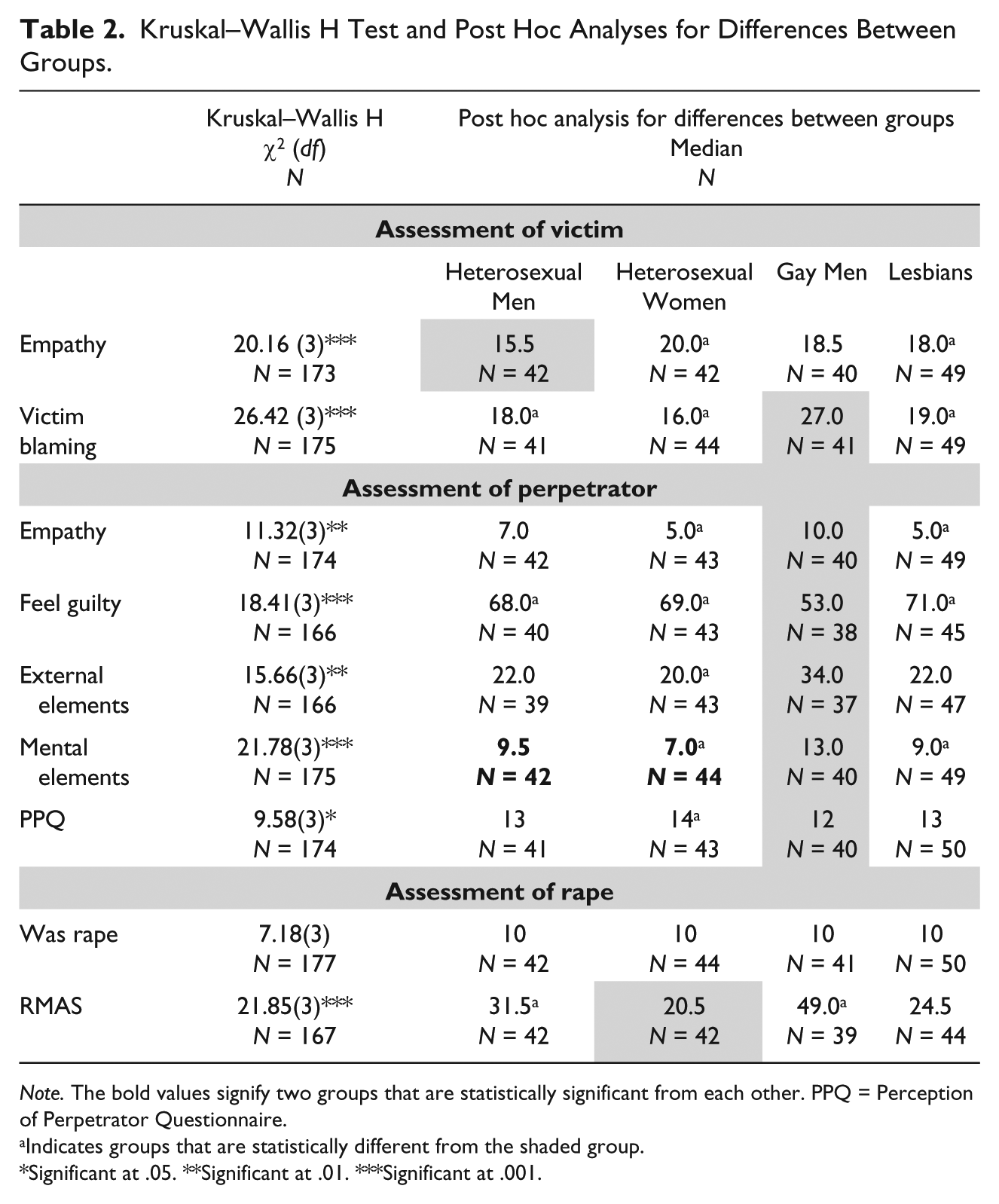
Note. The bold values signify two groups that are statistically significant from each other. PPQ = Perception of Perpetrator Questionnaire.
Indicates groups that are statistically different from the shaded group.
Significant at .05. **Significant at .01. ***Significant at .001.
Assessment of Victim
Exploration of the empathy and victim blaming variables, as summarized in Table 1, indicates that empathy is fairly high and victim blaming is fairly low across groups. Indeed, values on these variables are skewed toward high levels of empathy and low levels of victim blaming. Consistent with earlier research, we find that women have more empathy for the victim then men, while men blame the victim more than women (Bell et al., 1994; Davies et al., 2009; Grubb & Harrower, 2009; Mitchell et al., 1999; van der Bruggen & Grubb, 2014; White & Kurpius, 2002; Workman & Freeburg, 1999), with both of these differences being statistically significant. While we find no significant difference between heterosexuals and homosexuals in levels of empathy, we do see (contrary to Davies & Hudson, 2011; Davies & McCartney, 2003) that homosexuals blame Jessica significantly more than heterosexuals do.
To explore whether sexuality and sex interact, we utilize the Kruskal–Wallis H test to evaluate differences between the four participant groups on empathy and victim blaming (see Table 2 for values). For empathy, the test is significant. To find what differences between the groups drive this finding, we perform post hoc analyses using Dunn’s (1964) procedure with a Bonferroni correction for multiple comparisons. This analysis reveals statistically significant differences between heterosexual males and two groups: heterosexual women (p < .001) and lesbians (p = .011). Heterosexual males had lower levels of empathy than either heterosexual women or lesbians.
A Kruskal–Wallis H also finds significant differences between groups in terms of victim blaming. Post hoc analyses using Dunn’s (1964) procedure with a Bonferroni correction for multiple comparisons indicate that it is gay men who drive this finding, as they are significantly more likely to blame Jessica than heterosexual men (p = .001), lesbians (p = .004), and heterosexual women (p < .001).
Assessment of Perpetrator
There are three basic categories of dependent variables here: empathy, perpetrator blaming, and evaluation of the perpetrator’s level of violence. The descriptive statistics (see Table 1) indicate that participants, overall, have low empathy, blame John highly (e.g., think it is right that he feel guilty and do not excuse his behavior due to external or mental elements), and believe that he is more violent than men on average. As previous research suggests, we find that men are significantly more empathetic toward John than are women (e.g., Osland, Fitch, & Willis, 1996). Women blame John more than men do, as we can see with women’s significantly higher rates of thinking John should feel guilty and significantly lower rates of excusing John’s behavior for mental reasons. However, there are no significant gender differences in the view that external elements are to blame.
In terms of sexuality (see Table 1), there are no significant differences in empathy or how violent John is perceived to be in comparison to men in general. However, homosexuals are significantly less likely than heterosexuals to say John should feel guilty, and significantly more likely than heterosexuals to excuse John’s behavior due to external and mental elements.
The Kruskal–Wallis H tests (see Table 2) indicate significant differences between groups for all of the perpetrator variables. To determine what groups are driving each of these differences, we complete post hoc analyses using Dunn’s (1964) procedure with a Bonferroni correction for multiple comparisons. In terms of empathy, gay men are significantly more empathetic toward John than heterosexual women (p = .01) and lesbians (p = .046). In contrast, gay men are significantly less likely to believe John should feel guilty for his actions when compared with heterosexual women (p < .001), heterosexual males (p = .008), and lesbians (p = .021). Gay men are more likely to excuse John’s behavior due to external elements when compared with heterosexual women (p = .001). For mental elements, gay males are significantly more likely to excuse John’s behavior as something he could not control when compared with both heterosexual females (p < .001) and lesbians (p = .012). Further, heterosexual men were significantly more likely to blame his behavior on mental elements compared with heterosexual females (p = .046). Finally, heterosexual females characterized John as significantly more violent than other men when compared with gay males who scored lower on the PPQ (p = .023).
Assessment of Rape
Overall, the descriptive statistics (see Table 1) indicate that most people define John’s action as rape and that levels of RMA are generally low. Looking at Table 1, there appears to be no difference between any of the groups on defining John’s actions as rape. However, while they all have the same median, the underlying distributions between homosexuals and heterosexuals tested by the Mann–Whitney U shows a significant difference with homosexuals more likely to define John’s actions as rape. There are no gender differences with regard to the definition of his actions as rape. Consistent with previous research, men have higher levels of RMA than women’s levels (Carlson, 2013; Johnson et al., 1997). Contrary to previous research, homosexuals have higher levels of RMA than heterosexuals (Davies & McCartney, 2003).
The Kruskal–Wallis H tests (see Table 2) indicate no significant difference between groups for defining the act as rape, thus indicating that there may only be a difference in defining rape based on sexuality and not on the interaction between sexuality and sex. There is a significant difference for RMA, however. The post hoc analyses using Dunn’s (1964) procedure with a Bonferroni correction indicate that heterosexual females have significantly lower levels of RMA compared with heterosexual males (p = .023) as suggested by previous research (e.g. Carlson, 2013). Heterosexual females also had significantly lower levels of RMA when compared with gay males (p < .001).
Discussion and Conclusion
Despite the fact that criminology has played a role in labeling LGB people as deviants, sinners, criminals, or perverts, modern criminology is still permeated by heteronormative bias that prevents the field from addressing and correcting its past role in the stigmatization of LGB people (Ball, 2016; Panfil & Miller, 2015; Woods, 2015). Heteronormative bias can also serve to limit the value of research on non-LGB communities, as it creates a rigid framework that strictly divides people into LGB and non-LGB without acknowledging the diversity of sexuality and gender expression that can be found even within non-LGB communities. Failure to examine the effect of sexual identity also denies the agency of LGB people in the criminal justice system. Within vignette research on the attribution of blame in particular, LGB people are often confined to the passive role of victim (e.g., van der Bruggen & Grubb, 2014). Our research adds to a small but growing body of literature that examines sexual identity in terms of sexual assault.
This article is the first study to use a national sample that does not primarily rely on college students to examine how sexual identity and gender interact to impact empathy, attributions of blame, and RMA. In particular, we address how the observer’s sexuality (comparing heterosexual males, heterosexual females, gay males, and lesbians) affects their levels of empathy, blame attribution, and assessment of the depicted assault when the victim is portrayed as a heterosexual female in an acquaintance rape scenario. While, for all participants, the levels of empathy and blame for the perpetrator are high, and the levels of victim blaming, defining the act as rape, and RMA are low, some interesting patterns emerged in the differences between the groups.
We first analyzed the differences between men and women and found the same patterns as previous research. Men had higher levels of RMA (e.g., Carlson, 2013), and women had significantly more empathy (e.g., Osland et al., 1996). Victim and perpetrator blaming patterns were also as expected, with women blaming the perpetrator more and the victim less (e.g., van der Bruggen & Grubb, 2014). While this was unsurprising, we were surprised to find that our tests of differences between heterosexuals and homosexual showed significantly more blame for the victim, excuse of behavior for the perpetrator, and higher rates of RMA for homosexual respondents. We largely did not expect this to occur because of the higher rates of victimization experienced by sexual minorities (Walters et al., 2013). While the higher rates of victimization may explain why heterosexual women, lesbians, and gay men express more empathy for the victim than heterosexual males, something else is going on in terms of assignment of blame and RMA. Our analysis indicates that sex and sexual identity interact to produce important differences in terms of these other attributions.
Specifically, it appears that gay men are largely driving the differences. Unlike the research by Davies and McCartney (2003), gay men—when compared with the other groups—are significantly more likely to blame the victim, have significantly more empathy for the perpetrator, are significantly less likely to think the perpetrator should feel guilty for his actions, and are significantly more likely to blame external and mental elements. While these patterns would be unsurprising if it was the same for all men (heterosexual and homosexual) due to defensive attribution theory (Shaver, 1970), there are differences between gay men and heterosexual men as well. Gay men were significantly more likely to blame the victim, less likely to believe the perpetrator should feel guilty, more likely to blame mental elements (e.g., think he was unable to control himself) than even heterosexual males. This indicates that there is something about being a gay male that affects attributions beyond the experience of being male. Given our current data, it is difficult to pinpoint exactly what this difference is. However, we are hopeful that our ongoing research, which examines how empathy, attributions of blame, and RMA change based on the sex and sexuality of the presented victim, may shed light on the psychological processes at play.
Our results differ widely from the two studies by Davies and colleagues (Davies & Hudson, 2011; Davies & McCartney, 2003). One likely reason is the difference in the presented victim. Davies and McCartney asked about the rape of a gay man, while we ask about the rape of a heterosexual female. In Shaver’s (1970) defensive attribution theory, people shift blame away from the individual in the scenario with which they identify most. In this scenario, with a female victim and male perpetrator, perhaps gay males are identifying with the perpetrator at even higher rates than heterosexual males.
One possible reason this may occur is the research that indicates that some gay men have a strong preference for masculine and even hegemonic masculine traits (Clarkson, 2006; Sánchez & Vilain, 2012). Some research has indicated that gay men for whom masculinity is particularly salient are misogynistic or hold traditionally masculine views of women. Some of this evidence is indirect, as it focuses on at least some gay men’s preference for masculinity and dislike of femininity (e.g., Clarkson, 2006; Sánchez & Vilain, 2012). Shepperd, Coyle, and Hegarty (2010) challenge the idea that gay men support their heterosexual female friends, noting gay men’s use of misogynistic language, and Moon (1995) discusses how gay men’s use of the term fag hag similarly indicates misogyny. The younger gay male participants in Moon’s research view women as threats to their community, and a similar concern is raised by some of the gay men and lesbians who participated in Casey’s (2004) study of LGB individuals’ perceptions of the heterosexual women who entered LGB spaces (e.g., gay bars) in a British city. Additional researchers argue that the content of gay pornography similarly portrays masculinity positively and femininity negatively (e.g., Kendall & Funk, 2003; Morrison, 2004). Taken together, it is possible that this sample preferred masculinity, which may have lead them to over-identify with the perpetrator.
While future research should examine masculine identification to address this question, gay males’ significant lower endorsement of PPQ provides some support for this idea. In particular, gay men did not find the rapist to be more aggressive, more violent, or wanting to hurt the victim more than other men. One possible way to interpret this is that John’s actions are consistent with how masculinity is viewed by these gay men.
Another reason why we may have these findings is reflected in the evidence that gay men may be motivated to find themselves as dissimilar to women. Among the research that provides more direct evidence is Yueng, Stombler, and Wharton’s (2006) study of the gender practices of the members of a fraternity that explicitly recruits gay and bisexual men as well as supportive heterosexual men. They found that the members view men and women as fundamentally different and support the exclusion of all women from their organization since women are believed to have a substantially different understanding of the world. In addition, the members do not want lesbians to become involved as members of an auxiliary or “little-sisters” support organization for the fraternity because the members believe lesbians are more assertive and would try to take over the organization. In contrast, the members believe heterosexual women will essentially do as they are told. If gay men view femininity negatively and have more traditional expectations for how women should behave, they may be likely to support rape myths and blame women for their assaults.
The above research is speaking specifically to some subgroups of gay males and cannot be generalized widely because other research has found positive relationships between gay males and heterosexual females (e.g., Muraco, 2006; Russell, DelPriore, Butterfield, & Hill, 2013). Yet, conclusions by Shulze and Koon-Magnin (2017) on reasons that gay men endorse rape myths at significantly higher rates than queer identified individuals and at similar rates to heterosexuals further supports this rationale. In particular, they argue that queer individuals are less supportive of the gender binary than gay males (clearly reflecting the research of Yueng et al., 2006). They argue that gay males resemble heterosexuals (the researchers collapse heterosexual women and men together) in terms of their adherence to gender roles. This finding is consistent with previous research that has shown that gender role traditionalism and sexual conservatism are associated with higher RMA and victim blaming (Basow & Minieri, 2011; Burt, 1980; Grubb & Turner, 2012; Muehlenhard & Rodgers, 1998). To be clear, neither Shulze and Koon-Magnin (2017) or our research controlled for endorsement of gender traditionalism or sexual conservatism.
A further difference between our research and the two previous studies by Davies and colleagues is the type of sexual assault presented. The assault in the vignette in our study was an acquaintance rape while both of the vignettes in the Davies’ studies depicted a stranger rape. Because stranger rape is more in keeping with the script of a “real rape,” it is unsurprising that victim blaming would be lower as a result of their scenario as compared with ours. This is consistent with previous research comparing victim blaming across different rape scenarios (e.g., Grubb & Harrower, 2009). Beyond this, however, it is possible that gender and sexual identity also interact in terms of how individuals respond to different types of rape. This question has yet to be addressed in the literature.
Another difference between our research and Davies and Hudson (2011) is that we found significant differences between lesbians and gay males in terms of lesbians having significantly lower rate of victim blaming, less empathy toward the perpetrator, higher rates of believing the perpetrator should feel guilty, excusing the perpetrator for mental reasons less. At the same time, they had similar rates of empathy to the victim. At times, their results were more similar to heterosexual males (e.g., in terms of how they blamed the perpetrator) and others closer to heterosexual women (e.g., empathy and RMAS). This is important because it further implicates an interaction between sexuality identity and sex that needs to be explored further. One reason our results likely differ is again defensive attribution theory (Shaver, 1970). Lesbian females may identify more with a female victim of sexual assault than they would a male victim—even when that victim is heterosexual. To fully explore these suggestions, it would be important to compare these variables of interest across different sex and sexuality portrayed victims. We are planning research that would test this hypothesis.
To understand what needs to be done to challenge the rape culture that has such extreme personal and criminal justice costs, researchers need to come to a better understanding of what characteristics create systematic differences in attributions about rape. Speaking to a literature that has long recognized the importance of gender differences (e.g., Burt, 1980), we add to the recent research that points out that gender and sexual orientation interact in creating patterns of RMA, blaming, and empathy. As we discuss, the next stage of research should be dedicated to analyzing the underlying causes of these patterns and also extending the research to other sexualities (such as bisexual, pansexual, and asexual individuals) and also to studying how transgender identification may alter these patterns.
Footnotes
Acknowledgements
The authors would like to thank Melanie D. Hetzel-Riggin for her comments on an earlier draft of this article.
Authors’ Note
An earlier version of this article was presented at the American Society of Criminology. Research materials can be obtained by contacting the corresponding author.
Declaration of Conflicting Interests
The author(s) declared no potential conflicts of interest with respect to the research, authorship, and/or publication of this article.
Funding
The author(s) disclosed receipt of the following financial support for the research, authorship, and/or publication of this article: Funds from the W.O. Faber Center for Civic Leadership supported this research.