



Abstract
Bullying and school crime are important social problems that are receiving increased attention by scholars and policy makers. However, several critical questions remain unaddressed. First, does the public perceive bullying as a serious problem and judge schools—primary, secondary, and postsecondary—as safe or unsafe? Second, does the public use a “bullying lens” to judge school safety—that is, do citizens understand bullying as a serious threat to students’ well-being? Third, are there racial differences in these perceptions? Prior research identifies racial differences in the prevalence of bullying, as well as in students’ views of school safety and citizens’ fear of crime. Similar racial gaps may characterize public perceptions of bullying and school safety. This study begins to illuminate answers to these questions by analyzing data from a representative sample of Virginians. Multivariate regression analyses produce several notable findings. First, we find that members of the public believe bullying in schools is an increasingly serious problem, and their perceptions of bullying influence their judgments of whether schools and colleges/universities are safe. Second, Black members of the public are more likely than persons from other racial and ethnic backgrounds to perceive that bullying is increasing and is a serious problem in schools, and, in turn, to judge that schools and universities are less safe. Our results indicate that members of the public see bullying as a principal threat to student safety. They suggest there is a strong reservoir of public support for antibullying initiatives and, more broadly, efforts to increase student safety.
Bullying and school safety are among the most salient social issues facing educators and students in the contemporary United States (Hong & Espelage, 2012). Many, if not most, youth are involved at some point with bullying, either as perpetrators, victims, or both (Hymel & Swearer, 2015; Nansel et al., 2001). College students also suffer high rates of bullying (Chapell et al., 2004). Historically, public opinion has conceived of bullying as a normal, if regrettable, part of childhood and adolescence—that is, a mere aspect of “growing pains” (Pinker, 2011). 1 According to Pinker (2011), bullying was simply “written off . . . as one of the trials of childhood” (p. 441). Yet, prominent academic literature has stressed since the early 1990s that bullying involvement as either a victim or an offender yields many negative consequences for youth (Albdour & Krouse, 2014; Decamp & Newby, 2015; Solberg & Olweus, 2003). Following prominent incidents of violence at schools believed to trace to earlier instances of bullying victimization, many citizens and pundits have questioned what should be done to prevent violence and bullying on educational campuses (Jeong, Kwak, Moon, & San Miguel, 2013; Merrell, Gueldner, Ross, & Isava, 2008). There is, however, relatively little academic research on public opinion about bullying and school safety. Therefore, it remains unclear whether citizens perceive bullying and school safety to be salient social problems, or ones that have changed in importance over time.
Understanding public views about bullying is important not only because public opinion influences policy making (Burstein, 2003; Erikson, MacKuen, & Stimson, 2002) but also because citizens’ concerns about bullying may inform their broader perceptions of the safety (or lack thereof) of educational settings (primary, secondary, and postsecondary). Popular perceptions of the severity of bullying in schools may also have implications for citizens’ willingness to fund and participate in intervention programs both in and outside of educational settings. Scholars emphasize the importance of “whole-community approaches” to bullying reduction, which require engaging citizens broadly, not just parents and school administrators (Holt, Raczynski, Frey, Hymel, & Limber, 2013; Srabstein et al., 2008). As Espelage and Swearer (2003) put it, “It does take a village to reduce bullying” (p. 378). Community involvement, however, depends on public awareness of bullying as a serious social problem and citizens’ recognition that bullying both directly and indirectly affects the safety of students in educational settings.
While research exists on students’, school workers’ (staff, teachers), and parents’ perceptions of bullying (Holt, Kaufman Kantor, & Finkelhor, 2009; Vajares, Henrich, & Meyers, 2009; Waasdorp, Pas, O’Brennan, & Bradshaw, 2011), only a few public opinion polls gauge how the public perceives bullying or school safety (C.S. Mott Children’s Hospital, 2015; Jones, 2013). These polls provide descriptive evidence that the public is concerned about both issues. Importantly, however, there is a dearth of literature examining the correlates or effects of bullying perceptions. Theoretically, for example, there may be a racial gap in both bullying perceptions and judgments of school safety. Specifically, bullying appears to have a relatively high presence among the African American community (Albdour & Krouse, 2014; Wang, Iannotti, & Nansel, 2009). In addition, research indicates that compared with students from other racial/ethnic backgrounds, Black students report feeling less safe at school (Lacoe, 2015; Schreck & Miller, 2003; Thibodeaux, 2013). This is consistent with the related literature on fear of crime, with Blacks tending to be more fearful of victimization than Whites (Chiricos, Hogan, & Gertz, 1997; Eitle & Taylor, 2008; Weitzer & Kubrin, 2004). In addition, among members of the public, bullying perceptions may increasingly inform judgments about the safety of educational institutions. Presently, however, we lack evidence about these theoretical possibilities.
In the current study, we draw on data from a representative poll of residents of Virginia to analyze public opinion about bullying and school safety. The contribution of our analysis is threefold. First, we provide the first assessment of both the extent and correlates of bullying perceptions among members of the public, focusing specifically on racial differences in such perceptions. Second, we provide an initial test of what could be termed the “bullying lens” thesis—namely, that judgments about school safety are now made through, and in reference to, perceptions of bullying seriousness. Third, we provide the first examination of whether bullying perceptions can help to account for the effect of race on judgments of school safety.
Bullying: Definition, Prevalence, and Consequences
Although specific definitions of bullying vary across countries and researchers, most scholars agree that bullying involves both threatened and actual interpersonal aggression—that is, direct or indirect physical or psychological force (e.g., shoving, hitting, teasing, spreading rumors)—against a victim who is weaker or has less status than the perpetrator (Cornell & Limber, 2015; Hong & Espelage, 2012). The aggression is intentional, and its immediate goal is to “cause fear, discomfort, or injury” to the victim (Olweus, 1993, p. 9).
Bullying is very common in elementary, middle, and high schools (Nansel et al., 2001; Wang et al., 2009). National survey data find that around a third of students in Grades 6 to 10 report bullying experience—as either a perpetrator, victim, or both—in just the past month (Hong & Espelage, 2012). Bullying is also common in colleges and universities (Adams & Lawrence, 2011; Chapell et al., 2004; Chapell et al., 2006). Chapell and colleagues (2004), for example, analyzed data from a sample of 1,025 college undergraduates and found that 61% had witnessed bullying in college, 25% had been the victim of bullying by another college student, and over 18% reported perpetrating bullying against other college students.
There are numerous adverse consequences of bullying for both victims and perpetrators (Albdour & Krouse, 2014). Victims of bullying have higher rates of depressive symptoms, social disintegration, and negative self-perceptions (Solberg & Olweus, 2003), and display greater propensity toward gang involvement (Apel & Burrow, 2011), weapon carrying (Apel & Burrow, 2011), and delinquent actions (assault, lying, running away, drug use, vandalism, and theft; Decamp & Newby, 2015). Bullying perpetrators face increased odds of gang involvement, weapon carrying, substance abuse (Bradshaw, Waasdorp, Goldweber, & Johnson, 2013) aggression (Solberg & Olweus, 2003), and suicidal tendencies and attempts (Viljoen, O’Neill, & Sidhu, 2005). The negative effects of bullying involvement are long-lasting; for example, bullying in junior high and/or high school is associated with feelings of isolation and having fewer friends in college (Adams & Lawrence, 2011). Indeed, Lereya, Copeland, Costello, and Wolke (2015) found that childhood bullying victimization is associated with mental health problems, anxiety, depression, and self-harm and suicidality in adulthood.
Prominent academic literature has stressed since the early 1990s that bullying involvement as either a victim or an offender yields many negative consequences for youth (Albdour & Krouse, 2014; Decamp & Newby, 2015; Solberg & Olweus, 2003). Unfortunately, there is little evidence about public perceptions of the prevalence or consequences of bullying in schools. Scholars have argued that bullying has only recently emerged in the public’s view as a serious and increasingly serious social problem, having previously been seen as a normal childhood occurrence (Pinker, 2011). We test whether, today, the public does, in fact, have serious concerns about bullying in schools. Nor is it clear whether there is variation in such perceptions across different demographic groups within the general population. The research void is important, because it means that very little is currently known about the seriousness of bullying as a social problem from the perspective of members of the public, especially those in demographic groups where bullying is more prevalent and thus potentially exerts the greatest frequency of social and psychological harms. We discuss these issues in greater detail below.
Racial Gaps in Bullying Perceptions and Judgments of School Safety
Extant theoretical and empirical work suggests that race, specifically being Black, may shape perceptions of bullying and judgments about school safety. First, according to experts, bullying is a phenomenon that is racialized and is a particularly pressing problem among Blacks (Albdour & Krouse, 2014). Albdour and Krouse’s (2014) review of the research reveals evidence suggesting that Black youth are “a particularly vulnerable population with multiple risk factors that may increase susceptibility to bullying and victimization” (p. 70). Most notably, Black youth are disproportionately involved with bullying as offenders (Albdour & Krouse, 2014; Goldweber, Waasdorp, & Bradshaw, 2013; Schuster et al., 2012; Wang et al., 2009). For instance, Wang et al. (2009) found that 17% of Black youth reported physical bullying perpetration, whereas only 11% of White youth reported physical bullying perpetration.
One possible theoretical explanation for the imbalance of Black youth bullying is the environmental context in which their schools reside. Studies have found that a disproportionate amount of minorities reside in urban communities that experience a heightened amount of crime/violence, social isolation, family disruption, unemployment, and poverty (Anderson, 1999; Sampson & Raudenbush, 1999; Stewart & Simons, 2010). Schools that are nested within these urban communities tend to display more violence perpetration than schools not in urban communities (DeVoe et al., 2004; Hellman & Beaton, 1986; Snyder & Sickmund, 2006); oftentimes, this violence perpetration might be considered bullying and might be a reflection of the greater disadvantaged characteristics of the community (Brunson & Miller, 2009). Black communities are unique as these communities and schools are more likely to deal with bullying than other racial/ethnic groups. In fact, a study conducted by Hanish and Guerra (2000) found that Black youth were the only ethnic group of youth to experience an increase in peer victimization as ethnic homogeneity increased in the community and school. Again, it bears emphasizing that bullying involvement has detrimental effects on both perpetrators and victims (Albdour & Krouse, 2014). Therefore, higher rates of bullying perpetration among Black youth may increase Black citizens’ personal and vicarious experiences with, and awareness of, the broad social harms of bullying involvement (e.g., depression, suicide, school failure).
Second, prior research documents racial differences in students’ perceptions of school safety. Specifically, relative to other racial groups, Black youth report being more afraid both going to and from school (Alvarez & Bachman, 1997), and they also perceive their schools to be less safe (Lacoe, 2015; Schreck & Miller, 2003; Thibodeaux, 2013). For example, Thibodeaux (2013) found that when controlling for racial/ethnic makeup of student bodies, Black students reported feeling less safe at school compared with both White and Hispanic youth. In a particularly rigorous analysis, Lacoe (2015) found that Black youth reported feeling less safe at school even after controlling for neighborhood and community characteristics, and school climate. However, to our knowledge, researchers have yet to explore whether the Black public more broadly may perceive lower levels of school safety than members of other racial/ethnic groups. Better understanding of public judgments about school safety would provide important context for existing research on student perceptions as well as the public’s willingness to support antibullying legislation or publicly funded programming.
The heightened fear of victimization at school among Black youth dovetails with the broader literature on fear of crime, which generally finds that Blacks are, on average, more fearful of being victimized than Whites (Chiricos et al., 1997; Eitle & Taylor, 2008; Weitzer & Kubrin, 2004). Prior research also suggests that relative to Whites, Blacks (and non-Whites generally) tend to be more fearful of gang crime (Lane & Fox, 2012). Not least, the relationship between race and fear of crime is not limited to personal fear (Drakulich & Rose, 2013). Warr and Ellison (2000), for instance, found that race is a strong predictor of altruistic fear—that is, fear of one’s family members being victimized. The vulnerability hypothesis may explain this racial gap in fear (personal, altruistic, and gang). Theoretically, per the vulnerability hypothesis, the relationship between race and fear of crime likely reflects both Blacks’ greater vulnerability to victimization and their lower confidence in authorities to (a) protect them from victimization, (b) take their crime concerns seriously, or (c) respond effectively and in a racially unbiased way when they are victimized (Hale, 1996).
The vulnerability hypothesis would also seem to be highly relevant to understanding racial differences in bullying perceptions and judgments about school safety. Specifically, prior research documents that school authorities respond differently to Black and non-Black students, which is commonly referred to as the “racial discipline gap” (Gregory, Skiba, & Noguera, 2010). National data on race-based disproportionality in school discipline are clear. The U.S. Department of Education reported that Black students are suspended or expelled at 3 times the rate of White students and are also disproportionately more likely to be arrested at school or referred to law enforcement (U.S. Department of Education Office for Civil Rights, 2014). Skiba, Michael, Nardo, and Paterson (2002) concluded that there are indications of institutionalized racism in school discipline. Likewise, after reviewing the extant research, Gregory and colleagues (2010) observed that while there is strong evidence of differential treatment of students according to race, there is “a notable paucity of evidence that could support [the alternative] hypothesis that the racial discipline gap can be explained through differential rates of misbehavior” (p. 62).
Previous studies also suggest that discipline regimes in schools may serve to protect Whites’ racial interests and be motivated, at least in part, by perceptions of minority group threat (Payne & Welch, 2010; Welch & Payne, 2012). Welch and Payne (2010) directly tested the relationship between racial threat and school discipline, and demonstrated that schools with larger proportions of Black students are more likely to use harsher disciplinary policies (such as zero tolerance), controlling for socioeconomic characteristics, percent male students, school officials’ leadership, staff discipline training, student delinquency and drug use, urbanicity, concentrated disadvantage, and perceived safety.
In short, then, racialized discipline practices and regimes may lower Blacks’ confidence in school authorities to support and protect Black students. In turn, in conjunction with Blacks’ increased vulnerability to crime victimization generally, lower levels of confidence in school authorities may amplify concerns about bullying and reduce perceived school safety among both Black students and the Black public more broadly. Building on the above scholarship, we test the following two hypotheses:
The “Bullying Lens” Thesis
Theoretically, there are strong reasons to believe that bullying perceptions increasingly inform public opinion about school safety, such that judgments about safety are made through assessments of the seriousness of the bullying problem (Pinker, 2011). First, bullying itself is a prominent form of victimization at school and often involves physical violence. Nansel et al. (2001), for example, analyzed data from over 15,000 students in Grades 6 through 10 and found that (a) around 41% of students reported being bullied in the current term; (b) over half of these bullying victims had been hit, slapped, or pushed by a bully at least once; and (c) 15% reported experiencing frequent physical assaults. Other research likewise suggests that nearly a third of middle and high school students report being victims of bullying in the form of physical aggression, which often leads to injuries (Hymel & Swearer, 2015; Vaillancourt et al., 2010). In this sense, the public may recognize, and would be correct to do so, that bullying itself is a direct threat to student safety in schools (Hong & Espelage, 2012).
Second, the public may believe that bullying threatens school safety indirectly through its risk of causing subsequent school violence. Indeed, a poll conducted in 2001 by Gallup found that 62% of Americans believed that bullying played an extremely or very important role in causing school shootings (Moore, 2001). This perception may, in part, stem from the intensive media coverage of school violence (Kupchik & Bracy, 2009; Lawrence & Mueller, 2003). News stories about school shootings, for example, suggest that they trace, in part, to prior bullying victimization (Gerard, Whitfield, Porter, & Browne, 2016; Leary, Kowalski, Smith, & Phillips, 2003). To illustrate, press coverage of the shooting at Columbine High School suggested it was motivated, in part, by the perpetrators’ prior bullying victimization (Cornell & Limber, 2015). Likewise, news stories covering the 2007 mass shooting at the Virginia Polytechnic Institute and State University emphasized that the shooter, college student Seung-Hui Cho, had been the victim of bullying (“High School Classmates Say Gunman Was Bullied,” 2007).
Just as important, a connection in the public mind between bullying and subsequent school violence would be consistent with empirical evidence on the consequences of bullying. A large literature documents that bullying victimization is one of the few correlates of becoming a school shooter (Gerard et al., 2016; Leary et al., 2003; Wike & Fraser, 2009). Indeed, an investigation by the Secret Service revealed “one commonality among shooters: 71% had been targets of a bully” (Espelage & Swearer, 2003, p.367). Therefore, we test the following hypothesis:
As discussed above, prior theoretical and empirical scholarship on fear of crime and students’ perceptions of school safety suggests that we should anticipate racial differences in perceptions of bullying seriousness. If such differences exist, and bullying perceptions, in turn, inform judgments about school safety, we would expect race to have an indirect effect on judgments about school safety through bullying perceptions. Stated differently, bullying perceptions may help to explain the racial gap in judgments about students’ safety at school. Accordingly, the final hypothesis that we test is as follows:
Data and Method
We test our hypotheses using data from the Commonwealth Education Poll 2014-2015, a statewide telephone poll of adult (18 and older) Virginia residents. To ensure that citizens from cell-phone-only households were included in the sample, a dual sampling frame was employed that consisted of both landline and cell phone numbers. Half of interviews were conducted by landline, and half were conducted by cell phone. Trained interviewers conducted all of the interviews. The interviewers asked to speak with the “youngest male, 18 or older, who is now at home.” If no eligible male was present, interviewers asked to speak with “the youngest female, 18 or older, who is now at home.” This selection method yields higher completion rates than the Kish method and is better for obtaining representativeness on sex than the more common “last birthday” method (Keeter & Fisher, 1997; Yan, 2009).
The data are weighted to adjust for unequal probabilities of selection due to multiple adults living in households with more than one landline, and to ensure that the demographic characteristics of the sample reflect those of the adult population in Virginia. For the demographics, weights adjusted for sex, age, education, race, Hispanic origin, and county region (within Virginia), using the U.S. Census Bureau’s American Community Survey. However, substantively similar findings emerge in unweighted analyses (available upon request). After decades of declining response rates, telephone surveys now commonly obtain response rates under 10% (Pew Research Center, 2012). In our survey, the response rate for the landline subsample was 13.4%, and response rate for the cell phone subsample was 8.6%. This does not necessarily indicate bias. A recent report on survey research to the National Science Foundation concludes that “nonresponse bias is rarely notably related to [the] nonresponse rate” (Krosnick, Presser, Fealing, & Ruggles, 2015, p. 6). After listwise deletion for item nonresponse, the analytic sample is 672.
Dependent Variables
The first outcome variable is a measure of respondents’ judgments about the level of safety in local primary and secondary schools. The question asked, “In general, do you feel the public schools in your community are . . . very safe, safe, not too safe, or not at all safe?” We used the responses to generate an ordinal variable, Schools Unsafe, with the following categories: 1 = very safe, 2 = safe, 3 = not too safe, and 4 = not at all safe. The second dependent variable gauges respondents’ judgments about the level of safety in Virginia’s postsecondary educational institutions. The variable is measured with the question: “Based on what you know, how safe are college and university campuses in Virginia . . . very safe, safe, not too safe, or not at all safe?” We used the responses to generate an ordinal variable, Colleges Unsafe, coded as follows: 1 = very safe, 2 = safe, 3 = not too safe, and 4 = not at all safe. The weighted and unweighted descriptive statistics for all variables are shown in Table 1.
Descriptive Statistics (N = 672).

Mediating Variable
In the analysis, the mediating variable is respondents’ perceptions of the severity of bullying in schools. The questionnaire included two items measuring such perceptions. The first question measured perceptions about whether bullying in schools has become more severe over time. It asked, “Thinking back to when you were younger, do you think bullying in schools today is more of a problem than it was in the past, less of a problem, or is it about the same?” We recoded the responses such that 1 = less of a problem, 2 = about the same, and 3 = more of a problem. The second question measured perceptions of the seriousness of the bullying problem in schools today. It asked, “Based on what you know, how serious of a problem is bullying and harassment in schools . . . very serious, somewhat serious, not too serious, or not at all serious?” We reversed the responses to this question so that 1 = not at all serious, 2 = not too serious, 3 = somewhat serious, and 4 = very serious. Next, we standardized both of the above variables (perceived change and perceived seriousness, r = .448), and then averaged the responses to generate a standardized mean index, Bullying Problem, on which higher scores indicate a greater perceived severity of bullying in schools.
Independent and Control Variables
Our key independent variable is respondents’ race (0 = Other, 1 = Black). Importantly, the analysis also controls for respondents’ sex (0 = male, 1 = female), age in years (collapsed at 85 and older), Education (1 = high school degree or less, 5 = postgraduate work or degree), Income (1 = less than US$20,000, 7 = US$150,000 or more), political ideology (0 = liberal or moderate, 1 = conservative), party identification (0 = Democrat or Independent, 1 = Republican), parental status (0 = other, 1= parent [parent with a child under age 18]), personal or vicarious employment in the public schools system (0 = no, 1 = school employment), and urbanicity (0 = urban, 1 = suburban, and 2 = rural). Missing data on the Income variable were imputed using linear regression imputation (Stata “impute” command) based on respondents’ scores on the other measures in the data set.
Analytic Strategy
Our analysis unfolds in several stages. First, we explore the extent of public perceptions of the severity of bullying in schools. Next, we examine the effect of respondent race on perceptions of bullying severity, net of the controls. Because the Bullying Problem index is a continuous variable, we use ordinary least squares (OLS) regression to estimate this model. Next, we examine the direct and indirect effects of race on perceptions of school and college safety. Here, the two outcome variables (Schools Unsafe and Colleges Unsafe) are 4-point ordinal variables, and thus, we use ordered logistic regression to estimate the models. Testing for mediation in nonlinear probability models requires taking into account the fact that rescaling of coefficients due to differences across models in residual variances can result in changes in coefficients (Breen, Karlson, & Holm, 2013).We formally test for indirect effects using the KHB method developed by Kohler, Karlson, and Holm (2011) for analyzing mediation in nonlinear probability models. This method regresses the mediating (or Z) variable(s) on the independent variable (X) and uses the residuals in the reduced model to estimate the total effect of X (Karlson, Holm, & Breen, 2012). The unresidualized Z variable(s) is then used in the full model. The indirect effect of X is the difference in the coefficient for X in the reduced and full model.
Findings
As noted above, scant evidence exists about whether the public believes that bullying in schools is on the decline or rise, or is a serious problem. Therefore, before proceeding to the multivariate results, we first examine the distribution of responses to the two individual survey questions about school bullying. Recall that these questions were used to construct the Bullying Problem index. First, we find that most members of the public (55%) believe that bullying in schools is more of a problem today than in years past, whereas only a very small minority (7%) believes bullying has become less of a problem. Similarly, 50% of the public believes bullying in schools is a very serious problem and an additional 39% believe it is somewhat serious. Only a small minority of respondents (11%) believe bullying in schools is not too, or not at all, serious. In short, our survey data document that most of the public is very concerned about bullying and perceives it to be an increasingly serious social problem.
Attention now turns to examining whether there are racial differences in perceptions of the severity of bullying in schools. Table 2 presents the results of an OLS model predicting perceptions of the severity of the Bullying Problem with respondents’ race and the controls. An examination of the findings reveals that race exerts a sizable and highly significant positive effect on bullying perceptions (b = .277, p < .01). Black respondents are more likely than those from other races to report a high perceived severity of bullying in schools. 2 Two of the control variables also contribute significantly to the explanation of bullying perceptions. Specifically, as compared with men and younger individuals, respectively, women (b = .382, p < .001) and older persons (b = .008, p < .001) tend to perceive school bullying to be a more severe social problem.
OLS Regression Predicting Public Perceptions of the Severity of Bullying in Schools as a Social Problem.

Note. OLS = ordinary least squares; DV = dependent variable; b = unstandardized coefficient; RSE = robust standard error; Beta = standardized coefficient.
p < .05. **p < .01. ***p < .001 (two-tailed).
Next, we explore the roles of respondent race and bullying perceptions in explaining public judgments of the safety of local schools (primary and secondary). Table 3 presents the results of two ordered logistic regression models in which Schools Unsafe is the outcome variable. Model 1 includes only respondents’ race and the controls, whereas Model 2 also incorporates bullying perceptions (Bullying Problem). The findings for Model 1 show that race is positively and significantly associated with concerns about the safety of local schools (b = .599, p = .038). Specifically, net of the controls, the odds of Black respondents perceiving that their local schools are unsafe are 82% higher than those for non-Blacks. By contrast, this model shows that persons with higher incomes, those with prior employment in a public school, and those living in suburban locations are significantly less likely to believe their local schools are unsafe.
Ordinal Logistic Regressions Predicting Public Perceptions of School Safety.
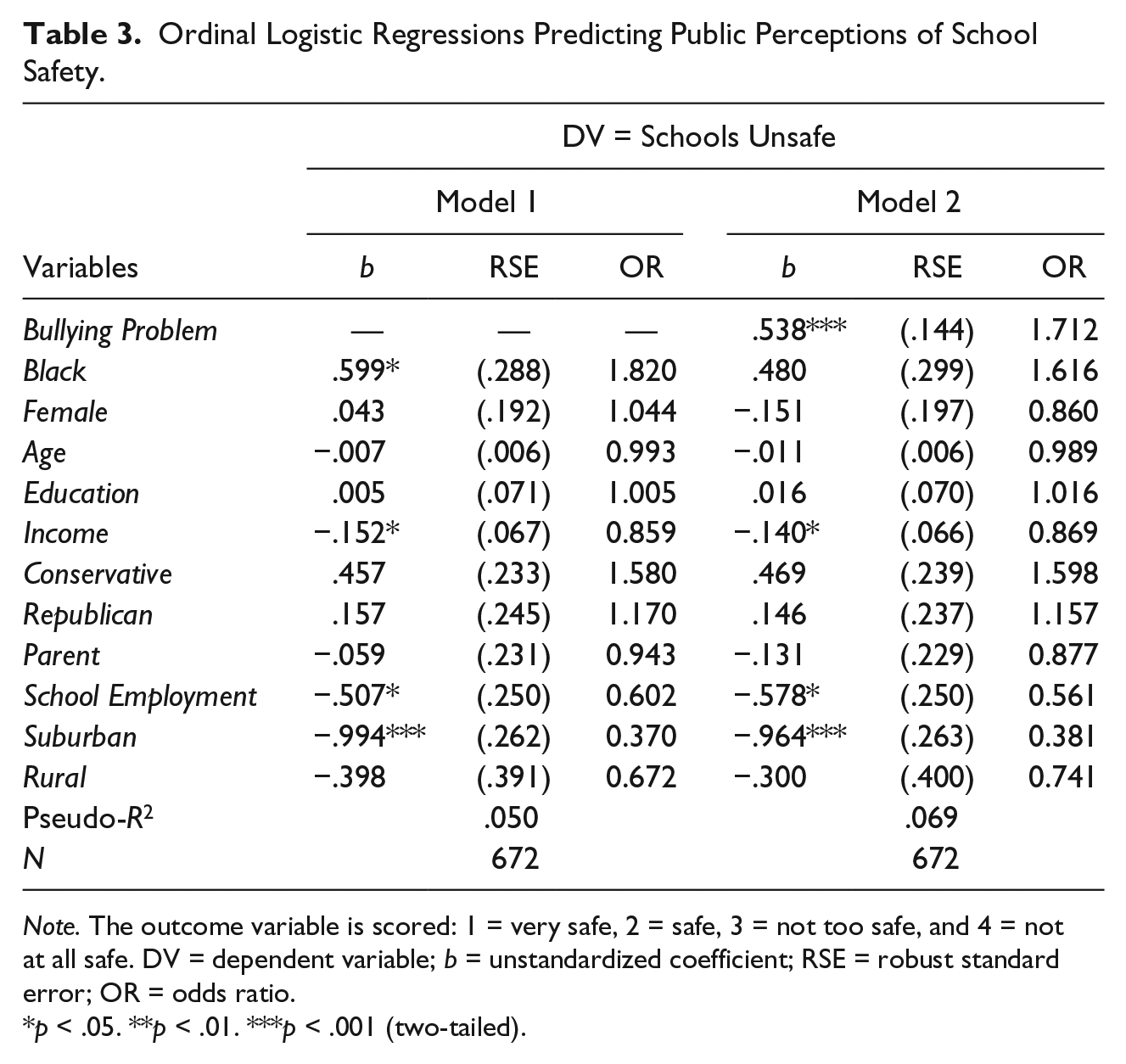
Note. The outcome variable is scored: 1 = very safe, 2 = safe, 3 = not too safe, and 4 = not at all safe. DV = dependent variable; b = unstandardized coefficient; RSE = robust standard error; OR = odds ratio.
p < .05. **p < .01. ***p < .001 (two-tailed).
Model 2 includes the Bullying Problem variable. As hypothesized, there is a sizable relationship between bullying perceptions and overall judgments of schools safety. Respondents who perceive bullying to be a more serious problem in schools are significantly more likely to judge that their local schools are unsafe (b = .538, p < .001). The standardized logistic regression coefficients (not shown) reveal that bullying perceptions are the second strongest predictor in the model (β = .227), behind suburban residence (β = –.232). In addition, after including the Bullying Problem variable, the coefficient for respondents’ race is reduced in magnitude and is no longer significant, indicating that race does not have a significant direct effect on judgments of school safety. A formal test for mediation using the KHB method reveals that respondents’ race has a significant indirect effect (b = .149, p = .024) on their probability of judging schools as unsafe via their beliefs about bullying. Stated differently, Black members of the public tend to judge their local schools to be less safe, in part, because they perceive a greater severity of bullying.
The final portion of the analysis examines judgments of the level of safety on college and university campuses. Model 1 in Table 4 presents the results of an ordered logistic regression of College Unsafe on respondents’ race and the controls. As was the case with perceptions of local schools, Black respondents are significantly more likely to judge colleges and universities to be unsafe, relative to non-Black respondents (b = .734, p = .015). Indeed, the odds of believing that colleges are unsafe are over 100% higher for Black compared with non-Black respondents. The results for Model 1 also show that females (b = .722, p < .001) and older persons (b = .013, p = .021) tend to judge colleges as less safe, whereas persons with higher incomes tend to judge colleges as more safe (b = –.169, p = .013). It is notable that sex exerts a strong influence on beliefs about college safety, but not on beliefs about local public schools (Table 3). This may reflect a greater salience of concerns about sexual offenses on college campuses.
Ordinal Logistic Regressions Predicting Public Perceptions of College Safety.

Note. The outcome variable is scored: 1 = very safe, 2 = safe, 3 = not too safe, and 4 = not at all safe. DV = dependent variable; b = unstandardized coefficient; RSE = robust standard error; OR = odds ratio.
p < .05. **p < .01. ***p < .001 (two-tailed).
Model 2 in Table 4 incorporates the Bullying Problem variable. Similar to judgments about the safety of local schools, bullying perceptions exert a large and significant influence on judgments about college safety (b = .434, p = .003). A one-unit increase on the Bullying Problem variable is associated with a 54% increase in the odds of judging colleges to be unsafe. Indeed, the standardized coefficients (not shown) reveal that bullying perceptions are, in fact, the strongest predictor in the model (β = .183), followed by income (β = –.154) and sex (β = .142). Although respondents’ race remains a significant predictor of judgments of college safety after including the Bullying Problem variable (b = .652, p = .036), the magnitude of the coefficient is reduced, relative to Model 1. A formal test for mediation using the KHB method reveals that respondents’ race has a significant indirect effect (b = .120, p = .040) on their probability of judging colleges as unsafe via their beliefs about bullying. In other words, as with judgments of local public schools, Blacks are more likely to believe that colleges and universities are unsafe, in part, because they tend to perceive a greater severity of school bullying. In the case of colleges and universities, however, race also has a statistically significant direct effect on judgments about students’ safety.
Conclusion
A facet of studies stemming from the bullying literature has examined how students, parents, and school staff perceive bullying, and how these groups judge youths’ safety at school. Yet, few public opinion polls have looked at how the general public perceives both bullying and school safety. We are aware of no published academic research that has examined such views, much less the relationships between them, or how race affects these perceptions. This is important because the public has the power to influence policy making (Burstein, 2003; Erikson et al., 2002). For example, a growing body of research demonstrates that changes in public opinion played a large role in causing mass incarceration (Enns, 2016). Public attitudes also affect the criminal justice system in other ways (Baumer & Martin, 2013; Brace & Boyea, 2008). Popular perceptions that the severity of bullying in schools is increasing may influence the extent to which citizens support and are willing to participate in community intervention programs. Community involvement beyond parents and teachers will likely be necessary for the success of bullying prevention efforts (Espelage & Swearer, 2003). One basic policy recommendation would be to use advertising campaigns to broadcast that there is a high public consensus that bullying behavior is morally unacceptable and a serious social problem. Prior research has shown that potential offenders are sensitive to such normative information (Thaler & Sunstein, 2009).
To our knowledge, our study is the first to analyze how the public perceives both bullying and school safety, whether the former informs the latter, and whether bullying perceptions mediate the effect of race/ethnicity on judgments of students’ safety in both schools (primary and secondary) and colleges/universities. Evidence from our results suggests that the public believes bullying in schools is an increasingly serious problem, and that their perceptions of bullying influence their judgments of whether schools and colleges/universities are safe. That is, school safety appears today to be judged by the public, in part, through what could be termed a “bullying lens.” The public apparently recognizes that bullying is a principle threat to students’ well-being, and thus that its prevalence has necessary implications for school safety. Theoretically, the public may realize that bullying has direct and indirect effects on school safety. Bullying often involves physical violence and, even when it does not, can lead to self-harm (e.g., suicide), or retributive violence against bullies and other students by bullying victims. Future research should explore whether perceptions of the consequences of bullying (e.g., school attacks) mediate the relationship between bullying perceptions and judgments of school safety.
A consistent finding in the literature on students’ judgments about school safety is that Black youth are more fearful of being victimized (a) going to and from school (Alvarez & Bachman, 1997), (b) at school generally (Lacoe, 2015; Thibodeaux, 2013), and (c) for specific forms of victimization at school (Schreck & Miller, 2003). Our findings for public views are consistent with the literature on youth perceptions. Black members of the public were more likely than persons from other racial and ethnic backgrounds to perceive that bullying is increasing and is a serious problem in schools, and to judge that schools are less safe. Furthermore, our analysis extended attention beyond primary and secondary schools. We found that Blacks, relative to other racial and ethnic groups, tended to judge college and university campuses to be less safe. To our knowledge, our findings provide the first evidence regarding public judgments about the overall safety of postsecondary educational institutions.
The extant literature on bullying victimization among youth suggests that Black students are more likely than students from other racial/ethnic backgrounds to underreport bullying victimization (Sawyer, Bradshaw, & O’Brennan, 2008). However, our findings indicate that compared with others, Black members of the public are more likely to perceive that bullying is a serious social problem for schools. The disparity between our findings and those showing underreporting by youth may reflect the effects of racial disadvantage on Black youths’ adoption of cultural values supporting interpersonal aggression, such as the code of the street (see Stewart & Simons, 2006). Prior research demonstrates, for example, that Black youths are significantly more likely than youths of other races to hold attitudes accepting of street code–related violence (Taylor, Esbensen, Brick, & Freng, 2010). Therefore, it may be that Black youth are more likely to perceive interpersonal aggression by other students not as bullying, but as a normal part of adolescent life that requires aggressive retaliation. The broader Black public, however, may be aware of the relatively high rates of interpersonal aggression in disadvantaged areas, but their understanding of bullying may be informed by different cultural values. Additional studies are thus needed that examine this possibility by exploring the influence of code of the street values on definitions of bullying and youths’ perceptions of their experiences as the targets of interpersonal aggression.
Given the absence of relevant prior work on public opinion about bullying, there remain several other promising directions for researchers seeking to build on our analysis. First, future research should work to identify the factors explaining the racial gap in perceptions of bullying and judgments of school and college safety. Recall that race continued to have a statistically significant direct effect on judgments about students’ safety in colleges, but not in local public schools. Several competing explanations, including personal or vicarious experiences with bullying or bullying victimization, might explain the racial gap in bullying perceptions. In addition, racial differences in confidence in school authorities to protect students, effectively respond to bullying incidents, and exercise their authority in a racially unbiased manner may also help to explain the racial gaps in bullying perceptions and overall judgments of school and college safety. Another possibility is that the Black citizens may have greater exposure than their counterparts from other racial and ethnic groups to campuses that are, on average, less safe (e.g., highly urban campuses or historically Black colleges and universities that may have less resources to spend on campus safety).
As important, future research should examine public support for specific policies and practices aimed at reducing bullying and enhancing school safety. Our findings suggest there is likely a strong reservoir of support for antibullying initiatives among members of the public. Given their high level of concern about bullying and belief that it affects school safety, many members of the public may be willing to contribute (financially and otherwise) to such efforts. Willingness-to-pay studies examining the public’s willingness to pay higher taxes for antibullying programs would thus be helpful. In addition, analyses are needed that explore the public’s perceptions about whether it is primarily the responsibility of parents, school officials, or the community at large to prevent bullying and school violence. Researchers should also explore public perceptions of the prevalence and severity of different types of bullying (e.g., physical vs. verbal vs. online) and their relationships to school safety. It is possible that public perceptions of specific types of bullying may have differential effects on judgments about students’ safety in primary and secondary versus postsecondary educational institutions. For example, perceptions of cyberbullying may be most consequential for perceptions of college safety, as this form of bullying victimization and bullying perpetration appears to be most prevalent at later ages (Schneider, O’Donnell, Stueve, Coulter, 2012).
More generally, our findings indicate that the factors influencing judgments about students’ safety in schools (primary and secondary) and colleges/universities are not identical. Indeed, other than race, bullying perceptions, and income, none of the other variables in our analysis had a statistically significant effect on judgments about both school and college safety. For example, we found that women were far more likely than men to judge colleges and universities as unsafe, but there were no sex differences in judgments about the safety of local public schools. Our preliminary speculation is that this difference reflects the potentially greater salience of sexual victimization risk on college campuses. Clearly, then, additional theory and research is warranted that attempts to illuminate the unique sources of fear and anxiety about victimization in these different types of educational institutions.
A central question that emerges from our analysis is where do members of the public obtain their information about bullying and school safety? Cultivation theory suggests that media coverage is a principal factor influencing public perceptions about crime and justice (Chiricos et al., 1997; Roche, Pickett, & Gertz, 2016). Previous studies find that media coverage depicts school crime as bad and getting worse (Kupchik & Bracy, 2009). A priority for future research should thus be to examine whether media exposure generally and exposure to news stories about school crime specifically influence public perceptions of bullying and, in turn, judgments about school safety.
Our study is not without limitations. First, our sample is limited to residents of Virginia, and the state’s particular constellation of public primary and secondary schools as well as colleges and universities may influence Virginians’ perceptions of school safety in unique ways. Future research is thus needed that tests the generalizability of the findings to residents of other states and to the country as a whole. Second, because of the limited number of respondents from other minority groups, we were unable to separately examine the attitudes of Hispanics, Asians, and other groups. 3 Additional studies are thus needed that draw on larger sample sizes to examine these groups. Third, we were unable to control for perceptions of school disorder (e.g., litter, graffiti). It is possible that perceptions of bullying and school safety are both influenced by perceptions of disorder. However, the omission of perceived disorder should not bias the associations between race and perceptions of bullying or school safety, because race temporally precedes perceived disorder. Despite these limitations, we believe our findings extend the existing literature in important ways, most notably by providing the first evidence about the relationships between race, bullying perceptions, and public judgments of school safety.
Bullying remains a serious social problem, one to which school and legal authorities are devoting greater attention. For example, StopBullying.gov is an interagency collaboration among the U.S. Department of Justice, U.S. Department of Education, and the U.S. Department of Health and Human Services to provide information about bullying causes, responses, and prevention efforts to the general public. Similarly, there is a strong trend toward greater security measures and punitive discipline in schools (Kupchik, 2010). Gauging public opinion about the problems of bullying and school crime, and the appropriateness of different potential solutions to these problems, is of critical importance. Members of the public hold great influence over policy making, as well as over the success of implemented social policies and practices. More generally, the adoption of policies that are inconsistent with public views may undermine the legitimacy of authorities in school and legal settings (Nadler, 2005; Robinson, 2008).
Footnotes
Declaration of Conflicting Interests
The author(s) declared no potential conflicts of interest with respect to the research, authorship, and/or publication of this article.
Funding
The author(s) received no financial support for the research, authorship, and/or publication of this article.