




Abstract
Prior research with a sample of male probationers indicates severity levels of one arresting intimate partner violence (IPV) offense are predictive of future frequency of such offenses and treatment completion. This study is an extended analysis looking at severity ratings across two IPV offenses to measure violence stability. The stability of IPV severity levels was analyzed in a sample of offenders in Lake County, Illinois. Offender subtypes of generally violent (GV) men and family only (FO) violent men were incorporated into stability analyses using generalized linear mixed modeling (GLMM) to determine whether certain types of offenders vary in violence levels over time. The purpose was to determine the predictive utility of using a single offense to determine the domestic violence trajectory for male probationers. Reoffense records of 80 men were collected from a larger sample of 352 males, ages 17 to 72 placed on probation in Lake County, Illinois, between 2006 and 2008. Severity of offenses was coded dichotomously based on a behaviorally derived measure. Results demonstrate 64% of reoffenders remained stable in IPV severity. Overall, severity levels decreased across time. This is the first study to use a probationary sample of men to analyze violence stability trends over time. This study confirms the utility of measuring a single offense to predict future violence trajectories for IPV offenders.
Introduction
Longitudinal studies of general male aggression as a whole suggest a considerable degree of stability (Olweus, 1979). Over the past 50 years, criminology and aggression literatures have established the continuity of antisocial and aggressive behaviors within individuals across time (Juon, Doherty, & Ensminger, 2006). Studies suggest this persistence exists not only for males, as high degrees of stability for female aggression have been documented (Huesmann, Dubow, & Boxer, 2009; Kokko & Pulkkinen, 2005; Kokko, Pulkkinen, Huesmann, Dubow, & Boxer, 2009). Furthermore, it is not only those who exhibit high levels of aggression who remain stable; on the contrary, individuals with initially low levels of aggression remain stably low across time (Huesmann et al., 2009). Longitudinal studies have measured aggression from childhood through middle adulthood, and suggest aggressive behaviors in school-age children are significantly linked to physical aggression and lack of self-control of anger in adulthood, with adolescent aggression mediating this relationship (Kokko et al., 2009). Given high stability levels exhibited in general aggression and antisocial behavior within individuals, one might expect to find associated stability specific to intimate partner violence (IPV) behavior.
In contrast to general aggressive behavior, IPV appears to be less stable over time. A multitude of IPV literature has focused upon violence trajectories and accompanying risk factors, although very little has focused on within-person change in violence. Early work suggested male-perpetrated IPV tends to increase in severity and frequency over time (Walker, 1984). However, longitudinal studies examining partner aggression demonstrate significant desistance, with some studies reporting stability in shorter time periods. For instance, although male-perpetrated IPV in a prior relationship has been found to be associated with IPV in a subsequent relationship, 70% of those who initially perpetrate desist in subsequent relationships, suggesting high variability in violent experiences across relationships (Whitaker, Le, & Niolon, 2010). In a national probability sample of couples, reported rates of violence decreased over time, even for husbands who frequently applied severe forms of violence on their spouses (Feld & Straus, 1989). Stability assessed as the presence of any IPV events over the course of 12 years in young men as a function of relationship continuity indicates men’s physical aggression against their partner tends to decrease over time, although there is more stability in the same relationship as opposed to different relationships (Shortt et al., 2012).
It is possible desistance and persistence of partner violence may be a function of the severity and frequency of violence used. Feld and Straus (1989) found men with the highest frequency of assaults in the first year of marriage were most likely to commit a severe assault 1 year later; however, minor assaults committed by either spouse also increased the likelihood that the male partner would commit a severe assault 1 year later. Conditional probabilities as a measure of stability were used by O’Leary and colleagues (1989) to measure aggression stability and indicated couples labeled as stably aggressive or stably nonaggressive had the most predictable future aggression projections, while couples without any presence of stability were less predictable in terms of future violence (O’Leary et al., 1989). Another community sample analyzed the violence of 45 couples in a 2-year follow-up study, all of whom were considered severely violent based on Conflict Tactics Scale (CTS; Jacobson, Gottman, Gortner, Berns, & Shortt, 1996; M. A. Straus, 1979) criteria. While substantial decreases in the frequency of violence were exhibited over a 2-year period, 46% of the couples did not reduce violence (Jacobson et al., 1996). Those who continued to aggress were considered more domineering, globally negative, and emotionally abusive toward their wives (Jacobson et al., 1996). Other factors have been found to affect stability. Men who persist in using violence against their partners differ in specific ways from those who do not, including reports of greater marital conflict and lower socioeconomic status (Aldarondo & Sugarman, 1996). Furthermore, relationship continuity was important in predicting violence stability: IPV stability was higher for men who remained with the same partners over time versus those who changed partners (Shortt et al., 2012). It appears there may be certain traits associated with a persistence in IPV, though more research is needed.
Despite significant desistance in IPV, there is considerable recidivism. Of those who recidivate, severity of violence does not fully predict future reoffense, as minor assaults have been conceptualized as “opening the door” to more severe levels of violence in the future (Feld & Straus, 1989). Furthermore, research is needed to determine whether there are any conclusive, defining factors predictive of violence stability. Evaluating not only the occurrence but also the changes in the severity level of violence and how it relates to different types of offenders over longer follow-up periods needs to be analyzed to truly understand the patterns of IPV over time.
Domestic violence research has identified typologies of male offenders in efforts to increase the effectiveness of interventions and predict future behavior (Langhinrichsen-Rohling, Huss, & Ramsey, 2000). Holtzworth-Munroe, Meehan, Herron, Rehman and Stuart (2003) utilized previously established, reliable subtypes of generally violent (GV) and family only (FO) violent men and related these subtypes to violence stability. Parallel to other violence stability research cited above, IPV incidents decreased over time (2003). The FO group had the lowest level of violence across time and were most likely to desist over a 3-year period, whereas GV men were unlikely to end their use of relationship aggression (2003). These findings are corroborated by a criminal history assessment of domestically violent men, in which the greatest predictor of reoffense was prior criminal history (Dutton, Bodnarchuk, Kropp, Hart, & Ogloff, 1997). Although research indicates certain factors may predict reoffense, the severity of these reoffenses has yet to be assessed. It is possible GV men continue to offend more frequently than FO men, but the offenses themselves may decrease in severity over time. Some previous studies have included violations of restraining orders as successive incidents of IPV, not necessarily indicating use of actual violence per se (Mele, 2009). Therefore, assessing the stability of IPV severity, incorporating reliable offender subtypes, will be of primary interest in this study.
The domestic violence literature does acknowledge the importance of measuring initial severity of IPV with respect to recidivism. For example, risk violence measures such as the Domestic Violence Risk Appraisal Guide (DVRAG) have been developed in efforts to improve upon previous measures which only looked at dichotomous outcomes (i.e., violence recidivism vs. no recidivism) to better predict the severity of recidivism in correctional contexts (DVRAG; Hilton, Harris, Rice, Houghton, & Eke, 2008). The DVRAG in particular supports previous predictions that offenders with antisocial/psychopathic traits are the most serious offenders (Huss & Langhinrichsen-Rohling, 2000). Perpetrator subtypes have deemed GV men as characterized by psychopathic traits (Boyle, O’Leary, Rosenbaum, & Hassett-Walker, 2008). GV men have been considered at higher risk to reoffend as well as reoffend at a faster rate than FO men (Cantos, Goldstein, Brenner, O’Leary, & Verborg, 2015; Goldstein, Cantos, Brenner, Verborg, & Kosson, 2016). Given the antisocial deviance component of psychopathy and its association with severe violence, one might predict GV men to recidivate at more severe levels across time than FO men.
Operationalization of violence severity has varied across studies. Some studies base measurements of violence severity on the perpetrator or victim account (Goldstein et al., 2016; Hilton, Harris, & Rice, 2007; Lorber & O’Leary, 2012). Acts of aggression in these studies were coded according to cutoffs in frequently used measures of domestic violence, such as the CTS (M. A. Straus, 1979) and the Ontario Domestic Assault Risk Assessment (ODARA; Hilton et al., 2004). Others have looked at the level of injury caused to the victim, with increasingly severe injuries representing more severe forms of violence (Quinsey, Rice, & Harris, 2006). Other indirect measures have also been incorporated into analyses of severity of violence predicting future risk, such as use of a weapon (Hilton et al., 2007). One of the most common instruments for measuring violence is the Revised Conflict Tactics Scale (CTS2; M. A. Straus & Douglas, 2004; M. A. Straus, Hamby, Boney-McCoy, & Sugarman, 1996). Given its widespread utilization and sound psychometric properties, the CTS2 violence criteria were used for the purpose of this study (M. A. Straus et al., 1996).
At present, there are no known studies assessing the stability of IPV severity using multiple arresting events over time in a sample of male probationers. Using a behavior-derived classification of perpetrator types, this study aimed to expand upon an earlier study and examine whether severity of violence ratings for two arresting IPV events remains stable for offenders (Goldstein et al., 2016). We wanted to determine whether the severity levels for domestic violence offenders with two offenses remain stable over time. Furthermore, we wanted to examine whether typology and time until the next offense were related to the severity of subsequent offenses to better predict stability patterns of offenders. For our first hypothesis, we predicted a significant association between the severity of violence for the initial IPV offense and the severity of violence for the second offense. It was also predicted that IPV will be more stable for certain types of perpetrators; specifically, we predicted typology would moderate the stability of severity of domestic violence offenses. Last, we hypothesized men whose violence was rated as severe on both occasions would reoffend at a faster rate than those whose violence severity was not rated as stable.
Method
Participants
The sample encompassed 457 men, ages 17 to 72 (M = 34, SD = 10.47) sentenced to probation in Lake County any time between 2006 and 2008 after committing a domestic violence offense (Goldstein et al., 2016). From this initial sample, 352 men had victim accounts of the initial arresting event available, in the form of police reports, and the reports were coded for severity of violence. The ethnic composition of the sample was as follows: 42.9% Caucasian, 35.8% African American, 20.2% Latino, and 1.2% with Other ethnic backgrounds. Furthermore, recidivism information was collected for the current study in collaboration with the research staff at Lake County Adult Probation Services. Staff at Lake County conducted a search incorporating all files of the men in the original sample through their electronic filing system. Those who had at least one subsequent domestic violence event following the initial recorded IPV event with an available police report were collected for inclusion in the current study. Follow-up length of time was any time from the initial domestic violence offense occurring between 2006 and 2008 through October of 2015. Of the 352 men, 96 had a second arresting IPV event with an available police report to code for severity of violence. Upon further investigation of these 96 cases, 16 were removed for a number of reasons, including denial by the victim of any physical violence and a lack of evidence of any physical IPV event (i.e., resisting law enforcement, phone harassment). The final sample, a subsample of the originally collected data, included 80 reoffenses with available police reports.
It should be noted this subsample comprises about 25% of the original sample. Given that 75% of the original sample did not recidivate, it is important to understand whether group who did not recidivate is distinct from those who reoffended. The study conducted with this original sample performed such comparison analyses (Goldstein et al., 2016). The conclusion from this study determined those who recidivate are in fact different from those who do not recidivate. Specifically, the relationship between violence severity and recidivism was significant such that higher levels of severity predicted risk of IPV recidivism. Furthermore, perpetrator type moderated the relationship between violence severity and IPV recidivism; specifically, severity of violence was predictive of recidivism for GV men but not FO men. The results from this study confirm those who recidivate in this sample are in fact different from those who do not in terms of violence severity.
Measures
Typology
Men were already classified by raters from the initial study as either FO violent or GV using a reliable and valid classification system based upon their prior history of violence (see Cantos et al., 2015). This categorization process included a thorough examination of the records of the 456 men placed on probation in Lake County, Illinois. All men had been mandated to treatment following an arrest for IPV within a 3-year period (2006, 2007, and 2008). A behavior measure was developed to categorize men as FO or GV (Cantos et al., 2015). Information was gathered through Lake County Probation Services. Men who engaged in at least one assault or violent offense not domestic in nature were classified as GV. Acts of this sort include armed robberies, simple battery, aggravated assault, armed robbery, and disorderly conduct (Cantos et al., 2015). Any aggravated assault or assault with a deadly weapon unrelated to the reported domestic violence offense was also coded as GV (Cantos et al., 2015). Evidence of aggression or conduct disorder in childhood (multiple fights, gang affiliation, arrests) in addition to prior violent offenses was designated as GV. Resisting arrest, traffic offenses, and isolated assault offenses did not qualify as GV. Men were categorized as FO violent if there was no other history of violent behavior present in their record. Data obtained from each offender’s file included the Level of Service Inventory–Revised (LSI-R), Pre-Intake Probation Form, and police record.
Graduate-level psychology students were trained in the operationalization of both GV and FO. Cases were coded in groups of 30 men continuously until adequate interrater reliability was established (kappa coefficients of above 80%). In addition, for every 100 cases in the sample, 20 cases were coded by both raters to assess for any interobserver drift. The original kappa coefficients for each 100 cases were as follows: first set, 0.79; second set, 0.90; third set, 0.61; fourth set, 1.0.
LSI-R
The LSI-R is a semistructured interview used to determine a person’s level of risk for reoffense. The interview contains 54 items with 10 separate domains (Criminal History, Education/Employment, Financial, Family/Marital, Accommodation, Leisure/Recreation, Companions, Alcohol/Drug problems, Emotional/Personal, and Attitude/Orientation). In a large normative sample of inmates in the United States, high levels of internal consistency have been observed (Andrews & Bonta, 2003). Although the LSI-R was not used explicitly in this study, the measure was used in the previous study in making the original typology categorizations.
Probation prescreen intake
The Intake provided information to record each probationer’s ethnic status, education level, and the Law Enforcement Agencies Data System’s (LEADS) criminal history data form. The LEADS provided the access to each probationer’s official arrest records at both the state and the national levels. This information was made available by Lake County Probation Services. The Intake includes the probationer’s self-reported account of the initial arresting incident.
Severity of violence
The violence severity coding procedure used by Goldstein and colleagues (2016) was utilized to code additional IPV arresting events examined in the current study. Files of all perpetrators were reviewed to identify additional domestic violence offenses following the initial incident previously coded for violence severity. All files with a second domestic violence offense in their record including an available police report were acquired. Victim accounts of the arresting offense were used for primary analyses, as the literature indicates perpetrators’ accounts may be less reliable because of minimization of the severity of assaults (Heckert & Gondolf, 2000). Violence severity was coded as a dichotomous variable (minor = 0, severe = 1). Specific acts of minor and severe violence were taken from items on the physical assault scale of the CTS2, one of the most common instruments used to measure IPV (CTS2; M. A. Straus & Douglas, 2004; M. A. Straus et al., 1996). Acts of severe violence included punching their partner, hitting their partner repeatedly, choking their partner, and use of a gun or knife. Minor acts included pushing their partner, grabbing their partner, or slapped or “hit” partner once. The highest reported severity level was coded if the event included multiple physical acts with differing severity levels. In addition, only dichotomous ratings from the initial offenses were utilized for this study. To establish interrater reliability of the severity of violence measure, two students applied the criteria to 20 hypothetical cases. The kappa coefficient for the victim’s account was 0.90, demonstrating high levels of agreement in violence ratings.
Stability of violence
Stability of violence was rated as an ordinal variable (0 = unstable, 1 = stably low, 2 = stably high). Offenders with two severe offenses will be rated as “stably high,” whereas those with two mild offenses will be rated as “stably low.” Those with one mild and one severe offense were considered unstable.
Time
Time to reoffense was analyzed by incorporating the amount of time between Offense 1 and Offense 2. The number of months between offenses will serve as the time variable.
Procedure
Records reviewed from a prior study conducted at the Division of Adult Probation Services of the 19th Judicial District of Illinois were obtained. Information derived from the records included individual terms of probation, demographic information, arrest records, treatment records, and probation revocation status. In collaboration with research staff at the Division of Lake County Adult Probation, records of a second domestic violence offense were gathered through the Lake County Database for the original sample of male offenders. Those who had accompanying police reports of these events available were coded for violence severity to assess stability of violence across two domestic violence offenses.
McNemar’s test was utilized to assess the relationship between the severity of the initial recorded offense and the severity of the second offense committed. McNemar’s test is used with matched-pairs data, thus being the appropriate statistic for this sample (Kim, 2013). Multilevel binary logistic regression was used to examine the effect of time on stability and whether the effect of time depends on offender subtype. The interaction of the predictors, time, severity of initial offense, and typology, was analyzed to assess whether typology moderates the impact of time on the severity levels of the second offense. A Cox proportional hazards model was used to examine the predictive utility of violence stability on the hazard rate for perpetrators in the sample. The analysis was conducted for the time between the initial offense to reoffense to determine whether subtype was associated with time to reoffense.
Results
Overview of Analyses
Principal analyses were conducted using McNemar’s test, binary logistic regression, and Cox regression. All analyses were performed using IBM SPSS Statistics 23. The dependent variables of interest were the severity levels of the second offense collected and stability levels across Offense 1 and Offense 2. The hazard rate in this study assessed the risk of recidivating at any time up to present given the stability levels of each perpetrator. Severity of violence, both as an independent and dependent variable, was defined based on the rated victim’s account in the police report, using a dichotomous measure.
Preliminary Analyses
Preliminary analyses were conducted to assess for the proportion of offender subtypes in various groups. Frequencies were run to determine the percentages of GV and FO violent men in each stability group. The percentages of each are shown in Figure 1.

Percentages of offender subtype by stability.
The percentages of GV (n = 15) and FO violent (n = 14) offenders in the unstable group are similar. For the stable low group (n = 10), we see a higher percentage of FO violent men (n = 6); however, in the stable high group (n = 41), there is a higher percentage of GV men (n = 27). The mean number of months between the first offense and the second offense was M = 15.44 (SD = 12.98), indicating, on average, men reoffended a little over 1 year after their first offense.
Primary Analyses
All primary analyses were conducted utilizing ratings of the victims’ accounts of violence severity, as documented in police reports. Analyses were conducted utilizing the dichotomous severity ratings from the original study (Goldstein et al., 2016) for Offense 1 and the dichotomous ratings in the current study for Offense 2.
Analysis of domestic violence stability
Eighty offenders had two domestic violence offenses available for analysis. An exact McNemar’s test determined that there was a statistically significant difference in the proportion of mild and severe offenders from the first offense to the second offense, p = .003, Cramer’s V = 0.10 (two-sided). Of those in the sample who committed an initial severe assault, 36.00% decreased in violence severity and committed a mild offense when they recidivated. Most offenders remained stable across both offenses. Fifty-one of the perpetrators (63.75%) were rated as stable in their offenses, either committing two mild offenses or two severe offenses. The stably high offenders constituted 51.25% of the sample, and the remaining 12.50% of the sample were stably low offenders. The cell numbers for severity levels at Offense 1 and Offense 2 are shown in Table 1.
Frequency of IPV Severity for Offenses 1 and 2.

Note. IPV = Intimate Partner Violence.
Analysis of predictors of violence severity for Offense 2
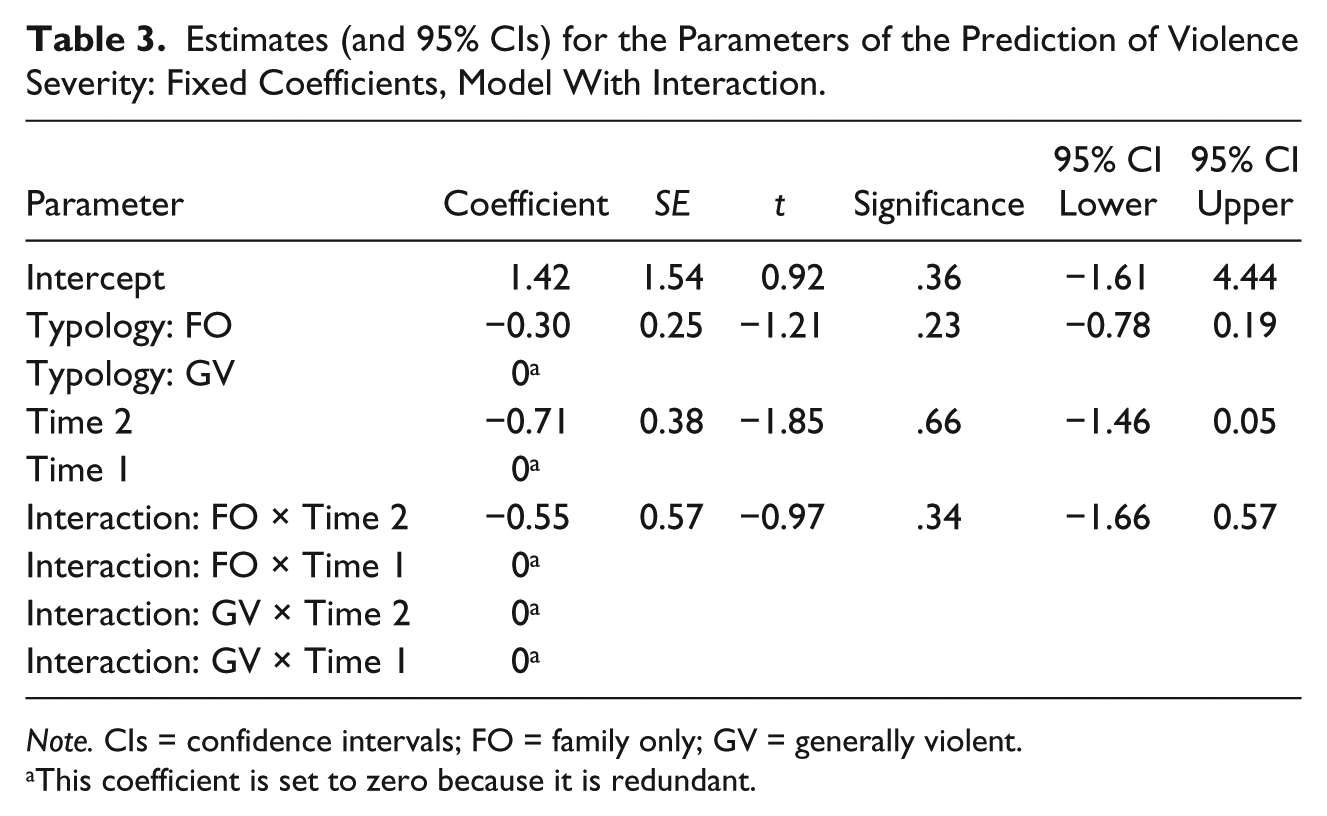
Binomial logistic regression was utilized to determine whether severity levels of Offense 2 could be predicted from typology (GV or FO), time, and the interaction of these two variables. In SPSS, the generalized linear mixed modeling (GLMM) procedure was used because the analysis involved repeated measures (offenses) nested within individuals (perpetrators). First, the data were restructured from wide to long format. The severity of violence variable was dummy coded as 0 = mild, 1 = severe. Typology was also dummy coded using 0 = FO and 1 = GV. The GLMM procedure was run both with and without the interaction term to determine the significance of main effects. Target values as well as the factors typology and time were sorted in descending order, with the reference category for severity being mild severity. The influence of these independent variables (and intercept) is displayed both with and without the interaction term in Tables 2 and 3.
Estimates (and 95% CIs) for the Parameters of the Prediction of Violence Severity: Fixed Coefficients, Basic Model.

Note. CIs = confidence intervals; FO = family only; GV = generally violent.
This coefficient is set to zero because it is redundant.
p < .05.
Estimates (and 95% CIs) for the Parameters of the Prediction of Violence Severity: Fixed Coefficients, Model With Interaction.
Note. CIs = confidence intervals; FO = family only; GV = generally violent.
This coefficient is set to zero because it is redundant.
In the basic model, the main effect of time was statistically significant (β = −0.95, SE = 0.282, p < .05), such that severity levels decreased over time (see Figure 2). However, when the interaction was added into the model time was no longer significant (β = −0.71, SE = 0.382, p = .066). Both models are displayed in Tables 2 and 3 for comparison. No main effect was observed for typology, and there was no typology by time interaction observed in the model. Thus, we were unable to conclude whether there are significant differences between those with severe reoffenses and those with mild reoffenses with respect to type of offender and time.
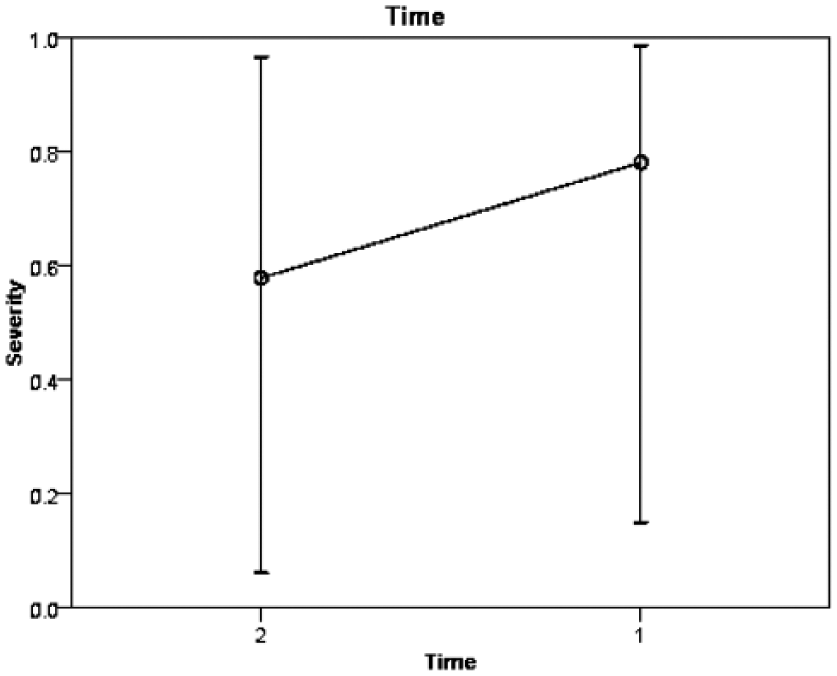
Main effect of time on severity levels.
Analysis of time to reoffense
We ran a Cox regression model to assess the predictive utility of stability level, typology, and the interaction of these two variables related to time to reoffense. Within the model, stability was not a significant predictor for the time to reoffense, and neither was typology nor the interaction of these variables. Therefore, we did not find evidence to support our third hypothesis.
Discussion
This study represents an initial investigation of the stability of violence severity for IPV offenses for individuals sentenced to probation. In addition to examining the construct of stability of violence across two offenses, the study analyzed potential predictors of violence severity at a second offense and the time to reoffending based upon stability status of the offender. This is the first study to our knowledge to examine stability of violence in this manner. The literature on men sentenced to probation has only measured stability as a function of the frequency of additional offenses, given the severity levels of the first offense only. Measuring the severity levels of subsequent IPV offenses serves an important methodological purpose. An earlier study conducted by Goldstein and colleagues (2016) found severity levels of one domestic violence offense were predictive of future reoffense rates and treatment completion. Specifically, severity of violence was predictive of recidivism for GV men (Goldstein et al., 2016). This investigation serves to determine whether predicting characteristics of reoffenders based on the severity of only one domestic violence offense is a reliable technique.
There is some preliminary evidence to support our first hypothesis. The McNemar’s test indicated that there was a significant proportion of unstable offenders, meaning the men changed in IPV severity levels from Offense 1 to Offense 2. However, what is most interesting is the majority of the sample remained stable across the two offenses. In fact, approximately 64% of the sample remained stably aggressive, and 51.25% of the sample was stably severe. Most of the stably severe group was comprised of GV offenders (65.90%). Given prior research has demonstrated GV men tend to persist in IPV and have lower treatment completion rates, this finding complements previous findings and highlights the severity of subsequent offenses (Cantos et al., 2015; Holtzworth-Munroe et al., 2003). This provides preliminary support that using just one IPV offense in terms of violence severity to predict other characteristics of offenders may be reliable. However, our findings are merely introductory with respect to analyzing IPV stability. Observing stability trends appears most useful for GV offenders, who tend to remain stably severe across time. Given that a greater amount of GV men reoffend compared with FO men, it is important to determine their reoffense patterns and violence trajectories to best predict the severity of future offense. Furthermore, research with additional larger samples would need to be done to confirm the stability trends observed in our study, especially given there was a significant portion of unstable offenders in our sample. It is important to understand which type of offender continues to be the most aggressive across time, as this information can be valuable in prevention of future violence, treatment, and legal settings (Lorber & O’Leary, 2012).
Our results with respect to our subsequent analyses did not reveal significant findings. We did have a significant main effect of time in our basic model analyzing predictors of future severity, such that severity decreased across time. However, this significant main effect was diminished when adding the interaction of time and typology with respect to severity levels of reoffenses. Due to the nonsignificant results of the interaction, simple effects were not examined. Our diminishing main effect indicates results may have been different had our sample been larger, given that only 25% of our original sample reoffended and even less of those had an available police report coding violence severity. According to the literature, which supports using a sample of at least 84, we were underpowered. Given preliminary observations, we recommend expanding upon these results to determine whether time and typology do play a significant role in predicting future offense severity, and ultimately stability patterns of IPV. However, these results appear consistent with the observed trend of desistence reported in the literature, given the observed reduction in violence severity at the second offense. Future research to further examine the interaction effects with a larger sample is recommended.
With respect to diversity, the results of the study must be understood in the context of the sample characteristics. This study aimed to examine male perpetrators, ages 17 to 72, only; however, previous research has highlighted the bidirectional nature of IPV and high prevalence rates of female aggression in many instances (Vivian & Langhinrichsen-Rohling, 1994; Whitaker, Haileyesus, Swahn, & Saltzman, 2007). Thus, analyses of only male perpetrators provide a limited understanding of the full range of IPV stability, particularly with respect to gender. Future research directed at understanding the offender types and stability of female IPV is warranted.
Several limitations must be considered when interpreting the findings from this study. Something not considered in this study was the impact relationship status had on reoffense. The participants likely varied in relationship status throughout the duration of the study. While some men may have been involved in long-term romantic relationships throughout the course of the study, others may have separated from their partners. We did not have full access to this information. It is possible given the relationship status of the participant, certain individuals may have had more opportunity to reoffend against an intimate partner by virtue of simply having a partner. Higher stability levels of IPV have been found for community samples of men who stay with the same partners over the course of a 12-year period as compared with those whose romantic partners change (Shortt et al., 2012). Future studies might consider incorporating relationship status and continuity or discontinuity of partner relationships for male perpetrators of IPV.
Another limitation is the limited availability of police reports for any IPV reoffense. It is likely the number of reoffenses included in our sample is an underestimate of the true level of IPV persistence. The use of official arrest records tends to downplay the incidence of IPV when compared with using partner reports as a result of failure to report some incidents (Gondolf, 1997). In addition, though the LEADS database is supposed to contain a person’s full arrest record, at times out of state arrests are missing. Future studies should incorporate the use of partner reports to have greater power when analyzing the stability of severity levels of IPV.
Footnotes
Declaration of Conflicting Interests
The author(s) declared no potential conflicts of interest with respect to the research, authorship, and/or publication of this article.
Funding
The author(s) received no financial support for the research, authorship, and/or publication of this article.