




Abstract
Several studies found that psychopathy is an important predictor of criminal behavior in general and of intimate partner violence in particular. However, these conclusions are often based on scales with less well-established validity, and some inconsistent results have emerged with regard to the contribution of specific psychopathic facets to intimate partner violence. In a sample of 152 batterers from Portugal aged between 22 and 70 years old, we examined whether Psychopathy Checklist–Revised (PCL-R) total scores and the four facets (scored based on a semistructured interview and on file information) predicted the frequency of intimate partner violence. Two separate linear regression analyses were conducted controlling for criminal variables. PCL-R total scores positively predicted intimate partner violence frequency, above and beyond the criminal variables. As for the four facets, only the PCL-R affective facet held a significant effect in predicting intimate partner violence frequency after controlling for criminal variables. These results support the inclusion of psychopathy in risk assessments and treatment of perpetrators of intimate partner violence, particularly with regard to the affective deficits of the construct.
Introduction
Psychopathy is a combination of specific personality traits defined by interpersonal (e.g., grandiose, arrogant, and manipulative interpersonal style), affective (e.g., lacking in empathy, guilt, and remorse), and behavioral characteristics (e.g., irresponsible and impulsive lifestyle, and violation of social and moral conventions; Hare, 2003; Neumann, Hare, & Newman, 2007). This view of psychopathy is entrenched in the most prominent assessment instrument in the field—the Psychopathy Checklist–Revised (PCL-R; Hare, 1991, 2003)—which combines a semistructured interview with file information. Factor analytic research (Hare, 1991) established that this measure captures two distinct factors of the syndrome: Factor 1, or interpersonal–affective factor, marked by the interpersonal–affective features; and Factor 2, or lifestyle–antisocial factor, marked by impulsivity, irresponsibility, and behavioral indicators of antisocial deviance. In a more recent formulation, Hare (2003) proposed that a two-factor four-facet hierarchical model is needed to describe the structure of psychopathy; the four facets represent the interpersonal, affective, lifestyle, and antisocial features of the disorder. Several studies state that psychopathy has an important role in the understanding of violence (Porter & Woodworth, 2007) and that PCL-R facets predict violent and general recidivism (e.g., Kennealy, Skeem, Walters, & Camp, 2010; Z. Walsh & Kosson, 2008). Acknowledging this role of psychopathy, the current study focuses on the link between psychopathy and violent criminal behavior, contributing to and extending previous work by focusing, in particular, on intimate partner violence (IPV) perpetration. IPV refers to acts of physical violence (e.g., slapping, hitting, kicking, and beating), psychological abuse (e.g., insults, belittling, constant humiliation, intimidation), sexual violence (e.g., forced sexual intercourse and other forms of sexual coercion), and/or controlling behaviors (e.g., isolating a person from family and friends; monitoring their movements) occurring in an intimate relationship (Krug, Dahlberg, Mercy, Ziwi, & Lozana, 2002).
Psychopathy is an important predictor of criminal behavior in general, and particularly of criminal violence (e.g., Hare, 2003; Skeem & Cooke, 2010; T. Walsh & Walsh, 2006). Studies revealed that incarcerated individuals with higher PCL-R scores commit more violent criminal offenses (Serin, 1991), and are more likely to recidivate violently (Hemphill, Templeman, Wong, & Hare, 1998). Comparative studies also suggest that psychopaths exhibit higher rates of aggressive behaviors in prisons and other forensic settings (e.g., Edens, Buffington, & Tomicic, 2000). Psychopathy has also been linked to failure in conditional release, violent recidivism, and poor treatment outcomes (e.g., Hare, 2003; Hemphill, Hare, & Wong, 1998). Moreover, the psychopathy construct is increasingly being applied as a predictor of dangerousness (DeMatteo & Edens, 2006; T. Walsh & Walsh, 2006) and violence (e.g., Leistico, Salekin, DeCoster, & Rogers, 2008). Some evidence suggests that total psychopathy scores (e.g., Marshall & Holtzworth-Munroe, 2010) and both psychopathy factors (i.e., bifactorial model) significantly correlate with future violence in men (e.g., Grann & Wedin, 2002; Hemphill, Hare, & Wong, 1998). However, other studies stated that each psychopathy factor seems to display a distinct association with violent behavior (Hare, 2003; Vitacco, Neumann, & Jackson, 2005). Nonetheless, evidence is contradicting as some researchers found that Factor 1 (i.e., the interpersonal–affective factor) has a higher predictive power of violence and violent recidivism (e.g., Hart, Hare, & Forth, 1994; Z. Walsh & Kosson, 2008) whereas others found that Factor 2 (i.e., lifestyle–antisocial factor) is more associated with violent recidivism than Factor 1 (e.g., Kennealy et al., 2010). These inconsistent results may be linked to the nature of the violent behavior, not assessed in the aforementioned studies, as the interpersonal/affective factor seems more important for instrumental violence and antisocial factor for reactive violence (e.g., Blais, Solodukhin, & Forth, 2014; Flight & Forth, 2007).
Research has suggested similarities between core features of psychopathy and specific male batterers subgroups, namely the generally violent/antisocial subtype (Huss & Langhinrichsen-Rohling, 2000; Spidel et al., 2007; Swogger, Walsh, & Kosson, 2007). These batterers tend to engage in violence outside their intimate relationship, present substance abuse and psychopathy, and have higher rates of criminal records and previous convictions (e.g., Huss & Langhinrichsen-Rohling, 2000; White & Gondolf, 2000). Huss and Langhinrichsen-Rohling (2000) highlighted several overlapping characteristics between psychopaths and generally violent batterers: they share a pattern of generalized violence, and both are likely to have higher levels of alcohol and drug dependency. Psychopaths and generally violent batterers are also similar in their interpersonal and affective features, such as manipulation, remorselessness, and callousness (Spidel et al., 2007). Moreover, both psychopaths and violent batterers tend to use instrumental violence, that is, violence planned and directed for personal gain (Spidel et al., 2007). Finally, psychopaths (e.g., Hare, 2003; Hemphill, Hare, & Wong, 1998) and generally violent IPV perpetrators (e.g., Holtzworth-Munroe & Stuart, 1994) are described as particularly dangerous and resistant to treatment.
Research also indicates that men with psychopathic and antisocial traits commit a disproportional amount of IPV (e.g., Boyle, O’Leary, Rosenbaum, & Hassett-Walker, 2008; Swogger et al., 2007), and prevalence data estimate that psychopathy among batterers ranges from 15% to 30% (e.g., Huss & Langhinrichsen-Rohling, 2000). Psychopathy has also been found to be related with IPV. For instance, Hervé, Vincent, Kropp, and Hare (2001), using PCL-R in a sample of 376 Canadian male prisoners, found that 21.9% of all psychopaths had previously committed IPV, being 1.6 times more likely to commit IPV compared with other nonpsychopathic prisoners. Similarly, Grann and Wedin (2002), in a retrospective follow-up study, found that higher scores on PCL-R positively predicted recidivism among individuals convicted for spousal assault. However, these studies scored the PCL-R (or PCL-R modified versions such as the PCL: Screening Version [PCL: SV]; Hart, Cox, & Hare, 1995) solely from file information when assessing batterers. There are some limitations to only file-based evaluations. First, it may be difficult to score the interpersonal–affective items without direct observation of the individual. Second, file-only scores frequently result in lower PCL-R scores than those obtained from file plus interview (Hare, 2003). And third, often institutional records are unavailable, incomplete, or omit certain information that may affect the reliability of PCL-R scoring (Hare, 2003).
Notwithstanding the increasing evidence linking psychopathy to IPV perpetration, few studies have examined the PCL-R factors separately. Swogger et al. (2007), using a sample of antisocial batterers in jail and other incarcerated offenders, concluded that although IPV was unrelated to PCL-R total scores, it was associated with relatively higher scores on the affective facet and relatively lower scores on the lifestyle facet. The intimate nature of IPV suggests that antisocial batterers may be characterized by greater callousness and poorer empathy than other antisocial offenders who direct violence only toward individuals outside their home. Both callousness and lack of empathy are prominent features of the affective dimension of psychopathy, commonly labeled deficient affective experience. Clinical observations (e.g., Dutton, 2003) and prior empirical investigations (e.g., Holtzworth-Munroe, Meehan, Herron, Rehman, & Stuart, 2000; Umberson, Anderson, Williams, & Chen, 2003) have identified emotional deficits in batterers, including lack of empathy, lack of remorse, and deficient emotional expression. Impulsivity is also a prominent feature of the lifestyle facet of psychopathy, and antisocial batterers have been characterized by high levels of impulsivity relative to other batterer groups (Holtzworth-Munroe, Meehan, Herron, Rehman, & Stuart, 2003; Holtzworth-Munroe & Stuart, 1994). Mager, Bresin, and Verona (2014), using the PCL: SV, analyzed the relationship between psychopathy and IPV perpetration in women and men. They found that only Factor 2 (i.e., the lifestyle–antisocial factor) and not Factor 1 (i.e., the interpersonal–affective factor) predicted violence when both variables were included in the same regression model for both the men and women who participated in their study. In summary, evidence suggests that PCL-R scores are related to violence and IPV perpetration. However, these conclusions are not always based on file-plus-interview ratings, and some inconsistent results have emerged with regard to the contribution of specific psychopathic facets to IPV. The primary aim of the current study was to determine whether PCL-R predicts the frequency of IPV. Previous studies conducted in different cultural settings have indeed attested that individuals with higher scores of psychopathy engage in IPV more frequently; however, to our knowledge, this topic has not been examined in the Portuguese context. Moreover, we attempted to extend previous research by using the PCL-R, scored with both interviews and file information of an institutional and noninstitutional sample of male batterers, and by analyzing both the PCL-R total and facet scores.
Method
Participants
The sample included 152 perpetrators of IPV against an intimate partner or ex-partner. Among them, 76 were in correctional facilities and 76 were in the community with suspended prison sentences or provisional suspension processes.
The participants’ age was, in average, 42.80 years (SD = 10.59), and ranged between 22 and 70 years old, and 96.1% (n = 146) were Caucasian. More than half of the offenders had concluded the sixth grade or less (n = 120; 78.9%) and belong to a low socioeconomic status (SES; n = 99; 65.1%). As displayed in Table 1, at the time of the crime, almost half of the participants were married or cohabiting with the victim (n = 75; 49.3%). The participants’ average previous incarcerations was .89 (SD = 1.19) and ranged from 0 to 6. Moreover, almost half of the participants had previous convictions for other crimes other than IPV, and more than half of them had previous convictions for IPV.
Sociodemographic and Penal Variables.

Note. IPV = intimate partner violence.
Instruments
The Psychopathy Checklist–Revised (PCL-R; Hare, 1991, 2003) is a 20-item checklist that uses a semistructured interview, case history information, and specific scoring criteria to rate each item on a 3-point scale (0 = not applied, 1 = applied somewhat, 2 = fully applied). The sum varies between 0 and 40. PCL-R has satisfactory internal consistency (Hare & Neumann, 2005). An initial exploratory factorial analysis revealed the existence of two correlated dimensions: Factor 1 (clinical) and Factor 2 (antisocial). Subsequently, Hare sustained the existence of four facets: interpersonal, affective, lifestyle, and antisocial (Hare, 2003; Hare & Neumann, 2005), both through exploratory and confirmatory analyses. In the current study, we used the Portuguese version of the PCL-R (Gonçalves, 1999), which reveals good psychometric properties (.84 alpha for total scores). In the present sample, the internal consistency for Factor 1 was .84 and .77 for Factor 2. The four-facet model values were .76 for interpersonal facet, .69 for affective facer, .58 for lifestyle facet, .54 for antisocial facet, and .82 for PCL-R total score. The checklist was coded independently by two trained psychologists based on interview and file information. Cohen’s kappa coefficient was used to measure the level of interrater reliability, ranging from .74 to .92.
The Marital Violence Inventory (IVC; Machado, Gonçalves, & Matos, 2007) is a self-report instrument composed by 21 items (e.g., slapping, kicking, punching, insult, threaten) rated on a scale of 3 points (0 = never, 1 = once, 2 = more than once), measuring two dimensions (physical and psychological violence) and a total score of the frequency of violence (the higher the score the higher the frequency of violence). The internal consistency for the current study was .81 for physical violence, .72 for psychological violence, and .80 for the total scale.
A questionnaire was developed to describe the sociodemographic characteristics of the participants. Perpetrators’ individual files were analyzed to obtain information about criminal record and antisocial history (e.g., previous convictions, number of detentions).
Procedure
Authorization to assess the institutionalized batters was obtained from the General Directorate of Reintegration and Prison Services–Ministry of Justice (DGRSP-MJ). Data were collected in eight national prisons. Data concerning noninstitutionalized batterers were collected through probation services, child protection services, and family services, located in the north of Portugal.
All the participants were informed about the nature of the study, were asked to voluntarily participate, and sign an informed consent. The participation rate was approximately 85%. The interviews and self-report questionnaires were administrated individually. The offenders’ institutional files were consulted, and relevant information for the PCL-R coding was collected. Ethic procedures concerning privacy and data protection established by the Portuguese legislation were followed.
Data Analysis
All the analyses were conducted using the SPSS Version 23. Descriptive statistics were performed using measures of central and dispersion tendency to describe participants’ criminal and demographic characterizations. We used Pearson and point biserial correlations and chi-squares to analyze the associations between the variables included in the present study. To determine whether PCL-R total and facet scores were related with IPV frequency (i.e., IVC total scores), two linear regression analyses were performed. The statistical assumptions for linear regressions were tested and fulfilled (Field, 2013).
Results
IPV
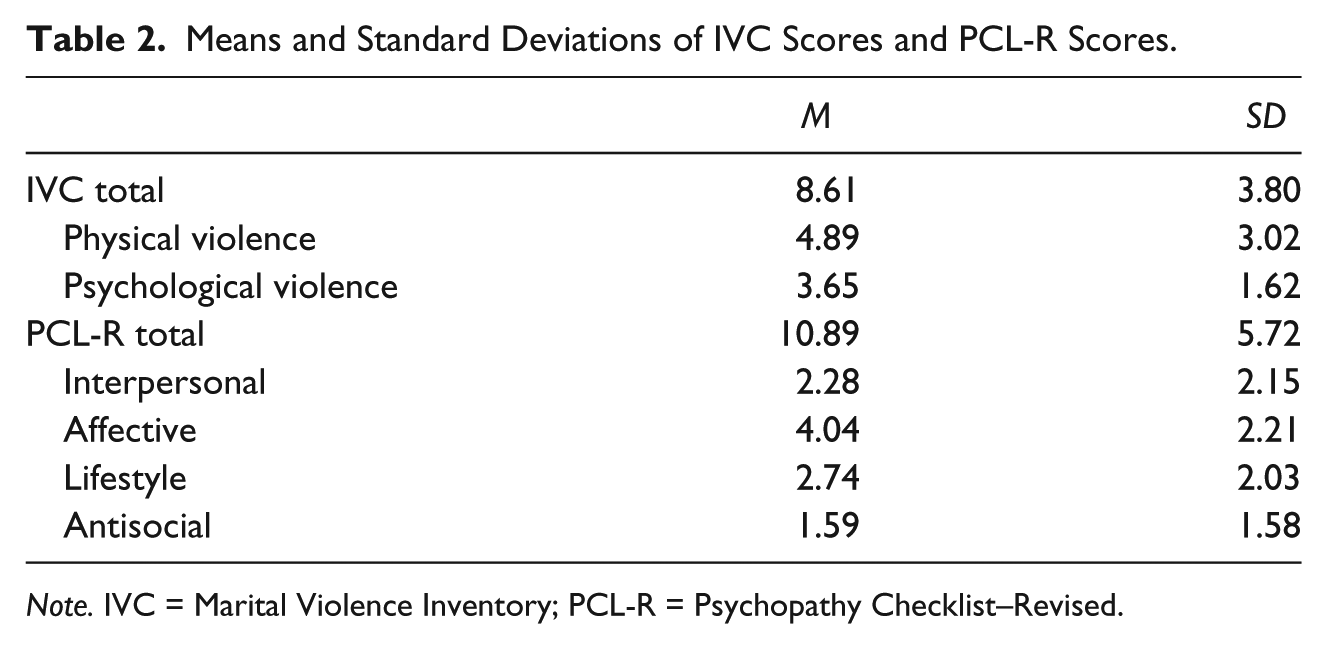
As displayed in Table 2, analyzing the global frequency of IPV perpetrated against the intimate partner (i.e., IVC total scores), batterers presented an average of 8.61 in a possible maximum of 42. In physical violence, batterers had an average of 4.89 (in a maximum of 26) and an average of 3.65 in psychological violence (in a maximum of 14), meaning that psychological violence is the type of the violence most perpetrated, t(186) = 6.896, p < .001.
Means and Standard Deviations of IVC Scores and PCL-R Scores.
Note. IVC = Marital Violence Inventory; PCL-R = Psychopathy Checklist–Revised.
Psychopathy
As presented in Table 2, the mean average of PCL-R total scores was 10.89. Analyzing the facets of the psychopathy construct, results revealed that batterers presented higher scores on affective facet and on lifestyle facet. The antisocial facet presented the lowest score.
Correlation Analysis
Results showed positive statistically significant correlations between IVC total scores and PCL-R total scores (r = .314, p < .01), affective facet (r = .326, p < .01), lifestyle facet (r = .228, p < .01). The interpersonal (r = .150, ns) and antisocial facets (r = .133, ns) did not revealed significant correlations with IVC total scores. Moreover, we found positive statistically significant correlations between IVC total scores and number of incarcerations (r = .227, p < .01), previous convictions for crimes other than IPV (rpb = .261, p < .01) and previous convictions for IPV (rpb = .311, p < .01). None of the sociodemographic variables were associated with IVC total scores, SES, χ2(34) = 42.212, ns; education level, χ2(51) = 67.642, ns; marital status, χ2(34) = 22.298, ns; ethnicity (r = .119, ns); and age (r = .096, ns).
IPV Frequency Prediction
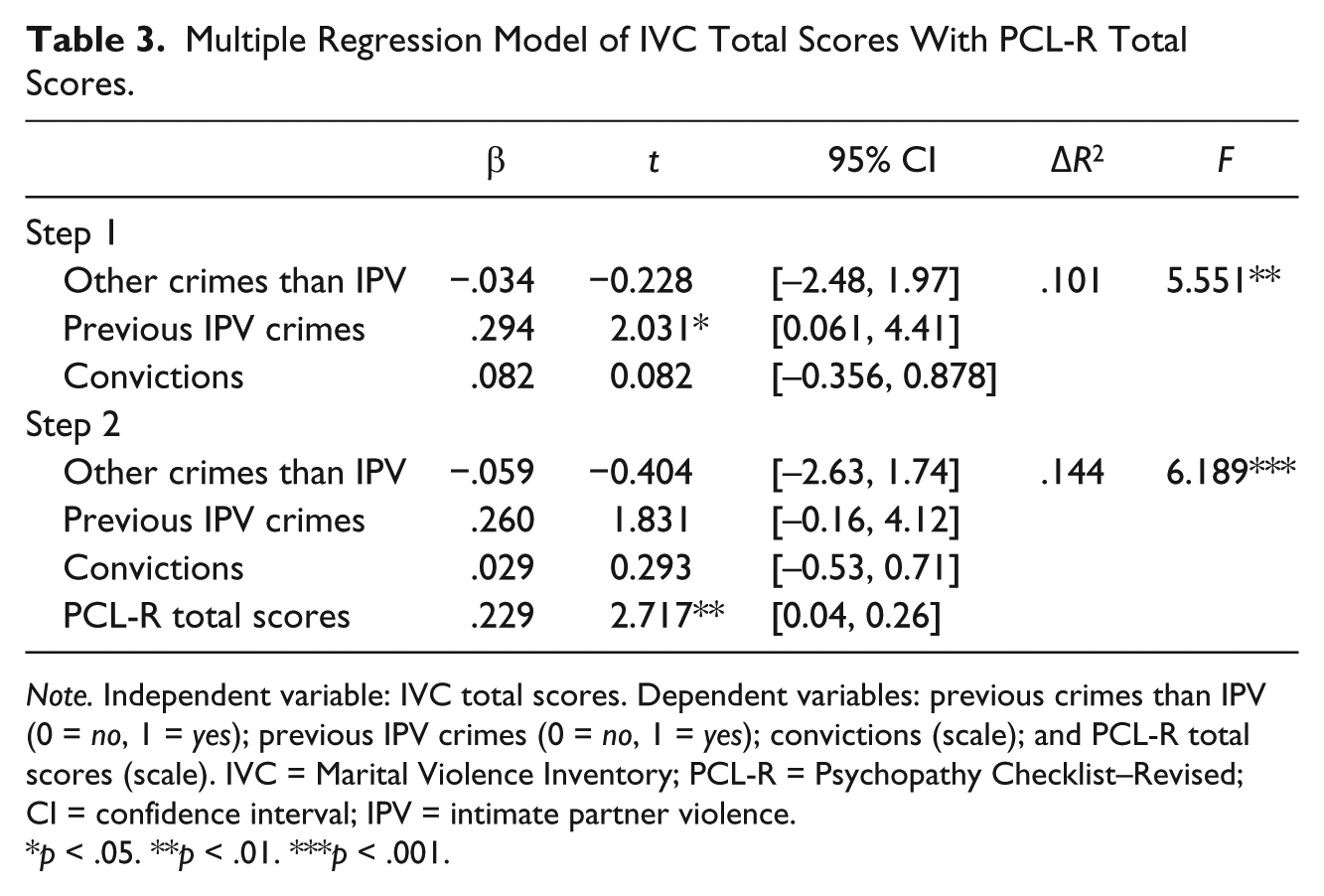
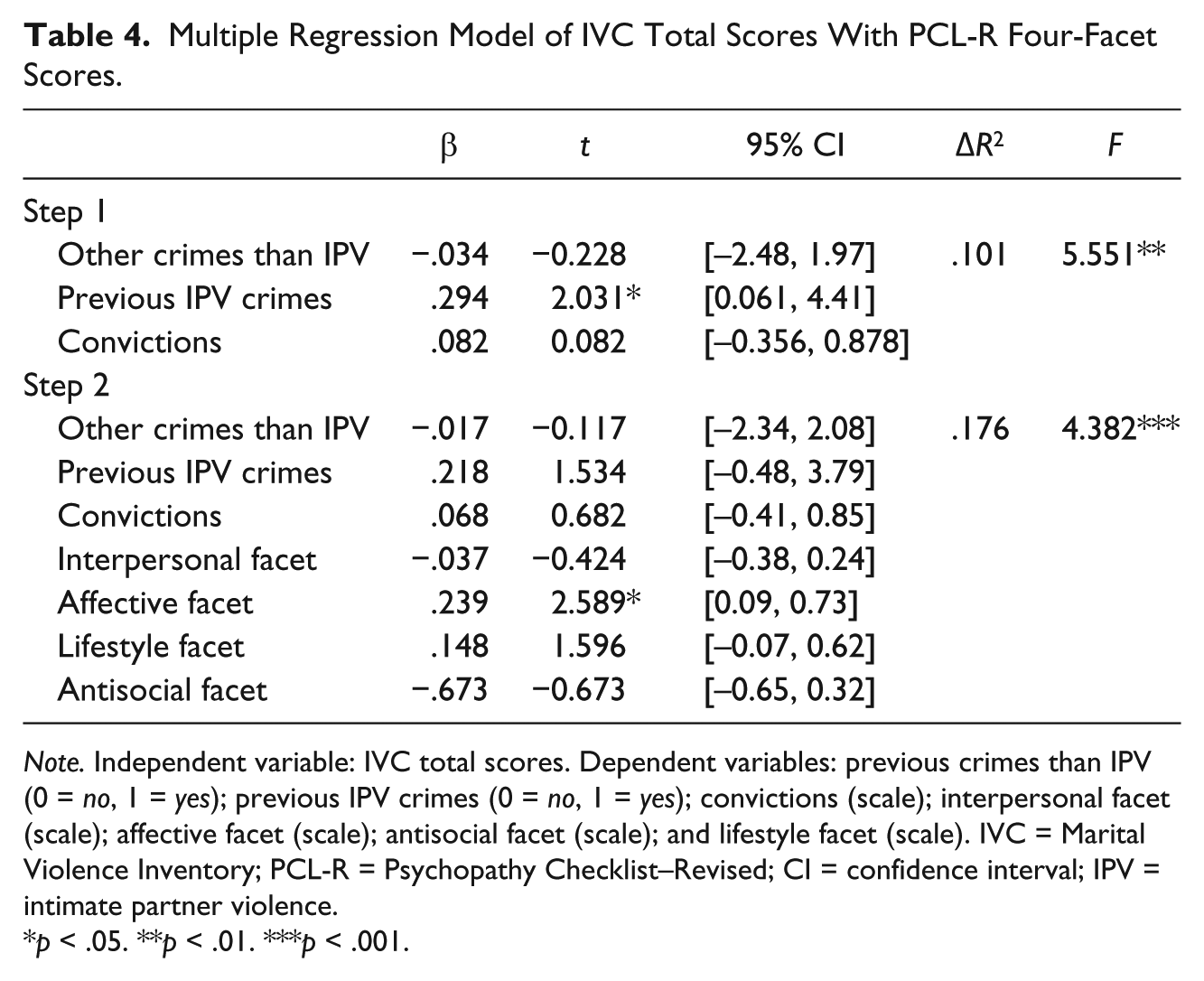
Two multiple regressions were conducted to determine the relationship between PCL-R total scores and PCL-R facet scores and the frequency of IPV. Because penal variables (previous convictions for IPV, previous convictions for crimes other than IPV, and number of incarcerations) may contribute to the frequency of IPV, we conducted stepwise multiple regressions in which those variables were entered as covariates in the first step. In the first regression, previous convictions for IPV, previous convictions for other crimes, and the number of incarcerations were entered on Step 1, followed by PCL-R total scores on Step 2. In the second regression, previous convictions for IPV, previous convictions for other crimes, and the number of incarcerations were entered on Step 1, followed by the PCL-R four-facet scores on Step 2. IVC total scores were used as independent variable. Results are displayed in Tables 3 and 4.
Multiple Regression Model of IVC Total Scores With PCL-R Total Scores.
Note. Independent variable: IVC total scores. Dependent variables: previous crimes than IPV (0 = no, 1 = yes); previous IPV crimes (0 = no, 1 = yes); convictions (scale); and PCL-R total scores (scale). IVC = Marital Violence Inventory; PCL-R = Psychopathy Checklist–Revised; CI = confidence interval; IPV = intimate partner violence.
p < .05. **p < .01. ***p < .001.
Multiple Regression Model of IVC Total Scores With PCL-R Four-Facet Scores.
Note. Independent variable: IVC total scores. Dependent variables: previous crimes than IPV (0 = no, 1 = yes); previous IPV crimes (0 = no, 1 = yes); convictions (scale); interpersonal facet (scale); affective facet (scale); antisocial facet (scale); and lifestyle facet (scale). IVC = Marital Violence Inventory; PCL-R = Psychopathy Checklist–Revised; CI = confidence interval; IPV = intimate partner violence.
p < .05. **p < .01. ***p < .001.
As displayed in Table 3, the penal variables significantly predicted IVC total scores, F(3, 148) = 5.551, p < .01. PCL-R total scores also significantly predicted IVC total scores after controlling for penal variables, F(1, 147) = 7.384, p < .01; f2 = .09. Together, these variables accounted for 12.1% of the variance, F(4, 147) = 6.189, p < .001; f2 = .14. The R2 change value was of .043 (f2 = .04), which means that PCL-R total scores contributed with an additional variance of 4.3% to the model (β = .056, p < .01).
In the second model (see Table 4), with the PCL-R four-facet scores, we identified a statistically significant predictive relationship between the PCL-R four-facet scores and IVC total scores, independent of the penal variables, F(4, 144) = 3.252, p < .05. The R2 change value was of .074, meaning that PCL-R four-facet scores contributed with an additional variance of 7.4% (f2 = .08) to the model. These variables, together, were statistically significant, F (7, 144) = 4.382, p < .001; f2 = .16, and explained 13.6% of the variance of IVC total scores. Analyzing individually the variables used in the prediction of IVC total scores, only PCL-R affective facet was positively related with IVC total scores (β = .239, p < .05). Neither PCL-R interpersonal facet scores (β = –.037, p = .672) nor lifestyle (β = .148, p = .113) or antisocial facet scores (β = –.673, p = .502) were significantly related to IVC total scores.
Discussion
This study aimed to increase our understanding of the relationship between psychopathy and IPV by determining whether psychopathy predicts the frequency of IPV. It was designed to extend previous research on batterers’ personality traits by using a well-established measure of psychopathy, that is, PCL-R, coded with both interview and file information.
The results revealed that the total score on PCL-R was a significant predictor of IPV frequency, beyond and above the penal variables, namely previous convictions for IPV, previous convictions for crimes other than IPV, and the number of incarcerations. These results are in accordance with previous studies conducted among samples with different cultural backgrounds that point to a relationship between psychopathy and battering (e.g., Echeburúa & Fernández-Montalvo, 2007; Grann & Wedin, 2002; Harris, Hilton, & Rice, 2011; Hilton, Harris, & Rice, 2001; Hilton, Harris, Rice, Houghton, & Eke, 2008; Huss & Langhinrichsen-Rohling, 2006) and show that men with psychopathic and antisocial traits commit a disproportional amount of IPV (e.g., Boyle et al., 2008; Swogger et al., 2007). Literature also refers that psychopathy fosters the onset of violent and cruel conducts (Echeburúa & Amor, 2010; Echeburúa, Amor, & Corral, 2009) and is related with a higher frequency and severity of violence (e.g., Grann & Wedin, 2002; Hilton et al., 2001; Hilton et al., 2008). Thus, the sociodemographic characteristics of the participants do not seem to influence the link between psychopathy and IPV, although this invariance lacks empirical examination. Our results do reveal, however, some specificities that may reflect cultural differences. Our participants obtained particularly low scores on the PCL-R compared with those found by other studies (e.g., Grann & Wedin, 2002; Swogger et al., 2007). Cooke and Michie (1999) have suggested reducing the diagnostic cutoff score of the PCL-R for European settings arguing cultural-related processes (e.g., differences in the criminal justice system, differences in the cultural norms regarding talking about one’s abilities) that “damp down, inhibit, or suppress the expression” (p. 65) of psychopathic characteristics. When PCL-R four-facet scores were included in the prediction model, only the affective facet was positively related with IPV frequency, meaning that higher scores on the psychopathy facet that captures the affective deficits are related with a higher frequency of IPV. These results are consistent with those of other studies that link affective facet of psychopathy to more severe forms of violence (e.g., Hall, Benning, & Patrick, 2004; Skeem, Mulvey, & Grisso, 2003). Moreover, previous studies have also found an association between Factor 1 (affective–interpersonal features) and IPV (Mager et al., 2014). The intimate nature of IPV suggests that violent batterers may be characterized by greater callousness and poor empathy (Swogger et al., 2007) and men with such features may be especially likely to engage in coercive violent control of their partners (e.g., Mager et al., 2014). In fact, prior empirical research (Holtzworth-Munroe et al., 2000) identified emotional deficits in batterers including lack of empathy, lack of remorse, and deficient emotional expression, which can lead to more violent acts in intimacy (Fernández-Montalvo & Echeburúa, 2008).
Research has revealed an association between the interpersonal and affective facet and instrumental violence (e.g., Flight & Forth, 2007). This conclusion is particularly interesting as IPV is described as “a pattern of behavior in any relationship that is used to gain or maintain power and control over an intimate partner” (The National Domestic Violence Hotline [United States], as cited in Kelly & Johnson, 2008, p. 478). Thus, batterers with higher scores on affective facet may also use higher levels of violence toward their intimate partner in an instrumental way, that is, to exercise power and control over their intimate partner and as a form of control and manipulation. Indeed, several authors have suggested that power, control, and personal gains are motives for psychopaths to enter and maintain an intimate relationship (Hervé et al., 2001), and psychopaths may use violence and/or coercion to achieve these goals (Pozueco, Moreno, Blázquez, & García-Baamonde, 2013).
The lifestyle and antisocial facets did not predict IPV frequency. Moreover, results revealed that batterers tended to present higher scores on affective facet, whereas in the antisocial facet, the scores are considerably lower. These results further support the instrumental rather than impulsive IPV (Chase, O’Leary, & Heyman, 2001). Psychopathic batterers may be characterized by greater premeditation (Swogger et al., 2007), and impulsivity may not be important for understanding individual differences in IPV as it is in violent behavior in general. In addition, antisocial behavior may not be a marked characteristic of IPV perpetrators, being the psychopathic batterer “emotionally cold and calculating rather than affectively labile and undercontrolled” (Swogger et al., 2007, p. 258). However, more research is needed to verify this relationship between affective facet and instrumental violence as we did not differentiate individuals according to the type of violence that they used (i.e., reactive or impulsive) in the current study.
Together, our results lead support to the inclusion of psychopathy in risk assessments. This is important not only because psychopathy was found to be a risk factor for IPV but also because it will be meaningful in terms of risk management and treatment (Huss, Covell, & Langhinrichsen-Rohling, 2006; Mager et al., 2014). IPV is associated with several physical, psychological, and mental health consequences for the victims (e.g., Coker, Smith, Bethea, King, & McKeown, 2000). There is also evidence that children’s exposure to interparental violence is associated with symptoms of depression, anxiety, behavioral problems, and eating disorders (e.g., Evans, Davies, & DiLillo, 2008). Only accurate risk assessments will allow the development of effective risk management measures, such as safety plans for the victims and adequately monitoring, supervising, and treating the offender, aimed to protect the victim and prevent the occurrence of new situations of victimization (e.g., Kropp, 2009). As for treating the offender, in particular, literature on psychopathy reveals that, in individuals with psychopathy or psychopathic traits, the root of problematic behaviors and psychological maladjustment is the psychopathy disorder, suggesting that the focus of the treatment should be psychopathy rather than IPV (e.g., Spidel et al., 2007). In addition, current perspectives on batterers’ treatment point to the development of specific interventions for specific types of batterers (Cavanaugh & Gelles, 2005). Notwithstanding, risk assessment and management tools still fail to account for psychopathy as a risk factor.
In addition, based on our results, and according to Swogger et al. (2007), we also advocate that psychopathic batterers may require a significant attention to affective deficits, enhancing their empathy toward intimate partner and increasing their sensitivity to feedback. Although conventional studies point that psychopaths are generally untreatable, are less likely to complete treatment programs, and may recidivate at a higher frequency (e.g., Rice, Harris, & Cormier, 1992), other researchers have claimed that interventions specifically tailored to the socioemotional developmental constrains of psychopathic characteristics may be effective (Reidy et al., 2015). Nonetheless, more research is needed to prove that increasing empathy among psychopathic individuals is in fact effective.
Despite the contributions of the present study, some limitations should be mentioned. First, our sample size was modest and nonrepresentative and was entirely composed by men, and the vast majority was Caucasian. A larger and a more ethnical diverse sample as well as the inclusion of women is recommended and may allow the comparisons between the groups. Research suggests significant ethnic and gender differences both in IPV and psychopathy (e.g., Field & Caetano, 2004; Nicholls, Ogloff, Brink, & Spidel, 2005; Skeem, Edens, Camp, & Colwell, 2004). Second, the study is cross sectional and longitudinal analyses are needed to better understand the role of psychopathy as a risk factor for IPV. Third, this study accessed IPV solely through the batterers’ self-report. Literature suggests that batterers’ reports are affected by social desirability (Dutton & Hemphill, 1992), and that batterers tend to deny or minimize their abusive behaviors (Henning, Jones, & Holdford, 2005). At last, the questionnaire that assessed the frequency of IPV only included one item of sexual violence; thus, this type of IPV was overlooked in the present study.
In sum, the current study holds an important contribution for understanding the relationship between psychopathy and IPV. Our findings contribute to previous literature by demonstrating a positive link between psychopathy affective facet and violence and a potential link between this facet and instrumental IPV. Although our conclusions extend solely to Portuguese Caucasian males, the similarity between our results and those found in other studies (e.g., Echeburúa & Fernández-Montalvo, 2007; Grann & Wedin, 2002; Harris et al., 2011; Hilton et al., 2001; Hilton et al., 2008; Huss & Langhinrichsen-Rohling, 2006) does suggest the invariance of the psychopathy–IPV link across cultural backgrounds.
Footnotes
Declaration of Conflicting Interests
The author(s) declared no potential conflicts of interest with respect to the research, authorship, and/or publication of this article.
Funding
The author(s) disclosed receipt of the following financial support for the research, authorship, and/or publication of this article: This study was conducted at Psychology Research Center (UID/PSI/01662/2013), University of Minho, and supported by the Portuguese Foundation for Science and Technology and the Portuguese Ministry of Science, Technology and Higher Education through national funds and cofinanced by European Regional Development Fund (FEDER) through COMPETE2020 under the PT2020 partnership agreement (POCI-01-0145-FEDER-007653). The study was also supported by Grant SFRH/BD/66110/2009 from the Portuguese Foundation for Science and Technology awarded to the first author.