



Abstract
A great deal of research has focused on the negative consequences of domestic violence (DV) on mental health. However, current studies cannot provide direct and reliable evidence on the impacts of DV on mental health in a short term as it is not feasible to measure mental health shortly before and after an unpredictable event like DV. This study aims to explore the short-term outcomes of DV on individuals’ mental health. We collected a sample of 232 victims (77% female) and 232 nonvictims (gender and location matched with 232 victims) on Sina Weibo. In both the victim and nonvictim groups, we measured their mental health status during the 4 weeks before the first DV incident and during the 4 weeks after the DV incident. We used our proposed Online Ecological Recognition (OER) system, which is based on several predictive models to identify individuals’ mental health statuses. Mental health statuses were measured based on individuals’ Weibo profiles and messages, which included “Depression,” “Suicide Probability,” and “Satisfaction With Life.” The results showed that mental health in the victim group was impacted by DV while individuals in the nonvictim group were not. Furthermore, the victim group demonstrated an increase in depression symptoms, higher suicide risks, and decreased life satisfaction after their DV experience. In addition, the effect of DV on individuals’ mental health could appear in the conditions of child abuse, intimate partner violence, and exposure to DV. These findings inform that DV significantly impacts individuals’ mental health over the short term, as in 4 weeks. Our proposed new data collection and analyses approach, OER, has implications for employing “big data” from social networks to identify individuals’ mental health.
Keywords
Introduction
A great deal of research focuses on the negative consequences of domestic violence (DV) on mental health. Golding (1999) found that 47.6% of the battered women suffer from depression and more than 17.9% of them have attempted suicide. The experience of intimate partner violence (IPV) increases depressive symptoms (J. C. Campbell & Soeken, 1999; Hogben et al., 2001; Kennedy, Bybee, Sullivan, & Greeson, 2010; von Eye & Bogat, 2006) and suicidal ideation (Coker et al., 2002; Krishnan, Hilbert, & VanLeeuwen, 2001; Sansone, Chu, & Wiederman, 2007). Compared with nonabused women, battered women are more likely to have lower self-esteem and less life satisfaction (J. C. Campbell, 2002; Dutton et al., 2006; Zlotnick, Johnson, & Kohn, 2006). Children who are abused during childhood are found to have higher rates of depressive symptoms and suicidal ideation during adolescence (Wolfe, Scott, Wekerle, & Pittman, 2001) and adulthood (Dube et al., 2001; Widom, 1998). Furthermore, exposure to DV can result in mental health problems during young ages, adolescence, and adulthood (Fergusson, Horwood, & Lynskey, 1996; Herrenkohl, Sousa, Tajima, Herrenkohl, & Moylan, 2008; Moylan et al., 2009).
However, few studies have investigated individuals’ mental health both pre and post DV (Cerdá, DiGangi, Galea, & Koenen, 2012). This muddles the effects of preexisting differences and DV itself. Existing longitudinal investigations that contain a previolence measurement usually focus on the assessment of the long-term effects of DV on mental health. However, the long-term effects were measured in the range of 1 year (Mertin & Mohr, 2001) to 10 years (Boney-McCoy & Finkelhor, 1995), which makes it difficult to distinguish the cause of mental health changes. In addition, limited studies have examined the short-term effects of DV on mental health. Given that the occurrence of DV is unpredictable, it is challenging to collect enough samples to assess the short-term effects of DV on mental health using survey methods. To explore the short-term effects of DV on mental health, it is essential to propose new data collection and analyses approach.
The exponentially growing popularity of Online Social Networks (OSNs) provides a new platform for health and violence research. Currently, more than 71% of Internet users are OSN users (Statista, 2017). Sina Weibo is a leading Chinese OSN, with more than 300 million registered users in 2016. Over one third of Weibo users are active daily users. These users present detailed information in their profiles (e.g., geolocation, gender, age), tweet messages, and exchange ideas and interact with each other using Weibo functions (e.g., reply, @function, retweet). All of their online information and behaviors are publicly available and can be used to recognize individuals’ psychological traits through predictive models, such as “personality” (Qiu, Lin, Ramsay, & Yang, 2012) and “mental health status” (A. Li, Hao, Bai, & Zhu, 2015). Hao, Li, Li, and Zhu (2013) utilized machine-learning algorithms to determine individuals’ mental health from social media data. The predicted scores had correlations from 0.30 to 0.40 with self-report survey results. Hao, Li, Gao, Li, and Zhu (2014) also built reliable and valid models to predict subject well-being (SWB) using Weibo data, which had a correlation score of 0.60 with the self-report survey results. Recently, Youyou, Schwartz, Stillwell, and Kosinski (2017) used predictive models to identify the psychological indexes in their personality study. The correlations between the model-predicted scores and self-report questionnaire scores ranged from 0.30 to 0.37. These studies showed that the research findings with social media data are reliable and consistent with survey study findings.
Compared with survey methods, the OSN-predicted psychological traits are more ecological. OSN predictions perform better in reflecting everyday interactions as they assess users’ behaviors indirectly and informally (Park et al., 2015). In addition, prediction models reduce the threats to internal validity of social desirability (Back et al., 2010; McCambridge, Witton, & Elbourne, 2014). We define Ecological Recognition (ER) as the approach of using ecological social media data to automatically recognize psychological traits by employing machine-learning models. We measured mental health indexes using publically available online social media data without contacting the participants, which is referred to as Online Ecological Recognition (OER). Compared with self-reports, OER functions as a more accessible, safe, and timely method to track mental health statuses following DV occurrences. This provides a significant improvement over traditional self-report measures when assessing temporary mental health status.
In the present study, we used OER to recognize individuals’ mental health statuses before and after their reporting of the first DV experience on Weibo. Three indexes of mental health status, including Depression, Suicide Probability, and Life Satisfaction, were predicted from victims’ online social media behaviors, including profiles and public tweet messages. The work here revealed the relationship between individuals’ experiences of DV and their mental health status. Furthermore, this study explored the impact of different types of DV experiences on mental health, including child abuse, IPV, and exposure to DV.
Method
Case Selection
We selected the DV cases from a pool of 1.16 million Weibo users. All Weibo users in our original data pool were active users, with more than 500 posts during the past 2 years. Approximately 92% of users had more than one update (e.g., login) every day on Weibo. We anonymized all the participants by reassigning them an ID number. From the user pool, we selected 232 users who reported their first DV experience on Weibo following three steps: (a) retrieving users by keywords; (b) manually screening for victims; (c) manually screening for victims who described their first DV experience.
Step 1: Retrieving users by keywords
We collected 877,440 posts that contained DV keywords from more than 50 billion posts in our Weibo data pool. We used a total of 117 keywords. Each keyword included the combinations of at least one DV-related word (“DV,” “domestic violence,” “mental abuse,” “neglect,” “quarrel,” “scold,” “beat me,” “abuse,” and “bruise”) and one personal pronoun (“husband,” “hubby,” “wife,” “wifey,” “father,” “mother,” “mom,” “dad,” “he/she,” “you,” “child/children,” “son,” and “daughter”). 1
Step 2: Manually screening for real DV experiences
This step sought to identify real DV experiences from the selected candidate posts from Step 1. We recruited 69 research assistants (RAs) and randomly divided them into 23 groups (three RAs in each group). Each group was assigned to read an average of 11,564 posts (duplicates removed). The three RAs in the same group independently worked on the same set of posts. We excluded the posts that met two criteria: (a) discussing DV news; or (b) expressing their personal opinions on DV events. The RAs checked whether a selected post was a real DV case. If so, the RAs established the types of DV as IPV, child abuse, or exposure to DV (see Appendix A). The post was labeled as a DV case when all three RAs reached an agreement following group discussions. If a user posted about his or her DV experience multiple times, we only analyzed the first post. There were a total of 644 posts, that is, 644 Weibo users who reported their DV experience on Weibo.
Step 3: Second round of screening to identify the victim’s first DV experience
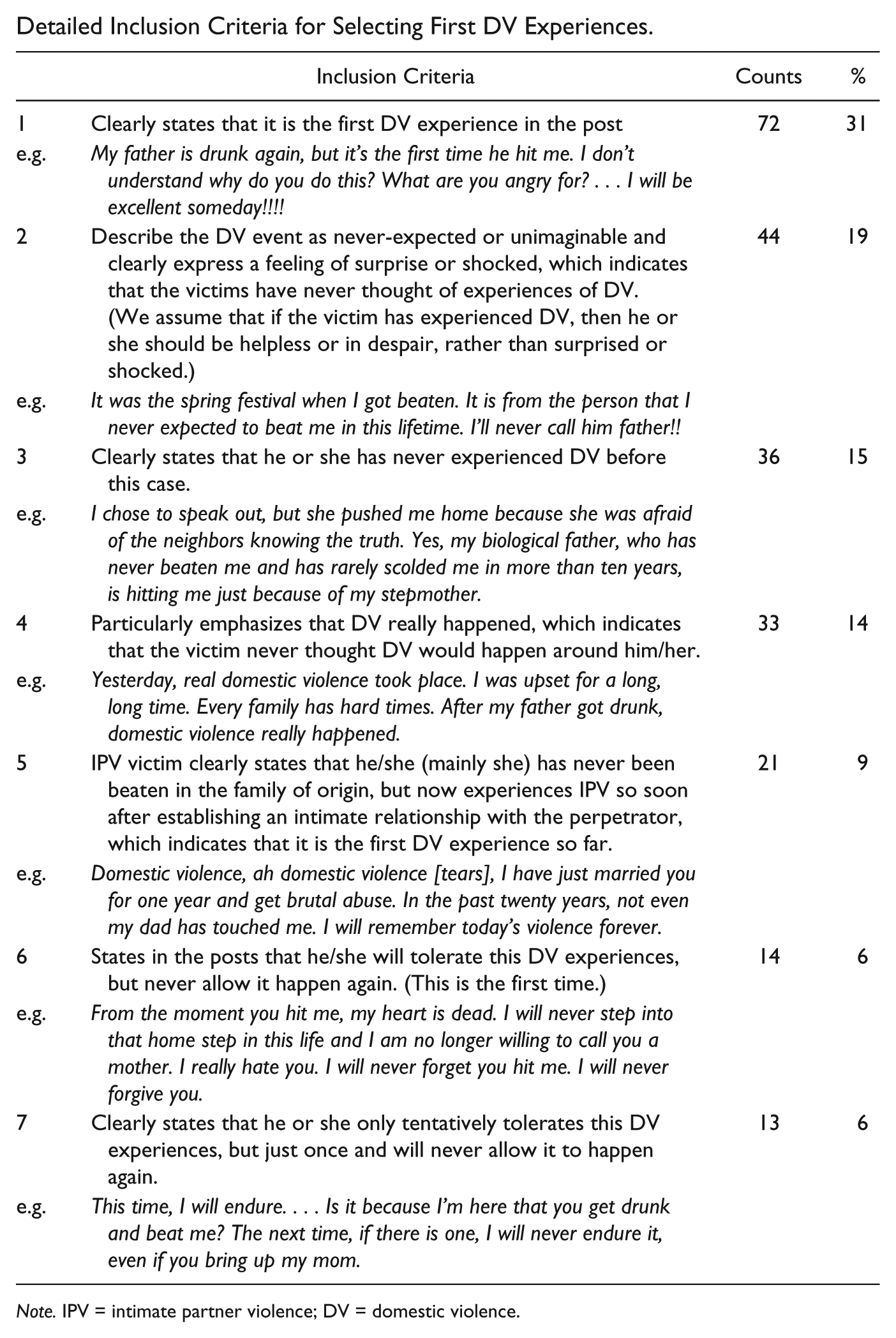
This step screened the posts that showed users’ first-time DV experience. Another three RAs were hired to code these 644 posts. The exclusion criteria were (a) the post contained phrases which implied long-term DV experience (e.g., “every time,” “always,” etc.); and (b) the post reported a DV case that occurred a long time before. The inclusion criteria are found in Appendix B. Each RA checked these 644 posts independently. We only kept posts that were coded as first-time DV experiences by all three RAs. We acquired 232 Weibo posts describing first-time DV experiences. The 232 users behind these posts were the victim group in this study.
Matched group
We selected the nonvictim Weibo users (N = 232) from the original user pool. The users in the matched group had no DV keywords in their posts. Each user in the matched group was paired with one user in the victim group of the same gender and living in the same location according to their Weibo profiles.
RA recruitment and training
We recruited 72 RAs for Step 2 and Step 3 during case selections. All of the RAs signed a Non-Disclosure Agreement (NDA) to dissuade disclosing user data. They were also forbidden from searching for the posts online and identifying post owners. Each of the RAs got 200 RMB as compensation. Among them, 69 undergraduate students were utilized at Step 2 to manually filter the real victims, and the other three were graduate students majoring in psychology at Step 3 for screening the first DV experience. We provided all RAs at Step 2 with training to recognize real victims and categorize them correctly (see Appendix A) and RAs at Step 3 training for identifying the first DV experience (see Appendix B). Both training sessions lasted for 2 hours on average with examples and exercises. The students began to rate the posts after they correctly labeled all posts during the training exercises.
Measurement
Instead of self-reporting, we measured 464 Weibo users’ mental health status by validated prediction models. The predictive models were linear regression models that predicted user’s mental status using OSNs’ dynamic features. In this study, “dynamic features” is a term that is relative to “static features,” which refers to those features having notable changes over time (e.g., per day, L. Li, Li, Hao, Guan, & Zhu, 2014). In other words, the value of these dynamic features is expected to be different at any given point.
We downloaded the 464 Weibo users’ data using the Application Programming Interface (API) provided by Sina Weibo (http://weibo.com). For each user, we extracted dynamic features from two perspectives: Linguistic Inquiry and Word Count (LIWC) features (see Gao, Hao, Li, Gao, and Zhu, 2013, and Zhao, Jiao, Bai, and Zhu, 2016, for more details) and behavioral features. LIWC is a widely used natural language processing tool mapping psychological and linguistic dimensions of written expression. It reports the degree of language usage in 88 dimensions (e.g., “positive emotion words,” “family words,” etc.). We calculated the 88 LIWC features using the Chinese version of the text analysis software, TextMind (Gao et al., 2013). TextMind divides a post into several word pieces (e.g., “I experienced DV” to “I,” “experienced,” “DV”). It then calculates the frequency of word pieces of each dimension. During the last step, TextMind outputs the ratio of the summarized frequency of each dimension to the total number of words as LIWC features. In addition to LIWC features, we also extracted 11 behavioral features: “counts of words,” “counts of words per sentence,” “counts of URLs,” “counts of @ names,” “counts of tags,” “counts of posts,” “counts of original posts,” “counts of comments,” “counts of positive emotion emoji use,” “counts of negative emotion emoji use,” and “counts of neutral emotion emoji use”. When a user posted on Weibo or updated his or her online profile, his or her online data changed and the value of dynamic features correspondingly was altered.
Based on the records of users’ online behaviors in our study, some users did not update their Weibo every day (e.g., updating their profiles, sending new posts, replying to others’ posts). Thus, our prediction models were built based on weekly feature extraction rather than that daily. For each week during the research period (4 weeks before DV and 4 weeks after DV), we extracted 11 behavioral features and 88 LIWC features, that is, 99 features for each user per week. According to previous studies, the prediction model produced the best prediction results when generated by the mean value of the previous 4 weeks (Hu, 2015). We then took the mean value of 99 features across 4 weeks as the input dynamic features of each user and fed them into the prediction models. Figure 1 portrays the procedure from data extraction to mental status prediction. The models therein make use of various machine-learning algorithms to establish mappings from dynamic features to related questionnaire scores. All the prediction models have reached a moderate correlation with questionnaire scores.

Procedures of dynamic features calculate from online Weibo data and mental health status predicted by dynamic features.
Predictive model of depression
We applied the prediction model to predict the degree of depression. This prediction model was developed by (Hu, 2015), where they invited 10,102 Weibo users to complete the 20-item Center for Epidemiological Survey (CES-D, Radloff, 1977) and asked for the users’ approvals to access their Weibo data. The Pearson correlation coefficient between the predicted and self-report scores achieved 0.39 (p < .01).
Predictive models of suicide probability
We implemented prediction models of suicide probability to predict one’s facet scores of Suicide Probability Scale (SPS, Cull & Gill, 1982): hopelessness, suicidal ideation, negative self-evaluation, and hostility. These machine-learning models were built and validated by Zhang et al. (2014) from the data of 1,041 Weibo users. The output of the prediction model was the user’s facet score of SPS: hopelessness (12 items), suicidal ideation (eight items), negative self-evaluation (nine items), and hostility (seven items). All of the items were 4-point Likert-type scales (ranging from 0 = not at all to 3 = the most) that describe the risk of suicide. The correlation between the predicted and self-report SPS scores reached the significant level of 0.01 across all four dimensions (Table 1).
The Pearson Correlation Coefficient Between the Prediction Model and Mental Health.

Correlation reaches the significant level of 0.01.
Predictive model of life satisfaction
The prediction model of life satisfaction was developed by Hao et al. (2014). Hao and colleagues invited 1,785 Weibo users to complete the Satisfaction With Life Scale (SWLS; Arrindell, Meeuwesen, & Huyse, 1991) and authorize their Weibo data for model training. The results indicated that stepwise regression performed best for most dimensions. The Pearson correlation coefficient between the predictions and questionnaire scores achieved 0.30 (p < .01).
Procedure
We recorded the timestamp of reporting the first-time DV experience as a boundary and measured mental health status twice. The first measurement employed the Weibo data of the 4 weeks before DV, and the second measurement made use of data from the 4 weeks after the DV experience. As the timestamp of the DV experience may differ from one user to another, we assessed mental health precisely 4 weeks before and after the incident for each victim individually. The nonvictims were analyzed in the same period as their paired victims—they were a one-to-one match. We first analyzed group differences between the victim group (N = 232) and the nonvictim group (independent sample t tests). We then compared the mental health change within both groups at T1 (the day before DV) and T2 (4 weeks after DV) through paired sample t tests. The significance level was α = .05 for all analyses. Effect sizes, d (with pooled standard deviations), were reported for mean differences (cf. Cohen, 1988). The same investigations were conducted on the subgroups of the three DV types: IPV, child abuse, and exposure to DV. In all these comparisons, the dependent variables were the OER-predicted scores of depression, suicide probability, and life satisfaction.
Results
Demographics
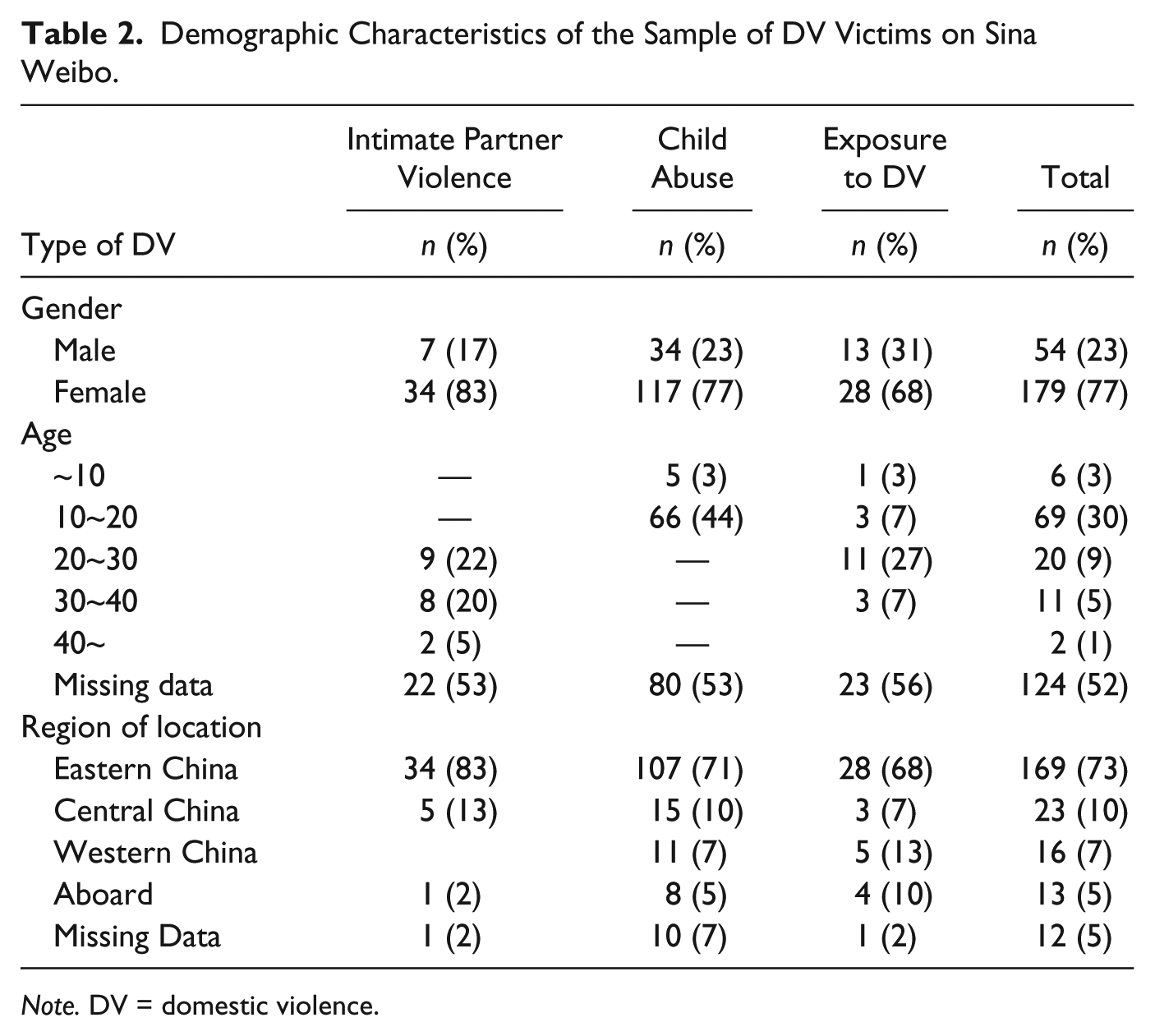
Among the users who registered their birth date in their profile (n = 124, 53%), 77% were females, and their ages ranged from 8 to 50 years with the median age of 17 years. Among the 232 victims, 40 people suffered from IPV, 151 people suffered from child abuse, and 41 people were exposed to DV. Seventy-three percent of the victims were from Eastern China, which is the wealthiest region in China. Table 2 features the demographic profiles of these groups.
Demographic Characteristics of the Sample of DV Victims on Sina Weibo.
Note. DV = domestic violence.
Consequences for Mental Health
First, to figure out whether the victims’ mental health status had already worsened before DV, we compared the three mental health indexes of victims and nonvictims at T1 (the day before DV). We determined that there was no significant difference between groups (p < .05) regarding depression, suicide probability, and life satisfaction. The results indicated that these victims had no significantly increased risk of mental health problems before DV.
To explore the impact of DV on mental health, we compared the scores of depression, suicide probability, and life satisfaction at T1 and T2 for both the victim group and the nonvictim group. In general, no significant changes were found in the nonvictim group (p > .05). In the victim group, depression and suicide probability increased after DV, and life satisfaction was reduced (see Table 3). Furthermore, the results showed that the victims scored higher on depression, t(231) = −4.080, p < .01, d = 0.27, after DV experiences. The average scores rose to 15.59 (SD = 2.22), very close to the clinical criteria for further treatments. Victims had higher scores for suicide possibility, especially in suicidal ideation, t(231) = −2.138, p < .05, d = 14, hostility, t(231) = −2.675, p < .01, d = 0.18), and hopelessness, t(231) = −2.283, p < .05, d = 0.13. Meanwhile, life satisfaction significantly decreased, t(231) = 3.087, p < .01, d = .20.
The Influence of DV on the Victim Group and the Nonvictim Group.

Note. “Before” represents online data 4 weeks before DV occurred and presents the current mental health status when DV happened, “After” represents online data 4 weeks after DV that presents the mental health status 4 weeks after DV. t value of paired sample analysis represented by t. DV = domestic violence.
p < .05. **p < .01.
Consequences of Different Types of DV
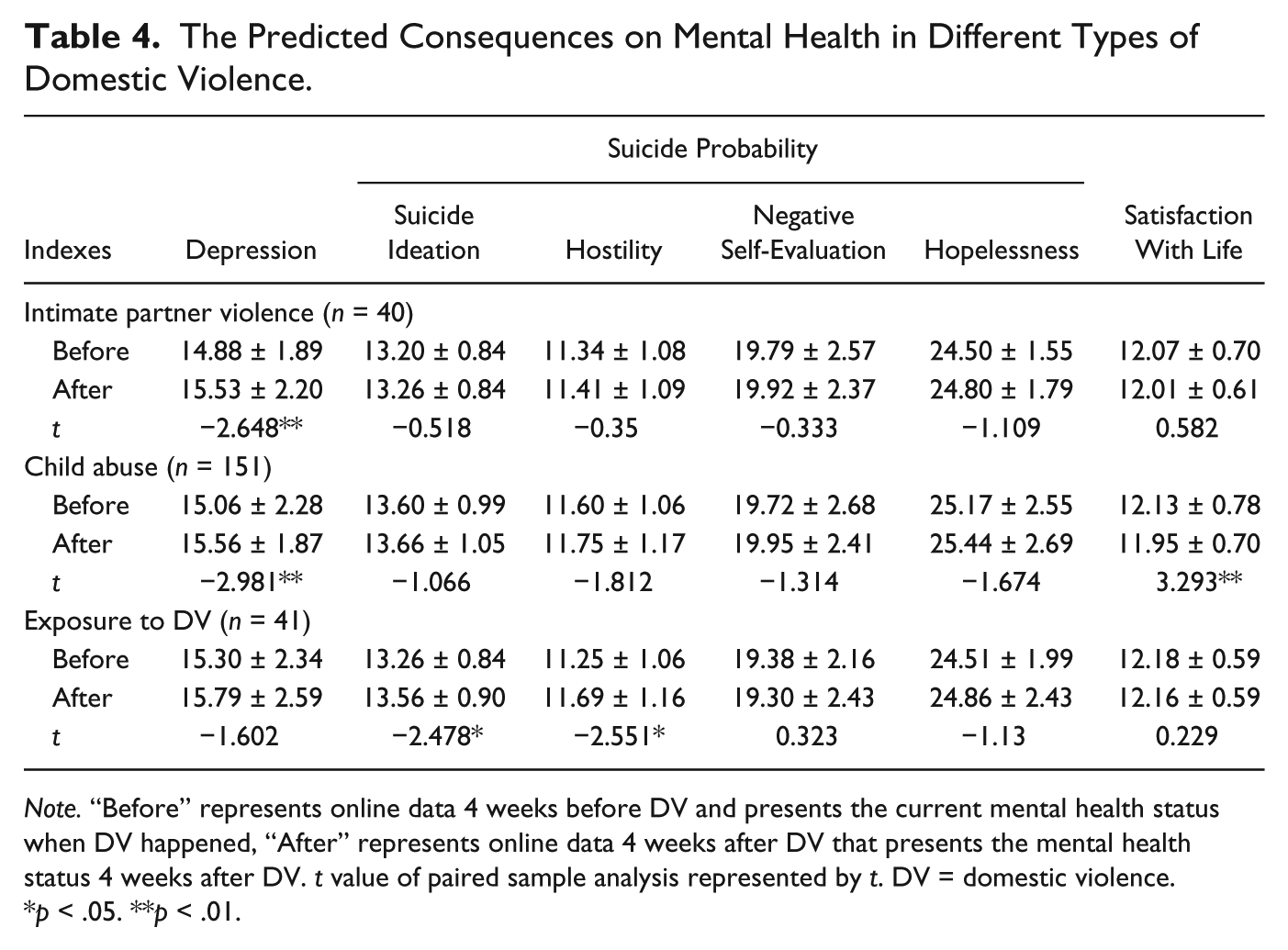
We also investigated the impact across three types of DV: IPV, child abuse, and exposure to DV. The estimated consequences of DV of each type were shown in Table 4. Within 4 weeks following DV, abused children experienced significantly increased depression, t(150) = −2.981, p < .01, d = 0.28. Meanwhile, child abuse was the only group that exhibited a decrease in life satisfaction, t(150) = 3.293, p < .01, d = 0.28. As the sample size of the abused children was nearly 3 times greater than the other two groups, paired sample t tests were also conducted on a randomly selected sample of 40 abused children. The results also showed that DV was associated with a decline in life satisfaction, t(40) = −2.478, p < .05.
The Predicted Consequences on Mental Health in Different Types of Domestic Violence.
Note. “Before” represents online data 4 weeks before DV and presents the current mental health status when DV happened, “After” represents online data 4 weeks after DV that presents the mental health status 4 weeks after DV. t value of paired sample analysis represented by t. DV = domestic violence.
p < .05. **p < .01.
The victims of IPV had elevated depression, t(39) = −2.648, p < .01, d = 0.40, which indicated that they showed more depressive symptoms after DV. No other significant change was found. In addition, exposure to DV triggered an increase in suicide probability, especially in suicide ideation, t(40) = −2.478, p < .05, d = 0.37, and hostility, t(40) = −2.551, p < .05, d = 0.40. The heightened score suggested a higher frequency of victims feeling hostility, isolation, and impulsivity with thoughts of suicide (Valadez et al., 2009).
Discussion
Our results demonstrate that DV has a significant impact on victims’ mental health in the short term of 4 weeks. Victims have increased levels of depression, higher suicide risks, and diminished life satisfaction after DV. In contrast, individuals in the nonvictim group do not reveal any significant change in terms of depression, suicide probability, and life satisfaction. This is the first study to identify the impacts of DV on mental health measuring both pre- and post-first-reported DV event at fixed points. Consistent with the existing literature, the findings show the negative effects of DV on mental health after considering the potential preexisting differences between the matching groups (J. C. Campbell, 2002; Dillon, Hussain, Loxton, & Rahman, 2013; Dutton et al., 2006; Ludermir, Schraiber, D’Oliveira, França-Junior, & Jansen, 2008; Resnick, Acierno, & Kilpatrick, 1997).
The results on the short-term effects of different DV types are consistent with that of previous work. We found that victims of IPV exhibited higher rates of depression after the first DV experience, which is in line with Devries et al. (2013). Victims of child abuse had greater depression and less life satisfaction in the present study, which was in agreement with previous studies regarding the association between child abuse experiences and negative psychological outcomes (Herrenkohl, Klika, Herrenkohl, Russo, & Dee, 2012; Lamb & Greenbaum, 1993). Higher rates of suicide risk among witnesses of DV in the present study was consistent with Kitzmann, Gaylord, Holt, and Kenny’s (2003) findings, where exposure to DV and mental health problems were strongly linked. Our findings identified the short-term effects of DV on mental health, and we also provided evidence for their differences among three types of DV, including child abuse, IPV, and exposure to DV.
Samples from previous studies were DV victims recruited from shelters or refuge houses who actively seeking help (R. Campbell, Sullivan, & Davidson, 1995; Krishnan et al., 2001; Pérez-Testor, Castillo, Davins, Salamero, & San-Martino, 2007). Existing findings regarding the effects of DV on mental health were also based on collections of victims from subsamples of longitudinal studies where very few participants reported their unpredictable DV experience (Brown, Cohen, Johnson, & Smailes, 1999; Hayatbakhsh et al., 2007). In this study, we proposed an alternative sampling method based on the publically available online records of their posts. Compared with previous work, we recruited a potential DV victim population through their postings about their DV experience through their social media messages. However, this also has its own set of limitations. The reliability of the reported DV experiences from the collected online users is one limitation of this study. Our analyses relied on Weibo users’ messages, and we assumed their self-reported DV experience was accurate. To overcome this limitation, we manually checked all the collected posts and users’ profiles. As one of the most popular OSNs, Weibo is an emerging data collection platform for social science and human behavior research. Our sample had the limitation of only including a population more likely than the general public to use social media, and specifically, post their DV experience publically. Thus, our study findings did not represent the entire DV victim population. However, although not everyone uses OSNs and not every OSN user prefers this kind of exposure, the online sampling and measurements could still offer a unique sample that could be larger, more updated, timely, and cost-beneficial than survey methods. We were able to identify the victims with relatively mild DV experiences in addition to those who actively sought help due to continual and severe DV sufferance. Our results indicated that the consequences of DV on mental health could be identified from publicly available social media data. Thus, our study informs the development of online assessment for DV victims through analyzing their social media messages. In addition, the work presented here calls for future studies to develop online social media tools for detecting social media users who search for help through posting DV experience.
Herein, we put forth a new approach to investigate individuals’ mental health as well as other psychological features. Today, large machine-learning models have been built to predict an individual’s psychological profiles from OSN data (e.g., Hao et al., 2014; Qiu et al., 2012; Zhang et al., 2014). These algorithms provide a superb opportunity for psychologists to measure which could not be measured before. For example, with the help of predictive models, Youyou et al. (2017) were able to eliminate the “reference effect” in personality similarity measurement; this study showed that it was able to conduct the before/after mental health measurements perfectly matched the timing of DV incidence. More potential for OER in psychological studies can be explored in the future.
Predicting users’ psychological traits can be beneficial for scientific exploration and monitoring victims’ mental health status. However, the improper use of prediction results may pose a threat to an individual’s well-being, freedom, or life no matter whether they are correct or not (Kosinski, Stillwell, & Graepel, 2013). To control the balance between the promises and perils of OER studies, extreme caution is necessary to protect victims’ privacy. We only use public data in this study, and the posts were anonymized during processing so that the user’s identity could not be paired with their mental health status.
There are several additional limitations in our study that merit attention. First, owing to the limited information available from Weibo posts and user profiles, there is the possibility that the users’ information on Weibo was not consistent with their actual condition, which refers to fake profile and false reports. For example, the user may hide prior DV experience on purpose. To cope with this limitation, we utilized rigorous inclusion criteria to ensure that our results were reliable based on the users’ online reports. Second, there was unavoidable subjectivity when judging the posts, even with careful consensus by three different judges and detailed criteria. Third, we did not further analyze the demographic information as confounding variables as certain users did not provide complete demographic information on their Weibo profiles, especially for age information. In future studies, the online method can be combined with offline surveys to further enhance the authenticity and completeness of data.
Fourth, most of the DV victims in this study were victims of physical violence (physical violence: n = 159; nonphysical violence: n = 73). The samples were biased probably because physical violence is more straightforward to perceive and easier to articulate compared with other types of abuse. Thus, our results suggest more of the effects of DV on physical violence victims. Fifth, our study only engages in exposure to one single type of violence. It is reported that children with dual exposure of DV (e.g., physical violence and sexual violence) may encounter increased vulnerability in mental health compared with those with exposure to a single type of DV (Moylan et al., 2009). Dose–response relationships exist between cumulative types of victimization (Ouellet-Morin et al., 2015). Future studies could explore more about it through online data. Finally, although the statistical results based on OER-predicted value could lead to new knowledge, we should be more careful when applying the prediction models to individuals or small samples that require heightened accuracy, such as assisting in diagnoses within clinical practice.
Despite these limitations, our study has made several important contributions. We have demonstrated a case using OER to overcome the restrictions of traditional measurement methods. In this case, we provided reliable evidence on DV’s short-term impact on several aspects of mental health, with the before/after measurements perfectly matching the timing of DV incidents. The OER approach in our study was regarded as having much potential for future explorations of mental health and violence. It is also hopeful that OER will help reduce DV hazards through automatically monitoring the victims’ mental health and actively detecting potential victims that need help.
Footnotes
Appendix
Detailed Inclusion Criteria for Selecting First DV Experiences.
| Inclusion Criteria | Counts | % | |
|---|---|---|---|
| 1 | Clearly states that it is the first DV experience in the post | 72 | 31 |
| e.g. | My father is drunk again, but it’s the first time he hit me. I don’t understand why do you do this? What are you angry for? . . . I will be excellent someday!!!! | ||
| 2 | Describe the DV event as never-expected or unimaginable and clearly express a feeling of surprise or shocked, which indicates that the victims have never thought of experiences of DV. (We assume that if the victim has experienced DV, then he or she should be helpless or in despair, rather than surprised or shocked.) | 44 | 19 |
| e.g. | It was the spring festival when I got beaten. It is from the person that I never expected to beat me in this lifetime. I’ll never call him father!! | ||
| 3 | Clearly states that he or she has never experienced DV before this case. | 36 | 15 |
| e.g. | I chose to speak out, but she pushed me home because she was afraid of the neighbors knowing the truth. Yes, my biological father, who has never beaten me and has rarely scolded me in more than ten years, is hitting me just because of my stepmother. | ||
| 4 | Particularly emphasizes that DV really happened, which indicates that the victim never thought DV would happen around him/her. | 33 | 14 |
| e.g. | Yesterday, real domestic violence took place. I was upset for a long, long time. Every family has hard times. After my father got drunk, domestic violence really happened. | ||
| 5 | IPV victim clearly states that he/she (mainly she) has never been beaten in the family of origin, but now experiences IPV so soon after establishing an intimate relationship with the perpetrator, which indicates that it is the first DV experience so far. | 21 | 9 |
| e.g. | Domestic violence, ah domestic violence [tears], I have just married you for one year and get brutal abuse. In the past twenty years, not even my dad has touched me. I will remember today’s violence forever. | ||
| 6 | States in the posts that he/she will tolerate this DV experiences, but never allow it happen again. (This is the first time.) | 14 | 6 |
| e.g. | From the moment you hit me, my heart is dead. I will never step into that home step in this life and I am no longer willing to call you a mother. I really hate you. I will never forget you hit me. I will never forgive you. | ||
| 7 | Clearly states that he or she only tentatively tolerates this DV experiences, but just once and will never allow it to happen again. | 13 | 6 |
| e.g. | This time, I will endure. . . . Is it because I’m here that you get drunk and beat me? The next time, if there is one, I will never endure it, even if you bring up my mom. |
Note. IPV = intimate partner violence; DV = domestic violence.
Authors’ Note
Nan Zhao and Tingshao Zhu are co-corresponding authors for this article.
Declaration of Conflicting Interests
The author(s) declared no potential conflicts of interest with respect to the research, authorship, and/or publication of this article.
Funding
The author(s) disclosed receipt of the following financial support for the research, authorship, and/or publication of this article: This study is supported by National Natural Science Foundation of China (31700984), National Basic Research Program of China (2014CB744600), and National Key Research & Development Program of China (2016YFC1307200).