



Abstract
Military sexual trauma (MST) and posttraumatic stress disorder (PTSD) both increase risk for suicidal self-directed violence (SDV). Suicide cognitions (i.e., unbearability, unlovability, and unsolvability) are strong predictors of future suicidal SDV. The present study investigated potential predictors of unbearability, unlovability, and unsolvability in veterans with MST-related PTSD. Suicide cognitions, depression, PTSD, quality of life, trauma-related negative cognitions, physical health functioning, mental health functioning, and childhood sexual assault were assessed in 12 male and 103 female veterans with MST-related PTSD. Higher depression scores, greater trauma-related negative cognitions about self, and poorer physical health functioning predicted increased unbearability scores. Greater trauma-related negative cognitions about self and self-blame, higher level of education, and higher depression scores predicted increased unlovability scores. Higher depression scores and greater trauma-related negative cognitions about self predicted increased unsolvability scores. In veterans with MST-related PTSD who express unbearability, unlovability, and unsolvability, assessing and addressing depression, trauma-related negative cognitions about self and self-blame, and physical health functioning may be an important step in reducing SDV.
According to data collected by the U. S. Department of Veteran Affairs in 2014, rates of suicide among veterans (i.e., 35.6 per 100,000) were 22% higher than civilian adults (i.e., 25 per 100,000) in the United States after adjusting for differences in age and sex (Office of Mental Health and Suicide Prevention, 2017). Survivors of military sexual trauma (MST) experience higher rates of suicidal self-directed violence (SDV; that is, behaviors that are self-directed and result in injury, or attempted injury, to oneself with intent to die; Crosby, Ortega, & Melanson, 2011; Department of Veterans Affairs, 2010) compared with veterans who do not experience MST (Kimerling, Makin-Byrd, Louzon, Ignacio, & McCarthy, 2016). Furthermore, MST is associated with psychiatric correlates of suicidal SDV, such as posttraumatic stress disorder (PTSD; Pompili et al., 2013; Surís & Lind, 2008). Therefore, identifying and addressing predictors of future suicidal SDV in veterans with MST-related PTSD is an important component of suicide prevention.
Fluid vulnerability theory (Rudd, 2006) posits that individuals have inherent vulnerability to suicidal SDV. This vulnerability is exacerbated by an individual’s pattern of assumptions (i.e., “suicidal belief system”) about one’s self, the world, and others as they pertain to suicide (Rudd, 2006). As suicide-specific cognitions in an individual’s suicidal belief system increase, individuals are at increased risk for suicidal SDV (Bryan, Grove, & Kimbrel, 2017). Among military personnel, three suicide-specific cognitions, those of unbearability (e.g., “I can’t stand this pain anymore”), unlovability (e.g., “I am completely unworthy of love”), and unsolvability (e.g., “Nothing can help solve my problems”), were found to significantly predict current suicidal ideation and future suicidal SDV (Bryan et al., 2014; Bryan, Kanzler, et al., 2017). Furthermore, suicide-specific cognitions (i.e., unbearability, unlovability, and unsolvability) were stronger predictors of future suicidal SDV than other commonly analyzed predictors (e.g., suicidal ideation; previous suicidal SDV; Bryan et al., 2014; Bryan, Kanzler, et al., 2017). Therefore, assessing and targeting factors that are associated with greater perceptions of unbearability, unlovability, and unsolvability may assist in reducing future suicidal SDV in veterans with MST-related PTSD.
Only one study to date has specifically examined the relationship between MST-related PTSD and suicide-specific cognitions (Surís, Link-Malcolm, & North, 2011). This study examined predictors of suicide-specific cognitions, as measured by total score on the Suicide Cognitions Scale (SCS; Rudd et al., 2010), in a sample of male and female veterans diagnosed with MST-related PTSD (Surís et al., 2011). Both PTSD-related hyperarousal and depression symptom severity were independently identified as significant predictors of total SCS score.
To extend these findings, the present study sought to identify variables that predict perceptions of unbearability, unlovability, and unsolvability. Although the purpose of the randomized clinical trial (RCT) from which the data were acquired was to evaluate the effectiveness of cognitive processing therapy (CPT), multiple measures that have been established as predictors of future suicidal SDV were also administered (Surís, Link-Malcolm, Chard, Ahn, & North, 2013). Specifically, poorer psychosocial functioning (i.e., physical-health-related functioning, mental-health-related functioning, and quality of life) have been linked to increased suicidal SDV (de Abreu et al., 2012; MacLean, Kinley, Jacobi, Bolton, & Sareen, 2011). Among survivors of trauma, increased trauma-related negative cognitions and childhood sexual assault (CSA) are also associated with increased risk for future suicidal SDV (Devries et al., 2014; O’Hare, Shen, & Sherrer, 2015). A greater understanding of which of these established predictors of suicidal SDV predict suicide-specific cognitions among veterans with MST-related PTSD has the potential to assist clinicians and researchers in assessment of risk of future suicidal SDV and development of interventions to reduce risk for future suicidal SDV.
The present study has two primary aims. First, to identify predictors of perceptions of unbearability, unlovability, and unsolvability in veterans with MST-related PTSD. Second, to identify which of these variables account for the most variance in unbearability, unlovability, and unsolvability cognitions.
Method
Participants
Baseline data were used from a larger RCT examining the effectiveness of CPT for male and female veterans with MST-related PTSD (Surís et al., 2013). Inclusion criteria were as follows: (a) veteran status with a current diagnosis of MST-related PTSD, (b) MST occurred at least 3 months prior to study entry, (c) MST was identified as the trauma causing the most significant distress, (d) at least one clear memory of the MST, and (e) stable psychiatric medication regimen for at least 6 weeks. Exclusion criteria were as follows: (a) active substance dependence within the last 3 months, (b) current psychosis, (c) unstable bipolar disorder, (d) homicidal intent, (e) severe cognitive impairment, and (f) current involvement in a violent relationship. Veterans with suicidal intent that warranted immediate intervention (e.g., psychiatric hospitalization) were also excluded from the RCT; however, veterans with suicidal ideation were included in the study.
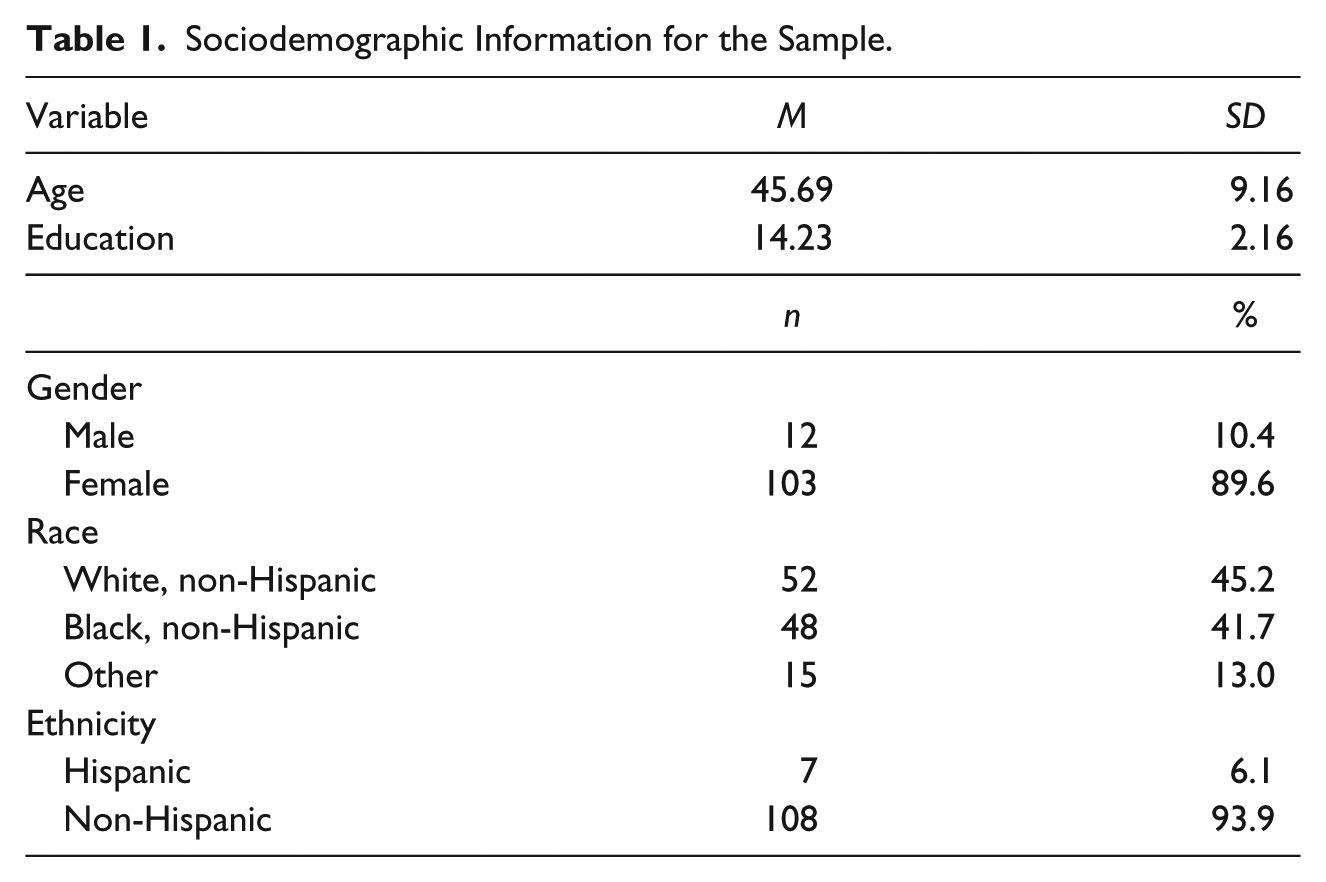
In total, 128 veterans were recruited for the parent RCT; however, complete baseline data on the variables of interest were available for only 115 of these veterans. The sample was predominantly female (n = 103, 89.6%), with the majority of veterans self-identifying as White (n = 52, 45.2%) or Black (n = 48, 41.7%). In addition, the sample was primarily non-Hispanic (n = 108, 93.9%). The mean age of the sample was 45.69 (SD = 9.16) years, and the mean number of years of education was 14.23 (SD = 2.16). Complete sociodemographic information for the sample can be found in Table 1.
Sociodemographic Information for the Sample.
Measures
The SCS (Rudd et al., 2010) is a self-report questionnaire that assesses suicide-specific cognitions related to three factors underlying an individual’s suicide belief system: unbearability, unlovability, and unsolvability (Bryan et al., 2014; Bryan, Kanzler, et al., 2017). The SCS has good internal consistency, convergent validity, and divergent validity, and is a significant predictor of both current suicidal ideation and likelihood of future suicidal SDV (Bryan et al., 2014; Bryan, Kanzler, et al., 2017). On the unbearability subscale, in a previous study, respondents who endorsed a lifetime history of SI on average scored 12.08 (SD = 1.00), and respondents with a lifetime suicide attempt on average scored 17.64 (SD = 1.47; Bryan et al., 2014). Average scores for the six-item unlovability and unsolvability subscales have not yet been reported for different clinical populations.
The Clinician Administered PTSD Scale (CAPS; Blake et al., 1995) was administered to confirm current MST-related PTSD diagnosis and PTSD criteria B (Re-Experiencing), C (Avoidance), and D (Hyperarousal) symptom severity as defined by the Diagnostic and Statistical Manual of Mental Disorders (4th ed., text revision; American Psychiatric Association, 2000). The CAPS is a commonly used psychodiagnostic measure of PTSD and has strong psychometric properties including good convergent validity with other commonly administered measures of PTSD symptom severity (Weathers, Keane, & Davidson, 2001).
The Posttraumatic Cognitions Inventory (PTCI) was administered to assess trauma-related negative cognitions (Foa, Ehlers, Clark, Tolin, & Orsillo, 1999). The PTCI is a self-report measure that assesses for trauma-related negative cognitions on three subscales: trauma-related negative cognitions about self (i.e, “I am a weak person”), trauma-related negative cognitions about the world (i.e., “The world is a dangerous place”), and trauma-related negative cognitions about self-blame (i.e., “The event happened because of the way I acted”). The PTCI has demonstrated good internal consistency and convergent validity (Foa et al., 1999).
The Beck Depression Inventory–II (BDI-II; Beck, Steer, & Brown, 1996) was administered to assess depression symptom severity within the past week. BDI-II Item 9, which assesses SI and suicidal intent, was excluded from the BDI-II score to avoid direct overlap between BDI-II and SCS scores (see Surís et al., 2011). The BDI-II is one of the most commonly administered self-report measures of depression symptom severity with strong psychometric properties (Beck et al., 1996).
The Short Form–36 Health Survey (SF-36; Ware, Snow, Kosinski, & Gandek, 1993) was administered to assess psychosocial and health functioning. The SF-36 is a self-report measure that generates scores for eight domains: Bodily Pain, Social Functioning, Emotional Role Functioning, Physical Role Functioning, Vitality, Mental Health, General Health, and Physical Functioning. Based on the size of our sample and number of hypothesized predictors of suicide-specific cognitions, composite scores of the SF-36 were used. Mental Health Composite scores (Vitality, Social Functioning, Emotional Role Functioning, Mental Health) and Physical Health Composite scores (Physical Functioning, Physical Role Functioning, Bodily Pain, General Health) were computed based on guidelines by Ware, Kosinski, and Keller (1994). Higher scores on both the mental health composite (MCS) score and physical composite score (PCS) are indicative of better overall mental and physical health functioning, respectively. The SF-36 is commonly used in health care and research settings and has sound psychometric properties (McHorney, Ware, & Raczek, 1993; Ware, Gandek, & the IQOLA Project Group, 1994).
The Quality of Life Inventory (QOLI; Frisch, Cornell, Villanueva, & Retzlaff, 1992) was administered to assess perception of overall life satisfaction. The QOLI is a self-report measure that generates a normed t-score based on perceived quality of life. The QOLI is a validated measure for use in psychiatric clinical research (Frisch, 2013; McAlinden & Oei, 2006).
The Sexual Abuse Exposure Questionnaire (SAEQ; Rowan, Foy, Rodriguez, & Ryan, 1994) is a self-report measure that was administered to assess CSA history. Veterans were asked to identify (i.e., yes, no, or unsure) if they have experienced invasive sex abuse acts (e.g., “exposure,” “fondling,” “intercourse”). For the purpose of this study, veterans were coded as having a history of CSA if they endorsed at least one exposure to CSA. The SAEQ has good reliability and is commonly used in research (Rodriguez, Ryan, Rowan, & Foy, 1996; Rowan et al., 1994).
A sociodemographic questionnaire was administered to determine age, education, gender, race, and ethnicity.
Analytic Plan
Three hierarchical multiple linear regression models were computed, with the SCS factors (unbearability, unlovability, and unsolvability) entered as the criterion variables. The first block comprised simultaneously entered sociodemographic (i.e., age, education, gender, and racial–ethnic self-identification) predictor variables. Based on the distribution of our sample and our analytic plan, race was defined as White, Black, or “Other.” The “Other” group included veterans who self-identified as American Indian/Alaskan Native (n = 3), Native Hawaiian/Pacific Islander (n = 2), or “Other” (e.g., biracial, multiracial; n = 10). Stepwise entry was utilized for the second block, which consisted of hypothesized predictors of suicide-specific cognitions (i.e., CAPS-B, CAPS-C, CAPS-D, trauma-related negative cognitions about self, trauma-related negative cognitions about the world, trauma-related negative cognitions about self-blame, truncated BDI-II, MCS, PCS, and QOLI scores, history of CSA). An entry level of p ≤ .15 was utilized for inclusion in the second block (Tabachnick & Fidell, 2013). Bivariate correlations were computed to assess for multicollinearity between continuous variables entered into regression analyses. A standard guideline of .80 or greater for multicollinearity between variables was utilized (Leahy, 2000). We also used a combination of tolerance and variance inflation factor (VIF) to further ensure that multicollinearity did not affect results, with a standard guideline of ≤ .20 for tolerance and ≥ 4 for VIF being indicative of multicollinearity (Menard, 1995; Pan & Jackson, 2008). For all statistical analyses, alpha was set at .05.
Results
Descriptive statistics for hypothesized predictors of unbearability, unlovability, and unsolvability can be found in Table 2. No significant multicollinearity was present based on bivariate correlations (see Table 3), tolerance, or VIF.
Descriptive Statistics for Unbearability, Unlovability, Unsolvability, and Hypothesized Predictors.
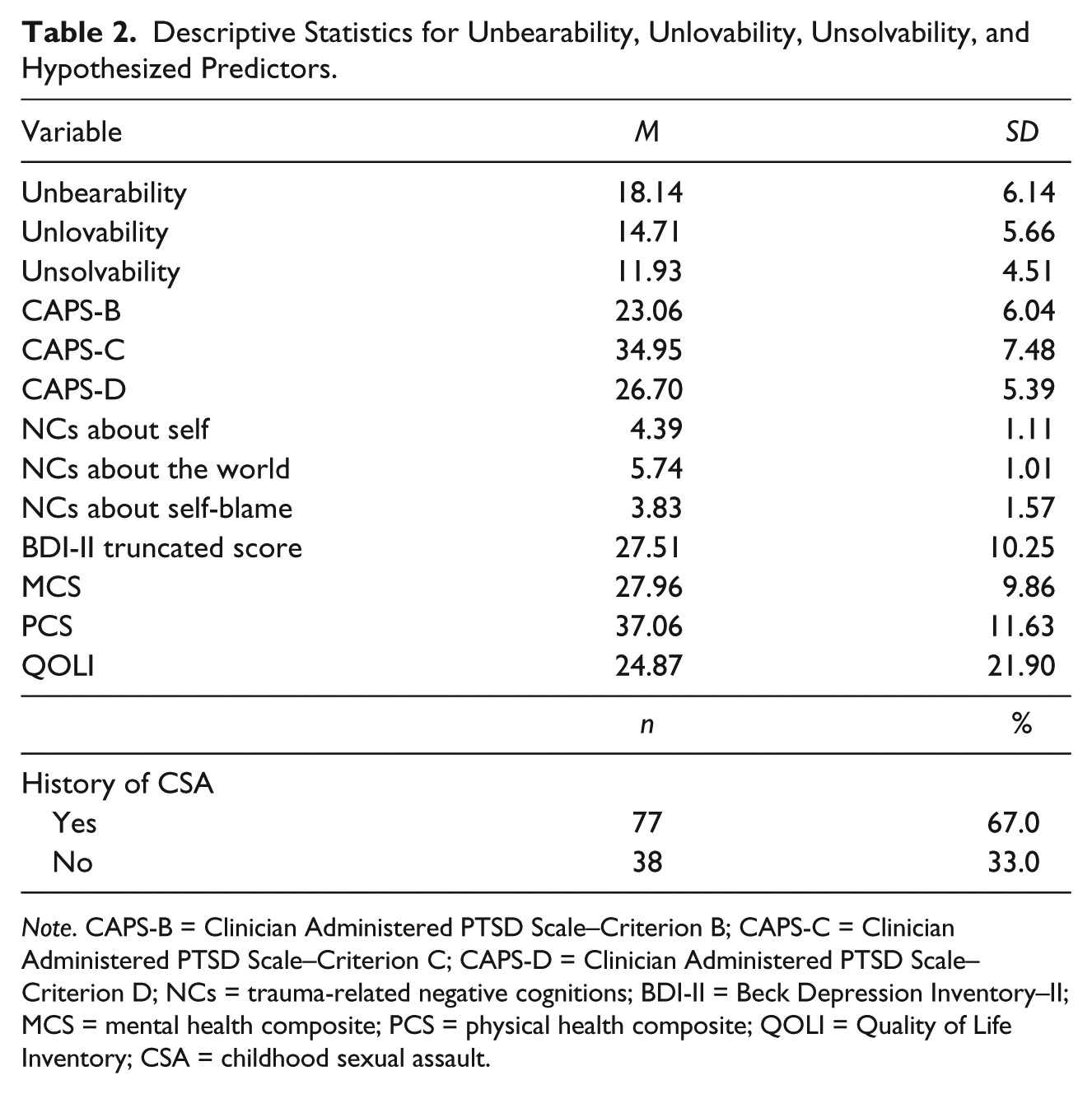
Note. CAPS-B = Clinician Administered PTSD Scale–Criterion B; CAPS-C = Clinician Administered PTSD Scale–Criterion C; CAPS-D = Clinician Administered PTSD Scale–Criterion D; NCs = trauma-related negative cognitions; BDI-II = Beck Depression Inventory–II; MCS = mental health composite; PCS = physical health composite; QOLI = Quality of Life Inventory; CSA = childhood sexual assault.
Bivariate Correlation Matrix for Unbearability, Unlovability, Unsolvability, and Hypothesized Predictors.
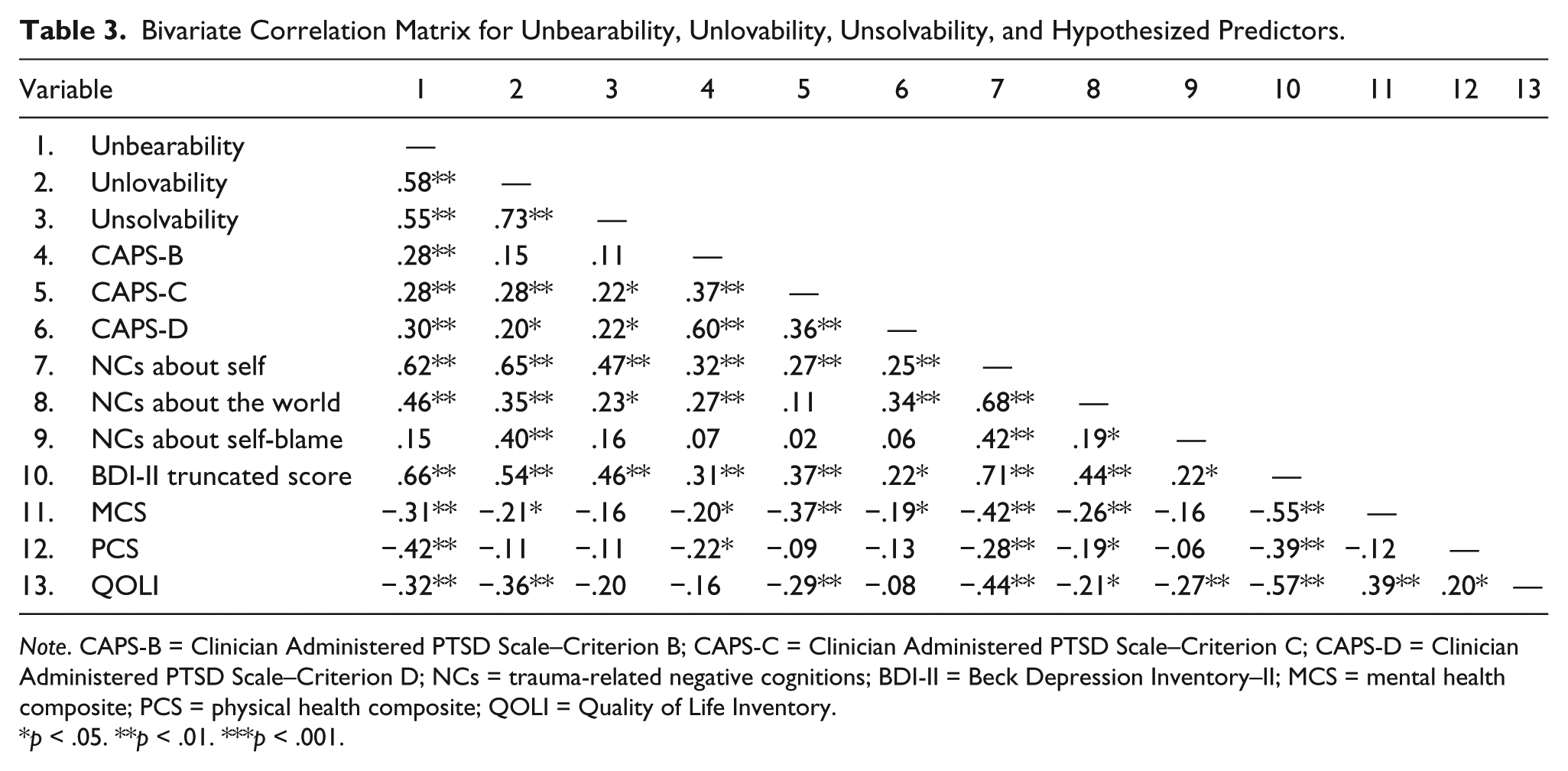
Note. CAPS-B = Clinician Administered PTSD Scale–Criterion B; CAPS-C = Clinician Administered PTSD Scale–Criterion C; CAPS-D = Clinician Administered PTSD Scale–Criterion D; NCs = trauma-related negative cognitions; BDI-II = Beck Depression Inventory–II; MCS = mental health composite; PCS = physical health composite; QOLI = Quality of Life Inventory.
p < .05. **p < .01. ***p < .001.
Unbearability
The unbearability regression model was significant, adjusted R2 = .48, F(8, 106) = 14.00, p < .001. Age, education, gender, race, and ethnicity were not found to be significant predictors of unbearability score (p > .05). After accounting for sociodemographic variables, BDI-II, trauma-related negative cognitions about self, and PCS scores were found to be significant predictors of the unbearability score (p < .05; see Table 4). CAPS-B, CAPS-C, CAPS-D, trauma-related negative cognitions about the world, trauma-related negative cognitions about self-blame, MCS, and QOLI scores, and history of CSA were not significant predictors and were not included in the final regression model (p > .05).
Regression Model of Predictors of Unbearability.

Note. BDI-II = Beck Depression Inventory–II; NCs = trauma-related negative cognitions; PCS = physical health composite.
p < .05. **p < .01.
Unlovability
The unlovability regression model was also significant, adjusted R2 = .47, F(8, 106) = 13.50, p < .001. Age, gender, race, and ethnicity were not found to be significant predictors of the SCS score (p > .05). However, lower education was found to be a significant predictor of greater unlovability score (p < .05; see Table 5). After accounting for sociodemographic variables, BDI-II and trauma-related negative cognitions about self and self-blame were significant predictors of the unlovability score (p < .05; see Table 5). CAPS-B, CAPS-C, CAPS-D, trauma-related negative cognitions about the world, MCS, PCS, and QOLI scores, and history of CSA were not significant predictors (p > .05) and were not significantly additive to the final regression model.
Regression Model of Predictors of Unlovability.

Note. NCs = trauma-related negative cognitions; BDI-II = Beck Depression Inventory–II.
p < .05. **p < .01. ***p < .001.
Unsolvability
The unsolvability regression model was also significant, adjusted R2 = .25, F(7, 107) = 6.39, p < .001. Age, education, gender, race, and ethnicity were not found to be significant predictors of SCS score (p > .05). After accounting for sociodemographic variables, only BDI-II and trauma-related negative cognitions about self were significant predictors of the unsolvability score (p < .05; see Table 6). CAPS-B, CAPS-C, CAPS-D, trauma-related negative cognitions about the world, trauma-related negative cognitions about self-blame, MCS, PCS, and QOLI scores, and history of CSA were not significant predictors (p > .05) and were not significantly additive to the final regression model.
Regression Model of Predictors of Unsolvability.
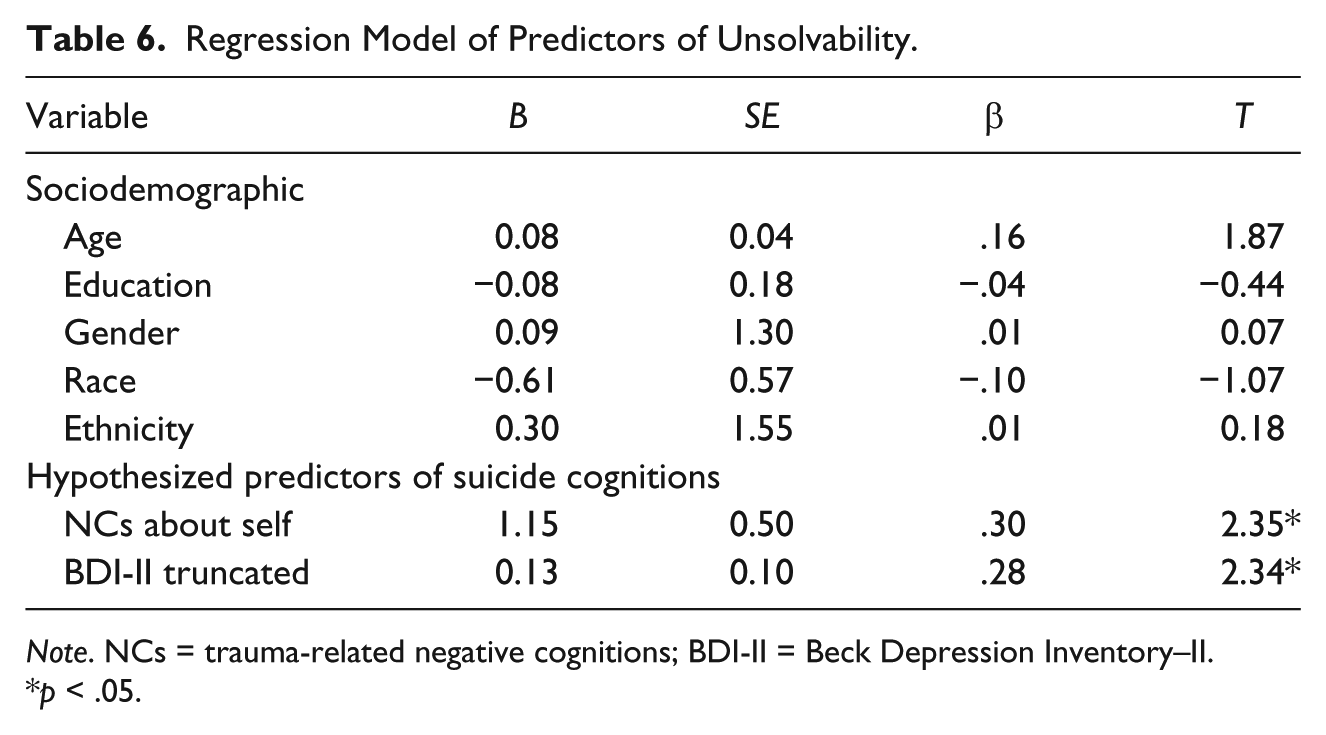
Note. NCs = trauma-related negative cognitions; BDI-II = Beck Depression Inventory–II.
p < .05.
Discussion
The present study examined the relationship between multiple established predictors of suicidal SDV and three suicide-specific cognitions, unbearability, unlovability, and unsolvability, among veterans with MST-related PTSD. After accounting for sociodemographic variables, greater depression severity was a significant predictor of unbearability, unlovability, and unsolvability, supporting results from a previous study (Surís et al., 2011). These findings are consistent with current research identifying depression as one of the strongest predictors of suicide (Nock et al., 2008). Although PTSD-related hyperarousal was a significant predictor of SCS total score (Surís et al., 2011), PTSD-related hyperarousal was not a significant predictor of unbearability, unlovability, or unsolvability in the presence of additional predictors of suicide.
Trauma-related negative cognitions about self were predictive of unbearability, unlovability, and unsolvability, whereas trauma-related negative cognitions about self-blame were only predictive of unsolvability. In addition, PCS scores were only significantly predictive of unbearability. These findings are consistent with previous research documenting that both trauma-related negative cognitions and physical health functioning are independently associated with suicidal SDV (MacLean et al., 2011; O’Hare et al., 2015). Education was a significant predictor of unlovability. This finding is consistent with previous research, which has identified that lower level of education is a risk factor for suicidal SDV (Steele, Thrower, Noroian, & Saleh, 2018) and suicidal ideation (Paradiso, Beadle, Raymont, & Grafman, 2016). Inconsistent with previous findings in other clinical populations (de Abreu et al., 2012; Devries et al., 2014), none of the other hypothesized predictors significantly accounted for variance in any of the three suicide-specific cognitions among veterans with MST-related PTSD.
The current theoretical understanding of suicide supports the association between trauma-related negative cognitions about self and suicide-specific cognitions. Based on the interpersonal theory of suicide, individuals’ suicide risk increases the longer their cognitions center around ideas of perceived burdensomeness and thwarted belongingness (Joiner, 2005). Veterans who report having trauma-related negative cognitions about self also report greater feelings of perceived burdensomeness and thwarted belongingness, which in turn may increase susceptibility to suicidal SDV (Joiner, 2005; Rogers, Kelliher-Rabon, Hagan, Hirsch, & Joiner, 2017).
Although the relationship between physical health functioning and suicide has been documented in other clinical populations, mechanisms underlying this association are not well understood. One possible explanation is that individuals with decreased physical health functioning experience heightened psychological distress, increasing their susceptibility to suicidal SDV (MacLean et al., 2011). Common treatments of physical illnesses can also exacerbate or induce psychological distress (e.g., side-effects of steroid-based medications: agitation, insomnia, emotional lability, nervousness, and depression; Goodwin, Kroenke, Hoven, & Spitzer, 2003; Pokladnikova, Meyboom, Vlcek, & Edwards, 2008). Comorbid physical health and psychiatric diagnoses are further associated with decreased treatment adherence and coping ability, often leading to amplification of symptom severity and functional impairment (Katon & Ciechanowski, 2002).
Several limitations were present in the present study. Due to safety concerns, veterans with active suicidal intent were not included in the original RCT; therefore, results may not generalize to veterans endorsing suicidal intent. However, participants in this study scored higher on the unbearability subscale than previous studies of veterans with a lifetime suicide attempt, indicating a clinically relevant level of suicidality (Bryan et al., 2014). Female veterans were overrepresented in this sample. Male veterans with MST-related PTSD may have different risk factors for suicide-specific cognitions, and investigating these potential differences should be considered in future research. This sample was also largely non-Hispanic and included primarily veterans who identified as White or Black. Different cultural groups may have different suicide risk (Griffith, 2016); therefore, future research should attempt to capture a more representative sample of veterans. In addition, the present study was based on a sample of treatment-seeking veterans with MST-related PTSD, and these results may not apply to nontreatment-seeking veterans or survivors of other trauma types (e.g., combat or civilian trauma). These results would benefit from replication in a larger sample to better understand the potential interrelationship between depression, physical health functioning, trauma-related negative cognitions about self, unbearability, and unlovability.
Based on these findings, clinicians and researchers assessing suicide risk in veterans with MST-related PTSD may benefit from awareness of the relationship between suicide cognitions and depression symptom severity, trauma-related negative cognitions, and physical health functioning. In addition, when examining unlovability scores, clinicians and researchers should consider level of education when interpreting results. PTSD interventions with established efficacy at reducing depression symptom severity and trauma-related negative cognitions about self (e.g., CPT and prolonged exposure therapy [PE]; Holliday, Link-Malcolm, Morris, & Surís, 2014; Kumpula et al., 2017; Resick, Nishith, Weaver, Astin, & Feuer, 2002), and improving physical health functioning (e.g., CPT, PE, exercise interventions; Davidson, Babson, Bonn-Miller, Souter, & Vannoy, 2013; Holliday, Williams, Bird, Mullen, & Surís, 2015; Powers et al., 2015; Rauch et al., 2009) should be further examined in terms of their ability to also decrease suicide-specific cognitions. A greater understanding of which predictors influence suicide-specific cognitions may provide clinicians the ability to improve assessment of risk of future suicidal SDV, and development and validation of interventions to reduce future suicidal SDV.
Footnotes
Authors’ Note
Ryan Holliday is now affiliated to Rocky Mountain Mental Illness Research, Education, and Clinical Center for Suicide Prevention, Denver, USA & University of Colorado Anschutz Medical Campus, Aurora, USA.
Declaration of Conflicting Interests
The author(s) declared no potential conflicts of interest with respect to the research, authorship, and/or publication of this article.
