



Abstract
The risk for sexual victimization in college is high, and although there can be significant mental and physical consequences for the survivor, resource utilization for this issue is extremely low. The current study used the frameworks of both the ecological model and the theory of planned behavior to examine factors related to resource use in undergraduate survivors of unwanted sexual experiences. The sample consisted of 217 undergraduates who reported at least one unwanted sexual experience while in college (89% female, 76.5% Caucasian, M age 19.6). Data were collected in an online survey from a private liberal arts college, and were analyzed using decision tree modeling. Results suggested that resource use was less related to demographic or event characteristics, but rather related to victim response to the event as well as perceptions about control over potential resource use. In addition to key assault prevention efforts, it is thus important to also support survivor mental health and self-efficacy postassault.
In the United States, it is estimated that almost one third of women will experience sexual assault of some form over the course of their lives (National Sexual Violence Resource Center [NSVRC], 2015). Sexual assault behaviors range from unwanted touching and comments to forced rape, with rates of forced penetration occurring for about 20% of women (NSVRC, 2015). The risk for any sexual victimization is at its highest during young adulthood, as suggested by nationally representative samples which have found that over one third of rape victims were first assaulted at ages 18 to 24 (e.g., Black et al., 2011), and this phenomenon is particularly well-documented for women on college campuses. The consequences of these experiences are significant, and according to the NSVRC (2015), sexual assault is one of the most costly crimes (Miller, Cohen, & Wiersema, 1996). Many survivors report significant mental health symptoms subsequent to victimization, and college students in particular report higher levels of substance use, risky behaviors, lower academic performance, and sexual dysfunction after a sexual assault (Jordan, Combs, & Smith, 2014; Turchik & Hassija, 2014).
Help-Seeking for Sexual Assault
Despite the significant consequences of sexual assault, utilization of resources by survivors is low. In terms of options for resources to consult after an assault, there are a wide variety of choices available. Survivors can disclose to informal sources (such as peers and family), use sexual assault–specific resources (such as rape-crisis centers or the National Sexual Assault Hotline), report to formal sources (such as medical professionals and law enforcement), or use university resources (if enrolled, such as Title IX staff and student conduct), and rates of reporting vary by type of resource used. In particular, survivors are most likely to tell a same-sex peer, and least likely to use formal resources such as police (e.g., Amstadter et al., 2010), and generally rates of reporting at all are low. In national studies, rape is the least reported major crime, and on college campuses, the overwhelming majority of survivors do not formally report the incident (Fisher, Cullen, & Turner, 2000). In a study of college women who had been sexually assaulted, a total of 55% had disclosed the event at all, most to a female peer, and only 8% had sought help from a formal source (Orchowski & Gidycz, 2012). In those who do report to formal sources, the most commonly used resource appears to be mental health counseling (e.g., Amstadter et al., 2010). However, reporting an event through formal channels can cause stress for the survivor and/or elicit negative reactions such as victim blaming, particularly when reporting to law enforcement (Sabina & Ho, 2014; Ullman, 1999). However, labeling the event and obtaining appropriate support are important steps toward recovery (Ahrens, Stansell, & Jennings, 2010; Ullman, 1999). In particular, obtaining trauma-focused treatment for more severe sexual assaults can help reduce self-blame, as well as symptoms of depression and posttraumatic stress (Russell & Davis, 2007), after these negative events. Previous research regarding assault survivors suggests that participating in counseling after sexual assault greatly reduces the risk of revictimization (e.g., Littleton, Axsom, Grills-Taquechel, 2009). Consequently, it is important to assist survivors in reaching appropriate and helpful resources.
Theoretical Models
There are many potential barriers to and facilitators of resource use in the undergraduate population, and the current study examined the key factors that relate to the decision to use these resources after an unwanted sexual experience. In a summative ecological model described by Campbell and colleagues (Campbell, Dworkin, & Cabral, 2009), the effect of sexual assault is considered at all levels ranging from the individual to the societal. This model suggests that actions taken in the aftermath of a sexual assault are likely affected by the combination of individual-level factors (such as victim and assault characteristics), microsystem factors (such as social support), mesosystem factors (such as access to resources), macrosystem factors (such as rape culture and racism), chronosystem factors (such as repeated traumas), and pervasive self-blame factors (Campbell et al., 2009).
Considering the ecological model as it applies to resource use after an assault, past research has suggested that several individual-level variables are related to these behaviors. For example, Caucasian race is related to increased resource use (Amstadter, McCauley, Ruggiero, Resnick, & Kilpatrick, 2008). In addition, more stereotypical assaults (i.e., those committed violently by strangers) and higher levels of mental health symptoms after assault are related to increased resource use (Price, Davidson, Ruggiero, Acierno, & Resnick, 2014; Starzynski, Ullman, Filipas, & Townsend, 2005). Past research has also implicated the role of individual beliefs such as “I should be able to handle this on my own” as barriers to resource utilization (Guerette & Caron, 2007).
At the microsystem level, most research has focused on social response after the survivor has told someone, rather than as a predictor of initial disclosure, and generally suggests that negative responses are related to reduced future resource use (e.g., Ullman, 1999). However, it is also useful to consider the ways in which a survivor’s social network may be related to their decision to use resources, even before the survivor has reached out. In this context, it is useful to also consider the theory of planned behavior (TPB; Ajzen, 1991), which suggests that intention to act is dictated by personal beliefs, social norms, and perceived control over the behavior. Regarding social norms, the TPB suggests that people choose to act based on anticipated approval or judgment from their social networks, which would suggest that survivors may reach out to resources based on these perceived social responses. Similarly, beliefs about potential resources, such as the belief that resources will be helpful or not, are also likely related to a survivor’s decision to reach out to resources. The present study addressed each of these factors.
Regarding the meso- and macrosystem factors suggested by the ecological model, past research does indicate that both having access to resources and being aware of societally held beliefs regarding sexual assault play a role in the process of resource utilization after sexual assault. Awareness of and ability to use resources appear to be related to resource use in general and specifically for sexual assault (Kessler et al., 2001; Price et al., 2014). In addition, shame and self-blame after a sexual assault seem to be key barriers to resource use (e.g., Allen, Ridgeway, & Swan, 2015; Orchowski & Gidycz, 2012). As suggested by the ecological model, self-blame seems to be a factor at all levels—both in terms of personal blame for the assault and in societal-level acceptance of common rape myths (Paul, Gray, Elhai, & Davis, 2009; Starzynski et al., 2005). Thus, it is particularly important to consider these issues as factors in the decision to use resources after sexual assault.
Current Study
Although the ecological and TPB models suggest a number of related variables and past research studies have supported the importance of these types of variables individually, the most critical factors in relation to a survivor’s decision to seek out resources after a sexual assault are still unclear. The current study evaluated many of these key variables in a sample of undergraduates who had experienced sexual assault, with the aim of investigating a comprehensive set of factors related to any type of resource utilization (i.e., at the formal or informal level). The study was framed as being about “unwanted sexual experiences” so that the responses would be inclusive of resource use after the broadest range of sexual behaviors. Given the nature of the research question, the data analysis was exploratory with a focus on use of resources as the main outcome. Previous research has particularly focused on trauma severity, severity of postassault mental health problems, and beliefs about blame as key correlates of resource use, and so it was expected that these variables might be most clearly related to resource use after assault. As suggested by the theoretical models described, independent variables included individual and social factors (including demographics, assault characteristics and history, mental health symptoms and coping strategies, personal beliefs about resource use and control, and social norms beliefs) and broader factors (including rape myth acceptance, blame, and awareness of resources).
Method
Participants
The sample consisted of 217 undergraduate student survivors of an unwanted sexual experience (89% female) who were recruited from a private liberal arts college in the Southeastern United States. Racially, 76.5% were Caucasian, 0.9% identified as Black, 2.3% identified as Asian/Pacific Islander, 1.4% identified as Latino, 0.5% identified as “other,” 12.9% opted not to answer, and an additional 5.6% identified with more than one racial group. By class year, participants were approximately 29% first year, 24% sophomore, 18% junior, and 27% senior. Regarding sexual orientation aside from the unwanted experience, about 90% of respondents indicated primarily heterosexual experiences, 5.8% indicated more heterosexual than homosexual experiences, 2.6% indicated equal heterosexual and homosexual experiences, and the remaining 1.6% indicated exclusively homosexual experiences. The average age of participants was 19.6 (SD = 1.25). The demographic makeup of this sample accurately represented the demographics of the campus from which the sample was drawn.
Regarding mental health history, about 50% of the sample reported that they had been diagnosed with a mental health condition prior to their unwanted sexual experience, and about 50% of the sample reported that they had sought any form of treatment for a mental health concern prior to the event. Regarding sexual history, approximately 75% of the sample reported that they had ever had sexual intercourse prior to the unwanted sexual experience. Regarding history of unwanted sexual experiences prior to entering college, 54.2% of the sample acknowledged unwanted touching, 15.7% reported unwanted oral sex, and 18.9% reported unwanted intercourse.
Recruitment and Procedure
Participants were recruited to take an anonymous online survey through various means at a predominantly undergraduate institution. These means included fliers, written messages on classroom boards, social media, email, and a psychology research participant pool derived from students participating for credit in the university’s introduction to psychology classes. Potential participants were eligible as long as they were a student at the university and over the age of 18. The survey was advertised as being about “unwanted sexual experiences,” and the sample was intended to be broad to include a wide range of unwanted sexual experiences as well as participants who both had and had not used any resources after the event.
Participants were directed to complete the anonymous survey utilizing Qualtrics, an online survey tool. Participants provided informed consent upon beginning the study and were provided with a list of available resources at the end of the study in the event that the survey should lead to emotional distress. The survey was designed to take 20 min or fewer. As this study was developed to capture the responses of those who had been a survivor of an unwanted sexual experience, a screening question asked the participants if someone had attempted to engage in sexual contact, oral sex, or sexual intercourse without their consent during their college career. Those who answered in the affirmative were directed to the survey questions regarding the after effects of the unwanted experience, while those who did not endorse an event were redirected to a separate survey regarding social responses to unwanted sexual assault. A total of 1,041 participants were eligible for the survey, and of those, 403 indicated a history of sexual assault. Of those 403, a total of 217 completed the entire survey, and the present report focuses solely on these survivors’ responses. Survey completion was defined as having completed a majority (75%) of each measure. Although it is not known exactly why all participants did not complete the survey, the data seems to suggest that a portion dropped out upon seeing the questions regarding specific sexual experiences, and the rest dropped out due to the length of the survey. At the conclusion of participation, respondents were offered the opportunity to enter into a raffle for one of 25 US$20 gift cards. To preserve anonymity of responses, participants were directed to a separate page to enter their contact information for the raffle. The study was approved by the local institutional review board prior to recruitment of participants.
Measures
Measuring victimization and consequences
In addition to their own demographics, participants were asked to report on the characteristics of the most distressing unwanted sexual experience, including their relationship to the perpetrator, the perpetrator’s race, their use of alcohol during the event, their level of injury and fear from the event, and the time and location of the event. They were also asked to report on the nature of the event and on their mental health after the event as described below.
The Sexual Experiences Survey Short Form Victimization (SES-SFV)
The SES-SFV was utilized to determine the nature of the unwanted sexual experience. The measure assesses 10 specific types of assault, including attempted and completed unwanted touching; oral, vaginal, and anal penetration; and forced taking advantage of another person (Koss et al., 2006). The measure also assesses the means the perpetrator used to perform that assault, for example, physical threats or taking advantage of an intoxicated individual. Items are phrased as specific behaviors to increase clarity of reporting, such as “Someone completed vaginal penetration (with their body parts or other objects) without my consent.” Respondents indicated how many times the incident and particular means of victimization had occurred since beginning college (0, 1, 2, or 3+). If respondents endorsed multiple victimizations, they were asked to consider the most distressing event for the duration of the survey.
The PTSD checklist for Diagnostic and Statistical Manual of Mental Disorders (5th ed.; DSM-5) (PCL-5)
The PCL-5 was utilized to assess levels of posttraumatic stress disorder (PTSD) in response to the specified unwanted sexual experience (Weathers et al., 2013). In this measure, respondents were asked to rate the level at which they “had been bothered” by PTSD symptoms on a scale from 0 (not at all) to 4 (extremely). Higher scores on this measure indicate more severe PTSD. Participants were asked to respond to the PCL-5 regarding their most distressing unwanted sexual event. The PCL is a widely used and validated measure of PTSD (Weathers et al., 2013) and Cronbach’s alpha in this sample was .97.
The Patient Health Questionnaire–9 (PHQ-9)
The PHQ-9 was used to assess depression among respondents (Kroenke, Spitzer, & Williams, 2001). This measure asked participants to rate how often they have experienced nine symptoms of depression in the last 2 weeks on a scale from 0 (not at all) to 3 (nearly every day). A higher total score indicates a more severe case of depression. Cronbach’s alpha for this measure was .93.
Measuring TPB variables
TPB measure
This measure assesses the four components of the TPB including personal attitudes, social norms, perceived behavioral control, and intention to do a specific behavior (Hess & Tracey, 2013). In the present study, the target behavior assessed was resource use after the unwanted sexual experience. Each item was rated on a 7-point scale, and scores for each subscale were summed. The TPB Attitudes scale used five items to assess an individual’s beliefs about seeking professional help to address problems that came as a result of their unwanted sexual experience. This scale asked individuals to rank their thoughts ranging from a positive attitude to a negative attitude, for example, seeking help from a professional was placed on a scale from “harmful” to “beneficial.” Cronbach’s alpha for this scale was .92. The TPB Social Norms scale used three items to assess an individual’s perception of what their friends’ feelings would be regarding seeking professional help to address problems that came as a result of their unwanted sexual experience. For example, the scale asked a person to rate how the people whose opinion they value would feel about their resource use, on a scale from “approve” to “disapprove.” Cronbach’s alpha for this scale was .69. The TPB Perceived Behavioral Control scale used four items to assess an individual’s beliefs about how much control they have over seeking help. For example, on a scale from “definitely true” to “definitely false,” respondents were asked to indicate their belief that they “could seek help from a professional to address a problem that resulted from an unwanted sexual experience.” Cronbach’s alpha for this scale was .71. Behavioral intention was measured with one item: “I intend to seek help from a professional to address a problem that resulted from an unwanted sexual experience.”
Measuring assault beliefs
Illinois Rape Myth Acceptance Scale (IRMA)
This measure was used to explore the respondent’s beliefs about common rape myths (Payne, Lonsway, & Fitzgerald, 1999). Respondents were asked to rank from 1 (strongly agree) to 5 (strongly disagree) statements containing myths about rape, such as “If a person doesn’t say ‘no’ they can’t claim rape.” This measure breaks down into four subscales focused on rape myths stating that the survivor asked to be assaulted, that the perpetrator did not mean to commit the assault, that the rape was not actually a rape, and that the survivor lied about the incident. Higher scores indicate lower belief in rape myths. Cronbach’s alpha ranged from .80 to .91 in this study.
Blame items
Five items assessing blame were utilized in this study. The items were based on the categories of blame addressed in the Rape Attribution Questionnaire (RAQ; Frazier, 2003), which include self-blame (both due to something permanent about oneself and due to a specific behavior or action one did), blaming chance, blaming the perpetrator, and blaming society. The RAQ includes 25 questions that cover these five areas, but in an attempt to minimize the number of questions on the survey, only five items were used in the current survey. The items directly addressed blame for each of those areas; for example, “The event is my responsibility because I am an unlucky person.” Survivors were asked to rate their beliefs regarding blame for the event on a scale from 1 (not at all) to 5 (very much). The model of using five individual questions has been used in several studies of sexual assault (i.e., Ullman, Peter-Hagene, & Relyea, 2014). Items were used individually, and so scale reliability was not calculated.
Measuring event response and resource utilization
Coping Strategies Inventory Short Form (CSI-SF)
The CSI-SF is a brief form of the Coping Strategies Inventory (Tobin, Holroyd, Reynolds, & Wigal, 1989), which has been widely used as a measure of general coping responses (Addison et al., 2007). In the current study, the questionnaire was framed to ask about coping in response to the unwanted sexual experience. This measure had a total of 16 coping strategies, such as “I try to let my emotions out,” rated on a scale from 1 (not at all) to 5 (very much). The items can be divided into four subscales: Problem Focused Engagement, Problem Focused Disengagement, Emotion Focused Engagement, and Emotion Focused Disengagement, or can be used as two overarching scales of engaged or disengaged coping. The two subscale model was used in this study, with Cronbach’s alpha ranging from .72 to .79.
Resource utilization
Respondents were provided with a list of 21 formal and informal resources, including personal contacts, university offices and administrators such as the Title IX coordinator, counseling services, and a confidential support line, and off-campus resources such as police, medical, and rape-crisis offices. Participants were asked whether they were aware of these resources, and whether they utilized these resources after the specified unwanted sexual event. For continuous data analysis, these endorsements were summed to make a total score for awareness and use. In addition, a variable was created that categorized participants into groups based on whether or not they had used any resources. The perceived helpfulness of these resources (whether they had been used or not) was also assessed by providing the name of the resources, and asking the respondent to rank the helpfulness of each resource on a scale from 1 (not at all helpful) to 10 (extremely helpful). These ratings were averaged for each participant. Cronbach’s alpha for these measures ranged from .80 to .92.
Data Analysis
Data were analyzed using IBM SPSS Statistics 23 and the SPSS Decision Tree add-on. Data were evaluated for outliers and missing data, and missing data were excluded from analysis. Individual missed items were deleted listwise. Frequencies and correlations were run based on the pertinent theories of behavior and survivor response. Important rates of use and correlations are described below, but the main goal of the project was to examine what factors were related to survivor resource use after a sexual assault. Given that many of the key independent variables, as well as the outcome of interest, were categorical or ordinal in nature, the Chi-Square Automatic Interaction Detector (CHAID) function of the Decision Tree add-on was used for the main analysis. With a categorical outcome variable, the CHAID function examines all possible chi-square interactions between the outcome and related variables to determine which independent variables most clearly classify participants based on the outcome variable. This recursive partitioning process continues until the split is no longer meaningful (p > .05) or the sample size per block is too small (n < 25). Given the number of analyses, this method automatically uses a Bonferroni correction to ensure appropriate significance testing.
Results
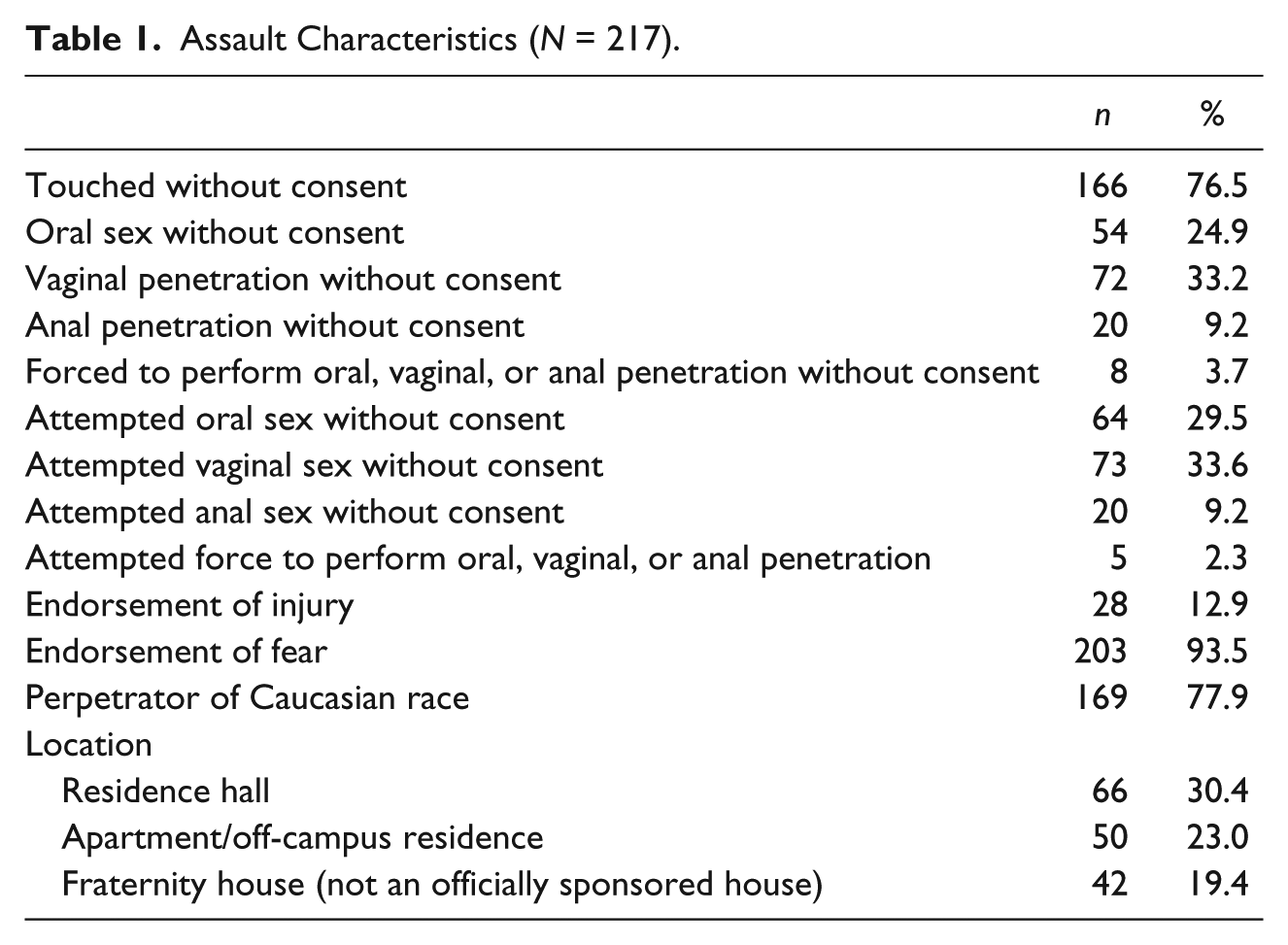
Of those who reported an assault, the most common forms were unwanted touching (76.5%), unwanted oral sex (24.9%), and unwanted vaginal penetration (33.2%). The majority were perpetrated by acquaintances (60.4%) and involved willing alcohol use on the part of the survivor (71.0%). Almost all occurred in the evening hours (91.2%; see Table 1 for further descriptors). Out of the 217 participants, 151 (69.6%) had told anyone about the assault. In the entire sample (whether they had actually used a resource or not), awareness of resources was high (typically 75% or higher; see Table 2). It appears that many students in the sample were less aware of official university channels such as student life (58.1%), administrators (58.5%), and Title IX services (35.0%). Participants also did not appear to be aware of sexual assault–specific resources for this issue (e.g., awareness of rape-crisis center was 56.7%), and did not consider a religious adviser to be a resource for this issue (awareness was 60.8%). In terms of helpfulness, participants rated friends and private mental health counselors as the most helpful (7.46 and 7.37, respectively, on a scale from 1 to 10; Table 2), while rating university staff members at all levels the least helpful (in the 4-5 range). In participants who had talked about the event with at least one resource, the most commonly used resource was telling a friend (88.1%), followed by telling a partner or family member (25.2%, 21.2%). Overall rates of formal use were low (2%-15%), but the most commonly used formal resources were university and private counseling (15.2%, 13.9%), university health services (7.3%), and a university-sponsored confidential reporting hotline (6.6%).
Assault Characteristics (N = 217).
Rated Awareness, Perceived Helpfulness, and Use of Resources.

Note. Aware = participant was aware of the resource for sexual assault; used = participant used the resource after sexual assault; helpful = participant rating of how helpful the resource would be for sexual assault. For awareness and helpfulness data, N = 217 (whole sample). For use data, N = 151 (subsection of sample that had used any resources).
Correlations among continuous variables were explored (see Table 3). Interestingly, a pattern emerged in which the primary variable significantly correlated with awareness of resources was rape myth acceptance, such that less belief in rape myths was related to more knowledge of resources. Depression was also related to awareness, such that more depressive symptoms were related to less awareness of resources. No variables regarding blame, attitudes, beliefs, or symptoms were related to perceived helpfulness of resources, with the exception of awareness of resources and lower disengaged coping. Resource use was correlated with self-labeling as an unlucky person, believing that one’s social network would support resource use, intending to use resources, and having higher levels of depression and PTSD (see Table 3).
Descriptive Statistics and Correlations With Outcome Variables.
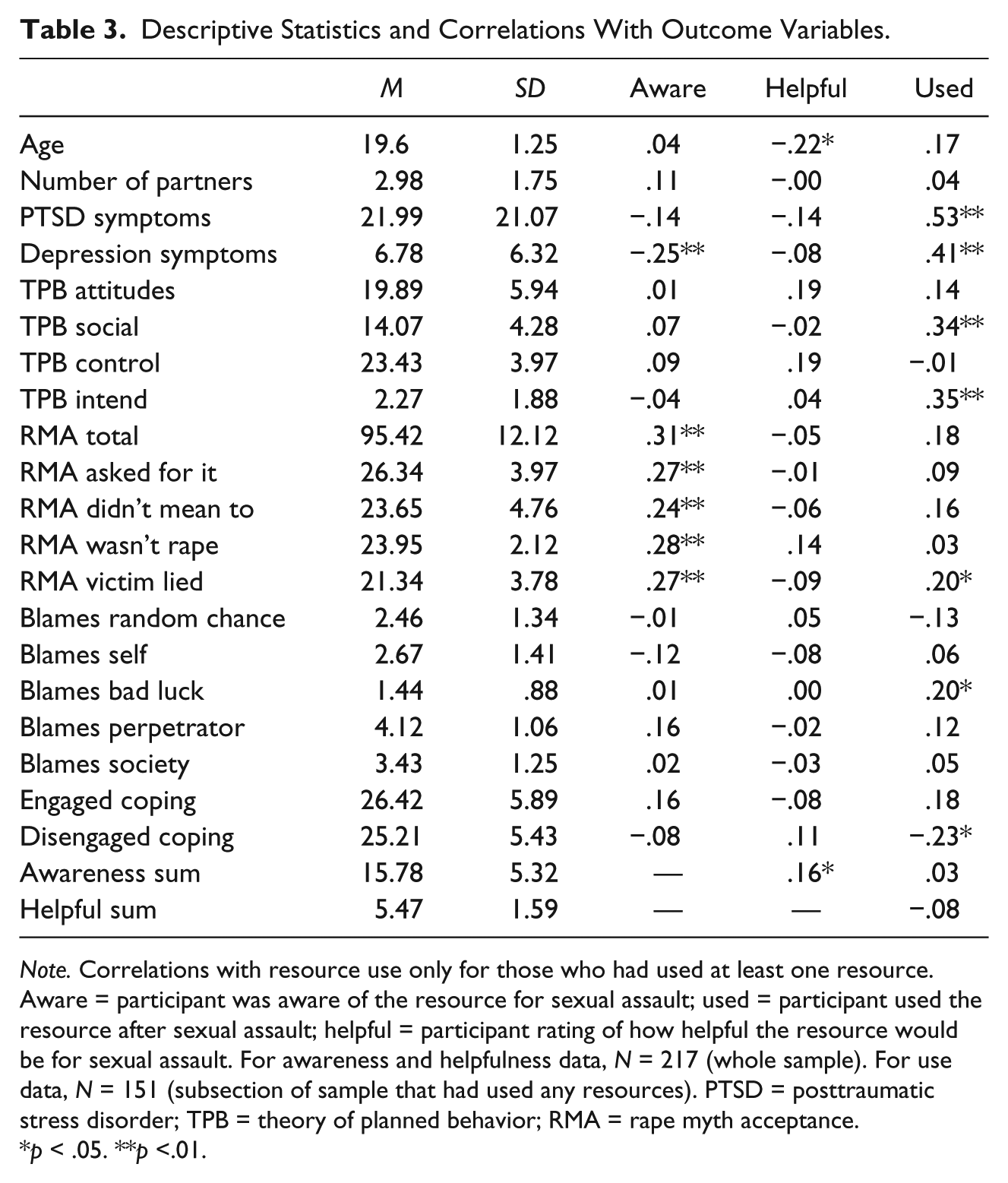
Note. Correlations with resource use only for those who had used at least one resource. Aware = participant was aware of the resource for sexual assault; used = participant used the resource after sexual assault; helpful = participant rating of how helpful the resource would be for sexual assault. For awareness and helpfulness data, N = 217 (whole sample). For use data, N = 151 (subsection of sample that had used any resources). PTSD = posttraumatic stress disorder; TPB = theory of planned behavior; RMA = rape myth acceptance.
p < .05. **p <.01.
As discussed, the primary goal of this project was to understand which of the many potential factors was most closely related to resource use in a population of undergraduate sexual assault survivors. To this end, data were examined regarding which independent variables most clearly classified participants into groups based on whether or not they had used any resources. The decision tree analysis (see Figure 1) suggested that the variable that most clearly split participants into groups of those who had used resources versus those who had not was level of PTSD symptoms (p = .02). This indicates that higher levels of PTSD were related to higher levels of resource use. Of those with higher PTSD scores, the next meaningful split occurred with the belief that the event was due to chance (p = .01); neutral beliefs about the event being due to chance were related to lower use of resources as compared with strong beliefs about chance in either direction (i.e., strong belief that it was or was not due to chance). In those who had high PTSD and were not neutral regarding the role of chance, the final key variable was belief in control over behavior regarding resource use (p = .01), such that strong belief in control over behavior was related to higher levels of resource utilization. A full 100% of those with high PTSD, strong beliefs about the role of chance in the event, and strong belief in their control of their behavior used resources after the event.

Decision tree analysis of binary resource use (used any resource vs. no resources).
Discussion
This study is unique in its ability to provide an analysis of which factors most clearly relate to resource use after sexual victimization. Results suggested that out of factors at each ecological level, ranging from the individual to the macro level and beyond, the key variables related to using resources after an unwanted sexual experience were PTSD symptoms, blame beliefs, and beliefs about control of resource utilization behavior. The finding that PTSD is an important factor in this situation fits with past literature (e.g., Starzynski et al., 2005) and suggests that levels of mental health symptoms in response to an unwanted sexual experience are a main driver of seeking support. It is possible that level of PTSD symptoms reflects survivor impairment after an assault, which may explain why PTSD symptoms and resource use are related. This finding could be encouraging, as this may suggest that those with the greatest need are getting the assistance they need. However, this does not necessarily mean that these survivors are getting adequate treatment or even appropriate treatments for PTSD, as they may only be talking to friends or participating in ineffective treatments. Thus, it is still a concern to ensure that survivors with PTSD symptoms receive helpful treatment. This also suggests that those who may not perceive their event as “serious enough” to have significant symptoms may not reach out for assistance, which may result in long-term mental health consequences, higher risk of revictimization (e.g., Ahrens et al., 2010), and/or a lack of consequences for the perpetrator.
In those that had high PTSD symptoms, belief about the event being due to chance was also related to resource use. Neutral beliefs about the role of chance were related to lower use of resources, while strong beliefs (i.e., either believed that the event was strongly due to chance or not due to chance) were related to higher use. This breakdown fits with a commonly held understanding of PTSD related to the just world belief. The just world belief is the idea that people get what they deserve, or that good things happen to good people, while bad things happen to bad people (e.g., Littleton, 2010; Resick & Schnicke, 1992). Most people are taught this maxim at a young age to help encourage good behavior, but after a trauma, this belief can cause emotional difficulty. For those who maintain the just world belief, a bad event happening must logically mean that the survivor deserved it, and so self-blame occurs. For those who reject the just world belief, the world is suddenly unpredictable and thus unsafe (Littleton, 2010). Based on the findings, it may be that having strong feelings about the event being due to chance may be related to this belief, such that believing that the event was totally random likely reflects letting go of the just world belief, while believing that the event was not due to chance may reflect strong self-blame that comes from holding tightly to the just world belief. In either direction, it seems that strong feelings about blame based on one’s worldview are a key part of deciding to use resources. This may suggest that negative thoughts are the key aspect of PTSD that are associated with resource use, and that they are thus an important target for intervention.
In those with high PTSD and strong beliefs about blame, belief in control over resource use behavior was also related to resource use. This was measured by the TPB Control scale, which asked participants if they believed that resource use was possible for them and if it was up to them whether or not they used resources. In the context of the TPB, this variable may reflect that feelings of helplessness in survivors can be a barrier to seeking assistance, or alternately that high self-efficacy can increase resource use behavior. The finding that control beliefs play a role in help-seeking may also reflect an access issue in that survivors who do not feel that they have adequate access to resources may be less inclined to seek help at all.
Given these findings, it appears that the factors associated with a sexual assault survivor’s resource utilization are less the concrete characteristics of the person and the event, but rather the way that the survivor responds to and makes meaning of the event and believes that they can effect change in the future. Considering the importance of one’s beliefs and response to a trauma of this type, it is important to assist survivors in appropriately labeling and processing an unwanted sexual experience and not discouraging resource use for events that are deemed “not serious enough.” Furthermore, it seems particularly important to address the culture around seeking assistance for this experience, in that many may not feel that they have access to appropriate resources, or feel that available resources are inadequate. In terms of formal reporting, it will be important for universities and other institutions to provide and promote further information regarding the nature and availability of these resources.
Notably, awareness of resources was not a significant differentiator of resource utilization behavior. This could be in part because rates of awareness in this sample were relatively high, thus limiting variability, or could reflect that simply knowing about a resource is insufficient as a motivator to use it. However, it is certainly true that if one does not know of a resource, they cannot use it. In the current sample of university students, the resources about which participants had the least awareness were official university reporting channels, which is concerning given that this is the primary method of tracking and response for most institutions of higher learning. The resource that participants were most aware of and most used was talking to a friend, which is consistent with past research (e.g., Orchowski & Gidycz, 2012). Given that friends may or may not respond in an empathic and helpful manner, this suggests that it is important to provide students with training regarding how to best support a survivor in addition to current trainings such as the bystander intervention.
The main variable related to awareness of resources was lower belief in rape myths, which suggests that to create an environment in which students are actively involved in the prevention of sexual assault and prepared to respond, it is important to create a university culture in which survivors are supported by their peers and by the university. In addition, depression was significantly negatively correlated with awareness of resources (PTSD was also negatively correlated, although nonsignificant), which stands in contrast to the finding that increased mental health symptoms are related to higher resource use. This may further suggest that awareness of resources does not necessarily relate to their use, or may suggest that those with mental health concerns are aware of and thus seek out only specific resources (i.e., counseling).
In addition, it is important to consider that that rates of formal resource use in this study were generally low. In part, this may result from the inclusive language used in the study that resulted in a broad sampling of assault histories and responses, or due to lower awareness of these resources as discussed. However, over one third of the sample reported vaginal or anal penetration without consent, while only about 10% of the sample endorsed even seeking medical attention. Although many resources are available to survivors in this context, the barriers to using appropriate resources remain high.
The current study is limited in its generalizability, given the primarily Caucasian, female, and heterosexual population drawn from a convenience sample. Thus, it will be important to replicate these findings in more diverse samples. Also, to counter the retrospective and cross-sectional nature of the current data, future research would benefit from prospective studies of resource use in this population. A strength of this study is that resource users as well as those who had not told anyone about the event were included as participants; however, this also limits the variables that can be examined. For example, social response to sharing information about one’s assault history is often related to future reporting behavior (e.g., Ullman, 1999), but this type of variable could not be examined given that not everyone in the sample had discussed the event with any resources. The role of social response could certainly influence future behavior in those who have already used some resources, and so should not be ruled out as an important potential influence. Future research should examine this phenomenon in diverse samples, and should continue to consider resource use after sexual assault from an ecological perspective.
Overall, this study of undergraduate survivors of unwanted sexual experiences confirmed and extended previous findings regarding the process of resource utilization. The findings suggest the critical role of both the survivor’s response to and interpretation of the event, and an encouraging environment that supports the survivor’s access to helpful resources. The current research suggests that in addition to ongoing assault prevention efforts nationwide, it is essential that universities and other institutions, along with survivors’ informal networks, support survivors’ self-efficacy regarding resource use in the wake of an assault.
Footnotes
Declaration of Conflicting Interests
The author(s) declared no potential conflicts of interest with respect to the research, authorship, and/or publication of this article.
Funding
The author(s) received no financial support for the research, authorship, and/or publication of this article.