




Abstract
Research indicates women who perpetrate intimate partner violence (IPV) experience both more frequent and more severe IPV victimization. However, the IPV field needs additional research to understand the complex relationship between various forms of IPV victimization (e.g., psychological, physical, sexual) and IPV perpetration by women. In particular, the field needs a better understanding of the unique interplay of various forms of IPV victimization and perpetration among female system-involved survivors (i.e., female survivors involved with child protective services and/or the court system and mandated to services). Such understanding would aid extant efforts to ensure that mandated services address the experiences and meet the needs of these system-involved women. To address this knowledge gap, we conducted an exploratory, secondary data analysis using cross-sectional baseline data collected as part of a larger evaluation study of a psychoeducational therapeutic IPV and parenting program for system-involved IPV survivors mandated to services (N = 73). Results from multiple regression analyses revealed that both psychological and physical IPV victimization were uniquely associated with the perpetration of psychological and physical abuse by system-involved female IPV survivors. Furthermore, our examination of the interaction between physical and psychological victimization and its impact on perpetration revealed that higher levels of both physical and psychological IPV victimization were associated with significantly higher levels of psychological perpetration (p < .01) and increased likelihood of physical perpetration (p < .05). Results are discussed in the context of service provision within systems, agencies, and programs targeting system-involved women mandated to services for IPV.
Keywords
Intimate partner violence (IPV)—physical, sexual, and/or psychological abuse perpetrated by a current or former intimate partner—represents a key social and public health concern (Black et al., 2011). Accumulated prevalence data from nationally representative surveys have indicated alarming rates of lifetime IPV victimization among American women (e.g., Black et al., 2011). Furthermore, the various forms of IPV victimization rarely occur in isolation; most often, several types of IPV co-occur, progressing from psychological aggression to the more violent forms of physical and sexual victimization (Black et al., 2011).
Although the majority of IPV research has focused on women’s experiences of IPV victimization, an increasing body of research has examined female IPV perpetration (e.g., Bair-Merritt et al., 2010; Spencer, Cafferky, & Stith, 2016; Stuart et al., 2006; Swan, Gambone, Caldwell, Sullivan, & Snow, 2008; Williams, Ghandour, & Kub, 2008). Despite mixed findings regarding the prevalence of IPV perpetration and limitations of this research (e.g., sampling, cross-sectional designs, measurement; Hamberger, Larsen, & Campbell, 2016), it is clear that some women use violence in their intimate relationships, with the most common forms being psychological aggression, followed by physical assault, and then sexual abuse (Williams et al., 2008).
Research suggests that women who use violence in their relationships often report prior or current IPV victimization (e.g., Swan et al., 2008). However, more nuanced research is needed to clarify this complex relationship and to better understand women’s experiences of IPV victimization and perpetration. In particular, research is needed to untangle the relationship between various forms of IPV victimization and IPV perpetration by women (Orengo-Aguayo & Lawrence, 2014). To begin addressing this gap, the current study used secondary data to explore women’s perpetration of physical and psychological IPV in heterosexual relationships, and the association between these two forms of perpetration and three forms of IPV victimization: physical, psychological, and sexual victimization. The current study also explored the interactive effect of physical and psychological victimization on the women’s perpetration of physical and psychological abuse. Furthermore, this study focused on an understudied group: female IPV survivors mandated to receive services because of their involvement in the court system and/or child protective services (CPS); hereafter, this population is referred to as system-involved survivors. Understanding the multifaceted relationship between these women’s experiences of IPV perpetration and victimization is critical to ensuring that mandated services are tailored to the needs of this population. Given this article’s focus on women’s experiences of IPV victimization and perpetration in heterosexual relationships, it is beyond the scope of this article to present an overview of research comparing male and female IPV perpetration, or IPV in heterosexual versus same-sex relationships. See Desmarais, Reeves, Nicholls, Telford, and Fiebert (2012) for a comprehensive review comparing male and female IPV perpetration, and Badenes-Ribera, Bonilla-Campos, Frias-Navarro, Pons-Salvador, and Monterde-i-Bort (2016) for a review on the prevalence and correlates of IPV among women in same-sex relationships.
Female IPV Perpetration
Women have reported a wide variety of motives for perpetrating violence against intimate partners (e.g., Orengo-Aguayo & Lawrence, 2014). Notably, most research on women’s motives for IPV perpetration has focused on the perpetration of physical IPV using samples composed of either university and college women or women involved in the justice/legal system (Langhinrichsen-Rohling, McCullars, & Misra, 2012; Neal, Dixon, Edwards, & Gidycz, 2015). One often cited motive for female perpetration of physical IPV is self-defense, with this motive being more frequently reported among women experiencing severe partner violence victimization (e.g., Bair-Merritt et al., 2010; Neal et al., 2015). Women also report retaliation, fear, defense of children, expressing difficult emotions, and provocation by their partners as motives for perpetrating violence against a partner (e.g., Neal et al., 2015; Stewart, Gabora, Allegri, & Slavin-Stewart, 2014; Swan et al., 2008). Overall, research examining women’s motives for engaging in IPV perpetration underscores the importance of understanding women’s use of violence within the context of their victimization experiences (Swan et al., 2008). Orengo-Aguayo and Lawrence (2014) noted, “For women to be able to report that their aggression was in retaliation, anger, or self-defense, there must be a context or situation to which they are responding” (p. 302).
Understanding Female IPV Perpetration in the Context of Victimization
A growing body of evidence suggests that women’s use of violence typically occurs within intimate relationships in which the women are either currently experiencing or have experienced IPV victimization (Swan et al., 2008). The finding that many women who use violence in their relationships are also victims has been documented across various samples, including (a) college students, adolescents, and young couples (e.g., Dardis, Edwards, Kelley, & Gidycz, 2013); (b) community women (e.g., Sullivan, Meese, Swan, Mazure, & Snow, 2005); (c) women arrested for IPV perpetration (e.g., Stuart et al., 2006); and (d) women court-mandated to attend batterer intervention programs (e.g., Simmons, Lehmann, & Collier-Tenison, 2008). Despite growing knowledge of the relationship and overlap between women’s IPV victimization and their perpetration of IPV, less is known about the relationship between distinct types of IPV victimization and IPV perpetration (e.g., physical, psychological, and sexual), with a few notable exceptions.
Hellmuth, Gordon, Stuart, and Moore (2013) examined women’s use of various forms of IPV (i.e., psychological, minor, and severe physical abuse) during pregnancy and postpartum and found perpetration of minor physical violence to be associated with higher levels of minor physical victimization, whereas perpetration of psychological aggression was associated with higher levels of psychological victimization. In an examination of the national Add Health data (a longitudinal data set focused on adolescents and young adults), Renner, Whitney, and Vasquez (2015) examined gender and racial/ethnic differences in risk factors for physical IPV perpetration, which included as potential risk factors the respondents’ sexual, psychological, and physical IPV victimization. For White and Black females, physical IPV victimization was associated with increased odds of perpetrating physical IPV. For White, Latina, and Asian females, sexual IPV victimization was associated with increased odds of physical IPV perpetration. These recent studies highlight the importance of disentangling the relationship between different forms of IPV victimization and perpetration. Unfortunately, only limited research has been conducted with community-based samples of adult women or system-involved women. The limited differentiation between types of IPV in studies examining the relationship between victimization and perpetration is particularly troubling given differences in precursors, correlates, and outcomes (e.g., Breiding, Black, & Ryan, 2008).
System-Involved IPV Survivors
For myriad reasons, communities across the United States have experienced an increase in the number of women IPV survivors whose involvement with CPS and/or the court system led to their being mandated to services (DeLeon-Granados, Wells, & Binsbacher, 2006; U.S. Department of Health and Human Services [U.S. DHHS], Administration for Children and Families, Administration on Children, Youth and Families, Children’s Bureau, 2015). Authorities within these systems often mandate women to services with the goal of reducing IPV perpetration, enhancing parenting, and reducing children’s exposure to IPV and potential maltreatment. As such, mandated services usually consist of typical batterer intervention programs or parenting services (DeLeon-Granados et al., 2006; Simmons, Lehmann, & Dia, 2010). To ensure these services actually address their intended goals of reducing perpetration and enhancing child well-being, it is important to understand the characteristics and experiences of female, system-involved survivors, particularly around IPV victimization and perpetration. Although researchers suggest that services should address female survivors’ perpetration in the context of their victimization (e.g., Stuart et al., 2006), there is a dearth of research examining the unique relationship between forms of IPV victimization and perpetration (e.g., physical, psychological, and sexual IPV victimization and perpetration) among this population to help guide service delivery. Understanding the interplay between IPV victimization and perpetration among system-involved survivors is critically important for ensuring mandated services are tailored to the needs and experiences of these women, and thus, ultimately enhancing the acceptability and effectiveness of mandated services.
Current Study
The current exploratory study used secondary cross-sectional data to examine the relationship between different forms of IPV victimization—sexual, physical, and psychological abuse—and the perpetration of physical and psychological IPV among system-involved, service-mandated female survivors. Although we had also initially planned to examine perpetration of sexual IPV, we were unable to perform these analyses given the limited occurrence of such abuse in our data. Therefore, the research questions guiding the study included the following:
Given the extant research suggesting that victimization is associated with perpetration, we hypothesized that each form of IPV victimization—physical, psychological, and sexual—would be uniquely associated with the perpetration of physical and psychological abuse.
In addition, given that research has indicated that distinct forms of IPV victimization rarely occur in isolation (e.g., Black et al., 2011), we also sought to examine how victimization experiences interact to impact perpetration. In particular, we sought to examine the interaction between physical and psychological victimization given the co-occurrence and strong association between these forms of victimization (e.g., Macy, Rizo, & Ermentrout, 2013; Sullivan, McPartland, Armeli, Jaquier, & Tennen, 2012). Therefore, we formulated a third research question:
Given the exploratory nature of this research question, at the outset of this study, we did not formulate a specific hypothesis about the interaction effect, other than taking the position that including the interaction would help explain more variance in perpetration. However, because we hypothesized that both physical and psychological IPV victimization are independently associated with perpetration, we also considered a possible hypothesis that higher levels of these two forms of IPV victimization would be associated with perpetration (either higher levels or a higher likelihood of perpetration).
Method
Our research team conducted an exploratory, secondary data analysis using cross-sectional baseline data collected as part of a larger outcome evaluation of the Mothers Overcoming Violence through Education and Empowerment (MOVE) program. MOVE is a 13-week IPV and parenting program for female, system-involved survivors mandated to services after being brought to the attention of CPS and/or the court system because of an IPV incident that occurred in the context of a heterosexual relationship. All methods were approved by the University of North Carolina at Chapel Hill’s Office of Human Research Ethics and our team obtained a National Institutes of Health Certification of Confidentiality.
Research Participant Recruitment and Procedures
Following referral by the courts or CPS, all IPV survivors who began MOVE between January 2009 and July 2011 were invited to participate in an outcome study of the program. The women were first provided an overview of the research during their program intake and informed that participation would include the completion of questionnaires at 3 times: (a) program entry, (b) program completion, and (c) 3-month follow-up. After providing informed consent, participants completed the program-entry questionnaire that consisted of demographic questions and standardized measures for all program outcomes. Depending on participants’ literacy, the questionnaires were either self-administered or read aloud by a member of the research team. Participants received a US$30 gift card to thank them for their time.
During the study period, MOVE was delivered to 10 cohorts that totaled 89 women. Of these women, 73 (82%) agreed to participate in the outcome study. The current study conducted a secondary data analysis using only the program-entry data pertaining to demographic characteristics, IPV victimization, and IPV perpetration.
Measures
Dependent variables
This study examined two dependent variables: (a) physical IPV perpetration and (b) psychological IPV perpetration. Both variables examined IPV perpetration over the past 12 months. Physical IPV perpetration was measured using the 12-item Physical Assault subscale of the Revised Conflict Tactics Scales (CTS2; Straus, Hamby, Boney-McCoy, & Sugarman, 1996) perpetration form. Psychological IPV perpetration was measured by the 14-item short version of the Psychological Maltreatment of Women Inventory (PMWI; Tolman, 1999) perpetration form. Items for both of these outcomes were rated on a 7-point scale: 0 (this never happened), 1 (once), 2 (twice), 3 (3-5 times), 4 (6-10 times), 5 (11-20 times), and 6 (20+ times). To describe participants’ experiences of perpetration, we calculated frequency and prevalence scores for both outcome variables following CTS2 guidelines (Straus et al., 1996). Frequency was calculated by recoding the response items to their appropriate anchor midpoints (e.g., the response item 3 to 5 times was recoded from 3 to 4) and summing the items within each scale (physical perpetration range: 0-240; psychological perpetration range: 0-280). The Cronbach’s alpha values were .87 for physical IPV perpetration and .74 for psychological IPV perpetration, indicating good reliability. Prevalence scores were calculated on a 2-point scale with 1 indicating one or more of the acts in the respective scale occurred in the past year, and 0 indicating none of the items in the respective scale occurred in the past year.
Independent variables
This study examined three independent variables: (a) physical IPV victimization, (b) sexual IPV victimization, and (c) psychological IPV victimization. These variables examined participants’ 12-month history of IPV victimization. Both physical and sexual IPV victimization were measured using the CTS2 victimization form, specifically the Physical Assault (12-item, α = .93) and Sexual Coercion (five-item, α = .82) subscales. Two items were dropped from the Sexual Coercion subscale (i.e., items related to insisting on sex and oral/anal sex) based on concerns raised by IPV survivors who provided feedback on the entry questionnaire. Psychological IPV victimization was measured by the 14-item PMWI victimization short version (α = .92). Rating and scoring of the three independent variables followed the same protocols previously described for the IPV perpetration variables.
Covariates
To account for potential confounders, the analysis used five demographic covariates including age, race, education, current employment, and number of children ≤5 years living with the participant. Prior research has found these variables to be associated with IPV victimization and/or perpetration (e.g., Macy, Rizo, Guo, & Ermentrout, 2013; Palmetto, Davidson, Breitbart, & Rickert, 2013; Stith, Smith, Penn, Ward, & Tritt, 2004). Both participant age and number of children ≤5 years living with the participant were continuous variables that were mean centered in our analyses. Race used one indicator variable: non-White (1) and White (0), with White used as the reference group. Education was assessed using two indicator variables: (a) graduated or attended college/technical school (1) and otherwise (0), and (b) completed or attended graduate degree program (1) and otherwise (0). The reference group for education was high school/general educational development (GED) or below. Current employment was assessed with two indicator variables: (a) part-time (1) or other (0), and (b) unemployed (1) or other (0). The reference group for current employment was full-time.
Data Analysis
Descriptive analyses were used to describe the demographic characteristics of the study sample and the participants’ experiences of IPV victimization and perpetration (see Tables 1 and 2). Given our interest in identifying the explanatory contribution of separate factors, we chose to perform multiple regression analyses using a stepwise process. This procedure was used to examine the unique contributions of physical, psychological, and sexual IPV victimization in explaining the perpetration of both physical and psychological IPV. Furthermore, by sequencing the multiple regression models, we were able to examine whether the inclusion of the interaction term for Physical × Psychological IPV Victimization helped to explain more variance in the perpetration of physical and psychological abuse than was explained by the main effects of physical, psychological, and sexual victimization. Descriptive information on the interaction term is presented in Table 2.
Participant Demographics (N = 73).

Note. CPS = child protective services; GED = general educational development.
Participants were asked to report on their current relationship status using the following response options: (a) married; (b) in relationship, living together; (c) in relationship, not living together; (d) divorced; (e) separated; (f) widowed; and (g) single. These response options were not defined and responses were based on participants’ perceptions of what best reflected their current relationship status.
Experiences of IPV Victimization and Perpetration.

Note. IPV = intimate partner violence.
Range: 0-280.
Range: 0-240.
Range: 0-100.
Range: 0-67,200.
Data diagnostics
Before conducting the regression analysis, we conducted data diagnostics to assess data characteristics, including normality of error distributions and multicollinearity. We assessed multicollinearity using the variance inflation factor (VIF) to ensure scores fell within acceptable limits (i.e., VIF <10), and determined the data lacked multicollinearity (VIF = 1.75). Normality of error distributions, or residuals, was determined after a visual assessment of various methods, including a histogram with normal curve, normal quantile plot, normal probability plot, and kernel density plot. Examination of psychological perpetration as a continuous, frequency variable indicated the variable and its residuals were normally distributed; therefore, psychological perpetration was modeled using linear regression. Similar examination of physical perpetration indicated the variable and its residuals were not normally distributed. Given the characteristics of the physical perpetration variable and the limited guidance available on creating meaningful categories of physical perpetration, this dependent variable was dichotomized and modeled using binary logistic regression. Similarly, physical IPV perpetration has been dichotomized in prior research (e.g., Macy, Rizo, Guo, & Ermentrout, 2013; Renner et al., 2015) and is substantively meaningful given differences between relationships with and without experience of physical abuse. Our study, with a sample size of 73, was powered adequately (.80) to detect large effect sizes. Accordingly, study findings will be interpreted with this consideration in mind.
Analytic strategy
The five demographic covariates and the three continuous measures of physical IPV victimization, sexual IPV victimization, and psychological IPV victimization were entered in Step 1 (Reduced Model). For each dependent variable, the interaction term for Physical × Psychological IPV Victimization was added in Step 2 (Full Model). All statistical analyses were performed using Stata 13.0 (Statacorp, 2013). Model significance was examined by the F-test statistic and likelihood ratio chi-square for the linear and logistic regression models, respectively. Two-tailed tests were used to evaluate the significance of each covariate and independent variable at a .05 level of statistical significance. The increased explanatory power of the full model for psychological IPV perpetration was explored by examining the change in R2 and conducting the related partial F-test. To assess the increased explanatory power of the full model for physical IPV perpetration, we examined the change in chi-square and conducted the related chi-square difference test. The Stata MARGINS command was used to plot simple effects underlying the significant interaction to provide better understanding of the interactive nature of psychological and physical victimization on subsequent perpetration. Considering the low incidence of missing data on the outcome variables of interest (i.e., physical IPV perpetration: n = 1, 1.37%; psychological IPV perpetration: n = 2, 2.74%), all cases were included in the analysis and no correction was made for missing values (Allison, 2001).
Results
Participant Characteristics
Table 1 presents participants’ demographic characteristics at the time they entered the MOVE program. Slightly less than half the sample (46.58%) was solely court mandated to services, whereas about 20% was solely CPS mandated to services. Participants ranged from 20 to 51 years of age (M = 30.96, SD = 7.76). About half of the women identified as African American (52.05%) and were employed full-time or part-time (58.90%). This was a highly educated sample of women, with nearly 70% having completed some post-high school coursework or having obtained diplomas at the undergraduate and/or graduate levels. At program entry, more than two thirds (68.06%) of the women described their relationship status as single or separated. Among the 23 participants who reported being married or in an intimate relationship, about 74% (n = 17) remained with the abusive partner who had brought them to the attention of CPS and/or the court system (i.e., same intimate partner as when referred to MOVE program). Two women were primary caregivers for children of their male partners, with all other participants identifying as mothers. The average number of children living either in or out of the participants’ homes was 2.52 (SD = 1.63, range = 0-9), and the average number of children aged 5 years or younger was 1.03 (SD = 0.73, range = 0-3).
Table 2 describes participants’ experiences of IPV victimization and perpetration over the 12 months prior to program entry. About 96% of women reported psychological victimization (M = 131.58, SD = 79.52), 90% reported physical victimization (M = 43.39, SD = 55.18), and 38% reported sexual victimization (M = 8.49, SD = 18.78). Regarding perpetration, 94% reported psychological perpetration (M = 54.07, SD = 38.76), 82% reported physical perpetration (M = 13.70, SD = 25.00), and 10% reported sexual perpetration (M = 1.06, SD = 5.37).
Psychological IPV Perpetration (Research Questions 1 and 3)
Overall
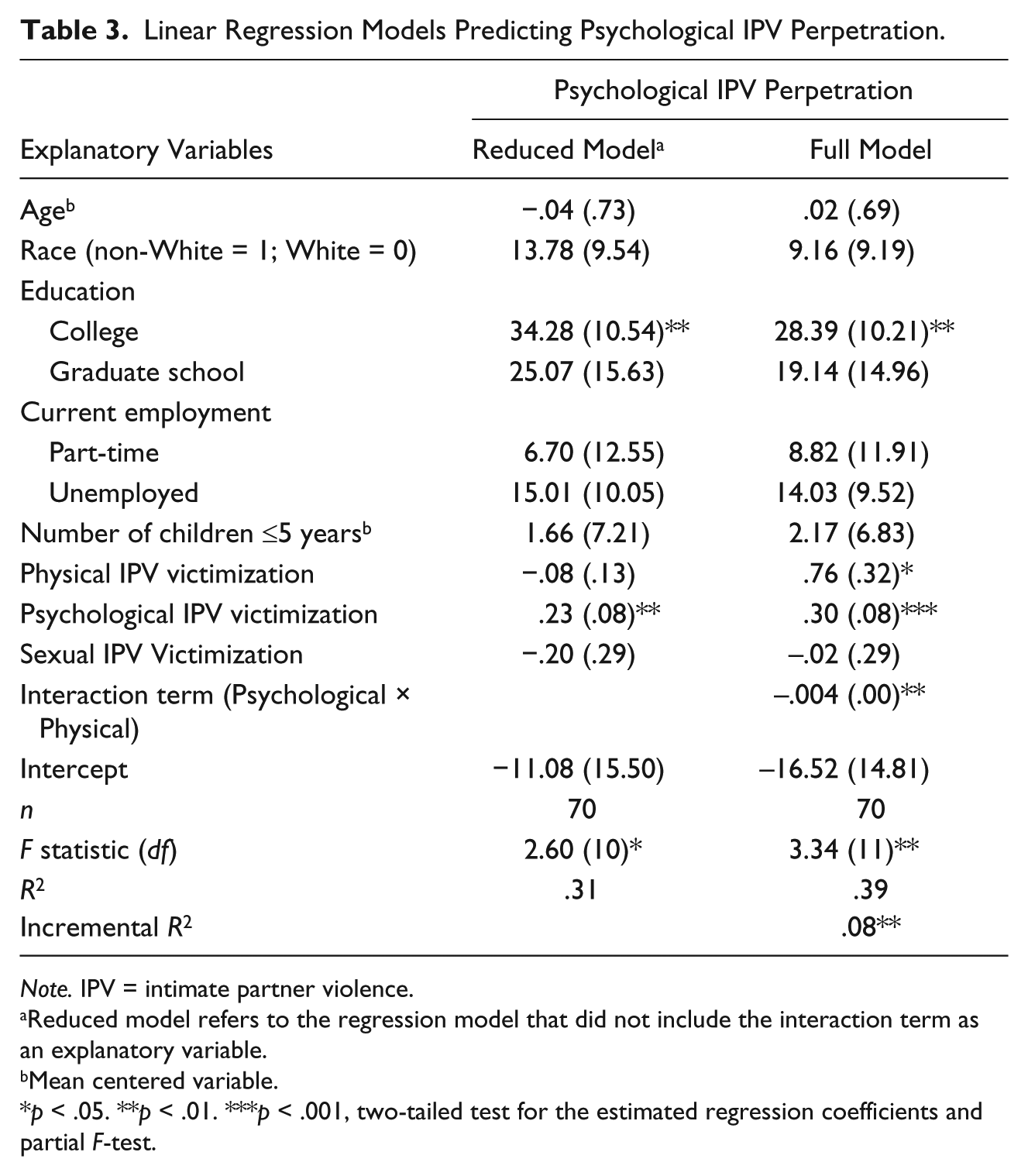
As a reminder, the first research question addressed whether physical, psychological, and sexual IPV victimization were associated with the perpetration of psychological IPV, whereas our third research question focused on examining whether the interaction between physical and psychological IPV victimization was associated with and helped better explain psychological perpetration. Table 3 presents the results for the reduced and full models of psychological IPV perpetration. Both models were statistically significant, F(10, 70) = 2.60, p < .051 and F(11, 70) = 3.34, p = .001, respectively, and demonstrated excellent model fit to the data. However, although the reduced model explained 31% of the variance, the full model explained 39% of variance in the perpetration of psychological IPV. The regression analysis indicated the inclusion of the interaction term for Physical Victimization × Psychological Victimization explained an additional 8% of variation in perpetration and was statistically significant based on the Partial F-test (p < .01).
Linear Regression Models Predicting Psychological IPV Perpetration.
Note. IPV = intimate partner violence.
Reduced model refers to the regression model that did not include the interaction term as an explanatory variable.
Mean centered variable.
p < .05. **p < .01. ***p < .001, two-tailed test for the estimated regression coefficients and partial F-test.
Reduced model
The only significant covariate for the reduced model was graduated or attended college/technical school. Controlling for all other variables, women who graduated from or attended college/technical school had, on average, an IPV psychological perpetration score 34.28 units greater than women whose highest level of education was high school/GED, or below (p < .01). The only significant independent variable was psychological IPV victimization. Other things being equal, a 1-unit increase in psychological IPV victimization was associated with a 0.23 unit increase in psychological IPV perpetration (p < .01).
Full model
Similar to the reduced model, the only significant covariate for the full model was graduated or attended college/technical school. Controlling for all other variables, women who graduated from or attended college/technical school on average had an IPV psychological perpetration score 28.39 units greater than women whose highest level of education was high school/GED, or below (p < .01). In the full model, two independent variables were significant: physical IPV victimization and psychological IPV victimization (Research Question 1). Other things being equal, a 1-unit increase in physical IPV victimization was associated with a 0.76 unit increase in psychological IPV perpetration (p < .05), and a 1-unit increase in psychological IPV victimization was associated with a 0.30 unit increase in psychological IPV perpetration (p < .001). However, the significant covariate and independent variable findings were conditional effects given the inclusion of our interaction term.
The interaction term was significant (p < .01; Research Question 3). Figure 1 displays the predictive margins for the interaction term in the full model. Specifically, this figure graphs the marginal means while holding all other variables constant at their mean. As evident in Figure 1, both physical and psychological IPV victimization are shown to be associated with increased perpetration of psychological IPV. For every unit increase in psychological victimization, the impact of physical victimization on psychological perpetration (the slope) decreases by .004 (and vice versa).

Interaction of physical and psychological victimization in full linear regression model for psychological IPV perpetration.
Physical IPV Perpetration (Research Questions 2 and 3)
Overall
Our second research question addressed whether physical, psychological, and sexual IPV victimization were associated with the perpetration of physical IPV. Similar to above, the third research question focused on examining whether the interaction between physical and psychological IPV victimization was associated with physical perpetration and accounted for a greater amount of variance in the resultant model. Results for the reduced and full models of physical IPV perpetration are presented in Table 4. Both models were statistically significant—reduced: χ2(10) = 23.37, p < .01; full: χ2(11) = 34.15, p < .001—demonstrating excellent model fit. The variables in the reduced model explained 35% of the variance in physical IPV perpetration, whereas the variables in the full model explained 51% variance. Based on the regression analysis and chi-square difference test, the inclusion of the interaction term for Physical × Psychological Victimization explained an additional and significant 16% variance in physical perpetration (p < .01).
Logistic Regression Models Predicting Physical IPV Perpetration.

Note. IPV = intimate partner violence.
Reduced model refers to the regression model that does not include the interaction term as an explanatory variable.
Mean centered variable.
p < .05. **p < .01. ***p < .001, two-tailed test for the estimated regression coefficient and chi-square difference test.
Reduced model
The only significant covariate for the reduced model was race (odds ratio [OR] = 12.44, p < .05). Other things being equal, participants who identified as non-White were 1,144% more likely (or about 12 times as likely) than participants who identified as White to have perpetrated physical IPV. One independent variable was significant in this model: psychological IPV victimization (OR = 1.03, p < .05). Other things being equal, every unit increase in psychological IPV victimization increased the chance of perpetrating physical IPV by 3%.
Full model
Similar to the reduced model, the only significant covariate in this model was race (OR = 18.29, p < .05). Other things being equal, participants who identified as non-White were 1,729% more likely (or about 18 times as likely) than participants who identified as White to have perpetrated physical IPV. After controlling for the covariates, the independent variables physical IPV victimization and psychological IPV victimization were statistically significant (Research Question 2). All else being equal, for every unit increase in physical victimization the chance of perpetrating physical IPV increased by 24% (OR = 1.24; p < .05), and for every unit increase in psychological victimization the chance of perpetrating physical IPV increased by 3% (OR = 1.03; p < .05). These are conditional effects given the inclusion of our interaction term.
There was a significant interaction between psychological and physical victimization on physical IPV perpetration (p < .05; Research Question 3). Figure 2 displays the predictive margins for the interaction term in the full model. As seen in Figure 2, both physical and psychological victimization are associated with increased perpetration of physical IPV. For every unit increase in psychological victimization, the impact of physical victimization on psychological perpetration (the slope) increases by .99 (and vice versa). However, as physical victimization increases, psychological victimization has a diminishing effect on the perpetration of physical IPV. For example, women who reported 50 incidents of physical victimization in the past year had a high likelihood of perpetrating physical abuse regardless of their experiences of psychological victimization.

Interaction of physical and psychological victimization in full logistic regression model for physical IPV perpetration.
Discussion
The current exploratory study examined the relationship between three forms of IPV victimization (physical, psychological, and sexual abuse) and the perpetration of physical and psychological IPV among 73 system-involved female IPV survivors. Similar to prior studies with young adults, community women, and women arrested for IPV, our findings suggest a relationship exists between IPV victimization and IPV perpetration among the vulnerable population of system-involved female IPV survivors (e.g., Dardis et al., 2013; Simmons et al., 2008). Specifically, results suggest a relationship between certain forms of IPV victimization and the perpetration of psychological and physical IPV among system-involved female survivors.
We found partial support for our hypothesis that physical, psychological, and sexual IPV victimization would each be associated with the perpetration of physical and psychological abuse. Specifically, results from the full models show that psychological and physical IPV victimization are both uniquely associated with the perpetration of psychological and physical abuse. Similar to Hellmuth and colleagues (2013) who examined victimization and perpetration among pregnant and postpartum women, we found a relationship between the perpetration of psychological aggression and high levels of psychological victimization. However, our study also found increased frequency of psychological perpetration was associated with increased frequency of physical victimization. In addition, our study echoed prior findings indicating that increased frequency of physical IPV victimization is associated with an increased likelihood of perpetrating physical IPV (Hellmuth et al., 2013; Renner et al., 2015). However, unlike prior studies, we found that perpetration of physical IPV was also associated with higher levels of psychological victimization. Contrary to our hypothesis, we did not find a significant relationship between sexual IPV victimization and the perpetration of either physical or psychological IPV.
The current study extended prior research by examining the interaction between physical and psychological victimization, and probing the relationship between this interaction term and physical and psychological IPV perpetration. Our findings suggest that the interaction between physical and psychological IPV victimization is significantly related to perpetration of physical and psychological IPV by women who are system-involved IPV survivors. Furthermore, the inclusion of this interaction term helps to explain the perpetration of physical and psychological abuse by system-involved, service-mandated female IPV survivors.
As hypothesized, higher levels of both physical and psychological IPV victimization were associated with higher levels of psychological perpetration and an increased likelihood of physical perpetration. Specifically, as physical victimization increases, increased psychological victimization is associated with increased psychological perpetration. Furthermore, women who experienced higher levels of physical victimization were more likely to perpetrate psychological abuse across all levels of psychological victimization. Similarly, as physical victimization increases, increased psychological victimization is associated with an increased likelihood of perpetrating physical IPV. However, when a woman is frequently physically abused (e.g., 50 incidents or more per year), she is more likely to perpetrate physical abuse regardless of the frequency of psychological abuse. Findings underscoring the relationship between physical victimization and perpetration across different levels of psychological victimization may be related to prior research suggesting that women’s perpetration of physical and psychological abuse is often used as a form of self-defense (e.g., Swan et al., 2008).
In addition to findings related to our research questions and hypotheses, two covariates were significant. Non-White participants were more likely to report perpetration of physical IPV compared with White participants, and participants who had attended or completed college (but had not attended graduate school) reported higher levels of psychological IPV perpetration compared with participants who had attended or completed high school. Regarding race/ethnicity, a prior review on the prevalence of IPV perpetration (Williams et al., 2008) found that African American and Latina women reported higher rates of IPV perpetration relative to White women. However, more recent research (Renner et al., 2015) has found fairly similar rates of IPV perpetration regardless of race/ethnicity. Prior research has also found mixed findings regarding the relationship between education level and IPV perpetration. Whereas some research has found lower educational attainment to be associated with an increased risk of IPV perpetration (e.g., Drapkin, McCrady, Swingle, & Epstein, 2005), other studies have found the opposite (e.g., Renner et al., 2015). Clearly, more research is needed to better understand the relationship between race/ethnicity, education, and IPV perpetration, as well as the underlying mechanism behind these relationships.
Implications for Practice and Research
Practice implications
Although the causes of these statistical relationships may only be speculated in the current study, results clearly indicate that the circumstances surrounding women’s use of violence are complex and interrelated. Even though prior research has suggested that IPV victimization can influence a woman’s decision to use violence (Feder & Henning, 2005; Simmons et al., 2008), the specific types of victimization and perpetration have remained largely unexplored. The results of the current study suggest that systems, agencies, and programs targeting system-involved women mandated to services for IPV should consider women’s histories of IPV perpetration in light of their victimization. Specifically, these systems, agencies, and programs should consider adding questions to their intake forms that screen for various forms of IPV victimization. Such screening is particularly relevant for psychological victimization, which is often minimized but has been found to be associated with numerous negative outcomes, including stress and mental health concerns (Al-Modallal, 2012).
Other implications for practice include training service providers on safety planning. The current study’s finding that victimization and perpetration are closely related is well represented in the literature. Therefore, it is important that service providers working with system-involved women mandated to services for IPV have up-to-date knowledge of best practices for safety planning and crisis intervention as well as local shelter services and child welfare protocols. This knowledge is especially important in cases with children in the home given the evidence of the association between IPV and child maltreatment (Hamby, Finkelhor, Turner, & Ormrod, 2010). Parenting and safety services for system-involved, service-mandated female survivors of IPV and their children should speak to their experience of victimization as well as to the unique needs and characteristics of these women. In particular, interventions targeting these families should be trauma-informed and address the consequences of IPV victimization (e.g., mental health).
Last, we urge providers to be aware of language and labeling. The stigma associated with being labeled a perpetrator is notably different from that of having isolated incidents of perpetration. Given the complex contexts in which female IPV perpetration occurs, providers might have difficulty in ascertaining details of specific acts of violence in a single meeting or even a single course of treatment. However, it is important to acknowledge the personal narratives of these women, inclusive of their experiences of both victimization and perpetration.
Research implications
As noted earlier, currently only a limited understanding exists of the link between experiencing different types of IPV victimization and perpetrating specific forms of IPV. Thus, additional research is needed to explore these associations. In particular, findings from the current study suggest that women’s psychological and physical IPV victimization are strongly associated with psychological and physical IPV perpetration. Although the literature has indicated an association exists between IPV victimization and perpetration among females (e.g., Orcutt, Garcia, & Pickett, 2005; Swan et al., 2008), few researchers have addressed the importance of psychological IPV victimization and its relationship to various survivor outcomes, including perpetration. Thus, we propose that researchers consider examining specific forms of IPV victimization (e.g., psychological, physical, and sexual) and relationship of each to various forms of IPV perpetration. Conducting such research among larger, more diverse samples using longitudinal designs to examine directionality and causation could elucidate meaningful relationships and potentially reveal key areas for future intervention and prevention. Furthermore, sexual perpetration should be considered in future research.
In addition to further quantitative research, we recommend qualitative research to better understand the interaction between physical and psychological victimization, and the ways in which this interaction is related to perpetration. Given the complexity of the relationship between female IPV victimization and perpetration, qualitative research would build on quantitative results. For example, qualitative research could examine motives for perpetration in light of different victimization profiles. Qualitative research would also give survivors the opportunity to describe their experiences in their own words, which has been extended as a best practice when conducting sensitive research with vulnerable populations (Rizo et al., 2017).
Limitations and Conclusion
Readers are urged to consider study findings in light of limitations. This inquiry was an exploratory study that used secondary data analysis. Importantly, the larger study (from which the data were obtained) did not aim to investigate perpetration in relation to victimization. However, our research team determined these data held potential for a preliminary examination of the relationship between forms of IPV victimization and perpetration among system-involved women mandated to services for IPV. Although the findings make an important contribution to the extant literature, additional questions are raised about the generalizability, directionality, and possible mechanisms underlying the identified relationships. The study’s small convenience sample limits external validity and generalizability to other populations, and as mentioned above, might not provide adequate statistical power to investigate the nuances of the complex and varied phenomena. Notably, the sample consisted of women attending a mandated IPV and parenting program targeting survivors of IPV experienced in heterosexual relationships. Furthermore, the cross-sectional nature of the data does not allow us to determine the temporal order of victimization and perpetration experiences; thus, directionality and causation are unknown. Future longitudinal research is needed with larger, more representative samples including survivors of heterosexual and same-sex relationships.
Had the larger study been designed with an initial aim to investigate perpetration in relation to victimization, the researchers might have used different measures and data collection efforts to more thoroughly investigate both victimization and perpetration. In particular, the current study was unable to thoroughly investigate sexual perpetration due to limited variability. In the current sample, sexual perpetration was heavily skewed and a rare event. Moreover, in responding to survivor feedback by removing certain items from the sexual IPV subscales, our actions might have negatively affected our data. Investigating sexual perpetration more thoroughly is both a limitation of the current study and potential direction for future research. Furthermore, the CTS2 has been critiqued as a measure of female IPV perpetration, particularly when used to compare female and male IPV perpetration (Hamby, 2014). However, the original study only examined experiences of physical and sexual IPV using the CTS2. Despite this limitation, the current study is exploratory in nature and sought to describe the relationship between IPV victimization and perpetration among women only. Future research should consider using IPV measures other than the CTS2, or collect such data using multiple measures.
Despite limitations, the current study addresses a critical gap in the literature by helping to untangle the complex relationship between IPV victimization and perpetration. Findings suggest a relationship exists between physical and psychological IPV victimization and the perpetration of physical and psychological abuse against an intimate partner among system-involved women mandated to services. Although the current study focused on a subsample of vulnerable women, our exploratory work can inform future research relevant to the larger population of community women and survivors. Given study findings, further investigation of the relationship between different forms of IPV victimization and perpetration is warranted.
Footnotes
Acknowledgments
We acknowledge the staff of InterAct and SAFEchild for their collaboration and help with this research. We acknowledge the following colleagues for their contributions to this effort: Dr. Rebecca J. Macy for her leadership of the overall project and her help and guidance with this particular study; Dr. Shenyang Guo for his statistical consultation on our preliminary analyses; and Diane Wyant for her comments on an earlier version of this manuscript.
Declaration of Conflicting Interests
The author(s) declared no potential conflicts of interest with respect to the research, authorship, and/or publication of this article.
Funding
The author(s) disclosed receipt of the following financial support for the research, authorship, and/or publication of this article: Funding for this research was provided by The Duke Endowment.