




Abstract
Male (n = 1,104) and female (n = 1,337) college students’ self-report surveys on childhood maltreatment, alcohol expectancies, and narcissistic personality traits are examined to determine their associations with relationship violence. Intimate partner violence was measured using the violence subscales of the revised Conflict Tactics. Because we were interested in the effects of gender and because z tests of the correlations and t tests of means indicated men and women differed significantly on several variables, ordinary least squares regression models were run separately for men and women. Results suggest there are both gender similarities and differences. Relationship violence was associated with child sexual abuse for both men and women, whereas high scores on negative alcohol expectancies and vulnerable narcissism, and low scores on grandiose narcissism, were significantly associated with violence for men only. In addition, z tests revealed the regression coefficients for child sexual abuse and negative alcohol expectancies were significantly different for men and women. Child sexual abuse and alcohol expectancies had stronger associations with men’s than women’s violent behavior. In addition, the models explained a greater amount of variance in men’s than in women’s behavior. Policy implications of the research will be discussed.
Studies consistently find that approximately a third of college students have physically assaulted a partner (Straus, 2004; Straus & Ramirez, 2007; Testa, Hoffman, & Leonard, 2011). Furthermore, both men and women commit intimate partner violence (IPV; Archer, 2000, 2002), but their reasons for doing so may vary, as less is known about the antecedents of women’s violent behavior (Ménard, Anderson, & Godboldt, 2009; Ross, 2011; Straus, 2011). Research also consistantly finds that experiencing early childhood trauma (White & Widom, 2003), using alcohol and other substances (Stith, Smith, Penn, Ward, & Tritt, 2004), and having a personality disorder (Dutton, 2006) are associated with being violent toward a romantic partner. However, gender differences in the roles of these characteristics have also been found (e.g., child sexual abuse—Fang & Corso, 2008; alcohol use—Foshee, Linder, MacDougall, & Bangdiwala, 2001; and psychopathology—Dowgwillo, Ménard, Krueger, & Pincus, 2016; Ehrensaft, Moffitt, & Caspi, 2004), suggesting gendered pathways to IPV may exist (Cubellis, Peterson, Henninger, & Lee, 2018; Jung et al., 2017). Legislation including Title IX, the Department of Education Dear Colleague Letter of 2011, and the 2013 Campus Sexual Violence Elimination Act, has been enacted requiring educational institutions (e.g., colleges) investigate and respond to crimes of interpersonal violence (e.g., sexual assault, stalking, dating violence) on campus. Thus, research on risk factors associated with both men’s and women’s IPV is needed to inform policy. The current study adds to the growing body of knowledge in this area by examining the effects of childhood maltreatment, alcohol problems, and narcissistic personality traits on partner violence. We also examine potential mediating effects of alcohol expectancies and narcissistic personality traits on the relationship between child abuse and partner violence, and finally, whether these relationships vary by gender (moderation).
Gender and IPV
Research on gender differences in the prevalence of IPV is mixed and results tend to vary depending on the sample and data collection method used. Data from criminal justice (e.g., arrest or court records) or emergency services (e.g., shelters, hospitals) find males are more often perpetrators of IPV (Dobash, Dobash, Wilson, & Daly, 1992), whereas research using self-report survey methods finds women are more violent than men, but their actions are less injurious (Archer, 2000, 2002; Straus, 2011). Research with college students finds about a third report using violence against a partner and rates of perpetration are similar for men and women (Straus, 2004; Straus & Ramirez, 2007). Despite the similarity in the rates of violence committed by men and women, gender differences in the causes and correlates of this violence are commonly reported (Baker & Stith, 2008; Foshee et al., 2001; Spencer, Cafferky, & Stith, 2016). For instance, in their large meta-analysis Spencer et al. (2016) found that most risk factors were distributed equally across the genders with a few exceptions, namely, child abuse, alcohol use, and relationship patterns of male demands and female withdrawal were stronger risk factors for male than female violence. These results suggest common antecedents to violence may have different effects on men’s and women’s behavior.
Child Abuse
Child abuse is associated with several negative outcomes including substance abuse (Reinert & Edwards, 2009; Widom, Schuck, & White, 2006), personality problems (Johnson, Cohen, Brown, Smailes, & Bernstein, 1999), and interpersonal violence (Gratz, Paulson, Jakupcak, & Tull, 2009; Knight, Menard, Simmons, Bouffard, & Orsi, 2016). Childhood exposure to violence was associated with dating violence among 2,500 college students (Gover, Kaukinen, & Fox, 2008; Kaukinen, Buchanan, & Gover, 2015). However, the fact that most abused children do not become violent suggests other factors may moderate or mediate the effects of child abuse on violence. Gender differences in the influence of child abuse on partner violence have been reported. For instance, Fang and Corso (2008) found that although neglect and physical abuse had an effect on both genders’ violence, child sexual abuse had a significant effect on men’s IPV but had no significant effect on women’s violence. Gender similarities and differences were also obtained in Brown and colleagues’ national epidemiological survey (Brown, Perera, Masho, Mezuk, & Cohen, 2015). In their study, although substance abuse mediated the relationship between physical and psychological abuse and IPV for both genders, among men, posttraumatic stress disorder mediated the relationship between sexual abuse and later IPV. Similarly, a study using international dating violence data (Cubellis et al., 2018) examined the mediating effects of antisocial traits on the relationship between child sexual abuse and partner violence. They found antisocial traits and behaviors fully mediated the effects of child sexual abuse on violence for women, but only partially mediated the effects for men. Combined these results suggest different models may explain men’s and women’s IPV and that the difference in models may be due to mediation effects of other variables (e.g., alcohol, personality pathology).
Alcohol Expectancies
Research finds alcohol use is associated with IPV (Foran & O’Leary, 2008; Okuda et al., 2015; Spencer et al., 2016), and gender differences among college students have been found. Some studies show alchool use is associated with both men’s and women’s violence (Hines & Straus, 2007), and others find the relationship between alcohol and violence is only significant for men (Medeiros & Straus, 2006). Several meta-anlyses have looked at the association between alcohol use and IPV (Foran & O’Leary, 2008; Spencer et al., 2016; Stith et al., 2004), but only two have been able to examine this association among female perpetrators. They found a significant association between alcohol use/abuse and IPV for both genders, but in both studies the effect size was significantly smaller among women compared with men (Foran & O’Leary, 2008; Spencer et al., 2016). These results suggest that women may be differentially affected by alcohol use or that the effects of alcohol on women’s violence may be mediated by a third variable. Given the association between alcohol use and IPV, and the possible moderating effects of gender on this relationship, further investigation is warranted.
Personality Pathology
In addition to childhood abuse and alcohol expectancies, research also finds a relationship between personality pathology, including narcissism, and IPV (Dutton, 2006). Personality disorders have been associated with IPV perpetration among both males and females (Spidel, Greaves, Nicholls, Goldenson, & Dutton, 2013), but other studies report gender differences. Simmons, Lehmann, Cobb, and Fowler (2005) looked at the effects of gender among those arrested for domestic violence using the Minnesota Multiphasic Personality Inventory-2 (MMPI-2; Butcher, Dahlstrom, Graham, Tellegen, & Kaemmer, 1989) and found that compared with men, women were more likely to have elevated histrionic, narcissistic, and compulsive personality traits; less likely to have dependent traits; and more likely to have MMPI-2 profiles indicative of personality disorders. Gender differences in narcissistic traits specifically were also found among a small sample of dating violence perpetrators (Ryan, Weikel, & Sprechini, 2008), where exploitativeness/entitlement was related to sexual coercion by women while narcissistic vulnerability was related to physical assault by men. Ménard and Pincus (2012) found that, in college students, narcissistic vulnerability was associated with men’s stalking perpetration but not with women’s stalking perpetration. A study examining the associations between Diagnostic and Statistical Manual of Mental Disorders (5th ed.; DSM-5; American Psychiatric Association, 2013) pathological personality traits and IPV among male and female college students also obtained mixed results regarding the effects of gender (Dowgwillo et al., 2016). For instance, detachment was positively associated with relationship violence for both genders. However, antagonism was associated with relationship violence for women, whereas disinhibition was associated with relationship violence for men. Thus, although personality pathology may predict IPV among men and women, the personality profiles associated with violence may differ by gender.
Theoretical Frameworks
Two developmental frameworks, social learning theory (Bandura, 1977) and the contemporary clinical model of pathological narcissism (Pincus, Roche, & Good, 2015), guided this research. According to these theories, children who experience or witness parental abuse learn maladaptive ways of interacting with others. Social learning theory (Bandura, 1977) posits observational learning, especially from high status others, like parents, is the primary way interpersonal skills are acquired. Through parental modeling and reinforcement, children in violent homes learn to use aggression to resolve conflicts. Consequently, they may behave violently toward their intimates, because they believe it is an acceptable means of dominating and controlling another’s behavior. Bandura’s (1977) social learning theory has been used to explain why some maltreated children have a greater propensity to offend than do their nonabused counterparts (Widom, 2014).
Similarly, child abuse is associated with the development of narcissistic personality traits (Horton, Bleau, & Drwecki, 2006; Kernberg, 1998; Kohut, 1977; Otway & Vingoles, 2006), which may explain abusive behavior toward others. Pathological narcissism is characterized by a strong need for self-enhancement with concomitant social recognition and admiration, combined with a compromised capacity for emotion-regulation (Morf, Torchetti, & Schürch, 2011; Pincus et al., 2015). Narcissists inability to manage and satisfy their narcissistic needs results in attempts to gratify them in maladaptive ways. For example, because they have an inflated view of themselves, they feel justified in exploiting others to meet their needs (Pincus & Lukowitsky, 2010). In addition, when their narcissistic needs are not met, they become dysregulated, commonly experience shame and rage, and may respond aggressively (Krizan & Johar, 2015; Pincus, 2013; Pincus & Wright, in press; Rasmussen, 2016; Wright, 2014).
In sum, consistent with these two theoretical models, individuals with traumatic childhood experiences may be more likely to be violent in intimate relationships, because they learned to relate to others in abusive ways. In addition to these direct effects, they may also experience abuse outcomes (e.g., alcohol abuse and personality pathology) that indirectly increase their likelihood of committing violence. However, research suggests these influences may differ by gender (Dowgwillo et al., 2016; Spencer et al., 2016). Thus, this study had three main objectives: (a) determine whether child abuse, alcohol expectancies, and narcissism are positively associated with relationship violence; (b) determine whether child abuse indirectly increases violence through alcohol expectancies and narcissistic personality traits (mediation); and finally, (c) determine whether these relationships vary by gender, as research regarding the effects of gender is quite mixed.
Method
Participants and Procedure
Participants were 2,773 undergraduate students from a large northeastern university, who completed the survey for course credit. Data for this research were collected as part of a larger study on college students’ relationships. Because the full survey was quite long (468 items), checks for invalid responses were completed and 327 surveys were removed based on the following criteria: Participants whose scores on the Jackson Infrequency Scale (Jackson, 1976; a validated screener designed to detect careless survey responses) were greater than the cutoff of 3. This scale presents 12 items with a clear keyed direction. In college students, scores of 3 are equivalent to a t score of 85 and the 99th percentile (Jackson, 1984). As well as those whose standard deviation scores across the two longest measures in the full survey equaled 0 were excluded. In addition, two participants were excluded for failing to indicate their gender, and two transgendered and one “other” gendered individuals’ surveys were removed as there were too few cases in these categories to analyze them separately. The final sample comprised 1,337 females and 1,104 males with a mean age 19.4 years (SD = 2.18). In the multivariate analysis, this number is further reduced due to missing data and listwise deletion techniques (e.g., 213 participants were missing information on age and five were missing information on race; see tables for specific Ns per analyses). Seventy-seven percent of participants were White, 6.7% were African American, 8.5% were Asian, 5.8% were Latino/a, and the remaining 1% were of mixed or other racial composition. This sample overrepresents younger students, women, and Whites relative to the institution’s student body and the U.S. university population. Participants were recruited from a variety of classes and were offered extra credit. All participants volunteered for the study and had alternative options for extra credit. The survey was completed online after participants reviewed and agreed to informed consent indicating participation was anonymous and voluntary, and that the study was approved by the institution’s review board.
Dependent Variables
Revised Conflict Tactics Scale (CTS2)
The CTS2 (Straus, Hamby, Boney-McCoy, & Sugarman, 1996) is a 78-item measure of both violent and nonviolent responses to interpersonal conflict, particularly conflict arising in dating, cohabitating, or marital relationships. It focuses on the frequency of specific responses rather than their causes or consequences. The items of the CTS2 map onto five higher order scales: Negotiation (“I showed respect for my partner’s feelings about an issue”), Physical Assault (“I pushed or shoved my partner”), Psychological Aggression (I stomped out of room or house or yard during a disagreement”), Sexual Coercion (“I used force to make my partner have sex”), and Injury (“My partner went to a doctor because of a fight with me”). Participants indicate the number of times they have used certain tactics within the past year by choosing one of the following responses: Never, Once, Twice, 3 to 5 times, 6 to 10 times, 11 to 20 times, more than 20 times, or it has happened before, but not in the past year. They then indicate the number of times their partner used the same tactics within the past year using the same scales. Prior research (Straus et al., 1996) reports internal consistencies ranging from .79 (Psychological Aggression) to .95 (Injury). In this study, we examined only violent tactics participants themselves used against their partner (perpetration). Violence comprised the sum of all items (33) from the physical assault, psychological aggression, sexual coercion, and injury subscales of the CTS2 (male α = .96; female α =.93). These are interpreted as reporting the use of violent tactics in intimate relationships.
Independent Variables
Child Abuse and Trauma Scale (CAT)
The CAT (Sanders & Becker-Lausen, 1995) presents 38 items and respondents indicated how frequently (0 = never, 1 = rarely, 2 = sometimes, 3 = very often, 4 = always) they experienced each statement when they were a child or teenager. The CAT has three subscales: child sexual abuse (e.g., “Did your relationship with your parents ever involve a sexual experience?” (male α = .88; female α =.76), child physical abuse (e.g., “Did your parents ever hit or beat you when you did not expect it?” (male α = .56; female α =.65), and child neglect (e.g., “As a child, did you have to take care of yourself before you were old enough?” (male α = .88; female α =.90).
Alcohol Expectancy Questionnaire (AEQ)
Research consistently finds alcohol expectancies correlate with alcohol use (Goldman, 1994; Labrie, Grant, & Hummer, 2011). Because it is easier to measure alcohol expectancies than actual use, we measured alcohol expectancies using the 34-item AEQ (Leigh & Stacy, 1993). Participants’ expectations of the effects produced by alcohol were measured using questions such as “When I drink alcohol I feel happy” and “When I drink alcohol I get into fights.” Each item was rated using a 6-point Likert-type scale from 1 (no chance) to 6 (certain to happen). We used the two broad subscales of positive and negative alcohol expectancies. The alphas for both subscales were as follows: positive—male α = .96, female α =.96; negative—male α = .89, female α =.90.
Pathological Narcissism Inventory (PNI)
Participants’ narcissistic traits were assessed using the 52-item PNI (Pincus et al., 2009). Participants rated each item (e.g., “When people don’t notice me, I start to feel bad about myself,” “I am preoccupied with thoughts and concerns that most people are not interested in me,” “I often fantasize about being admired and respected”) on a 6-point scale ranging from 0 (not at all like me) to 5 (very much like me). We used the two higher-order scales of the PNI, which assess narcissistic grandiosity (male α = .87; female α = .87) and narcissistic vulnerability (male α = .95; female α = .96; Wright, Lukowitsky, Pincus, & Conroy, 2010). The former reflects engaging in maladaptive and compensatory self-enhancement strategies and holding self-serving beliefs and the latter reflects poor self-, behavior-, and emotion-regulation in response to self-enhancement failures and ego threats (Pincus, 2013).
Control Variables
To improve the estimation precision in the regression models, we included two demographic variables, age and race, as controls. The mean age among men was 19.67, with a range of 18 to 47 years, and the mean age for women was 19.19, with a range of 18 to 53 years. Although these age ranges are broad, the vast majority of participants were between the ages of 18 to 25 years (98.3% of men and 99.3% of women). Regarding race, because a majority of participants identified as White (76.9% of men and 77.2% of women) and because there were too few respondents in each of the other racial/ethnic groups to examine them separately, we dichotomized race and coded it as 0 for Whites and 1 for members of all other racial groups.
Analytical Plan
We first compared male and female participants’ scores on the dependent and the independent variables using t tests (two-tailed). Next, Fisher’s r to z transformations were calculated on the correlations of the independent variables with CTS2 violence to conduct z tests to determine whether significant gender differences existed at the bivariate level. Next, we conducted ordinary least squares (OLS) regression analyses separately for men and women to determine if different models were associated with participants’ violence tactics. Initially, variables were entered in blocks and mediation tests were completed following the addition of each block to determine if significant mediation occurred (Aiken & West, 1991; Clogg, Petkova, & Haritou, 1995). The order of model entry was the same for men and women: First, the controls variables were entered followed by childhood abuse variables, the alcohol expectancies variables, and the PNI narcissistic grandiosity and vulnerability subscales. However, no significant mediation was found. Therefore, a two-step model is presented, wherein the first step includes the controls and the second step includes all remaining variables. Finally, to assess for significant moderation, z tests (z=
Results
Bivariate Analyses
As seen in Table 1, the mean scores were significantly different between men and women. Compared to women, men had higher mean scores on CTS2 violence, CAT physical abuse, and PNI Grandiosity scales. Table 2 contains the correlation matrix with women’s scores on the upper diagonal. For both men and women, CAT sexual abuse, CAT physical abuse, CAT neglect, AEQ negative, and PNI Vulnerability were significantly and positively associated with CTS2 violence. In addition, among women the correlation between AEQ positive and CTS2 violence was significant. However, results from the Fisher’s r to z transformations indicate there are only two significant gender differences. In both cases, the correlations between CTS2 violence and both CAT sexual abuse and negative alcohol expectancies were positive but were higher for men than for women.
Mean Comparison of Men’s and Women’s Scores.
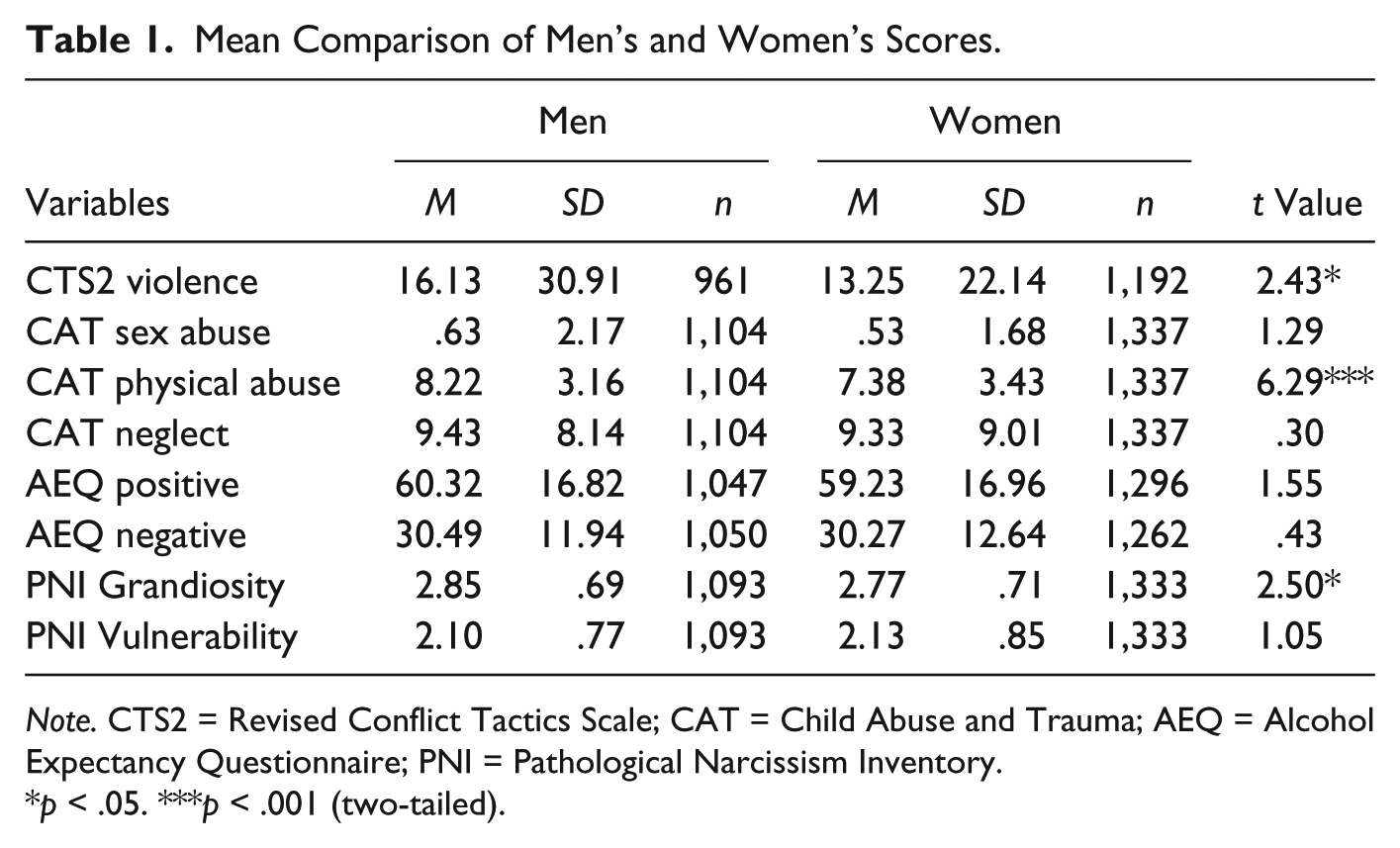
Note. CTS2 = Revised Conflict Tactics Scale; CAT = Child Abuse and Trauma; AEQ = Alcohol Expectancy Questionnaire; PNI = Pathological Narcissism Inventory.
p < .05. ***p < .001 (two-tailed).
Correlation Matrix With Men (n = 1,104) on Lower, and Women (n = 1,337) on Upper, Diagonal.
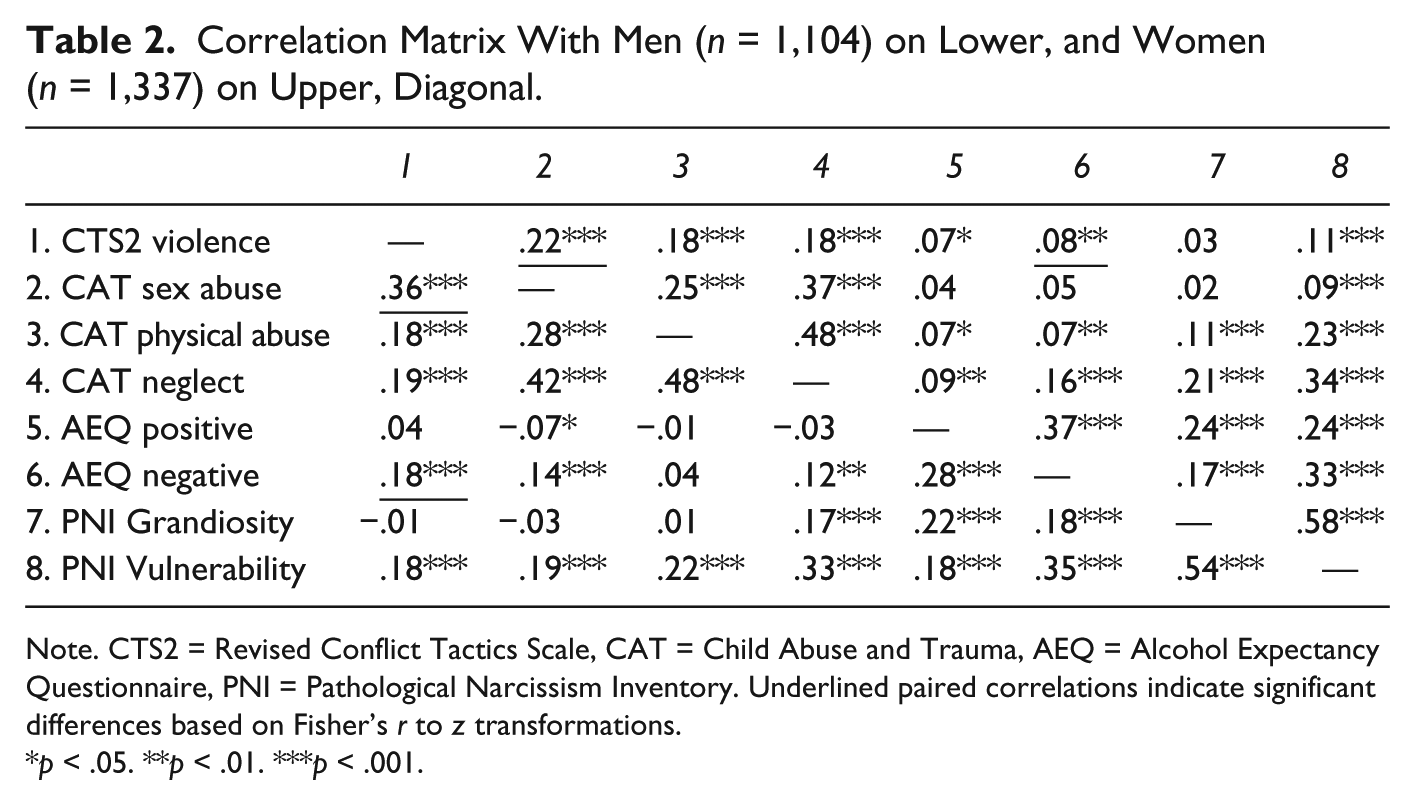
Note. CTS2 = Revised Conflict Tactics Scale, CAT = Child Abuse and Trauma, AEQ = Alcohol Expectancy Questionnaire, PNI = Pathological Narcissism Inventory. Underlined paired correlations indicate significant differences based on Fisher’s r to z transformations.
p < .05. **p < .01. ***p < .001.
Multivariate Analysis
Table 3 presents the results of OLS regression for the CTS2 violence scores. The first three columns contain results for men and the last three columns contain results for women. Although we expected mediation effects, the limited drop in the magnitude of the coefficient, combined with post hoc mediation tests, indicated there was no significant mediation of the relationship between the child abuse and CTS2 violence by either alcohol expectancies or narcissistic personality traits among men or women (models not shown). For this reason, we present and discuss only the final models, entering the control variables first, followed by all independent variables simultaneously.
OLS Regressions of Men’s and Women’s Violent Behavior.
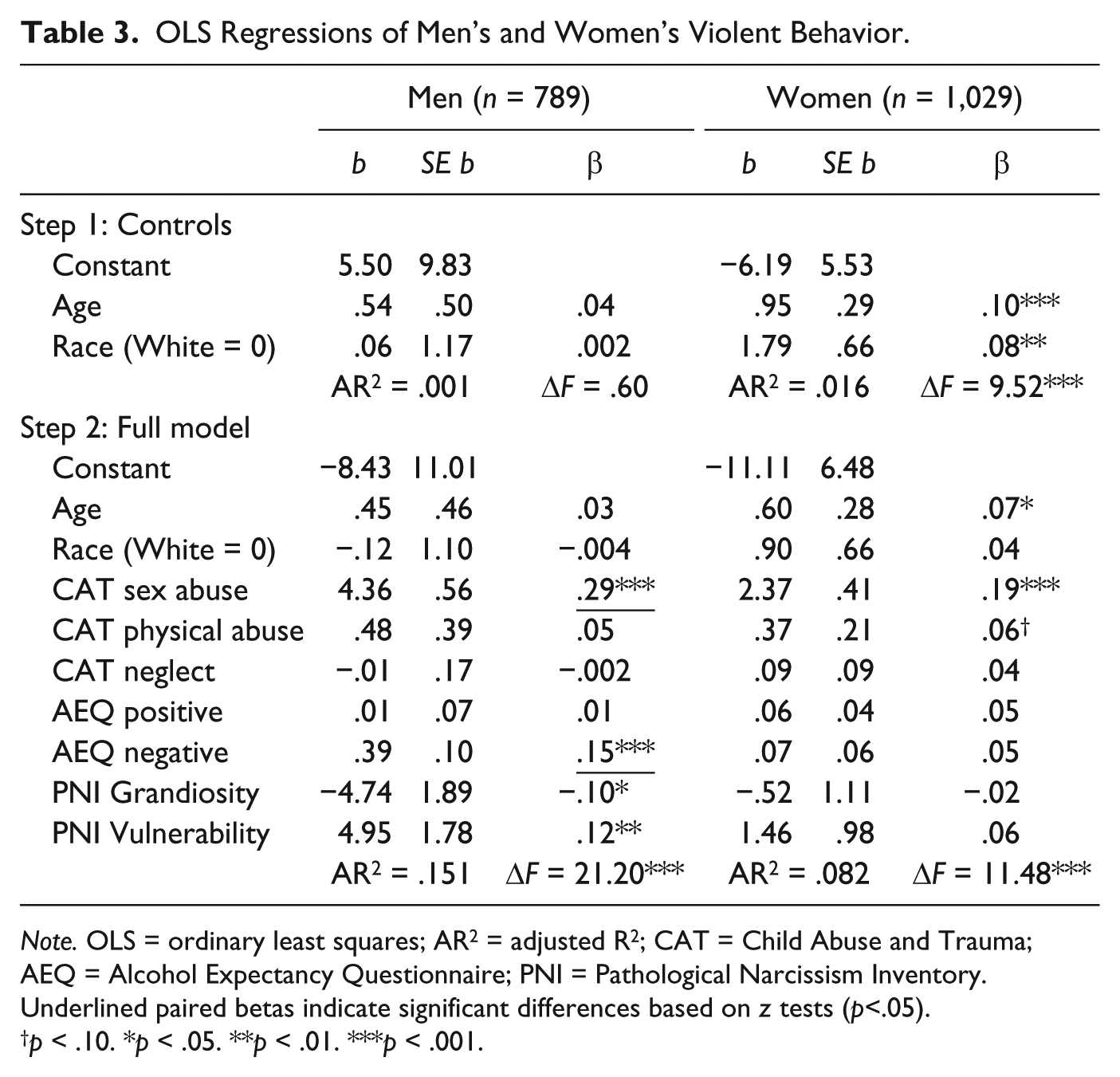
Note. OLS = ordinary least squares; AR2 = adjusted R2; CAT = Child Abuse and Trauma; AEQ = Alcohol Expectancy Questionnaire; PNI = Pathological Narcissism Inventory. Underlined paired betas indicate significant differences based on z tests (p<.05).
p < .10. *p < .05. **p < .01. ***p < .001.
The final model accounts for 15.1% of the variance in men’s violence. Neither covariate (age, race) were significantly associated with men’s violence. However, CAT sexual abuse, negative alcohol expectancies, and PNI vulnerability were all positively associated with CTS2 violence, and PNI grandiosity was negatively related to CTS2 violence. Among women, both control variables (age, race) were positively and significantly related to violence in the first step of the regression model. However, these variables account for a limited amount of variance (1.6%), race drops from significance in the full model, and age effects in this sample may be an artifact of having had more time to offend. The addition of the independent variables increased the explained variance to 8.2% of CTS2 violence. Participants’ CAT child sexual abuse scores were positively and significantly associated with women’s violence. The relationship between child physical abuse and violence was also positive and approached standard levels of significance (p = .088) among women.
Regarding the potential moderating effects of gender, results from the z tests of regression coefficients finds two significant differences. First, although CAT sexual abuse was positively and significantly related to both men’s and women’s violence, the magnitude of this effect was greater for men than for women (z = 2.86, p < .01). Second, although the association of the negative alcohol expectancies and partner violence were positive for both men and women, the effect was larger and significant for men only (z = 2.85, p < .01).
Discussion
Consistent with the two theoretical perspectives and prior literature, child maltreatment, alcohol expectancies, and narcissistic traits were associated with male college students’ perpetration of relationship violence as measured using the violence subscale of CTS2. Counter to expectations, neither alcohol expectancies nor narcissistic personality traits significantly mediated the relationship between child abuse and partner violence. As in prior studies (Dowgwillo et al., 2016; Spencer et al., 2016) both similarities and differences across genders were observed.
As anticipated, child abuse was associated with interpersonal violence. For both genders, sexual abuse was associated with higher scores on violence. Although not all forms of child abuse were significantly related to IPV, these results mostly conform with social learning theory (Bandura, 1977) and prior research, which finds those who grow up in abusive homes are more likely to be violent than their nonabused counterparts (Kaukinen et al., 2015; Knight et al., 2016; Milaniak & Widom, 2015). With regard to alcohol expectancies, negative alcohol expectancies were positively associated with men’s violence but were unrelated to women’s violence. Although the alcohol–violence link appears to be well established among men (Foran & O’Leary, 2008; Stith et al., 2004), fewer studies have examined the effects of alcohol on women’s violent perpetration. Studies that have, also found alcohol had a greater influence on men’s than women’s violence (Foran & O’Leary, 2008; Spencer et al., 2016). Perhaps women are influenced more by other substances (e.g., illicit drugs; Ménard, Nagayama-Hall, Phung, Erian-Ghebrial, & Martin, 2003; Moore et al., 2008).
According to the clinical model of pathological narcissism (Pincus & Lukowitsky, 2010; Pincus et al., 2015; Wright, 2014), narcissistic grandiosity reflects maladaptive self-enhancement motivation and vulnerability reflects dysregulation in response to self-enhancement failure and other ego threats. We found that men with lower scores on narcissistic grandiosity and with higher scores on narcissistic vulnerability may be at risk for violence in intimate relationships. This suggests that for men, in the absence of alternative self-enhancement pursuits, hypersensitivity to validation and recognition by others, combined with deficits of self, emotion, and behavioral regulation in response relational disappointments, may be associated with using violent tactics to compensate, by-pass shame, and reestablish an inflated self-image in the face of perceived ego threats (Krizan & Johar, 2015; Lambe, Hamilton-Giachritsis, Garner, & Walker, 2018; Rasmussen, 2016; Scheff & Retzinger, 2001). In contrast, perhaps men with concomitant high levels of narcissistic grandiosity may simply devalue and reject partners associated with narcissistic injury, rather than become dysregulated and violent. Narcissistic traits have been associated with IPV among men, but the association is more tenuous among women. For instance, in some studies narcissism was found to play a greater role in women’s violence (Simmons et al., 2005), whereas in other studies narcissism had a greater role in men’s violence (Ryan et al., 2008). Gender differences in the associations between narcissism and other forms of personal violence including sexual coercion (Blinkhorn, Lyons, & Almond, 2015) and stalking (Ménard & Pincus, 2012) have also been found, suggesting narcissistic personality traits may be important for understanding gender differences in the influence of personality pathology on partner violence.
Prior research suggested alcohol expectancies and personality traits would mediate the relationship between child abuse and IPV (Brown et al., 2015; Cubellis et al., 2018), but results from our sample did not replicate these findings. Although there was no significant mediation, moderating effects of gender were found. At both the bivariate and the multivariate levels, two variables were differentially associated with men’s and women’s violence—child sexual abuse and negative alcohol expectancies. These results are consistent with research that finds the effects of child sexual abuse and alcohol are more salient for men’s than women’s violence (Cubellis et al., 2018; Spencer et al., 2016).
It is noteworthy that both tests of the effect sizes and the amount of variance explained suggest the models provide a better understanding of men’s than women’s violence. Similar findings comparing perpetration behavior in men and women have been reported (Riggs & O’Leary, 1996). It may be that the failure to include questions regarding provocation explain this result, as research finds women arrestees report self-defensive motives for their violence (Hamberger, 1997; Stuart, Moore, Hellmuth, Ramsey, & Kahler, 2006). Regardless, it is productive to examine gender differences in IPV, as clearly research still needs to determine what factors uniquely influence women’s violence.
Policy Implications
Our findings have important policy implications. Results suggest services should be provided to child abuse victims as a primary prevention against IPV. Given research finds 85% of college students have experienced child abuse or some other type of traumatic event in their lifetime, intervention and treatment programs in schools may help to reduce this risk for IPV (Frazier et al., 2009). University counseling centers should screen for prior trauma and have staff trained in trauma recovery to assist students in need.
Results also suggest partner violence prevention education needs to target both male and female students, as both may be abusive. Legislation (e.g., Title IX, Campus saVE Act) now requires educational institutions document, investigate (and notify criminal justice authorities when appropriate), eliminate, prevent, and respond to interpersonal violence or risk losing federal funding. In response to these government mandates, many colleges and universities have introduced bystander intervention programs (i.e., Green Dot) that do show promise (Coker et al., 2015). However, evidence-based prevention programs directed at violent perpetrators are still needed. Relatedly, even though negative alcohol expectancies only influenced men’s violence, given the role of alcohol in violence more generally (Foran & O’Leary, 2008), it may be beneficial to provide brief alcohol intervention programs, as one meta-analysis found such programs to be effective in reducing alcohol consumption and related problems among young people (Tanner-Smith & Lipsey, 2015).
Finally, for those whose partner violence culminates in criminal justice intervention, our results suggest assessment instruments may need to include static risk factors like gender and prior child abuse, as well as dynamic risk factors like substance abuse and pathological narcissism into their evaluations. Research finds general risk assessment instruments do not perform as well with female offenders (Reisig, Holtfreter, & Morash, 2006) and the development of instruments designed specifically for women who commit IPV is still preliminary (i.e., ODARA; Hilton, Popham, Lang, & Harris, 2014). Others have also suggested the need for gender-responsive IPV interventions (Cooney, Small, & O’Connor, 2008; Swan, Gambone, Caldwell, Sullivan, & Snow, 2008) with some programs, such as Beyond Violence (Covington, 2013) being developed specifically for violent or aggressive women. In sum, the development of gender-specific risk assessments and treatment protocols has begun, but more research into the etiology of women’s violent behavior is needed to inform prevention and treatment programs.
Limitations
This study includes a large sample and multivariate analyses, but there are a few limitations. First, the data come from retrospective, self-report surveys, which may be subject to bias. However, all measures used here have been widely used and well validated. Second, reliability of the CAT physical abuse subscale was low, affecting its predictive power. Third, the sample overrepresents Whites and women, and because all participants came from one university, results have limited generalizability. In addition, because too few participants identified as LGBTQ+, we were only able to complete analyses on heterosexual students. Researchers have expressed the need for more work on IPV in the queer community (Mason et al., 2014). Finally, the data are cross-sectional; therefore, causal inferences cannot be drawn from the results. This study’s findings and its limitations point to the need for longitudinal investigation into the effects of early childhood maltreatment, alcohol expectancies, personality pathology, and especially gender on IPV. A growing body of research finds perpetration models explain a greater proportion of men’s than women’s behavior (Baker & Stith, 2008; Ménard et al., 2003; Ménard & Pincus, 2012; Riggs & O’Leary, 1996; Spencer et al., 2016); thus, research is needed to identify the antecedents of women’s violence to better inform educational awareness, prevention, and treatment policies.
Footnotes
Declaration of Conflicting Interests
The author(s) declared no potential conflicts of interest with respect to the research, authorship, and/or publication of this article.
Funding
The author(s) received no financial support for the research, authorship, and/or publication of this article.