




Abstract
Some negative experiences during adolescence can jeopardize psychological adaptation throughout life. Therefore, promoting adolescent resilience is an important goal to prevent symptoms of psychopathology. The Resilience Portfolio Model puts forward a framework to understand how different strengths (classified into three dimensions: regulatory, interpersonal, and meaning-making) can help people adapt and even thrive. Through this lens, the current study examines post-traumatic growth after victimization and other adversities. Participants were 407 Spanish adolescents aged from 14 to 18 (79.6% indicated some exposure to adversity). After testing their psychometric adequacy, different measures of strengths, well-being, victimization, and adversity were included in a survey for analyzing their association with post-traumatic growth. Density (more intensity of strengths), diversity (more variety of strengths), and all strength dimensions discriminated between those who scored high or low in post-traumatic growth. While endurance, meaning-making density, and diversity of strengths predicted higher post-traumatic growth, a higher emotional regulation related to lower post-traumatic growth. The model offers a guide for analyzing and promoting resilience in adolescent populations, and a series of short tools for evaluating a broad set of strengths.
Introduction
Children and adolescents may have different adverse experiences during their development, inside and outside their family environment. These include economic disadvantage, separation or death of relatives, illness, different forms of violence, and so on. The risk of developing psychological and emotional difficulties caused by these experiences may last into adulthood. In fact, there is an extensive literature describing the health and developmental implications of early negative experiences (Shonkoff, Garner et al., 2011; Werry, Medford, & Corson, 2015). However, a substantial percentage of young adults exhibit adaptive functioning despite a history of childhood adversities. Analyzing strategies people use to cope and enhance well-being across the lifespan holds numerous benefits that justify investing efforts in this line of research (Howell et al., 2016). Adolescence is also a key developmental stage for promoting this objective (World Health Organization [WHO], 2014), and focusing on resilience represents a shift from looking at risk factors that lead to psychosocial problems to the identification of strengths in the face of negative experiences.
This construct of resilience has been elusive because of its varied use in different disciplines and theoretical perspectives. Most definitions refer to two core concepts of adversity and positive adaptation (Fletcher & Sarkar, 2013). Thus, resilience requires responding to different adversities ranging from ongoing daily hassles to major life events, as well as a positive adaptation to them. In some cases, resilience is also associated with thriving after negative experiences, which connects with the concept of post-traumatic growth (Grych, Hamby, & Banyard, 2015). Thus, resilience means not only the maintenance of psychological health despite adversity, but also a broadening of perspective, developing new coping skills, or bolstering social relationships following negative experiences (Feeney & Collins, 2015). However, although resilience and post-traumatic growth are empirically related, they are different psychological constructs (Vloet, Vloet, & Bürger, 2017). Thus, while post-traumatic growth has been defined as a positive change that occurs after a highly stressful experience (Tedeschi & Calhoun, 2004), resilience is not necessarily linked to extreme events (Feeney & Collins, 2015) nor to positive change. Although resilience can include those aspects, resilience is a broader term that also refers to other indicators of functioning and can include returning to pre-trauma levels of functioning.
Research on resilience has variously considered it as a trait, an outcome, or a process (Lee et al., 2013). Early studies focused on the search for protective factors, as well as on the distinction between those who manage to adapt to their circumstances and those who do not. Currently, most research has switched the focus to understanding the process through which individuals overcome the adversities they experience throughout their lives (Fletcher & Sarkar, 2013; Masten, 2011).
The Resilience Portfolio Model (Grych et al., 2015) is a strengths-based framework that provides an integrative understanding of the protective factors and processes that facilitate resilience in people exposed to violence and other adversities. The model proposes that each individual has a resilience “portfolio,” which may include both diverse characteristics of the person that promote a healthy functioning and sources of support outside of the person.
According to the model, strengths can be grouped into three different domains. Regulatory strengths facilitate the capacity to control impulses, manage difficult emotions, and persevere in the face of setbacks. Interpersonal strengths are individual characteristics that foster the development and maintenance of close relationships, as well as resources found in one’s social network. Meaning-making strengths refers to the capacity to make sense of the events that occur in their lives and to maintain coherence between events and their broader beliefs and values.
The model adopts the concepts of density (more intensity of strengths) and diversity (more variety of strengths or also called poly-strengths; Hamby, Grych, & Banyard, 2018a; Hamby, Taylor, Jones, Mitchell, Turner, & Newlin, 2018b). This implies assuming an additive mechanism to explain how protective factors may work together to compensate for risk factors. More specifically, it is proposed that the total amount of strengths is more important for adapting to adversity than the presence of any particular strength. However, evidence provided by the authors in subsequent studies also suggests that some strengths seem more advantageous than others do. For example, Banyard, Hamby, and Grych (2016) came upon independent and positive associations between different strengths and health indicators. In addition, Hamby et al (2018a) found some regulatory strengths (emotional regulation, emotional awareness, and endurance), meaning-making (purpose, optimism, and religious involvement), and interpersonal strengths (compassion, generativity, and community support) are more strongly associated with thriving.
The Current Study
Part of the challenge of understanding resilience is analyzing a broad set of strengths, as well as to confirm that the constructs of density and diversity play important roles in enhancing adaptation and thriving. To this end, the model has given rise to different tools for assessing strengths in the three domains (Hamby, Grych, & Banyard, 2013; Hamby et al., 2018a). The current study takes the Resilience Portfolio Model as a reference for analyzing resilience in Spanish adolescents, as well as some of its instruments. Beyond analyzing the psychometric adequacy of some of these scales in a Spanish sample, the aim of this study is to test the usefulness of the density and diversity constructs to examine resilience in adolescents who have experienced different levels of burden, witnessing partner violence (WPV) and teen dating violence (TDV) victimization. For this purpose, post-traumatic growth will be used as an indicator of thriving.
So far, studies on resilience in Spain have been scarce and restricted to some specific fields (Oñate & Calvete, 2017; Sánchez & Robles, 2014), perhaps because some works have come to question the usefulness of this construct due to some inaccuracies in past uses (Piña, 2015). However, the arguments put forward to advise against the construct of resilience are no longer valid. Research is now moving toward a more integrated approach that allows analyzing resilience across disciplines and levels of analyses (Bowes & Jaffee, 2013; Brody, Yu, & Beach, 2016; Masten, 2011). This includes paying more attention to the role of culture and context on resilience, because most research has been carried out in North America (Masten, 2011). In Spain, there is a growing interest in better understanding this process in adolescents (López-Fuentes & Calvete, 2016; Moreno, García-Moya, Rivera, & Ramos, 2016; Segura, Pereda, Guilera, & Hamby, 2017). The economic burden on numerous families and its negative consequences may be contributing to its increasing relevance. In this social context, Spanish teenagers are exposed to many different adverse experiences with potential long-lasting aftermaths. For instance, more than 90% of the adolescent population has experienced some type of victimization, 75% at least two forms of victimization, and 10% may be classified as poly-victims (García & Ochotorena, 2017).
Understanding resilience also requires taking into account the previous burden of adversity. Prior traumatic load before an event is important to coping responses after the event, because the accumulation of negative experiences makes it more difficult to maintain psychological health and thriving (Grych et al., 2015). The Resilience Portfolio Model offers a framework that integrates both burden and strengths to better understand resilience processes, as well as a series of short tools that facilitate assessing numerous strengths at the same time.
According to the model, we expected that the strengths of the three domains identified (predictive variables) relate positively to post-traumatic growth as an indicator of resilience (criterion variable). In addition, we expected that density and diversity are more strongly associated with post-traumatic growth than any particular strength. The other predictor variables (burden, WPV, TDV, and well-being) are expected to be associated differently with post-traumatic growth. Specifically, we expect that greater psychological well-being to be associated with higher post-traumatic growth, whereas greater adversity load and victimization are expected otherwise.
Method
Participants
Participants were 407 Spanish adolescents (243 girls, 164 boys) aged from 14 to 18 (M = 15.8; SD = 1.18). All participants were born in Spain, of European ethnic origin. They were studying different levels in public high schools. Of them, 276 had some dating experience, and 127 were in a dating relationship at the time of the study. Asked about negative experiences, 79.6% indicated experiencing some of type of burden such as the illness or death of a relative (44.2%), family conflicts (38.1%), divorce (23.6%), economic problems (18.4%), bullying (11.8%), health problems (9.8%), and maltreatment (6.9%). In addition, results showed that 31.5% had witnessed some interparental violence in their homes, and 20% had been involved in dating violence.
Procedure
The study received the approval from the Institutional Review Board of the study’s home institution. In addition, permissions were obtained from the heads of the participating high schools, participants’ parents, and from the participants themselves. Participation was voluntary (only 0.5% refused to participate) and unpaid. Confidentiality and anonymity were guaranteed in advance. Trained research staff administered paper-and-pencil questionnaires during school hours to collect data. All the adolescents who were in the classrooms and answered the questionnaire were included in the sample.
Measures
The instrument included several different measures. In addition to questions about teenagers’ negative experiences (Yes/No questions), it assessed psychological strengths, psychological well-being, post-traumatic growth, and two types of victimization: WPV and TDV victimization.
Scales from the Resilience Portfolio Measurement Packet (Hamby et al., 2013; Hamby et al., 2018a) were considered to assess psychological strengths, psychological well-being, and post-traumatic growth. This set gathers tools that have been adapted to be used at the same time without tiring the participants. From the strengths identified by the proponents of the model, we selected those more clearly associated with thriving (Hamby et al., 2018a) and more relevant to the adolescent population in Spain, considering both their age and their sociocultural characteristics. These strengths were distributed among the three dimensions proposed by the Resilience Portfolio Model, that is, regulatory, meaning-making, and interpersonal domains.
A reverse translation (English-Spanish-English) of items and instructions was made, taking into account cultural and linguistic differences. Exploratory analyses were also computed for all subscales to test their psychometric adequacy. In this sense, although the honesty subscale was initially considered, it was removed from the beginning due to its low internal consistency.
Regulatory strengths
Five scales were selected to assess regulatory strengths.
Anger management
The Anger Management Scale consisted of 5 items whose response options ranged from 4 (mostly true) to 1 (not true). An example of these items is “I can calm myself down when I am upset.” Cronbach’s alpha in this sample reached a value of .66.
Coping
Cognitive, emotional, and behavioral strategies of coping were measured initially through 13 items whose response options ranged from 4 (mostly true) to 1 (not true). Most of them are strategies focused on problem solution (e.g., “When dealing with a problem, I try to step back from the problem and think about it from a different point of view”), but the scale also includes some emotion-focused strategies (e.g., “I take steps to take better care of myself, and my family for the future”). In this case, exploratory analyses led us to remove 2 items to improve the internal consistency (“I spend time trying to understand what happened” and “I often wait it out and see if it doesn’t take care of itself.” Cronbach’s alpha of the final version of the subscale was .70.
Psychological endurance
This regulatory strength was assessed through 6 items. They refer to an individual’s tendencies to be a source of strength to others in times of need (e.g., “People rely on me through good times and bad”) and to persist diligently when presented with difficulty (e.g., “I am quick to pick myself back up again when I get ‘knocked down.’”). Response options ranged from 4 (mostly true) to 1 (not true). Cronbach’s alpha reached a value of .70.
Emotional awareness
To assess the ability to monitor and identify one’s own emotions, 2 items were used (“I am aware of my feelings and I pay attention to how I feel”). The response options ranged from 4 (mostly true) to 1 (not true). Cronbach’s alpha was .70.
Emotional regulation
To assess emotional stability and ability to manage distressing feelings, 4 reverse-scaled items were used (e.g., “When I’m upset, it takes me a long time to feel better”). Response options ranged from 1 (not true) to 4 (mostly true). Cronbach’s alpha was .61.
Interpersonal strengths
To assess interpersonal strengths, two different scales were selected:
Social Support
Perceived social support from friends (e.g., “I can talk about my problems with my friends”) and adults other than parents (e.g., “There are adults other than my parents who would give me good suggestions and advice”) were assessed through 6 items. Response options ranged from 4 (mostly true) to 1 (not true). The internal consistency reached a score of .78.
Attachment to parents
The same 6 items were used to assess secure attachment to fathers (“I turn to your father [or father figure] when you’re worried about something”) and mothers (“I turn to your mother [or mother figure] when you’re worried about something”). The internal consistency reached .88 for father, and .87 for mother.
Meaning-making strengths
From this last group of strengths, purpose and optimism were selected:
Purpose
This strength refers to the degree to which an individual has a sense of meaning in life and a reason for living. It was assessed through 3 items (e.g., “My life has a clear sense of purpose”). Response options ranged from 4 (mostly true) to 1 (not true), and internal consistency reached a value of .70.
Optimism
Defined as having generalized positive expectancies, optimism contributes to meaning as the ability to pursue goals and have a valued future (Scheier, Carver, & Bridges, 1994). Two items with an inverted sense (“If something can go wrong for me, it will; I hardly ever expect things to go my way”) were used to assess this strength.
Response options ranged from 4 (mostly true) to 1 (not true). Internal consistency reached a value of .56.
Subjective well-being
Satisfaction with one’s quality of life was assessed through 13 items (e.g., “I am satisfied with my life; I have a lot to be proud of”) from different instruments (as used in Hamby et al., 2018a). Response options ranged also from 4 (mostly true) to 1 (not true). Internal consistency reached a score of .90.
Post-traumatic growth
Individuals describe post-traumatic growth as positive results gained after having experienced adverse or stressful events. This scale includes 9 items from the Posttraumatic Growth Inventory (Tedeschi & Calhoun, 1996) that assess increased strengths, spiritual change, new life possibilities, and appreciation of life (e.g., “I changed my priorities about what is important in life; Now I know that I can handle hard times”). Response options ranged from 4 (mostly true) to 1 (not true). Internal consistency reached a score of .85.
Measures of victimization
Four items from the Conflict Tactic Scales (CTS, Straus & Douglas, 2004) were included to assess both WPV from each parent and TDV victimization. The items measured different levels of aggression (threatening to harm, pushing, hitting, and causing injury that required medical attention). In all cases, response options ranged from 0 (never) to 10 (very often).
Witnessed partner violence
Internal consistency of the scale used to assess WPV reached values of .84 for witnessing father’s partner violence, and .85 in the mother case. A global index calculated for both parents reached a value of .85.
Dating violence victimization
In this case, internal consistency of the scale reached a value of .60 for victimization.
Data Analyses
The first step was to try to determine if resilience signs can be detected in a Spanish adolescent sample through different tools provided by the Life Paths Measurement Packet. After testing their psychometric properties, we tried to confirm the three-factor structure proposed by the model (regulatory, interpersonal, and meaning-making strengths). For this purpose, confirmatory factor analyses (CFA) were performed with LISREL 8.80 (Jöreskog & Sörbom, 2006), using weighted least squares. Given that virtually any deviation from perfection may produce a statistically significant chi-square with a large sample, three indices independent of sample size were used: (a) the Standardized Root Mean Square Residual (SRMR, absolute character), where values less than .08 are considered optimal fit, and fit improves as the value approaches .00; (b) the Root Mean Square Error of Approximation (RMSEA, parsimonious character), where values close to .06 are considered optimal fit; and (c) the Comparative Fit Index (CFI, incremental character), where values .95 or higher are indicative of a good fit. The goodness of fit of the models was determined according to the method proposed by Hu and Bentler (1999), who suggested a two-index presentation format. This always includes the SRMR (.08 or lower) with RMSEA (.06 or lower) or with CFI (.95 or higher). Well-being was used in this phase of the analyses to obtain validity evidence of the three-factor structure.
A second step was to examine the relationships between the set of strengths, the indexes, and thriving. For this purpose, the 33rd and 66th percentile composite scores on post-traumatic growth were previously determined. Then, participants were classified as “low” (those who scored below the 33rd percentile) or “high” (those who scored above the 66th percentile) in each measure and selected for further analyses. Finally, ANOVAs and binary logistic regressions were performed as supplementary analyses. In this way, we proceeded to check the relevance of each factor in the prediction of the post-traumatic growth after confirming significant differences between the two groups.
Results
CFAs and Other Psychometrics
To test whether the factor structures proposed were suitable for the data, a CFA was performed for each model (Table 1). All models show a good fit to meet all criteria (SRMR < .08, RMSEA < .06, and CFI > .95). The CFA also showed that all items had loadings on the expected factors greater than .30, with p values < .001. The global density model is shown in Figure 1. While analyzing the overall internal consistency of the four models, none of the elements revealed inappropriate behavior. All items show a corrected homogeneity index greater than .30.
Goodness of Fit Indices for Each Tested Model.
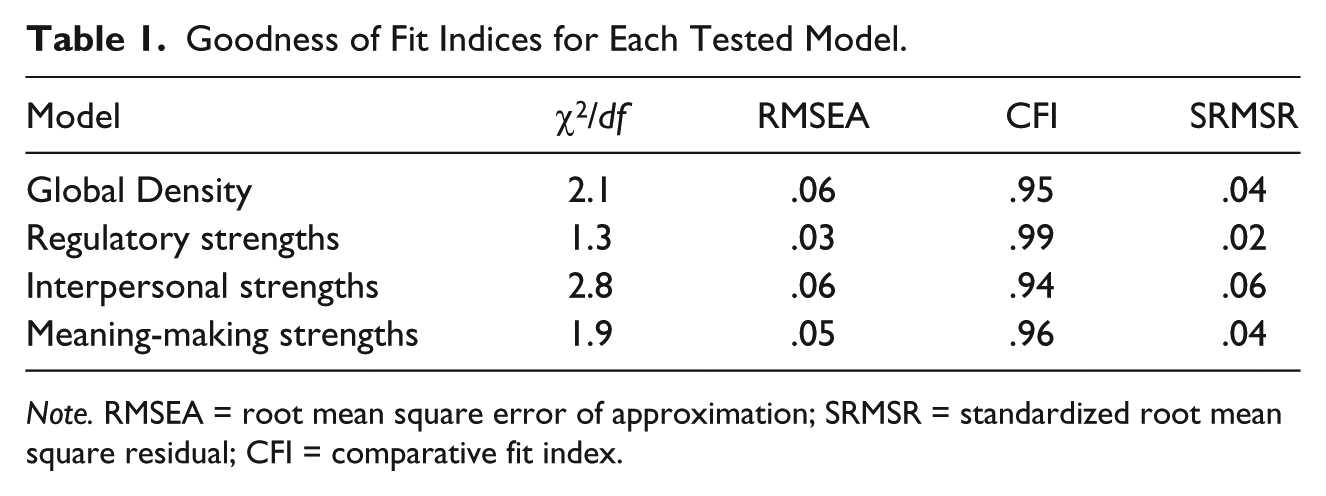
Note. RMSEA = root mean square error of approximation; SRMSR = standardized root mean square residual; CFI = comparative fit index.
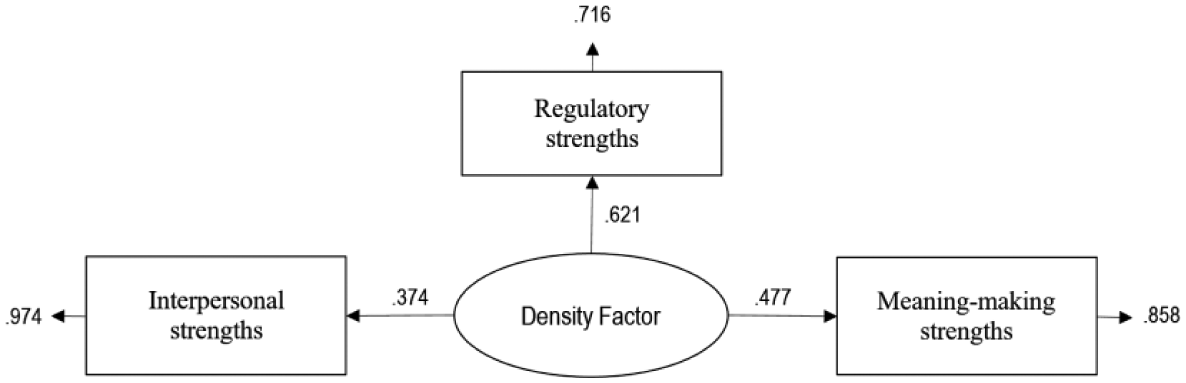
Path diagram of the model (scores correspond to standardized factor loadings).
To analyze the validity of the scales, zero-order correlations between the different indexes of density and well-being were computed. As shown in Table 2, the results indicate significant high correlations in all cases.
Correlations Between Well-Being, Density, and the Three Dimensions of Strengths.
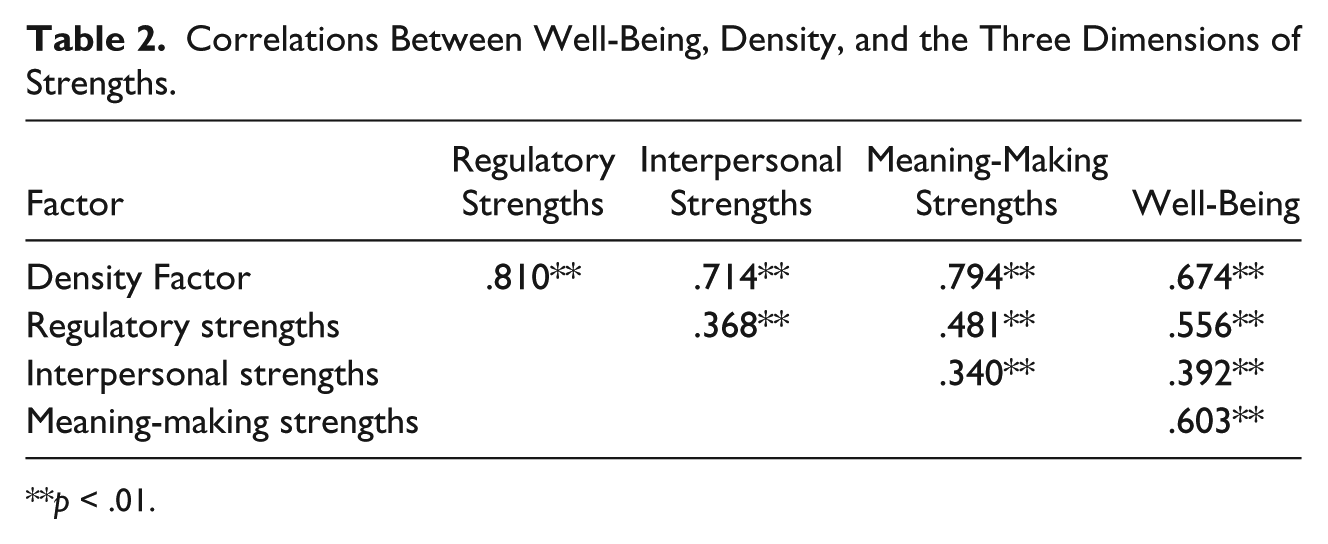
p < .01.
Relationships Between Strengths and Resilience
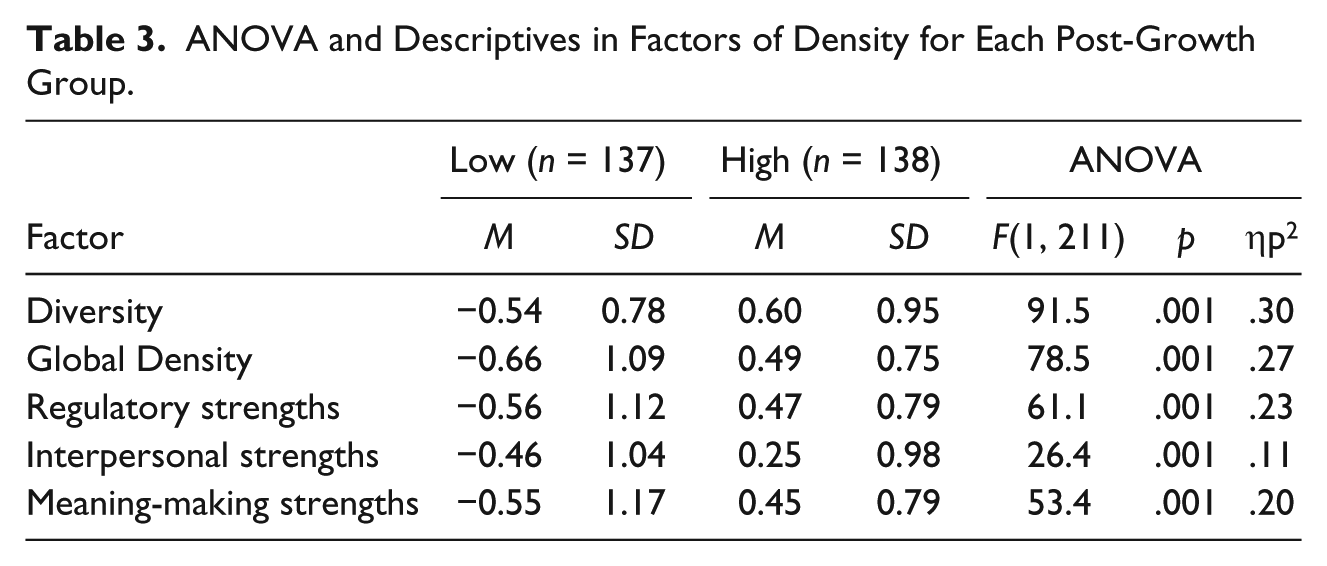
In addition to using the density indexes (a global density index and the three dimension indexes), a new index indicating the diversity of strengths was computed by counting every strength for which a person had a score that is at least .5 SD above the mean. The proponents of the model have adopted this form of calculation in previous studies (Hamby et al., 2018a). Standardized scores of all those indexes were computed, and ANOVA was used to test significant differences between adolescents high and low in post-traumatic growth. As shown in Table 3, both groups showed differences in all indexes, with higher values for those who indicated greater resilience.
ANOVA and Descriptives in Factors of Density for Each Post-Growth Group.
Moreover, binary logistic regression analysis, including all the strengths and the former indexes, was performed to predict post-traumatic growth (Table 4). The model allowed for the correct classification of 78.7% of the participants (79.0% of the true-negatives and 78.3% of the true-positives). In other words, the model is able to predict both nonresilient and resilient cases with a specificity and sensitivity close to 80%. Specifically, psychological endurance, meaning-making density (which includes purpose and optimism), and diversity predicted higher post-traumatic growth among adolescents. By contrast, a higher emotional regulation related to lower post-traumatic growth.
Binary Logistic Regression to Predict Levels (High and Low) of Post-Traumatic Growth.
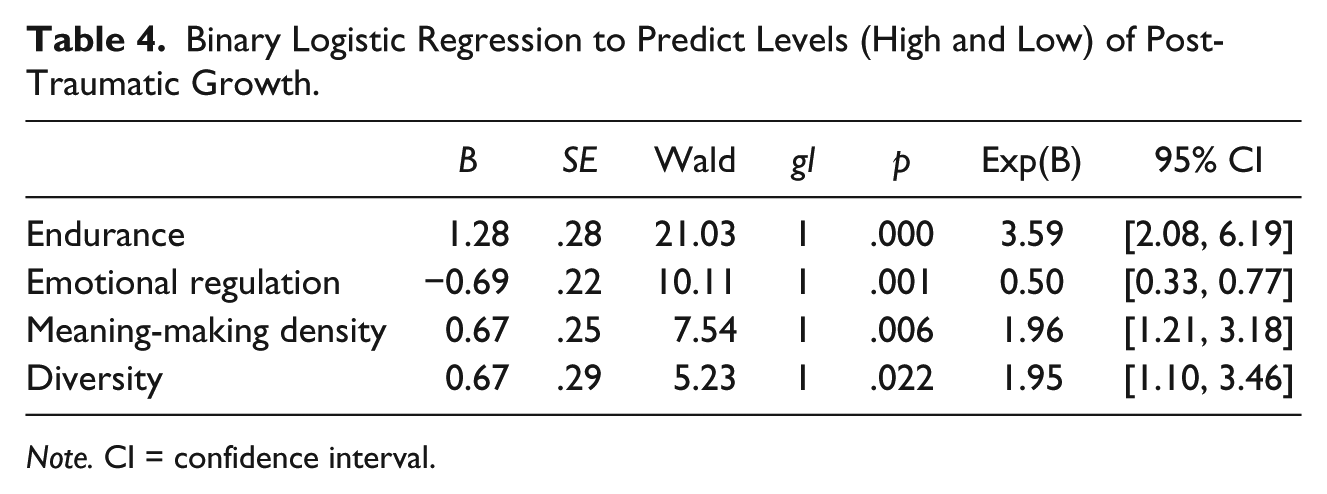
Note. CI = confidence interval.
Burden, Victimization, and Post-Traumatic Growth
An index of burden was computed by counting the number experiences reported for each participant (mode = 1). This index and the indexes of WPV and TDV victimization were used to carry out new binary logistic regressions. The results indicated those indexes do not predict post-traumatic growth. However, they improve the model when they are included into it, allowing the correct classification of 83.9% of the participants (77.9% of the true-negatives and 88.5% of the true-positives). Finally, a new binary logistic regression, adding well-being to the previous factors, was carried out to control for the overall level of functioning. However, its inclusion did not increase the specificity and sensitivity of the model (78.1% of the true-negatives and 82.9% of true-positives).
Discussion
This study examined resilience after adversity in a Spanish sample of adolescents through the lens of the Resilience Portfolio Model (Grych et al., 2015). For this purpose, we used different tools developed by the proponents of this model to examine the constructs of density and diversity, which try to capture the idea of a portfolio of strengths and resources that allows youth to face victimization and other adversities.
The first step was to look for evidence of the validity of these measures through the related construct of well-being. According to prior literature, well-being and resilience are positively correlated, with most people reporting both high well-being and high resilience, or, conversely, low well-being and low resilience. However, some individuals can also show different values on these measures (Mguni, Bacon, & Brown, 2012). The results of the current study confirmed moderate correlations between well-being and all strengths and indexes analyzed. In addition, CFA supported the structure of both the different subscales used and the three dimensions proposed (regulatory, interpersonal, and meaning-making strengths). This final version of the scales is almost identical to the original, as only 2 items were removed from the coping scale to improve its internal consistency. All items in the final version showed adequate psychometric properties. Therefore, these measures are appropriate for the study of resilience in Spanish-speaking adolescent populations.
The results also confirmed the predictions of the model regarding the indexes of density (more intensity of strengths) and diversity (more variety of strengths or also called poly-strengths). With the exception of emotional regulation, all indexes and strengths analyzed discriminated between those classified as high or low in post-traumatic growth. However, thriving levels of post-traumatic growth were predicted by psychological endurance, meaning-making density (represented by purpose and optimism), and diversity. The significance of those two global measures is consistent with what the model proposes, as well as with previous findings in a U.S. sample (Hamby et al., 2018a). These findings also make plausible an additive mechanism that would operate to compensate risk factors. Moreover, the weight of endurance by predicting thriving highlight the importance of persisting to overcome adversity, despite the difficulties. In addition, connecting to something larger than themselves and having a greater diversity of strengths was protective. People usually strive to make sense of stressful events, but it does not always improve well-being (Park, 2010). In this sense, interventions aimed to facilitate meaning making could also help prevent rumination and reinforcement of nonadaptive beliefs. Given that stakeholders are more willing to support strengths-based than deficit-focused approaches (Masten, 2011), promoting these specific strengths among adolescents would contribute to increase resilience and prevent psychological consequences of negative experiences.
Emotional regulation was also significant in the predictive model, but it was through a negative link. Overall, adolescents have especial difficulty to self-regulate (Hagler, Grych, Banyard, & Hamby, 2016). However, it may be exacerbated when they have been exposed to a high burden of adversity. In this sense, the negative link between emotional regulation and resilience suggest some plausible interpretations. For example, there is extensive evidence linking early adversity and poor emotional regulation (Pakulak, Stevens, & Neville, 2018). Hence, this association could indicate an effort of adaptation in those who have been exposed to burden. Along the same lines, the positive link between endurance and post-traumatic growth also suggests a sustained effort to adapt. Moreover, although emotional regulation is required for social and school adaptation, these results could indicate that it does not seem to help post-traumatic growth. High emotional regulation may appear in inhibited and overcontrolled adolescents, which would indicate vulnerability or maladaptation. In these cases, training in expressive writing may be doubly effective, helping to reduce behavioral inhibition and to get meaning.
Most research on protection factors has focused on static variables on which it is difficult to intervene, such as good parenting (in earlier years) or good intellectual skills (Grych et al., 2015). By contrast, the strengths analyzed in this study show clues for optimizing design and assessment of interventions and policies aimed at fostering adolescent health. Promoting density and diversity of strengths, as well as those specific strengths most clearly associated with post-traumatic growth, could improve the effectiveness of interventions for adversity. In fact, there are good reasons for promoting resilience (Howell et al., 2016). Given resilience is no longer considered a static quality, increasing strengths among adolescents should be a priority. Researchers differentiate between resilient, competent, maladapted, and vulnerable young people (Masten, 2011), and findings on resilience can improve either prevention or therapy for these groups.
Although the measure of burden and the indexes of victimization were not significant, their inclusion in the model to predict post-traumatic growth improved the predictions (specificity and sensitivity). In this sense, we confirmed that strengths had more impact on post-traumatic growth than prior exposure to violence and other adversities. These results are consistent with Hamby et al. (2018a) and a meta-analysis carried out by Lee et al. (2013), which has indicated that the largest effect on resilience comes from protective factors, and only a moderate effect from risk factors. Moreover, the study also confirms that a substantial number of adolescents had been exposed to a diverse range of negative experiences, stressing the need to adopt a broader perspective on intervention (Hamby et al., 2018b). In this sense, the results of this study suggest that interventions may be more effective if they address a broader spectrum of adversity.
The findings from this study have implications for diversity by providing evidence from a sample of adolescents from Spain. The findings support the Resilience Portfolio Model developed from U.S. data, in the very different culture of Appalachia. The results suggest similar strengths may benefit individuals from diverse socioeconomic statuses and cultures, but more work expanding this research to other cultural groups is needed.
Limitations and Future Directions
This study presents some limitations that need to be taken into account, both to interpret the findings and to establish new avenues of research. First, while the findings of this study are based on a cross-sectional design, resilience is a process that involves maintaining or reacquiring well-being throughout life. It is necessary to analyze longitudinal data to better understand the changes during adolescence, as well as the possible existence of turning points that facilitate or hinder post-traumatic growth (Masten, 2011). However, this type of cross-sectional study is appropriate for testing new ideas and identifying key targets of more cost-intensive longitudinal research. Second, the results support the premise that density and diversity of strengths play an important role in post-traumatic growth. However, a larger sample would make it possible to test if some rarer forms of adversity may require specific strengths for coping and thriving, which point to a new avenue of research. In this sense, research indicates that different types of traumas may have differential impacts on specific beliefs (Kaufman, Allbaugh, & Wright, 2017). Therefore, strengths required to cope with some types of burden might also be different. Third, as suggested by the poly-victimization model (Hamby et al., 2018b), a larger sample and greater precision in the measures of adversity could improve the ability to differentiate between different profiles of victimization.
Implications for Intervention
The results point to the need to increase the diversity of strengths in adolescence through the simultaneous reinforcement of different strengths. This may contribute to resilience in numerous ways. For example, improving social support and coping may prevent exposure to certain negative experiences and ensure a better response to them. In a similar vein, greater emotional awareness can contribute to reducing vulnerability and avoiding revictimization (Zamir & Lavee, 2015). Meaning-making density may be increased using expressive writing, which may help youth find a purpose at the same time it reduces dysfunctional interpretations and emotional reactions. In future work and intervention development, more attention needs to be paid to the optimum level of functioning for each strength. For example, although emotional regulation is necessary for social and school adaptation, professionals could pay greater attention to cases in which it entails inhibition or overcontrol. Finally, promoting psychological endurance and optimism, although associated with different strength domains, seem like potential longer term goals for the education system. The messages through the media could also be a focus of attention, as well as how they could help promote strengths on a large scale.
The resilience process may differ across cultures (Ungar, 2013), which makes it necessary to compare the findings within and across cultural and social contexts. In Spanish culture, family is very important, and adolescents stay longer with their families than young people from other countries. However, this can be either a source of protection or burden. Adolescents who reported post-traumatic growth in this study seem to lean more on their own assets than on resources that come from others. In this sense, preparing professionals to provide them with adequate support and make them aware that they can count on such support is a way to improve interventions.
Footnotes
Acknowledgements
This research could be culminated thanks to the stay in the Life Paths Appalachian Research Center (LPARC), United States.
Declaration of Conflicting Interests
The author(s) declared no potential conflicts of interest with respect to the research, authorship, and/or publication of this article.
Funding
The author(s) disclosed receipt of the following financial support for the research, authorship, and/or publication of this article: Ministerio de Educación, Cultura y Deportes (Spain) under grant PRX17/00059.