



Abstract
In the United States, approximately 25% of minors have witnessed a violent act, specifically physical assault. African Americans from under-served backgrounds are more likely than other racial and ethnic groups to be exposed to traumatic events. However, there is scant literature examining violence exposure, SC, and life satisfaction collectively, specifically in an African American college sample. The current study sought to determine the associations among violence exposure, SC components, and life satisfaction in an African American college sample. The current sample was comprised of 356 participants (80% female) with a mean age of 20.23 (SD = 1.70). Eighty-eight participants (25%) reported being exposed to violence in their lifetime. Employing logistic regression, we determined violence exposed individuals were less likely to report high satisfaction of life than their non-exposed counterparts (OR = 0.58, 95% CIs = 0.33, 1.00). Individuals with high level of self-kindness were approximately two times more likely to have higher satisfaction of life (OR = 2.48; CI = 1.52, 4.05) compared to their low level self-kindness counterparts and in the presence of demographic covariates. These findings may educate and increase awareness of the impacts of traumatic events. This education could lead to the implementation of interventions to build upon overall well-being in order increase life satisfaction in college students.
Keywords
Approximately one in 15 children are exposed to intimate partner violence each year, with 90% of these children being eyewitnesses to such violence (National Coalition Against Domestic Violence, 2015). In addition, more than 15 million children in America witness some form of domestic violence each year in the United States (Center for Family Justice, 2017). This form of physical violence by a loved one or in the home may be deemed as a form of trauma (Finkelhor et al., 2009). Trauma is used to describe experiences or situations, such as physical abuse, sexual abuse, or an unexpected death, that are emotionally painful and distressing, and that overwhelm people’s ability to cope, resulting in leaving them powerless (Center for Nonviolence and Social Justice, 2014; Finkelhor et al., 2009). In the current study, the construct of violence exposure was defined as the state of having witnessed an argument turn into a physical fight (Mendelson, Turner, & Tandon, 2010). Research suggests that individuals with a history of violence exposure may continue to be exposed into adulthood (Rosenthal, 2000). Examining violence exposure prevalence among ethnicities, research suggests that African Americans from underserved backgrounds are more likely than other ethnic groups to experience violent events (Alim et al., 2006; Walker, 2015). Rosenthal conducted a study of 455 college students (50% African American), which found that 98% of the sample witnessed some form of violence and two thirds had been victims themselves over the last 3 years. The psychophysiological consequences of violence exposure during youth and adulthood are well documented and substantially elevate adult risk of psychological dysfunction and decreased overall quality of life (Gillespie et al., 2009).
Violence exposure is linked to various mental health and behavioral sequelae, including depression, anxiety, posttraumatic stress, and low self-esteem (Seedat et al., 2004). In addition, there is a strong association between exposure to violence and psychosocial maladjustment during development, which may manifest as aggressive and antisocial behavior (Bacchini, Affuso, & Aquilar, 2015; Ouellet-Morin et al., 2016). Witnessing or experiencing violence against oneself or others may alter understandings of the world for young children into adulthood, which may develop internalizing problems (i.e., depression, anxiety) and externalizing problems (i.e., delinquency, aggression, risky behaviors; Bush & Eisenhower, 2014). Witnesses to violence exposure may also learn to use aggression against others for acceptance and believe that it is an appropriate response to situations involving novel peer provocation (Bacchini et al., 2015).
Looking to mitigate the effects of violence exposure, previous research posits individuals exposed to violence had lower life satisfaction and happiness (Bogolyubova, Tikhonov, Ivanov, Panicheva, & Ledovaya, 2020; Rivera, 2000). Specifically, exposure of childhood physical abuse and sexual abuse are often associated with reduced life satisfaction (Rausch et al., 2016). In addition, having witnessed domestic violence and/or exposed to parental violence were associated with satisfaction of life (Lepistö, Luukkaala, & Paavilainen, 2011). Exposure to such violence creates a sense of ongoing fear of lack of safety, which could negatively interfere with one’s life (Rausch et al., 2016; Rivera, 2000). Lepistö et al. (2011) found that individuals from violent homes were more likely to rate their life satisfaction poorer compared with those from nonviolent homes. Research suggests that poor life satisfaction results not only from violence exposure but also from self-compassion (Bogolyubova et al., 2020; Yang, Zhang, & Kou, 2016).
Self-compassion has been conceptualized as a positive indicator of mental health (Morley, 2015). The experience of trauma can alter core beliefs and assumptions that many people hold about themselves, the future, safety (personal and general), and the goodness of others (Scoglio et al., 2018). In addition, mindfulness, a component of self-compassion, has been shown to be a negative indicator of criminality (Morley, 2015). Self-compassion entails being kind and understanding toward oneself in instances of pain or failure, rather than being harshly self-critical; perceiving one’s experiences as part of the larger human experience, rather than seeing them as isolating; and holding painful thoughts and feelings in mindful awareness, rather than overidentifying with them (Scoglio et al., 2018). Self-compassionate people relate to themselves kindly and nonjudgmentally, and are less likely to suppress unwanted thoughts and negative emotions (Miron, Orcutt, Hannan, & Thompson, 2014). Previous research suggests that establishing and maintaining a compassionate perspective may help buffer against the negative effects of trauma exposure, as well as provide an effective therapeutic target for those seeking treatment for posttraumatic stress disorder (PTSD) symptoms (Seligowski, Miron, & Orcutt, 2015). Additional studies have demonstrated that self-compassion is positively associated with life satisfaction, emotional intelligence, and social connectedness (Maheux & Price, 2015). Self-compassion promotes well-being through helping individuals feel cared for, connected, and emotionally calm when one undergoes difficulties and hardship (Yang, Zhang, & Kou, 2016). Thus, exposure to dysfunctional environments or abusive childhood experiences may translate into negative and critical self-appraisals, coupled with increased difficulty extending kindness and understanding toward oneself (Gilbert & Proctor, 2006). Neff, Rude, and Kirkpatrick (2007) found that self-compassion in college students was associated with adaptive psychological indicators such as happiness, optimism, and positive affect. Self-compassion can shield people against the impact of illness and distressing and challenging situations (Duarte, Ferreira, Trindade, & Pinto-Gouveia, 2015).
A significant amount of trauma-related studies have mainly focused on veteran and community-based samples; however, research has expanded to examining college student samples. Research suggests more than half of students enter college with a history of a traumatic event (Boyraz, Horne, Armstrong, & Owens, 2015; Mrug, Madan, Cook, & Wright, 2015). These data highlight the high trauma exposure rates in college students, with college attendance being a risk factor for particular trauma types (i.e., sexual assault; Read, Bachrach, Wright, & Colder, 2016). For college students exposed to a traumatic event, memory loss affected not only their ability to develop secure relationships with peers but also their grade point average (GPA; Sitler, 2009). Individuals exposed to physical/sexual trauma compared with accidental trauma (e.g., natural disasters, motor vehicle accidents) may be at greater risk of PTSD and comorbid psychopathology (Berenz et al., 2016).
Although more mature than younger youth, older adolescents and emerging adults are still vulnerable to negative influences due to ongoing developmental processes, such as brain maturation (Mrug et al., 2015). Nevertheless, exposure to violence is thought to stimulate aggressive behavior through the same social–cognitive and behavioral mechanisms, such as observational learning, adoptions of proviolent beliefs and attitudes, and priming of aggressive behavior (Bradshaw, Rodgers, Ghandour, & Garbarino, 2009). The presence of threat and self-blame in children and young adults exposed to violence in the home has been linked to a number of negative behaviors and emotional consequences across developmental periods such as aggression, poor social skills, and so forth (Miller, Howell, & Graham-Bermann, 2014). Exposure to distressing events in one’s life can change how he or she perceives himself or herself and situations that happen to him or her (Scoglio et al., 2018).
Scant literature examines the independent associations between violence exposure and self-compassion with satisfaction of life, collectively in a college sample, especially in an African American sample. African Americans have been overrepresented in the national tabulation of violence exposure, suggesting there is a stigma on mental health and trauma within the African American community (Walker, 2015; Fletcher & Hilts, 2017) Examining the experiences of African American students is essential because it brings awareness and assists with faculty and schools as a whole to provide support to students (Alim et al., 2006; Walker, 2015). In the current study, we sought to examine the associations between violence exposure, self-compassion, and satisfaction of life with an African American college sample. We hypothesize that African American students exposed to violence in their lifetime will have negative self-compassion and poorer satisfaction of life compared with their nonexposed counterparts.
Method
Participants
There were 356 undergraduate college students included in the current study. The present data were collected from the parent study titled, “The Checkpoint Survey Study” (Keen, Blanden, & Rehmani, 2016). This study recruited undergraduate college students from psychology, mathematics, and biology courses at Virginia State University. Inclusion criteria for the current study included individuals between 18 and 25 years of age with no history of traumatic brain injury. This study has received annual approval from the Virginia State University Institutional Review Board.
Procedures
The study procedure included one study visit, which lasted approximately 30 min. Each participant completed an online survey that included a demographic assessment, violence exposure measure, and psychosocial measures, such as self-compassion and satisfaction of life. After completion of the online survey, participants’ names were collected and recorded to receive extra credit in their respective courses.
Measures
Assessment of self-compassion
The Self-Compassion Scale is a 26-item measure that was used to assess trait levels of self-compassion through six orthogonal subscales (Neff, 2003). The Self-Compassion Scale subscales are Self-Kindness (kindness and understanding toward one’s self), Self-Judgment (harsh self-judgment or criticism), Common Humanity (the realization that suffering and inadequacies are a part of the human condition and that one’s unique experience is a part of the natural human experience), Isolation (egocentric feelings of separation), Mindfulness (a nonjudgmental, receptive mind state where individuals pay attention to their feelings and thoughts as they arise without trying to change them and running away from them), and Overidentified (the excessiveness of personal suffering and failure to recognize others experiencing similar issues). The measure is used on a 5-point Likert-type scale ranging from 1 representing almost never to 5 representing almost always. Items include “When times are really difficult, I tend to be tough on myself” and “When I fail at something important to me I try to keep things in perspective.” The Self-Kindness subscale yielded a Cronbach’s alpha of .78, Self-Judgment subscale yielded .83, Common Humanity subscale yielded .79. The Isolation subscale yielded a Cronbach’s alpha of .82, Mindfulness subscale yielded .80, Overidentified subscale yielded a .80, and the total score yielded a Cronbach’s alpha of .84.
Assessment of life satisfaction
The Satisfaction With Life Questionnaire (Diener et al., 1985) assesses global cognitive judgments of one’s own life satisfaction as a whole. This scale consists of five items using a 7-point Likert-type scale that ranges from 7 = strongly agree to 1 = strongly disagree. Example items include “I am satisfied with my life” and “If I could live my life over, I would change almost nothing.” The total score is computed by adding up the five items and obtaining a total mean score. The responses in the current sample on this measure yielded a Cronbach’s alpha of .85.
Assessment of violence exposure
Violence exposure was assessed using a five-question self-designed measure adapted from the Child PTSD Symptom Scale, which assessed one’s trauma history over the course of his or her lifetime (Foa, Johnson, Feeny, & Treadwell, 2001). In the current study, “Have you witnessed an argument turn into a physical fight?” was used to assess violence exposure. Responses varied from 0 = no to 1 = yes. Sample questions include, “Have you witnessed verbal abuse by a parent/caretaker in your household?” or “Have you witnessed physical abuse by a parent/caretaker in your household?”
Assessment of covariates
Age (in years), sex, classification, and GPA were collected via the demographic questionnaire. Sex was dummy coded where males were represented by “0” and females were represented by “1.” Age was dummy coded where ages 19 and younger were represented by “0” and ages 20 and older were represented by “1.” A median split was conducted on GPA and was then dummy coded to 2.89 or lower, represented by “0” and 2.90 or higher, represented by “1.” Classification represented the number of years participants have been in college and was dummy coded where freshman was represented by “1,” sophomore represented by “2,” junior represented by “3,” and senior represented by “4.” All measures were dichotomized to provide clarity of interpretation of the likelihood of variables, variables were split at the median. The covariates age, sex, and GPA were included in analyses because they were found to be associated with satisfaction of life in previous literature (Lyons & Huebner, 2016; Walker, 2015). However, classification was included in the analyses due to the significant relationship with the Self-Compassion subscales Self-Kindness and Satisfaction of Life.
Data Analysis
All analyses were conducted utilizing SPSS version 24 (IBM, 2016). Means, standard deviations, frequencies, range, and Cronbach’s alpha coefficients were calculated for each measure. Independent t tests and chi-square analysis were performed to determine whether covariates age, sex, classification, or GPA significantly differed or were associated with violence exposure. Continuous variables for Self-Compassion subscales and satisfaction of life were dichotomized by splitting the distribution of scores at the median. All variables were dichotomized to ensure clear interpretation of the main study dichotomous variable: violence exposure. 1 Chi-square analyses were performed examining associations among satisfaction of life (high/low) with violence exposure (yes/no) and Self-Compassion subscales (high/low). A series of unadjusted logistic regression analyses were employed to determine the influence of demographic variables, violence exposure, and self-compassion on satisfaction of life scores. Subsequently, adjusted logistic regression analyses were employed, statistically adjusting for statistically significant covariates. Based on correlations, covariates that were significant were adjusted for in the logistic regression analyses.
Results
Table 1 presents means, standard deviations, and frequencies conducted on the demographic variables and psychosocial measures. The mean age for the overall sample was 20.23 years (SD = 1.70 years) with 286 (80.3%) women and 70 (19.7%) men. Approximately half (58%) of the sample were freshmen or sophomore and the overall mean GPA was 2.83.
Sample Characteristics.
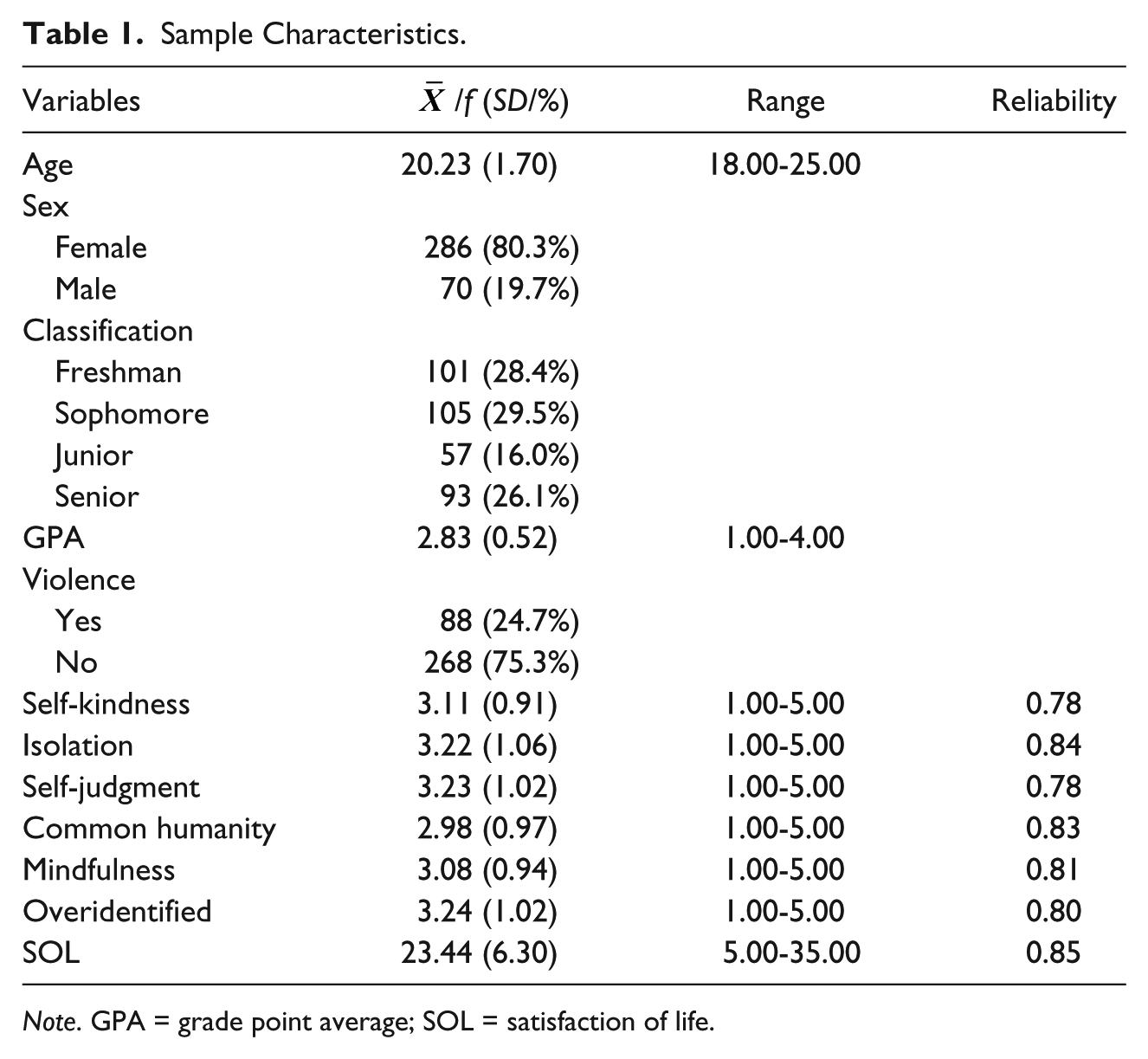
Note. GPA = grade point average; SOL = satisfaction of life.
Zero-order Pearson correlations were conducted to determine associations between the predictors and outcome variables (see Table 2). The covariate GPA was significantly associated with satisfaction of life (r = .163, p = .002). Violence exposure was negatively associated with self-judgment (r = −.143, p = .001), isolation (r = −.140, p = 001), and overidentified (r = −.146, p = .001). Self-kindness was positively associated with GPA (r = .124, p = .020), common humanity (r = .323, p = .001), mindfulness (r = .412, p = .001), and satisfaction of life (r = .192, p = .001). Self-judgment was negatively associated with common humanity (r = −.229, p = .001) and mindfulness (r = −.165, p = 002). Self-judgment was positively associated with isolation (r = .646, p = 001), overidentified (r = .635, p = .001), and satisfaction of life (r = .190, p = .001). Overidentified was negatively associated with sex (r = −.145, p = .006). Satisfaction of life was positively associated with self-kindness (r = .254, p = .001), self-judgment (r = .190, p = .001), isolation (r = .194, p = .001), mindfulness (r = .147, p = .005), and overidentified (r = .205, p = .001). There were no other significant associations among the predicting and outcome variables.
Correlations Among Covariates, Violence Exposure, Self-Compassion, and Satisfaction of Life.

Note. GPA = grade point average; Self-Kind = Self-Kindness subscale of the Self-Compassion Scale; Self-Judge = Self-Judgment subscale of the Self-Compassion Scale; Comm Human = Common Humanity subscale of the Self-Compassion Scale; Isolate = Isolation subscale of the Self-Compassion Scale; Mindful = Mindfulness subscale of the Self-Compassion Scale; Over Ident = Overidentified subscale of the Self-Compassion Scale; SOL= Satisfaction With Life Scale.
p < .05. **p < .01. Bold face values describe significant values.
A series of chi-square and t tests were conducted to examine the associations and differences among demographic characteristics, satisfaction of life, and trauma and self-compassion between those who reported experiencing violence exposure in their lifetime and those who did not (see Table 3). There was a significant association between participants exposed to violence and satisfaction of life (χ2 = 7.58, p < .01, φ = .006), self-judgment (χ2 = 7.26, p < .01, φ = .007), isolation (χ2 = 6.96, p < .01, φ = .008), overidentified (χ2 = 7.63, p < .01, φ = .006).
Violence Exposure, Self-Compassion, Satisfaction of Life Cross Tabulation.

Note. GPA = grade point average.
Unadjusted logistic regression analyses were employed to determine whether violence exposure and self-compassion were associated with satisfaction of life (see Table 4). Individuals exposed to violence were less likely to report having a high satisfaction of life than their nonexposed counterparts (odds ratio [OR] = 0.58, 95% confidence interval [CI] = [0.33, 0.99]). Individuals who reported having a high level of self-kindness were 2 times more likely to report having a high satisfaction of life than their low-level self-kindness counterparts (OR = 2.41, 95% CI = [1.41, 4.13]). Individuals who reported having a high level of isolation were 2 times more likely to report having a high satisfaction of life than their low-level isolation counterparts (OR = 2.38, 95% CI = [1.21, 4.69])
Violence Exposure and Self-Compassion Regressed on Satisfaction of Life.
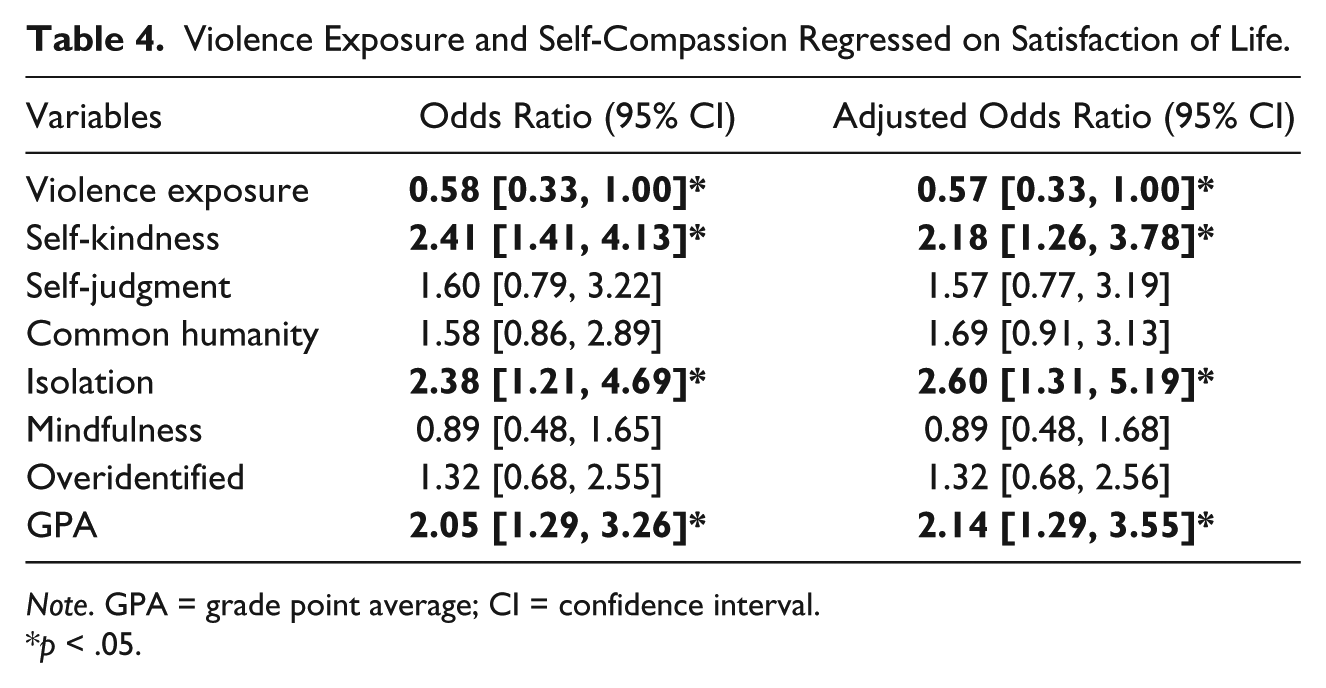
Note. GPA = grade point average; CI = confidence interval.
p < .05.
Adjusted logistic regression was used to examine whether satisfaction of life was associated with violence exposure, self-compassion, and covariate GPA (see Table 4). Covariates were not included in the analyses due to all being not significant. Individuals with a GPA of 2.90 or higher were 2 times more likely to report a high satisfaction of life (adjusted odds ratio [AOR] = 2.14, 95% CI = [1.29, 3.55]). Individuals with high self-kindness were 2 times more likely to report having a high satisfaction of life (AOR = 2.18, 95% CI = [1.26, 3.78]). Individuals with high isolation were 2 times more likely to report having a high satisfaction of life (AOR = 2.61, 95% CI = [1.31, 5.19]). In an attempt to explore the interactions between predicting variables, there were no significant interactions.
Discussion
There is scant literature examining violence exposure and psychosocial factors within an African American sample, especially in college students. The purpose of the present study was to determine the associations between violence exposure, self-compassion, and satisfaction of life. The findings from the current study suggest an association between violence exposure and satisfaction of life. The findings were consistent with previous literature, which posits that exposure to traumatic experiences was associated with poorer life satisfaction (Anke & Fugl-Meyer, 2003; Maheux & Price, 2015; Pereira, Pedras, & Lopes, 2012; Seligowski, Miron, Orcutt, 2015). There was an association between satisfaction of life and self-compassion, which is consistent with previous literature regarding the positive relationship between self-compassion and satisfaction of life (Jennings & Tan, 2014; Maheux & Price, 2015; Yang, Zhang, & Kou, 2016). However, the current findings are unique, in that, both the Self-Compassion subscales, Self-Kindness and Isolation, were associated with satisfaction of life. Of the scant literature exploring the relationship between self-compassion and satisfaction of life, few have examined the self-compassion components with life satisfaction (Hall, Row, Wuensch, & Godley, 2013; Neff, 2016; Yang et al., 2016). The association between self-kindness and life satisfaction was in line with previous literature, in that, an increased self-kindness predicted increased life satisfaction (Neff, 2016). People who have high self-kindness, which is the kindness and understanding toward oneself, are more likely going to have high quality of life. However, the association between isolation and satisfaction of life was inconsistent with previous literature, such that a decrease in isolation predicted an increase in life satisfaction (Neff, 2016). This association is unique, in that, it may suggest that individuals may see their inadequacies as unique and may have formulated this perspective of being special compared with everyone else.
Interestingly, GPA was significantly associated with satisfaction of life. The current study’s findings are consistent with the research literature that posits that individuals, specifically college students with a higher GPA report a higher satisfaction of life (Walker, 2015). However, the findings are inconsistent with some literature indicating that intrapersonal factors, such as GPA were not associated with global life satisfaction (Suldo, Riley, & Shaffer, 2006). Previous literature explored GPA as a predictor of self-compassion and not as a covariate. Research suggests that life satisfaction relates positively to students’ academic performance. More specifically, individuals who have a higher satisfaction of life also display higher GPAs and greater engagement (Lyons & Huebner, 2016). It is suggested that young adults who are in college and believe to have a high GPA tend to feel better about themselves as they will associate positive characteristics to their lives (i.e., intelligent, happy, proud).
Therapeutic-based interventions are now instituting a “trauma-informed care” approach, which focuses on the person’s experience to help him or her better cope with psychological distress (Valdez & Lilly, 2015). The current study provides an additional framework to foster positive change by quantifying the importance of self-kindness, self-compassion, and self-understanding. Previous studies have shown that greater self-kindness and mindfulness were associated with less overall posttraumatic stress symptoms (Valdez & Lilly, 2015). Increasing these components or focusing on these elements within the therapeutic process will likely increase one’s satisfaction with life or at least identify the positive traits that can promote change. Typically, in the therapeutic process, the focus is on one’s deficits. However, current research supports a direct focus on affirming and reinforcing self-kindness, self-compassion, self-understanding, and other positive traits to process distress as it may buffer against the negative effects of trauma (Seligowski, Miron, & Orcutt, 2015). Thus, clinical outcomes will likely improve.
There were a few limitations to the current study. Although the rate of men to women fall within range of many universities, the overall sample size for the initial wave of the Checkpoint study had a small subsample of males. The study was cross sectional, which limited its generalizability. Although this study was conducted in a predominately Black college student sample, Other ethnicities were underrepresented in the sample. One strength of the present study included contributing unique findings to the literature in an underrepresented sample. Another strength of the study was the collection of data provided by a diverse sample of college students from a historically Black college or university (HBCU).
In summary, this is one of the first studies to explore violence exposure, self-compassion, and satisfaction of life at an HBCU. Much of the previous research examines trauma exposure with self-compassion and/or satisfaction of life through a military lens, focusing on veterans with PTSD, but findings suggest that a growing number of college students have been exposed to trauma, specifically violence exposure (Boyraz et al., 2015; Mrug et al., 2015). Early trauma should be considered when developing interventions for college students’ mental health, although individuals with trauma exposure have difficulties disclosing personal traumatic events (Kim, Noh, & Park, 2015). Increasing levels of self-compassion may contribute to greater life satisfaction and subjective well-being for trauma survivors, a treatment aim consistent with the recovering model of mental health care (Seligowski, Miron, & Orcutt, 2015). Although no empirically supported treatment has been developed to increase self-compassion in trauma survivors specifically, Gilbert (2009, 2010) and Neff and Germer (2013) have designed therapeutic protocols to teach and increase self-compassion skills in both clinical and nonclinical populations (compassion-focused therapy and the Mindful Self-Compassion program, respectively; Gilbert, 2009, 2010; Neff & Germer, 2013; Seligowski, Miron, & Orcutt, 2015). With this comes the need for new and innovative prevention and intervention programs to address trauma and well-being (i.e., self-compassion, self-perception) among college students. This may be imperative in underrepresented samples, such as HBCU students.
Footnotes
Declaration of Conflicting Interests
The author(s) declared no potential conflicts of interest with respect to the research, authorship, and/or publication of this article.
Funding
The author(s) received no financial support for the research, authorship, and/or publication of this article.