




Abstract
Colleges are increasingly adopting “affirmative consent” policies, which require students to obtain conscious and voluntary consent at each stage of sexual activity. Although this is an important step forward in violence prevention, very little is known about how best to present the policies to students. This is important, as research on sexual harassment policy training finds that training can reinforce traditional gender beliefs, which undermines policy goals. Building on this literature, we argue that affirmative consent policy trainings emphasizing punishment will increase support for affirmative consent but will reinforce traditional gender beliefs. We tested our predictions with an experiment in which we randomly assigned undergraduate participants to one of three conditions where they read an excerpt of (a) an affirmative consent policy that emphasized the threat of punishment, (b) an affirmative consent policy that emphasized a normative/moral message, or (c) an ergonomic workstation policy that served as our control condition. We found that punishment framing increased men’s support for the policy, had no effect on their likelihood to comply, and increased their perception that “most people” hold men to be more powerful than women. For women, the punishment and normative framings increased support equally, but the normative framing actually decreased likelihood to comply. The policy conditions had no effect on women’s gender beliefs. The results suggest that while an emphasis on punishment can help legitimate nonconsensual sex as a social problem, it will not necessarily increase college students’ compliance with affirmative consent, and runs the risk of activating essentialist stereotypes about gender difference. As the issue of campus sexual assault becomes increasingly politicized and contested, our findings highlight the need for more research.
Colleges in the United States are increasingly adopting “affirmative consent” policies, which both require students to obtain conscious and voluntary consent at each stage of sexual activity and establish punishments for policy violation (Napolitano, 2015). Although this is an important step forward in violence prevention, very little is known about how best to present the policies to students. This is important, given research finding that most college sexual assault prevention programs are ineffective at reducing sexual violence (DeGue et al., 2014) and research finding that related prevention efforts, such as sexual harassment policy training in the workplace, can actually reinforce traditional gender beliefs (e.g., Tinkler, Gremillion, & Arthurs, 2015). Changing underlying cultural beliefs is a particularly important goal for laws and policies addressing gendered victimization, as beliefs and stereotypes about women are often used to excuse perpetrator behavior (LeMaire, Oswald, & Russell, 2016).
How can affirmative consent policies be presented most effectively? The goal of this article is to examine how affirmative consent policy framing affects support for the policy, anticipated compliance, and both implicit and explicit attitudes about women and men. Specifically, our study uses an experimental design to compare reactions to a university sexual misconduct policy that threatens punishment to one that underscores the moral/normative imperative. By focusing on sexual misconduct, we examine a social problem in which tougher punishments are seen as an essential part of the solution. For example, victim advocates point to light punishments and weak university responses to victim complaints as evidence of America’s rape culture (e.g., Bazelon, 2014). Reflecting the national outrage to a Stanford University student being sentenced to only 6 months in jail following a rape conviction, Vice President Joe Biden wrote in a letter to the victim, “I am filled with furious anger both that this happened to you and that our culture is still so broken.” Implicit in these reactions is the assumption that stricter punishments would not only deter potential perpetrators but also help to dismantle rape culture by sending a clear message that rape is not acceptable, thereby changing the beliefs, values, and norms that undergird patterns of sexual violence.
To develop our argument, we draw from perceptual deterrence and normative compliance theories. These models reflect very different philosophies about how crime might be controlled. Although substantial research has examined the effects of deterrence versus normative approaches on crime reduction, research has paid less attention to how the symbolic messages embedded in these different approaches affect broader cultural beliefs. Understanding the role of these symbolic messages in shaping gender beliefs is essential to effective enforcement of policies governing sexual violence, since these policies are designed primarily to protect female victims from male offenders.
University Affirmative Consent
In 2013, President Obama signed into law the Campus Sexual Violence Elimination Act (Campus SaVE Act), which aimed to reduce sexual violence on college campuses. As part of the law, private and public universities that received federal funding were required to adopt and advertise policies consistent with Title IX protections of female students (Richards, 2016). As a result, higher education institutions in the United States have revised their sexual misconduct policies to incorporate affirmative consent and are now implementing and publicizing these new policies (Keenan, 2015).
Most affirmative consent policies require both parties to obtain affirmative, conscious, and voluntary consent at each stage of sexual activity, and these policies make it clear that a prior relationship, intoxication, or an inability to indicate clear consent can never be used as reasons for failing to obtain consent. Clear communication about sexual desires, however, requires a shift in heterosexual interaction norms that have historically prescribed men to be sexually assertive and women to be deferential (Hamilton & Armstrong, 2009; Lorber, 2004). Consequently, these policies are controversial; they have been criticized for “ruining good sex,” making sexual encounters into legal contracts between parties, and giving alleged victims more rights than the accused (Dalmia, 2014; Friedersdorf, 2014; Grasgreen, 2013).
In addition, affirmative consent policies generally protect women victims and punish men offenders. Policies that protect one group by punishing another group may elicit backlash arising from perceived threats to status and the underlying normative order. Such effects have been demonstrated in studies of sexual harassment policies, which have been shown to sometimes incite negative attitudes about women and reproduce gender stereotypes that encourage men’s aggression and women’s submissiveness (Tinkler, 2012, 2013; Tinkler et al., 2015; Tinkler, Li, & Mollborn, 2007). However, these unintended effects of such policies are not inevitable. Our goal is to explore how campus sexual misconduct policies can be communicated in a way that changes the broader cultural beliefs and norms that buttress unequal relations. At this stage, there has been no published research of which we are aware that has examined the effects of affirmative consent policies. As such, our study serves as an important first step in what must be a sustained effort to further research this topic.
Theoretical Background
Research on crime control differentiates between approaches that emphasize punishment and approaches that focus on normative compliance. These approaches also shape framing of legal directives. It is through such framing that citizens learn of new laws, develop opinions about laws, and make compliance decisions. We argue that the explicit and implicit messages conveyed by deterrence and normative framing shape not only the likelihood of obeying the law but also affect wider beliefs that can either reinforce or undermine a law’s overarching goal.
The focus on punishments underlies much of our nation’s crime control policy and is based on the deterrence model, which proposes that would-be offenders are deterred by punishments that are swift, certain, and appropriately severe (Beccaria, 1764/1986; Becker, 1968; Bentham, 1879). The perceptual deterrence model assumes that individuals weigh the perceived costs and benefits of engaging in criminal activity, choosing not to engage in crime when they believe that significant punishment is likely. There is considerable support for the model, with many studies finding that perceptions about the likelihood of apprehension affect projected offending (see Nagin, 2013). This effect is documented for a range of illicit and prohibited activities—including sexual violence (Bachman, Paternoster, & Ward, 1992) and tax evasion (Klepper & Nagin, 1989). Although policy makers who are tough on crime often draw on society’s moral values to justify severe punishments (e.g., capital punishment communicates society’s abhorrence for murder), there has been little research on the direct effect of the threat of punishment on broader cultural beliefs, and there is no published research examining how punishment framing for sexual misconduct policies affect beliefs about men and women.
In contrast to deterrence approaches, the normative compliance model argues that normative expectations and moral beliefs motivate legal compliance. This model emphasizes the role of procedural justice—respectful and fair treatment—in building consensus around citizens’ moral obligations to comply with legal authorities (Tyler, 1990). According to this perspective, when people perceive that the actions of institutional authorities reflect a “shared sense of right and wrong” (Hough, Jackson, Bradford, Myhill, & Quinton, 2010, p. 3), they are more likely to see institutional authorities as legitimate and, in turn, comply with institutional policies (Tyler, 2006). Thus, people obey the law not because they fear punishment, but because they feel a moral obligation to obey legitimate authority. In support of the model, perceptions of legitimacy have been found to increase compliance with the law, cooperation with legal authorities, and have even been found to reduce the acceptance of violence as a way to solve a private conflict (Jackson, Huq, Bradford, & Tyler, 2013; Sunshine & Tyler, 2003; Tyler, 1990).
Despite decades of research on perceptual deterrence and normative models of law, surprisingly little research has examined how the framing of laws in either deterrence or normative messages influences support for the law or related attitudes. Policy framing is particularly relevant for laws and policies that challenge existing status hierarchies, such as affirmative consent policies, since such edicts usually target deeply entrenched beliefs and interaction norms that favor some groups over others (Tinkler, 2013). Below, we develop the novel argument that punishment messaging is more effective at engendering support for an affirmative consent policy than is normative messaging but at the same time punishment messaging elicits stereotypical gender attitudes, which ultimately undermine policy effectiveness.
Hypotheses
In line with perceptual deterrence theory, we argue that because the threat of punishment signals that society deems nonconsensual sexual behavior to be a serious offense, the threat of punishment will increase support for an affirmative consent policy (Schwartz & Orleans, 1967). Punishments increase not only the stakes for being deviant—that is, a group outsider—but also positive emotion (see Darley, 2009, for a review) and social cohesion among law abiders (Erikson, 1966). Experimental research has even shown that people experience rewarding brain states when someone who they believe deserves to be punished receives a punishment (de Quervain et al., 2004). Since most Americans believe sexual assault is morally abhorrent (Tinkler, Becker, & Clayton, 2018) and do not want to associate themselves with sexual perpetrators, information that the university punishes those who do not obtain affirmative consent sends an important symbolic message. Thus, we predict that the threat of punishment will increase support for an affirmative consent policy more than will a policy that emphasizes normative justice, in part, because it more powerfully stigmatizes nonconsensual sexual behavior.
However, threats of severe punishments may exacerbate the gender divisions and stereotypes that often underlie sexual violence. By increasing support for policies that require affirmative consent, the threat of punishment legitimates the notion that any sexual activity without affirmative consent is sexual misconduct. The shift from a “no means no” to a “yes means yes” standard broadens the sexual behaviors that count as nonconsensual. One effect of having a policy that combines this shift with the threat of punishment is that it increases the number of potential perpetrators and victims. Because sexual misconduct is so gendered and most often involves men assaulting women (Cantor et al., 2015), expanding the universe of potential perpetrators and victims means coming to think of more men as perpetrators and more women as victims. In other words, the threat of punishment for violating affirmative consent shifts our cultural image of the perpetrator from a pathological deviant to the average college man and our image of the victim to the average college woman. Although this is arguably the intended effect and more realistically reflects the nature of sexual assault on college campuses (Bureau of Justice Statistics, 2014), an ironic consequence of this shift is that it challenges one of the broad tenets underlying the fight for gender equality—the idea that men and women are more similar than they are different. Thus, we hypothesize that because the threat of punishment legitimates the claim that sexual assault is endemic and common, it reinforces traditional stereotypes that emphasize gender differences. By threatening punishments, such framing highlights women’s and men’s competing interests, evoking stereotypical notions about men’s power and women’s weakness.
Method
We test our hypotheses with a laboratory experiment in which we evaluate reactions to a campus affirmative consent policy that varies in the framing (threat of punishment vs. normative compliance). Before conducting the study, we piloted the manipulations and the instruments that measure our dependent variables. Below, we briefly describe our preliminary research before reporting the main study.
Pilot Study
At the outset of our research, we sought to develop an affirmative consent policy presentation that was consistent with the policies and language being adopted by universities. After extensive research, 1 we used the definition of affirmative consent written into law in California (Student Safety: Sexual Assault Act, S. 3681, 2014) in the computer presentation that served as our policy manipulation. We developed the punishment and normative justice manipulations based on preliminary testing and research of university sexual misconduct policies. 2 Most university policies use both normative messaging and the threat of punishments. Our experimental design borrows language from actual policies but isolates the effect of normative versus punishment framing.
We piloted the experiment using participants from Amazon’s Mechanical Turk (MTurk). For the pilot, we used a 2 (affirmative consent policy vs. control policy) × 2 (threat of punishment framing vs. normative framing) between-subjects design in which participants were randomly assigned to read one of the four policy statements before answering questions measuring their beliefs about gender and campus sexual misconduct policies. We had participants in the control condition read about a university’s new alcohol use policy that required designated servers at university events. The sample consisted of 107 participants (59.8% male) with a mean age of 34 years. It was comprised of primarily Whites (81.3%) and Asians (15%), with a smaller proportion of African Americans (3.7%) and Hispanics (5.6%). Most participants had experience with higher education with 36.4% holding a bachelor’s degree and 23.4% having completed some college. Only a small number (six) were current students.
Manipulation checks showed that 96% of participants correctly recalled the condition to which they had been exposed and 92% correctly answered quiz questions about the specific language of the policy to which they had been exposed. Our measures of gender beliefs and attitudes about the policy demonstrated reliability (αs > .77).
The pilot study provided preliminary support for key hypotheses, but there were limitations that we aimed to address in the main study reported below. First, consistent with our hypotheses, we found that the threat of punishment increased participants’ support for the policy, likelihood to comply with the policy, and the belief that men are more powerful than women. However, contrary to our expectations, we found the same effects of punishment framing across affirmative consent and alcohol use conditions. Since alcohol use and sexual misconduct are so intertwined on college campuses, we were unable to make conclusions about the independent effect of the affirmative consent policies. In other words, we needed a more neutral control condition. In addition, while most of the sample had attended college, we did not know whether our findings would be different for current college students who are most directly affected by campus sexual misconduct policies. Furthermore, limitations in our sample size prevented us from fully examining gender differences. In the main study, we address each of these issues.
Laboratory Study
Overview
Undergraduate participants were invited to participate in a laboratory study in which they read and evaluated a university policy for course credit. We used a between-subjects design in which participants were randomly assigned to read one of three campus policy statements before answering questions measuring their beliefs about gender and campus sexual misconduct policies. The three conditions were affirmative consent policy with punishment framing, affirmative consent policy with normative framing, and a control condition. 3 In the control condition, participants read the university policy for setting up ergonomic computer workstations. Although we do not make specific hypotheses about gender differences, we recruited an equal number of women and men, and randomly assigned them to each condition.
Participants
In exchange for fulfillment of an Introductory Psychology course requirement, 149 undergraduates at a public university participated in the experiment. Because our hypotheses relate to a policy intervention that is being implemented across college campuses nationwide and college-age women are disproportionately victimized by sexual assault (Bureau of Justice Statistics, 2014), our use of an undergraduate sample has the benefit of being relevant to the individuals most affected by new sexual misconduct policies. We excluded three participants from the analysis due to a failed manipulation check during the study. The final sample for our analysis (N = 146) consisted of 73 men and 73 women ranging in age from 18 to 69 years old (M = 19.79, SD = 4.38). Participants in this sample are mostly White (76.7%), with a small percentage of Asian (13.7%), African American (11%), or nonclassified (1.4%) students. 6
Materials and procedures
Participants were told the study was about how universities can better communicate new campus policies. Participants read a policy statement that they were told was just adopted by “Braymont University.” Participants read about Braymont University’s new policy rather than their own campus policy to reduce the effects of discourse around their university’s sexual misconduct policy. They then completed a three-question quiz purportedly assessing their memory of what they had just read. The quiz was designed to reinforce the message of the policy. Participants were then told that they would be participating in another task that measures cognitive memory processes. This task was actually an Implicit Association Test (IAT; Greenwald, McGhee, & Schwartz, 1998) measuring implicit gender stereotypes. After the IAT, participants answered questions about their gender beliefs and support for the adoption of affirmative consent policies. Finally, participants answered questions about their demographic characteristics.
We manipulated the policy content by randomly assigning participants to read about either the university’s “affirmative consent” or “computer workstation” policy, which served as our control condition. The affirmative consent policy conditions stated that the university now “requires that both parties in a sexual encounter obtain conscious, voluntary, and affirmative consent at each stage of sexual activity” and emphasized that a “prior relationship, intoxication, or an inability to indicate clear consent can never be used as reasons for not obtaining consent before sexual activity.” Participants in the control condition read a statement about the university’s commitment to providing ergonomically safe computer workstations on campus (see the appendix; Tinkler et al., 2015).
We also manipulated the framing of each policy. In the punishment conditions, the statement emphasizes that violation of the policy “could lead to suspension, removal from campus residences, referral to the police on criminal charges, civil lawsuits, and expulsion.” In the normative framing conditions, the statement emphasizes that violation of the policy “interferes with the university’s core values,” “affects students’ mental and physical health,” and that the policy is “better for everybody on campus because it demonstrates respect for the rights and safety of our community” (see the appendix).
Dependent Variables
Support and compliance
We measured participants’ support for affirmative consent policies with a question that defined affirmative consent and asked whether they would be supportive of the university changing their sexual misconduct policy to require affirmative consent. Participants marked their support on a 7-point scale (not supportive at all to very supportive).
We measured likelihood to comply with the university sexual misconduct policy on a scale comprised of three questions that ask about their likely behavior if they were students at the university (α = .59). All three questions were measured on a 7-point scale ranging from not at all likely to very likely. The first asks how likely they would be to comply with the affirmative consent policy by obtaining clear and conscious consent prior to any sexual activity. The second question asks how likely they would be to report a sexual assault to the Office of Sexual Misconduct if they were assaulted by a student. The third asks how likely they would be to persuade a friend to report a sexual assault. Since the latter two items relate to reporting and the first relates to compliance during a sexual encounter, we also conducted all analyses with each item separately and with just the reporting items combined into a scale. Substantive findings were the same.
Gender stereotyping
Explicit beliefs are conscious and more easily controllable, while implicit beliefs are unintentionally activated, often existing outside of one’s awareness. Since changing norms make explicitly sexist statements socially inappropriate (Swim, Aikin, Hall, & Hunter, 1995), we measured both implicit and explicit beliefs. To measure implicit beliefs about gender difference, we used the IAT. The IAT is a response time computer program that records the speed with which research participants make associations between social categories, capitalizing on the tendency for people to make faster associations between concepts that they more strongly associate with each other. 4 In the IAT for this study, respondents categorized female and male names with career and family words by rapidly pressing one of two computer keys. More ease (i.e., with more speed) categorizing female names when they are paired with family (vs. career) words and male names when they are paired with career (vs. family) words suggests stronger implicit associations of men and women with their traditional gender roles.
The results presented below calculate the IAT effect using Greenwald, Nosek, and Banaji’s (2003) improved algorithm and the recommended built-in error penalty that accounts for the time it takes to correct an error. 5 Consistent with prior research, we interpret a positive IAT effect that is significantly different than zero as evidence that participants associate men and women with their traditional gender roles. A greater “IAT effect” indicates a stronger association.
For comparability, we followed the approach of Tinkler et al. (2007) in their experiments on the effects of sexual harassment policies by measuring explicit gender beliefs in two ways: We asked participants to first complete ratings of men and women based on what they think “most people” believe and then complete all of the same scales based on their “personal opinion.” We used semantic differential items on 7-point scales for pairs of words measuring how participants thought “most people” rate men’s and women’s power and also how they personally would rate men’s and women’s power. The participants were first asked to mark where “most people” would position men on scales between two polar adjectives: respected/not respected, powerful/powerless, high status/low status, leader/follower (Tinkler et al., 2007). Then participants completed the same scales for how they think “most people” would rate women. We then followed the same procedures for measuring participants’ personal beliefs. We measure “most people’s” beliefs (referred to in Status Characteristics Theory as “status beliefs”; see Correll & Ridgeway, 2006, for a review) because research shows that awareness of gender stereotypes—even if they are not personally endorsed—can powerfully shape cross-gender interaction behavior in ways that validate and reify men’s status and power advantages (Ridgeway, 2011). We combined the items to form separate scales of “most people’s” beliefs (men’s power α = .77; women’s power α = .83) and “personal” beliefs (men’s power α = .82; women’s power α = .72). We then subtracted the women’s power scale from the men’s so that positive numbers indicate the belief that men are more powerful than women.
Results
We did not hypothesize gender differences, but we report all results split by gender to explore the possibility of differences. 6 Table 1 shows mean differences across conditions for male participants, and Table 2 shows mean differences for female participants. Participants in all conditions tend to support affirmative consent and report that they would comply with the university policy. All participants also tend to implicitly associate men and women with their traditional gender roles (IAT D score is significantly different than zero; p < .001) and express the belief that men are more powerful than women.
Men’s Variable Means (SDs) Across Conditions.

p < .1. *p < .05 (significantly different than control condition; two-tailed except for hypothesis tests which are one-tailed).
Women’s Variable Means (SDs) Across Conditions.
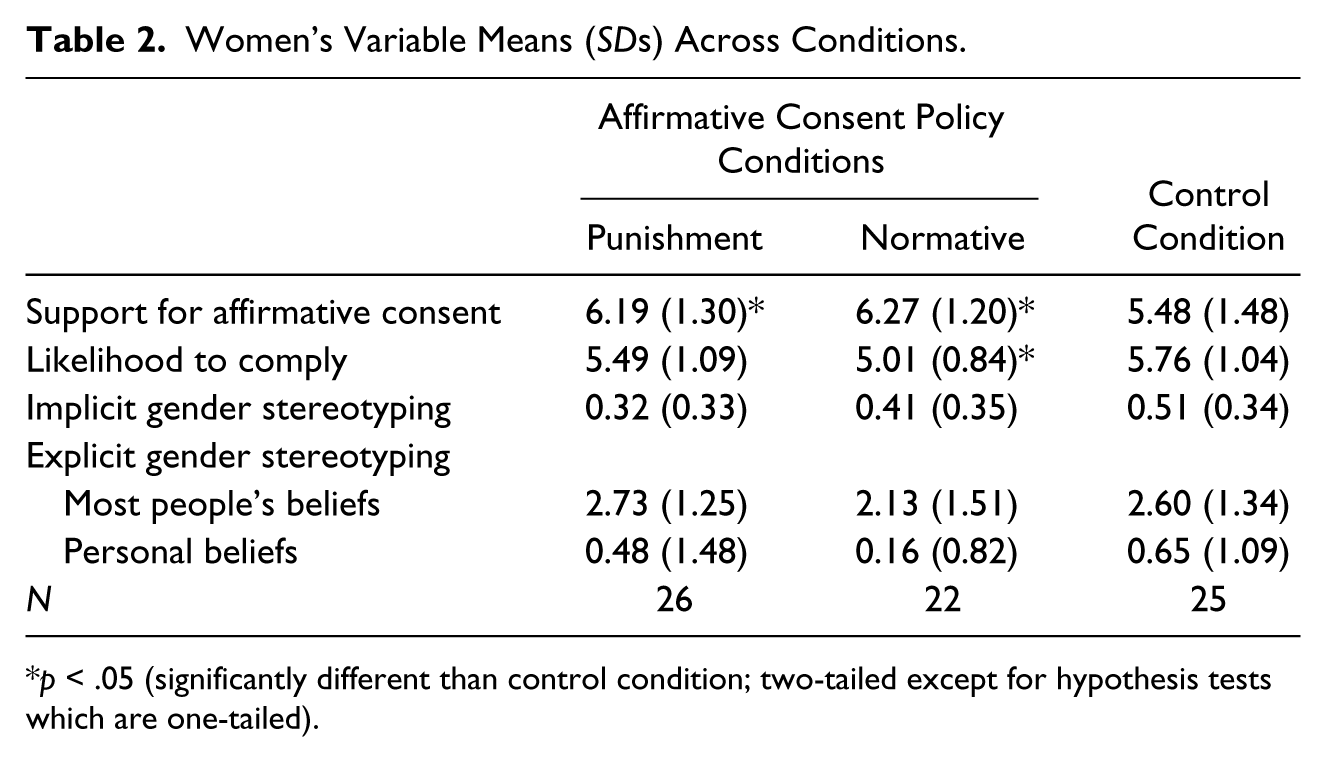
p < .05 (significantly different than control condition; two-tailed except for hypothesis tests which are one-tailed).
Table 3 reports ordinary least squares (OLS) estimates in which we regress the four dependent variables on the indicator for being in the punishment condition and on the indicator for being in the normative condition. The control condition is the omitted variable. We hypothesized that exposure to punishment threat in the affirmative consent policy condition would increase support for the policy and compliance with it (H1). For male subjects, we find that the punishment condition significantly increases support. The normative coefficient is positive but not significant. We find no effects of either policy framing on likelihood of compliance. Thus, we find partial support for H1 among male subjects.
Ordinary Least Squares Estimates of Policy Support, Compliance, and Gender Beliefs.
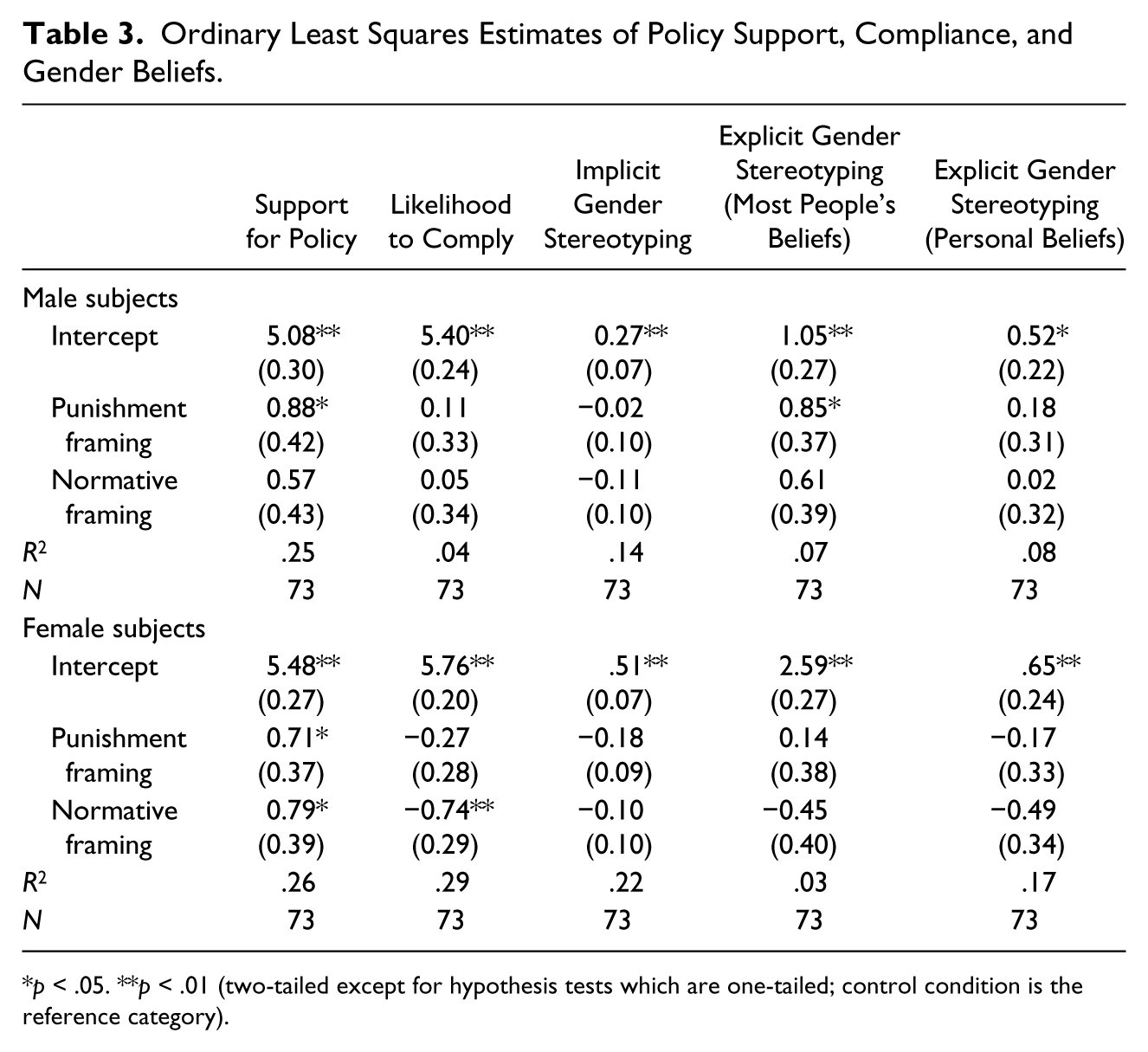
p < .05. **p < .01 (two-tailed except for hypothesis tests which are one-tailed; control condition is the reference category).
Among female subjects, both the punishment and normative affirmative consent conditions increase support for the policy. However, there is no difference between the punishment and normative conditions (p > .1). In other words, for female participants, it does not appear to be the threat of punishment per se, but simply exposure to the affirmative consent policy information that increases support. On the likelihood to comply scale, the normative framing significantly decreases women’s likely compliance. This was not expected. The punishment condition coefficient is also negative though much smaller in magnitude and not significantly different than the control condition. Thus, for women students, the only evidence we find for a positive punishment effect is that punishment framing has a less detrimental effect on likelihood to comply than does the normative framing. We discuss this unexpected finding in more detail in the discussion below.
H2 predicted that the threat of punishment would lead to more implicit and explicit gender stereotyping. We find no significant differences across conditions for the implicit measure of gender attitudes or for the explicit measure of participants “personal” beliefs about men’s and women’s power. However, we find that among male subjects, the punishment framing increased the perception that “most people” think men are more powerful than women (p < .05). Thus, we find partial support for H2.
Discussion
In sum, we find support for the hypothesis that the threat of punishment increases support for the affirmative consent policy and limited support for the hypothesis that punishment framing reinforces gender beliefs. Most surprisingly, the normative messaging has no effect on men’s likelihood to comply and actually decreases women’s likelihood. Recall that compliance is a composite of likelihood to obtain affirmative consent prior to sexual activity, likelihood to report, and likelihood to persuade a friend to report. Given that women are much less likely to be accused of sexual misconduct and much more likely to be a victim or have a friend who is a victim, it is not surprising that women participants respond differently than men.
Although we cannot be sure why the normative framing of the affirmative consent policy increases support for the policy but decreases women’s likelihood to comply, it might be because much of the public attention to the issue of campus sexual assault has focused on the fact that universities (and law enforcement) rarely punish perpetrators. Thus, it is possible that both affirmative consent conditions make the futility of women complying with the policy more salient, while the normative condition decreases compliance mostly because there is no threat of punishment. The likelihood to comply is lower in the normative than the punishment condition though the difference is only significant at p < .1. We do not wish to capitalize on chance by overinterpreting a “marginally significant” difference, but this finding is consistent with the above interpretation and suggests the need for future research.
On the gender stereotyping measures, punishment framing increases the perception among male subjects that “most people” think men are more powerful than women. Thus, while the punishment framing did not change the personal opinions of male students, it still appeared to activate the stereotype that men are more powerful than women. This is important because research shows that awareness of gender stereotypes—even if they are not personally endorsed—can powerfully shape behavior in ways that reinforce men’s advantages (Ridgeway, 2011). Our study shows that threatening punishments for violating affirmative consent can increase the salience of gender stereotypes—an effect that may undermine broader efforts to equalize gender relations. It is worth noting that we find no support for this hypothesis among women. Prior research has shown that women’s reactions to sexual harassment training are more complicated than men’s (Tinkler, 2012, 2013). This may also be the case in reactions to affirmative consent policies.
Limitations
Limitations of this study suggest the need for future research. Although we find evidence in support of our hypotheses, the effects do not hold across dependent variables. We can think of three possible explanations for why. First, the relatively weak findings may be a result of measuring subtle processes with a relatively small sample. Although the sample size per cell is within the typical range for tightly controlled laboratory experiments of this type (Marszalek, Barber, Kohlhart, & Holmes, 2011; Tinkler et al., 2015), effect sizes would have to be relatively large (i.e., Cohen’s d > 0.8; Cohen, 1988) for us to detect an effect at 80% power. Post hoc power analyses suggest that even for the moderate/large effect (Cohen’s d = 0.65) of punishment messaging on men’s status beliefs, the statistical power is only 60% with the current sample size. With a larger sample size, we would have more confidence that the nonsignificant differences we find are socially meaningful and not simply a methodological artifact. 7 Second, participants were asked to evaluate a brief policy statement to “help universities better communicate new policies” rather than being officially trained by their university on the policy. In other studies that have measured the effect of sexual harassment policy training on gender beliefs (e.g., Tinkler et al., 2007), the participants were trained on their university policy and were told the training was university-mandated for all lab studies in which participants interacted with a partner. This training experience was thus more real than in our study in which students were exposed to but not trained on policy information. Training may have different effects because the trainers are imparting a normative message just by communicating the policy information to students. Moreover, given the brevity of the manipulation and the jargon of the policy, it is possible that some students did not fully understand the meaning of affirmative consent. Confusion about the meaning of affirmative consent could have muted the effects of our manipulations.
Another related and likely possibility for our weak findings is the contested nature of the debate about campus sexual misconduct and the shifting moral boundaries around nonconsensual sexual contact. It may be that people’s views are not fully formed on this issue. On one hand, there is a strong societal consensus that rape is wrong and so for many Americans, stricter punishments may seem like the appropriate regulatory response. On the other hand, because campus sexual misconduct usually occurs between students who know each other and are a part of the same social world, many students hesitate to advocate punishments for “just drunk guys” (i.e., those who appear more like average college students than stereotypical rapists). In a recent qualitative study of young people’s experiences with nonconsensual sexual contact in public drinking settings, Tinkler et al. (2018) find evidence of this ambivalence and argue that deeply held beliefs about men and women’s roles in romantic pursuits structure both the assertion that unwanted sexual contact is normative, to be expected, or not “real” aggression and the assertion that it is serious and should be handled more stringently by law enforcement. Young people can draw on these two contradictory discourses in part because they are both tied to gender stereotypes that frame men as naturally more aggressive and stronger than women. (p. 50)
The debates over how to reduce campus sexual assault are also contestations about changing gender norms and beliefs. As such, the inconsistencies in our findings may reflect the inevitable contradictions that arise with a new policy that has the potential to challenge deeply held norms and beliefs about men and women.
In addition, future research would benefit from obtaining more diverse samples. Although the racial make-up of participants in the laboratory study roughly mirrors the student population from which the sample was drawn, the relative lack of diversity leaves important questions unanswered. For example, we did not obtain a large enough sample of racial minorities to make comparisons across groups. It is important to consider racial differences in responses to sexual misconduct policies given previous use of rape laws in the United States to punish African American men, while failing to protect African American women (Davis, 1981). We also do not have information on participants’ sexual orientation. Research finds that young adults who identify as LGBTQ (lesbian, gay, bisexual, transgender, questioning, queer) have significantly higher rates of sexual assault than do non-LGBTQ youths (Edwards, 2015), suggesting the potential importance of sexual orientation in shaping reactions to affirmative consent policies. Finally, more age diversity in future research is important since the older generations are the primary decision makers and the younger generations are most affected by campus sexual misconduct policies.
In summary, more experimental research on policy implementation and enforcement is essential to the broader goal of reducing campus sexual assault. Lessons learned from this study lead us to make the following recommendations. First, given the contestations over campus sexual misconduct and the relatively small effects captured in this study, future experimental research should aim for a larger than typical sample size. Second, study designs should anticipate gender differences and test for the possibility that the mechanisms shaping reactions to sexual misconduct policies differ for men and women. Third, researchers should design studies such that racial and sexual minorities comprise a high enough proportion of the sample size that differences can be statistically analyzed.
Policy Implications
Affirmative consent laws have been passed or are pending legislation in 26 states, and the language of affirmative consent has been widely adopted across universities (Affirmative Consent & Stopping Campus Sexual Assault, 2017). In addition, questions about the enforcement of such policies are at the heart of debates about sexual misconduct on college campuses. In spite of this rapidly transforming regulatory environment, we are aware of no research that has evaluated the effect of affirmative consent policies on student attitudes and behavior. Although our results are tentative, they are nonetheless an important data point for policy makers to consider.
Victim advocates tend to argue for stricter punishments because holding more men accountable for their behavior is seen as a strategy for dismantling rape culture. The purpose of our study was to explore this argument empirically. In doing so, our findings bring up new questions about how to improve campus sexual misconduct policies. We find that the threat of punishment increases support but not compliance among college students. Actual compliance with an affirmative consent standard has the potential to upend heterosexual interaction norms (and challenge traditional gender stereotypes) because it means women being more affirmative in their sexual desires and men abstaining from aggressive sexual pursuits. Without strong evidence that the threat of punishment increases students’ intended compliance, though, we hesitate to advocate strongly for a punishment approach.
We are particularly hesitant because we find that one of the unintended consequences of highlighting the specter of punishment for a broader number of nonconsensual sexual behaviors is that it can reinforce essentialist notions of gender difference. This may be an inevitable consequence of shining a light on the pervasiveness of men’s sexual aggression, but it is nonetheless important to consider in the implementation of policies aimed at reducing rates of campus sexual assault. That said, the increased support for the policy engendered by the threat of punishment suggests that punishment is more effective than normative messaging in legitimating nonconsensual sex as a social problem. Moreover, the fact that normative messaging actually decreased women students’ anticipated compliance suggests that when policies do not include information about punishment, victim reporting may go down. Punishment appears better than normative messaging at moral suasion but increases gender stereotyping.
This suggests to us that prevention training would do well to focus on strategies for norm change that encourage behavioral rather than attitudinal change and that unify rather than polarize men and women. In this regard, we are encouraged by recent research on bystander intervention training (e.g., Coker et al., 2016). Because bystander intervention encourages both men and women bystanders to change their behavior, emphasizes accountability (like the threat of punishment does), and focuses on norm change through behavioral change (rather than through normative/moral messaging, which may be interpreted by women students as simply paying lip service), it may have more promise for legitimating nonaffirmative consent as a social problem while avoiding the reinforcement of stereotypes about gender difference. To our knowledge, no research has looked specifically at how bystander intervention affects implicit and explicit gender beliefs. This would be an important area for future research.
Footnotes
Appendix
Acknowledgements
The authors wish to thank Bryan Cannon and the student researchers from the Laboratory for the Study of Social Interaction (Prentiss Autry, Cerentiy Collins, Alexandria Hamilton, Kelsey Mattingly, Lauren Miller, and Zachary Szemborksi) for their research assistance.
Declaration of Conflicting Interests
The author(s) declared no potential conflicts of interest with respect to the research, authorship, and/or publication of this article.
Funding
The author(s) disclosed receipt of the following financial support for the research, authorship, and/or publication of this article: The research was partly funded by a seed grant from The University of Georgia Owens Institute for Behavioral Research.