



Abstract
Although the past few decades have taught us much about college and university responses to various forms of interpersonal violence affecting campus communities, this has largely not extended to campus law enforcement agencies. The lack of attention to this area is unfortunate given the role that these officers play on the campuses that they serve. The current study builds upon previous research using the Survey of Campus Law Enforcement Agencies data to examine the change in individual campus law enforcement resources (i.e., personnel) dedicated to rape prevention and stalking over time (2004-2011) across 4-year institutions of higher education. Of the 352 campus law enforcement agencies under study, over 31%, 24%, and roughly 22% increased their resources/dedicated personnel for stalking, general rape prevention, and date rape prevention, respectively. In fact, the largest percentage of agencies increased their resources/dedicated personnel for stalking compared with 12 other agency-involved campus issues or tasks. Taken together, regardless of their reported resources in 2004, in 2011 a large percentage of agencies reported full-time personnel/units and personnel dedicated to rape prevention and stalking on an as-needed basis, and far fewer relied only on policies and procedures or did not officially address the campus issue or task. These findings are important in light of continued changes in campus responses to crimes affecting their campus communities.
Cases of interpersonal violence at institutions of higher education continue to garner attention at the national level and propel the discourse surrounding campus responses to crime. While research has shed light on crime prevention programs, designation of resources across campuses, and policies surrounding the reporting of crime as they pertain to sexual assault (Karjane, Fisher, & Cullen, 2002; Richards, 2016), less has focused on the role that campus law enforcement agencies play in responding to these incidents (but see Smith, Wilkes, & Bouffard, 2014, 2016). This is problematic, as campus police officers play a very important role in the prevention and response to crimes affecting the campus community (Bromley & Fisher, 2002). Although campus police departments engage in a variety of crime prevention strategies (e.g., Reaves, 2008, 2015; Reaves & Goldberg, 1996), little is actually known about these efforts.
Reports from the Survey of Campus Law Enforcement Agencies series (Reaves, 2008, 2015; Reaves & Goldberg, 1996) provide an overview of campus law enforcement agencies’ roles, responsibilities, and resources, including the overall percentage of agencies that employ units with personnel assigned full-time and those that designate personnel when needed for a number of issues (e.g., stalking) or tasks (e.g., rape prevention). The current study extends the work of Reaves (2008, 2015) by examining changes in campus police departments’ prevention and response to sexual violence and stalking in the same universities over time (i.e., between the 2004-2005 and the 2011-2012 Survey of Campus Law Enforcement Agencies data efforts).
Sexual Victimization and Stalking Experienced by College Students
The majority of the literature on college student victimization focuses on sexual victimization experienced by female students. Although the operationalization of sexual victimization can vary dramatically by study (e.g., broad definitions vs. more narrow definitions of sexual victimization)—which certainly complicates our understanding of victims’ experiences (Fedina, Holmes, & Backes, 2018; Kilpatrick, 2004; Muehlenhard, Peterson, Humphreys, & Jozkowski, 2017)—the bulk of the literature suggests that sexual victimization is not an uncommon experience of female college students. Muehlenhard and colleagues (2017) took stock of the literature exploring estimates of sexual assault experienced by college students and noted that the often-cited “one-in-five” statistic is an appropriate average estimate for understanding sexual assault experienced by college women; however, scholars caution that it varies across institutions of higher education (Cantor et al., 2015). Muehlenhard and colleagues’ (2017) assessment described sexual assault as both penetration and non-penetrative, sexual touching either through force, the threat of force, or incapacitation.
Individual studies provide insight into estimates of specific forms of sexual victimization. In fact, college students experience, and campus officials may be called on to respond to, a range of sexual victimizations—including but certainly not limited to what would be legally defined as rape or criminal sexual touching (see Fedina et al., 2018; Fisher, Cullen, & Turner, 2000). However, due to measurement differences across studies, it is important that the definitions of what is being measured are clear. This will be illustrated by way of example. The recent Association of American Universities (AAU) campus climate study found that roughly 11% of undergraduate female students across 27 campuses reported nonconsensual penetration by force (completed or attempted) or incapacitation, acts which would likely be legally considered rape (Cantor et al., 2015). They also found that almost 18% of undergraduate females reported nonconsensual sexual touching (i.e., not penetration) by force or when incapacitated. All together, they reported that approximately 23% of undergraduate females experienced nonconsensual sexual contact (either penetration or touching) by force or incapacitation since their time in college. The AAU study then reported nonconsensual sexual contact by coercion (i.e., not using or threatening physical harm, rather promising rewards for engaging in behavior or threatening nonphysical harm) and nonconsensual sexual contact by the absence of affirmative consent (e.g., “initiating sexual activity despite your refusal,” “ignoring your cues to stop or slow down,” “went ahead without checking in or while you were still deciding,” “otherwise failed to obtain your consent”). They found that under 1% of undergraduate females reported nonconsensual sexual contact by coercion, and 11.4% of undergraduate females reported nonconsensual sexual contact due to the absence of affirmative consent. 1 As this example shows, it is important (a) to recognize multiple forms of sexual victimization affecting college students and (b) that studies clearly define what behaviors constitute the various forms of sexual victimization.
Similar to sexual victimization, the definition of stalking varies by jurisdiction and by study. Although it requires that the victim experience fear or a reasonable person would feel fear as a result of the offender’s behavior (Catalano, 2012; Sheridan, Blaauw, & Davies, 2003), legally defined stalking behaviors might mistakenly be perceived as “romantic” gestures from their partner (Belknap & Sharma, 2014), misinterpreted as harmless by victims (Cass, 2011), and accepted as less problematic by potential jurors—particularly males (Dunlap, Lynch, Jewell, Wasarhaley, & Golding, 2015). In reality, stalking is anything but harmless (Belknap & Sharma, 2014). In addition to the impact stalking can have on victims in and of itself, it is often linked to other harmful behaviors, including intimate partner violence (e.g., Logan, Shannon, & Cole, 2007; Melton, 2005; Tjaden & Thoennes, 1998) and attempted and completed intimate partner femicide (e.g., McFarlane et al., 1999).
Many college students report being stalked. According to a study conducted by Fisher and colleagues (2000), 13% of college women were stalked in the roughly 7 months before they were surveyed. Similarly, Mustaine and Tewksbury (1999) reported that almost 11% of their sample of 861 college women across nine different institutions had experienced behaviors that they self-defined as stalking in the previous 6 months. Most recently, the AAU survey reported that just under 7% of undergraduate females reported behaviors defined as stalking since enrolling at their institution (Cantor et al., 2015).
Responses to Campus Crime
Federal Responses
Over the past few decades, schools have been subject to many federal requirements concerning the response to issues occurring on campus or impacting their campus communities. Title IX of the Education Amendments of 1972 states that students should be free from gender-based discrimination or sexual harassment. The 2011 Dear Colleague Letter issued by the Office for Civil Rights highlighted schools’ responsibilities under Title IX, including how campuses should respond to incidents perpetrated against students, and procedures for preventing campus crime (U.S. Department of Education, Office for Civil Rights, 2011).
The Jeanne Clery Disclosure of Campus Security Policy and Campus Crime Statistics Act (referred hereon as the Clery Act) also impacted institutions of higher education. After Lehigh University student Jeanne Clery was raped and murdered in her dorm room by another student in 1986, her parents lobbied legislatures for greater transparency in crime statistics on university campuses. Eventually, the Crime Awareness and Campus Security Act of 1990 was renamed the Jeanne Clery Disclosure of Campus Security Policy and Campus Crime Statistics Act, and institutions of higher education were required to make available information such as annual security reports, crime logs, and prevention strategies occurring on campuses. 2
The Violence Against Women Reauthorization Act of 2013—under the Campus SaVE Act—added dating violence, domestic violence, sexual assault, and stalking into campus crime statistics. In addition, colleges and universities must include and discuss prevention efforts. In 2014, the White House under President Barack Obama reaffirmed that prevention of sexual assault is a major priority for institutions of higher education, and federal law mandates the existence of college and university prevention programs (White House Task Force to Protect Students From Sexual Assault, 2014). The most recent changes to the federal guidelines for responding to victimizations experienced by students came in September 2017 and November 2018 after U.S. Secretary of Education Betsy DeVos recommended a dismantling of the 2011 Dear Colleague Letter and accompanying Title IX guidelines for institutions of higher education. Specific changes and outcomes of this announcement remain to be seen.
University and Campus Law Enforcement Responses
It should come as no surprise that researchers have also examined how universities respond to the issue of campus crime—particularly sexual violence—partly as a result of the federal guidelines and requirements. State-specific (Schwartz, McMahon, & Broadnax, 2015), region-specific (Hayes-Smith & Hayes-Smith, 2009), and national reviews (Karjane et al., 2002; Richards, 2016) of college and university responses to campus crime consistently show that there is clear variation in the policies, procedures, and resources across campuses. Karjane and colleagues’ (2002) review of over 2,400 institutions of higher education reported differences in the ways institutions defined sexual assault, policies for reporting and responding to sexual assault, and resources provided to students. Richards’s (2016) recent study expanded upon the work of Karjane et al. (2002) and found that while there have been improvements over time in institutions’ responses to sexual assault, there is still substantial variation across university responses (see also Woodward, Pelletier, Griffin, & Harrington, 2016; and see Richards & Kafonek, 2016 and Burke & Sloan, 2013 for information on state-level variations). It should be noted, however, that there is a dearth of research focusing on prevention for other forms of interpersonal violence, such as dating violence and stalking, and college students’ experiences with these types of crimes (Banyard, 2014).
Another component of campus communities that has been very rarely studied is campus law enforcement agencies and their roles in the prevention and response to interpersonal violence experienced by college students. Most of the discussion surrounding campus law enforcement focuses on formal reporting behaviors of victims (e.g., Fisher et al., 2000; Kilpatrick, Resnick, Ruggiero, Conoscenti, & McCauley, 2007; Krebs, Lindquist, Warner, Fisher, & Martin, 2007). The lack of research on campus police is surprising considering there has been much discussion around police responses to sexual assault, domestic violence, and stalking outside of the college context. Why it has not translated to campus communities is unclear, especially because many campus law enforcement agencies have arrest powers, responsibilities, and organizational and structural characteristics similar to local police departments (e.g., Bromley, 1996, 2003; Paoline & Sloan, 2003; Sloan, 1992; Sloan, Lanier, & Beer, 2000). For instance, across U.S. 4-year institutions with enrollments of more than 2,500 students, almost 70% employ sworn police officers (Reaves, 2015). Furthermore, Peak, Barthe, and Garcia (2008) identified that between 1986 and 2006, an increased number of campus agencies included the term “Police Departments” in their agency title (as opposed to terms such as “Security Department” or “Security Office”), which seemingly marked a shift in the roles of the agencies. These police departments have been described as “fully part of, and connected to, the broader local law enforcement community” (Peak et al., 2008, p. 258; see also Paoline & Sloan, 2003). Despite the similarities to local police departments, Bromley (2003) noted that campus officers are also “involved in activities that go beyond traditional law enforcement” (p. 40) and according to Paoline and Sloan (2013), “have relied to a larger degree on a proactive, crime prevention approach” (p. 334) compared with their municipal counterparts. Therefore, the failure to examine how these police departments address interpersonal violence—especially prior to it occurring—is problematic.
Fortunately, Reaves’s (2008, 2015; Reaves & Goldberg, 1996) reports using Survey of Campus Law Enforcement Agencies data provide a baseline understanding of campus police agencies and insight into the policies and resources designated for addressing interpersonal violence. According to Reaves and Goldberg (1996), in 1995, a date rape prevention program or unit was offered in over two-thirds of agencies serving institutions with at least 2,500 students; fewer agencies (60%) had a program or unit for stranger rape prevention (also see Bromley & Reaves, 1999, for differences between agencies with sworn officers and those with non-sworn security). According to results from the 2004-2005 survey, almost 80% and 60% of campus law enforcement agencies serving 4-year institutions of at least 2,500 students employed a full-time unit or had designated personnel addressing rape prevention and stalking, respectively (Reaves, 2008). According to data from the 2011-2012 survey, of 4-year institutions with 5,000 or more students, 86% of agencies either assigned a full-time unit or had other designated personnel for general rape prevention, 84% did so for date rape prevention, and 75% for stalking, signaling an increase in resources for each of these areas (Reaves, 2015). 3
Beyond these reports, however, little is known about the extent and type of prevention programs that exist within police departments. In a study of campus police officers across multiple institutions of higher education in Texas, just over 60% answered that their department was partaking in some form of sexual assault prevention program, although the specific type of prevention was not discussed in the study (Smith et al., 2014). Sampson’s (2011) problem-oriented policing (POP) guide on college student acquaintance rape suggested that when officers are engaged in rape prevention, it generally focuses on self-defense training, and assessing and proposing changes to environmental factors that may be “vulnerable to rape” (Sampson, 2011, p. 25). Similarly, the Blueprint for Campus Police: Responding to Sexual Assault (hereon referred to as the Blueprint) – which was developed by Busch-Armendariz, Sulley, and Hill (2016) to guide campus police responses to sexual violence – highlights that programs such as Rape Aggression Defense and programs that escort students from different locations on campus as a safety mechanism are often utilized on college campuses. However, both Sampson (2011) and Busch-Armendariz et al. (2016) identify that these programs may be problematic because of their inherently narrow focus on stranger rape (rather than acquaintance rape, which is far more prevalent on a college campus; see, for example, Kilpatrick et al., 2007; Krebs et al., 2007). Moreover, these programs often lend themselves to focusing on what the victim can do to prevent the victimization, rather than changing the perpetrator’s behavior.
The Blueprint, then, “replaces tradition with science” (Busch-Armendariz et al., 2016, p. 7) and highlights evidence-based responses to sexual violence. Adopting the Centers for Disease Control and Prevention’s (2004) guidance on levels of sexual violence prevention, Busch-Armendariz and colleagues (2016) specifically note that officers must undertake all three levels of prevention to address sexual violence before and after it occurs—primary (before sexual violence occurs), secondary (response immediately after the sexual violence occurs), and tertiary (long-term responses to deal with the violence)—on their campuses. Although the Blueprint was developed with the response to sexual assault in mind, the authors note that the recommendations can also be applied to the response to other campus issues, including stalking.
Because of the gap in the literature in the area of campus law enforcement responses to interpersonal violence, our understanding of university responses to these issues is limited. The current study expands upon the work of Reaves (2008, 2015; Reaves & Goldberg, 1996), which highlights the composition, roles, and responsibilities, among other factors, of college and university law enforcement agencies. In 2015, Reaves compared the percentage of institutions of higher education with enrollments of 5,000 or more students that have designated personnel to address a variety of issues in 2011 with what was reported in 2004. Reaves (2015) also provided the overall percentage of institutions with full-time personnel dedicated to certain issues and the overall percentage of institutions with designated personnel as needed.
Although examining the change in the overall percentage of universities with certain resources dedicated to campus issues provides an understanding of how agencies are responding to issues affecting college campuses, it does not shed light on individual campus agency approaches to these issues. Not focusing on the changes across individual campuses masks important information about campus agency responses. This study uses the 2004-2005 and 2011-2012 Survey of Campus Law Enforcement Agencies datasets to explore the designation of agency resources or personnel for rape prevention and stalking in the same universities over time (i.e., between the 2004-2005 and the 2011-2012 Survey of Campus Law Enforcement Agencies data efforts).
Therefore, this study is guided by three substantive research questions:
Method
The current study uses data from the Bureau of Justice Statistics 2004-2005 and the 2011-2012 Survey of Campus Law Enforcement Agencies datasets. Law enforcement agencies on 4-year campuses enrolling 2,500 or more students are included in the samples. 4 Agencies were initially contacted to complete a web-based survey (and later offered fax or mail-in survey options) pertaining to topics including, but not limited to, their personnel, operations, hiring practices, and resources. Only one survey was collected per agency. In 2004-2005, 750 schools (i.e., 750 law enforcement agencies on 4-year campuses enrolling 2,500 or more students) were eligible for inclusion in the data collection efforts; in 2011-2012, 861 schools (i.e., 4-year campuses enrolling 2,500 or more students) with law enforcement agencies were eligible for inclusion in data collection efforts.
In the 2004-2005 survey, all agencies received the original version of the survey (33 questions), but if they did not respond to initial requests for survey participation, they were asked to complete a shortened version of the survey. The original survey contained a question asking agencies about resources (e.g., full-time unit; designated personnel) directed toward 13 specific campus issues or topics, including date rape prevention, general rape prevention, and stalking. The shorter survey did not ask about these police department resources/designated personnel. 5
In the 2011-2012 survey, agencies received either a long- (64 questions) or short-version (36 questions) of the survey (or had the option to answer less detailed surveys); the short version did not include the question asking agencies about their resources toward 19 specific campus issues or topics, including date rape prevention, general rape prevention, and stalking. Only institutions with 5,000 or more students were asked to complete the long version of the survey. 6
The current study only includes agencies that provided responses about the specific campus issues or topics relevant to date rape prevention, general rape prevention, and stalking in both data collection efforts. A number of universities were excluded as part of this requirement. 7 Therefore, this study analyzes resources designated for date rape prevention, general rape prevention, and stalking for 352 law enforcement agencies serving 4-year private and public institutions of higher education. 8 The 352 agencies represent individual campuses in 48 states and the District of Columbia.
Measures
In both surveys, agencies were asked the extent to which they respond to certain issues or tasks. In the 2004-2005 survey, agencies were asked about the following: alcohol education, bias/hate crime, community policing, crime prevention, cybercrime, date rape prevention, drug education, general rape prevention, research and planning, self-defense training, stalking, student security patrol, and victim assistance. In the 2011-2012 survey, the following tasks or problems were added to the above list: bicycle/pedestrian safety, suicide prevention, identity theft, intimate partner violence, social network abuse, and white-collar crime. For purposes of this study, only those tasks or issues referred to in both surveys—with a particular emphasis on date rape prevention, general rape prevention, and stalking—will be examined.
Dedicated personnel and resources
For each particular task or issue, agencies were asked to rate on a continuum the degree to which they delegated dedicated personnel or resources. 9 To determine the change in agency resources to a given issue, the number assigned to the resource level in the 2011-2012 survey was subtracted from the resource allocation level in the 2004-2005 survey (1 = unit with personnel assigned full-time; 2 = designated personnel used as needed; 3 = agency had only policies and procedures regarding the issue; 4 = agency did not officially address the issue). Therefore, a score of “0” indicated no change in resources between 2004 and 2011, “–1” indicated that the agency allocated one less resource level to the issue, “–2” indicated that the agency allocated two less resource levels to the issue, “–3” indicated that the agency allocated three less resource levels to the issue, “1” indicated that the agency allocated one greater resource level to the issue, and so on. Therefore, “–1,” “–2,” and “–3” indicated fewer resources allocated, and “1,” “2,” and “3” indicated greater resources allocated over time. A positive change in resources dedicated to date rape prevention, general rape prevention, and stalking between 2004 and 2011 was calculated and dichotomized (increased resources/personnel = 1; fewer/the same resources/personnel = 0).
Campus characteristics
Because it is possible that prevention efforts may be impacted by macro-level factors, characteristics of the institutions of higher education were obtained from the National Center for Education Statistics: College Navigator (NCES) (https://nces.ed.gov/collegenavigator) for each of the 352 law enforcement agencies. 10 Information about the setting of the campus was collected to differentiate between rural or town (1 = yes; 0 = no), suburb (1 = yes; 0 = no), and city (1 = yes; 0 = no) campus settings. 11 Also collected was information about the level of control of the institution (1 = public; 0 = private), whether residential facilities are provided to students on or near campus (1 = yes; 0 = no), whether the campus is religiously affiliated (1 = yes; 0 = no), the designation of a historically Black college or university (1 = yes; 0 = no), and whether the institution had at least one varsity athletic team (1 = yes; 0 = no).
Two agency-related variables were used from the 2004-2005 and the 2011-2012 Survey of Campus Law Enforcement Agencies. Although the 2004 operating budgets were not provided, the 2011 operating budget for the police agency was available; some agencies provided an exact budget, while others estimated their operating budget. For purposes of this study, the 2011 operating budget was split into four levels: US$0 to US$1,000,000; US$1,000,001 to US$2,000,000; US$2,000,001 to US$3,000,000; and US$3,000,001 or more. Finally, the change in full-time personnel (including sworn officers, officers without arrest power, civilian personnel, and student employees) between 2004 and 2011 was calculated and dichotomized (increased personnel = 1; fewer/the same personnel = 0).
Analyses
The substantive analyses for this study are multifaceted to address the three research questions. The first research question aims to explore the change or stability in university resources/designated personnel dedicated to date rape prevention, general rape prevention, and stalking over time. Stability in resources is represented by scores of “0” in the computation discussed in the “Measures” section. If a university agency received a “–1,” “–2,” or “–3” score for any resource, they are considered to have fewer resources allocated to that issue in 2011 relative to 2004. If a university agency received a “1,” “2,” or “3” score for any resource, they are considered to have greater resources allocated to that issue in 2011 relative to 2004. First, the exact direction of the change or stability is examined for each of the three tasks or issues, and the percentages of agencies that fall in each direction (i.e., increase, decrease, stable) are presented. Then, to more comprehensively understand the direction and focus of agency resources/dedicated personnel to date rape prevention, general rape prevention, and stalking, cross-tabulations comparing the change in resources/dedicated personnel between 2004 and 2011 were conducted. The cross-tabulations show the specific change (e.g., an agency had dedicated full-time personnel in 2004 and policies and procedures only in 2011).
The second research question follows a similar analysis plan as the first research question. The change (or stability) in resources/designated personnel dedicated to date rape prevention, general rape prevention, and stalking is compared with the change (or stability) in resources for the various tasks or campus issues listed in the section above (e.g., alcohol education; community policing; self-defense training; victim assistance). The percentages of agencies that increased, decreased, and remained stable in their resources/dedicated personnel to the various tasks and campus issues are presented and the issues and tasks are ranked, whereby higher ranks indicate larger percentages of agencies with no change, increases, and decreases to the given campus issue or task, respectively.
The third research question—which aims to explore the campus and agency characteristics related to an increase in resources/personnel dedicated to date rape prevention, general rape prevention, and stalking—is addressed using three multivariate logistic regressions. The dependent variable for each analysis indicated any increase in resources/designated personnel for that particular issue.
Findings
Table 1 provides the characteristics of the sample of agencies under study. Just over three-fourths of the agencies served public campuses; the remainder were located on private, not-for-profit institutions of higher education. Approximately 61% of agencies were on campuses located in cities, roughly 20% were located in towns or rural areas, and 20% were on suburban campuses. The overwhelming majority (over 97%) of campuses had residential facilities on or near the campus and had at least one varsity athletic program representing the campus. Less than 10% of the agencies served campuses with religious affiliations, and roughly 3% included agencies on campuses serving historically Black colleges or universities.
Sample Characteristics.
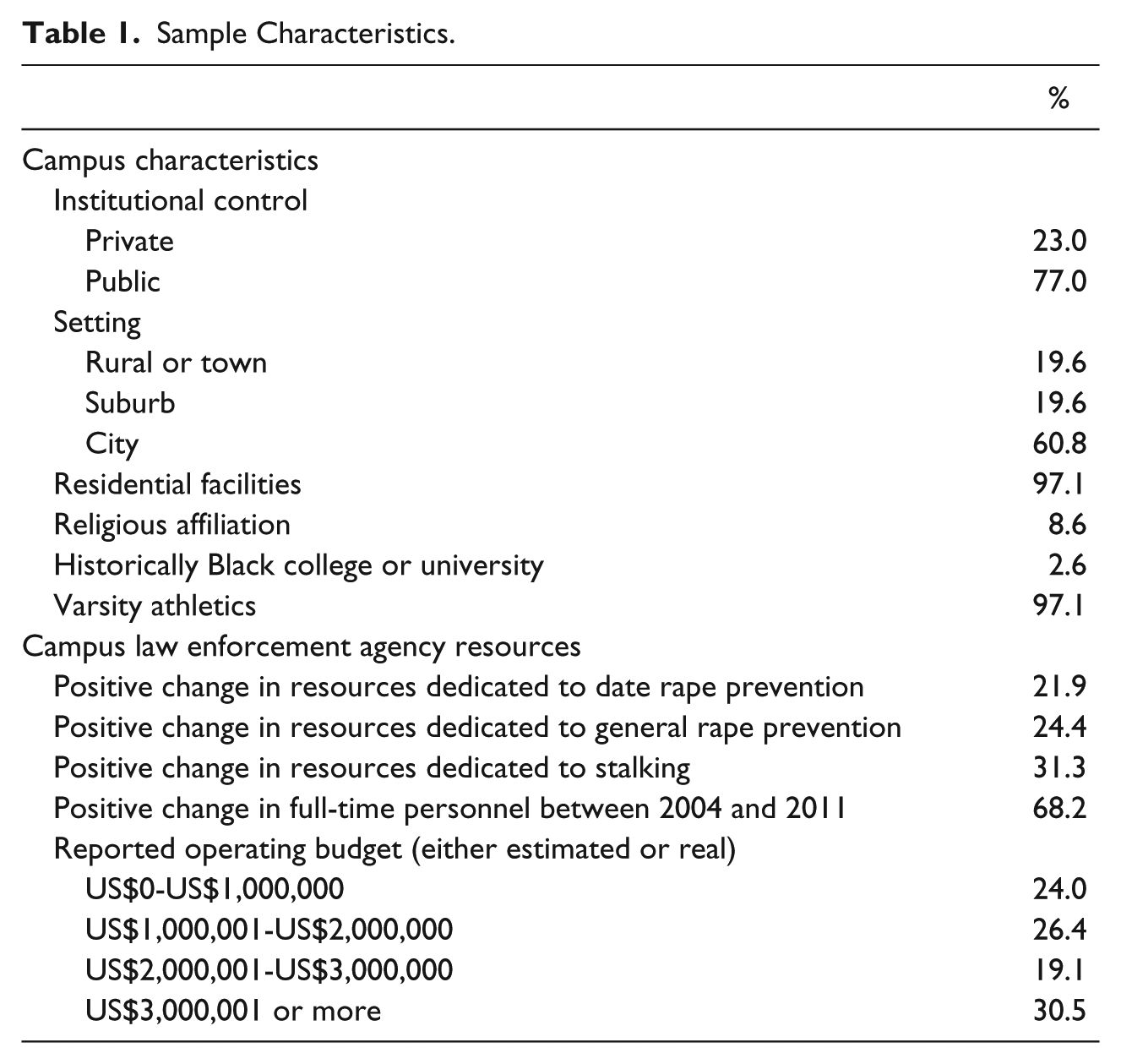
Between 2004 and 2011, only a subset of agencies reported a positive change in the amount of resources/dedicated personnel awarded to date rape prevention (roughly 22%), general rape prevention (roughly 24%), and stalking (roughly 31%). Approximately 68% of the agencies under study experienced a reported increase in full-time personnel within the agency, including sworn and non-sworn officers and other personnel. 12 Finally, over 30% of agencies were operating under a budget of over US$3,000,000 and roughly 19% had an operating budget between US$2,000,001 and US$3,000,000. The remainder of agencies had an operating budget of US$2,000,000 or less. It is important to note, that for roughly half of agencies, the reported budget was estimated.
RQ1: Changes in University Resources/Designated Personnel Dedicated to Date Rape Prevention, General Rape Prevention, and Stalking
Table 2 provides a general description of the changes in university police department resources/designated personnel dedicated to date rape prevention, general rape prevention, and stalking, by focusing on the percentage of universities that increased or decreased their resources/designated personnel—and by what level (e.g., 1, 2, 3 levels)—or stayed stable between 2004 and 2011. The specific changes in resource/designated personnel (e.g., in 2004, agencies had no formal response, but in 2011, agencies had a full-time unit) for the 352 agencies are shown in Table 3. The majority of institutions remained consistent in the level of resources delegated to date rape prevention, general rape prevention, and stalking. There was no change in resource level/personnel dedicated to date rape prevention and general rape prevention for about 60% of agencies; half of the institutions did not change their resources/dedication of personnel for stalking. Roughly 18% of institutions reduced their level of resources for date rape prevention, approximately 16% of institutions did so for general rape prevention, and almost 19% of institutions reduced their level of resources for stalking.
Percentage of Agencies With Changes or No Change in Date Rape Prevention, General Rape Prevention, and Stalking Responses Between 2004 and 2011.

Note. Rounding brings the percentages to just over 100%.
Changes in Date Rape Prevention, General Rape Prevention, and Stalking by Specific Resource/Designated Personnel Level, by Number and Percentage of Universities.

The remainder of institutions provided greater resources in 2011 than in 2004. The largest increase in resources/dedicated personnel was issued for stalking, whereby over 31% of agencies increased their resources to the issue. As previously mentioned, the percentage of agencies changing their approach to date rape and general rape prevention was not as high (roughly 22% and 24%, respectively); however, a greater percentage of agencies already had more dedicated resources in to these issues in 2004 compared with stalking (Table 3). Specifically, in 2004, nearly 85% of the agencies included in this study had either a full-time unit or designated personnel on an as-needed basis for date rape prevention and/or general rape prevention. Comparatively, roughly 68% of agencies had such personnel for addressing stalking in 2004. 13
As shown in Table 3, there were substantial increases across resources/dedicated personnel allocated to date rape prevention, general rape prevention, and stalking for those agencies that had policies/procedures only or did not officially address the topic in 2004. Specifically, approximately 76%, 82%, and 76% of agencies that had only had policies and procedures in 2004 for date rape prevention, general rape prevention, and stalking respectively had some form of dedicated personnel (full-time or as needed) in 2011. Similarly, of the agencies that did not officially engage in tasks for date rape, general rape prevention, and stalking in 2004, 65%, approximately 73%, and roughly 71%, respectively, had some form of dedicated personnel in 2011, with others improving to having policies/procedures. Therefore, by 2011, the majority of agencies—regardless of their resource level in 2004—had some form of dedicated personnel to date rape, general rape prevention, and stalking by 2011.
The greatest reductions in resources/designation for date rape and general rape prevention were seen for agencies that had full-time units in 2004. In 2011, 77% and 79% of those agencies, respectively, reported having personnel dedicated as needed rather than the full-time unit. These agencies are still considered to have designated personnel for these tasks; in fact, of the agencies that had full-time units in 2004, only two dropped down to policies/procedures only and none failed to address the issue in 2011.
As it pertains to changes in resources/dedicated personnel to the issue of stalking, in 2004, a smaller number of agencies had full-time personnel for this issue (less than 5%; n = 16) compared with those with date rape and general rape prevention full-time units during the same year. However, similar to the findings for date rape and general rape prevention, the majority of agencies with full-time units in 2004 did not sustain those full-time units in 2011. The reduction in resources was not dramatic, and no agency that had a full-time unit in 2004 reduced to policies/procedures only or failed to address the issue in 2011. Similar to date rape and general rape prevention, the majority of agencies that had personnel designated as needed to the issue of stalking remained in 2011. However, unlike resources for date rape and general rape prevention, a greater percentage of agencies with personnel designated as needed reduced their resource allocation, rather than increased resources.
RQ2: General Direction of Campus Agency Resources/Designated Personnel Dedicated to Date Rape Prevention, General Rape Prevention, and Stalking Relative to Various Issues and Tasks
Table 4 displays the percentage of campus agencies that remained stable, increased, or decreased their resources or dedicated personnel for 13 different issues or tasks over time. With the exception of stalking and bias/hate crimes, issues related to interpersonal violence and prevention did not result in either the greatest increases or decreases in university resources between 2004 and 2011. Between 2004 and 2011, the greatest percentage of campus agencies increased their resources/designated personnel for stalking (31.3%), research and planning (29.8%), community policing (29.8%), bias/hate crimes (28.7%), and cybercrime (28.1%). The largest percentage of agencies decreased their resources/designated personnel for student security patrol (29.5%), research and planning (25.9%), cybercrime (25.6%), community policing (23.6%), and bias/hate crimes (23.3%).
Percentage of Agencies With Changes or No Change in Campus-Related Issues and Tasks Between 2004 and 2011.

Higher ranks indicate larger percentages of agencies with no change in the respective campus issue or task.
Higher ranks indicate larger percentages of agencies with increases in the respective campus issue or task.
Higher ranks indicate larger percentages of agencies with decreases in the respective campus issue or task.
RQ3: Factors Related to an Increase in Resources/Personnel Dedicated to Date Rape Prevention, General Rape Prevention, and Stalking
Table 5 highlights the institutional-level factors that were associated with an increase in campus law enforcement agencies’ resources for date rape prevention, general rape prevention, and stalking. Across all three analyses, very few factors included in the models predicted an increase in agency resources toward these issues. Campus agencies serving public institutions were less likely to produce an increase in resources dedicated to date rape and general rape prevention; however, the control of the university had no impact on resources dedicated to stalking. Although campus setting appeared to matter, its impact was inconsistent across outcome. Compared with agencies serving agencies in cities, agencies serving campuses located in rural or town settings were less likely to report an increase in resources/dedicated personnel for general rape prevention, and agencies serving campuses located in suburban settings were less likely to experience an increase in resources/dedicated personnel to address stalking.
Logistic Regression Models Predicting an Increase in Changes in Campus Law Enforcement Agency Resources/Dedicated Personnel for Date Rape Prevention, General Rape Prevention, and Stalking (N = 336).
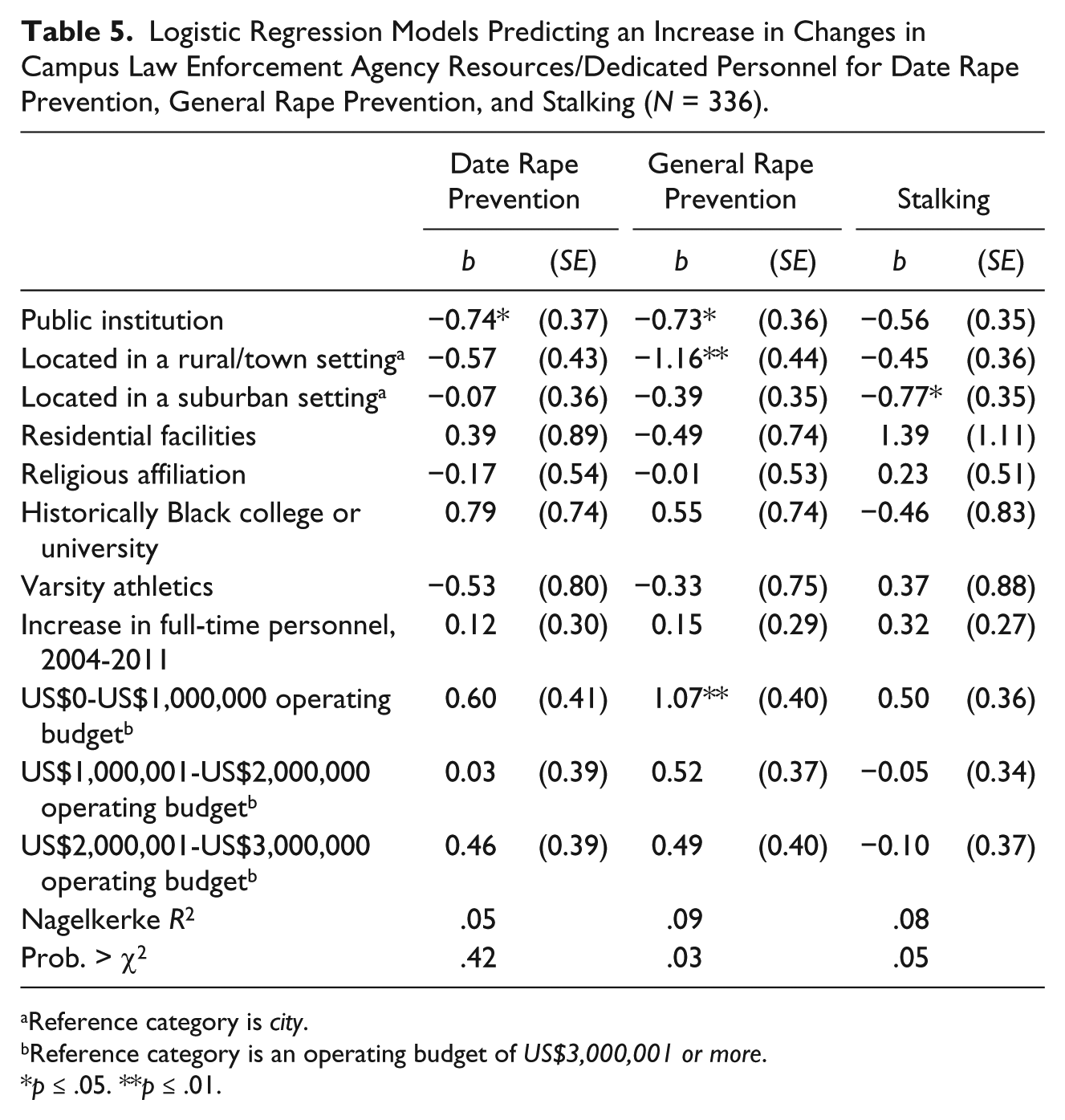
Reference category is city.
Reference category is an operating budget of US$3,000,001 or more.
p ≤ .05. **p ≤ .01.
Reported 2011 operating budget impacted general rape prevention resources, such that agencies with the lowest operating budgets were more likely to increase resources/dedicated personnel to general rape prevention compared with agencies with the highest operating budgets. Specifically, almost 31% of agencies with the lowest operating budgets showed improvements in resources, compared with roughly 20% of agencies with the highest budgets (results not shown). No other factors significantly predicted an increase in resources.
Discussion
Interpersonal violence experienced by college students has continued to gain the attention of campus administrators, researchers, activists, and the federal government. Unfortunately, only a small subset of research has explored how campus law enforcement agencies respond to these issues. The current study builds upon the work of Reaves (2008, 2015; Reaves & Goldberg, 1996) by specifically focusing on campus law enforcement dedication of resources to campus sexual assault, dating violence, and stalking over time. In addition to providing descriptive statistics on a number of different topics relevant to campus police agencies, Reaves used the Survey of Campus Law Enforcement Agencies datasets to provide important baseline information about the overall percentage of universities that dedicated full-time personnel or personnel when needed to tasks and issues impacting the campus community. By examining the specific changes in the dedication of resources in the same police agencies over time, rather than the percentage of agencies that designate resources in the aggregate, our understanding of how campus agencies have (or have not) changed their policies is improved. Furthermore, this line of research ultimately, and organically, leads to the next step to understanding the impact of these changes on the students these agencies serve.
This study found that relative to all other issues or tasks under study—including date rape and general rape prevention—the issue of stalking yielded the greatest increase in agency resources/dedicated personnel between 2004 and 2011. That is, over 30% of agencies increased their resources or personnel dedicated to address stalking on their campuses. That a greater percentage of agencies increased their resources for addressing stalking compared with rape prevention is not entirely surprising. Since the 1990s, rape prevention on college campuses has received much of the focus of federal legislation centered on interpersonal violence on campuses or affecting college students, as well as much of the research focus. It is logical that campus police agencies—and other groups on campus—would have already had programs to address this growing concern. Stalking, on the contrary, first became a criminalized offense in 1990, and the anti-stalking response has seemingly lagged behind that of other forms of interpersonal violence. Nevertheless, greater awareness and attention to the issue of stalking—including how various forms of stalking such as cyber stalking can substantially affect a college population that heavily uses technology—is warranted, and it appears that institutions of higher education are taking notice.
It is also likely that since the Violence Against Women Act (VAWA) amendment to the Clery Act was passed in 2013 and greater stipulations were placed on universities for collecting crime statistics related to stalking (among other forms of interpersonal violence), an even greater number of agencies have implemented responses to stalking. This remains to be seen in future surveys of campus law enforcement agencies. Furthermore, each legislative session may also result in additional changes for institutions of higher education to address their responses to various forms of interpersonal violence on their respective campuses. For example, Richards and Kafonek (2016) identified a number of proposed and enacted legislation during the 2014-2015 legislative session that would impact university responses to sexual assault, including, but not limited to, the establishment of memorandums of understanding with local criminal justice agencies, new or improved policies and procedures, and new or improved services for victims of sexual assault.
Thus, it is clear that agencies are examining their responses and prevention efforts toward issue such as rape prevention and stalking and it is likely that changes will continue to take place. For now, when looking at the specific changes in resources/dedicated personnel to rape prevention and stalking, in the aggregate, a greater number of agencies have more full-time personnel and personnel dedicated to the issue or task as needed, and fewer rely only on policies and procedures or do not officially address the campus issue or task. Moreover, when examining individual campus changes, by 2011, the majority of agencies—regardless of their resource level in 2004—had some form of dedicated personnel to date rape and general rape prevention by 2011. These increases are consistent with other research that found improvements in university responses (not specific to law enforcement) to sexual violence on college campuses over time (e.g., Reaves, 2015; Richards, 2016). As it pertains to stalking, nearly 76% of agencies that only had policies/procedures on dealing with stalking in 2004 had some form of designated personnel by 2011; approximately 71% of those agencies that did not officially address stalking had some form of designated personnel by 2011.
Interestingly, however, a notable percentage of agencies reduced their resources dedicated to rape prevention and stalking, particularly away from full-time units or personnel. Although it cannot be determined with the current data, it is possible that other prevention programs developed on campus (e.g., bystander intervention programs) removed the perceived need for full-time campus police units for these tasks or issues. Still, the argument can easily be made that prevention messages coming from law enforcement officers may have a different impact on students than messages coming from other prevention groups. It would be interesting to explore this possibility.
Finally, Moylan and Javorka’s (2018) recent examination of campus-level characteristics for understanding sexual assault provides a compelling argument for why such factors must be considered when understanding crimes impacting college students. Moylan and Javorka (2018) highlighted the importance of considering the effects of factors including, but not limited to, campus services and resources, athletic programs, fraternities, and institutional demographics (e.g., level of institutional control, region) on campus sexual violence. Such campus-level characteristics may provide greater insight into variations in campus sexual victimization experienced by college students. It is plausible that campus-level characteristics also impact campus prevention strategies.
In the current study, however, few campus-level variables impacted increases in resources/designated personnel for rape prevention or stalking. For example, public institutions were less likely to increase their resources toward date rape or general rape prevention. Specifically, 32% of the agencies serving 81 private institutions increased resources for date rape prevention relative to 19% of the agencies serving 271 public institutions. Similarly, 36% of the agencies serving private institutions increased resources for general rape prevention compared with 21% of the agencies serving public institutions. Although a similar percentage (roughly 10%) of agencies serving private and public institutions had units with personnel assigned full-time for date rape prevention in 2004, a greater percentage of agencies serving public institutions had full-time units for general rape prevention than those serving private institutions. Similarly, in 2004, agencies serving public institutions were already more likely than their private counterparts to have personnel used as needed for date rape and general rape prevention. They were also less likely to only have policies and procedures and no policies for both date and general rape prevention (results not shown).
Campus setting also impacted the likelihood of an increase in resources, but the relationship was inconsistent across outcome. Although prior research is mixed regarding the relationship between campus geographic location and sexual assault (e.g., Mohler-Kuo, Dowdall, Koss, & Wechsler, 2004; Stotzer & MacCartney, 2016), it is possible that location is an important factor to consider when understanding campus crime. In the current study, it is unclear why the inconsistency exists without knowing more about the prevention programs used by agencies under study.
Finally, agencies with lower operating budgets were more likely to increase personnel dedicated to general rape prevention relative to agencies with higher operating budgets (almost 31% of agencies with the lowest operating budgets compared with 20% of the agencies with the highest operating budgets). Although this might initially seem counterintuitive, further analyses suggested that the majority of agencies with lower budgets only had policies/procedures or did not address the issue in 2004, and therefore had more ways to increase resources (results not shown). 14
Conclusion
Based on the findings of this study, it is clear that university police departments play central roles in responding to rape and stalking and undertaking prevention activities given the sheer number of agencies engaging in these efforts. Although a nontrivial percentage of agencies failed to address the issue of stalking or engage in prevention tasks for date rape and/or general rape in 2004, by 2011 the majority of those agencies had some degree of dedicated personnel to the issues. Still, there is clear variation in the degree of resources/dedicated personnel toward stalking and rape prevention across universities and over time.
Limitations
Although this study begins to fill a gap in the literature, there are limitations worth noting. The first limitation relates to the data itself. In the 2011-2012 Survey of Campus Law Enforcement Agencies survey, only agencies serving campuses with 5,000 or more students received the version of the survey that asked questions about resource/personnel designation. Because only institutions of higher education with responses to questions about resources/personnel in both surveys were included in this study, this study only reflects agencies operating on campuses with larger enrollments. 15 That is, based on this study, our understanding of the resources devoted to date rape and general rape prevention and stalking does not apply to smaller colleges and universities (with enrollments of 4,999 or fewer students). This is important because in Fall 2011 (the year covered in this survey), the majority of institutions had enrollments under 5,000 students (National Center for Education Statistics, 2012).
Reaves’s (2008) report does provide insight into resources and dedicated personnel at institutions of higher education with varying student enrollments. Based on his report, there is reason to believe that resources devoted to issues and tasks may differ by the size of the institution, with fewer smaller institutions having full-time or designated personnel devoted to date rape and general rape prevention and stalking. As a result, it is plausible that the changes experienced by smaller schools also differ from that of their counterparts with larger student populations. Future research and data collection efforts should attempt to address this issue. Second, although the survey asked agencies the extent to which they designate personnel or resources (e.g., full-time unit, as needed, policies and procedures, none), it is largely unclear how these designations operate in the various institutions. Specifically, it would be helpful to better understand how campus agencies designate resources or personnel on an as-needed basis. One can imagine variability across institutions. 16 Unfortunately, this study was unable to explore this line of inquiry.
Third, the logistic regression models included in this study were not very strong predictors of the outcomes under study. The analyses included many static characteristics of the college and universities under study (e.g., geographic setting, private/public, religious affiliation). Therefore, other variables—perhaps more dynamic factors such as changes in crime rates—that were not included in this study are likely better predictors of the increase in changes. This limitation ties into the first recommendation for future research.
Future Research
The findings of this study are important for understanding another layer of university responses to issues that may affect their students. This study was conceptualized to add to the base knowledge in this area. Future research can build upon this research in a number of ways. First, future research should consider why the changes in resources/designation occurred. Such an analysis was not possible in the current study, as the data did not lend itself to determining when the changes in resources/designated personnel occurred between 2004 and 2011. As a result, it would be difficult to include variables that could potentially predict this change (e.g., Clery Act or Title IX investigations in the year or two prior to the change, number of incidents reported to law enforcement in the year or two prior to the change, changes in staff in the year or two prior to the change, student enrollment changes).
Next, future research should consider exploring campus law enforcement responses to other forms of interpersonal violence, such as dating violence. Recently, the AAU survey reported that almost 10% of students in 27 campuses across the country experienced either controlling behaviors, threats of harm, or physical force by a partner at some point in college (Cantor et al., 2015). Due to the nature of the data and the types of analyses included in the current study, only stalking and rape prevention was discussed in this article. Nevertheless, campus responses to dating violence should receive further attention and any additional data collection efforts from the Survey of Campus Law Enforcement Agencies series will provide useful information on how campus agencies continue to address issues impacting the campus community. Focusing on interpersonal violence such as dating and domestic violence is especially noteworthy considering a number of important federal mandates and initiatives have taken place since the last Survey of Campus Law Enforcement Agencies in 2011-2012. The extent to which these impact campus police practices is unknown.
In 2002, Bromley and Fisher noted that despite the enhanced role of campus police, “we know very little about the level and types of assistance afforded to campus crime victims” (p. 147). It appears that little has changed. Because the types and extent of prevention and response efforts across law enforcement agencies at institutions of higher education is unclear, this area is (still) ripe for future empirical study (see Bromley & Fisher, 2002). Sampson (2011) noted that college and university law enforcement prevention “consists of providing self-defense training, doing environmental assessments of outdoor areas vulnerable to rape, and recommending the installation of cameras lights, locks, etc.” (p. 25). Nevertheless, these practices are not consistent with what extant research suggests is effective in prevention for these types of crimes, as the majority of these crimes involve persons who know each other rather than strangers. Future work should consider exploring the type of prevention and response efforts by campus law enforcement agencies at colleges and universities across the country. Specifically, research that examines the content of the prevention programs and campus police strategies would be an excellent starting point.
Finally, future research could examine if, and how, campus law enforcement agency and university responses and prevention efforts impact overall crime rates on their campuses. It is well-established that many victims of interpersonal violence, including sexual violence and stalking, do not report their victimization to law enforcement agencies for a variety of reasons, including, but not limited to, beliefs that their experiences were not serious enough to warrant a report, beliefs that their report will not be taken seriously, and not wanting others to know (e.g., Fisher et al., 2000; Fisher, Daigle, Cullen, & Turner, 2003; Fisher, Hartman, Cullen, & Turner, 2002; Kilpatrick et al., 2007; Krebs et al., 2007; Sabina & Ho, 2014). However, it would be interesting to assess whether agencies with more proactive and comprehensive prevention and response strategies have different amounts of reported victimization. It has been noted by others that simply having higher official reports of victimization does not necessarily mean that a campus is more dangerous; rather, it could be indicative of victims feeling more comfortable and/or more empowered to come forward (e.g., Cantalupo, 2014; White House Task Force to Protect Students From Sexual Assault, 2014). Moreover, as more campuses implement campus climate surveys, students may feel more open to reporting their victimization to the survey, even if they did not report to official university sources. In 2014, the federal government recommended campuses to undergo the development of campus climate surveys to better understand the prevalence of sexual crimes experienced by students (White House Task Force to Protect Students From Sexual Assault, 2014).
As we develop a greater understanding of the role of campus law enforcement agencies and their role in preventing and responding to interpersonal violence, we will begin to fill in the gaps in university responses to crime perpetrated by students and victimization experiences of students. Campus law enforcement officers stand poised to make a significant impact on campus efforts. The Blueprint is an excellent guide for campus agencies aiming to change their approaches to more evidence-based responses (Bush-Armendariz et al., 2016). Similarly, Sampson (2011) provided recommendations for law enforcement-led prevention programs including programs that focus on rape perpetrated by someone known to the victim (as opposed to stranger rape, as it is far less common), aimed at college men (mandatory programs focused on education and prevention), college women (focused on education and risk-reduction), potentially high-risk groups such as fraternities and athletes, and campus personnel. In addition, some recommendations include focusing on risk-reduction to prevent revictimization (this must be conducted carefully or else it could potentially be victim blaming), and educating police officers about acquaintance rape and changing the focus away from victim-focused and instead victim-centered and justice for victim (see Bush-Armendariz et al., 2016; Sampson, 2011). With further research, a significant component of the puzzle surrounding university responses to interpersonal violence can begin to be filled.
Footnotes
Acknowledgements
My sincerest thanks to Callie Marie Rennison, Megan Bears Augustyn, and Justin Nix for their constructive feedback on earlier versions of this paper. In addition, many thanks to the anonymous reviewers; their comments and recommendations significantly improved this manuscript.
Declaration of Conflicting Interests
The author(s) declared no potential conflicts of interest with respect to the research, authorship, and/or publication of this article.
Funding
The author(s) received no financial support for the research, authorship, and/or publication of this article.