




Abstract
The goal of the current study was to identify risk factors that predict sexual intimate partner violence (IPV) victimization across young women’s relationship histories, within a socioeconomically diverse sample recruited from a university, a 2-year college, and community organizations serving low-income young women. We interviewed 148 young women aged 18 to 24 years about partner victimization (physical IPV, coercive control, and sexual IPV) within each of their relationships (up to four relationships, beginning with their first; 388 in total). We used the life history calendar to structure the interviews and obtain detailed information about each relationship, including age difference between participants and their partners, and relationship length. We used multilevel modeling to examine primary caregiver highest grade completed (an indicator of socioeconomic status [SES]), participant age, age difference, relationship length, setting, and physical IPV/coercive control as predictors of sexual IPV during their first relationship and across Relationships 1 to 4. Sexual IPV during participants’ first relationship was inversely associated with SES and age, and positively associated with physical IPV/coercive control; 2-year college and community participants reported lower rates of sexual IPV during the first relationship, compared with university participants. The trajectory of sexual IPV across Relationships 1 to 4 declined among university participants and increased among 2-year college participants; age difference and physical IPV/coercive control positively covaried with sexual IPV across Relationships 1 to 4. Low SES, young age, large age difference, and the presence of physical IPV and coercive control may be risk factors for sexual IPV victimization within adolescent relationships. Sexual violence prevention and intervention approaches should incorporate these risk factors, and be designed to reach an increasingly socioeconomically diverse population across a variety of settings, to be effective.
Adolescents’ and emerging adults’ partner relationships are frequently marked by violence, which can include physical victimization, psychological abuse and controlling behavior, and sexual violence (Halpern, Spriggs, Martin, & Kupper, 2009; Ybarra, Espelage, Langhinrichsen-Rohling, Korchmaros, & Boyd, 2016). Although the prevalence of physical and psychological intimate partner violence (IPV) across gender continues to be debated, girls and young women are much more likely to experience sexual IPV, particularly rape (Vagi, Olsen, Basile, & Vivolo-Kantor, 2015; Wolitzky-Taylor et al., 2008). Sexual IPV typically co-occurs with other forms of IPV, with co-occurring sexual and physical IPV among adolescent girls linked to health-risk behaviors such as alcohol and drug use, unhealthy weight control, sexual risk taking, and suicidality (Kim-Godwin, Clements, McCuiston, & Fox, 2009; Silverman, Raj, Mucci, & Hathaway, 2001; Vagi et al., 2015). Furthermore, sexual violence victimization during adolescence predicts sexual revictimization during young adulthood, which is itself associated with poor health and mental health outcomes such as alcohol and drug use, posttraumatic stress disorder, anxiety, depression, and suicidality (Classen, Palesh, & Aggarwal, 2005; Humphrey & White, 2000). Thus, it is critically important to improve our understanding of what predicts young women’s sexual IPV victimization across adolescent and emerging adult relationships so that we can intervene effectively: If we can identify risk factors, we can improve the effectiveness of our prevention and intervention approaches by incorporating these findings.
Research on risk factors for sexual IPV victimization has lagged in comparison with the study of physical and psychological IPV, despite evidence that partner sexual violence is experienced by girls and women as especially shameful and harmful (Bagwell-Gray, Messing, & Baldwin-White, 2015; Katz, Moore, & May, 2008; Kennedy & Prock, 2018). Among girls and young women in particular, we have limited information regarding what factors predict sexual IPV victimization. Low socioeconomic status (SES), operationalized as either mother’s highest grade completed or receipt of free/reduced price school lunch during elementary school, has been linked to increased risk of physical IPV during adolescence, via acceptance of dating abuse and gender stereotypes, and lower levels of parent–child bonding and child social skills (Foshee et al., 2008; Maas, Fleming, Herrenkohl, & Catalano, 2010); reduced parental monitoring may also play a role (Leadbeater, Banister, Ellis, & Yeung, 2008). In one of the few studies to longitudinally examine predictors of sexual IPV victimization among adolescent girls, lower SES (operationalized as mother’s highest grade completed) was associated with sexual IPV at the bivariate level, but not in multivariate models; instead, being depressed and having a friend who had experienced sexual IPV were key predictors (Foshee, Benefield, Ennett, Bauman, & Suchindran, 2004).
A handful of studies have found that the initiation of sexual activity at an early age as well as age difference between adolescent girls and their (older) male partners are predictors of increased risk of physical IPV victimization, sexual coercion, and unwanted sexual behavior; researchers have theorized that young age and older partners oftentimes lead to reduced relationship power for young women, resulting in greater risk of victimization (Gowen, Feldman, Diaz, & Yisrael, 2004; Halpern et al., 2009; Oudekerk, Guarnera, & Reppucci, 2014; Volpe, Hardie, Cerulli, Sommer, & Morrison-Beedy, 2013). Relationships between younger girls and older partners may also be relatively longer in duration as well as more serious, which, in turn, are both associated with heightened IPV risk (Cleveland, Herrera, & Stuewig, 2003; Johnson, Manning, Giordano, & Longmore, 2015). Finally, a few studies have demonstrated an association between physical IPV, psychological abuse or coercive control, and sexual IPV among adolescents and young adults (Kennedy, Bybee, McCauley, & Prock, 2018; Catallozzi, Simon, Davidson, Breitbart, & Rickert, 2011); however, predictors of sexual IPV have not been assessed.
In the current study, we examine primary caregiver highest grade completed (an indicator of SES), participant age, age difference between participant and partner, relationship length, and physical IPV/coercive control as predictors of sexual IPV victimization across relationship history within a socioeconomically diverse sample of young women. Despite the fact that only 40% of 18- to 24-year-olds are enrolled in postsecondary settings, university students are overrepresented in the IPV literature, whereas both those attending 2-year colleges—who comprise just less than half of postsecondary students—and those who are low income and not in school, are underrepresented (American Association of Community Colleges, 2018; Rennison & Addington, 2014; Voth Schrag, 2016); we address this critical issue by recruiting participants from a university, a 2-year college, and a range of community sites serving low-income young women. We chose to focus on coercive control, rather than psychological IPV, for two reasons: First, coercive control—distinct from psychological abuse and defined as nonphysical coercion, demands, or constraints in the context of a credible threat of consequences for noncompliance—has been demonstrated to be an important form of IPV victimization among adult women, but it remains underresearched among adolescents and young adults (Catallozzi et al., 2011; Dutton & Goodman, 2005; Miller, 2006); second, coercive control can help us understand the context of physically abusive acts within relationships, as well as shed light on the gendered nature of these relationships. For example, both women and men may be similarly likely to use verbal insults against their partners, but men are much more able to convey a credible threat, and, thus, impose coercive control (Dutton & Goodman, 2005). In addition, we employ an innovative approach to capture and examine relationship-level data, beginning with participants’ first relationship, in contrast to the customary approach, which typically assesses IPV with a current partner, within the past year, or over the lifetime. By taking a relationship-level approach (i.e., using the relationship as the reference period and capturing IPV across the relationship history), we are able to accurately reflect participants’ lived experiences, capture the first relationships they entered into and explore whether these initial forays are unique in comparison with subsequent ones, and examine sexual IPV and its predictors across multiple relationships.
To retrospectively assess IPV within each relationship participants had experienced, we used the life history calendar (LHC) to structure data collection, and multilevel modeling (MLM) to analyze the resultant relationship-level data. This study builds on our prior descriptive exploration of IPV victimization patterns across adolescent relationships, using the same sample of young women (Kennedy et al., 2018). In that earlier work, we found that physical IPV, coercive control, and sexual IPV typically co-occurred; relationship length was positively associated with the number of IPV types; and transition patterns into and out of violent relationships were heterogeneous. The current study extends our understanding of the predictors of sexual IPV over the course of up to four adolescent relationships, beginning with the first one, using MLM. We were guided by the following research questions:
Method
Participants
Our study was a cross-sectional design in which 148 young women completed an LHC interview and recalled landmark events and IPV victimization (physical, coercive control, and sexual) within each of their 388 relationships. We recruited participants aged 18 to 24 years (M = 20.75 years, SD = 1.91 years) who had experienced IPV with a male partner, from a 4-year university (n = 50), a 2-year college (n = 48), and nine different community sites serving low-income young women (n = 50), including a county health clinic, a transitional living program for homeless youth, and a Women, Infants, and Children office. Given the difficulty in reaching the low-income subsample, we used a snowball sampling approach in concert with recruitment from the community sites. The sample was diverse: African American (39%) and White (39%) young women were the largest groups, followed by Latina (10%), biracial (7%), and Asian American (5%). University participants were disproportionately likely to be White (62%) or Asian American (10%), whereas the 2-year college and community participants were more likely to be Latina or African American (15% and 64%, respectively).
Per the American Psychological Association Committee on Socioeconomic Status, parental or caregiver educational attainment is often the SES indicator of choice for research conducted with young people, who can provide reasonably accurate reports of primary caregiver educational attainment, but may typically have less knowledge about caregivers’ occupation or wealth (Diemer, Mistry, Wadsworth, Lόpez, & Reimers, 2013); for these reasons, we operationalized SES as primary caregiver highest grade completed for the current study. SES was highest for university participants (M = 14.62, SD = 2.16), followed by 2-year college (M = 12.79, SD = 2.50) and community participants, M = 11.94, SD = 2.32, F(2, 147) = 17.35, p < .000; average SES was 13.12 (SD = 2.57). Community participants were slightly older than the university and 2-year college participants (21.34 years old vs. 20.20 and 20.71, respectively) at the time of the interview, F(2, 147) = 4.72, p = .010. University participants reported a higher average number of male partners in comparison with the 2-year college and community participants: 2.90 (SD = 0.81) versus 2.48 (SD = 0.90) and 2.48 (SD = 0.93) respectively, F(2, 147) = 2.93, p = .026. Setting was not related to interview length, F(2, 147) = 0.45, p = .642, or to participants’ reporting a current relationship, χ2(2, N = 148) = 0.67, p = .714.
Procedure
We used the LHC to conduct the participant interviews; the calendar is composed of grids that capture the variables of interest during the focal time period. As we described in our first LHC study with this sample of young women (Kennedy et al., 2018), the LHC enables improved accuracy in measuring the timing of participants’ experiences through the use of landmarks (i.e., significant life events), which serve as memory signposts to aid retrieval (Belli, Shay, & Stafford, 2001; Belli, Stafford, & Alwin, 2009). A handful of early longitudinal studies, in which researchers compared prospective data obtained at Time 1, via a traditional participant interview, with retrospective LHC interview data obtained many years later, demonstrated the LHC’s high recall accuracy (i.e., in the 90% or above range, across the three studies; Caspi et al., 1996; Ensel, Peek, Lin, & Lai, 1996; Freedman, Thornton, Camburn, Alwin, & Young-DeMarco, 1988). More recently, researchers examining trajectories of IPV directly compared the LHC with a standard retrospective interview in terms of its facilitation of the accurate recall of IPV victimization across participants’ life course (Yoshihama, Gillespie, Hammock, Belli, & Tolman, 2005); findings indicated that the LHC elicited more reports of IPV, especially victimization that occurred early in the life course, thus effectively countering demonstrated recall difficulties common among research participants. As such, the LHC offers the best approach to retrospectively capture details about each relationship participants have experienced, beginning with their first.
During the interview, landmark events (e.g., moving to a new state, parents’ separation) were first recorded; these events help to facilitate accurate recall of the relationship variables. Information about each relationship, such as when the relationship began, how old the participant was when it began, and so on, was recorded on the calendar, and then the interviewer collected detailed data about IPV experiences within each relationship on a separate sheet. We defined “relationship” as a connection with a male partner that participants considered important and lasted at least one week; intimate partner relationships did not need to include sexual activity to be included. Before recruitment, we received approval from our institutional review board. We distributed flyers, which described a study on “partner conflict” using behaviorally specific examples, at each site; we conducted the interviews in a private room. The interviews lasted just less than an hour (M = 53.97 min, SD = 14.61 min). Participants reported 418 total relationships, which included a few fifth and sixth relationships (ns = 15 and 5, respectively), as well as a small number of relationships with female partners (n = 10). We dropped the fifth and sixth relationships, along with those with female partners, because the numbers were so small and the data were anomalous, for example, 80% of the relationships with female partners were nonviolent. Thus, our final sample (N = 148) includes 388 relationships, with 148 participants reporting a first relationship, 132 a second, 77 a third, and 31 a fourth; participants were compensated US$50.
Measures
Physical IPV victimization
Physical abuse within each relationship was measured using the Revised Conflict Tactics Scale (CTS2) physical assault subscale (Straus, Hamby, Boney-McCoy, & Sugarman, 1996). The 12 items range from less severe (e.g., “Has your boyfriend grabbed you?”) to more severe (e.g., “Has your boyfriend beaten you?”). In keeping with norms in the field, we captured frequency categorically: Response options were no (coded 0), 1 to 5 times (coded 1), and more than 5 times (coded 2); scores were averaged across the 12 items. Per Hamby’s (2016) recommendations, we prefaced our assessment with the following: “Note that we are interested in the use of violence that does NOT include joking around, play-fighting, wrestling, etc.” Alphas for the CTS2 items for each of the four relationships ranged from .91 to .93.
Coercive control IPV victimization
We assessed coercive control within each relationship using seven items from the pilot Brief Coercion Scale (Cook & Goodman, 2006). Critics of the Conflict Tactics Scale (CTS) have argued that simply counting physical behaviors with no regard to gendered contextual factors, such as coercion, can result in data that are misleading and inaccurate (Hamby, 2016). We measured coercive control in the context of physical IPV: If a participant endorsed any physical IPV items, she was asked about coercive control. We also included an eighth item not linked to physical IPV to assess coercive control independently (“Even if he never used physical violence, did he ever try to control you with behaviors like [the seven coercive control items listed]?”). In keeping with norms in the field, we captured frequency categorically: Response options were no (coded 0), 1 to 5 times (coded 1), and more than 5 times (coded 2); scores were averaged across the eight items. Alphas for each of the four relationships ranged from .80 to .81.
Sexual IPV victimization
Sexual IPV within each relationship was assessed using six behaviorally specific items based on the definition of rape used in the National Intimate Partner and Sexual Violence Survey (Black et al., 2011). We assessed for attempted rape and completed rape via threats, force, or alcohol and/or drugs (“Has your boyfriend used threats to try to make you have sex [oral, vaginal, or anal]?” “Has your boyfriend used threats to make you have sex [oral, vaginal, or anal]?” “Has your boyfriend used alcohol or drugs to try to make you have sex [oral, vaginal, or anal]?” “Has your boyfriend used alcohol or drugs to make you have sex [oral, vaginal, or anal]?” “Has your boyfriend used force [like hitting, holding down, or using a weapon] to try to make you have sex [oral, vaginal, or anal]?” “Has your boyfriend used force [like hitting, holding down, or using a weapon] to make you have sex [oral, vaginal, or anal]?”). In keeping with norms in the field, we captured frequency categorically: Response options were no (coded 0), 1 to 5 times (coded 1), and more than 5 times (coded 2); scores were averaged across the six items. Alphas for each of the four relationships ranged from .74 to .85.
Demographic and relationship characteristics
To capture SES, we assessed for primary caregiver’s highest grade completed, for example, a primary caregiver completing high school plus 1 year of college resulted in a participant’s SES score of 13 (Foshee et al., 2008). To assess a participant’s age as well as her partner’s age, we asked her to list her age and her partners’ age, in years, at the beginning of each relationship; we computed the age difference for each relationship by subtracting her age from her partner’s. We log transformed the age difference variable to address high skew and kurtosis, using the log10 transformation. Note that because age difference was log transformed, its effects are curvilinear rather than linear. Coefficients of log-transformed independent variables can be interpreted as the amount of change in the dependent variable that is associated with a percentage change in the independent variable (Wooldridge, 2012). Relationship length was assessed by asking participants for the duration of each relationship, in months.
Analytic Strategy
We first explored the relationship-varying descriptives across setting and relationship, and we examined bivariate correlations among the primary variables. To account for multiple measurements for each participant, we used mean scores for the correlations (e.g., if a participant reported three relationships, we computed the mean of the three measurements of each primary variable that was relationship varying). Next, we used MLM to estimate the between- and within-person effects of physical IPV/coercive control, SES, age, age difference, and relationship length on sexual IPV during the first relationship as well as over Relationships 1 to 4; given the differences in SES by setting (university, 2-year college, and low-income community), we included setting as a covariate. Because physical IPV and coercive control were measured as linked and were highly correlated (.79), we combined them into one predictor for the MLM; however, because one item assessed coercive control independently from physical IPV, and some participants experienced coercive control without physical IPV, we included them separately for the descriptives and correlations. We defined individual participants as the Level 2 unit of analysis, and participants’ multiple relationships as the Level 1 unit. We set the intercept of the outcome (sexual IPV) at the first relationship. The analyses were conducted using Hierarchical Linear Modeling 7.01; we used full maximum likelihood estimation to allow us to statistically compare the unconditional and conditional models (Raudenbush, Bryk, Cheong, & Congdon, 2011). We report unstandardized coefficients.
To avoid redundancy in the conditional model and distinguish the between-persons (Level 2) effects of the predictors from the within-person (Level 1) effects of the relationship-varying predictors, we computed deviation scores for the latter variables by subtracting each participant’s first relationship score from subsequent relationship scores. The resulting scores capture change in the predictors during Relationships 2 to 4, relative to the first relationship. For example, if a participant reported the length of her first relationship as 24 months, and the length of her second as 15 months, –9 would be her deviated relationship length score for Relationship 2. We estimated statistical power for the MLM analyses using Optimal Design software (Spybrook, Bloom, Congdon, Hill, & Martinez, 2011). The sample size provided 80% power to detect as significant (at two-tailed p < .05) a Level 2 effect accounting for at least 4% of the variance, or a Level 1 effect accounting for at least 2%.
We first created an unconditional model, in which we examined sexual IPV in the first relationship and the linear trajectory of change in sexual IPV across Relationships 1 to 4; we allowed the intercepts to randomly vary. Next, in our conditional model, we examined the effects of between-persons variability in the Level 2 predictors (SES, participant age, age difference, relationship length, physical IPV/coercive control, and setting) on sexual IPV in the first relationship and the trajectory of sexual IPV during Relationships 1 to 4. In addition, we included the Level 1 deviated predictors (change in age difference, relationship length, and physical IPV/coercive control) to assess the effects of within-person change in each on sexual IPV over Relationships 1 to 4, after accounting for the Level 2 effects. We allowed the intercepts to randomly vary, and we grand-mean centered the continuous Level 2 predictors to aid interpretation; university was the reference category for setting.
Results
Descriptives and Bivariate Correlations
We compared relationship-varying descriptives across relationship and setting (see Table 1): Across the three settings, participants were similarly likely to be just below 15 years of age at the start of their first relationship. Age differences between participants and their partners increased from the first to the fourth relationship, whereas relationship length tended to decrease, both with differences by setting. University participants generally reported lower rates of physical IPV and coercive control across Relationships 1 to 3, in comparison with either the 2-year college or community participants. Sexual IPV rates were consistent across setting with the exception of Relationship 4, when the university participants reported a significantly lower rate than the 2-year college participants. Bivariate correlations are reported in Table 2; we examined the continuous relationship-varying variables detailed at the descriptive level above, as well as SES (primary caregiver highest grade completed). As previously noted, to account for multiple measurements for each participant, we used mean scores for the relationship-varying variables (i.e., all the primary variables except SES). SES was negatively associated with age difference, relationship length, and each of the IPV variables; participant age was negatively correlated with relationship length, coercive control, and sexual IPV. In general, age difference and relationship length were positively associated with the IPV variables; the latter were all associated with one another (rs range = .19-.79, p < .05).
Descriptives for Relationship-Varying Variables by Setting and Relationship Number.
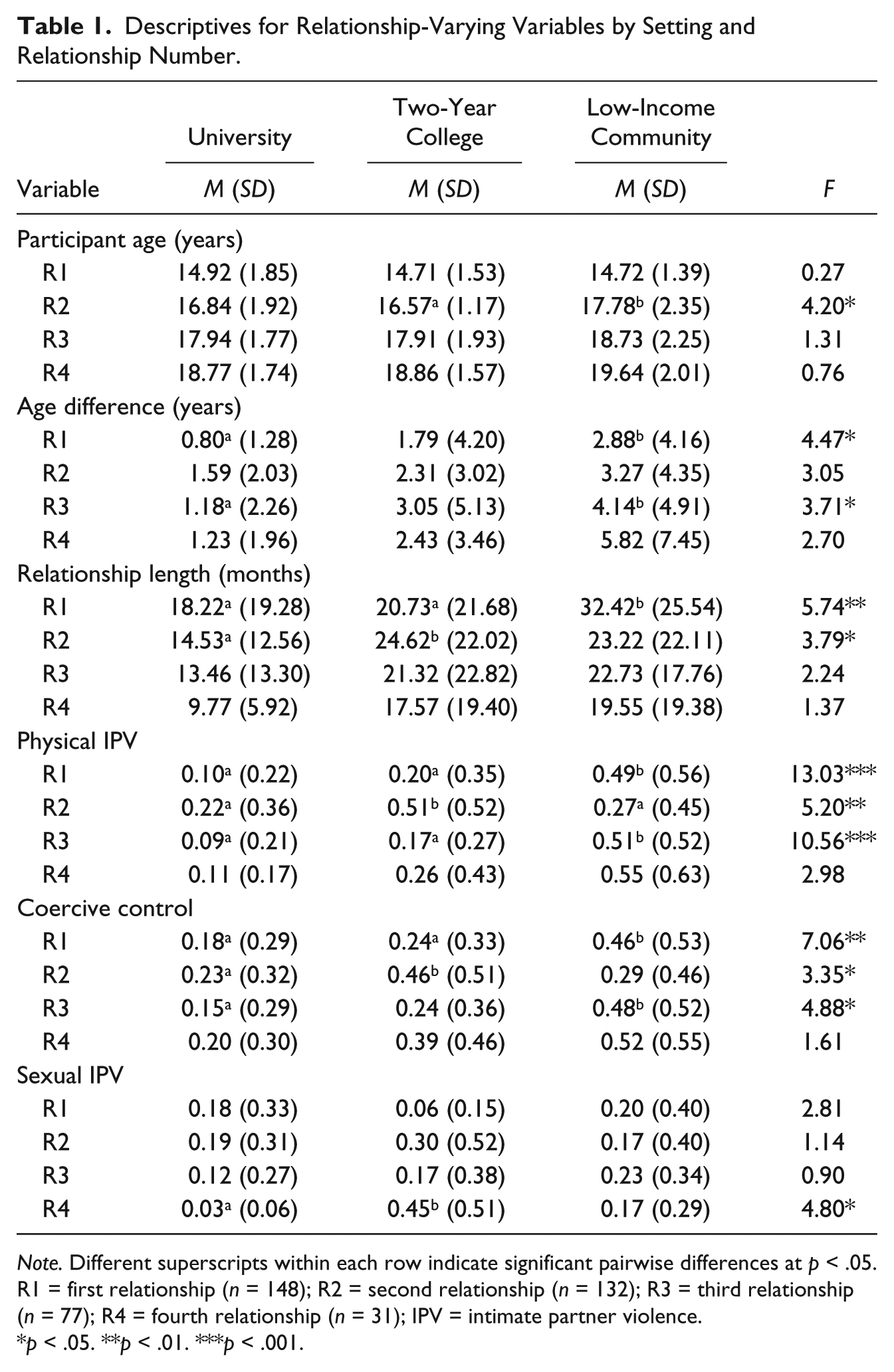
Note. Different superscripts within each row indicate significant pairwise differences at p < .05. R1 = first relationship (n = 148); R2 = second relationship (n = 132); R3 = third relationship (n = 77); R4 = fourth relationship (n = 31); IPV = intimate partner violence.
p < .05. **p < .01. ***p < .001.
Bivariate Correlations Between Primary Variables (N = 148).
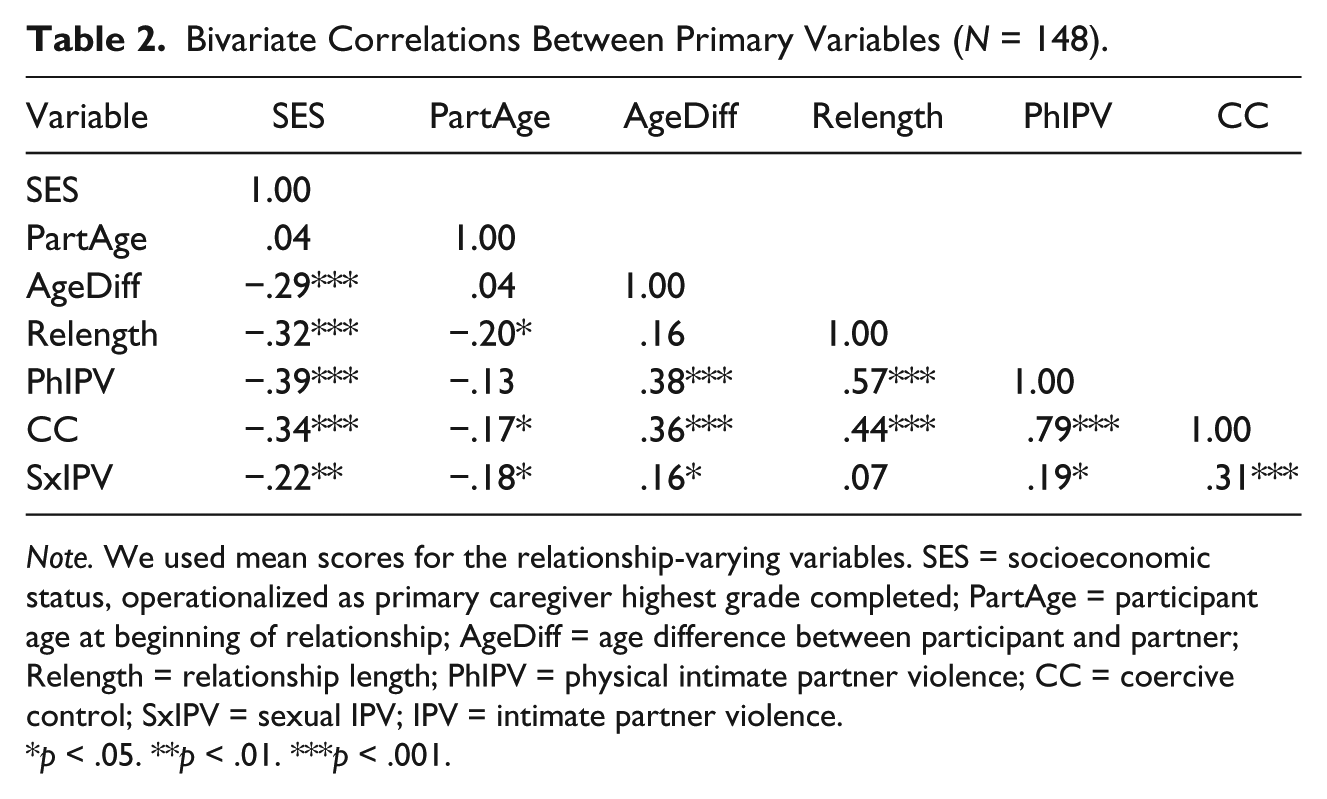
Note. We used mean scores for the relationship-varying variables. SES = socioeconomic status, operationalized as primary caregiver highest grade completed; PartAge = participant age at beginning of relationship; AgeDiff = age difference between participant and partner; Relength = relationship length; PhIPV = physical intimate partner violence; CC = coercive control; SxIPV = sexual IPV; IPV = intimate partner violence.
p < .05. **p < .01. ***p < .001.
The Unconditional Model: The Effect of Relationship Number in Predicting Sexual IPV
We began by examining sexual IPV during the first relationship, as well as the trajectory of change in sexual IPV across Relationships 1 to 4, in an unconditional model containing only relationship number (1, 2, 3, 4) as a predictor (not shown). Participants varied significantly in their rate of sexual IPV during the first relationship, as indicated by the significant variance of the random intercept (σ 00 = .01, p = .047). On average, participants’ average trajectory of sexual IPV across Relationships 1 to 4 remained stable, with no significant increase or decrease (γ10 = .01, p = .63), indicating that relationship number was not a significant predictor of sexual IPV.
The Conditional Model: Between-Persons and Within-Person Effects on Sexual IPV
Model fit was significantly improved by the addition of the between-persons (Level 2) and within-person (Level 1) predictors, Likelihood Ratio χ2(13) = 137.96, p < .01. We present results for the conditional model in Table 3. As shown in the table’s first section, sexual IPV in the first relationship was inversely associated with SES (γ01 = –.02, p = .04) and participant age (γ02 = –.02, p = .04). Two-year college and low-income community participants had significantly lower rates of sexual IPV in comparison with university participants (γ05 = –.19, p < .001, and γ06 = –.15, p = .02, respectively), and physical IPV/coercive control was positively associated with sexual IPV (γ07 = .43, p < .001). The slope intercept, which reflects the trajectory of change in sexual IPV at the point where all slope predictors are zero, is the slope for the reference category: university participants (see the second section). Thus, controlling for the between-persons effects on sexual IPV during the first relationship, the university participants experienced a 0.06-unit decrease in sexual IPV in each relationship subsequent to the first relationship (γ10 = –.06, p = .02), whereas two-year college participants experienced a 0.11-unit increase in sexual IPV in each relationship subsequent to the first, in comparison with university participants (γ12 = .11, p = .02). In absolute terms (i.e., not relative to the reference category), the 2-year college participants’ rate of sexual IPV increased .05 per relationship.
Conditional Model Predicting Sexual IPV: Between-Persons and Within-Person Effects.

Note. IPV = intimate partner violence; SES = socioeconomic status, operationalized as primary caregiver highest grade completed. We report undstandardized coefficients.
The slope intercept is the slope for the reference category for setting: university students.
p < .05. **p < .01. ***p < .001.
After controlling for the between-persons effects on sexual IPV in the first relationship and the trajectory of sexual IPV across Relationships 1 to 4, the within-person effects of change in age difference and change in physical IPV/coercive control on sexual IPV across Relationships 1 to 4 were significant (see the third section). Recall that we log transformed age difference using the log10 transformation; thus, a 10% increase in the change in age difference was associated with a 0.01-unit increase in sexual IPV, γ20 = .35, p < .001, derived by 0.35 × log10(1.1) (Wooldridge, 2012), whereas a 1-unit increase in the change in physical IPV/coercive control was associated with a 0.42-unit increase in sexual IPV (γ40 = .42, p < .001). In other words, when age difference and physical IPV/coercive control increased in a relationship, sexual IPV also increased. Finally, although model fit was significantly improved by including the between-persons and within-person effects of the predictors, the random intercept variance remained significant, indicating that variability across participants in their rate of sexual IPV in the first relationship (σ 00 = .01, p < .001) was not completely accounted for by the explanatory variables.
Discussion
The focus of the current study was to examine multiple risk factors that predicted sexual IPV during young women’s first and subsequent relationships across adolescence and emerging adulthood. We found that SES was inversely related to sexual IPV within the first relationship, though it did not predict the trajectory of sexual IPV. Lower SES may predict sexual IPV during the first relationship via reduced family support, bonding, communication, and monitoring (Leadbeater et al., 2008; Livingston, Hequembourg, Testa, & VanZile-Tamsen, 2007; Maas et al., 2010). For example, a girl in early adolescence who enters a serious partner relationship independent of any caregiver monitoring may “get in over her head” very quickly, but have no one to talk with about her concerns; because of inexperience and lack of guidance, she may normalize the sexual IPV she endures (Livingston et al., 2007). Lower participant age was inversely associated with sexual IPV during the first relationship, whereas change in age difference positively covaried with the rate of sexual IPV across Relationships 1 to 4. Very young age (<14 years) at the start of the first relationship indicates a lack of developmental readiness, coercion (consistent with statutory rape laws), and reduced power, which, in turn, influence the risk of sexual IPV (Halpern et al., 2009; Leitenberg & Saltzman, 2000). Increasing age differences over the course of several relationships may similarly be associated with increasing power differences between participants and their older partners; evidence indicates that older partners are more likely than younger ones to coerce sex and engage in other forms of abuse (Gowen et al., 2004; Volpe et al., 2013).
Regarding differences by setting, although there were no significant differences in the rate of sexual IPV across setting for Relationships 1 to 3, when we controlled for a variety of predictors in the MLM, both the 2-year college and community participants had lower rates of sexual IPV in their first relationship, in comparison with the university participants. There were also between-setting differences in the rate of sexual IPV across relationships: The two-year college participants’ trajectory of sexual IPV increased significantly more steeply than the university participants’, which declined significantly. In other words, university participants reported higher sexual IPV in their first relationship after controlling for other predictors such as SES, participant age, and relationship length, but their rate of sexual IPV across subsequent relationships declined, particularly in comparison with the 2-year college participants. Given the lack of empirical evidence in this area, these findings are difficult to interpret. Coker, Follingstad, Bush, and Fisher (2016) compared women attending college with similarly aged young women not attending college on rate of sexual IPV, and found no differences; however, they included university and 2-year college students in their college category and only assessed for past 12-month prevalence of sexual IPV, so their results are not directly comparable with ours. Because our sample is small and of indeterminate representativeness, these results should be interpreted with caution, and understood as the first step in building knowledge about the rates of sexual IPV within socioeconomically diverse groups of adolescents and young adults. The key point is that there is likely heterogeneity across groups as well as relationships, rather than a uniform profile of IPV that captures all young women’s experiences across adolescence and emerging adulthood.
We found that physical IPV/coercive control was positively associated with sexual IPV in the first relationship as well as over Relationships 1 to 4, after controlling for other predictors. Our study is the first, to our knowledge, to examine these three types of IPV over the course of multiple adolescent relationships; as such, our findings add support to the developing literature on co-occurring IPV among adolescents (Halpern et al., 2009; Vagi et al., 2015; Ybarra et al., 2016). Given that co-occurring IPV is a significant risk factor for especially poor outcomes among girls and young women (Vagi et al., 2015), it is imperative that we acknowledge and address adolescent IPV as a multidimensional problem that includes sexual violence. Finally, participants demonstrated significant variability in their level of sexual IPV during the first relationship that was not accounted for by our model’s explanatory variables. Childhood victimization, including sexual abuse, very likely influences the risk of sexual IPV in adolescence and emerging adulthood (Choi & Temple, 2016; Smith, White, & Holland, 2003), but was not assessed in the current study.
Our study has several limitations. First, we have no way of knowing to what extent our sample is representative of young women who have experienced IPV from university, 2-year college, and low-income community settings. As previously mentioned, our findings should be considered a first step in developing our knowledge about IPV within socioeconomically diverse groups of young women. Second, we relied on participants’ self-report; self-report has been shown to yield reliable, valid data when assessing sensitive topics with adolescents (Caskey & Rosenthal, 2005), but we could have strengthened our study by including other data sources. Third, we did not assess for childhood or concurrent sexual victimization for the current study, instead focusing our attention on key risk factors as predictors of sexual IPV.
Implications for Research, Policy, and Practice
In terms of research, our methods and findings highlight the usefulness of examining predictors of sexual IPV using a relationship-level approach beginning with participants’ first relationship, rather than measuring IPV within the last year, with a current partner, or over the lifetime. This innovative method allowed us to accurately capture participants’ lived experiences with their intimate partners, explore their first relationships in comparison to subsequent ones, and examine sexual IPV and its predictors across participants’ relationship histories. Future research should consider using relationship-level data to examine IPV characteristics, patterns, and predictors over time among adolescents and young adults; furthermore, given that we know relatively little about sexual IPV in comparison with other forms of IPV, both qualitative and quantitative research on the topic should be pursued, especially research that examines sexual IPV in conjunction with other forms of IPV (Logan, Walker, & Cole, 2015). We also initiated efforts to explore heterogeneity among young IPV survivors by recruiting participants from a university, a 2-year college, and community sites serving low-income young women; it is critically important that we move beyond relying on high school and university samples for research on adolescent and young adult IPV (Rennison & Addington, 2014; Voth Schrag, 2016).
Regarding policy and practice implications, prevention and intervention efforts targeting sexual assault among adolescents and young adults must incorporate an understanding of boyfriends as common perpetrators (Black et al., 2011; Smith et al., 2003), and efforts aimed at IPV prevention and intervention must include sexual relationship violence, rather than just focusing on physical and psychological IPV (Logan et al., 2015). Low SES, young age, age differences between a young women and her partner, and the presence of physical IPV and coercive control may be risk factors for sexual IPV victimization within adolescent and emerging adult relationships, and, thus, an understanding of these factors should be incorporated into our prevention and intervention approaches with young people. To be most effective, our efforts must begin prior to early adolescence and continue through the transition to young adulthood, and be designed to reach an increasingly socioeconomically diverse population. For example, although sexual violence on university campuses has received extensive attention from researchers, advocates, legislators, and the media, there is a clear need for all of us to assess and address sexual violence among students attending 2-year colleges, as well as among young people who are poor or low income and not attending school. In addition, although Title IX legislation is most commonly discussed in reference to sexual assault on traditional (residential) college campuses, it also applies to K-12 schools; Title IX, then, may provide an opportunity to advocate with middle and high schools for more systematic, integrated, and targeted prevention programming that addresses both sexual and physical interpersonal violence among youths. Finally, the differences we identified between participants from university, 2-year college, and community settings suggest that prevention strategies may need to be tailored to the setting, rather than treating sexual or other forms of violence as a singular phenomenon across all types of institutions (Moylan & Javorka, 2020). Without these comprehensive approaches across a variety of settings, our work to prevent sexual violence among adolescents and young adults will be superficial at best.
Footnotes
Authors’ Note
The authors presented an earlier version of this work at the Society for Social Work and Research annual conference, January, 2018, in Washington, D.C.
Declaration of Conflicting Interests
The author(s) declared no potential conflicts of interest with respect to the research, authorship, and/or publication of this article.
Funding
The author(s) received no financial support for the research, authorship, and/or publication of this article.