



Abstract
The purpose of this article is to explore some underlying mechanisms of women’s psychological aggression in intimate partner violence (IPV), as a phenomenon that requires better understanding and intervention, even in cases when it does not lead to physical violence. Psychological aggression is known to be the most prevalent pattern of IPV for both genders, and its impact on many survivors is known to be equal and sometimes worse than that of physical harm. Despite the fact that most aggressive conflicts between couples do not escalate into physical violence, research mainly addresses psychological aggression in the context of its correlation with it. This article is based on qualitative interviews with 30 women who were in bidirectional abusive heterosexual relationships, who were at least psychologically aggressive toward their male intimate partner, and who were willing to be interviewed about this experience. Results of the phenomenological psychological method of analysis of the interviews are presented, focusing on the women’s personal accounts for using psychological aggression. These accounts are further analyzed from two perspectives: (a) the bimodal classification of impulsive, as opposed to instrumental, aggression; and (b) the client’s perceived need-to-control the partner as opposed to the ability to exercise self-control. The article also discusses implications for theory and practice, especially in the refining of relevant intervention goals with psychologically aggressive women.
Keywords
Psychological aggression is known to be the most prevalent pattern of abuse in intimate partner violence (IPV) for both genders (Cornelius, Shorey, & Beebe, 2010; National Intimate Partner and Sexual Violence Survey [NISVS], 2014; Stets, 1990). Furthermore, survivors of physical IPV often state that the pain and impact of psychological aggression is equal to, if not worse than, those of physical violence (O’Leary, 1999; Strauchler et al., 2004; Walker, 1979), and some research claims that it may have as negative an influence on exposed children as does physical violence (Odgers & Jaffee, 2013).
Psychological aggression has received much theoretical and practical research interest, but mainly owing to its strong correlation with physical violence (Cascardi, Jouriles, & Temple, 2020), and the prevalent view that it precedes and predicts the escalation of emotional hostility to physical violence (Follingstad, Rutledge, Berg, Hause, & Polek, 1990; Schumacher & Leonard, 2005; Winstok & Perkis, 2009). However, due to its widespread occurrence, its pathway to physical violence and its strong prediction of women’s physical injury in IPV relationships (Stith, Smith, Penn, Ward, & Tritt, 2004), psychological aggression warrants closer inquiry and a clearer conceptualization (Winstok & Sowan-Basheer, 2015).
The purpose of this article is to address women’s psychological aggression in IPV, a phenomenon that requires intervention and solution, even when it does not lead to physical violence. Cases of IPV can be only psychological or psychological in conjunction with verbal or physical violence. Although any type of violence can be perpetrated by one side only or by both sides (Straus, 2015), this article focuses on the psychological aggression of women in bidirectional IPV relationships (i.e., as perpetrators and victims), to explore some of the underlying mechanism of this type of violence and broaden our recognition of its more subtle nuances.
The women’s accounts are analyzed according to the bimodal classification of impulsive as opposed to instrumental aggression (Stanford, Houston, & Baldridge, 2008) and the need-to-control versus the ability to self-control in hostile conflicts (Winstok & Perkis, 2009). Such analyzing of IPV according to this bimodal classification has so far been done only with men’s aggression toward their women partners (e.g., Ennis, Toop, Jung, & Bois, 2017).
Psychological Aggression
Despite its centrality in the definition of IPV and its multiple shapes and forms, there is yet no consensus on a valid and reliable definition or measurement of psychological aggression (McHugh, Rakawski, & Swiderski, 2013; Winstok & Sowan-Basheer, 2015). As a punitive and degrading action, psychological aggression is difficult to measure and depends upon what criteria one focuses—intent, outcome, duration, severity, gender in context, culture in context—to name but a few. In the research literature, one can find synonymous classifications (e.g., emotional abuse or verbal violence) and a long list of behaviors and components, with no clear conceptualization and boundaries (Winstok & Sowan-Basheer, 2015), such as acts of passive aggression and one’s being overly sarcastic; deliberate acts to make the victim feel diminished or embarrassed (the use of verbal insult and intimidation; being coercive, possessive, or controlling; or breaking objects and threatening the partner’s life). All of these may fit the definition, their potentially hurtful impact being self-explanatory (e.g., Cascardi et al., 2020; Centers for Disease Control and Prevention [CDC], 2017; Taft, Murphy, King, Dedeyn, & Musser, 2005). Common to them all is the undermining of the bond of trust, consolation and protection, to which intimate relationships aspire. In psychologically aggressive relationships, this bond becomes an area of frustration and hostility, feelings of unworthiness, shame, and, sometimes, actual fear (Arriaga & Schkeryantz, 2015). For this article, the definition used by the U.S. CDC will serve as a benchmark: “Psychological Aggression is the use of verbal and non-verbal communication with the intent to harm another person mentally or emotionally, and/or to exert control over another person” (CDC, 2017).
Aggression by Women
The perception of women as nonaggressive or less aggressive than men in IPV conflicts is deeply rooted, and empirical research on women’s violence and aggression, from early childhood to adulthood, is limited (Putallaz & Bierman, 2004; Serbin et al., 2004). The higher participation of men in criminal behavior and violent felonies in the general population indeed shows a stronger association between men and violent behavior (Catalano, Smith, Snyder, & Rand, 2009), even though women do not always play a minor role. According to recent research, there is an approximate range of 10% to 35% in the perpetration rate of women in cases of violent nonsexual crime, including general criminal activity (i.e., robbery, assault, aggravated assault, and homicide) as well as domestic offenses (Estrada, Bäckman, & Nilsson, 2015; Hamby, 2005; Matos, 2018; Truman & Langton, 2015).
Studies in the sphere of IPV, however, show different rates of perpetration by gender (Straus, 2011). According to a solid and ever growing body of research, bidirectional perpetration in both physical violence (Archer, 2000) and psychological aggression (Carney & Barner, 2012) is the dominant pattern of IPV, with similar rates of perpetration by women and men (Langhinrichsen-Rohling, Selwyn, & Rohling, 2012). The two asymmetric patterns of perpetration that men are found to perform more frequently are sexual violence and stalking (NISVS, 2014; Swan, Gambone, Caldwell, Sullivan, & Snow, 2008).
Studies that looked at risk factors and predictors of women’s perpetration against a male partner found many similarities to factors preceding men’s IPV, such as histories of child abuse and neglect, insecure attachment, higher dominance of substance dependence, personality disorders, and lower income background (Babkock, Miller, & Sirad, 2003; Dowd, Leisring, & Rosenbaum, 2005). Such findings were evident in both women only (Abel, 2001; Babkock et al., 2003) and mixed gender samples (Henning, Jones, & Holdford, 2003).
The research literature on psychological aggression in IPV relationships (or its synonymous terms such as emotional aggression/violence/abuse) initially dealt with this phenomenon in IPV relationships of men perpetrators and women victims (e.g., Follingstad et al., 1990; Walker, 1979). More recent research has presented findings on women’s psychological aggression as well (e.g., Carney & Barner, 2012; Karakurt & Silver, 2013). Among population survey in the United States, data show that about half of both the men and women have experienced psychological aggression by an intimate partner in their lifetime (48.4% and 48.8%), respectively (Black et al., 2011). To the best of our knowledge, a specific in-depth focus on and description of women’s psychological aggression in the context of IPV has not yet been addressed in the literature.
Method
This study is based on a qualitative approach and applies an abductive methodology that combines both deductive and inductive elements (Henwood & Pidgeon, 2004). Data were gathered in keeping with theoretical sampling-reasoning (Charmaz, 2006), starting with tentative research categories based on empirical knowledge and clinical evidence (i.e., deductive), continuing by refining these categories along the research process, and ending by conceptualizing them (i.e., inductive).
The study was conducted in Israel with a sample of 30 Jewish women who were psychologically aggressive in bidirectional abusive heterosexual relationships. As the Jewish Israeli population is a multicultural majority consisting of different ethnic groups that represent both traditional (i.e., patriarchal) and more modern (i.e., egalitarian) attitudes toward gender equality (Goldscheider, 2015), the background of both types of ideologies are represented by the women in our sample. Ethnically, the sample does not reflect the reality of Israeli women which also includes women from the Arab Muslim, Christian, and Druze minorities. Due to the very limited number of Arab women that answered the sample criteria at the time, the sample eventually included Jewish women only. Formally, as a result of social activism on the part of individual feminists and pro-feminists, women’s organizations, and women members of parliament (Freedman, 1991), IPV has been defined as a criminal act in Israeli legislation, since 1991. Consequently, specific government agencies for the prevention of family violence have been established across the country and situated in major cities and peripheral towns.
Once the research was approved by the ethical committee at the author’s academic institution, the study was publicized to directors of government welfare agencies that serve IPV clientele, asking them to refer us to women who had perpetrated IPV, specifying three inclusive criteria for participation: (a) being a heterosexual woman, (b) who was at least psychologically aggressive toward a male intimate partner, and (c) who was willing to be interviewed about this experience. Eventually, most of the women (26/30) were referred to the study by the Family Violence Prevention Center network and the Adult Probation Service, the two main community services that deal with IPV in Israel. These social agencies gave the sample a clinical character (see Table 1), albeit with its various limitations—that is, missing out on more “common couple violence” (Johnson, 1995), or hearing narratives that were already reframed according to the service IPV ideology. Ongoing recruitment of sample participants continued until the researcher felt, through analyzing the initial data, that theoretical saturation had been attained.
The Women’s Sample Characteristics at Time of Interviews (N = 30).
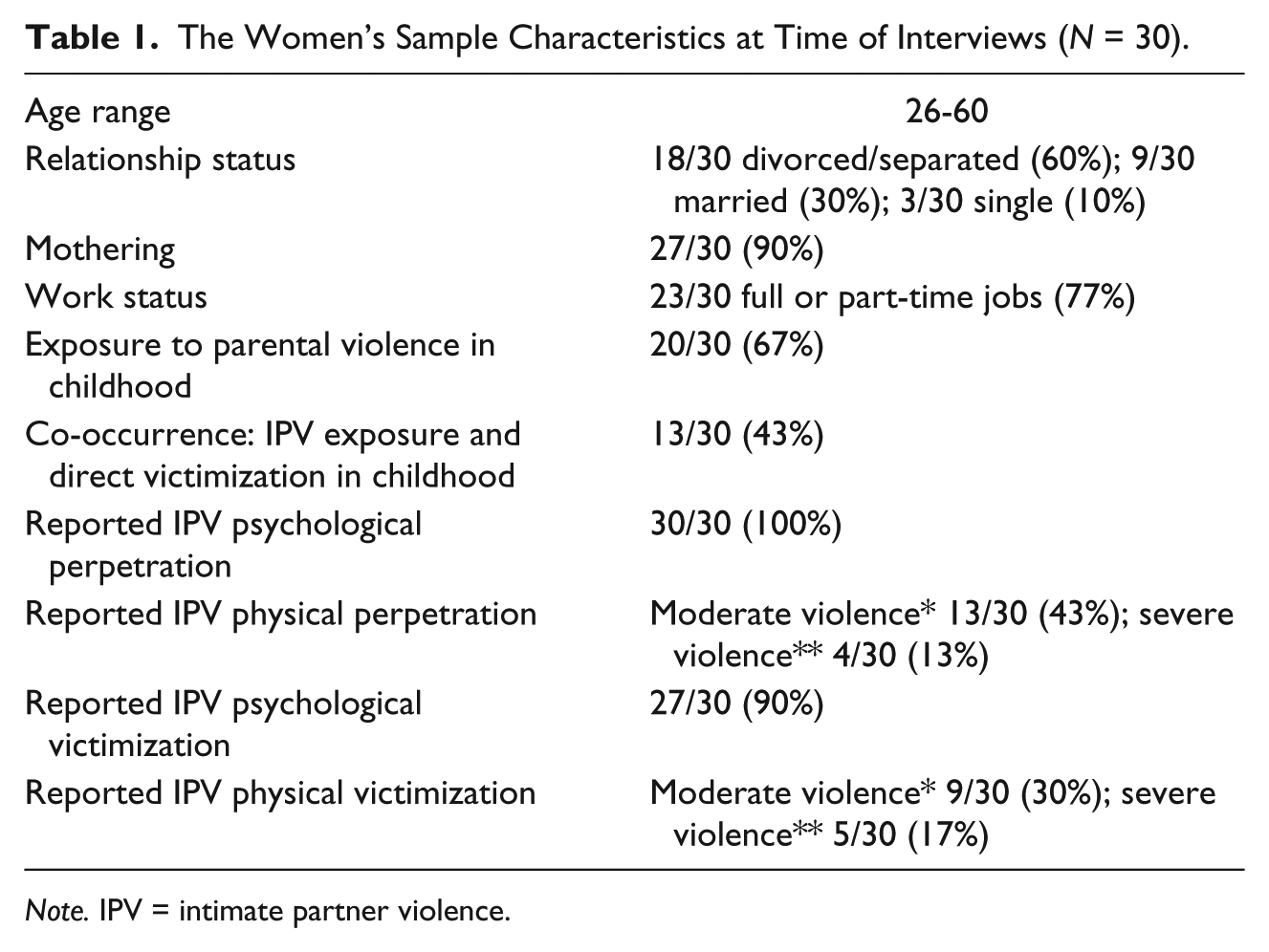
Note. IPV = intimate partner violence.
*Moderate and **severe physical violence were defined according to the revised Conflict Tactics Scales (CTS2; Straus, Hamby, Boney-McCoy, & Sugarman, 1996) definition of “minor violence” (e.g., pushing, grabbing, slapping) and “severe violence” (e.g., kicking, choking, attacking with an object that could cause harm), respectively. In this sample, some women’s severe physical assaults included, for example, head butting, tossing boiling water, or smashing a beer glass on a partner’s forehead—aggressive sorts of behavior that carry a potential outcome of severe physical injury.
All the women were interviewed in sole sessions of between 90 and 120 min. With the main objective of getting an inside perspective on the experience of women behaving aggressively in an intimate relationship, a semistructured interview guide was constructed, based on open-ended questions relating to the following more particular aspects in the woman interviewee’s life. These were (a) childhood experience with family of origin (e.g., Think of yourself at age 5 years, your room, siblings, parents—What memories do you have?), (b) their IPV experiences, (c) the way they define their behavior (as violence or not?), (d) their accounts of it (e.g., How did violence manifest itself in your relationship?), and (e) their experiencing their violence in the context of gender (e.g., What was similar and different in your spouse’s and your violence?). The interviews were recorded and later transcribed verbatim by the researcher.
Personal accounts by women describing how they have used psychological aggression toward a man partner are analyzed according to the bimodal classification of impulsive as opposed to instrumental aggression. Impulsive behavior is characterized by physiological and emotional arousal, which is more effect-driven than cognitively intended. Stereotypically, impulsive people are thought to be “hot-headed,” lacking poor anger moderation skills, and reacting to provocation without thinking of the consequences of their behavior. By contrast, instrumental aggression is characterized as being more controlled and premeditated—a less emotional, more strategic, and goal-oriented way of acting out aggression in a conflict (Stanford et al., 2008).
Data analysis was done according to the descriptive phenomenological psychological method of (a) keeping a fresh mind-set to data while “bracketing” former knowledge (i.e., phenomenological reduction), (b) sticking to actual descriptions of the phenomena rather than interpretations, and (c) using free imaginative variation for conceptualizing the essential structure of the phenomena, looking at them through a psychologically sensitive lens (Giorgi, 2012). Initially, the researcher marked situations that seemed meaningful and relevant to the research questions in each interview; subsequently, the researcher identified situations, contexts, and circumstances that reoccurred in similar structure, but with different content, throughout the interviews. Finally, a conceptualization of the most prevalent and meaningful categories led to themes and subthemes. For the final table of themes of this study see appendix.
Credibility was attained through the extensive engagement of the researcher with the various phenomena of partner violence, his engaging a purposeful sample, his having a close familiarity with the transcribed interviews, and his presentation of extensive quotes. To minimize gender bias in the male-interviewer and female-interviewee dynamic, the issue was addressed and interviewees were asked about this dynamic directly. Most interviewees stated that they considered that the gender difference was secondary to the interpersonal atmosphere, chemistry, and trustworthiness (Williams & Heikes, 1993). To protect the interviewee’s privacy, initials were given to the women behind the quotes.
Although the researcher’s view of IPV is closer to the “family violence” paradigm that understands IPV as more of an interactive dynamic between couples rather than a predominantly male gender problem (Winstok, 2011), he shared, for further validity, his data and reflections with several senior practitioners in the field and with research colleagues of orientations toward partner violence that differ from the researcher’s theoretical view of IPV (e.g., feminist researchers). Although these peer discussions revealed no fundamental disagreements, they served to broaden the researcher’s views about some of his interpretations.
Findings
Following are quotes from incidents of psychological aggression that give an in-depth picture of some thoughts, feelings, and behavior of women living in abusive relationships with a male partner. Despite the context of their aggression being a reactive or an initiated act, both embody different qualities of psychological aggression and tend to escalate conflict. Examples start with impulsive expressions of anger and continue with the instrumental. The most common motivations for their impulsive outbursts presented by women in this study were feelings of frustration, insult, and being mistreated. The motivations behind more instrumental aggression behavior were self-defense, protection of children, retaliation, and creating deterrence.
Impulsive Aggression
As mentioned, impulsive aggression is characterized by a loss of control over anger, which is commonly manifested by an eruption of shouting, screaming, and throwing or breaking objects. First are three descriptions of the inner mechanism of low self-control following what some women have phrased as “the need to let off steam,” which precedes the outbursts: It was sheer hot temper. You do not control yourself. You know how it is with a balloon; you blow into it and blow into it, until one day it explodes. It is a process that you cannot control. . . . He would start and I would follow. (Mrs. T) There are men that think all the power is in their hands, and in cases like mine, you swallow and swallow and swallow. It becomes like a volcano or a snowball that gathers speed and at some point crashes. That’s what happens to me: I feel like a volcano that at one point spits out its lava. (Ms. S) It is a whole set of circumstances, where one thing adds on top of another, and another, and at some point it all comes out and explodes in a way that is wrong. (Ms. J)
Using metaphors of tension building and eruption phenomena, these three accounts express the simple tension build-up mechanism, whereby feelings of anger and hostility add up to a point that needs release, suggesting a lack of agency over one’s contribution to the aggressive dynamic. This mechanism of feeling that is exacerbated over time, adding layer upon layer of tension to the point of outburst, fits Lenore Walker’s (1979) model of the “cycle of violence,” which was one of the first attempts to capture battering men’s emotional escalation mechanisms and pathways to a violent assault.
The next two accounts share what follows such an outburst of anger and its aftermath: We would argue and I would ask him, “are you waiting for the monster to come out of me?!” And I felt the answer was yes, and when I used to lose it, it wouldn’t be pleasant. I would scream and throw whatever came close to my hand—plates, glasses, whatever I would grab I would throw . . . and he would leave the house and run away. (Ms. R) I remember an incident where we had a fight and I left the house for my parents. On the way I tried to call him and he wouldn’t answer which got me even more upset. So I returned home, but he was in the house with a friend, binge drinking. I walked straight to him, took all their alcohol and poured it down the kitchen drain . . . He obviously commented about it and I got angrier, so I knocked down the mirror on the wall before me, and it broke into pieces all over the floor. Only then, after doing all of this, could I calm down. But only after I had let it all out . . . every last bit of it! (Ms. G)
Ms. R. accounted for her impulsiveness by attributing a negative intention to her husband (i.e., “are you waiting for the monster to come out of me?!” And I felt the answer was yes). Such an interpretation of one’s partner’s ill intentions is also known from early CBT (cognitive behavioral therapy) interventions with perpetrating men, whereby one’s cognitive tendency in a conflict is toward the negative framing of situations that consequently escalate anger. Similarly, Ms. G’s returning to conflict after initially detaching reflects her difficulty to de-escalate, which leads her to smash the wall mirror. In her words, she describes how this impulsive act released the tension that had built up inside her, allowing her to regain control over her anger.
A further episode of impulsive behavior is Ms. Z’s response to a futile argument with her husband about money-spending priorities, and describing her feeling of being financially dependent as a “trap.” She opted out in the following way: As I left the house I saw his car and a chair standing next to it. I don’t know how it came together, but I had this rage. I stepped out of the front gate, lifted this chair, which was made of wood and steel, and I started hammering it over the car’s front window. And as it finally smashed to pieces, I started going around and breaking every single window of his car. I broke them all! He stood there behind the fence yelling “ I am calling the police!,” and I screamed back, cursed him, and threw the chair at him, though it fell to the ground and broke. I think I was bleeding, I can’t fully remember. I went away crying, walked down the street and called my brothers . . . (Ms. Z)
This event seems severe in both its impulsive energy (“I don’t know how it came together, but I had this rage”) and in its material aftermath damage. Ms. Z told of other severe events of aggressive behavior which she claimed were rooted in her rough childhood with a battering father who was at times in prison, in a neighborhood where street and family violence were a standard norm. Yet, eccentric as it may be in its behavioral sense, it is similar in its pattern to events described above: an impulsive, emotionally charged reaction, characterized by poor ability to modulate anger, and to de-escalate thoughts and behavior, whether through a negotiation with the other side or by the perpetrator’s one-sided unconditional action.
Instrumental Aggression
The following are women’s accounts of various tactics for retaliation, including the degradation of the partner, by using a more thought-out and emotionally contained method. From giving the silent treatment to ridiculing their partner’s masculine performances, the behavioral expressions of these women appear to be emotionally less heated, giving them a more deliberate and punitive character.
Ms. N, a mother of two, was financially independent and assertive. She described her husband as a domineering, emotionally dependent, and jealous man, quick to feel rejected by her. When telling about her way of dealing with his domineering style, she describes her moves, which again, suggest a lack of self-awareness for her agency in escalating the aggressive dynamic: I felt that we were rather equal in this way; that one doesn’t need physical violence to abuse the other. Keeping quiet is also sufficient. There were many silent-treatments on my part. Not from his. Shortly after we had a fight, it was over for him. “Next!” is how he would put it; his point of view was—we had a fight, it was over and done! But I would not talk to him for long periods of time . . . there was even a period of six months that I totally ignored him. (Ms. N)
Ms. N speaks of the power she holds by being able to detach herself from her husband in the aftermath of conflicts. Although time and space are needed by many couples to cool off from an argument, ignoring a partner for a period of 6 months seems like a strategy of immense punitive power. By ignoring her husband in times of conflict, it seems she intentionally fuels his discomfort,
A similar strategy—hurting the partner by fueling his anxieties—is told by Mrs. A, another working mom who claimed she was married to a controlling husband: What would upset him the most was when I didn’t answer him; when I used to ignore him! That would totally throw him off balance! Or not being home when I know he should be arriving, to take the children and go somewhere without letting him know where we are . . . that would get him started: “Where are you?!! Why don’t you call me”?!! I could also do things on purpose, like dress-up really nicely for work, with make-up and high heels, as a response to his accusations of me being unfaithful. (Mrs. A)
Mrs. A told of her motivation to get-back at her husband by consciously plotting her steps. Like Ms. N, realizing his vulnerability as a suspicious and controlling partner, she stressed his tendency to feel disregarded, thereby propelling his anxiety. Her behavior and retaliating motivations consequently escalate the conflict.
Another passive-aggressive strategy for retaliating and causing emotional distress was by stopping or refraining from doing domestic roles, or denying the partner certain taken-for-granted privileges that are common in a co-habiting relationship. Mrs. S, a woman who ran the household, described such a dynamic: I stopped functioning as a housewife: I stopped preparing food for him, I only made food for the children, and I would make food and hide it from him. Since he was the one who bought the food, he would say “I bought this food and it’s my right to eat here.” I would say “No, it’s not! Make your own food; there is food in the fridge, make it yourself!.” That would make him crazy. . . . I also stopped doing his laundry. I would do everyone’s laundry but his; I would leave his clothes untouched. So if he got up in the morning and realized he had no clean underwear, he would threaten “I will not let you use the laundry machine!” (Mrs. S)
In her retaliation strategy of stepping-back from and denying him the privileges that are commonly exchanged among co-habiting couples, Mrs. S describes how withholding and refusing interaction was functional in getting him upset. One may see a sense of entitlement that this man expresses regarding his right to eat what his wife has prepared, or the legitimacy of Mrs. S’s nonviolent act of stepping-back from the couple’s division of labor. In turn, if the husband was to limit the food he bought to the exclusive disposal of himself and the children, or exclude himself from, for example, his role as the family driver or handyman, would such acts not be defined as psychological aggression? Such abstention from roles and marginalization of rights has a passive-aggressive quality and can go both ways. In this case, her behavior disrupts her partner’s life routine and embodies a dismissive message that seems counter-productive for solving the conflict.
One other group of events describes situations whereby women verbally provoke and directly insult their male partner. The following examples include invalidating the partner’s intelligence, his family of origin, or his masculinity through hostile and toxic remarks that tend to undermine a person’s sense of worth.
Mrs. Y portrayed her grown-up life as a grand mistake, succumbing to her mother’s disapproval of her true love and ending up marrying the wrong partner. Although she held a graduate degree and directs a medical service, her husband was a blue-collar worker with only basic formal education, a power gap that became a recurrent theme for putting him down: He works all day under serious heat; he’s a blacksmith and often comes home complaining he’s had a hard day. When I tell him I also had a hard day, he dismisses it by saying “Yeh, you sit all day under your air-conditioner . . .”; and I say, “Wow, look here, I am not to blame that your mother didn’t have the means to invest in you and your education!!.” I tell him “you’re illiterate!.” Why should he be the only one to humiliate?! I am more educated than he is! He will tell me that I am mentally ill. “Who the hell do you think you are?” I tell him: “Your family is a bunch of mentally ill people and you are illiterate!”; and he replies by shouting back “You are constantly condescending! You think you’re something better . . . !” (Mrs. Y)
Here, as described, is a trivial dynamic of mutual lack of empathy that Mrs. Y and her husband share for one another’s self-pity. Responding to his remark about her privileged physical working conditions, she escalates the conflict by invalidating his family of origin as having no vision for their children’s future. Her remarks imply her family is better, and by labeling him “illiterate” she expresses her opinion of him as a flawed outcome of a flawed family. The hurtful and invalidating qualities of her remarks are self-evident in her husband’s response.
Whereas degrading her husband for belonging to a mentally ill and illiterate family is a gender neutral “flaw” that can go either way, highlighting a man’s inability to fulfill fundamental male-expected roles are more gender particular in their vulnerability for men: I would tell him he’s a loser, because he is! He’s a zero! He could not get rid of his addiction; he could not support us as a family breadwinner! I should have told him that as well, and I am sorry I never did, but even a child he wasn’t capable of making. So he was a zero! He had a whole complex about that, so I would never tell him such a thing, I still had some consideration for his feelings . . . (Ms. B)
In linking her husband’s inability to work and earn a salary to his being worthless as a man, Ms. B highlights his deficient manhood: he could not support the family, could not step-out of his drug addiction, and could not perform sexually. Breadwinning, being in control, and being sexually competent are three basic, aspired gender roles that men want to project and be recognized for. And so, by mirroring her partner’s multiple masculine insufficiencies, she irritates his pride, a strategy that seems poignant and disparaging.
By similar logic, Mrs. C deters her husband from mistreating her and threatens to publicly expose his sexual impotence: I knew how to use his sexual impotence very well. In times when he would verbally question my self-worth I would tell him “what are you worth?! We both know you can hardly get it up and standing!.” Say such a thing to a man and you’ve brought him down, as low as it can get! And I used that as a threat several times, telling him that if he keeps on treating me badly I will go ahead and share this with people in our community, the men in our community—and I wasn’t afraid to do so! (Mrs. C)
As Mrs. C rightfully mentioned, being sexually impotent can be a major soft spot for some men, and therefore the failure to perform in intimate sexual situations can be a powerful tool for a woman to either devaluate a man’s self-worth, or to gain control through the threat of public shaming. In realizing the potential anxiety her husband might experience in this matter, Mrs. C threatens him by “letting everyone know,” a load of potential embarrassment that proved, in her words, to be a powerful deterring mechanism.
Discussion
The prevalence of psychological over physical aggression is well documented in IPV research and requires intervention and solutions, which are so far too few. The purpose of this article is to describe some underlying mechanisms of women’s psychological aggression in interactively violent relationships with a man partner. The qualitative findings that were presented in this article are based on a sample of 30 Jewish Israeli women, all of whom offended their partner in some form of psychological aggression, while over half of them also described an escalation to physical assaults, both moderate and severe. Despite the fact that all the women in the sample described being both a victim and a perpetrator (i.e., being in a bidirectional violent relationship), the quotes suggest that most of these women presented their own use of aggression as a result of the behavior of the partner. Such framing—that as mentioned earlier, suggest a lack of agency over one’s own aggressive behavior—might be the result of the characteristics of the sample. In other words, referred to the study by the two main government IPV services which were founded and developed in Israel according to the feminist perspective (Eisikovits, Bailey, & Winstok, 2015), most women in the sample adopted a narrative of themselves as victims. Nevertheless, as an outcome of the study’s purpose, the current in-depth interviews with these women on their psychological aggression present a closer look at some of its mechanisms, as a behavioral intermediate junction between the intrapsychic arousal of emotions and the frequent escalation into a physical aftermath.
This article described women’s psychological aggressive behavior according to the impulsive-instrumental model, two types of aggressive behavior that are considered to differ, one from the other, by the parameter of control. In IPV relationships, research has shown that violence can be a result of low self-control capabilities (Chase, O’Leary, & Heyman, 2001; Stuart & Holtzworth-Munroe, 2005), as well as coercive behavior by one party on his or her partner to achieve a desired outcome (Felson & Messner, 2000). In IPV, some see the relationship between self-control and the need to control the partner as the result of a process originating in one’s sense that his needs are being threatened (Winstok, 2008). Both forms of control may come into question when intimate couples are confronted with disagreements, and one or both sides anticipate being deprived of a desired outcome. Conflict situations propel the need to regain mastery over the course of events and resolve the dissonance between what is available and what is desired (Stets, 1990).
The initial understanding of IPV as reflecting men’s needs and strategies for controlling women (Dobash & Dobash, 1979) has been challenged by recent research that shows that controlling one’s intimate partner is a strong motivation for women as well (Bates, Graham-Kevan, & Archer, 2014; Whitaker, 2014). Women’s aggression in IPV and its relation to the need to control their partner and the ability for self-control has received only limited research. Winstok and Perkis (2009) have analyzed men’s control and aggression and have concluded that while impulsive psychological aggression is driven by low self-control, instrumental aggression is driven by a high need to control the partner. Their findings show that the need to control the partner and the ability for self-control are elements that interact and predict one’s level of aggressive expression in intimate conflicts. Applying their analysis of men to the case of women may be a useful way for unfolding some of the mechanisms behind women’s psychological aggression, and address them in a more knowledgeable way in IPV preventive interventions.
Theoretical Implications
At times of emotional arousal in a frustrating conflict, psychological aggression is a common mode of behavior that is perceived as a relatively moderate and less harmful tactic for a person to achieve his needs. Between the impulsive and the instrumental ways of aggressive behavior, some people have a tendency for one or the other that may unfold in different potential scenarios.
One scenario, for example, may be an escalation to physical violence directly from instrumental aggression tactics. If instrumental psychological aggression promotes the desired outcome, the conflict may be resolved and likely end. If the desired outcomes are not achieved, one might directly escalate to physical assault. Yet, another more likely scenario is that one party, feeling frustrated and emotionally aroused, will turn to the impulsive mode (e.g., shouting, screaming, throwing, or breaking artifacts).
That said, it is likely that, in real life, impulsive or instrumental aggression are not enacted in their pure and exclusive form, but rather interplay according to the unfolding of the conflict. In other words, impulsive aggression is likely to follow the failed outcomes of the instrumental approach, because most people try to promote their interest vis-à-vis their partner without losing their temper and control over their behavior. If the desirable outcome is not achieved by instrumental psychological means, the level of frustration elevates, ability for self-control is challenged, and impulsive psychological dynamics may unfold, thus elevating the chances for physical assault. A third scenario is also possible—especially for highly agitated individuals with low self-control—whereby, a conflict is initially addressed with an impulsive reaction which, if proved inefficient, heightens the risk for escalating to physical violence.
Each one of the three scenarios may represent a person’s tendency vis-à-vis the issue of control: A need to control the partner may mainly be exhibited in instrumental tactics that requires an ability for self-control, and a low ability to control the other and/or low ability to self-control, will more likely fuel the impulsive.
The clinical character of the sample influenced the types of women, the types of violence, and, as mentioned above, the story-constructions we heard. Accordingly, and due to the high prevalence of psychological aggression in the general population, there remains a need for future studies about women’s aggression with community samples, with women who do not see themselves as primary victims.
Implications for Practice
This article has described some elements in the mechanism of women’s psychological aggression that may or may not lead to physical violence, have severe consequences on people’s well-being, and represent various problems in a couple’s problem-solving skills. Psychological aggression may also cover for more essential problems in couples’ relationships, and therefore—whether passive or active, covert or overt—should always be an important target for intervention. Giving attention to, and discussing with, IPV clients their tendency for impulsive or instrumental aggressive behavioral expression may refine intervention focus and goals and improve intervention relevancy and results. Although aggressive expressions are usually not purely impulsive or instrumental (one type may become the other and vice versa), screening for a person’s prior interactions in IPV conflicts will reveal his or her inclination to one of the two.
First, the in-depth qualitative look into various psychological aggressions may assist practitioners in widening their view of and seeing through the more subtle and indirect nuances of psychological aggression, helping them identify them as aggressive behavior with some destructive impact. Second, the findings of this research differentiated between two types of psychological aggression and may help in the screening of aggressive women clients and indicate the need for a more deliberate intervention focus with them. For example, women like Ms. J and R, who described moments of impulsively losing control, may benefit mostly from a focus on anger management and emotional regulation (e.g., time-out technique, awareness to negative interpretation of neutrals situations). For women like Ms. N, who may ignore their partners for months, or Mrs. S, who absented her husband from the family table, a focus on attitudes concerning aggressive problem-solving might be a useful central goal. Assuming that instrumental aggression on the part of men reflects a higher level of one’s functioning when compared with impulsive personalities (Stanford et al., 2008; Winstok & Perkis, 2009), we may find that instrumental aggressive women might similarly have the psychological ability to appreciate, and the cognitive ability to utilize, nonaggressive conflict resolution tactics.
Both intervention focuses (i.e., emotional regulation skills and changing of attitudes toward conflict resolution) have the potential to de-escalate couple conflicts and enhance women’s assertiveness, whether by channeling anger into assertive negotiation or by learning the power of persuasive arguments.
Footnotes
Appendix
Final Grid of Larger Study’s Themes Relating to the Women’s IPV Experiences (Bailey, 2014).
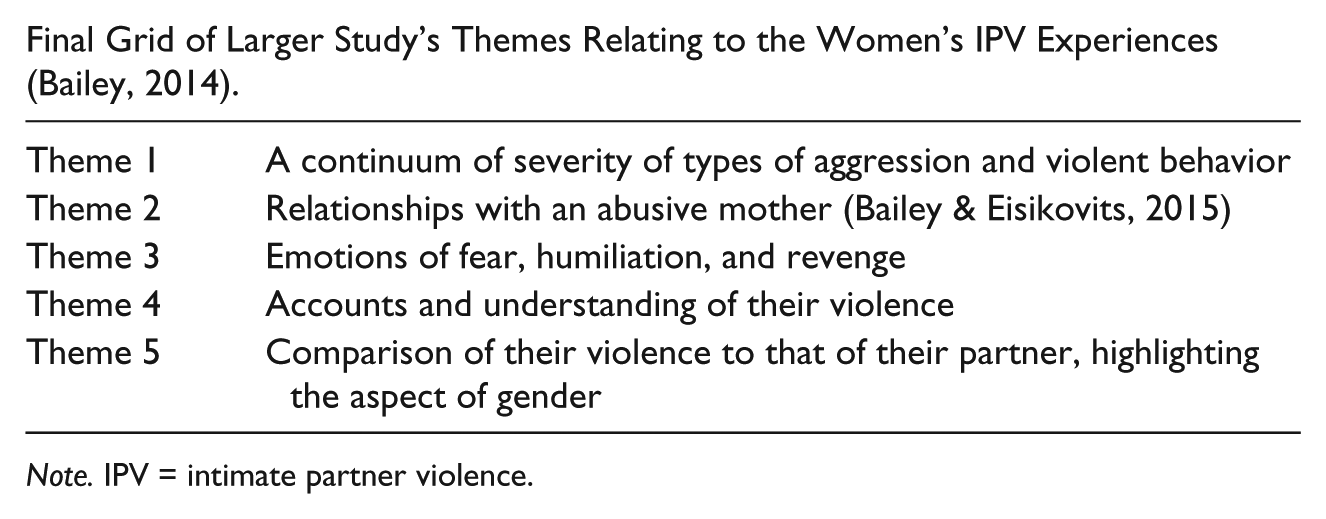
| Theme 1 | A continuum of severity of types of aggression and violent behavior |
| Theme 2 | Relationships with an abusive mother (Bailey & Eisikovits, 2015) |
| Theme 3 | Emotions of fear, humiliation, and revenge |
| Theme 4 | Accounts and understanding of their violence |
| Theme 5 | Comparison of their violence to that of their partner, highlighting the aspect of gender |
Note. IPV = intimate partner violence.
Author’s Note
The author thanks Prof. Zeev Winstok of Haifa University and Dr. Clinton Bailey from Jerusalem for their comments and feedback.
Declaration of Conflicting Interests
The author(s) declared no potential conflicts of interest with respect to the research, authorship, and/or publication of this article.
Funding
The author(s) received no financial support for the research, authorship, and/or publication of this article.