



Abstract
This study analyzed the association between parental conflict and adolescents’ problematic Internet use (PIU), especially the mediating role of adolescent emotional dysregulation and the moderating role of adolescents’ effortful control. About 870 middle school students participated in this survey, reporting on their perceived parental conflict, their own emotional dysregulation, effortful control, and PIU. The results demonstrated that the association between parental conflict and adolescent PIU was completely mediated by adolescent emotional dysregulation. Adolescent effortful control was found to moderate the indirect relation of parental conflict to adolescent PIU, with parental conflict more strongly associated with PIU for adolescents with lower levels of effortful control. Our findings add to the extant insights on how parental conflict could contribute to adolescent PIU.
Introduction
The increasingly widespread availability of Internet resources has facilitated the development of problematic Internet use (PIU) among an increasing number of adolescents (X. Li, Newman, Li, & Zhang, 2016; Vigna-Taglianti et al., 2017). PIU could be conceptualized as excessive use of the Internet which engenders negative consequences in everyday life (Spada, 2014). Caplan (2010) has formulated PIU as comprising five components: (a) preference for online social interaction, characterized by one’s beliefs that online interaction is safer and more efficacious; (b) cognitive preoccupation, involving obsessive thought patterns regarding Internet use; (c) mood regulation, referring to one’s motivation to use the Internet to mitigate one’s negative emotional state; (d) compulsive Internet use, involving deficient self-regulation in using the Internet, and leading to (e) negative outcomes, such as interference with normal life and work. Caplan (2010) has demonstrated that the use of the Internet for mood regulation could elevate the risk for compulsive Internet use, leading to negative outcomes. Consistent with the interest in the potential contribution of adverse familial factors to PIU, parental conflict has been found to potentially contribute to adolescent PIU (Zhou et al., 2017). Taking into account the potential contribution of parental conflict to child emotional insecurity (Davies, Forman, Rasi, & Stevens, 2002), it could be expected that adolescents exposed to marital conflict may be especially vulnerable to PIU as a result of using Internet as a way of alleviating negative mood. The present study intend to examine the underlying processes involved in the association of marital conflict and adolescent PIU by testing a moderated mediation model, in which parental conflict was assumed to be positively related to adolescent emotional dysregulation, which is further positively linked with their PIU. Moreover, the indirect relation from marital conflict to adolescents’ emotional dysregulation to their PIU was assumed to be moderated by adolescent effortful control.
Adolescents’ Emotional Dysregulation as the Mediator
Emotional regulation involves one’s capacity to respond to the ongoing environmental demands with appropriate and flexible emotions (Cole, Michel, & Teti, 1994). Adequate emotional regulation enables individuals to monitor, appraise, and control their emotional experience, then modulating emotional responses tactfully (Thompson, 1991). By contrast, emotionally dysregulated individuals are prone to emotional response patterns that are inconsonant with the contextual demands or their desired goals (Zeman, Cassano, Perry-Parrish, & Stegall, 2006). Marital or parental conflict is a multidimensional construct that could be assessed in light of its frequency, intensity, and resolution (Grych, Seid, & Fincham, 1992). Abundant research has demonstrated the links between parental conflict and maladjustment in children (Henning, Leitenberg, Coffey, Turner, & Bennett, 1996; Maker, Kemmelmeier, & Peterson, 1998; Oramas, Stephens, & Whiddon, 2017). In the current study, we intend to explore the possibility that adolescents with higher parental conflict might display higher levels of emotional dysregulation, which is further positively related to higher levels of PIU.
Parents are the primary socializing agents in cultivating children’s emotional regulation capacity. Marital conflict may impair the development of child emotional regulation. Consistent with social learning theory (Bandura, 1986), parents’ conflictive behaviors involving over-aroused parental emotion may function as models for children to acquire ineffective emotional regulation strategies. Negative parental conflict resolution styles have been found to be related to maladaptive emotional regulation in 9- to 12-year-old children, further precipitating internalizing problems in these children (Siffert & Schwarz, 2011). Following the emotional security theory (Davies et al., 2002), exposure to parental conflict may engender elevation of emotional arousal and dysregulation in children. Exposure to violence scenarios such as parental conflict has been associated with emotional difficulties in children (Margolin, 2005). The above literature demonstrated the role of parental conflict in eliciting adolescent emotional dysregulation.
Individuals suffering from emotional dysregulation are more likely to endorse addictive behaviors as a way of alleviating negative emotional states and recovering from psychological distress (Schreiber, Grant, & Odlaug, 2012). Inadequate emotional regulation has been demonstrated to be linked with adolescent PIU (Chun, 2016). Psychopathological problems such as depression and social anxiety, which are characterized by emotional dysregulation, have been found to be associated with PIU (Caplan, 2007; Ceyhan & Ceyhan, 2008; Kim & Davis, 2009). Caplan (2003) has constructed a model of preference for online communication, positing that depressed and lonely individuals who are characterized by emotional dysregulation may prefer to communicate online with others, finally leading to maladaptive outcomes. Integrating the association between parental conflict and child emotional dysregulation and that between emotional dysregulation and PIU, we expected that emotional dysregulation would mediate the relationship between parental conflict and adolescent PIU, one theme rarely explored in prior research.
Adolescents’ Effortful Control as the Moderator
Effortful control involves an individual’s “ability to inhibit a dominant response and/or activate a subdominant response, to plan, and to detect errors” (Rothbart & Bates, 2006). Empirically, it is often measured in terms of attentional regulation and behavioral control, with the former component assessing one’s ability to willfully focus or shift attention as demanded, and the latter consisting of activation control and inhibitory control, gauging one’s capacity to volitionally activate or inhibit behaviors as needed (Muris & Ollendick, 2005). Adequate effortful control enables an individual to willfully inhibit, activate, or modulate attention and behavior (Eisenberg, Smith, Sadovsky, & Spinrad, 2004) and contributes to one’s efforts to effectively cope with stressful situations (Compas, Connor-Smith, Saltzman, Thomsen, & Wadsworth, 2001), including parental conflict.
Effortful control plays a pivotal role in emotional self-regulation (Eisenberg et al., 2004). It has been found to protect adolescents against emotional symptoms (Morris & Age, 2009). Confronted with negative life events, individuals high in effortful control should be more adept at diverting their attention to positive or neutral environmental stimuli. The various components of effortful control as stated above may play similar roles of impairing the relation of parental conflict to child emotional dysregulation. Derryberry and Reed (2002) have demonstrated that good attentional control could allow individuals to shift attention from the threatening information, relieving their anxiety. Accordingly, children with adequate attentional control should be more proficient in dealing with their perceived threat from parental conflict, lowering the likelihood of child emotional dysregulation. Moreover, children with higher inhibitory control may also be more adept at cutting off the negative input from parental conflict. Likewise, those with adequate activation control may be more inclined to take active steps to improve their negative emotions. Based on the above inferences, we expected that adolescents’ effortful control may moderate the relationship between marital conflict and child emotional dysregulation. Specifically, we take great interest in the likelihood whether adolescents with higher effortful control may manifest lower emotional dysregulation in the context of parental conflict, thus lowering their likelihood of PIU. In addition, we only made an exploration into whether effortful control could moderate the association between child emotional dysregulation and their PIU due to little prior research on this linkage.
Hypotheses for the Present Study
To sum up, the present study aims to explore the association between parental conflict and adolescent PIU, especially the mediating and moderating factors involved in this association. Based on the above review, we proposed and tested the following mediation and moderation hypotheses cross-sectionally among a large school-based sample of Chinese adolescents (Figure 1):

A moderated mediation model of the association between parental conflict and adolescent PIU.
Method
Participants and Procedures
About 900 students in the seventh through ninth grades were recruited as voluntary participants from two junior high schools situated in Eastern China. Complete data were obtained for 870 students (497 boys and 373 girls), with an average of 13.61 years (ranging from 12 to 16 years). 47.85% of the students’ fathers and 58.61% of the mothers reached an educational level below high school. 29.45% of the fathers and 47.76% of the mothers had a monthly income below 3,000 yuan.
Prior to the questionnaire survey, we had sought institutional approval to conduct this research. Then verbal parental consent was obtained through phone calls or texting, as previous researchers did (Wang, 2017). Moreover, students were informed in advance that they were free to participate or not. The data collection process began in early April in 2017, with all the questionnaires finished in Chinese language. With the help of the teacher in charge, trained graduates directed the students to compete the questionnaires in class during a 15-min interval. On completion, the questionnaires were collected and taken back by our graduates.
Measures
Parental conflict was assessed with the Conflict Properties subscale from the Children’s Perception of Parental Conflict scale (Grych et al., 1992). The subscale consists of 19 items loading on three factors, including frequency (e.g., “I often see my parents arguing”), intensity (e.g., “My parents get really mad when they argue”), and resolution (e.g., “Even after my parents stop arguing they stay mad at each other”). Adolescents responded to each item on a five-point Likert-type scale from 1 (completely disagree) to 5 (completely agree). Confirmatory factor analytical results indicated that the above-mentioned three-factor model fit the data satisfactorily: χ2/df = 5.62, comparative fit index (CFI) = 0.95, root mean square error of approximation (RMSEA) = 0.07, with standardized item loading values ranging from 0.54 to 0.83. Parental conflict was computed by averaging all the items across (α = 0.90), with higher scores representing more marital conflict.
Emotional dysregulation was assessed with the Emotional Reactivity subscale of the Differentiation of Self Inventory (Skowron & Friedlader, 1998). This subscale comprises eleven items, measuring individuals’ emotional liability in responding to environmental events (e.g., “People have remarked that I am overly emotional,” or “I wish that I were not so emotional”). All the items were self-rated on a five-point Likert-type scale from 1 (not at all true of me) to 5 (completely true of me). Confirmatory factorial analyses demonstrated that one-factor model fit the data satisfactorily for emotional dysregulation: χ2/df = 6.21, comparative fit index (CFI) = 0.92, root mean square error of approximation (RMSEA) = 0.076, with standardized item loadings ranging from 0.47 to 0.77. All the 11 items were averaged, with higher scores representing higher emotional dysregulation.
Problematic Internet use (PIU) was assessed with Caplan’s (2010) Generalized Problematic Internet Use Scale. This scale includes 15 items, with three items loaded on each of the following five dimensions with satisfactory internal reliability: Preference for online social interaction (e.g., “Online social interaction is more comfortable for me than face-to-face interaction,” α = 0.81), mood regulation (e.g., “I have used the Internet to make myself feel better when I was down,” α = 0.89), cognitive preoccupation (e.g., “I would feel lost if I was unable to go online,” α = 0.88), compulsive Internet use (e.g., “I have difficulty controlling the amount of time I spend online,” α = 0.85), and negative outcomes (e.g., “My Internet use has made it difficult for me to manage my life,” α = 0.75). Adolescents responded to each item on a five-point Likert-type scale from 1 (not at all true of me) to 5 (completely true of me). Confirmatory factorial analyses demonstrated that the five-factor model fit the data satisfactorily: χ2/df = 5.46, CFI = 0.95, RMSEA = 0.06, with standardized item loadings ranging from 0.72 to 0.88. All the items were averaged, obtaining an index with higher scores representing higher PIU.
Effortful control was assessed with the Effortful Control subscale of the Early Adolescent Temperament Questionnaire-short form (Capaldi & Rothbart, 1992). Each item was self-rated on a five-point Likert-type scale 1 (almost always untrue of me) to 5 (almost always true of me). The current study displayed satisfactory internal consistency for the three dimensions of this subscale: attention (e.g., “I can easily focus myself on the schoolwork,” α = 0.78), inhibitory control (e.g., “I can easily stop doing something I am doing as needed,” α = 0.75) and activation control (e.g., “It is difficult for me to complete a task on time,” α = 0.84). Confirmatory factor analytical results demonstrated that the three-dimension model fit the data satisfactorily: χ2/df = 5.46, comparatively fit index (CFI) = 0.98, root mean square error of approximation (RMSEA) = 0.058. All the items were averaged, obtaining an index with higher scores representing higher effortful control.
Control variables. Adolescents’ age, gender, and their socioeconomic status (SES) have been controlled due to previous research demonstrating their relations to PIU (Kim & Davis, 2009). Parental educational level was coded with four levels from 1 (equal to or below junior high school) to 4 (graduate education or above). Parents’ monthly salary was coded with five levels from 1 (equal to or less than 2000 yuan) to 5 (equal to or more than 5000 yuan). The mean level for paternal and maternal education were 1.82 (SD = 0.69) and 1.73 (SD = 0.96). The mean level for fathers’ and mothers’ monthly salary were 2.81 (SD = 1.16) and 1.83 (SD = 1.01). A score was produced by standardizing scores of parental education and monthly salary and then averaging them to produce an SES index.
Data Analytical Strategy
We checked whether the variable distributions conformed to the parametric and multivariate prerequisites before testing the moderated mediation model. Then bivariate correlations were calculated to check multicollinearity and whether the associations among the main variables conformed to expectations. There was no multicollinearity problem and the expected variable associations were consistent with a priori assumptions. Age, gender, and SES were controlled for in estimating the following model. Missing data were addressed using full information maximum likelihood estimation (Enders & Bandalos, 2001).
The approach proposed by Muller, Judd, and Yzerbyt (2005) was applied to test our model. Specifically, the parameters of three regression models would be estimated. In Model 1, the moderating effect of adolescents’ effortful control on the association between parental conflict and adolescents’ PIU would be estimated. In Model 2, the moderating effect of adolescents’ effortful control on the association between parental conflict and adolescents’ emotional dysregulation would be estimated. In Model 3, the moderating effect of adolescents’ effortful control on both the partial effect of adolescents’ emotional dysregulation on adolescents’ PIU and the residual effect of parental conflict on adolescents’ PIU would be estimated. The details for model specifications have been presented in Table 2. All the predictors were standardized to minimize multicollinearity (Dearing & Hamilton, 2006).
Edwards and Lambert (2007) have posited that moderated mediation could be judged to exist if either or both of the following two moderating patterns appear: (a) the path from parental conflict to adolescents’ emotional dysregulation was moderated by adolescents’ effortful control, and/or (b) the path from adolescents’ emotional dysregulation to adolescents’ PIU was moderated by adolescents’ effortful control. Then, we conducted simple slope analyses using the standardized coefficients (Dearing & Hamilton, 2006) to visually demonstrate the moderating role of adolescent effortful control.
To compute the conditional indirect effect, the PROCESS module written by Hayes (2015) ( http://www.afhayes.com ) was used to obtain the mediation effect at one standard deviation below and above the mean of the moderator (effortful control). Specifically, 1,000 bootstrap samples would be specified to estimate the moderated mediation effect via the bias-corrected bootstrap confidence interval. All the above analyses were performed using SPSS 22.0.
Results
Descriptive Analyses
As displayed in Table 1, both parental conflict and emotional dysregulation were positively correlated with adolescent PIU (rs = 0.21 and 0.36, ps < 0.001). Parental conflict was positively associated with adolescents’ emotional dysregulation (r = 0.40, p < 0.001) and negatively correlated with adolescents’ effortful control (r = −0.29, p < 0.05). These results sustained the first hypothesis and presented the preliminary basis for testing the mediator and moderator hypotheses.
Descriptive and Correlational Statistics for the Main Variables (N = 870).

Note. Gender was dummy coded such that 0 = boy and 1 = girl. PIU = Problematic Internet use.
p < .001.
Regression Analyses of the Moderated Mediation Model
As displayed in Table 2, the first model demonstrated an overall positive effect of parental conflict on adolescent PIU (β = 0.12, p < 0.001). The second model presented both a significant main effect of parental conflict (β = 0.33, p < 0.001) and a significant parental conflict × adolescents’ effortful control interaction effect on adolescents’ emotional dysregulation (β = −0.15, p < 0.001). To facilitate description, we plotted adolescents’ emotional dysregulation against parental conflict, separately for low and high levels of adolescents’ effortful control (1 standard deviation [SD] below the mean and 1 SD above the mean, respectively; see Figure 2). Simple slope test revealed that for adolescents with low effortful control, parental conflict was more strongly associated with adolescents’ emotional dysregulation (bsimple= 0.47, p < 0.001), in comparison to the same slope among adolescents with high effortful control (bsimple= 0.20, p < 0.001). In the third model, there existed a positive relation of adolescents’ emotional dysregulation to their PIU (β = 0.22, p < 0.001). The direct relation of parental conflict to adolescent PIU was nonsignificant (β = 0.05, p > 0.05). There existed no moderating effect of adolescents’ effortful control on the relationship between adolescents’ emotional dysregulation and their PIU (β = −0.05, p > 0.1). Results from the PROCESS indicated that the conditional indirect effect was greater for adolescents with low levels of effortful control (0.077, 95% confidence interval [CI] [0.034, 0.124]) than for adolescents with high levels of effortful control (0.052, 95% CI [0.027, 0.091]). These results were consistent with the above simple slope analyses.
Testing the Moderated Mediation Effect of Parental Conflict on Adolescent PIU (N = 870).
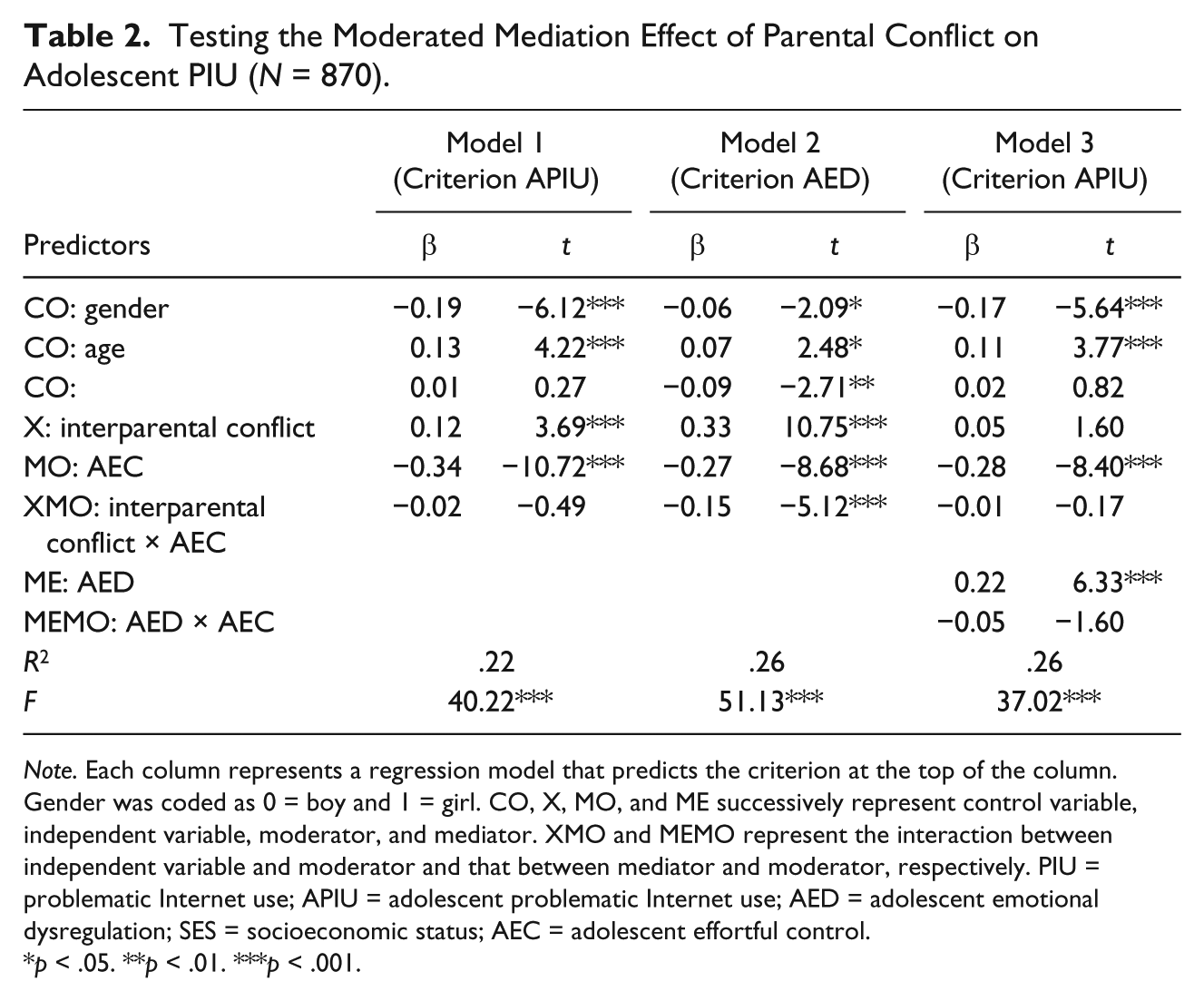
Note. Each column represents a regression model that predicts the criterion at the top of the column. Gender was coded as 0 = boy and 1 = girl. CO, X, MO, and ME successively represent control variable, independent variable, moderator, and mediator. XMO and MEMO represent the interaction between independent variable and moderator and that between mediator and moderator, respectively. PIU = problematic Internet use; APIU = adolescent problematic Internet use; AED = adolescent emotional dysregulation; SES = socioeconomic status; AEC = adolescent effortful control.
p < .05. **p < .01. ***p < .001.

The interparental conflict × adolescent effortful control interactive effects in relation to adolescent emotional dysregulation.
Integrating the two significant linkages on the indirect path from parental conflict to adolescent PIU and the nonsignificant direct path from parental conflict to adolescent PIU, it could be stated that the indirect effect of parental conflict on adolescents’ PIU was completely mediated by their emotional dysregulation. Moreover, this indirect association was moderated by adolescents’ effortful control. For adolescents with low effortful control, parental conflict could exert a much stronger impact on adolescents’ emotional dysregulation, then enhancing the risk for adolescent PIU. These results provided support for the second and third hypotheses.
Discussion
The current study explored the mediating role of adolescents’ emotional dysregulation in the relation of parental conflict to adolescents’ PIU, as well as the moderating role of adolescents’ effortful control in this indirect relationship. Our findings indicated that the potential contribution of parental conflict to adolescents’ PIU could be explained completely by adolescents’ emotional dysregulation. More specifically, this indirect relationship was stronger for adolescents with low effortful control than for those with high effortful control.
Analyses of the Mediating Role of Adolescent Emotional Dysregulation
The association between parental conflict and PIU among our sample of early adolescents is consistent with the positive influence of stressful life events on adolescents’ PIU (D. Li, Zhang, Li, Zhen, & Wang, 2010). Moreover, adolescents may be preoccupied in Internet activities to alleviate life stress and ameliorate negative emotional states (X. Li et al., 2016). Therefore, as a life stressor, parental conflict may enhance the risk of adolescent PIU. Taken a step forward, we found that parental conflict was positively associated with adolescents’ emotional dysregulation, then risking adolescents for PIU.
The current study indicated that parents’ conflictive behaviors were likely to induce emotional dysregulation in adolescents. Our findings provide further support for the cognitive-contextual framework (Grych & Fincham, 1990) and especially for the emotional security theory (Davies et al., 2002). Adolescents could perceive much threat to their well-being through repeated exposure to parental conflict and sometimes they may even blame themselves due to internal attributions of parental conflict. Consistent with the emotional security theory (Davies et al., 2002), our findings demonstrated that parental conflict with higher frequency, stronger intensity, or poor resolution is more likely to destroy adolescents’ emotional regulatory capacity. Moreover, our results indirectly support the tripartite model of familial influence on children’s emotional regulation (Morris, Silk, Steinberg, Myers, & Robinson, 2007), in that parents’ emotional negativity displayed during parental conflict may gradually shape the development of maladaptive emotional regulation in children through their repeated observation and mimicry.
In line with prior research demonstrating that individuals high in emotional dysregulation tend to endorse ineffective emotional regulatory tactics such as addictive behaviors to suppress or relieve their emotional distress (Gonzalez, Zvolensky, Vujanovic, Leyro, & Marshall, 2008), our findings supported the potential contribution of emotional dysfunction to adolescents’ PIU. In other words, Chinese adolescents exposed to parental conflict are more likely to exhibit emotion dysregulation, which is also associated with coping through online activities. It may be that adolescents with much exposure to parental conflict have acquired inappropriate emotional control strategies, making them less competent in offline interpersonal context and more prone to online social interaction to gratify their emotional needs. Therefore, adolescents would inappropriately cope with emotional distress stemming from parental conflict by compulsive or problematic Internet use.
Analyses of the Moderating Role of Adolescent Effortful Control
Adolescents’ effortful control was found to play a moderating role on the linkage between parental conflict and adolescents’ emotional dysregulation. Specifically, in the same context of parental conflict, adolescents with low effortful control are more prone to emotional dysregulation, whereas those with high effortful control tend to develop lower emotional dysregulation. Our findings supported the buffering function of adolescents’ effortful control on the indirect relationship from parental conflict to adolescents’ PIU via their emotional dysregulation and could be expounded in light of the roles of the three elements of effortful control. First, high attentional control could allow adolescents to more effectively cope with various negative emotions such as discomfort and fear (Derryberry & Rothbart, 1988), distressing emotions frequently experienced by children exposed to parental conflict. According to the cognitive-contextual theory (Grych & Fincham, 1990), children would appraise their efficacy in coping with the episode of parental conflict. When they feel adequate coping efficacy, high activation control, as one important element of effortful control, would promote them to engage in attempts to help settle down parental conflicts. Otherwise, adolescents may also rely on inhibitory control, as another key element of effortful control, to inhibit their negative emotions that arise from repeated exposure to parental conflict. We found that high effortful control dampens but does not break off the indirect impact of parental conflict on adolescents’ PIU. These findings could enrich extant research on the associations between adverse familial factors and child PIU, enlightening future endeavor to guard against PIU.
Limitations and Implications
A few limitations in the present study remind us of carefully elucidating the findings and shed light on future directions along this line of research. First, the cross-sectional design of our study precludes us from making causal inferences regarding the variable associations, an issue waiting to be resolved in longitudinal studies. For example, adolescents who spend a lot of time online, as a function of having less face-to-face social contact, may develop worse emotion regulation over time, or children high in emotional dysregulation and/or PIU may induce more parental conflict. Second, social desirability effect may contaminate adolescent reports of their effortful control and emotional dysregulation. A multiple-informant approach may help improve this issue. Third, our study was conducted only among Chinese adolescents, limiting the generalizability of the findings due to the cultural variation in the association between parental conflict and adolescent functioning (Bradford et al., 2003). A multinational study of the same model would provide more insights into the mechanisms regarding how marital conflict contributes to adolescent PIU.
Despite these limitations, our findings provide more insights into efforts to prevent and intervene in adolescent PIU. They inspire practitioners to attach importance to both child factors (i.e., emotional dysregulation) and familial contextual factors (i.e., parental conflict) in protecting adolescents against PIU. In addition, programs aiming at ameliorating adolescents’ effortful control are also beneficial. From the preventive perspective, psychological practitioners should help parents identify the deleterious impact of parental conflict on adolescents’ emotional dysregulation and PIU, trying to reduce marital conflict consciously. For example, family psychologists could help parents identify factors leading to marital conflict and help them constructively resolve marital conflict. Second, children should be taught appropriate attributions of parental conflict to lower their emotional distress. Taking into consideration the role of social support in buffering the negative impact of stressful life events on child development (Cohen & Wills, 1985), a wide network of social support including parents, teachers, and friends, should be beneficial to adolescents who experienced much parental conflict. Due to the buffering effect of effortful control on the relation of parental control to adolescent emotional dysregulation, it would be rewarding to improve their effortful control so as to reduce their risk for PIU.
Footnotes
Declaration of Conflicting Interests
The author(s) declared no potential conflicts of interest with respect to the research, authorship, and/or publication of this article.
Funding
The author(s) disclosed receipt of the following financial support for the research, authorship, and/or publication of this article: This work was supported by Major Project of Humanities and Social Sciences Research Foundation from Ministry of Education of China [Grant Number: 13JJD880004].