



Abstract
Specialized domestic violence courts are presumed to be more effective than general case processing in understanding and addressing the unique issues associated with this crime type, which should lead to reduced recidivism among offenders. Research, however, is less clear about whether and how domestic violence courts reduce recidivism. This study analyzes data from a misdemeanor, expedited domestic violence court in southeast Texas to assess whether defendant characteristics and court processing characteristics influence recidivism among offenders processed through the specialty docket. Results indicate that case processing time was a significant predictor of rearrest for domestic violence. Offenders who had a prior domestic violence arrest were twice as likely to have a subsequent domestic violence arrest. Offenders who received a jail sentence were significantly more likely to have a subsequent domestic violence arrest. Policy implications and future research needs are also discussed.
Research focusing on the arrest and processing of domestic violence offenders has garnered much attention in previous years. The arrest of domestic violence offenders and successful prosecution (meaning an offender is found guilty) can result in a lower recidivism rate and may have a deterrent effect of up to 18 months in some jurisdictions (Tolman & Weisz, 1995) and up to 3 years in others (Maxwell, Garner, & Fagan, 2001). Research also suggests that offenders who are arrested have lower recidivism rates than offenders who are not arrested for domestic violence, among offenders with less prior violence and injury against the victim (Davis & Smith, 1995). More importantly, the arrest and prosecution of domestic violence offenders sends a message to society that this type of violence is unacceptable (Hoctor, 1997; Karan, Keilitz, & Denaro, 1999; Keilitz, 2000; Maytal, 2008; Miccio, 2005).
Specialized domestic violence courts are commonly used to process domestic violence offenders once they are arrested. These courts were first implemented in the mid to late 1990s, gaining popularity until there were 129 criminal domestic violence courts identified in the United States as of 2010 (Labriola, Bradley, O’Sullivan, Rempel, & Moore, 2010). One unique feature of some domestic violence courts is the use of expedited case processing, which attempts to resolve domestic violence cases more quickly than traditional courts (Cissner, Labriola, & Rempel, 2015; Labriola et al., 2010).
Some prosecutors have adopted a no-drop policy for domestic violence cases. This means that the prosecutor can continue with a domestic violence case, even if the victim refuses to cooperate (Davis & Smith, 1995; Ford, 2003; Wills, 1996) and/or the prosecutor can force a victim to participate in the prosecution through threat of legal action (Davis & Smith, 1995; Ford, 2003). Research has shown some support for no-drop policies (Davis & Smith, 1995; Ford, 2003; Hoctor, 1997; Wills, 1996), but there are also some potential negatives to treating domestic violence cases in this manner. For example, some research suggests that disposition of a domestic violence case, whether it be dismissal, probation plus treatment, or jail sentence, has no statistically significant effect on recidivism (Davis, Smith, & Nickles, 1998). This suggests that pushing a case through to resolution may not have the positive effect prosecutors are looking for.
With the increasing number of domestic violence courts, it is important to further explore recidivism among domestic violence offenders processed in these courts, especially understanding the court-related factors that may predict recidivism, as described briefly above. The current study uses data derived from an evaluation of an expedited domestic violence court in southeast Texas with the goal of identifying individual and court-related factors that predict recidivism.
Why SPEED Matters
It is believed that there are many benefits to the use of expedited case processing procedures in domestic violence cases. While one study evaluating an expedited court that was not processing domestic violence offenders suggested that expedited court processing may not reduce recidivism (Butters, Prince, Walker, Worwood, & Sarver, 2018), research into domestic violence courts has supported several benefits. To begin, it was originally thought that domestic violence courts reductions in case processing time may lead to reduced recidivism (Cissner et al., 2015; Moore, 2009). For the offenders, expedited case processing has been shown to reduce the number of misdemeanor and felony arrests prior to case disposition (Davis, Smith, & Rabbitt, 2001). While not statistically significant, victims reported less incidents of abuse while cases were moving through the expedited process and a reduction of violence within 6 months of the disposition of the case (Davis et al., 2001). Any reduction in violence could be construed as a benefit to the victim, so this finding deserves more research.
Another benefit of expedited case processing involves recanting. The first month is vital; if a victim is going to recant, it happens on average within the first month of the case (Cook, Burton, Robinson, & Vallely, 2004). Research by Cook and colleagues (2004) found the first month of a domestic violence case is particularly important to victims recanting, as during this time victims are considering the pros and cons of their involvement in the case. When a victim did recant, it was often before the first hearing, which suggests shortening the length of time between arrest and the first hearing could reduce the number of victims that recant (Cook et al., 2004). While prosecutors can move forward with a case without a statement from the victim, it is still helpful to the case if the victim does not recant.
Saving money is an equally important aspect of expedited case processing. Effective, early interventions in domestic violence cases can lead to more positive outcomes, including a reduction in domestic violence, which saves the courts time and money (Cook et al., 2004). An increase in pleas and reductions in jail sentences could possibly translate in to cost-savings (Davis et al., 2001). Finally, when cases are expedited, it often reduces the overall number of hearings that offenders and victims need to attend (Cook et al., 2004). This means there is greater compliance among victims due to the reduction in appearances that the victim needed to make (Davis et al., 2001).
The Current Study
The current study focuses on a misdemeanor expedited domestic violence court in southeast Texas. The specialized court docket was established in the fall of 2010 after the county received grant funding through the Violence Against Women Act. The District Attorney’s office sought this funding to create a specialized misdemeanor domestic violence court with the goal of increasing conviction rates and improving relationships with the local law enforcement community. When the court was first initiated, it processed half of the Class C (misdemeanor) assault-family violence cases in the county with one dedicated prosecutor. Around the 1-year anniversary of the court, all of the Class C assault-family violence cases were moved to the specialty docket, and in late 2012, a second prosecutor was added. Cases heard could involve any type of familial relationship not just intimate partner violence. It is important to note that cases in this court were not referred but assigned, meaning the defendants were not given the option of having their case heard in another court.
The court began as an expedited court, also known as a “rocket docket” because of the speed in which cases were processed. In this system, defendants were generally arraigned within 2 weeks and then had a pretrial hearing within the next 2 weeks. At this point, defendants had the option to agree to a plea bargain or set for trial. Once the case was set for trial, the court would no longer accept plea bargains. The docket was initially scheduled biweekly, with the goal of having cases closed within 60 days. This type of system forced cases to move through the system quickly, and resets were not generally granted without extenuating circumstances. Similar to other specialized courts, the expedited docket also emphasized specific treatment for offenders. Most offenders who accepted a plea or were found guilty at trial were required to attend a Batterer Intervention and Prevention Program (BIPP), and when applicable some were required to participate in substance abuse programming. The court has also emphasized communication with victims throughout the process, incorporating a victim advocate in the court process.
As a full coverage court, there is no appropriate comparison group of misdemeanor domestic violence defendants processed in a standard court setting for a full outcome evaluation. Rather, the current study will provide a descriptive study that capitalizes on variation in defendant and case processing characteristics among the court’s domestic violence cases in relation to the likelihood of recidivism. For example, while a goal of the court is to speed up processing time, not all cases are resolved quickly, and analyses will assess whether this difference is related to subsequent arrest. Based on the goals of the court, we present three hypotheses:
Method
Sample
The court provided a list of misdemeanor domestic violence cases including descriptive and identifying information about defendants who appeared in the court between 2010 and the first half of 2014. Defendant information was submitted to Texas Department of Public Safety (DPS) criminal records search to obtain complete criminal histories. A total of 838 cases were submitted to DPS, and successful matches were obtained for 732 individuals, for a match rate of 87.4%. An additional 24 cases were identified as “Felony Transfer” cases, meaning that the case had immediately been passed to a felony court. Since they were not processed in the expedited docket, those cases were removed from the analysis, resulting in a final sample of 708 misdemeanor “assault family violence” cases processed by the expedited domestic violence court and for which complete criminal history information was available. The offenses seen by the court were all Class C misdemeanors involving physical contact. A majority of defendants were male (78.4%), White (89.4%), and non-Hispanic (82.6%), with an average age of about 34.
Variables
Descriptive statistics for all variables are presented in Table 1.
Descriptive Characteristics of Cases Processed by the Court.

Dependent variables
The dependent variables in the study include dichotomous indicators for any subsequent arrest and any subsequent domestic violence arrest. Nearly one-third of defendants (31.8%) were rearrested, and 11.3% were rearrested specifically for a domestic violence offense (including physical assault, violation of a protection order, interference with 911) following processing in the expedited domestic violence court. Since follow-up time varied for each individual, two measures were created to capture rearrest within 1 year for any offense (22.6%) and specifically for a domestic violence offense (8.6%).
Defendant characteristics
A number of independent variables reflect defendant characteristics, including demographic measures of sex (male = 1), race/ethnicity (a categorical variable coded as 0 = White, Non-Hispanic, 1 = Non-White, Non-Hispanic, and 2 = White, Hispanic), and a continuous measure of age. In addition, two continuous variables captured prior offending in terms of total number of prior arrests (ranging from 0 to 24, M = 3.09, SD = 3.86) and number of prior arrests for domestic violence (ranging from 0 to 4, M = 0.15, SD = 0.89). Due to the limited range and variability for prior domestic violence arrests, the variable was dichotomized with 0 meaning no prior domestic violence arrest and 1 meaning at least one prior domestic violence arrest (11.6% of defendants).
Case processing characteristics
Reflecting the perspective of court personnel that more efficient case processing will positively impact outcomes, additional variables were constructed to reflect different aspects of court processing. First, case processing time was assessed as the number of days between case filing and disposition (ranging from 0 to 871 days, M = 104.8, SD = 117.9). In addition, the stated purpose of the court was to reduce processing time with the idea that cases processed within 60 days would produce a more positive outcome. A dichotomous variable reflecting the court’s goal measured whether case disposition occurred within 60 days (0 = less than 60 days, 1 = 60 days or longer), and about half of cases (50.4%) were closed within 60 days. One additional court-related variable reflected whether a case was dismissed (1 = dismissed, 21.5%). Finally, recidivism may also be related to the disposition received, and a dichotomous variable captured whether the defendant received jail time (1 = jail disposition, 22.3% of defendants).
Results
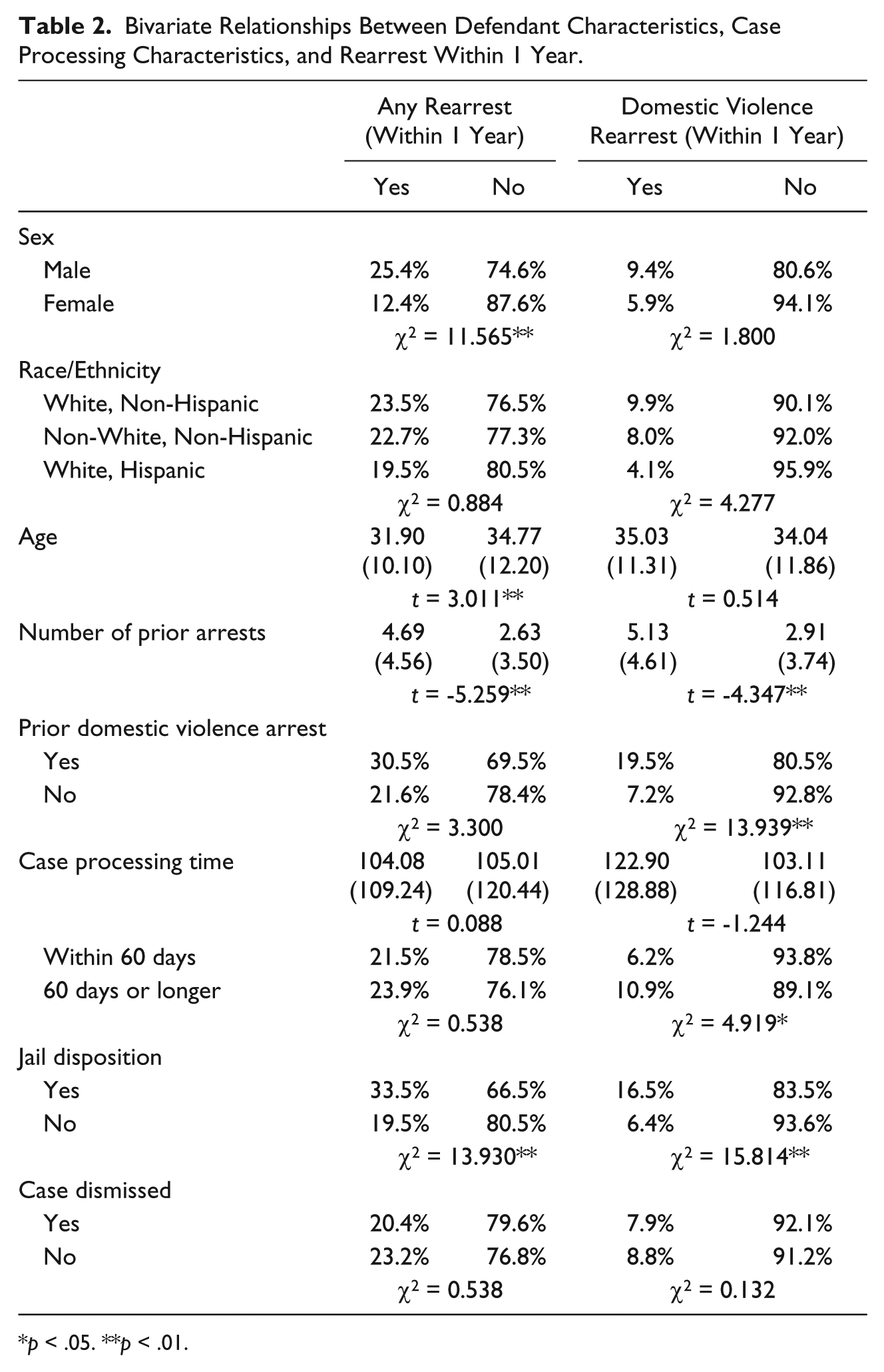
Analyses were designed to identify significant predictors of recidivism. Bivariate comparisons were first conducted, followed by multivariate logistic regression analyses to predict the likelihood of a subsequent arrest. Table 2 presents bivariate analyses of the relationship between defendant and case processing characteristics and the likelihood of rearrest. In general, female defendants are significantly less likely to have a subsequent arrest for any offense, but gender was not a significant predictor for subsequent domestic violence arrest. The likelihood of having a subsequent arrest for either any offense or specifically a domestic violence offense is similar across race/ethnicity, but the relationships were not significant. While those with any rearrest were significantly younger than those not rearrested, there appears to be no significant bivariate relationship between age and domestic violence rearrest.
Bivariate Relationships Between Defendant Characteristics, Case Processing Characteristics, and Rearrest Within 1 Year.
p < .05. **p < .01.
As expected, defendants who were rearrested for any offense and specifically for domestic violence had a significantly greater number of total prior arrests. Having a prior domestic violence arrest was not significantly related to rearrest for any offense, but there was a strong and significant relationship between having a prior domestic violence arrest and being rearrested for a domestic violence offense. Having a prior domestic violence arrest more than doubled the likelihood of a subsequent domestic violence arrest (7.2% DV rearrest for those with no prior vs. 19.5% for those with a prior DV arrest).
Table 2 also shows relationships between case processing characteristics and subsequent arrest. While case processing time is not significantly related to any rearrest, there was a significant relationship between the dichotomous case processing variable and domestic violence rearrest. Having a case processed in 60 days or longer significantly increased the likelihood of a subsequent DV arrest (6.2% DV rearrest for those with case processing time within 60 days vs. 10.9% for those with a case processing time of 60 days or longer). There is also a significant relationship by disposition of the case. Defendants sentenced to time in jail were more likely to be rearrested for any offense (19.5% rearrested for no jail vs. 33.5% for jail disposition) and were more than twice as likely to be rearrested for a domestic violence offense (6.4% for no jail vs. 16.5% for jail disposition). There was no significant relationship between any rearrest or DV rearrest and whether or not the case was dismissed.
Predicting Rearrest
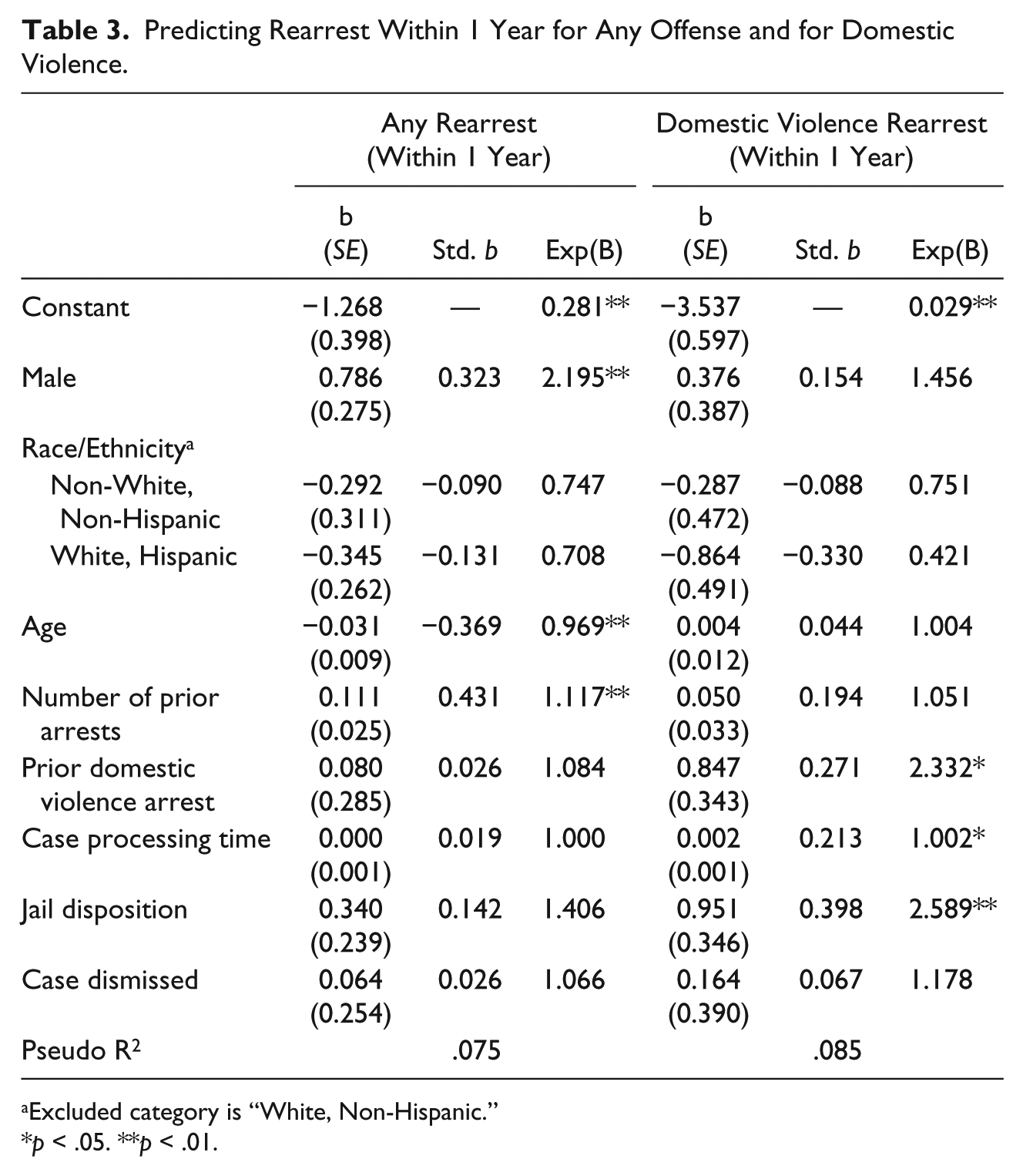
Multivariate logistic regression models were estimated to predict the likelihood of any rearrest as well as specifically rearrest for domestic violence (See Table 3). Few variables significantly predicted the likelihood of any rearrest among these misdemeanor domestic violence defendants. In particular, older individuals were significantly less likely to be rearrested, and those with more prior arrests were significantly more likely to be rearrested. Males were also significantly more likely to be rearrested for any offense. Standardized coefficients were calculated to determine the strength of each variable. The number of prior arrests was the strongest predictor in the model, followed by age, and then gender.
Predicting Rearrest Within 1 Year for Any Offense and for Domestic Violence.
Excluded category is “White, Non-Hispanic.”
p < .05. **p < .01.
By contrast, a number of defendant and case processing characteristics significantly predicted domestic violence rearrest. Controlling for the impact of prior arrests overall, having a prior arrest for domestic violence significantly increased the likelihood of a domestic violence rearrest. Specifically, the odds of a domestic violence rearrest were over twice as high with a prior domestic violence arrest, exp(B) = 2.332, p < .05. As predicted by court personnel, case processing also significantly impacted domestic violence rearrest. Defendants whose cases took longer than 60 days from filing to disposition were significantly more likely to be rearrested for a domestic violence offense, exp(B) = 1.002, p < .05. In addition, those who received a jail sentence were significantly more likely to have a domestic violence rearrest; specifically, the odds of a domestic violence rearrest were nearly 2.6 times higher for those with a jail disposition, exp(B) = 2.589, p < .01. Again, standardized coefficients were calculated for the model. For the DV rearrest model, jail disposition was the strongest predictor, followed by prior DV arrest, and finally case processing time. It is also important to note that when pseudo R2 was calculated for each model, the DV rearrest model had more explained variance (about 8.5%) than the any rearrest model (about 7.5%). However, both models still contained a large amount of unexplained variance.
Discussion
Although this particular domestic violence court was not specifically developed to follow a traditional domestic violence court model, it does seem to have some of the same goals as those ascribed to more formal domestic violence courts, including more efficient processing of cases, some coordination of response, offender accountability, and a focus on victim services. The original intention of the expedited domestic violence court was primarily to reduce case processing time to increase convictions, but the court also provides some access to victim services in the form of a dedicated victim advocate, and penalties for defendants almost always include assignment to a batterer program. The current study was designed to assess which factors predict recidivism among this group of misdemeanor domestic violence offenders, especially considering elements of the court process that may impact the likelihood of continued involvement in domestic violence.
Results presented here identify both defendant and case processing characteristics that impact the likelihood of recidivism. The results showed that as defendants get older, they are less likely to recidivate, which is supported by previous research (Murphy, Musser, & Maton, 1998). Not surprisingly, one of the strongest and most consistent findings for both any rearrest and domestic violence rearrest specifically was prior offending. The number of prior arrests significantly predicted overall recidivism. This is supported by previous research that has found a history of prior arrests may be related to domestic violence recidivism (Dutton, Bodnarchuk, Kropp, Hart, & Ogloff, 1997; Shepard, 1992).
Above and beyond the impact of prior offending in general, specifically having a previous domestic violence arrest significantly increased the likelihood of domestic violence rearrest. This highlights a degree of continuity in domestic violence offending regardless of the actions of the court, even though some studies have shown that intervention may reduce the likelihood of rearrest (Murphy et al., 1998). At the same time, elements of court processing (i.e., case processing time and jail disposition) did predict domestic violence recidivism, even controlling for continuity in behavior. This is in contrast to findings that suggest a jail sentence would not influence domestic violence rearrest (Gross et al., 2000; Ventura & Davis, 2005).
The expedited misdemeanor domestic violence court examined here was developed with the intention of reducing case processing time, with the hope that fewer victims would recant, more cases would proceed through the system, and more guilty verdicts would be reached. As mentioned previously, one of the common goals of domestic violence courts is more efficient case processing (Cissner et al., 2015; Labriola et al., 2010). As with other domestic violence courts, this seems to emphasize offender accountability, and the significant results found here suggest that speedier processing may have a positive effect on outcomes. In particular, in cases with a longer time between case filing and disposition (i.e., 60 days or more), the likelihood of domestic violence rearrest was significantly greater. As the court had hoped, it may be that reduced processing time encourages accountability and reduces offending. It may also be that case processing time is a reflection of some other aspect.
The other case processing factor that significantly impacted domestic violence rearrest was a jail disposition. Those defendants who were sentenced to jail were significantly more likely to be rearrested for a domestic violence offense. While it may be the case that harsher dispositions in misdemeanor domestic violence cases are viewed as unfair and produce defiant and criminogenic outcomes (see Sherman, 1993), it seems more likely that the disposition is a reflection of the court’s perception of risk for a particular defendant. Observational data collected as part of a separate piece of the study indicated that the court did not use a systematic risk assessment strategy, but it seems likely that the prosecutors and judge have some sense of the risk posed by each defendant which is included in a disposition decision. It is also possible that the jail disposition resulted from ancillary factors like a failed drug test or failure to comply with other orders, which may also indicate a greater degree of risk for a particular defendant.
The findings presented here suggest some elements that impact recidivism among misdemeanor domestic violence offenders, but there are some limitations that should be recognized and addressed in future research. As a full coverage court, all misdemeanor domestic violence cases in the county were referred to this expedited court. As such, there is no concurrent comparison or control group. While these results suggest that some court actions may impact recidivism, it remains unclear whether the expedited court itself reduces recidivism among domestic violence offenders as compared to other types of courts or processing. The amount of information provided on each defendant was limited. We did not have access to background information about the defendants or to presentence investigation reports or risk assessments if they were being used; length of jail sentence was also not available to us. There was also no information provided about defendant compliance with specific aspects of the sentence. Completion of the assigned batterer intervention program would be especially useful in assessing domestic violence recidivism.
Future research would benefit from more extensive information regarding defendants themselves, compliance with conditions of the sentence, as well as information about the victim. Evaluation of this type of court in the future would need a clear comparison group with random assignment to clarify what impact the expedited nature of the court is having on recidivism. Other considerations needed for future research would include comparing the expedited nature of this court with a more traditional domestic violence court model and more representative racial, ethnic, and gender groups. Another area of future research should include whether expedited domestic violence courts reduce recantations from victims; that information was not available to us from the court so analysis of that goal could not be made at this time.
While many domestic violence courts share common goals, not all courts can incorporate them all. But this does not mean that these courts are not effective. As mentioned above, components of the court studied may have an impact on recidivism, but more research is still needed. If it is found that certain components of domestic violence courts are more influential on recidivism than others, jurisdictions with limited resources can focus their efforts on the identified components that appear most effective. The study of this misdemeanor court in Texas has implications for other similar courts, as it is important to understand what parts of a domestic violence court are most beneficial for the victims, the offenders, and society.
Footnotes
Declaration of Conflicting Interests
The author(s) declared no potential conflicts of interest with respect to the research, authorship, and/or publication of this article.
Funding
The author(s) disclosed receipt of the following financial support for the research, authorship, and/or publication of this article: This research was supported in part by funding from the State of Texas, Office of the Governor, Criminal Justice Division [WF-10-V30-27225-01]. The views expressed here are solely those of the authors and do not necessarily reflect the views or policies of the State of Texas or any other government institution.