




Abstract
Research on bystander behavior in situations of dating violence (DV) and sexual violence (SV) in youth populations is growing; yet, there is a distinct lack of qualitative studies to identify nuances in specifically how and when youth are taking action to help to inform theory, measurement, and programming. The current study examined bystander action plans of high school youth after their participation in a classroom-based, bystander-focused prevention program, to inform bystander behavior measurement and programming within the context of DV and SV research and practice. High school youth (N = 889) from schools across New England completed a bystander-focused violence prevention curriculum and subsequently wrote a bystander plan of action addressing a situation of DV or SV that they had seen before or were likely to see again in the future. The responses were qualitatively coded for type of situation and bystander action, while noting situational aspects (e.g., location, relationship to those involved, engagement of others). Students reported a variety of strategies (ranging from directly telling the perpetrator to stop to creating a distraction) and ways of thinking about situations of DV and SV, and related behaviors (e.g., bullying). Many students listed unique situations and bystander behaviors that were not addressed as part of the curriculum. Bystander action plans also varied as a function of situational variables (e.g., relationship to those involved). These results indicate that measures of bystander behavior for high school students need to look different from established measures for older age groups. Furthermore, bystander programming may be more effective if more thoughtful attention is given to how youth see helping in situations of DV and SV as connected to other problematic behaviors.
Dating violence (DV), which encompasses any physical, psychological, and sexual abuse in a romantic relationship by a current or former partner (Breiding, Basile, Smith, Black, & Mahendra, 2015), and sexual violence (SV), defined as any sexual activity when consent is not obtained or given freely (Basile, Smith, Breiding, Black, & Mahendra, 2014), are both major public health issues in the United States (Max, Rice, Finkelstein, Bardwell, & Leadbetter, 2004).
These issues are particularly salient among high school–aged youth, who experience high rates of DV and SV victimization (Centers for Disease Control and Prevention, 2014). Bystander-focused prevention (i.e., training individuals on how to intervene to prevent DV and SV) is a promising prevention strategy for combating high rates of DV and SV (Banyard, 2015).
However, to date, there is little research examining the context of bystander action for DV and SV among high school students, and ways youth try to help in these contexts. Given the early stages of inquiry into such questions, more descriptive qualitative research is needed. Thus, the purpose of the current study was to identify how youth engage to help and in what contexts, with the goal of informing measurement development and bystander-focused DV and SV prevention programming.
One way to understand prevention of DV and SV is through the role of bystanders. Bystanders are witnesses of high-risk situations who can choose to intervene, before, during, or after an incident of violence has occurred (Banyard & Moynihan, 2011). In high school populations, about 94% of students witness an incident of DV or SV in a given year (Edwards, Rodenhizer-Stämpfli, & Eckstein, 2015). Only a few studies have examined high school students’ bystander behaviors in situations of DV and SV (Casey, Storer, & Herrenkohl, 2018; Edwards et al., 2015). Two of these used focus group methods, which, although descriptive, produced smaller samples that warrant further confirmation in a larger study. Furthermore, focus groups can be subject to participant self-censorship through actively withholding comments and peer influence to conform with others, especially for adolescents who often behave differently in the context of peers than when alone (Carey & Asbury, 2016). Students identified the most common types of SV and DV in high school relationships to be sexual pressure, verbal and emotional abuse, stalking, and controlling behaviors. They also noted that many of these situations were taking place online. The bystander action methods that students said they did or would employ in situations of DV or SV included talking with a friend who disclosed abuse or trying to give advice, checking in with victims, being physically aggressive toward the perpetrator, taking actions to distract the perpetrator or diffuse the situation, verbally confronting the perpetrator, withdrawing from friends in abusive relationships to signal they do not approve, or seeking help from a trusted adult (Casey et al., 2018; Edwards et al., 2015).
Quantitative studies examining correlates of bystander behavior point to differences between high school students and the more often studied samples of college students (Jouriles, Kleinsasser, Rosenfield, & McDonald, 2016; Jouriles, Rosenfield, Yule, Sargent, & McDonald, 2016). Whereas college students were more likely to intervene during a simulated situation of DV if they felt a responsibility to intervene, efficacy for intervening, and perceived benefits of intervening, high school students’ efficacy to intervene was the only variable predictive of their behavior (Jouriles, Kleinsasser, et al., 2016; Jouriles, Rosenfield, et al., 2016). These differences could be, in part, due to developmental differences between the age groups. Some known differences include high school youth using less words during conflict resolution, having more gendered dating attitudes and behaviors, and having less monogamous dating relationships (Lanza & Collins, 2008; Markiewicz, Lawford, Doyle, & Haggart, 2006; Norona, Thorne, Kerrick, Farwood, & Korobov, 2013). Edwards and colleagues (2015) also found that high school youth needed more fundamental information on the topics of DV and SV as part of prevention training than is necessary for other age groups.
Overall, researchers have focused more on college students’ experiences of bystander behavior than high school students’ experiences of bystander behavior. A more complete understanding of high school students’ bystander actions needs to begin with a better description of how and in what situations they intervene. The overarching aim of the current study is to examine personal narratives of students regarding situations of DV and SV, after participation in a classroom-based bystander-focused prevention program. This study extends previous research in a few ways. First, we build on the findings of Edwards et al. (2015) and Casey et al. (2018) by utilizing a larger sample of students and a different form of qualitative methodology, namely, narrative writing. Previous research has noted the prevention and intervention benefits of writing exercises as they can promote self-reflection, reframing of experiences, and contribute to positive youth development (Kliewer et al., 2011; Taylor, Jouriles, Brown, Goforth, & Banyard, 2016; Wilson, 2011). Using narratives in prevention-oriented research can thus serve several functions: to reinforce prevention messages and to generate rich qualitative data about youth’s experiences taking action to end violence. As a more individual-focused method, it provides alternate data from focus groups because participants anonymously describe their ideas free from peer review and potential pressures of norms that might be operating when youth talk in front of other students. Furthermore, given that students had received bystander training first, this study allows us to examine what aspects of bystander programming remained salient for them. This is the first study, to our knowledge, to assess bystander narratives. Bystander narratives may be an interesting methodological tool that could be used in future program evaluation studies. This study also goes beyond the scope of previous studies, by examining what specific bystander actions students are more likely to employ based on the specific situations of DV and SV, as well as how other variables such as location and relationship to victim or perpetrator were associated with bystander action plans.
Ultimately, the goal of this study is to inform bystander behavior measurement and programming efforts for youth in areas that are particularly salient to current youth populations. By qualitatively examining student narratives, we address the following aims:
To determine what aspects of the programming particularly resonate with high school–aged youth. This is assessed through the examination of situations and bystander action plans that students chose to write about that are taught as part of the curriculum.
To examine what the students are adding on their own in terms of unique situations and bystander actions that they find are personally relevant. Using this information, we can gather what may be missing from current bystander measures and programming.
To identify nuances in how and when youth are taking action to help, as well as how situational factors may influence how students choose to engage in particular bystander behaviors.
Method
Participants
The sample was 940 high school students from 11 schools in northern New England who participated in a large study that assessed the impact of the Bringing in the Bystander–High School Curriculum© (BITB-HSC; Leyva & Eckstein, 2015) on reducing DV and SV. Following institutional review board approval, passive parental consent procedures were utilized, where guardians of students below the age of 18 were sent an opt-out form with information on the project and how to withdraw their child if they did not want their child to participate. Students below the age of 18 were only eligible to participate if a guardian did not withdraw them via opt-out consent procedures. Students who were 18 or 19 years old provided their own consent to participate, and students below 18 years who were eligible to participate read an assent form to decide whether they would like to complete the surveys. The participants’ age ranged from 13 to 19 years (M = 15.68, SD = 1.17 years) with freshman and sophomore students making up 66% (n = 586) of the participant pool. A slight majority of the students identified as female (52%, n = 462). The majority of the students within the study identified as heterosexual (90%, n = 809) and Caucasian (85%, n = 755).
Procedure
The Bringing in the Bystander–High School Curriculum© (Leyva & Eckstein, 2015) involved seven, 45-min sessions over the course of 7 weeks. This curriculum taught students about recognizing DV and SV, and the spectrum of behaviors that fall within it, and strategies for positive bystander intervention. In general, the curriculum used multiple pedagogical approaches including lectures, group discussions, videos, interactive and experiential exercises, group work, and worksheets. The first three sessions provided a general background on the topics including overviews of DV and SV, as well as an examination of cultural and systemic factors that contribute to these problems. The following two sessions introduced students to the bystander model and provided examples of both negative and positive bystander behaviors. The final two sessions applied the bystander model specifically to the issues of SV and DV through the use of scenarios. These scenarios challenged students, with the help of the facilitators, to develop effective intervention plans, with a specific focus on strategies that are safe and individualized to a person’s individual level of comfort. Facilitators were trained to encourage ideas that were safe and realistic and to redirect suggestions that could potentially put a bystander at risk.
During the final session, students were asked to write a plan of action for when they next encountered a situation of DV or SV. This plan of action prompt instructed them to write about a situation of DV or SV that they had seen before or were likely to see in the future, and then state what they would do to be a positive bystander the next time they encountered that situation. The purpose of this prompt was to further solidify the knowledge the students had gained during the program, and to help them think through how they could apply the skills that they had learned in ways that felt effective and safe to them. The prompt was purposely worded to ask about things they had seen or that they felt they were likely to see, because the aim of the question was to understand more broadly how students think about bystander intervention. We were trying to capture personal narratives as well as perceptions of community narratives. Restricting the question to situations they had actually already observed would have limited the narratives, because we know that opportunity to help varies widely by individuals (McLean & Syed, 2015). Rather, we wanted to capture their personal narratives about bystander action that were likely formed at least in part through their prevention program participation, as well as previous personal experiences, rather than narrowly asking about situations they had the opportunity to observe.
Of the 940 students who participated in the prevention programming, 889 filled out a plan of action form. After removing participants who did not answer both parts of the prompt (n = 28), did not take it seriously (e.g., ignored the prompt or wrote about something else entirely), were incomprehensible (n = 55), or wrote about multiple, unrelated situations (n = 233), the total number of participant responses coded was 573. Students who wrote about multiple, unrelated situations did not have their plans of action coded because it was unclear which situation was associated with which given bystander action. We wanted to understand both what situations high school youth were witnessing and how they planned to respond depending on the specific situation. For this reason, we did not code these responses.
Students’ plans of action (n = 573) were coded using qualitative content analysis (Krippendorff, 2004) by three separate coders. Coders read through all the responses independently to catalog commonly cited words and phrases related to types of actions taken. Similarities and differences between identified words and phrases were discussed among coders, until a primary set of codes was developed. A small subset of the data was coded by all three coders (n = 20) and then coders met to revise and finalize the codes. All responses were then coded, with two coders reviewing each case. Codes for types of situation, type of bystander action, location of situation, engagement of others, and relationship to those involved in the situation were included. Interrater reliability between coders was 93.37%. Remaining code discrepancies were discussed until agreement was reached.
Results
Across students’ narratives, common themes emerged related to types of situations, types of bystander action, location of situation, relationship to those involved in the situation, and engagement of others. Of note, the Bringing in the Bystander–High School Curriculum© included discussion of two forms of violence—sexual assault, including sexual harassment, and relationship abuse. The cirriculum presents these forms of violence on a continuum (e.g., ranging from unwanted fondling to completed rape specific to sexual assault), and scenarios and discussions focus on “hot spots” for these forms of violence to occur such as house parties and secluded locations at school. Moreover, scenarios and programmatic discussions focus on higher base-rate incidence such as situations of violence that involve peers and friends (rather than strangers); and, suggested bystander strategies are centered around those that are both effective and safe and also emphasize a menu of options, so that students feel like they can respond in ways that align with their unique personalities and preferences.
Common Situations
As documented by content coding of narratives, 18 different types of situations requiring bystander action were identified by students. See Table 1 for a list of all 18 behaviors, described in more detail herein. Percentages related to situations add up to more than 100% because some students, while reporting on just one situation, reported that it included multiple facets to the situations as part of their narrative (e.g., a situation of SV leading to bullying).
Frequency of Reported Problematic Situations That Youth Had Seen Before or Were Likely to See in the Future.
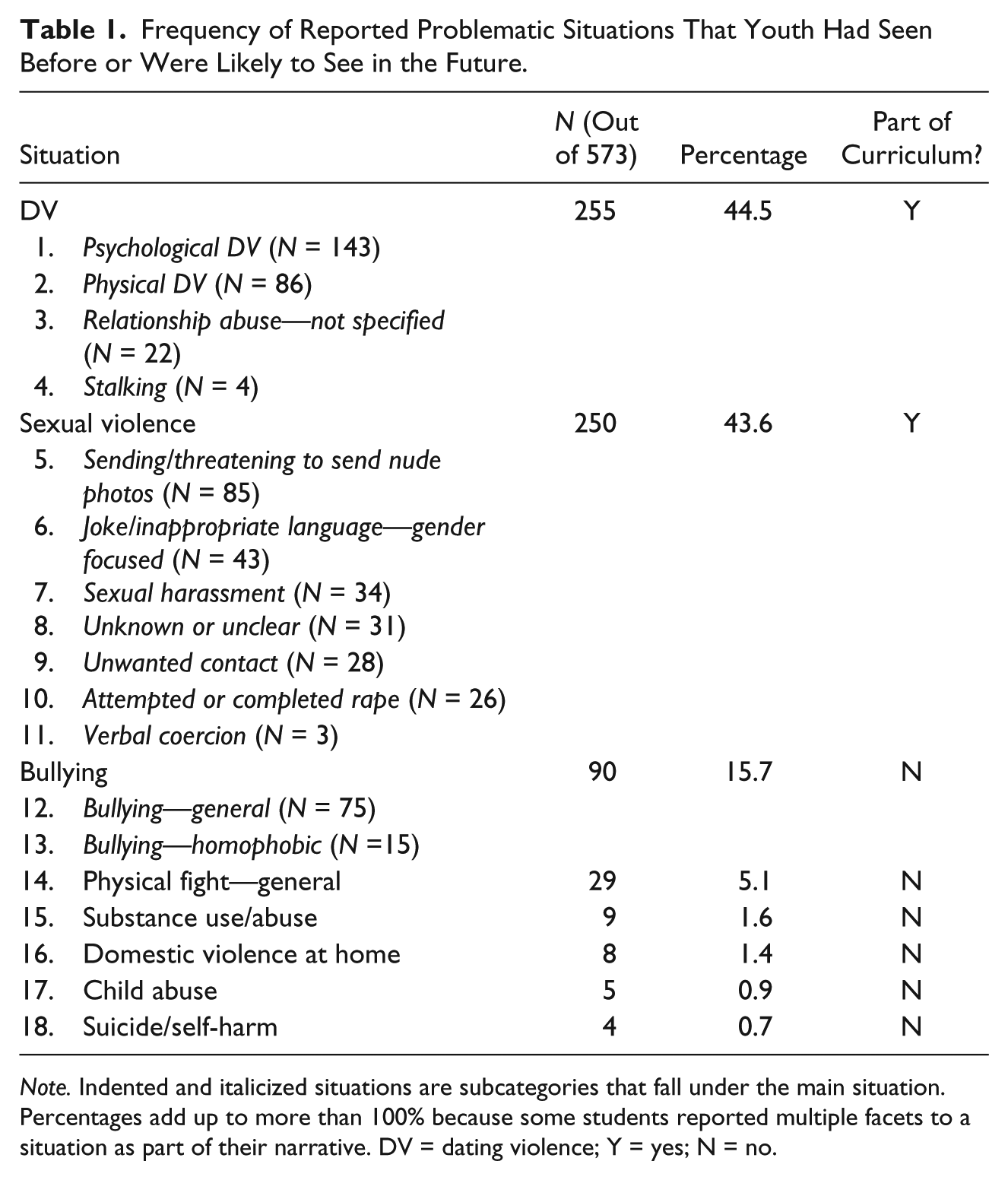
Note. Indented and italicized situations are subcategories that fall under the main situation. Percentages add up to more than 100% because some students reported multiple facets to a situation as part of their narrative. DV = dating violence; Y = yes; N = no.
Dating Violence
The most common situation that the students wrote about was DV (44.5%). DV encompasses the subcategories of physical, psychological, and nonspecific relationship abuse as well as stalking. An example of psychological DV is, “This guy was yelling at his girlfriend because she was talking to her friend (who was a boy) and he almost hit her (he hit the wall beside her).” Psychological DV (25.0%) was mentioned most, followed by physical DV (15.0%): “A couple gets into a heated argument; you can tell the girl is very upset. She tries walking away but the guy grabs her arms and hits her.” Nonspecified relationship abuse accounted for 3.8% of DV, and included situations in which relationship abuse was mentioned, but not the specific type, such as “My friend is crying because she was being abused be her boyfriend.” Stalking was also mentioned, but only in a few cases (1.6%): Your friend comes to you and tells you his ex-girlfriend is stalking him. He broke up with her a few days ago, and she just won’t leave them alone. She has his passwords and hacks his accounts. She constantly texts him and sits by his house. He never feels like he is alone, always being watched. She keeps posting old pictures and telling people that they’re together and personal info about him.
Sexual Violence
Youth also frequently mentioned situations of SV (43.6%). Situations of SV included unwanted contact (e.g., “I’ve seen people slapping and grabbing people’s bums when they’re walking up the stairs”), attempted or completed rape (e.g., “You’re at a party and you see two guys next to an extremely drunk girl on the couch. You can tell she is out of it and the guys are talking about bringing her upstairs to have sex with her”), verbal coercion (e.g., “A guy tells his girlfriend that if she doesn’t have sex with him is going to dump her”), and unknown/unclear situation of sexual assault (e.g., “A guy at a party is all over a girl who is passed out drunk on the couch. She is unresponsive, and the guy is getting more aggressive. People are turning their heads or laughing about it”). Other situations involving SV included sending or threatening to send nude photos (e.g., “Your friend had photos of his girlfriend (naked) on his phone. He told you once he broke up with her he was going to send them to all his contacts”), sexual harassment (e.g., “Guys behind girls in school. They are making remarks about their butts and how they want to do things to them. The girls you are with are very uncomfortable”), and making gender-focused jokes or using inappropriate language (e.g., “Hanging out at lunch with friends, someone told a sexist joke where the punchline had something to do with women being inferior, need to stay in the kitchen, etc.”).
Of the 43.6% of situations regarding SV, 14.8% were sending or threatening to send nude photos, 7.5% were making gender-focused jokes or using inappropriate language, 5.9% were sexual harassment, 5.4% were categorized as unknown or unclear sexual assault, 4.9% were unwanted contact, 4.5% attempted or completed rape, and 0.5% of cases involved verbal coercion.
Other situations
Although students were asked to report on situations of DV or SV that they had seen before or were likely to see again in the future, 25.4% of students wrote about situations that were not overtly related to DV or SV. Another common situation students wrote was bullying (15.7%). Bullying encompassed general bullying (13.1%; e.g., “A group of guys making fun of a person that has stuttering problems”) and homophobic bullying (2.6%; e.g., “I saw someone picking on a really good friend who is gay. They guys were trying to get her to hook up with them and ‘change’ her back”). Situations involving physical fights encompassed 5.1% of cases as well (e.g., “Two kids get into a fist fight over some money the kid owes”). A few other situations were mentioned by at least a few students including substance use (1.6%), domestic violence at home (1.4%), child abuse (0.9%), and suicide/self-harm (0.7%).
Location of situations
More than half of the students also included physical location (53.6%) when describing a situation that they had seen before or were likely to see in the future. Of those who provided locations, 31.9% were at school, 30.9% were online, and 21.2% were at a party. Other, less commonly mentioned locations included in public (9.1%), at home (5.1%), or in the school bus (2.0%).
Bystander Actions
Students’ responses to situations that they believed needed bystander action were categorized into 28 different actions (see Table 2 for a summary of frequencies of all bystander actions reported). The most common actions are described below. Percentages related to bystander actions add up to more than 100% because many students reported multiple actions as part of their action plan.
Reported Bystander Actions to Intervene in Observed Problematic Situations.

Note. Indented and italicized situations are subcategories that fall under the main situation. Percentages related to bystander actions add up to more than 100% because many students reported multiple actions as part of their intervention plan. Y = yes, N = no, and Y* = yes but not an encouraged action.
Confront the perpetrator(s)
The most common bystander action was to directly confront the perpetrator(s) by saying “stop” or “that’s not cool” (34.4%). An example given was to say “‘hey, that’s not cool,’ let them know that having sex doesn’t make you a bad person,” in response to a situation of sexual harassment. Other reported actions that involved confronting the perpetrator(s) included telling the perpetrator(s) to be calm or chill (8.4%; e.g., “I could go up to the person yelling and tell them to calm down”).
Create a distraction
Creating a distraction to diffuse the situation was the second most common bystander response (29.7%). Interestingly, this behavior was not part of the BITB-HSC training, indicating that students generated this response independent of the curriculum. One type of distraction identified was talking about something else as a means of distraction (14.3%). One student said he would “try to intervene during argument by pretending you know the girl and asking a question about something,” in response to psychological DV. Another type of distraction was doing something to distract (9.1%; e.g., “I would start banging on lockers which not only would distract them but would attract attention of the teachers”). Students also wrote about creating a distraction but did not specify how (6.3%; e.g., “I would create a distraction”). A few students also reported that they would use humor to diffuse the situation (5.1%; e.g., “say ‘that was so funny that I forgot to laugh,’ people usually see that as a signal to stop trying to tell jokes”).
Help the victim
The third most commonly cited bystander response was to check in with the victim to see whether he or she was okay (16.8%). In response to sexual harassment, they wrote that they would “Ask if she’s ok, tell her you’re there for her if she needs anything”. Other bystander actions that helped the victim included offering the victim emotional support (15.2%; e.g., “Express empathy for the girl; defend her when people blame her; talk to her and show I care and support her; provide moral support if she needs to talk”), and getting the victim removed from the situation and to safety (14.5%), I went up to them, pretending to be the girl’s friend and getting her to go to the women’s bathroom with me. I made sure she was okay and was able to call a taxi to get her home safely. I waited with her until the taxi came.
Get in the middle of the situation to break it up
Another 15.7% of students said they would get in the middle of a situation to break it up, physically (4.9%), “I’d try to get in the middle of the pushing, so she won’t get hurt”; nonphysically (3.0%), “Get in between them and use humor to break it up”; or in a nonspecified way (2.6%), “You could go up to them and try to break it up”. Getting in the middle of a situation to break it up was another bystander behavior that was generated independent of the BITB-HSC.
Engage in discussion
Some students reported they would engage in a discussion about the situation (13.4%) either by asking the perpetrator how they would feel in the situation (3.3%; e.g., “Ask him ‘what he would feel like if his girlfriend did the same thing to him’”), asking the perpetrators why they are doing what they are doing (4.4%; e.g., “Ask them why they are mad and offer a different perspective on the situation”), or listening to both sides of the story (5.8%; e.g., “Talk to my friend saying if he doesn’t stop she will leave him soon. Talk to their girlfriend about it and see how she feels”). Again, this specific behavior was not a part of the bystander curriculum.
Engagement of others
As part of their bystander actions, 46.8% of students reported that they would engage others to help them intervene. Of the students who reported they would engage someone, school personnel were most commonly cited (41.0%), followed by an older person (25.0%), their peers (19.0%), the police (15.7%), parents (13.4%), other authority figure (4.5%), or another individual not specified (10.4%). Percentages add up to more than 100% because many students listed multiple people to engage. For example, in response to a situation of physical DV, one student wrote that he or she would “gather 2 or 3 friends. One friend goes to the closest classroom to get a teacher. One or two friends remove the guy and then take the girl to the guidance counselor or her next class: wherever she feels safer”. In this situation, they are engaging both their peers and the school personnel.
Bystander Actions Specific to Situation Listed
There were notable similarities and differences in bystander actions depending on the situation listed. A consistently common bystander action across types of violence was saying “stop” or “not cool,” and was mentioned in 34.4% of situations. This action was one of the most common as a response to SV (41.6%), DV (19.2%), and bullying (36.4%). The two other most common actions for DV were creating a distraction (32.5%) and removing the victim from the situation and getting her to safety (16.9%). Creating a distraction was also one of the most common responses to SV (23.6%), along with offering emotional support to the victim (15.6%).
In response to bullying, most frequently cited bystander actions after saying “stop” or “not cool” to the perpetrator included checking in with the victims to see whether they are okay (22.7%), and engaging in a discussion with the perpetrators, asking them why they did that or how would they feel (8.0%). For fighting, 5.2% of students mentioned creating some type of distraction, engaging in discussion (2.4%), and checking in with the victims to see whether they were okay (2.4%). See Table 3 for more frequently reported situations and the corresponding bystander actions.
Most Frequently Reported Situations and Their Corresponding Bystander Actions.

Relationship to Individuals Involved
Many participants (38.2%) listed their relationship to the individuals in the situation they described: 20.8% students named themselves as friends of the victim, 6.8% as friends of the perpetrator, 2.4% as friends with both the victim and perpetrator, and 4.0% said that the individuals in the situation were strangers. An additional 4.2% of students had another type of relationship with the individuals in their listed situation, such as neighbor, parent, or sibling. When the students described a situation in which they were the friend of the victim, they were most likely to offer emotional support (40.3%), offer advice (26.9%), and remove the victim from the situation (21.0%). When they described a situation in which they were friends with the perpetrator, they were most likely to engage them in discussion (41.0%), say “stop” or “not cool” (41.0%), or tell them to be calm or chill (20.5%). When friends with both, they were most likely to say “stop” or “not cool” (57.1%), engage in discussion (42.9%), or check in with the victim (28.6%). When the individuals in the situations were described as strangers, the most common bystander actions included creating a distraction (34.8%), getting in the middle to break it up (21.6%), and removing victims from the situation and get them to safety (26.1%).
Discussion
The current study employed qualitative methods to identify how youth may intervene in response to situations of DV and SV, after participation in a bystander-focused prevention program, with the goal of informing measurement development and bystander-focused DV and SV prevention programming. Through the examination of the students’ narratives, we were able to assess what students were taking away from the program, and describe what they are adding in terms of unique situations and bystander actions that they find to be personally relevant. Although all situations involving DV and SV that students listed in their narratives were covered in the bystander curriculum, all the other situations they listed were not. These included bullying, fighting, substance use, child abuse, domestic violence in the home, and issues of suicide and self-harm. This wide range of situations that students wrote about indicated to us that they were applying the concepts of the bystander curriculum to other problematic situations that they may be experiencing or witnessing.
Some of the most common bystander behaviors that students wrote about in their narratives were those that were taught in the curriculum, including directly telling the perpetrators to stop what they are doing or telling them what they are doing is not cool, checking in with the victims to see whether they are okay, and offering emotional support to the victim. This reflection of the bystander behaviors taught in the curriculum supports the notion that these behaviors are some that students realistically see themselves engaging in. Interestingly, some of the most widely cited behaviors students wrote about were not related to those taught in the bystander curriculum. Several of the positive behaviors that students came up with on their own included creating a distraction, stepping in to break it up, getting the victim to safety, engaging in discussion, and reminding people about the consequences of their actions. These plans illuminate how there are other bystander actions that youth may be more likely to engage in beyond what is currently being taught or measured.
Furthermore, we found that certain aspects of the curriculum were rarely mentioned or not mentioned at all in the students’ narratives. The curriculum stresses that students should be more thoughtful of the media that they consume and have conversations about it with their peers. This was something that we did not see come up in their narratives. The curriculum also reminds students that it is just as important to intervene on the lower end of the SV continuum; yet, less than 10% wrote about a situation such as this (e.g., inappropriate jokes or language related to gender). It is possible that the curriculum could be adapted to cover this more in depth. Finally, in the curriculum, there were discussions about how social media can be used for good (e.g., starting a positive hashtag or contributing to one). These types of actions did not appear in students’ narratives, despite the fact that 30% of students wrote about a situation that happened online. Focusing more on using social media as a tool for intervening in situations of SV and DV, and providing more concrete examples of how students could do this, may help students feel more comfortable being a positive bystander online.
We also aimed to identify nuances in how and when youth are taking action to help as well as how situational factors may influence how students choose to engage in particular bystander behaviors. We found that students reported a variety of strategies (ranging from directly telling the perpetrator to stop to creating a distraction) and ways of thinking about situations of DV and SV, and related behaviors (e.g., bullying). Furthermore, we noticed that bystander action plans varied as a function of situational factors (e.g., location, relationship to those involved, engagement of others). The findings of the current study support earlier work by Casey et al. (2018) and Edwards et al. (2015), and extend it by showing how different types of action are attached to specific types of interpersonal violence or harassment situations. Furthermore, the larger sample in the current study builds the evidence base for this range of bystander opportunities and situations and suggests that talking about these types of incidents should be part of bystander training curricula.
Research Implications
First, the findings of this study suggest that current measurement of bystander behavior among youth is likely not adequately capturing the range of experiences in which youth have the opportunity to intervene and the specific strategies that they employ. Comprehensive and valid measurement is key to understanding a phenomenon (i.e., bystander behavior) and documenting the impact of programming. The majority of existing bystander measures have been developed for college student samples and tend to focus mainly on DV and sexual assault. To date, a few bystander measures have been created that measure youth’s bystander behavior specifically, but these have been informed by college studies and also tend to focus mainly on DV and SV (Cook-Craig et al., 2014; McMahon, 2015; Miller et al., 2012). The current findings suggest that youth who have taken part in a DV and SV prevention program see impacts of the program on taking action related to sexting and bullying. Bystander measures should include these situations when being used for youth. If these measures are not reflecting the nuanced strategies of bystander behavior that youth discuss here, this could be an issue for assessing programming impacts effectively. None of the existing measures for high school youth captured all the bystander behaviors that students wrote about, including the Bystander Behavior Scale, developed by Cook-Craig et al. (2014), which was used in the current study to assess the efficacy of the Bringing in the Bystander–High School Curriculum©.
The current findings also suggest new types of bystander action to include in revised measures. Approximately 30% of students in the current study wrote that they would create some type of distraction. Another 5% stated that they would use humor to diffuse the situation. These strategies are not currently being captured but may be the only ways in which some students feel comfortable intervening. Other behaviors not captured by this scale include engaging others in a discussion. Students mentioned employing tactics such as asking “why are you doing that?” or “how would you feel?” instead of simply asking the perpetrator to stop. These more nuanced strategies for engaging the parties involved in a dialogue are not currently included in the measurement of bystander behaviors. Other behaviors mentioned that would not be captured by current bystander measures include reminding the perpetrators of the potential consequences of their actions, removing an individual from a negative situation, and naming the behavior (e.g., “that’s sexual assault”).
In addition to adding more behaviors to measures of bystander actions, existing items could be modified to capture more students’ experiences. We found that 30% of our sample wrote about a situation that happened online, and items such as “speaking up for someone” may not be reported if students do not know it can happen in person or online. It would be helpful to make it clear that bystander behaviors do not have to be strictly in person. In support of this, recent focus group research by Edwards et al. (2015) reported that a large portion of DV and SV happen online or via text message. Also, about 40% of the students in this study included their relationship to those involved in the situation. The most common bystander actions varied depending on the relationship of the bystander to those involved; friend of the victim, friend of the perpetrator, friends of both, or the victim and perpetrator were both strangers. To date, extant bystander measures (with the exception of some vignette studies) do not often differentiate between a friend or stranger, especially those that have been developed and used for samples of youth. It may be worthwhile to capture youth’s personal relationships to the perpetrator and victim in relation to their bystander behaviors.
Practice and Policy Implications
In addition to methodological implications, these data provide suggestions for DV and SV (and related problematic behaviors) for youth. Because of the diversity of students’ responses and situations we found, it may be more helpful for programming to use less prescribed scenarios and focus more on having students work through ones they generate themselves and think they are most likely to experience.
Much of the information provided by students, in itself, can be valuable in terms of curriculum development. Many of the action plans shared here were rich and descriptive in the language and examples that were used. Whenever creating bystander scenarios for training purposes, it is essential to build ones that are realistic and relatable. Adolescents understand their own day-to-day experiences and challenges better than an adult attempting to write a curriculum for a teenaged audience. It is strongly recommended that curriculum developers, as much as possible, use examples and specific language that emerge from the experiences of adolescents. Current measures of bystander behavior could be easily adapted by implementing small language changes that meet the unique demographics of the youth population. There are a variety of situations that came to light as a result of this study, which could be used as hypothetical scenarios in future programming.
Conversely, many of the plans of action that students shared were vague and nonspecific (i.e., I would tell someone; I would say something). When trying to move people from plan to action, it is suggested that the plans be personal and specific (Prochaska, DiClemente, & Norcross, 1992). From a teaching and programming perspective, this is a reminder to challenge students to be more explicit in the plan they suggest. When asking participants to share their bystander plan, it is suggested that follow-up questions be used to increase the specificity of their plan (i.e., Who is someone that you trust who you could tell? Can you tell me exactly what you would say, in your own words, to your friend?). By doing so, participants may go beyond a vague plan and hopefully toward a definitive one that is more actionable.
An overwhelming majority of the participants in this study chose a bystander behavior that, at least in its description, was positive and safe. In an earlier study using focus groups (Edwards et al., 2015), students who had not received Bringing in the Bystander–High School Curriculum© were more likely to describe their reaction to problematic behaviors with apathy or intervention strategies that were unsafe. Granted, in the current study, students were asked more directly to develop a bystander strategy. Simply asking students to develop a plan of action may explain some of the differences found here. Regardless, it is encouraging that, after receiving this curriculum, the overwhelming majority of participants were capable of describing a positive and safe intervention plan, and that very few students responded to this request with apathy or a plan that would put themselves in harm’s way. That being said, 1.6% of students suggested a form of physical violence as their strategy, and approximately 8% noted that they would physically break up an altercation. This is a reminder than even when programming strongly emphasizes safety and self-care, some participants will still consider negative and potentially dangerous actions to be their default response. This underscores the need to keep considerations of safety at the forefront of any bystander-themed curriculum.
Finally, although students were asked to report on situations of DV or SV, 40% of students wrote about situations that were not overtly related to DV or SV. This indicates that the students were taking the DV- and SV-focused bystander curriculum, and potentially applying it to other problematic situations that they encounter. This was unexpected but encouraging, as it aligns with Hamby and Grych’s (2012) research about the interconnectedness of all forms of violence, and how that violence prevention should be focused on all individuals’ experiences, and not by subtypes of violence (e.g., DV or SV alone). Although it remains an empirical question, there could be great utility and cost savings in creating bystander-focused programming that addresses a number of health behaviors (e.g., DV, SV, bullying, suicide, problematic alcohol use).
Limitations
There are a few limitations to the current study that should be considered. First, the sample was nondiverse, ethnically and regionally, which limits the generalizability of the findings to other youth populations. Future research would benefit from a more diverse sample, located in different geographical areas of the country and representing more racial and ethnic groups. Also, the prompt that the students addressed was open ended, and, thus, there was little control over what they wrote and in what format. Although this could also be seen as a strength that allows for honest responding, some students wrote about multiple unrelated scenarios and multiple bystander actions. As such, it was unclear which scenario was related to a specific bystander action, so these data were, therefore, excluded from analysis. Future studies could include more explicit directions that would help to connect bystander opportunities with actual responses. Also related to the prompt, students were asked to write about a situation they had seen before or were likely to see in the future; so, we do not know whether the situations they described were actually situations that they had witnessed or experienced before. Furthermore, because the data are not longitudinal, we do not know whether students are actually applying their plans of action to problematic situations they witness. Finally, the students completed the prompt after they had finished all the sessions of the Bringing in the Bystander–High School Curriculum©, which could have primed their responses. Future research could examine plans of action outside of the context of an evaluation study.
Conclusion
The current study shed light on a number of unique bystander behaviors not currently addressed in bystander curriculum developed for high school youth. These findings suggest that measures of bystander behavior should include a wider range of possible behaviors to accurately reflect youth helping in situations of DV and SV. Also, bystander programming may be more effective if more thoughtful attention is given to the more nuanced aspects of helping in situations of DV and SV and related problematic behaviors.
Footnotes
Acknowledgements
We owe a great deal of gratitude to our school and community partners and the 50+ research assistants and program facilitators. Without these agencies and individuals, this project would not have been possible.
Declaration of Conflicting Interests
The author(s) declared no potential conflicts of interest with respect to the research, authorship, and/or publication of this article.
Funding
The author(s) disclosed receipt of the following financial support for the research, authorship, and/or publication of this article: Funding for this study was provided by the Centers for Disease Control and Prevention (CDC), Grant #R01-CEO02524. Its contents are solely the responsibility of the authors and do not necessarily represent the official views of the CDC or the Department of Health and Human Services.
