




Abstract
The field of psychopathy research largely argues that the disorder is a heterogeneous concept with two predominant subtypes: primary psychopathy and secondary psychopathy. Early research examined psychopathy subtypes in terms of traits specific to psychopathy. However, recent research suggests that psychopathy may be conceptualized more dimensionally as an extreme variation in normative personality traits. This concept propels the examination of psychopathy using a broader model of personality, the Five Factor Model. Using model-based cluster analysis, this study uses the Five Factor Model to identify subtypes. Utilizing an American college sample, a cluster analysis was performed on the highest third of Psychopathic Personality Inventory (PPI)-Total scorers using the Neuroticism Extraversion Openness Personality Inventory–Revised (NEO-PI-R) domains. This analysis yielded a two-cluster solution, with one cluster representing Primary psychopathy and the other representing Secondary psychopathy. The two clusters displayed differences in Neuroticism, Conscientiousness, Openness, and Extraversion, which may be important for understanding psychopathy subtyping using general personality traits. Associated traits such as aggression, anxiety, and borderline traits largely match other subtyping research. Overall, the results support the existence of psychopathy variants in a nonoffending sample, the dimensionality of psychopathy, and the ability of normative personality traits to differentiate psychopathy subtypes. Unveiling the complex nature of psychopathy through illumination of its dimensions has strong implications for future research as it can help specify an otherwise elusive disorder. Such desired specification can reveal psychopathy’s etiology and potential treatment options. The results of this research in particular suggest a link between profiles of normal personality traits and aggressive behavior indicating the potential for risk assessment. Moreover, this research provides evidence for psychopathy’s dimensionality versus categorical casting, contributing to the debate about mental disorder classifications in general.
Keywords
Introduction
Cleckley (1941) described the psychopath as charming, grandiose, callous, manipulative, and impulsive. The construct is typically associated with limited anxiety and an increased propensity for aggression and violence. The Diagnostic and Statistical Manual of Mental Disorders (American Psychiatric Association [APA], 2013) does not recognize psychopathy as an official disorder. However, it is often studied in association with Cluster B personality disorders (Murphy & Vess, 2003), including Antisocial Personality Disorder (ASPD; Kucharski, Falkenbach, Egan, & Duncan, 2006; Lynam & Vachon, 2012), Borderline Personality Disorder (BPD; Snowden, Craig, & Gray, 2013), and Narcissistic Personality Disorder (NPD; Blackburn, Logan, Donnelly, & Renwick, 2003; Law & Falkenbach, 2018).
The current literature includes support for the heterogeneous nature of psychopathy (for a review, see Skeem, Poythress, Edens, Lilienfeld, & Cale, 2003). Early subtyping theory (Karpman, 1941) suggested two distinct variants with particular etiologies and expressions that may bear practical implications for violent behavior and treatment. According to this classification, primary psychopaths are callous, manipulative, charming, overtly narcissistic, 1 and lack emotional and anxious response, whereas secondary psychopaths are anxious, emotionally reactive, covertly narcissistic, aggressive, and impulsive. The multifactor structure of psychopathy assessment measures (e.g., Psychopathy Checklist–Revised [PCL-R]; Hare, 2003; Psychopathic Personality Inventory [PPI]; Lilienfeld & Andrews, 1996) reflects this dual perspective 2 (Benning, Patrick, Hicks, Blonigen, & Krueger, 2003). Correlational studies in nonforensic samples support psychopathy subtyping theory, revealing that Factor 1 is associated with overt/healthy narcissism (Falkenbach, Howe, & Falki, 2013), positive affect (Delgaizo & Falkenbach, 2008), and low levels of anxiety (Benning, Patrick, Salekin, & Leistico, 2005; Marcus, Fulton, & Edens, 2013), whereas Factor 2 correlates with BPD traits (Miller et al., 2010), anxiety, and covert/pathological narcissism. However, correlations alone are insufficient for analyzing the multiple traits of subtypes (Falkenbach, Beltrani, & Reinhard, 2018; Lykken, 1995).
Model-based cluster analysis (MBCA) objectively reveals predictable and distinct groupings based on multiple variables (Falkenbach, Beltrani, & Reinhard, 2018; Skeem et al., 2003). Model-based cluster analysis research with forensic (Poythress et al., 2010; Skeem, Johansson, Andershed, Kerr, & Louden, 2007), undergraduate (Falkenbach, Barese, Balash, Reinhard, & Hughs, 2015; Falkenbach, Poythress, & Creevy, 2008; Falkenbach, Reinhard, & Larson, 2017; Falkenbach, Stern, & Creevy, 2014; Lee & Salekin, 2010), and even police (Falkenbach, Glackin, & McKinley, 2018) samples has confirmed the existence of theoretically coherent psychopathy subtypes. Primary psychopathy groups have elevated positive affect and relatively low inhibition and anxiety, whereas secondary psychopathy groups have high BPD traits, hostile and angry aggression, and anxiety. However, questions remain regarding the ability of psychopathy factors and narcissism types to differentiate these subtypes. Because this subtype distinction has implications for understanding the construct of psychopathy, its etiology, and its amenability to treatment, further research on the two psychopathy variants is crucial.
Contemporary research has strayed from the traditional, categorical conceptualization of psychopathy to a more dimensional model (Edens, Marcus, Lilienfeld, & Poythress, 2006; Guay, Ruscio, Knight, & Hare, 2007; Marcus, John, & Edens, 2004). Amid much debate (Marcus et al., 2013; Miller & Lynam, 2012), psychopathy research using samples of community members, undergraduates (e.g., DeMatteo, Heilbrun, & Marczyk, 2006; Falkenbach, Poythress, Falki, & Manchak, 2007; Khan, Brewer, Kim, & Centifanti, 2017; Ullrich, Farrington, & Coid, 2008), corporate employees (e.g., Howe, Falkenbach, & Massey, 2014; Smith & Lilienfeld, 2013; Spencer & Byrne, 2016), law enforcement officers (Falkenbach, Balash, Tsoukalas, Stern, & Lilienfeld, 2018), and political figures (Lilienfeld et al., 2012) across culture (e.g., Issa, Falkenbach, Trupp, Campregher, & Lap, 2017), gender (Lee & Salekin, 2010), and race (Gatner, Blanchard, Douglas, Lilenfeld & Edens, 2018) has flourished, evaluating the construct on a continuum, beyond the limits of institutionalized samples. Taken together, the interest in researching psychopathy in more diverse samples, the support for the existence of primary and secondary subtypes, and the suggestion that psychopathy may be understood dimensionally rather than taxometrically compel researchers to attempt to understand psychopathy subtypes based on a broader personality model (e.g., Five Factor Model [FFM]). Using more generalizable characteristics allows for unique subtyping hypotheses and more profound implications (Hicks, Markon, Patrick, Krueger & Neumann, 2004).
FFM and Psychopathy
Although conventionally used to describe variations in normal personality, the FFM of personality (i.e., Extraversion, Agreeableness, Conscientiousness, Neuroticism, and Openness), has been used to examine the extreme presentation of personality traits that result in personality disorders (e.g., Lynam & Widiger, 2001; Miller, Pilkonis, & Morse, 2004) and consequential aggression. Widiger and Lynam (1998) initiated the use of the FFM to define psychopathy by transliterating the 20 items of the PCL-R into the domains and facets of the FFM using the Neuroticism Extraversion Openness Personality Inventory (NEO-PI; Costa & McCrae, 1992). The resulting profile of the prototypic psychopath reflected low Agreeableness, low Conscientiousness, mixed Neuroticism (high Angry Hostility and Impulsiveness, low Self-Consciousness), and mixed Extraversion (high Excitement Seeking, low Warmth, and Positive Emotionality). The authors concluded that all items of the PCL-R correspond to one or more facets of the FFM. However, no item of the PCL-R could be distinguished by one specific FFM facet representation.
Expanding on this work, Miller, Lynam, Widiger, and Leukefeld (2001) recruited experts to create a psychopathy prototype using the FFM. Those experts rated the psychopath as low in Agreeableness (all facets) and Conscientiousness (facets of Dutifulness, Self-discipline, and Deliberation). In addition, they found a mixture of high and low traits from the domains of Neuroticism (high Angry Hostility and Impulsiveness, low Self-Consciousness, Anxiety, Depression, and Vulnerability) and Extraversion (high Excitement Seeking and Assertiveness, low Warmth). Apart from a couple of differences, this iteration of psychopathy is very similar to the psychopath that Widiger and Lynam (1998) described.
Further research testing these profiles has been limited to correlational studies. Studies utilizing the FFM have universally demonstrated that psychopathy is negatively related to the broad domains of Agreeableness and Conscientiousness (Harpur, Hart, & Hare, 2002; Lynam, Whiteside, & Jones, 1999). However, the relationship between Neuroticism (Lynam & Widiger, 2007) and Extraversion (Harpur et al., 2002; Lynam et al., 2005) has yielded mixed results. Among the potential causes of these discrepant findings may be the variation in populations sampled (forensic versus community), the failure to consider the heterogeneity of psychopathy, and the divergent relationships between psychopathy and individual facets of the higher order domains. Correlational research across psychopathy factors confirms Factor 1 negatively correlates with Agreeableness (except Tendermindedness; Ross, Lutz, & Bailey, 2004), and Neuroticism (except Impulsiveness; Poy, Segarra, Esteller, López, & Moltó, 2014), and positively correlates with Extraversion and Openness (Derefinko & Lynam, 2006; Poy et al., 2014), whereas Factor 2 negatively correlates with Conscientiousness, Agreeableness (except Modesty; Ross et al., 2004), and Extraversion (Derefinko & Lynam; Positive Emotionality only; Ross et al., 2004), and positively correlates with Neuroticism.
Hicks and colleagues (2004; Hicks, Vaidyanathan, & Patrick, 2010) identified psychopathy subtypes in criminal samples using a general personality model. Two subtypes were identified: Emotionally Stable Psychopaths (consistent with primary psychopathy) and Aggressive Psychopaths (consistent with secondary psychopathy). The Emotionally Stable group exhibited traits similar to the FFM facets of high sensation seeking, low warmth, and low positive emotions, whereas the Aggressive group displayed high aggression, hostility, and anxiety. While these findings do provide a body of dispositionally oriented research that supports personality-based psychopathy subtypes, the researchers did not use the FFM and findings may not generalize to noncriminal populations. Therefore, the next step is to employ the FFM in a noncriminal sample to empirically test for the psychopathic profiles suggested in the literature.
Current Study
The current study considers psychopathy prototypes based on the FFM model by subjecting the domains of the NEO-PI–Revised (NEO-PI-R) to a MBCA. In a nonforensic sample, there is predictably a low base rate of psychopathy. In an effort to better capture psychopathy subtypes in nonclinical samples, prior researchers (Drislane et al., 2014; Falkenbach, Glackin, & McKinley, 2018; Falkenbach et al., 2017; Lee & Salekin, 2010) isolated the participants with the highest psychopathy scores. This high scoring group is then compared with the remaining individuals in the sample. The same procedure was replicated in the current study to isolate individuals with higher levels of psychopathy. It was hypothesized that at least two clusters, representing the subtypes, would emerge from this high-psychopathy scoring group. One group, representing primary psychopathy, was expected to exhibit low levels of Neuroticism and Agreeableness as well as high levels of Extroversion and Openness. Since some of the NEO Facets within the domain of Conscientiousness (specifically Competence, Order, Achievement Striving, Self-Discipline, and Deliberation) match descriptions of primary psychopathy, those traits were expected to be moderate in primary psychopaths.
A second group representing secondary psychopathy was expected to have low levels of Agreeableness and Conscientiousness accompanied with high levels of Neuroticism. Most of the facets of Extroversion (i.e., Warmth, Positive Emotion) and Openness (i.e., Feelings, Values) were expected to be low for secondary psychopaths. Once the prototypes were established, several theoretically coherent variables were used to validate the psychopathic subtypes. The primary group was expected to have higher scores on Factor 1 psychopathy traits (PPI-I) and overt narcissism. The secondary group was expected to have higher scores on Factor 2 psychopathy traits (PPI-II), covert narcissism, anxiety, aggression, as well as BPD and ASPD features.
Method
Participants
An archival data set collected in 2006 was used in the current study. The participants in the original study were 198 undergraduate students enrolled in a northeastern college in the United States. This sample consisted of 60 males (30.3%) and 138 females (69.7%) with age ranging from 18 to 45 years (M = 19.72, SD = 2.98). Of the participants, 88 identified themselves as Hispanic (44.2%), 40 as African American (20.2%), 40 as Caucasian (20.2%), 7 as Asian (3.5%), and 23 as Other or missing racial information (11.6%).
The 67 participants (40.3% males and 59.7% females) with PPI Total scores in the highest third of the sample (i.e., psychopathic 3 group) ranged from 18 to 34 years old (M = 19.49, SD = 2.65). About 33 identified themselves as Hispanic (49.3%), 14 as Caucasian (20.9%), 11 as African American (16.4%), 2 as Asian (3.0%), and 7 as Other/missing (10.5%). The remaining 131 (25.2% male and 74.8% female) participants served as the comparison (i.e., nonpsychopathic) group. The groups did not differ by race or age, but there was a higher percentage of females in the nonpsychopathy group than in the psychopathy group (χ2 = 4.79, p = .029). The PPI total scores for the psychopathic group ranged from 443.98 to 613.77 (M = 417.07), whereas the PPI total scores for the nonpsychopathic group ranged from 331.55 to 466.93 (M = 486.55).
Clustering Measure
Neuroticism Extraversion Openness Personality Inventory Revised, Form S (NEO-PI-R)
The NEO-PI-R is a self-report measure evaluating the five dimensions of personality in the FFM (Neuroticism, Extraversion, Openness, Agreeableness, and Conscientiousness; Costa & McCrae, 1992). Each broad domain contains six lower order facets (see Table 1). The measure is composed of 240 items: 48 items per domain and eight items per facet. Each item is rated on a 5-point Likert-type scale (Strongly Disagree to Strongly Agree). The NEO-PI-R has demonstrated good reliability and validity. Internal consistency ranged from .86 to .92 for the NEO-PI-R domains and from .56 to .81 for the facets (Costa, McCrae, & Dye, 1991).
Correlations for PPI Factors.
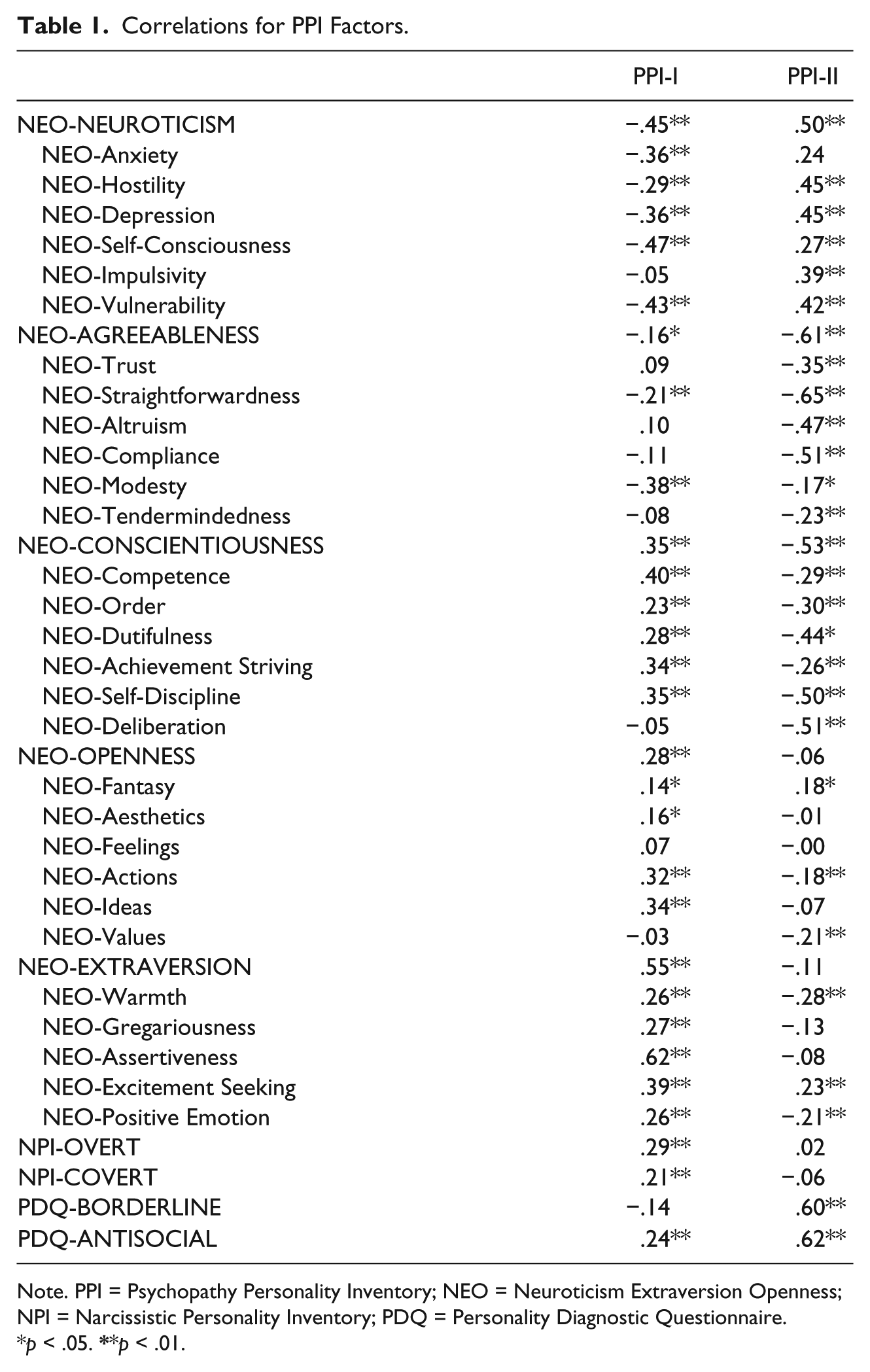
Note. PPI = Psychopathy Personality Inventory; NEO = Neuroticism Extraversion Openness; NPI = Narcissistic Personality Inventory; PDQ = Personality Diagnostic Questionnaire.
p < .05.
Validation Measures
PPI
The PPI contains 187, 4-point Likert-type style (False to True) items evaluating psychopathy across eight subscales (Lilienfeld & Andrews, 1996). Factor 1 (PPI-I) consists of the Social Potency, Fearlessness, and Stress Immunity subscales. Factor 2 (PPI-II) consists of the Carefree Nonplanfulness, Impulse Nonconformity, Machiavellian Egocentricity, and Blame Externalization subscales. Coldheartedness (PPI-C) is a stand-alone subscale (Benning et al., 2003). Internal consistency ranged from .90 to .93 for total scores, from .70 to .90 for subscale scores, and .89 and .93 for the PPI-I and PPI-II, respectively.
Personality Diagnostic Questionnaire–Revised (PDQ-R)
The PDQ-R (Hyler & Rieder, 1987) is a True/False self-report measure designed to identify personality disorders in clinical and nonclinical populations based on the Diagnostic and Statistical Manual of Mental Disorders 4 (3rd ed., rev.; DSM-III-R; APA, 1987). It has a negative predictive power between .94 and 1.00. The nine-item borderline personality scale of the PDQ-R (BPDQ-R) and the eight-item antisocial personality scale of the PDQ-R (APDQ-R) were used in this study. Internal consistencies for the PDQ-R ranged from .56 to .84.
Narcissistic Personality Inventory (NPI)
The NPI is a 40-item self-report measure based on the DSM-III-R 5 (APA, 1987) diagnostic criteria for NPD (Raskin & Terry, 1988). Participants are presented with two statements and select whichever best represents their personal attitudes. There is ongoing debate as to the ability of the NPI to adequately capture various aspects of narcissism (e.g., Krizan & Herlache, 2017; Pincus & Lukowitsky, 2010), although Ackerman et al. (2011) argues it is an adequate measure of overt and covert narcissism. For consistency with previous theory (Skeem et al., 2003) and research (Falkenbach et al., 2013; Falkenbach, Glackin, & McKinley, 2018; Falkenbach et al., 2014), the current study utilized the NPI to assess two types of narcissism using seven factors: Overt narcissism (Authority, Self-Sufficiency, Superiority, Vanity, and Exhibitionism) and Covert narcissism (Exploitativeness and Entitlement; Ackerman et al., 2011). 6 Internal consistency was .82 for overall scores and ranged from .50 to .83 for factor scores.
Aggression Questionnaire (AQ)
The AQ contains 29 self-report, 5-point Likert-type style (not at all like me to completely like me) items, assessing four subscales of aggression (Physical Aggression, Verbal Aggression, Anger, and Hostility) (Buss & Perry, 1992). Research has shown that the AQ is reliable in nonclinical populations. Internal consistency was .89 for total scores and ranged from .72 to .85 for the subscales.
State-Trait Anxiety Inventory (STAI)
The STAI measures Trait Anxiety (STAI-T) and State Anxiety (Spielberger, Gorsuch, & Lushene, 1970). The 20 self-report, 4-point Likert-type style (almost never to almost always) items of the STAI-T assesses participants’ trait anxiety levels. Historically, the STAI has demonstrated excellent internal consistency (.86 -.92).
Procedure
These archival data were originally collected as part of a study of psychopathic traits in college students. In a group setting, undergraduate college students from an urban university participated in the study for course credit in introductory psychology courses. Participants signed informed consent forms that explained the procedure, which was approved by the university Institutional Review Board. Each participant completed a demographics form and a randomly ordered packet containing the personality, psychopathy, and validation measures.
Nonforensic samples have low base-rates of psychopathy leading to criticism of early psychopathy subtyping research with such samples (Falkenbach, 2004). Most recent psychopathy subtyping research in nonforensic samples has implemented the suggestion of critics that this research should focus on those with high-psychopathic traits (Falkenbach, Glackin, & McKinley, 2018; Falkenbach et al., 2017; Lee & Salekin, 2010). These studies’ high-scoring participants’ scores ranged from 344.00 to 454.75 (M = 380.05; Falkenbach et al., 2017). The low-scoring participants’ scores were approximately 80 points lower and ranged from 236.00 to 375.00 (M = 318.70). Following such precedent, the current study analyzed only the high-psychopathy trait group in the sample and compared them to the lower-psychopathy trait comparison group. This method reduced the sample size for MBCA. Although we utilize the term “high-psychopathic traits” for analytic purposes, and the current range and mean scores are higher than other student samples, it is important to note that these are college students who likely do not meet traditional psychopathy diagnostic criteria.
Data Analysis
The current study used MBCA of the five NEO-PI-R domain scores (i.e., Extraversion, Agreeableness, Conscientiousness, Neuroticism, and Openness). This type of analysis breaks down the sample into distinct subtypes (Falkenbach, Beltrani & Reinhard, 2018; Rapkin & Luke, 1993) based on patterns of scores across multiple measures. This analysis uses a goodness-of-fit index (see Fraley, 1998, for further details concerning the assumptions underlying the goodness-of-fit index) and the Bayesian Information Criterion (BIC) to objectively determine the number and parameters of each cluster (see Falkenbach, Beltrani, & Reinhard, 2018, for a review). MBCA tests different models that vary by assumptions (amount of variability [size], strength of relationship [shape], and direction of relationship [orientation]). The relationship between each of the components dictates the subtypes yielded and the assignment of individuals to respective clusters (see Falkenbach, Beltrani, & Reinhard, 2018; Fraley, 1998). The Mclust program used in the current study tests 14 models for up to nine subpopulations for a potential total of 126 different models, an generates a corresponding BIC score. The BIC score is an approximation to the Bayes factor; the larger (or less negative) the number, the better the fit. The difference between BIC values for particular cluster solutions relates to the posterior odds or the ratio of the probability that one model is correct over the probability that another model is correct. By specifying the odds that one model is the best fit compared to other models, the BIC goodness-of-fit index in MBCA provides a more objective analysis of subgroups than earlier analytical methods, which attempted to validate psychopathy subtypes. Since MBCA is concerned with the fit of a subtype in relation to the others identified, the BIC indicates that the subtype represents the specified prototype, rather than any other possible subtype. For example, when comparing two BIC statistics, a difference of 10 strongly indicates that the higher value model is the better fit with a probability of 150:1 (Raftery, 1995).
Results
Correlations between the NEO-PI-R and the PPI were calculated (see Table 1). The PPI-I was significantly negatively correlated with NEO-N, NEO-A, and STAI, and positively correlated with NEO-C, NEO-O, NEO-E, PDQ-A, NPI-O, and NPI-C. The PPI-II was significantly negatively correlated with NEO-A and NEO-C and positively correlated with NEO-N, STAI, PDQ-B, and PDQ-A.
Cluster Analysis
Using the five NEO-PI-R domain scores to analyze the sample, the best-fitting Mclust model was a 1-cluster solution (BIC score of −990.75). MBCA methodology encourages expanding the investigation to all solutions with a BIC score within 10 of the best-fit model. The next best-fitting model (BIC score of −996.93) was a 2-cluster solution, with spherical clusters of equal volume. This two-cluster solution was a best match with psychopathy theory, and a BIC score difference (5.32) of less than 10 supports the use of it as the model of choice (Raftery, 1995). The means and standard deviations for the NEO factor and facet scores, as well as the validation measures, are presented in Table 2. To validate the clusters, the analyses included one-way analyses of variance (ANOVAs) and post hoc analyses using the Tukey method. Figure 1 depicts z scores demonstrating relative scores across clustering and validation measures. The first cluster, named the primary 7 cluster, was significantly higher than the second cluster on NEO-C, NEO-O, and NEO-E in addition to all corresponding Openness facets except Fantasy, Feelings, and Values. The second cluster, named the secondary cluster, was significantly higher on NEO-N and all facets except Impulsivity. The primary cluster demonstrated significant elevations in PPI-I, PPI-C, and NPI-O. The secondary cluster demonstrated significant elevations in PPI-II, STAI, AQ-Total, AQ-Physical, AQ-Anger, AQ-Hostility, and PDQ-B. The third group, termed the nonpsychopathic group, was significantly higher on NEO-A and lower on PPI-II, AQ-Total, and AQ-Verbal than the other groups, but not on the Trust, Altruism, and Tender-Mindedness facets. This nonpsychopathic group was significantly lower than the primary group on PPI-I, PPI-C, NEO-O, NEO-E, NPI-O, NPI-C, and AQ-Total, but not on the Openness facets of Aesthetics, Feelings, Actions, and Values or on the Extraversion facets Warmth, Gregariousness, and Positive Emotions. The nonpsychopathic group was significantly lower than the secondary group on STAI, AQ-Physical, PDQ-B, AQ-Anger, and AQ-Hostility. The nonpsychopathic group also scored significantly higher than the secondary group on NEO-C, NEO-O, and the related facets.
Chronbach’s Alphas, Ms and SDs on Measures.
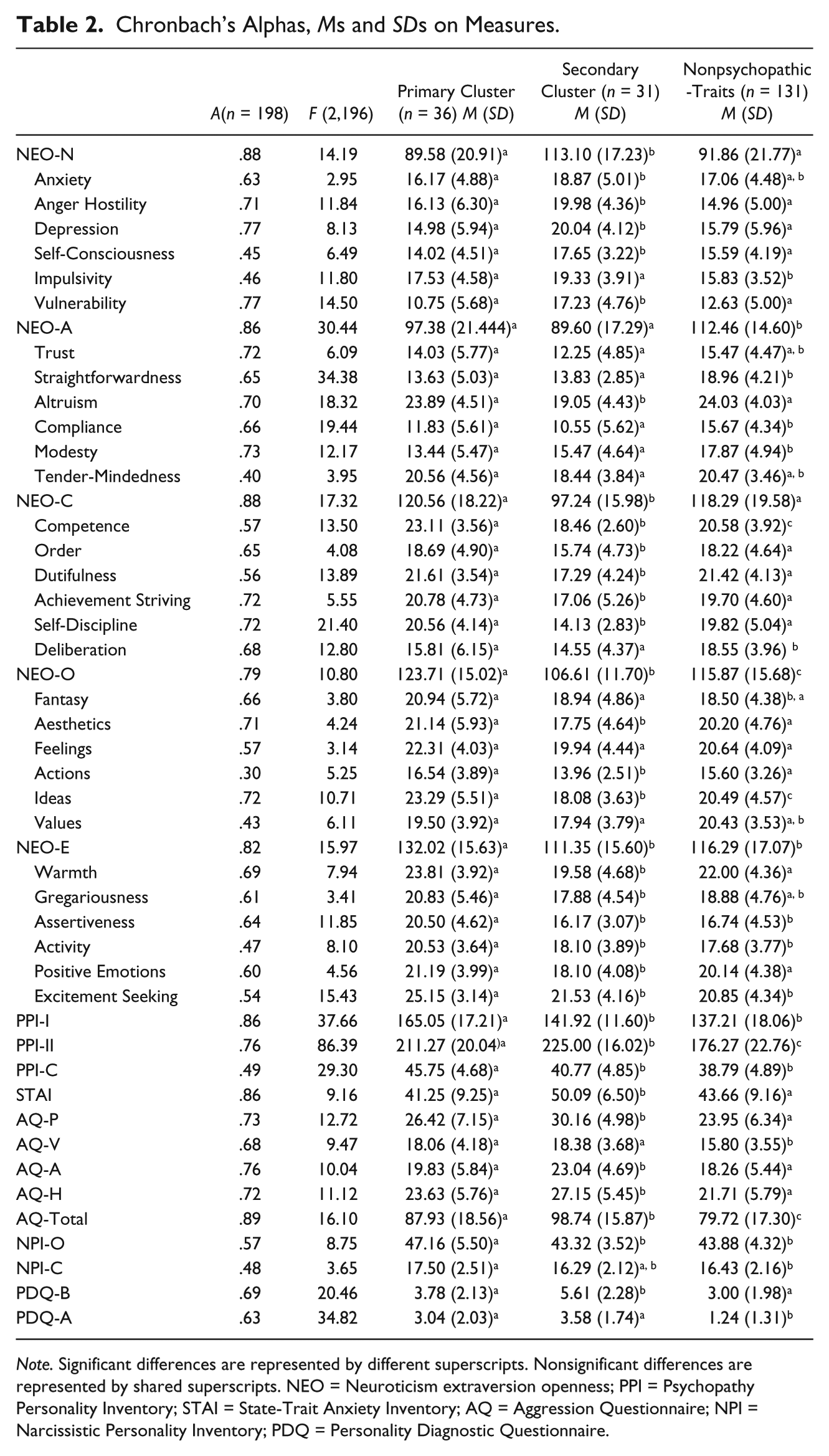
Note. Significant differences are represented by different superscripts. Nonsignificant differences are represented by shared superscripts. NEO = Neuroticism extraversion openness; PPI = Psychopathy Personality Inventory; STAI = State-Trait Anxiety Inventory; AQ = Aggression Questionnaire; NPI = Narcissistic Personality Inventory; PDQ = Personality Diagnostic Questionnaire.
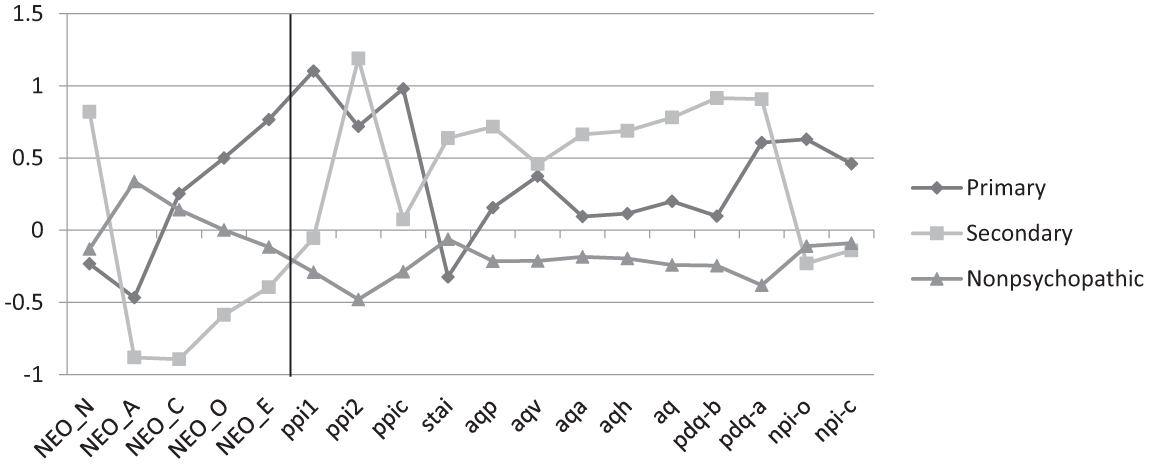
Z scores on cluster and validation variables.
Discussion
The current study considered the existence of psychopathy prototypes in an undergraduate sample based on the FFM of personality. In support of our hypotheses, the MBCA results on the highest third of the sample yielded two distinct patterns consistent with typologies supported by the psychopathy subtyping literature (Karpman, 1941; Skeem et al., 2003). Individuals in the primary cluster demonstrated low Neuroticism (all facets), Agreeableness (all facets except Altruism), and anxiety; moderate Conscientiousness, Openness, antisocial traits, BPD traits, and aggression; and high psychopathy, Extraversion, verbal aggression, and narcissism. The individuals in the secondary group demonstrated high Neuroticism (all facets), PPI-II, anxiety, aggression, antisocial traits, and BPD traits; moderate PPI-I and narcissism; and low Agreeableness (all facets excluding Modesty), Conscientiousness (all facets), Openness (all facets excluding Fantasy), and Extraversion (all facets excluding Activity and Excitement Seeking). The nonpsychopathic, comparison group demonstrated high Agreeableness and low-to-moderate Openness, Conscientiousness, Extraversion, and Neuroticism. This group demonstrated low to moderate levels of all validation measures.
The results are generally consistent with theory and research that support the presence of psychopathic subtypes in undergraduates. However, whereas the finding of high overt narcissism in the primary cluster is in accordance with theory and prior research (Claes et al., 2009; Falkenbach et al., 2013), the high covert narcissism observed in this cluster rather than the secondary group (Skeem et al., 2003) was unexpected. Perhaps this finding is the result of the failure of narcissism as a construct to distinctly differentiate psychopathy subtypes, particularly in subclinical samples. Whereas correlational studies reflect the clear discriminant validity of narcissism (Claes et al., 2009; Falkenbach et al., 2015; Falkenbach et al., 2013), the current study does not reflect the same findings; both narcissism types were associated only with Factor 1 traits. Two studies considered this distinction in psychopathy subtypes, and both failed to find the expected significant difference between primary and secondary psychopathy with regard to types of narcissism (Falkenbach, Glackin, & McKinley, 2018; Falkenbach et al., 2014). There is also some concern regarding the validity of the NPI as a measure of narcissism types (Krizan & Herlache, 2017; Pincus et al., 2009; Vater et al., 2013) and in the current study the poor internal consistency of both NPI scales likely contributed to the inability of this measure to adequately assess narcissism in this sample.
The subtype differences and correlational findings noted in the current study were comparable to previous research connecting the FFM and psychopathy (Derefinko & Lynam, 2006; Miller et al., 2001; Poy et al., 2014; Ross et al., 2004; Widiger & Lynam, 1998), particularly in terms of Neuroticism, Extraversion, and Agreeableness. Results, such as the positive association of PPI-I with Openness and negative association of PPI-II with Extraversion, are most similar to those of Derefinko and Lynam (2006), likely because of the use of the PPI as opposed to the Levenson’s Self Report Psychopathy (LSRP) scale used in their research (Ross et al., 2004). However, inconsistent with previous research (Derefinko & Lynam, 2006; Miller et al., 2001; Ross et al., 2004), the primary cluster in this study displayed elevation on Conscientiousness. In addition, correlations from the current study demonstrated a significant positive relationship between PPI-I and all facets of Conscientiousness (except Deliberation). Whereas Widiger and Lynam’s (1998) initial conceptualization of general psychopathy and the FFM predicted low scores on all facets of Conscientiousness, the expert-generated psychopathy prototypes in Miller et al. (2001) assigned higher scores to the facets of Competence, Order, and Achievement Striving. The correlations in the current study suggest that the earlier lack of clarity regarding this domain may be best explained by failure to consider subtypes. These facets were indeed higher in the primary group than the secondary group. When taking subtypes into consideration, the theoretical overlap of facets of Conscientiousness, such as Competence, Order, and Achievement Striving, with Factor 1 traits of psychopathy, such as glibness and planfulness, make the positive associations found in the current study seem reasonable and justifiable.
Considering the higher levels of Conscientiousness, Openness, and Extraversion of individuals in the primary cluster, this profile, with the exception of low Agreeableness, might be interpreted as positive, supporting the conclusion that primary psychopaths may be more “successful.” The possibility of adaptive traits defining primary psychopathy challenges the traditional view of psychopathy. However, as supported by theory and research in nonforensic samples (e.g., Falkenbach, Balash, et al., 2018; Falkenbach, Glackin, & McKinley, 2018; Howe et al., 2014; Lilienfeld et al., 2012), a reframing may be in order. Indeed, there is even counterintuitive evidence that those high in primary psychopathic traits may be better moral decision makers (Balash & Falkenbach, 2018).
This idea is not without controversy; some researchers suggest a disorder by definition is a pathological condition that causes impairment (Miller & Lynam, 2012). While superficially the traits associated with the primary psychopathy subtype appear positive, closer examination demonstrates potential pathology indicated by less agreeableness, and more narcissism, psychopathy traits, impulsivity, aggression, and antisocial traits. These elevations have implications for behavior—particularly violence risk (Derefinko, DeWall, Metze, Walsh & Lynam, 2011; Falkenbach et al., 2013; Yu, Geddes, & Fazel, 2012). Hicks and colleagues (2004) address this disparity; they purport that the primary subtype appears to be “well adjusted in many contexts” (p. 285) while also exhibiting “tendencies toward sensation seeking and fearlessness” and “lacking in close attachments” (p. 283). Considering the use of a nonforensic sample in the current study, it is certainly possible that these results underestimate the level of pathology that might be associated with a more deviant or aggressive population, such as those used in the research by Hicks and his colleagues (2004, 2010). Still, Cleckley’s (1941) early conceptualization of the psychopath as seemingly socially adept despite the social deficits is aligned with these findings in the current sample’s primary group.
Prior research has indicated that NEO-PI profiles can be used to identify psychopathic characteristics (Lynam et al., 1999; Widiger & Lynam, 1998) and the current study empirically validates these profiles of psychopathy subtypes. The fact that these subtypes were validated utilizing a measure commonly reserved for the assessment of normative personality (the NEO) further supports this claim and bolsters the use of this measure in future psychopathy analyses. Vize, Miller, and Lynam (2018) show that some FFM facets share commonality with psychopathy, aggressiveness, and antisociality, indicating that there are more normative, general personality traits that may underlie both psychopathy and aggression to some extent. The ability to assess the construct on a spectrum of normative personality traits demonstrates strength in the profile for use in nonforensic contexts and acts as an alternative to psychopathy specific measures. Thus, the current findings provide a richer description and understanding of the psychopathy subtypes as they apply to noncriminal populations.
This study utilized model-based cluster analysis on nonincarcerated individuals and supported the continued investigation into the use of the NEO-PI, and other normative personality scales, to assess subtypes of psychopathy. The current study is limited by the initially small sample and subsequent shrinkage in sample size after selecting only high-psychopathy scorers to be considered for the cluster analysis. Despite this limit, significant differences were noted.
This study also has several demographics related limitations. Whereas studies have supported the presentation of psychopathy in undergraduate populations (Falkenbach et al., 2015; Falkenbach et al., 2008; Falkenbach et al., 2014; Lee & Salekin, 2010), the normative nature of the personality traits in this sample limits the generalizability of these findings to clinical populations. Another limitation worth noting is the proportion of males to females: 60 males to 138 females included in the study overall and 27 males to 40 females selected for the cluster analysis. In addition, the proportion of males to females is particularly concerning considering the gender differences on some of the measures. While the pattern (males higher on PPI-I than females; females higher on BIS and STAI) is comparable to previous subtyping research that considers gender (Falkenbach et al., 2015; Falkenbach et al., 2017; Lee & Salekin, 2010), gender comparisons should be considered closely and future research should include larger samples aimed at equal gender distribution. This study was also limited by the racial makeup of the sample subjected to the MBCA. The psychopathy groups did not differ by racial membership; this finding in itself mirrors the rather ambiguous findings regarding race differences in psychopathy. While some research has found small racial differences in the presentation of psychopathic traits, these studies often investigated psychopathy in a more pathological sample (see Skeem, Edens, Camp, & Colwell, 2004 for a review).
Prior research has used model-based cluster analysis on incarcerated samples using alternative personality measures (Hicks et al., 2004; Hicks et al., 2010), but the NEO-PI and the FFM have not been tested to determine psychopathic subtypes in incarcerated populations. Future research should investigate whether or not these same clusters emerge in a more pathological or deviant population. Inconsistencies, such as a positive correlation between Factor 1 traits and Conscientiousness as well as the inability of the NPI narcissism types to distinguish between psychopathy subtypes, could be tested in future studies to assess whether or not these findings are inherent to nonforensic samples or whether they will present consistently across populations. In conclusion, this study approached psychopathy subtyping theory with the intent to clarify how primary and secondary subtypes cluster using a general personality model. The Five Factor Model of personality has been widely researched on its own, but only more recently has it been considered in the context of psychopathy. Although some studies have sought to utilize this measure for subtyping based on the predominant models, few have used an analysis as meaningful as model-based cluster analysis, and, to our knowledge, none have tested the Five Factor Model. The finding that this model has the ability to differentiate subtypes has theoretical, empirical, and practical implications. Theoretically, having information regarding a psychopathic individual’s distinct general personality traits may open doors to interpreting the etiology of each subtype by examining the etiologies associated with the NEO-PI domain expressions. Empirically, the improvement upon psychopathy specific assessment and correlational analysis provides an expansive understanding of psychopathy and several avenues for future study. Practically, if the psychopathic profiles found through this study can be replicated and confirmed, it may support the use of these profiles in nonforensic settings and allow for this construct to be measured using general personality traits and potentially aid in risk assessment for violence and aggression.
Supplemental Material
NEO_Adult_Supplemental_material_submitted – Supplemental material for Identifying Psychopathy Subtypes Using a Broader Model of Personality: An Investigation of the Five Factor Model Using Model-Based Cluster Analysis
Supplemental material, NEO_Adult_Supplemental_material_submitted for Identifying Psychopathy Subtypes Using a Broader Model of Personality: An Investigation of the Five Factor Model Using Model-Based Cluster Analysis by Diana M. Falkenbach, Ellen E. Reinhard and Marissa Zappala in Journal of Interpersonal Violence
Footnotes
Authors’ Note
Some of the data from this paper was submitted for a presentation to the annual conference of the American Psychology-Law Society in Atlanta, Georgia (March 2016).
Declaration of Conflicting Interests
The author(s) declared no potential conflicts of interest with respect to the research, authorship, and/or publication of this article.
Funding
The author(s) received no financial support for the research, authorship, and/or publication of this article.

Ethical Approval
All procedures performed in studies involving human participants were in accordance with the ethical standards of the institutional and/or national research committee and with the 1964 Helsinki declaration and its later amendments or comparable ethical standards.
Informed Consent
Informed consent was obtained from all individual participants included in the study.
Notes
Author Biographies
References
Supplementary Material
Please find the following supplemental material available below.
For Open Access articles published under a Creative Commons License, all supplemental material carries the same license as the article it is associated with.
For non-Open Access articles published, all supplemental material carries a non-exclusive license, and permission requests for re-use of supplemental material or any part of supplemental material shall be sent directly to the copyright owner as specified in the copyright notice associated with the article.
