



Abstract
Stalking is a complex issue involving multiple behaviors and interactions between the stalker and their target. Research has typically involved grouping risk behaviors related to stalking; however, the research question in the current research was to what extent a temporal method would allow investigators to map the dynamics of stalking. Behavior Sequence Analysis is a form of systems analysis that examines sequences of events over time, providing statistically significant results from complex real-world data. The Behavior Sequence Analysis method was applied to 39 participants’ detailed accounts of stalking written in online forums. The study provides illustration of the antecedents of stalking and how it may initiate and develop through to end of contact. Both stalker behavior and decisions made by victim were included in the models. The results show multiple patterns of stalkers’ behaviors; however, the results also clearly show that victims need not perform many behaviors for stalkers to continue with their actions. A main finding was how many behavior transitions occurred before victims felt a significant problem. A large number of participants indicated that they (repeatedly) reported their case of stalking to police and authorities; however, they were mostly dismissed or felt that police did not stop the stalker’s actions. A major implication of the current research is providing a novel method to produce a framework that may be used to operationalize definitions of stalking based on coherent frameworks of stalkers’ behaviors over time.
There are multiple lay definitions of stalking, and defining the term legally and academically has proven difficult. There is not yet one generally accepted definition of stalking in either the literature or in terms of jurisprudence. While stalking may have always existed in some form in human societies, the historical societal construction and criminalization of stalking has changed in recent years (Spitzberg & Cupach, 2003); indeed, in the last 50 years stalking legislation has gained incredible momentum, with multiple countries passing or reinforcing anti-stalking legislation.
Understanding exactly what defines “stalking” as opposed to other behaviors has still remained a difficult issue. This is due, in large part, to the variation in victims’ experiences and uncertainty over what may constitute a legally prosecutable case. The issue is exacerbated when considering cyberstalking compared to physical stalking, and whether they are separate or unified behaviors (Marcum, Higgins, & Nicholson, 2018; Reyns, Henson, & Fisher, 2012). Researchers have aimed to utilize academic literature to develop a better, more unified definition, and some criminal statutes have similarly come to reflect a baseline definition through various precedents that defer to quantifying harassment and what constitutes unreasonable behavior (Arntfield, 2019). Legal definitions of stalking vary from country to country; however, a general definition of stalking is a wilful form of continued pursuit or harassment, which is unwarranted, often with malicious intent, and causes fear through repeated intrusive behaviors (Spitzberg, 2002; Westrup & Fremouw, 1998). The wilful, intentional commission of stalking behaviors is central to the definition of stalking, as is the fear and emotional distress caused by the stalkers’ actions. Clearly, there is a subjective difference between amorous affection, and disturbing or fear-evoking behaviors, which is central to the debate on how to define stalking (Spitzberg, 2002; Westrup & Fremouw, 1998). An additional central issue involved in stalking definitions is exactly how long “continued” means, or how often “repeated” infers; it can be difficult to establish whether a particular case constitutes stalking or not. Operationalizing and mapping the temporal repetition of behaviors that comprise stalking is an area of research that is in vital need of study.
Within the academic literature, research on stalking broadly falls into two approaches: clinical and relational (Spitzberg & Cupach, 2003). Clinical literature tends to use paradigms and models of mental illness and disturbance (Meloy, 1996; Segal, 1989), classified along criteria and dimensions (e.g., Diagnostic Statistic Manual, DSM). The clinical population are typically smaller samples, which are more extreme in their behaviors and interactions. The second approach focuses on dysfunctional interactions or relations arising during attempted courtship (Cupach & Spitzberg, 1998). In this second approach, stalking is viewed more as disorder or culture and societal construction of courtship (Cupach, Spitzberg, & Carson, 2000). Given the aim of academic research approach to predict the trajectory of stalking behaviors, the current research clearly fits more within this approach.
Given the lack of clarity in operationalizing a definition of stalking, prevalence rates for stalking are difficult to establish accurately. Large population surveys estimate the lifetime risk for stalking to be around 15% in Western countries (e.g., Australian Bureau of Statistics, 2016; Smith et al., 2017). Smaller studies have reported a wide range of incidence and prevalence rates, depending on sampling and definitional differences. Using self-report data from participant questionnaires and interviews produces varied estimates. For example, stalking rates have been estimated to be as high as 41.2% in a sample of Australian undergraduates (Thompson, Dennison, & Stewart, 2012).
While there is huge variety in how stalking might present itself, certain actions are more common across victim accounts. Spitzberg (2002) conducted a meta-analysis of 103 different samples that recorded stalking behaviors (see also Spitzberg & Cupach, 2007). These were classified into groups, and the most frequently reported behaviors across the 103 studies were as follows: stalking by proxy (mean of 67% across samples), telephone calls (57%), expressions of affection (54%), contacts in person (48%), appearances/approaches (47%), following (47%), and bids for relational escalation (42%). Threats and physical attacks were reported at rates of 35% and 30% respectively. The repeated occurrence of threatening behavior and attacks are concerning. Threats have been demonstrated to be an important precursor of violence in stalking cases, as it is well documented that stalkers are likely to act on threats (McEwan, Mullen, MacKenzie, & Ogloff, 2009; Rosenfeld, 2004), and research has suggested that up to 45% of threats are associated with sexual or physical violence (Pathé & Mullen, 1997). Acting on threats has been found to be more common if the victim had a prior intimate relationship with their stalker (e.g., Pathé & Mullen, 1997). An estimated 40% to 50% of all stalking cases involve an ex-partner (e.g., Davis, Ace, & Andra, 2000; Douglas & Dutton, 2001; Smet, Loeys, & Buysse, 2012). Clearly, understanding the temporal development and escalation of stalking behaviors, including threats, is important in terms of raising awareness of the dangers associated with stalking and in terms of risk management.
Researchers have suggested a number of typologies in attempts to clarify the complex issue of stalking and the various behaviors and motivations therein. The most generally accepted classification covers five subtypes and was developed by Mullen, Pathé, Purcell, and Stuart (1999). The Rejected subtype stalks following the loss of an intimate relationship, with the motivation rooted in reconciliation, revenge, or both. Resentful Stalkers feel that they are the victim of an injustice and/or mistreatment and seek frighten the victim to achieve vengeance. Intimacy Seekers operate under a belief that they actually have, or should have, a relationship with the target, even though no relationship exists or is likely to exist. The Incompetent Suitor is frequently lonely and stalks to obtain a date or a sexual encounter. The motivation of Predatory stalkers is rooted in sexual deviancy and the seeking of sexual gratification. Although the motivations for stalking are broad ranging, many of the same behaviors are seen across stalker subtypes (see Sheridan & Roberts, 2011, and Racine & Billick, 2014 for review).
Some behaviors that are frequently seen in stalking cases across subtypes may not immediately appear to be high risk (Davis & Chipman, 1997). While “everyday” behaviors such as telephoning victims may sound innocuous to an observer, it is important to remember that in the context of an ongoing stalking case these phone calls would likely be frequent, possibly threatening, and experienced in conjunction with other behaviors. Understanding the cumulative effects of individual events is vital; while in isolation, many of the behaviors could be “normal,” in stalking they would be part of an ongoing, intrusive campaign. As the stalking develops these behaviors build up, in conjunction with other actions, until serious social, psychological, physical, and financial harm are seen (e.g., Kuehner, Gass, & Dressing, 2007). One study reports that some victims have suggested they would have preferred to suffer physical violence rather than the intrusion of stalking, as this would have been more tangible, easier to cope with, and would have resulted in more help (Pathé & Mullen, 1997). This shows that regardless of the exact presentation of the stalking, the distress it causes is very real, and should be treated as such.
A further area of consideration and investigation is the type of behaviors that may be engaged in throughout a stalking episode, in particular, the type of help-seeking or self-protective behaviors that victims may perform (Fissel, 2021; Gowland, 2013; Reyns & Englebrecht, 2010). While a large amount of research has focused on the behaviors performed by stalkers (Spitzberg, 2002; Spitzberg & Cupach, 2007), fewer have focused on victim behaviors, and fewer still have sought to integrate these two areas, so show the dynamic interaction between stalker and victim. It may be that certain defensive or protective behaviors performed by the victim may lead to different responses from the stalker.
A frequently employed method to research stalking behaviors is to survey victims on the events that they have experienced. This method can provide comprehensive lists of related behaviors and the identification of risk factors for stalking violence. However, this usually results in the presentation of behaviors as isolated events, with little relation to or interaction with other behaviors. The risk factor survey approach makes it difficult to predict which behaviors occur sequentially, rather than just most frequently. Furthermore, these studies are unable to consider the context and development of stalking behavior over time. Although the nature of the stalker–victim relationship is usually included as a variable, detailed consideration is not normally given to how the stalking initiated and at what point a relationship could be said to be pathological in nature. To date, only one study to the authors’ knowledge has attempted to analyze the temporal development of stalking behaviors (Yanowitz & Yanowitz, 2010). Yanowitz and Yanowitz (2010) asked participants to create stalking “scripts” to show what they thought would happen in a hypothetical stalking scenario. Participants were found to follow gender stereotypes and may have been influenced by media portrayals of stalking. While this study provided an initial approach to analyzing the development of stalking behaviors, it focused on perceptions of stalking behavior as opposed to real cases of stalking. Furthermore, approaches that are more sophisticated are now available.
Behavior Sequence Analysis (BSA; Keatley, 2018) is a form of systems analysis and examines sequences of events over time. A benefit of BSA is that it can analyze real-world qualitative (and quantitative) data in a statistical and useful manner (Keatley, 2018). BSA takes a temporal approach to understanding complex behaviors and has shown the common pathways seen in criminal activity (Keatley, 2018). BSA on qualitative accounts, such as those employed within the current research, follows three main stages. First, the accounts are broken down into separate behaviors or events, known as parsing. The individual behaviors and events are then coded or categorized (literally given a code, A, B, C, etc.). Similar behaviors are given the same code, to reduce complexity and provide a more systematic approach to analysis. Finally, the analysis examines for how many times A leads to B or B leads to C and so on. Chi-square analyses provide a test of significance, and standardized residuals are used to show which transitions are occurring above the level of chance. Previous applications of BSA include sexual assault and rape cases (Ellis, Clarke, & Keatley, 2017; Fossi, Clarke, & Lawrence, 2005; Lawrence, Fossi, & Clarke, 2010); serial homicide (Keatley, Golightly, Shephard, Yaksic, & Reid, 2021; Keatley & Clarke, 2020); deceit (Marono, Clarke, Navarro, & Keatley, 2017; Marono, Clarke, Navarro, & Keatley, 2018); marital conflicts (Gottman, Markman, & Notarius, 1977); road traffic accidents (Clarke, Forsyth, & Wright, 1998); and drink driving (Keatley, Barsky, & Clarke, 2017). A similar approach could provide a useful addition to the literature surrounding stalking.
This is the first research, to the authors’ knowledge, to apply BSA to the progression of stalking behaviors. Research has previously indicated individual, isolated behaviors that comprise stalking; however, the sequence of events from first incident to end of contact is less clear. Understanding the progression of behaviors as stalking develops would allow researchers and practitioners to clearly identify markers of stalking, as well as highlight key points for intervention, and allow a new perspective on what helps prevent and curtail stalker contact. As outlined, there are a number of issues inherent in defining and operationalizing stalking. The current research defined stalking as repeated behaviors that were unwanted on behalf of the victim, and caused emotional upset and/or fear. Clearly, this is subjective to the individual, which is a limitation of research in this area. However, the current research will seek to help address this issue by clearly mapping the behaviors of stalker and victim, and the interactions between them. This mapping of interactions, including behaviors made by the victim to stop or reduce the stalker’s behavior (e.g., help-seeking, reporting, and self-protective behaviors) will form a framework for understanding the development of stalking over time. As this was the first application of BSA to stalking, no formal, direct hypotheses were made. However, behaviors and themes shown in previous research, such as surveillance, communicative approaches, and violence, were likely to be seen in the current study.
Method
Research Design
In the current study, the individual pursuing the victim is referred to as the “stalker.” This term was used for ease of explanation; however, as previously discussed there are definitional difficulties inherent to the term “stalking,” and as such whether the individual in question is technically a “stalker” depends on the criteria used, and the judgment of the observer. Stalking was defined as repeated, unwanted behaviors performed by the stalker that were performed to follow, surveil, or involve himself in the victim’s life leading to distress and fear on behalf of the victim. Victim’s accounts were included if they clearly showed a number of these types of behaviors, organized over time, 1 and the victim reflected their emotional disturbance and/or fear in reaction to the behaviors (clearly showing they did not want to receive such unwanted attention).
For the purpose of this study the title of “stalker” has been selected, as this is appropriate for the individual’s role in the sequence as the pursuer of the victim. Furthermore, this was how the individual was described within the accounts. Alternative titles carry implications that may affect how well they apply in these cases; for instance, “perpetrator” implies a legal aspect, when the individual may not meet the legal criteria to be convicted of stalking. Similarly, “pursuer” could imply a romantic inclination that may not be present in all cases. “Stalker,” therefore, was considered the most neutral title and is the best fit for studies investigating stalking, despite technicalities and definitional issues. Ethical approval for both studies was gained from the University of Lincoln, UK Research Ethics Committee.
Sample
Data were collected from a sample of 39 female’s reports of stalking gathered from accounts found on various online victim support forums. Forums were found and accessed through Internet searches of stalking and stalking-related terms, and a check was conducted to ensure no review sites claimed the forums to be sensationalist or misrepresentative. In all cases, the forums had no negative reviews and all posts appeared genuine in terms of content and user interactions. 2 Forums were generally self-help oriented wherein victims could speak about their life history and personal accounts and receive support from other users. Accounts were selected based on an adequate level of detail (meaning multiple behaviors were needed spanning a time period of many weeks or months) Furthermore, data had to meet the criteria set out by Keatley (2018), which was that information was clear to analyze, temporal, and included at least three distinct behaviors or events. The sample reported a mean number of 31.37 (SD = 17.64; range = 7-104) behaviors or events. Of the 39 cases, only 15 reported the length of the stalking cases (M = 3.44 years, SD = 4.06). Participants’ ages were typically masked or hidden; however, those who were given were in their mid-20s to -30s. Of the 39 cases, three were provided by close family members who gave an in-depth account of the stalking process, which resulted in the murder of the victim. These were included in the final analyses as they provide an insight into stalking leading to murder; to omit them would mean missing a large behavior sequence chain in the analyses.
Materials
The study utilized 39 qualitative, in-depth accounts of stalking cases. An a priori behavior list was created based on previous research in the literature and experts’ input. This resulted in a list of approximately 50 behaviors; however, to ensure complete coding of stalking cases, this list was expanded to include any additional behaviors seen in the transcripts. This ensures that an exhaustive list was used for final analyses, which is a prerequisite for BSA (Keatley, 2018).
BSA Procedure
Cases were gathered online from victim support forums from the United Kingdom. An exhaustive list of mutually exclusive behaviors was then formulated based on previous research and the content of reports. Behaviors were then assigned a code (e.g., A, B, C . . . n) to group similar behaviors (e.g., “left me flowers,” “left me roses” are both categorized as code A). Each case was then converted into a series of coded behaviors or events (e.g., A, B, C, etc.), resulting in each case becoming a “string” of codes. Strings were then analyzed in the statistical package R studio (R Core Team, 2013). A chi-square analysis then identified significant transitions between behaviors, and standardized residuals (SRs) were calculated to identify which of these transitions occurred above the level expected by chance. Results were represented in a transition frequency matrix 3 and graphically in state transition diagrams (see Figures 1 and 2).

The beginning transitions of stalking behaviors.
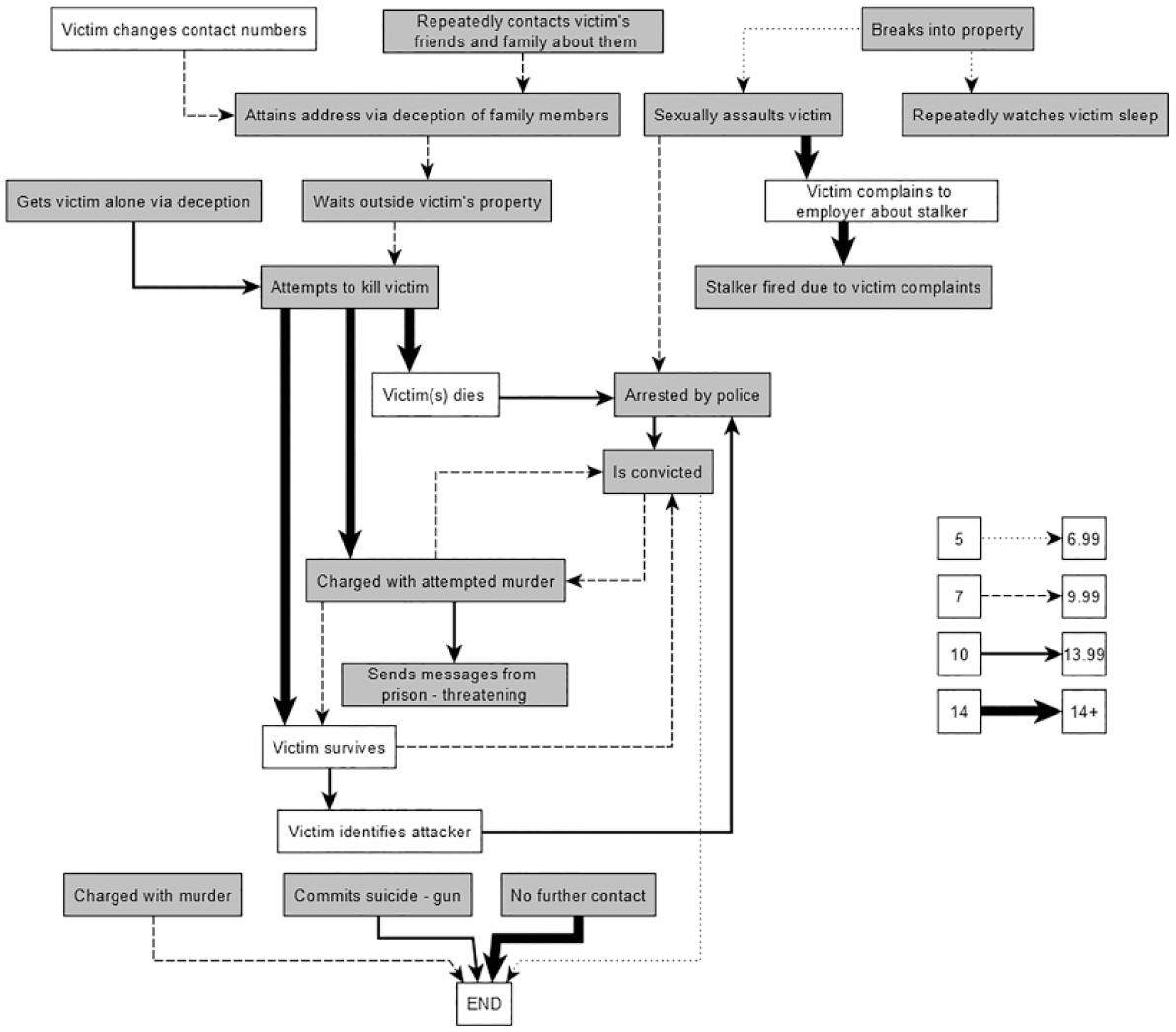
Behaviors related to the latter parts of stalking.
Results
Frequencies
The first stage of BSA is to calculate the frequencies of individual behaviors and events in the data. This provides an overlap with previous research that outlines key risk factors and indicators of stalking, and also provides an initial insight into the types of behaviors most prevalent in the dataset. In the current data, the most frequently occurring behaviors and events were as follows: is reported to the police (n = 109); makes phone call to victim (n = 73); victim is dismissed by authorities (n = 71); victim learns they were filmed/photographed without their knowledge, in day-to-day life (n = 54); sends letters to victim—threatening (n = 51); and makes contact with victim via social media (n = 48). The 10 most frequent behaviors and events are included in Table 1; please see Supplemental Material S2 (see Note 3) for full table.
The 10 Most Frequent Behaviors/Events in the Reports.

Indicates behavior performed by victim.
Indicates behavior performed by stalker.
Clearly, given there were only 39 individual reports in the original dataset, there is repetition of some behaviors for each victim. The high number of “is reported to the police” shows that victims are not passively ignoring their stalker’s behaviors but are attempting to obtain law enforcement support. However, there is clearly an issue with police ability to intervene, perhaps due to a lack of physical evidence. These frequencies also show the importance of social media as a method of contacting and stalking victims.
State Transition Diagrams
The state transition diagram is a simplified graphical representation of the results. It can be read like a flowchart, and line thickness is used to indicate size of SRs. Each arrow in the diagram represents a significant relationship between behaviors/events, where the SRs were more than the value expected by chance (with thicker arrows indicating larger SRs). If all transitions were included in the diagram, there would have been too many connecting arrows to be published clearly. 4 Therefore, in keeping with previous publications (Ellis et al., 2017; Keatley, 2018), a more stringent cut-off criteria was used in the current diagram. A cut-off criterion of transitions that had an SR of five or more was applied. This dramatically reduces the complexity of the diagram, and the transition frequency matrix can be used to see the full set of transitions. However, this cut-off criteria meant that the diagram was effectively split into two main parts. 5 This does not mean that the victims’ reports were split into two parts, it simply means that at this stringent cut-off criteria, there is no clear link (with a high enough SR) to connect the first and second parts of the sequence diagram.
Some transitions are not connected to the main diagram; these are “islands” and mean that while the transition from one behavior to the other is significant, it is not significantly linked to any particular point in the sequence (see Supplemental Material S3).
BSA
In this study, a lag-one sequence analysis was used. Lag-one, or first order, BSA analyzes pairs of behaviors, for example, A → B, which form part of a larger sequence (e.g., B → C, C → D). The BSA highlights which behaviors occur in transitions together more often than would be expected by chance. A full transition frequency matrix provides the entire set of transitions; however, in the current dataset, the matrix is 207 rows, which is beyond the ability of most people to visualize. Therefore, a simplified State Transition Diagram is used to graphically represent the progression of behaviors and events, from the beginning of the case to the end.
The state transition diagram appears to have two main groupings of behaviors; the first, closer to the start of the sequence, consists of more commonplace, everyday behaviors, such as starting relationships and moving in together (see Figure 1). The BSA analysis indicates variation in how the victim first encountered their stalker. Victim reports identified several “starting points” with high SRs: makes contact with victim via social media (n = 11, SR = 8.10), begins messaging victim online (n = 2, SR = 8.02), and requests date with victim (n = 5, SR = 5.87). Several other behaviors were also noted as starting points, with lower SR scores. This section also contains the majority of “distanced” and surveillance behaviors, such as monitoring victim’s social media and creates fake accounts to talk to victim.
The second, later grouping (see Figure 2) includes more predatory, violent behaviors. While this section also contains surveillance behaviors, the behaviors here are more threatening and in-person, rather than online. This section of the diagram also contains more aggression, violence, and criminality, such as breaks into property → sexually assaults victim (n = 2; SR = 5.47) and waits outside victim’s property → attempts to kill victim (n = 4; SR = 9.52).
The behavior is reported to the police by victim was the antecedent to victim dismissed by authorities (SR = 22.03, n = 52), and is spoken to/cautioned by police (n = 4; SR = 3.64). Victims also typically repeatedly reported their stalker’s behaviors to the police; therefore, is reported to the police cycled around itself multiple times (n = 29; SR = 8.22). In a few cases, reports to the police did result in a restraining order being given (n = 2, SR = 1.52). However, stalkers were reported to break their restraining order, after being given one (n = 2, SR = 10.85). Importantly, if the victim could identify their stalker, this was linked with police arresting the stalker (n = 2, SR = 10.75).
Victims attempting to block phone calls or emails did not lead to desistance on behalf of the stalker, who would then create fake profiles to monitor the victim (n = 2, SR = 3.83), or hack into the victim’s social media (n = 2, SR = 2.15). Similarly, changing addresses or moving residence did not deter stalkers, who in two cases attained the victim’s new address via forms of deception (SR = 7.86).
Discussion
The aim of the current study was to provide new insights into the sequence of behaviors in victims’ accounts of stalking. BSA has been used in a number of criminal areas, and this is the first time it has been applied to stalking behaviors. Individual behaviors most frequently identified were found to be similar to those from Spitzberg’s (2002) meta-analysis of stalking studies, which found that a combination of communicative, approach, and surveillance behaviors were the most commonly experienced stalking activities. This provides support for the validity of accounts in the current research in that victims’ accounts were not atypical of accounts analyzed by the wider literature.
The BSA indicated that victims’ only actions (with the exception of behaviors very near to the start of the sequence, such as meeting or starting a relationship with the person who became their stalker) were to discourage further contact. The analyses showed that there were many initial starting points for sequences to develop from, indicating how difficult it is to predict stalking behaviors from initial starting points. A large number of victims reported their case of stalking to police or other Law Enforcement Organizations, which is not always the case (Fissel, 2021; Reyns & Englebrecht, 2010). However, this may be a corollary of the sample used in the current study (i.e., those who are likely to report their cases to authorities may also be more likely to report their cases in online forums). There is an indication that more extreme efforts by victims to avoid their stalker (such as moving house), did not deter the stalker, who then tried to, for example, find their new address via the deception of friends and family. In cases where the new address was found, the stalker was then likely to wait outside the victim’s home, which was an antecedent of the stalker attempting to kill the victim. This could indicate that victim’s attempts to distance themselves from their stalker actually frustrate or anger the stalker, leading to an increase in the physical threat to their lives.
The split in the diagram could also reflect the presence of different stalking typologies. Past research has suggested that ex-intimate stalkers are more likely to threaten and commit violence against the victim, and thus potentially have different behavioral sequences than cases with a stranger or acquaintance stalker (see Churcher & Nesca’s, 2013, meta-analysis). Future research could examine the differences between the sequences of behaviors present in stalking cases committed by each relational subtype and motivational subtype to help determine the points at which cases develop differently by subtype. This could help build the case for recommendations for the employment of alternative methods during interventions depending on the stalker’s classification, to better protect the victim. Thus, it is important to be as specific and accurate as possible when considering the possible actions of each “type” of stalker, building upon earlier evidence that has produced separate risk models for ex-intimate and non-ex-intimate stalking (McEwan et al., 2009).
Further insight was obtained into the relationship between cyberstalking behaviors and offline stalking. It has sometimes been assumed that cyberstalking is a distinct form of stalking with its own set of unique behaviors and motivations (e.g., Marcum et al., 2018; Reyns et al., 2012). The present work did not include any cases that took place solely online, so cannot on its own refute this argument. However, it was seen that Internet-based stalking was an important element of the cases covered, and that some cases initiated on social media platforms. In some of these instances, this contact led to an intimate relationship. In other cases, online stalking behaviors were seen within situations where the stalking initiated offline, and formed part of the stalker’s repertoire of activities. These findings demonstrate that splitting stalking cases and comparing them based on offline versus online behaviors or by relational subtype can miss the complexities of the development of stalking and the recognition of potential trigger points for escalation and danger. However, clearly, there may be cases of stalking that occur either fully online or offline, and separate future analyses should seek to investigate these.
A strength of studies such as the present one is the method used; BSA is uniquely capable of providing statistically significant results from complex real-world data. This allows research using given-instance analysis, as the target of study (stalking cases) is predefined and studied directly, rather than gathering substitute or situational data from experiments or questionnaires, which would then be extrapolated to try and establish what exactly happens in real cases. The current research, therefore, has high ecological validity and real-world application. In addition, BSA is based on victims’ recollections and accounts, without the need for questioning or research methods that may lead to framing or affect victim statements (see Scott, Rajakaruna, & Sheridan, 2014). Furthermore, applying BSA has allowed further illustration of the antecedents of stalking and how it may initiate. Because the stalking behaviors are contextualized and not considered in isolation, future studies could help pinpoint triggers for danger and escalation. Decisions made by the victim are included in the models, providing the potential for more detailed advice to be provided, particularly if this advice were related to stalker subtype.
A limitation of the current study was that only victims’ accounts were analyzed. Although this allows a more in-depth insight into the lived experiences of victims, it does not necessarily provide as full an account of stalkers’ behaviors. Future research should seek to interview stalkers and sequence behaviors from the stalkers’ perspective alongside autobiographical accounts. There are obviously inherent limitations in asking criminals to participate in research; however, it would provide an initial insight into the types of behaviors that stalkers’ perform, and whether the victims are aware of the wider variety of behaviors. Further limitations of the study are that a small sample size was used, which may affect the generalizability of results to the wider population of stalking cases; however, given the preliminary screening of cases in the current study, the general trends may overlap to a wider group. The only noticeable divergence may be in the reporting of cases to police, which may be an issue of correlation between those likely to report their cases to authorities also being those more likely to report their cases online. Furthermore, the reporting of cases online may be a limiting factor (as behaviors and events cannot be validated); however, this is an issue inherent in reporting of stalking cases in general, and an area for future research to tackle, perhaps in longitudinal methods.
In terms of future research, if longitudinal temporal methods were used, such that cases of stalking were analyzed over time (rather than retrospectively), then researchers could use a time-series approach wherein the timing of behaviors and events is also recorded. This time-stamping would begin to offer insight into the general lengths of timings of certain behaviors (e.g., how long before stalking is reported; how many times does a behavior need to occur in a certain time period to have an effect on the victim, etc.). This time-stamping of events would allow temporal patterns and trends to be established. For example, it may be that stalking behaviors cluster together, or spread out across time. It may be that after the victim responds in a particular way, the stalker clusters multiple behaviors together, or desists stalking for a period of time. This time-series approach to stalking would offer a new insight into stalking interactions over time. 6 Future research should also aim to further the diversity of samples used. The aim of the current study was to show how a BSA approach may be used in stalking cases. A female sample was selected based on females being the most likely victims (Spitzberg & Cupach, 2007); however, now that BSA has been tested and applied to stalking behaviors, future research should aim to increase the diversity of BSA applied to different genders, cultures, and age groups, for example. Indeed, recent research by Reyns and Scherer (2018) has investigated the role of disability and stalking, which could be reanalyzed in a temporal approach as outlined here.
In conclusion, the current study identified previously highlighted behaviors in stalking cases. It provides a new method for investigating the sequential chains of behaviors that victims of stalking experience. The identification of particular sequences of behaviors that precede violence and disruptive intrusion provides a key intervention point, and an opportunity for authorities and victims to recognize increased risk before serious harm occurs. Although risk models already exist, these do not always take into account contextual information and the responses of victims. Furthermore, establishing the general progression of behaviors throughout a stalking case could prove vital in educating victims and law enforcement on what stalking actually is, to help them recognize and manage cases. Stalking often continues for extended periods and, because many of the activities that comprise it can be judged as innocuous when examined individually, the problem is often entrenched before it is recognized and taken seriously. Further research should look into the different sequences of actions between stalker subtypes, effective methods of intervention, and the best ways to raise awareness within both victims and those agencies who have a remit to support them.
Footnotes
Declaration of Conflicting Interests
The author(s) declared no potential conflicts of interest with respect to the research, authorship, and/or publication of this article.
Funding
The author(s) received no financial support for the research, authorship, and/or publication of this article.
