



Abstract
Disclosure of interpersonal violence (i.e., sexual violence, sexual harassment, dating violence, and stalking) is often the first step toward receiving social and systemic support. Research demonstrates that sexual assault and dating violence survivors on college campuses are more likely to disclosure to informal sources (i.e., friends and family) than formal sources (e.g., police, Title IX, counseling centers). However, there is limited research examining disclosure rates after other forms of violence (i.e., stalking, sexual harassment), and little is known about the impact of the survivors' identities on disclosure. Utilizing four academic years (2016-2019) of aggregated campus climate data from a large Southeastern university, the current study examined rates of disclosure across experiences of sexual violence, sexual harassment, dating violence, and stalking while identifying whether the prevalence and type of disclosure (formal versus informal-only) differed by gender, sexual orientation, and/or race/ethnicity. Of 8,017 participants, 4.6% reported sexual violence, 18.9% reported sexual harassment, 12.3% reported dating violence, and 11.3% reported stalking in the past academic year. Results of multinomial logistic regression indicated that, across all four types of violence, men (as compared to women) had lower odds of disclosing both informally-only and formally. Bisexual as compared to heterosexual students had higher odds of formal disclosure of sexual harassment and stalking while gay/lesbian students had higher odds of formally disclosing sexual harassment. Individuals of another race/ethnicity (compared to White students) had lower odds of informal-only disclosure of dating violence. Findings underscore the need to implement programs to improve the social reactions of friends and family members receiving disclosures, and to increase culturally-tailored service provision.
Keywords
Interpersonal violence, including sexual violence, sexual harassment, stalking, and dating violence, are all too common occurrences among college students (Krebs et al., 2007, 2016; Mellins et al., 2017). Exposure to violence is highest among the most marginalized individuals, including women, gender expansive individuals, and sexual minorities. Exposure to violence is associated with a myriad of detrimental impacts, including mental health issues, academic consequences, and physical health concerns (Demers et al., 2018; Lindquist et al., 2016; Mengo & Black, 2016; Messman-Moore et al., 2009; Orchowski & Gidycz, 2012; Turchik & Hassija, 2014). Disclosure of these violent experiences to a formal source such as police, Title IX offices, or counseling services can link victim/survivors to institutional resources that can provide accommodations and information. Formal sources can also facilitate healing by connecting survivors to evidence-based and trauma-informed care (Artime & Buchholz, 2016). However, few victims of campus violence disclose their experiences to formal resources (Orchowski & Gidycz, 2012). Far more common is the experience of disclosing victimization only to informal sources such as friends and family (Sabina & Ho, 2014). Additionally, a notable number of victims never disclose their victimization to anyone (Demers et al., 2018; Orchowski & Gidycz, 2012). Because disclosure is linked to receiving valuable social support and opens access to institutional resources and accommodations, it is important to document the frequency of college student disclosure to formal and informal resources across multiple forms of violence, as well as to determine whether disclosure occurs equitably across social identifiers such as gender, race, and sexual orientation.
Literature Review
Disclosure is defined as the act of telling or discussing one’s experience of victimization with another person (Orchowski & Gidycz, 2012). Disclosure is typically separated into two categories of recipients, formal and informal. Formal sources or recipients include entities such as law enforcement, university officials (e.g., the Title IX office, mandated reporters), and counseling centers. Disclosure to formal sources can include but be differentiated from the official act of reporting. Reporting refers to discussing an experience of victimization with a formal agency representative (e.g., police, university official) with the explicit desire to officially record the experience. Formal reporting generally comes with the expectation that this particular type of disclosure will lead to an investigation, potential adjudication, and/or on-going engagement by the justice or conduct system (Orchowski & Gidycz, 2012). In contrast, informal disclosure recipients typically consist of friends and family members (Stoner & Cramer, 2019).
College campuses represent a particular environment with unique informal and formal recipients of disclosure (e.g., more peers than family; resident assistants and professors who may be mandated reporters as well as campus-specific reporting agents). However, college survivors of sexual assault may be even less likely than survivors in the general population to disclose their victimization experiences to formal sources (Fisher et al., 2000). Research on disclosure of violent experiences also reveals varying disclosure prevalence rates across forms of violence. Demers and colleagues (2018) examined rates of disclosure of unwanted sexual contact, unwanted sexual intercourse, intimate partner violence, and stalking within a sample of more than 6,000 undergraduate students. Rates of disclosure to informal sources after unwanted sexual contact, unwanted sexual intercourse, and stalking were high (69%–80%), whereas fewer college students disclosed experiences of intimate partner violence to informal sources (30%). However, across all forms of violence, disclosure to formal sources was low (i.e., 2% for intimate partner violence, 7% for unwanted sexual contact, 8% for stalking, and 12% for unwanted sexual intercourse).
Other studies that focus on disclosure of one form of violence at a time have found similar prevalence rates as reported by Demers et al. (2018). This includes rates of informal disclosure for sexual violence ranging from 41% to 87% (Cantor et al., 2015; Fisher et al., 2003; Walsh et al., 2010) and rates of formal disclosure after sexual violence ranging from 1% to 36% (Cantor et al., 2015; Littleton & Henderson, 2009; Miller et al., 2011). Rates of informal disclosure after dating violence have ranged from 30% to 75% (Amar & Gennaro, 2005; Demers et al., 2018; Edwards et al., 2012), while formal disclosure of dating violence rates are low, ranging from 2% to 12% (Ameral et al., 2020; Ashley & Foshee, 2005; Demers et al., 2018; Edwards et al., 2012). Less research has been conducted on disclosure of stalking experiences to others, but evidence seems consistent with other forms of violence such that informal disclosure (31%–47%; Buhi et al., 2009; Reyns & Englebrect, 2014Reyns & Englebrecht, 2014) is more frequent than formal disclosure (6.4%–29%; Ameral et al., 2020; Buhi et al., 2009; Reyns & Englebrect, 2014Reyns & Englebrecht, 2014). No known research has investigated disclosure patterns after experiences of sexual harassment. This study fills that gap.
Why Encourage Disclosure
Disclosure of violence can be beneficial to victims. Ullman (2010a) specified a theory of disclosure linking social reactions upon disclosure to likelihood of mental health symptoms and future disclosure. Informal disclosure to family and friends can reduce isolation and provide important social support for survivors (Sabina & Ho, 2014). Survivors who receive positive and validating responses after an informal disclosure typically report improved mental health (Sylaska & Edwards, 2013) and fewer symptoms of depression, anxiety, and post-traumatic stress disorder (Edwards & Ullman, 2018). However, informal support is not universally helpful. Not all positive social reactions are protective against psychopathology (Dworkin et al., 2019) and negative reactions, such as disbelief, victim-blaming, attempts to control the victim’s behavior, and/or joking about the incident, are associated with poorer mental health outcomes (Littleton, 2010; Orchowski et al., 2013; Sabina & Ho, 2014). The social reactions that survivors receive upon disclosure also influence the likelihood of future/additional disclosures, both informally and formally (Ahrens, 2006; Illes et al., 2018). As mentioned previously, formal disclosure confers the benefit of linking the victim/survivor to additional resources, accommodations, and support (Walsh et al., 2010). However, lack of supportive reactions by formal recipients of disclosure can also have detrimental impacts on survivors (Ullman & Peter-Hagene, 2014Ullman & Peter‐Hagene, 2014).
Disclosure by Gender, Sexual Identity, and Race
While there are obvious benefits to disclosure, for some there are also inherent risks, particularly for individuals from minoritized groups. These perceived risks may influence decisions to disclose. Men are less likely to disclose experiences of sexual assault, intimate partner violence, or stalking compared to women (Demers et al., 2018; Walsh et al., 2010). Sylaska and Edwards (2015) found that only 35.1% of their lesbian, gay, bisexual (LGB+) sample disclosed experiences of physical IPV to anyone; this includes the 7.8% who disclosed to a formal support. Comparing this to the range of disclosure rates of dating violence for general samples described above, informal disclosure for LGB+ individuals is on the low end of that range. However, formal disclosure is in the middle of the range. Moreover, Palmer et al. (2021) found substantial rates of informal disclosure of intimate partner violence for LGB+ subsamples (78.3%). Notably, this rate was not significantly different than their heterosexual subsample. Differences were also not observed in rates of formal disclosure of IPV between the LGB+ and the heterosexual samples, ranging from 4% to 9%. Rates of informal disclosure of sexual violence was 76.7% for their LGB+ subsample, a rate that was also not statistically different than the heterosexual subsample. However, after experiencing sexual violence, more LGB+ students (35.6%) disclosed to either an off-campus formal resource or an on-campus formal resource (20.0%) than the heterosexual subsample (13.7% and 9.4%, respectively). Demers et al. (2018) found that racial minorities were more likely to disclose than their White counterparts, whereas other research finds that formal reporting (especially to the police) is lower for Black women (Fisher et al., 2003).
Minority stress theory (Meyer, 2003) specifies that the stigma, prejudice, and discrimination that can arise from being part of a marginalized group can create stressful and hostile social environments, which can in turn be detrimental to mental health outcomes and behaviors. This stress becomes the baseline for groups who experience prejudice and discrimination, and creates unique challenges when coupled with the stress of disclosing sexual victimization. Cultural barriers to disclosure have been documented across racial minority groups and LGB+ communities, including expecting many formal disclosure recipients to be operating on deeply embedded “rape myths,” as well as prejudicial beliefs about enhanced sexual violence in racial minority men, in conjunction with historically negative interactions with service and legal systems (Armstrong et al., 2018; McMahon & Seabrook, 2020; Scott et al., 2017). Both groups have been shown to fear discriminatory treatment by agencies who serve victimized populations (Binion & Gray, 2020). Formal disclosure rates are often low due to survivor’s anticipation of such future discriminatory behavior (Binion & Gray, 2020).
Of particular importance to sexual minority individuals is the frequent experience of needing to conceal their sexual identity to others (Binion & Gray, 2020). This functions as a proximal stressor that is associated with internalizing negative societal messages that may further prevent victims from disclosing their victimization to anyone, but especially to formal sources (Cole et al., 1996). This is consistent with studies that have demonstrated LGB+ survivors report anticipating more negative social reactions to disclosure than heterosexual survivors (Love et al., 2017; Moschella et al., 2020). By extension, the way in which marginalized populations can experience additive prejudice and discrimination within a college environment may also suppress disclosure rates among survivors with these identities. These patterns might be particularly apparent when considering disclosure to formal sources.
Gaps and Purpose
Thus, while much is known about disclosure of sexual assault among college students, less is known about disclosure of other forms of violence, particularly experiences of sexual harassment, within this population. Furthermore, there is a gap in documentation of the rates of informal-only vs. formal disclosure of different types of violence stratified by gender, sexual orientation, or race among college students. To address these gaps, the purpose of this paper is two-fold: Document rates of disclosure across experiences of sexual violence, sexual harassment, dating violence, and stalking among college students. Identify whether the prevalence and type of disclosure (formal vs. informal-only) differs by gender, sexual orientation, and/or race/ethnicity among the four types of violence.
Methods
Participants
Demographics.

Measures
Gender Identity
Gender identity was assessed by asking students to select the option that best describes their gender identity, with response options including: woman, man, transgender woman, transgender man, genderqueer or gender non-conforming, questioning, or not listed. These response options were collapsed into three categories for analytic purposes due to small subgroup numbers: cisgender woman; cisgender man; or another gender identity (including transgender woman, transgender man, genderqueer or gender non-conforming, questioning, and not listed).
Sexual Orientation
Sexual orientation was assessed by asking students to indicate which sexual orientation label they considered themselves to be. Response options included: heterosexual or straight; gay or lesbian; bisexual; asexual; questioning; or not listed. Response options were collapsed into the following categories for analysis because of small subgroup numbers: heterosexual or straight; gay or lesbian; bisexual; or another sexual identity.
Race/Ethnicity
Race/ethnicity was assessed by asking students to indicate whether they are Hispanic or Latino (yes/no). Students also indicated their racial identification using a check-all-that-apply (American Indian or Alaska Native, Asian, Black or African American, Native Hawaiian or Other Pacific Islander, White, or Other). Due to small subgroup numbers, these variables were combined and collapsed to create a four-category race/ethnicity variable: White/Non-Hispanic; Black/Non-Hispanic; Hispanic/Latino; and another race.
Victimization Experiences
Multiple questions were used to ascertain whether a student had been a victim of sexual violence, sexual harassment, dating violence, or stalking in the past year. These were behaviorally based questions on which students indicated the number of times they had experienced the behavior since that start of the fall semester. Items were modified from the American Association of Universities (AAU) survey (Cantor et al., 2015). See Mennicke et al. (2019) for a full list of items. For each form of violence, if a student indicated that they experienced any one of the behaviors more than zero times, they were marked as being a victim of that form of violence.
Disclosure Experiences
For each form of violence, if a student indicated being victimized, they were asked a series of follow-up questions. Related to disclosure, students were asked to indicate if, because of these harassing, inappropriate, or offensive behaviors, they: talked with a friend or family member; talked with a resident advisor; talked with a counselor, therapist, or other mental health provider; called a hotline or got online information; contacted police or other authorities; or talked with staff or faculty associated with the university. Students could check all that applied. These responses were combined to create a three-category disclosure variable with the following options: disclosed to no one; disclosed to informal sources only (including friends and family); disclosed to a formal source (including resident advisor, counselor/therapist/mental health provider, called a hotline, police or other authorities, staff/faculty). Of note, individuals who were marked as formally disclosing may have also informally disclosed.
Procedures
Data from the original study were collected by the University of Kentucky as part of the Multi-College Bystander Efficacy Evaluation (U01CE002668). The purpose of the original study was to evaluate the effectiveness of bystander intervention programs from 25 universities using a natural experimental design. University-specific data were made available to this study’s first author. Surveys were distributed and managed using REDCap, a secure, web-based application (Harris et al., 2009). Prior to completing the survey, students electronically indicated their informed consent. Promotional materials indicated that this was a campus climate survey to learn about harassment and violence. Students received initial survey invitations via email, as well as three reminder emails. Additional recruitment activities included posters, flyers, and social media posts encouraging participation. A random drawing of small to medium prizes (e.g., university bookstore gift cards) was offered to incentivize participation. All procedures were approved by the institutional review boards at the two original universities conducting the overall investigation.
Analytic Plan
To answer aim one, the frequency of disclosure was tabulated separately for each form of violence. Bivariate associations were examined using chi-square tests of independence. To address aim two, multinomial logistic regressions were conducted for each form of violence. The outcome variable was disclosure type, with no disclosure as the reference group. Independent variables include gender identity (reference group = women), sexual orientation (reference group = heterosexual/straight), and race/ethnicity (reference group = White/non-Hispanic). To ensure there was no multicollinearity between independent variables, VIF statistics were examined and no problems were identified (using a threshold of >4). All other assumptions of logistic regression were met. Differences were considered statistically significant if p < .05.
Results
Descriptive and Bivariate Statistics
Exposure rates by gender, sexual orientation, and race/ethnicity.
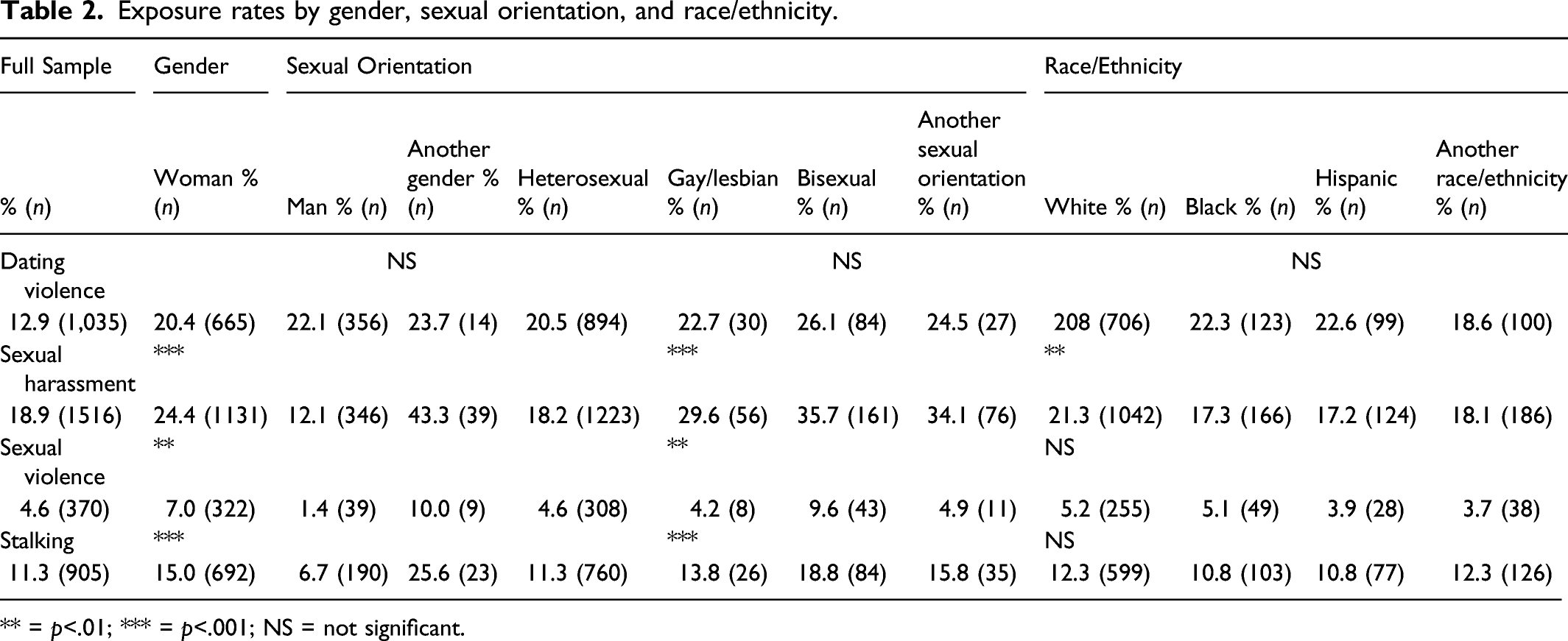
** = p<.01; *** = p<.001; NS = not significant.
Disclosure type within form of violence by social identities.

Note. Formal disclosure may include individuals who also disclosed informally.
*p<.05 **p<.01 ***p<.001.
Multinomial Logistic Regressions
Multinomial logistic regression statistics.

*p<.05, **p<.01, ***p<.001.
The regression predicting disclosure after sexual harassment was also significant (χ2 [16] = 78.24, p < .001, Nagelkerke’s R 2 = .06). Significant predictors included gender and sexual orientation. Compared to women, men had 0.40 lower odds of informal-only disclosure to friends/family than no one, and 0.40 lower odds of disclosing to formal sources as compared to no one. Compared to heterosexual students, gay/lesbian students had 4.36 higher odds of disclosing sexual harassment to formal sources as opposed to disclosing to no one, whereas bisexual students had 1.78 times higher odds of disclosing to formal sources than no one.
The regression predicting type of disclosure after stalking was significant too (χ2 [168] = 27.17, p < .05, Nagelkerke’s R 2 = .03). Gender was a significant predictor. Specifically, compared to women, men had 0.57 lower odds of disclosing stalking victimization to informal-only sources (i.e., friends/family) than disclosing to no one. Additionally, students of another gender identity (compared to women) had 0.16 lower odds of disclosing to informal-only sources than disclosing to no one.
The regression predicting disclosure after dating violence was also significant (χ2[16] = 73.07, p < .001, Nagelkerke’s R 2 = .08). Gender, sexual orientation, and race were significant predictors. Men, as compared to women, had 0.35 lower odds of disclosing dating violence to informal-only sources (i.e., friends/family) than disclosing to no one, and 0.44 lower odds of disclosing to formal sources as opposed to disclosing to no one. Compared to White/non-Hispanic students, those who were identified as another race/ethnicity had 0.57 lower odds of disclosing dating violence victimization to informal-only sources (i.e., friends/family) as compared to disclosing to no one. Compared to heterosexual individuals, bisexual students had 1.97 higher odds of disclosing victimization from dating violence to formal sources as opposed to disclosing their dating violence victimization to no one.
Discussion
This study investigated the rates of formal and informal-only disclosure of experiences of sexual violence, sexual harassment, stalking, and dating violence among college students. This paper makes three significant contributions to the field. First, it is the first known study to examine college students’ disclosure patterns post sexual harassment experiences. Second, it analyzes disclosure of multiple types of violence with the same sample, whereas most prior research has examined one form of violence at a time (with the exception of Demers et al., 2018). Finally, because of the large sample size, it investigates the influence of race, gender, and sexual orientation on disclosure patterns, which has not been done before for these four types of violence.
Prevalence rates of four types of violence were described. Reports of victimization differed substantially by type of violence, with approximately one in every five students experiencing sexual harassment while approximately 5% of the sample endorsed experiencing sexual assault. Violence prevention efforts on college campuses continue to be essential. However, given the frequency with which college students are experiencing sexual harassment, greater attention should be paid to this form of victimization and its consequences when conducting campus climate surveys and designing prevention and intervention activities.
Subgroup differences in prevalence rates were noted. Men indicated fewer experiences of sexual assault, sexual harassment, and stalking than women and than students with another gender identity, but did not differ in their rate of dating violence victimization. Students with another gender identity were particularly at-risk for victimization. This finding supports previous works indicating that some types of violence are more gendered than others (Iverson et al., 2013). Current findings also highlight the increased violence risk faced by students identifying as bisexual and gender diverse. Additional safety measures, prevention efforts, and intervention strategies are needed for these vulnerable populations.
Addressing the first aim and in alignment with prior research, across all forms of violence, informal-only disclosure was more common than formal disclosure. These findings have been documented in prior literature for sexual violence, dating violence, and stalking (Demers et al., 2018); yet, this is the first known study to simultaneously investigate type of disclosure for sexual harassment among college students. Considering rates of disclosure across types of violence is important because the overall rates of disclosure varied by form of violence. Students who experienced sexual violence and stalking disclosed at higher rates (>60%) than students who experienced dating violence or sexual harassment (<50%). Specifically, more than half of the students who experienced sexual harassment or dating violence disclosed these experiences to no one. It is possible that specific characteristics of sexual harassment and dating violence, such as perceived severity of the event and relationship to the perpetrator, may account for the obtained differences in disclosure rates. Though the existing literature has often focused exclusively on sexual assault, victims appear to be less likely to formally disclose their experiences if the perpetrator was a friend or intimate partner compared to a stranger (Spencer et al., 2017). As dating violence is specifically perpetrated by intimate partners, it may explain lower rates of disclosure of this experience. Additionally, events that are perceived as less serious (Ameral et al., 2020) and/or evoke less fear (Demers et al., 2018) are less likely to be disclosed. This may also explain the low levels of disclosure for sexual harassment, as it is potentially less violent and injury threatening than other forms of violence. Overall, these results suggest that more research should be conducted to understand the sexual harassment experiences of college students as they seem to be a frequent but not talked about occurrence.
When disclosure happens, it is more likely to be to family or friends than formal recipients. Because informal disclosure is more common and often co-occurs with formal disclosure, it is essential that universities provide resources and support to improve the social reactions that friends and family provide upon receiving a disclosure of violence. One example of such an approach is the Supporting Survivors and Self program, which was created for college students to increase their positive social reactions and decrease their negative social reactions to future disclosures of sexual assault and intimate partner violence (Edwards & Ullman, 2018). A preliminary study of the Supporting Survivors and Self program demonstrated significant decreases in anticipated negative reactions to sexual assault and intimate partner violence disclosures and increases in anticipated positive reactions to intimate partner violence disclosure (Edwards & Ullman, 2018). The program has also demonstrated positive secondary effects including reduced post-traumatic symptomatology in those who disclose (Edwards et al., 2021). Given the relatively low rate of disclosure of dating violence victimization (to informal-only as well as formal sources) found in this study, universities should continue to develop and implement such programs. The scope of these programs should also be expanded to include other forms of interpersonal violence, such as stalking and sexual harassment.
While rates of disclosure differed by form of violence, social identifiers including gender, sexual identity, and race operated uniquely when considering disclosure of victimization. Gender was a significant predictor of disclosure across all forms of violence. Regardless of the form of violence, men (as compared to women) were less likely to disclose their victimization formally or informally. Individuals with another gender identity (as compared to women) were similarly less likely to disclose their stalking experiences to an informal source (as opposed to telling no one).
Sexual orientation was a useful predictor of disclosure for experiences of sexual harassment and dating violence, with individuals with sexual minority identities being more likely to use formal resources (as opposed to disclosing to no one). Race was only useful for understanding the disclosure experiences of dating violence, with individuals from another race (as compared to White students) being less likely to informally disclose as compared to telling no one about their victimization.
The lower likelihood for individuals of another race, compared to White students, to disclose dating violence is consistent with minority stress theory. Victims who hold minority identities may face additive stressors and may be less likely to disclose, particularly to formal sources, due to fear of future discriminatory behavior (Binion & Gray, 2020). However, increased likelihood of formal disclosure by sexual minority individuals and a lack of significant differences in disclosure of other forms of violence across individuals who hold stigmatized identities is inconsistent with minority stress theory. One possibility is that the additive stress associated with stigmatized identities may have increased the need for formal versus informal disclosure, as formal disclosure is expected to result in resources that will address the detrimental effects of victimization on an individual’s wellbeing. It is also possible that cultural changes are occurring such that some individuals who previously considered themselves as vulnerable now are accessing resources and are utilizing formal support in ways that have not been documented before. Additional research, conducted across time, will be needed to determine this.
Theoretically, disclosure to informal sources is expected to precede disclosure to formal sources (Ahrens et al., 2007; Ullman, 2010b). Our data are generally consistent with this model in that there are relatively few students who disclosed their victimization only to formal sources; most had also disclosed their experiences to an informal source. Formal reporting may be limited due to the historical lack of justice enacted against survivors’ perpetrators. Low rates of criminal conviction of sexual assault perpetrators (approximately 1 in 4; Lonsway & Archambault, 2012) paired with the often-negative responses to disclosure or “secondary victimization” (Symonds, 1980) experienced by survivors, may contribute to low rates of formal disclosure. Formal services could benefit from being more trauma-informed, culturally tailored, and accessible. Doing so may increase utilization of their services, which could increase connection to resources and support among diverse, marginalized survivors.
Furthermore, work needs to be done to enhance equity in disclosure by ensuring that resources (both formal and informal) are culturally tailored to marginalized individuals. Men were consistently less likely to formally or informally disclose across forms of violence, underscoring the need for university services to be presented in a way that makes them be perceived as being available for victims of all genders. Historically, and for good reason, victim services have been geared toward women victims because of the heightened exposure and documented impacts among this group (Krebs et al., 2007). However, research consistently demonstrates that men are also victims of sexual assault (Krebs et al., 2007; Mellins et al., 2017), and that male victims experience additional barriers to help-seeking because of cultures of toxic masculinity and stereotyped victim–perpetrator relationships (Walsh et al., 2010). Helping victimized men access needed resources should be an on-going concern on college campuses.
Some sexual minority groups were more likely to formally disclose sexual harassment and dating violence compared to heterosexual individuals. However, when considering the full sample, these two forms of violence had the lowest formal disclosure rates. It is possible that sexual minority individuals have not internalized societal scripts about the perceived unimportance of sexual harassment and dating violence, making them more inclined to report these events. Alternatively, it could be possible that sexual minority students experience more pervasive, severe, or frequent sexual harassment and dating violence, contributing to their increased likelihood of formal disclosure. However, this explanation does not comport with prior literature which has found that sexual minority adults often perceived intimate partner violence as being “not a big deal,” and this perception contributes to lower reporting rates (Sylaska & Edwards, 2015). It is encouraging that in this sample sexual and racial minorities disclosed formally at rates similar to (or higher than) their privileged counterparts. Future research will be needed to determine if this is a campus-specific finding or can be generalized more widely.
Implications
Multiple implications can be drawn from the current work. First, it is important to continue to conduct campus climate surveys annually on disparate campuses to determine both the prevalence of various types of violence and rates of disclosure to formal and informal-only sources. Second, these findings suggest that a substantial minority of college students have experienced victimization from sexual violence, harassment, stalking, and/or dating violence. There is a less robust literature on college students’ experiences of sexual harassment as compared to sexual assault, stalking, and dating violence. Yet, the current findings suggest that sexual harassment is relatively common, but is often disclosed to no one. Expanding violence prevention efforts to include this experience would be beneficial. Third, disclosure of victimization is most likely to occur to family and friends, rather than formal sources. Therefore, efforts to help friends and family respond supportively to these disclosures is paramount and in alignment with Ullman’s theory of disclosure (2010), as poor responses from disclosure recipients are linked with mental health difficulties among survivors.
The fourth finding to emerge from this study is that disclosure rates vary by type of violence, gender identity, sexual orientation, and race. Men, in particular, seem to have lower disclosure rates as compared to women, perhaps because their experience is rarely depicted in the media and is less often the focus of prevention efforts. It is also a rarer event. Reasons for not disclosing reported among sexual minority college student victims may also apply to men. Namely, perceptions that the victimization was “no big deal,” it is a “private matter,” concerns about others’ reactions, and having no one to tell were all factors in not disclosing (Sylaska & Edwards, 2015). Surprisingly, bisexual and individuals of another gender had a higher likelihood of disclosing to formal sources. Future research needs to determine how these disclosures were experienced by the survivors and the extent to which these disclosures improved access to necessary resources and services. This is particularly important in light of findings that giving advice, taking control of the situation, or appearing to not understanding the event emerged as the least helpful responses for sexual minority college students who had disclosed their victimization (Sylaska & Edwards, 2015). Our results are also in line with calls to train Title IX investigators in evidence-based and trauma-informed approaches to interviewing (Meissner & Lyles, 2019). Finally, preliminary evidence from this study suggests that disclosure of dating violence victimization is particularly stigmatized for men and students of color. These findings support the need for culturally specific prevention and intervention efforts that are specifically tailored to this type of violence.
Limitations
Several limitations to this study should be noted. Some subgroup sizes were very small, which precluded analyses of some important social identities (e.g., disaggregating the victimization and disclosure experiences of transgender individuals from genderqueer individuals) and utilizing a more intersectional approach. This concern highlights the need to have an on-going process of assessing campus climate annually, over multiple years, with unique identifiers, to be able to accumulate enough participants to understand the experiences of marginalized populations. Overall response rates to the survey were generally low (12.4%), but this is not uncommon among campus-wide climate surveys (Cantor et al., 2015). Data were collected cross-sectionally which precludes a causal interpretation of these relationships. Additionally, because experiences were assessed within the past academic year, it is possible that victims had not yet disclosed, but will disclose in the future. Thus, this is not the full story of disclosure for these individuals. Additionally, the items used to measure gender and sexual orientation are outdated and not comprehensively inclusive, limiting their relevance. Data were collected from one large public university in the Southeastern part of the United States. Care should be taken when generalizing these findings to other regions, non-college students, different types of violence, or students with social identities not assessed in the current study.
Conclusions
Many current intervention programs focus primarily on sexual assault and are aimed toward predominantly heterosexual women survivors (Harris & Linder, 2017). The considerable rates of sexual harassment, dating violence, and stalking, in addition to the rates of overall violence for those who do not identify as heterosexual women within the current study, suggest that an intentional effort should be made toward services for the inclusivity of survivors of violence, broadly defined. Continued attention should be paid toward prevalence and disclosure rates of multiple forms of violence over time, as both may be explicitly influenced by socio-cultural movements like #metoo and “share your story” that may play a hand in reinforcing or call attention to disclosure behavior. The current study demonstrates the importance of considering who (under which social identities) is disclosing what (type of victimization) to whom (formal vs. informal-only), to create better intervention programs and compassionate resources for all survivors.
Footnotes
Declaration of Conflicting Interests
The author(s) declared no potential conflicts of interest with respect to the research, authorship, and/or publication of this article.
Funding
The author(s) disclosed receipt of the following financial support for the research, authorship, and/or publication of this article: Research was supported by the Centers for Disease Control and Prevention Cooperative Agreement U01CE002668. The Centers for Disease Control and Prevention had a supervisory role in the design and conduct of the study but had no direct role in the collection, management, analysis, or interpretation of the data; the preparation, review, or approval of the manuscript; or the decision to submit the manuscript for publications. The findings and conclusions in this article are those of the authors and do not necessarily represent the official position of the Centers for Disease Control and Prevention. Manuscript preparation was supported, in part, by the National Center for Injury and Violence Prevention and Control of the Centers for Disease Control and Prevention under award number K01CE003160.REDCap: Study data were collected and managed using REDCap electronic data capture tools hosted at the University of Kentucky. The project described was supported by the NIH National Center for Advancing Translational Sciences through grant number UL1TR001998. The content is solely the responsibility of the authors and does not necessarily represent the official views of the NIH.
