



Abstract
Homeless youth experience high rates of child physical and sexual abuse, and many are revictimized on the streets. Despite their high rates of victimization, few studies have examined whether specific victimization types (e.g., sexual vs. physical) cluster together and for whom (e.g., sexual minority youth). As such, the purpose of this study was to identify clusters of homeless youth based on their exposure to different forms of child abuse and street victimization, to examine what factors distinguish each cluster, and how unique clusters are related to youths’ mental health using data collected at two time points. The sample included 150 youth experiencing homelessness in the Midwest. Latent class analysis was used to identify clusters of youth. Three latent classes emerge: The low exposure class had significantly lower rates of child physical and emotional abuse and threats compared with the medium- and high-exposure groups. The high exposure group had significantly higher rates of child sexual abuse compared with the other groups. Females, sexual minority youth, and those who have lived in more foster care homes were more likely to be in the high exposure group compared with the low and/or medium exposure groups. Multivariate results revealed that those in the medium and high exposure cluster groups had higher rates of Wave 1 depressive symptoms and Wave 1 anxiety compared with youth in the low exposure cluster. Overall, although these young people experience high rates of abuse and victimization both at home and while on the street, there are gradations in these experiences such that certain victimization experiences subgroups are at heightened risk for poor mental health.
Introduction
The National Network for Youth (2018) estimates that between 1.3 and 1.7 million youth in the United States have experienced at least one night of being homeless within a specific year. Research evidence, which typically focuses on American and European samples, finds that some youth run away or leave home due to family conflict (Tyler & Cauce, 2002) and/or child abuse (Bender, Brown, Thompson, Ferguson, & Langenderfer, 2015), while other youth are forced to leave home (i.e., kicked out) because of their sexual orientation (Cochran, Stewart, Ginzler, & Cauce, 2002). Moreover, many of these youth endure further traumatic experiences while on the street: 32% have been sexually assaulted, and 94% have been physically assaulted since being on the street (Tyler & Beal, 2010). In terms of mental health, studies find that homeless youth have high rates of depression: 31% of homeless youth met criteria for a major depressive episode (Bender et al., 2015). Elevated anxiety has also been found among homeless youth (Tyler, Schmitz, & Ray, 2018).
Although previous research has looked at the link between child abuse, street victimization, and/or mental health (Bender et al., 2015; Tyler et al., 2018), there is a paucity of research that has examined whether different types of child abuse and street victimization types cluster together and for whom (e.g., females, sexual minority youth). Moreover, although it is often assumed that abuse in general is associated with poorer mental health outcomes, it is possible that there are gradations in these experiences, which may be differentially associated with mental health. Finally, gradations in abuse also may vary by youth characteristics. Answers to these questions have policy implications because if differences are found, this may suggest that individualized treatments and interventions may be needed rather than a “one size fits all” approach. As such, the purpose of this study is to (a) identify clusters of homeless youth based on their exposure to different forms of child abuse and street victimization, (b) examine what factors distinguish each cluster, and (c) how these unique clusters are related to youths’ mental health among 150 Midwestern youth experiencing homelessness.
Early Childhood Experiences of Abuse
Early experiences of child abuse have been found to be a risk factor for youth running away or leaving home. That is, studies find that more than 50% of homeless youth have experienced child physical abuse in their families of origin prior to running away (Bender et al., 2015; Rattelade, Farrell, Aubry, & Klodawsky, 2014), and between 34% and 47% have experienced child sexual abuse (Bender et al., 2015; Tyler & Melander, 2015, respectively). Being a victim of child abuse has been found to increase youth’s risk of running away from home at earlier ages and running away multiple times (Tyler, Hoyt, Whitbeck, & Cauce, 2001), which can negatively affect their mental health (Tyler et al., 2018) and increase their risk for re-victimization (Harris, Rice, Rhoades, Winetrobe, & Wenzel, 2017). Studies have also found a positive link between experiencing child abuse and re-victimization on the street (Edalati, Krausz, & Schütz, 2016; Tyler & Melander, 2015). A history of foster care placement among homeless youth is another risk factor found to be associated with child abuse and poorer mental health (Tyler & Melander, 2010).
Victimization Since Being on the Street
In terms of street victimization, Bender et al. (2015) found that 21% of their sample of homeless youth had been sexually assaulted since being on the street whereas Tyler and colleagues found a prevalence rate of 35% among their sample of homeless young people (Tyler, Whitbeck, Hoyt, & Cauce, 2004). Prevalence rates for physical victimization are also high: 52% of homeless youth in Bender et al.’s study, and 94% of those young people in a study by Tyler and Beal (2010) reported being physically assaulted since leaving home. Running away from home more frequently has also been found to be correlated with experiencing more physical street victimization (Tyler & Beal, 2010).
Mental Health of Homeless Youth
Homeless youth also suffer from various mental health issues that have been linked to early life stressors. Mental health problems can detract from homeless youth’s ability to function and manage various stressors. One early life stressor that numerous homeless youth experience is child abuse, which is linked to higher rates of sexual and physical victimization (Tyler & Melander, 2015), higher levels of depressive symptoms (Bender, Ferguson, Thompson, & Langenderfer, 2014; Lim, Rice, & Rhoades, 2016), and greater anxiety (Tyler et al., 2018). Staying on the streets for extended periods of time is another early life stressor that is likely to affect mental health. Specifically, running away from home more frequently is tied to experiencing more physical victimization on the street, meeting criteria for major depression, and/or having greater anxiety (Brown, Begun, Bender, Ferguson, & Thompson, 2015; Tyler et al., 2018). Finally, foster care placement has also been linked to higher depressive symptoms (Tyler & Melander, 2010).
Subgroups of Homeless Youth at Heightened Risk
Although rates of child abuse, street victimization, and poor mental health are high among homeless youth, research finds that certain subgroups are at heightened risk. That is, lesbian, gay, and bisexual (LGB) homeless youth experienced more child sexual and physical abuse compared with their heterosexual counterparts (Rew, Whittaker, Taylor-Seehafer, & Smith, 2005; Tyler, 2008; Whitbeck, Chen, Hoyt, Tyler, & Johnson, 2004). Female homeless youth have been found to experience more sexual abuse compared with their male counterparts (Tyler & Cauce, 2002; Whitbeck et al., 2004). In terms of street victimization, research finds that females and LGB youth experienced higher rates of sexual victimization compared with males and heterosexual youth, respectively (Tyler & Beal, 2010; Whitbeck et al., 2004). In addition, some studies have found that female homeless youth experienced significantly more anxiety (Tyler et al., 2018) and greater symptoms of depression (Bao, Whitbeck, & Hoyt, 2000), compared with their male counterparts while LGB homeless youth were more likely to meet criteria for major depression compared with heterosexual homeless youth (Whitbeck et al., 2004). Young people who run away from home numerous times and spend more time on the street also were at greater risk for depression (Brown et al., 2015), anxiety (Tyler et al., 2018), and physical victimization (Tyler, Gervais, & Davidson, 2013). Finally, Whitbeck et al. (2004) found that older aged youth experienced more physical victimization compared with their younger aged counterparts. Overall, research shows that LGB youth and females are two subgroups that appear to be at heightened risk for various forms of victimization as well as poorer mental health.
Theoretical Framework and Hypotheses
We use a life stress framework (Lin & Ensel, 1989; Pearlin, 1989), which emphasizes multiple levels of influence including the individual, family, and the environment. These complex elements are fundamental to understanding the relationship between various stressful life events homeless youth experience both at home and on the street. In addition, the life stress framework assumes that individuals exposed to one serious stressor (e.g., child sexual abuse) will be exposed to additional stressors, which can then cluster together (Pearlin, 1989). At the individual level, occupying the social status of LGB may be a significant source of stress for homeless youth due to its socially marginalized position within society (Hatzenbuehler, 2011; Kelleher, 2009). Homeless sexual minority youth’s exposure to stigma may be exacerbated by both their marginalized social status and structural vulnerability (Bruce, Stall, Fata, & Campbell, 2014). Subsequently, these youths are more likely to experience multiple trauma (Meyer, 2015). In addition, because females experience higher rates of both child sexual abuse and sexual victimization while on the street, compared with males (Tyler et al., 2004), females are at greater risk for experiencing multiple trauma. Therefore, occupying the social status of female may also be a significant source of stress. Related, because of the cumulative nature of risk (Tyler & Whitbeck, 2004), and the strong correlation between child abuse and re-victimization (Harris et al., 2017; Tyler & Melander, 2015), especially for females (Tyler & Cauce, 2002) and LGB youth (Rew et al., 2005; Tyler, 2008; Whitbeck et al., 2004), it is expected that homeless youth exposed to multiple forms of early trauma (e.g., sexual abuse, emotional abuse) will undergo subsequent trauma, including experiencing physical and sexual victimization while on the street. Thus, all these stressful life events will have a negative impact on these young people’s mental health, but it is expected that the impact will be greater for females and sexual minority youth.
Applied to the present study, we hypothesized the following:
Data and Method
One hundred fifty youth were interviewed in shelters and on the streets from July 2014 to October 2015 in two Midwestern cities. Selection criteria required participants to be between the ages of 16 and 22 and meet the definition of runaway or homeless. Runaway refers to youth under age 18 who have spent the previous night away from home without the permission of parents or guardians (Ennett, Bailey, & Federman, 1999). Homeless youth, as inclusively defined by the 2015 reauthorization of the McKinney-Vento Homeless Assistance Act, includes those who lack permanent housing such as having spent the previous night with a stranger, in a shelter or public place, on the street, staying with friends, staying in a transitional living facility, or other places not intended as a permanent domicile (National Center for Homeless Education & National Association for the Education of Homeless Children and Youth, 2017).
Procedure
Four trained interviewers with prior experience working with homeless youth conducted the interviews (two in each city). Interviewers approached youth at shelters, food programs, and during street outreach. Interviewers varied the times of the day that they went to these locations, on both weekdays and weekends. This sampling protocol was conducted repeatedly over the course of the study. Informed consent was obtained from all participants who were informed that they would need to complete all three parts of the study if they agreed to participate (i.e., baseline structured interview, 30 days of text messaging, and a follow-up structured interview). Here we report findings from the baseline structured interview (Time 1), and the follow-up structured interview (Time 2) conducted 30 days apart. Findings from the text messaging portion are reported elsewhere (Tyler & Olson, 2018). 1 The interviews lasted 45 min and 20 min, respectively, and participants received a $20 and $10 gift card, respectively, for completing the interviews. Referrals for shelter, counseling services, and food services were offered to all youth regardless of their decision to participate. Less than 3% of youth (N = 5) refused to participate or were ineligible. A total of 112 youth (75%) completed the follow-up interview. The Institutional Review Board at The University of Nebraska-Lincoln approved this study.
Measures
Child physical and emotional abuse and threats included items adapted from the Conflict Tactics Scale (Straus, Hamby, Finkelhor, Moore, & Runyan, 1998). All questions began with how frequently their parent/caretaker, for example, did any of the following to them such as hit them with a fist or kicked them hard (physical abuse); shouted, yelled, or screamed at them (emotional abuse); and used threats, which included the parent/caretaker saying they would send the youth away or kick them out of the house (0 = never to 6 = more than 20 times). A mean scale was created for physical abuse, which included seven items (α = .91), and a mean scale was created for emotional abuse, which included three items (α = .84). Threats was a single-item indicator. A higher score on each of these three individual dimensions indicated more frequent physical abuse, more frequent emotional abuse, and threatened more often.
Child sexual abuse included seven items (adapted from Whitbeck & Simons, 1990) that asked youth, “How often has any adult or someone at least 5 years older than you asked you, for example, to do something sexual or had you touch them sexually (0 = never to 6 = more than 20 times)?” Due to skewness, the seven items were dichotomized (0 = never and 1 = at least once) and then a count variable was created where a higher score equaled a greater number of different types of sexual abuse experienced. Cronbach’s alpha was .92. These same items have been used in previous studies with homeless young people (Whitbeck & Simons, 1990; α = .93; Tyler & Melander, 2015; α = .88).
Sexual street victimization included four items such as how often were you “touched sexually when you didn’t want to be” and “forced to do something sexual.” The same questions were asked at both Wave 1 and Wave 2, but the introduction to the question was “since leaving home” for Wave 1 (0 = never to 3 = many times) and “in the past 30 days” for Wave 2 (0 = never to 3 = 5 or more times). Due to skewness, the individual items were dichotomized (0 = never and 1 = at least once), and then a count variable was created where a higher score indicated a greater number of different types of sexual victimization experienced. Cronbach’s alpha was .90 and .74, at Wave 1 and Wave 2, respectively. Due to the small number of reports of sexual victimization at Wave 2 (n = 10), this item was dichotomized (0 = no and 1 = yes). These same items have been used in previous studies with homeless youth (Tyler & Beal, 2010; α = .83).
Physical street victimization included six items such as how often were you “beaten up” and “robbed.” The same questions were asked at both Wave 1 and Wave 2, but the introduction to the question was “since leaving home” for Wave 1 (0 = never to 3 = many times) and “in the past 30 days” for Wave 2 (0 = never to 3 = 5 or more times). A mean scale was created where higher scores indicated greater street physical victimization. Cronbach’s alpha was .85 and .81, at Wave 1 and Wave 2, respectively. These same items have been used in previous studies with homeless youth (Whitbeck & Simons, 1990; α = .82).
Depressive symptoms included 10 items from the Center for Epidemiological Studies Depression scale (CES-D; Radloff, 1977). The CES-D, which requires respondents to reflect on their experiences during the past week, includes items such as “I was bothered by things that don’t usually bother me” and “You were happy” (0 = never to 3 = 5-7 days). Certain items were reverse coded and then a mean scale was created where higher scores indicated more depressive symptomology. The same items were asked at both Wave 1 and Wave 2, and Cronbach’s alpha was .79 and .81, respectively. This alpha reliability is consistent with studies of general population youth using the same 10-item short form of the CES-D (Bradley, Bagnell, & Brannen, 2010). A similar scale has been used with homeless youth (Bao et al., 2000; α = .89).
Anxiety included 10 items from the Endler Multidimensional Anxiety Scale-State (Endler, Parker, Bagby, & Cox, 1991) that asked youth how they feel about a particular situation when they are getting ready to start their day, such as “I fear defeat” and “I am unable to focus on a task” (1 = not at all true to 5 = completely true). A mean scale was created so that higher scores indicated more anxiety. The same items were asked at both Wave 1 and Wave 2, and Cronbach’s alpha was .88 and .89, respectively.
Respondent gender was coded 0 = male and 1 = female, and males served as the reference category. Sexual orientation was coded 0 = lesbian, gay, bisexual (LGB) and 1 = heterosexual, where LGB youth were the reference category. Age is a continuous variable, which measured the age of the respondent at the time of the interview. Number of times run was a single item that asked youth for the total number of times that they had ever run away or left home (adapted from Whitbeck & Simons, 1990). Number of foster care homes was a single item indicator that measured the total number of times that youth had lived in a different foster care home. Due to skewness, this variable was collapsed into the following categories: 0 = no foster care homes, 1 = one foster care home, 2 = two different foster care homes, 3 = three to five different foster care homes, and 4 = six or more different foster care homes. Youth who had never been in foster care served as the reference category.
Data Analytic Strategy
We performed a latent class analysis in Mplus (version 7; Muthén & Muthén, 1998-2015) using a total of eight variables: four abuse variables (i.e., physical, emotional, threats, and sexual) and four victimization variables (i.e., physical and sexual victimization at both Wave 1 and Wave 2) to identify subgroups within our sample of homeless youth. We performed this analysis six times specifying the number of classes from 1 to 6 to determine which had the best fit. Fit indices (Log-likelihood, Bayesian information criterion [BIC], adjusted BIC, and Lo-Mendell-Rubin Adjusted Likelihood Ratio Test [LMR LRT]) were used to determine the best fitting number of classes; sharp reductions indicate improvements in fit and were used to guide decision making.
Once classes were determined, we performed mean and proportion comparisons using t-tests to identify significant differences in means by class membership. These comparisons are performed on the eight abuse and victimization variables used to assign the classes, depression, and anxiety measures from both waves, and demographic variables to describe the nature of each class. Last, we performed ordinary least squares (OLS) linear regressions of anxiety and depressive symptom measures from Waves 1 and 2, using class membership and demographic characteristics as correlates.
Attrition Analysis
We performed statistical comparison of the means (chi-squared and t-tests) to determine whether those who dropped out between Wave 1 and Wave 2 were significantly different from those who were present at both waves. Results showed that there were no significant differences by gender, sexual orientation, age, number of times youth had run away, number of foster homes they had been in, child physical or emotional abuse, sexual or physical victimization at Wave 1, and their depressive symptoms and anxiety levels at Wave 1. Those who dropped out between waves did, however, differ significantly on childhood threats and sexual abuse. Those who dropped out between waves reported childhood threat scores that were 1.28 higher on average, t(144) = 3.121, p = .022. In addition, those who dropped out before Wave 2 had experienced almost one more form of child sexual abuse compared with those youth who responded at Wave 2, t(148) = 2.328, p = .021.
Results
Participants
Our sample included 150 homeless youth at Wave 1, 51% of whom were female. Ages ranged from 16 to 22 years (M = 19.4 years). Twenty-two percent of youth reported being LGB; of these, 13% were bisexual. In terms of race/ethnicity, 41.3% were White, 26% Black or African American, 10% Hispanic or Latino, 4% American Indian or Alaskan Native, 13.3% were biracial, and 5.3% multiracial. Approximately 62% of youth had been in at least one foster home, and of these, 15% had been in six or more different foster homes. The average number of times youth reported running away or leaving home was 4.9 times. In terms of abuse, 80% of youth experienced physical abuse, 41% sexual abuse, 97% emotional abuse, and 84% reported being threatened by a parent/caregiver. While on the street, 85% reported at Wave 1 that they had been physically victimized, while 32% were sexually victimized. In the past 30 days (Wave 2), 44% of youth reported being physically victimized, whereas 9% had experienced sexual victimization.
Multivariate Results
Table 1 shows four fit indices (log-likelihood, BIC, adjusted BIC, and LMR LRT) used to determine the best fitting class-solution for the latent class analysis based on victimization experiences. Although the BIC and adjusted BIC are lowest in the six-class solution (see Table 1), we chose to use the significant drop in the LMR LRT as an indicator for a four-class solution. This, however, is not analytically feasible given class membership sizes (one cluster was n = 11). For this reason, we combined Classes 2 (n = 11) and 3 (n = 73) into a single medium exposure cluster. These two clusters only differed significantly on one variable, sexual victimization at Wave 1, t(82) = 21.191, p = .000 (see supplemental table for descriptive statistics of the four-class solution). We combined these classes post-latent class analysis, rather than using the three-class solution as provided by the analysis. The combination of the latent class analysis results and the post hoc merging of two classes yielded three final groups: low exposure (n = 38), medium exposure (n = 84), and high exposure (n = 28) youth.
Fit Indices for Latent Class Analysis.
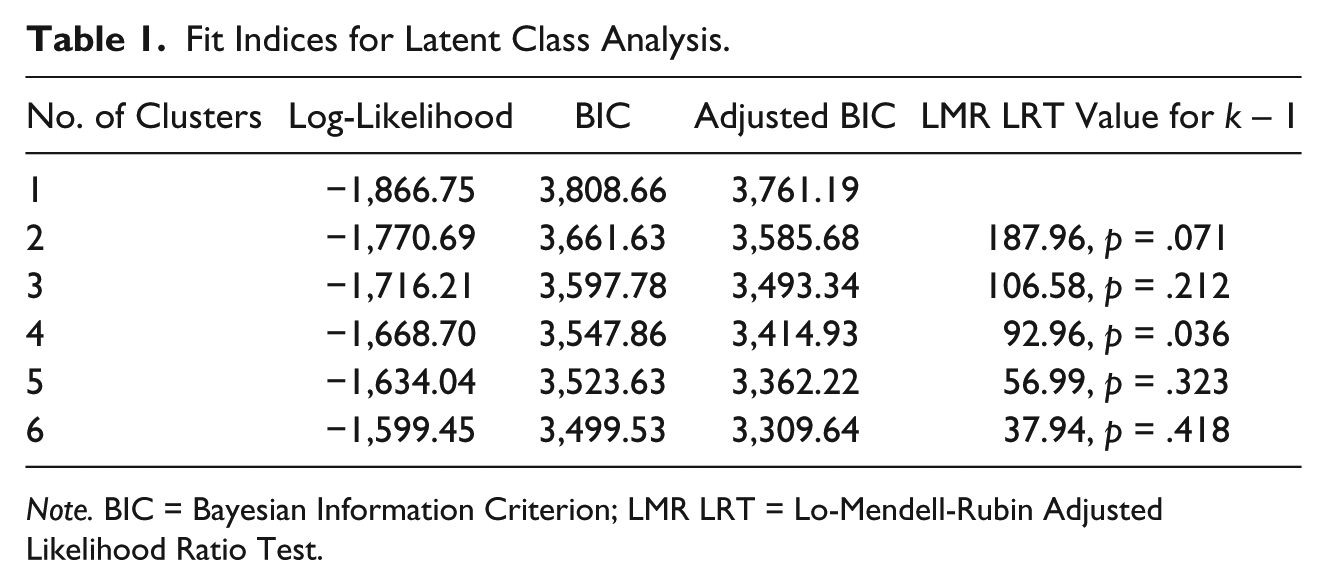
Note. BIC = Bayesian Information Criterion; LMR LRT = Lo-Mendell-Rubin Adjusted Likelihood Ratio Test.
Table 2 shows descriptive statistics of the victimization variables used in the latent class analysis, the outcome variables, and demographic variables by cluster membership. We use superscripts to denote significant differences in the univariate statistics by cluster. As shown in column 1, the low exposure class had significantly lower rates of child physical, emotional, and threat abuse compared with the medium and high exposure groups. For child sexual abuse, the high exposure group had significantly higher rates as compared with the other groups. For both sexual and physical street victimization at Wave 1, the three classes had significantly different values, with Cluster 1 having the lowest rates (M = .05 and .52, respectively) and Cluster 3 having the highest rates (M = 3.64 and 1.36, respectively). For Wave 2, sexual and physical street victimization, however, there were no significant differences in the mean by cluster.
Descriptive Results by Cluster Membership.

Note. “p” represents the proportion within each category. ME = medium exposure; HE = high exposure; LE = low exposure.
Mean is significantly different from the mean for the medium-exposure cluster (p < .05).
Mean is significantly different from the mean for the high-exposure cluster (p < .05).
Mean is significantly different from the mean for the low-exposure cluster (p < .05).
The middle portion of Table 2, which examines Hypothesis 1, shows the distributions of the four outcome variables by cluster membership. Across all four outcomes, the highest rates of depression and anxiety at both time points is among the high exposure clusters, and the lowest rates are among the low exposure clusters. At Wave 1, youth in the low exposure group had significantly lower rates of anxiety and depressive symptoms compared with the other two groups. There were no significant differences in rates of anxiety and depressive symptoms among the three clusters at Wave 2.
The bottom portion of Table 2 shows descriptive statistic results for demographic variables by class membership, and examines Hypothesis 2a, 2b, and 2c. While both the low and medium exposure classes were split almost evenly between males and females, nearly three-fourths of the high exposure class was female, a value significantly different from the medium exposure class. Most youth in the low and medium exposure classes were heterosexual, while only about half (54%) of those in the high exposure group identified as heterosexual, a value significantly lower than the means for the other two classes. There were no differences by class membership in respondent’s mean age or mean number of times that youth had run away or left home. Finally, high exposure youth stayed in more foster homes, and this mean was significantly different from the medium exposure group.
Table 3 shows OLS linear regression models for depressive symptoms and anxiety at Waves 1 and 2, and these models examine Hypotheses 3 and 4. Model 1 shows that both medium exposure (b = .337, p < .01) and high exposure (b = .542, p < .01) cluster members have higher depressive symptoms at Wave 1 compared with youth who are in the low exposure cluster. Running away or leaving home more frequently is associated with increased depressive symptoms at Wave 1 (b = .020, p < .05), whereas staying in more foster homes is associated with lower levels of depressive symptoms at Wave 1 (b = −.072, p < .05).
Ordinary Least Squares Regression Models for Depressive Symptoms and Anxiety at Waves 1 and 2.
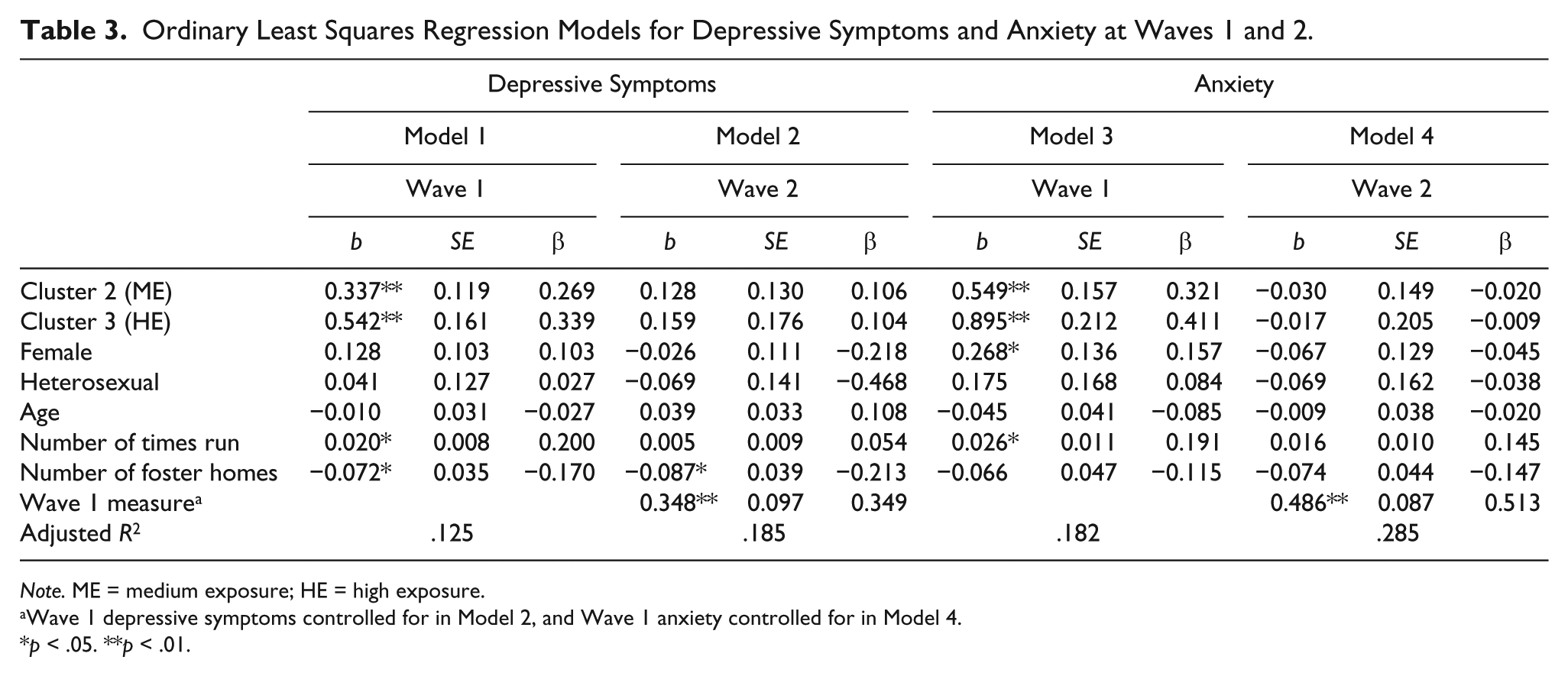
Note. ME = medium exposure; HE = high exposure.
Wave 1 depressive symptoms controlled for in Model 2, and Wave 1 anxiety controlled for in Model 4.
p < .05. **p < .01.
Model 2, which controls for the youth’s depressive symptoms score at Wave 1, revealed that only two variables were significantly correlated with Wave 2 depressive symptoms. First, living in more foster homes was associated with lower levels of depressive symptoms (b = −.087, p < .05). Second, higher levels of depressive symptoms at Wave 1 was associated with higher levels at Wave 2 (b = .348, p < .01).
Model 3, which shows the results for anxiety at Wave 1 revealed that youth who were in the medium (b = .549, p < .01) and high exposure (b = .895, p < .01) clusters had higher anxiety scores at Wave 1 compared with those who were in the low exposure cluster. Females (b = .268, p < .05), compared with males, and those who ran away or left home more frequently (b = .026, p < .05) had higher anxiety scores at Wave 1. Model 4, which controlled for Wave 1 anxiety, revealed that the only significant correlate in this model was Wave 1 anxiety; youths who had higher rates of anxiety at Wave 1 were also likely to have higher rates at Wave 2 (b = .486, p < .01).
Discussion
The purpose of this study is to identify clusters of homeless youth based on their exposure to various forms of child abuse and street victimization, and examine what factors distinguish each cluster and how these unique clusters are related to youths’ mental health among 150 Midwestern youth experiencing homelessness. Overall, we find that even though these young people experience high rates of abuse and victimization both at home and while on the street, there are gradations in these experiences. In terms of class membership, we find differences based on gender and sexual orientation with a significantly higher proportion of females and LGB youth in the high exposure cluster. Moreover, the medium and high exposure groups have significantly higher rates of child physical, emotional, and threat abuse compared with the low exposure group. The high exposure group also has significantly higher rates of child sexual abuse and sexual and physical street victimization at Wave 1 compared with the other two groups. Finally, youth in the medium and high exposure clusters report more depressive symptoms and greater anxiety compared with those in the low exposure cluster.
Our findings are generally consistent with a life stress framework (Lin & Ensel, 1989; Pearlin, 1989) as individual, family, and environmental factors are all important in understanding the relationship between various stressful life events these young people experience at home (different forms of child abuse) and on the street (victimization), and their relation to mental health. At the individual level, occupying the social status of either female or LGB appears to be a significant source of stress for homeless youth, such that both these subgroups experience more child abuse and street victimization (high exposure cluster) compared with their counterparts. Related, the strong association found between experiencing child abuse and re-victimization found in both the present study and in the broader literature (Harris et al., 2017; Tyler & Melander, 2015) for females (Tyler & Cauce, 2002) and LGB youth (Rew et al., 2005; Tyler, 2008; Whitbeck et al., 2004), further supports the life stress framework in that stressors tend to cluster together (Pearlin, 1989), and this is especially true for certain groups. Although this theory has typically been applied to general populations, our study expands the application of the life stress framework to a population of youth who are experiencing homelessness and, as such, is useful for explaining the relationship between various stressors and mental health among various populations.
Our findings are partially consistent with Hypothesis 1: Youth in the medium and high exposure clusters report higher levels of depressive symptoms and greater anxiety at Wave 1 compared with youth in the low exposure cluster. It is plausible that repeatedly experiencing numerous types of abuse and victimization places tremendous strain on these youth, thereby decreasing their ability to effectively cope. That is, having to cope with such traumatizing events over time likely leaves youth feeling anxious and depressed about their current situation. This poor mental health may be further exacerbated for those youth who have few individuals who they can rely on for support as social networks have been found to be integral to enhancing homeless young people’s sense of well-being (Barczyk, Thompson, & Rew, 2014). Moreover, it is possible that because abused youth are more likely to run away from home at an earlier age and spend more time on the street (Tyler et al., 2001), they have less available family support (Bao et al., 2000), which, subsequently, can lower youths’ well-being (Barczyk et al., 2014).
Although we also expected cluster membership to be associated with Wave 2 depressive symptoms and anxiety, this portion of Hypothesis 1 was not supported. One possible explanation is that because youth’s mental health is consistent over the 30 days between Wave 1 and Wave 2, there is minor variation and, thus, little change. This explanation is supported by our results, which show that depression and anxiety levels are consistent across waves and that the relationship between other correlates and Wave 2 mental health become nonsignificant with the inclusion of Wave 1 mental health measures. Another possible explanation for this finding may be the relatively low number of victimization experiences that occurred between Waves 1 and 2; thus, youth’s mental health may be attributed to other experiences within this time frame.
Consistent with Hypothesis 2a and 2b, females and LGB youth are more likely to be in the high exposure cluster compared with males and heterosexual youth. This finding that females experience more types of abuse and victimization is consistent with the literature, which finds that female homeless youth suffer more sexual abuse (Tyler & Cauce, 2002; Whitbeck et al., 2004) and more sexual street victimization (Tyler & Beal, 2010; Whitbeck et al., 2004) compared with their male counterparts. Our finding that LGB youth experience more victimization also is consistent with prior work, which finds that LGB youth suffer more child physical and sexual abuse (Rew et al., 2005; Tyler, 2008) and more sexual street victimization compared with heterosexual youth (Tyler & Beal, 2010; Whitbeck et al., 2004). Although we expected older aged youth to be in the high exposure cluster, Hypothesis 2c was not supported. One possible explanation is that because these youth are similar in age, we were unable to detect age distinctions.
Our third hypothesis (3a) is partially supported such that females report greater anxiety at Wave 1 compared with males, but we find no difference in depressive symptoms by gender. Contrary to Hypothesis 3b and 3c, depressive symptoms and anxiety did not vary by sexual orientation or age. One possible explanation is that all these young people generally have poor mental health given their current life circumstance of experiencing homelessness. Having to find a place to sleep for the night and locating basic necessities and other essentials is stressful for youth and likely increases their risk for depression and anxiety (Tyler & Schmitz, 2018). Thus, experiencing homelessness may be a leveling factor and, thus, we see few differences in mental health per se by gender, sexual orientation, and age.
Finally, our results show that youth who run away from home more frequently report higher levels of depressive symptoms and greater anxiety at Wave 1, which is consistent with Hypothesis 4 and prior research. That is, the more times youth leave home, the more time they spend on the street, and staying on the streets for extended periods of time is likely to affect their mental health. For example, prior research finds that running away from home more often is tied to experiencing more physical victimization on the street (Tyler et al., 2018), meeting criteria for major depression (Brown et al., 2015), and experiencing greater anxiety (Tyler et al., 2018). Moreover, being away from home for longer periods of time reduces family support (Bao et al., 2000), which can also lower youth’s well-being (Barczyk et al., 2014).
Although we find a significant correlation between number of foster care homes and depressive symptoms at Waves 1 and 2, the relationship was in the opposite direction of our Hypothesis 4. That is, we find that youth who have been in more foster care homes report lower levels of depressive symptoms at Waves 1 and 2. Our finding is inconsistent with some prior research that has found that foster care placement is associated with higher depressive symptoms (Tyler & Melander, 2010). One possible explanation for our counter intuitive finding may be that some youth were removed from an abusive family prior to running away, and through their placement in foster care, they were able to obtain the necessary treatment and counseling to help them effectively cope, which may have resulted in lower depression. Moreover, prior research shows that being in more foster homes is linked to having a caseworker and mentor (Tyler et al., 2018). Thus, foster care may put youth in touch with social support systems, which helps to reduce the negative effects of stress. This potential explanation is consistent with previous studies, which note the resilient qualities of individuals previously in foster care (Daining & DePanfilis, 2007; Samuels & Pryce, 2008).
Limitations
In terms of limitations, data are self-reported and retrospective, which may have resulted in some recall bias. Given the difficulties sampling homeless populations, the sample was not random, as is the case with the majority of research with homeless youth; therefore, results cannot be generalized to all diverse populations of homeless youth. Related, though our sample began with 150 youth, we only have 112 youth by Wave 2, which is rather small. Despite this, our attrition analyses revealed few differences between youth who dropped out between Wave 1 and Wave 2 and those who were present at both waves. Also, while our model implies a causal order, we are only examining associations among study variables, and therefore, we cannot assume causation. Related, it is possible that reciprocal pathways could be occurring. Finally, it is possible that some youth experiencing poorer mental health may have been less likely to be interviewed for this study, and thus, the prevalence of mental health problems reported here may be underestimated.
Practice Implications
These findings have implications for service providers. First, because certain subgroups of homeless young people including females and LGB youth have been abused and re-victimized in various contexts (i.e., sexual, physical, emotional, threatening) with high prevalence rates, programs are needed that specifically target these varying contexts as solutions and intervention strategies may need to be multifaceted to effectively deal with the different forms of trauma and its cumulative effect. Related, programs may need to be tailored for specific subgroups of homeless youth such as females and LGB young people. Moreover, because youth in the medium and high exposure groups have greater anxiety and more depressive symptoms, services are needed that promote prosocial coping skills among these young people so that they do not turn to using drugs to cope with traumatizing events (Harris et al., 2017; Kidd & Carroll, 2007). Finally, intervention programs that assist youth with developing problem-solving skills that increase their self-esteem and self-worth, and that provide them with a sense of purpose may lead to improvements in these young peoples’ mental health and overall well-being.
Conclusion
Overall, our study has numerous strengths including conducting follow-up interviews with a population that is highly mobile and difficult to access to assess changes in depression, anxiety, and street victimization over a 30-day period. Moreover, our research fills a gap in the existing literature on understanding how different forms of child abuse and street victimization types cluster together to create different classes or clusters that are uniquely associated with gender, sexual orientation, depressive symptoms, and anxiety. Although child emotional abuse (i.e., calling youth “dumb or lazy” and swearing at them) is a common occurrence for many of these youth, we see clear differences in prevalence of sexual abuse and threats (i.e., threatening to kick the youth out of the home). Youth who experience the highest frequency of threats (medium and high exposure clusters) also experience elevated emotional abuse and sexual abuse beyond that of youth found in the low exposure group. Thus, young people in the high exposure cluster, which includes significantly more females and LGB youth, are exposed to proportionately more physical and emotional abuse, more threats, and more sexual abuse prior to leaving home. Moreover, rates of sexual and physical victimization at Wave 1 are also higher for females and LGB youth indicating the prolonged exposure to child abuse and re-victimization. Thus, it appears that abuse and victimization may be cumulative, and youth who experience more frequent abuse and more types of abuse prior to leaving home also experience proportionally more types of street victimization. Thus, child abuse and street victimization are not “evenly distributed” among homeless youth. Instead, our results show that those in the medium and high exposure clusters are experiencing significantly more trauma, which translates to more depressive symptoms and anxiety.
Supplemental Material
Supplemental_Table_JIV_FINAL – Supplemental material for A Latent Class Analysis of Lifetime Victimization Among Homeless Youth
Supplemental material, Supplemental_Table_JIV_FINAL for A Latent Class Analysis of Lifetime Victimization Among Homeless Youth by Kimberly A. Tyler and Colleen M. Ray in Journal of Interpersonal Violence
Footnotes
Declaration of Conflicting Interests
The author(s) declared no potential conflicts of interest with respect to the research, authorship, and/or publication of this article.
Funding
The author(s) disclosed receipt of the following financial support for the research, authorship, and/or publication of this article: This article is based on research supported by a grant from the National Institute on Drug Abuse (DA036806). Dr. Kimberly A. Tyler, principal investigator.

Notes
Supplemental Material
Supplemental material for this article is available online.
Author Biographies
References
Supplementary Material
Please find the following supplemental material available below.
For Open Access articles published under a Creative Commons License, all supplemental material carries the same license as the article it is associated with.
For non-Open Access articles published, all supplemental material carries a non-exclusive license, and permission requests for re-use of supplemental material or any part of supplemental material shall be sent directly to the copyright owner as specified in the copyright notice associated with the article.
