




Abstract
The purpose of this study was to explore the role of social support for posttraumatic growth (PTG) and identity processes in a sample of 217 women victims of intimate partner violence (IPV), recruited from women shelters, social support centers, and through counseling psychologists. The results of the study highlight the important role of social support in seeking positive personal resolutions after experiencing traumatic events of IPV. It indicates that social support, but not social nonsupport, predicts higher levels of PTG and the development of new positive identities. In particular, social support was positively associated with the manifestation of all five identity processes, that is, with identification with commitment, commitment making, exploration in breadth, exploration in depth, and ruminative exploration. Furthermore, contextual and socioeconomic factors, such as time after last violence, relationships with the perpetrator, place of residence, education, and age of the victims of IPV were also related to identity processes. Severity of the violence, time after the last violence, education, and personal income were related to PTG. Thus, this study indicated that there are significant contextual and socioeconomic differences in the PTG and reconsideration of one’s identity. Recommendations for practitioners and future research have been suggested.
Intimate partner violence (IPV) refers to family violence (and/or the threat of violence) that occurs between adult partners who are currently or were formerly cohabiting and/or sexually intimate (Breiding, Basile, Smith, Black, & Mahendra, 2015). A woman living with a violent intimate partner is experiencing repetitive physical, economical, psychological, and/or sexual abuse that perpetrators use to achieve, maintain, and regain control of their intimate partners (Johnson, 2008). This traumatic experience affects among other things the individual’s overall functional capacity (Woods, 2000).
IPV seems to be a global phenomenon that needs to be explored further, looking at related economic, social, and psychological factors. The lifetime prevalence of IPV among women who have had an intimate partner in high-income regions of the United States is 23.2% (Devries et al., 2013), 19.3% in high-income countries of Western Europe, whereas in Central and Eastern Europe (including Lithuania), it is around 27% (Gracia, 2014). Lithuania is a former Soviet Union country located in Northern Europe, in the Baltic region. Almost three decades of political independence have brought numerous essential changes in the postcommunist societies, such as the establishment of democracy and other Western values. Lithuania is keeping up with the larger European countries regarding industry growth rates (Müller, Kals, & Pansa, 2009). Thus, Lithuania with its booming economic growth becomes increasingly WEIRD (Western, educated, industrialized, rich, and democratic) as most of other Western countries and we expect that the findings from our study could be generalized to similar social and economic contexts.
Most of the research on the consequences resulting from IPV has focused on the negative impact on women’s short-term and long-term physical and mental health (Beydoun, Beydoun, Kaufman, Lo, & Zonderman, 2012; Bonomi, Anderson, Rivara, & Thompson, 2007; Campbell, 2002). However, during the past decade, posttraumatic growth (PTG) researchers have been examining whether some positive changes could occur in the aftermath of the trauma (Tomich & Helgeson, 2004). In a paper by Tedeschi and Calhoun (2004), PTG is conceptualized as “the individual’s struggle with the new reality in the aftermath of trauma that is crucial in determining the extent to which posttraumatic growth occurs” (p. 5). Some qualitative studies addressed PTG in women victims of IPV (Anderson, Renner, & Danis, 2012; Senter & Caldwell, 2002), whereas quantitative studies on this topic are still scarce.
Identity formation is a lifelong developmental process which is seen as a main developmental task in adolescence; however, it stays important throughout the life span (Bogaerts et al., 2018; Erikson, 1968). A trauma is typically a very shocking event that challenges the fundamental beliefs, goals, and values that people construct to have direction and purpose in their lives (Berman, 2016; Robinaugh & McNally, 2011). Therefore, experiencing a traumatic event central to the personal identity is likely to lead to uncertainty regarding current life choices or, in other words, identity reconsideration (Berman, 2016; Nolen-Hoeksema, 1996). Some studies revealed that traumatic events led to trauma-induced identity transformations (Tay, Rees, Chen, Kareth, & Silove, 2015; Zheng & Lawson, 2015), whereas other studies have found that negative experiences led to positive changes in identity (Abu-Ras, Senzai, & Laird, 2013; Webster & Deng, 2015). Furthermore, positive identity transformations may influence the processes of PTG (Joireman, Parrott, & Hammersla, 2002). However, a detailed examination of how IPV affects identity, and how new identity-related choices may influence the processes of PTG, is lacking.
Social support and caring given to women victims of IPV have been identified as important factors in the adjustment following traumatic events (Littleton, 2010). Social support, provided during the first 2 years after the traumatic experiences, could finally lead to PTG (Anderson et al., 2012). In contrast, the lack of support has a negative impact on a victim’s adjustment (Bosch & Bergen, 2006). Given that adequate social support may have the potential of promoting PTG and overall well-being, it is an important factor to consider in the study of identity transformations and PTG, especially following traumatic victimization.
The main aim of this study is to explore the role of social support for PTG and reconsideration of one’s identity in a sample of Lithuanian women victims of IPV. The study aims are presented in more detail after the literature review given in the following sections.
IPV, Identity, and PTG
IPV affects the physical and psychological well-being of women coming from all social backgrounds and of different ages (Heise & Kotsadam, 2015). IPV is conceptualized as “behavior within an intimate relationship that causes or has the potential to cause physical, sexual, or psychological harm, including acts of physical aggression, sexual coercion, psychological abuse, and controlling behaviors” (Feder & Macmillan, 2012, p. 1571). In 2014, the FRA survey (European Union Agency for Fundamental Rights, 2014) was conducted in 28 European countries, where 42,000 women were interviewed about their experience of violence committed by their current partner. The results showed that 22% of women had experienced physical and/or sexual violence (FRA, 2014). According to the FRA survey, Lithuania belongs to the group of countries where 20% to 29% of women experienced physical and/or sexual partner violence (FRA, 2014). Similar results were found in a population survey in Lithuania (N = 1,111) conducted by authors of this article (Kaniušonytė, Truskauskaitė-Kunevičienė, & Žukauskienė, 2018). They reported that at least one incident of psychological IPV since the age of 18 was experienced by 51.1% of women, 30.8% had experienced economical IPV (e.g., restricted access to financial resources), 23% had experienced physical IPV, and 18% of the women had experienced sexual IPV at least once in their life.
Incidents of interpersonal violence are consistent with the definition of a traumatic event, as trauma is defined as a person’s emotional response to “actual or threatened death, serious injury, or sexual violence” (American Psychiatric Association, 2013, p. 271). Critical traumatic events (such as serious health problems and loss of important people in the person’s life) may have significant impact on the survivor’s psychological and physical well-being. Therefore, most of the research on the consequences resulting from IPV has focused on the victims’ mental and physical health problems (Afifi et al., 2009; Coker et al., 2004; Karakurt, Smith, & Whiting, 2014; Tomasulo & McNamara, 2007).
Despite the negative consequences resulting from trauma that were mentioned above, some studies document that many victims of IPV experience some form of PTG (Draucker, 2001; Valdez & Lilly, 2015). The model of PTG, proposed by Tedeschi and Calhoun (2004), comprises five domains of PTG, namely, greater appreciation of life along with a changed sense of what is really important; development of closer, more intimate, and more meaningful relationships with other people; a greater sense of personal strength; recognition of new possibilities for one’s life; and spiritual development. (p. 6)
Most victims of sexual assault have reported positive changes in relationships with significant others, increased empathy toward other people, more positive attitude to life, and changes in spirituality (Frazier, Conlon, & Glaser, 2001). They also indicated that their victimization experiences had forced them to take it upon themselves to create a better life, such as taking care about one’s own safety, seeking for justice, and achieving some personal positive outcome from those traumatic experiences. By accomplishing these tasks, the women, as indicated by Draucker (2001), found meaning in their suffering.
Most studies that have addressed PTG in female victims of IPV are qualitative studies and their findings suggest the possibility of PTG (Anderson et al., 2012; D’Amore, Martin, Wood, & Brooks, 2021; Valdez & Lilly, 2015). In a survey of women using shelter services, most women reported PTG (Cobb, Tedeschi, Calhoun, & Cann, 2006; Senter & Caldwell, 2002). Thus, findings from available studies show that women victims of IPV can experience PTG, but empirical studies exploring the PTG of female victims of IPV are still scarce.
Identity reconsideration after the trauma and PTG could be considered as partly overlapping (Triplett, Tedeschi, Cann, Calhoun, & Reeve, 2012) as life crises challenge individual’s beliefs, values, and so on and lead to cognitive processing of the trauma. However, it could also lead to intrusive forms of rumination. Cognitive processing of trauma is shown to be beneficial for the victim of IPV, as it helps to rebuild cognitive structures or beliefs that are challenged by the major trauma (e.g., Arandia, Mordeno, & Nalipay, 2016; Ehlers & Clark, 2000), but intrusive rumination is considered as exclusively negative (e.g., Lyubomirsky & Nolen-Hoeksema, 1995) because painful memories invade the person’s cognitive world. On the contrary, some other forms of rumination are believed to be beneficial to an individual, for instance, deliberate and purposeful re-examination of the past experiences where the victim attempts to understand what has happened and tries to find solutions how to deal with the current problems (Lindstrom, Cann, Calhoun, & Tedeschi, 2013; Nolen-Hoeksema & Davis, 2004). For example, deliberate rumination was associated with PTG in Kleim and Ehler’s (2009) study.
Similar processes are identified in identity research, where, according to Meeus, Iedema, and Maassen (2002), identity formation occurs through exploration of new possible selves and commitment to new identity. It might be assumed that developmental changes could occur only when individuals’ core beliefs about himself or herself are challenged and therefore a major trauma, resulting from IPV, could be closely related to identity reconsideration. In a qualitative study of women who had experienced IPV, they indicated changes in well-being, self-esteem, and identity processes during and after leaving a violent partner (Matheson et al., 2015). These studies suggest that some changes in identity formation are possible.
The Role of Social Support in PTG and Reconsideration of Identity
Social support is perceived as emotional and practical assistance from others (House, Robbins, & Metzner, 1982; Taylor, 2011). In accordance with a convoy model of social relationships (Antonucci, 2001), individuals are surrounded by a network of people from whom they derive support, self-definition, and a sense of stability and continuity. Most often, the main sources of the support are the individuals’ family and friends. Social support and a high quality of family relationships could serve as valuable resources for individuals in the process of identity exploration (Dumas, Lawford, Tieu, & Pratt, 2009; Meeus, Oosterwegel, & Vollebergh, 2002). However, when the quality of family relationships is low or interactions between family members are weak, other important people in the person’s life, such as peers, neighbors, and other acquaintances, could serve as sources of social support by helping an individual to overcome difficult times and situations (DuBois et al., 2002). Thus, the convoy model highlights the importance of the role of social support in the development of identity over the life course. However, most studies analyzing associations between social support and identity formation processes are conducted using samples of adolescents who are undergoing normative life crisis, whereas studies on the associations between social support and identity development in adulthood, and especially in samples of women victims of IPV, are very rare. In those few studies, victims of IPV often relied on their friends as very important resources when they needed help (Ahmad, Rai, Petrovic, Erickson, & Stewart, 2013; Lerner & Kennedy, 2000).
To understand the role of social support for individual’s physical and mental health, different theoretical approaches have been applied, for instance, the main effect hypothesis approach and the buffering hypothesis approach. The main effect hypothesis states that social relationships influence individuals’ health and well-being under all conditions (Loucks, Berkman, Gruenewald, & Seeman, 2006), whereas the buffering hypothesis (Uchino, 2006) suggests that social relations are most influential during times of stress. The buffering hypothesis was confirmed by Coker et al. (2004) who found that abused women who received good social support often had better mental and physical health. It is reasonable to presume that positive social support is beneficial because it could provide comfort and safety throughout the coping process that occurs after major traumatic events. Thus, according to Charuvastra and Cloitre (2008), social support contributes to emotion regulation under conditions of traumatic stress and, more particularly, lowers the risk for the occurrence of posttraumatic stress disorder.
Social support was associated with PTG in survivors of breast and prostate cancer, bereaved HIV/AIDS caregivers, Gulf War I veterans, and earthquake survivors (Cadell, Regehr, & Hemsworth, 2003; Cobb et al., 2006; Jia, Liu, Ying, & Lin, 2017; Maguen et al., 2011; Thornton & Perez, 2006). Some studies also documented the positive effect of social support on the well-being of women survivors of IPV (Frias & Agoff, 2015), because “supportive persons serve as a connection in helping women access broader formal and informal networks, and access resources which in turn decreases isolation” (Bosch & Bergen, 2006, p. 319). Using a longitudinal study design, the role of social support in PTG was examined in a study by Beeble, Bybee, Sullivan, and Adams (2009) that involved interviewing 160 victims of IPV six times over 2 years. Their findings revealed the buffering effects of social support; for instance, social support was positively related to the quality of life (QOL) and negatively related to depression. Social support for abused women might increase their PTG, along with the reconsideration of identity, yet still very few studies have addressed this question.
On the contrary, lack of support from significant others can actually hinder a victim to leave an abusive relationship (Bosch & Bergen, 2006). Estrellado and Loh (2014) suggest that families of female victims of IPV are not always a source of support, as disclosure to family members could lead to further victimization and stigmatization of the victims. Furthermore, some studies show that women leaving and returning to a partner several times after the IPV were less likely to receive support from family and friends (Goodkind, Gillum, Bybee, & Sullivan, 2003). Similar findings were reported in Fanslow and Robinson’s (2010) study, showing that for 40% of women who disclosed that they were abused by an intimate partner, no one in their social network tried to help them. However, to our knowledge, no empirical research is available that examines the role of lack of support for PTG and for identity formation in women experiencing IPV.
Sociodemographic Factors and PTG in Victims of IPV
Only scarce information exists about the relationship between sociodemographic factors and PTG in samples of women victims of IPV (Elderton, Berry, & Chan, 2017). In one of the few available studies, Grubaugh and Resick (2007) found that women’s older age and lower levels of education were positively associated with PTG, which was not the case for race, marital status, and assault type. Moreover, after the traumatic event, positive changes generally increase over time and adverse changes decrease (Frazier et al., 2001). Also, termination of abusive relationship is associated with more PTG in comparison with women still in a relationship with the abuser (Cobb et al., 2006). However, those findings are not very conclusive, as women tend to leave and return to a violent partner several times (Barnett, 2001). It is possible that those who are in an ongoing abusive relationship can also report some degree of PTG. Anyway, it could be expected that time after the last incident of IPV will be positively associated with PTG.
The place of residence of women victims of IPV (urban vs. rural) could be related to the availability of the resources that enable women to experience PTG and identity formation. Studies on IPV are often conducted only in urban populations (Coyer, Plonczynski, Baldwin, & Fox, 2006; Eastman & Bunch, 2007; Van Hightower & Gorton, 2002). However, women living in a scarcely populated rural environment may find it more difficult to leave an abusive relationship (Logan, Walker, Cole, Ratliff, & Leukefeld, 2003). Living in secluded area often means social and geographical isolation, transportation problems, having a lower income, and less available social support (Bosch & Bergen, 2006; Edwards, 2015). Therefore, it could be expected that women living in rural areas will be less progressing in PTG and identity formation comparing with those living in more developed urban areas.
Study Aims
The main purpose of the present study was to explore the role of social support for PTG and reconsideration of one’s identity in a sample of women who reported exposure to different forms of IPV. Therefore, we examined whether social support is associated with PTG and identity processes. It was hypothesized that social support will be positively related to PTG, whereas social nonsupport will have a negative relation. Furthermore, we explored the importance for PTG and the identity formation process of sociodemographic variables, severity of violence, time after last violence episode, and relationship status with the perpetrator.
Method
Participants and Procedures
The participants of the current cross-sectional study were 217 women from 12 regions in Lithuania recruited from women’s shelters, social support centers, and through counseling psychologists. They were asked to participate in a study on identity and PTG in female victims of IPV (INTEGRO). Questionnaires were administered both on paper and online. In most cases, the responsible psychologist was present while the respondents filled in the questionnaires.
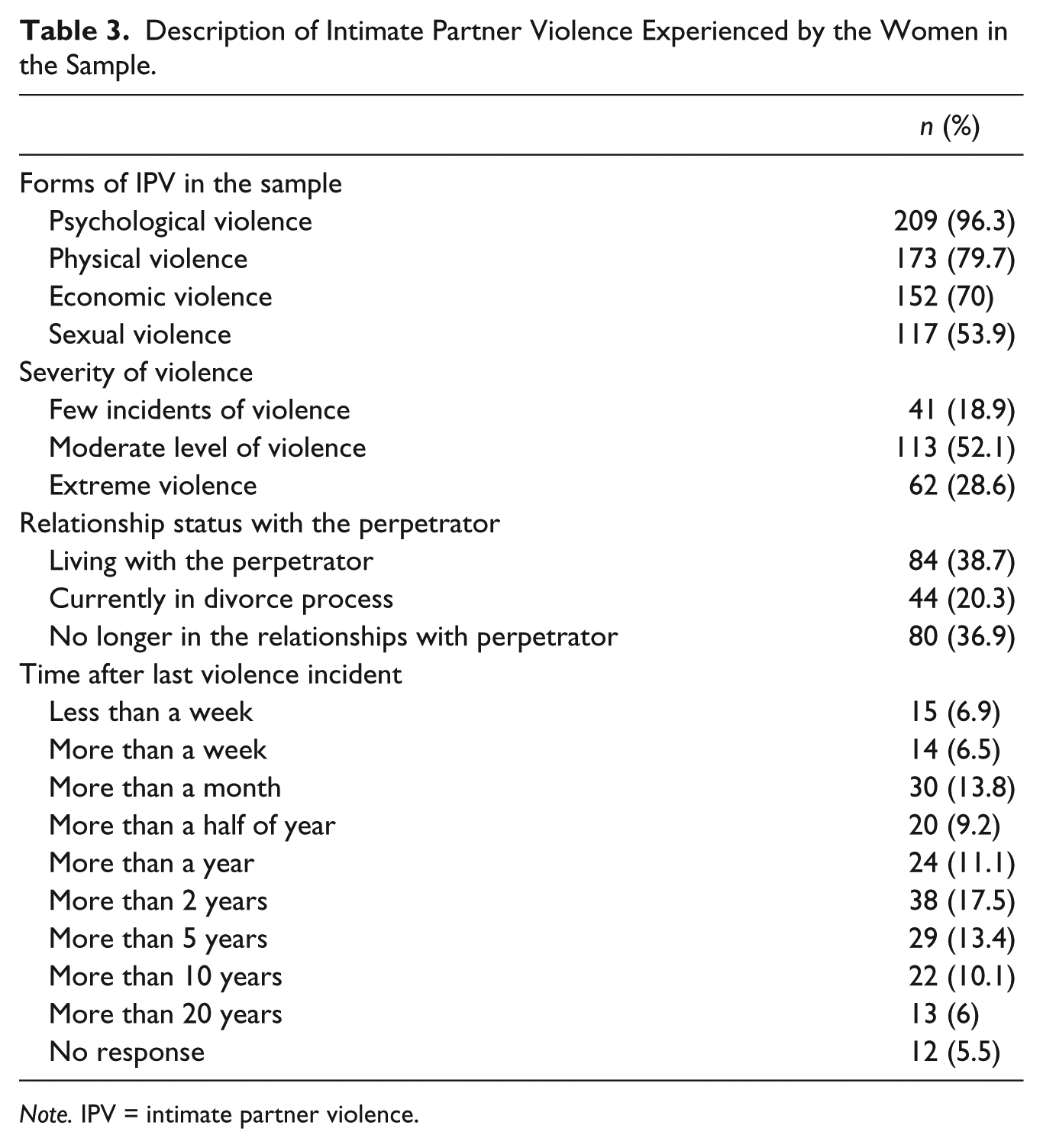
The mean age of the participants was 38.92 (SD = 10.29). Less than a half (44.6%) of the women were currently living with a partner, 31.9% were single, 20.7% had a partner but were not living together, and 2.8% were involved in episodic relationships with one or several partners. Most of those having a partner (93.8%) reported that the gender of their partner is male, 2.1% indicated that their partner is female, and 4.1% refused to report the gender of their partner. Most of the women having a partner (83.4%) were involved in long-term relationships (more than 2 years). More demographic variables are presented in Table 1. All women who participated in the current study have experienced at least one form of interpersonal violence from their partners. The IPV-related sample characteristics are presented in Table 3.
Sample Characteristics.

Measures
Social support and social nonsupport were measured with 20 items from Bosch Support Measure (Bosch & Bergen, 2006; Bosch & Schumm, 2007). Subscales of social support (e.g., “Encouraged you to share your story and feelings with others”) and social nonsupport (e.g., “Backed away from you or avoided you when they found out about the abuse”) were defined by 10 items each. Respondents rated the items on a 5-point Likert-type scale ranging from 1 (never) to 5 (always). Cronbach’s alphas of the two subscales were .94 and .92, respectively. A confirmatory factor analysis (CFA) indicated an acceptable structural validity of the scale, χ2(166) = 297.17, Tucker–Lewis index (TLI) = .92, comparative fit index (CFI) = .93, root mean square error of approximation (RMSEA) = .06. For the final analysis, the items of the two subscales were parceled following the item-to-construct balanced method (Little, Cunningham, Shahar, & Widaman, 2002). Three parceled indicators were used for each of the latent constructs of social support and social nonsupport. Here and further in the study, the model fit was tested relying on multiple indices (Little, 2013): the TLI and the CFI, with values higher than .90 indicative of an acceptable fit and values higher than .95 suggesting an excellent fit; and the RMSEA, with values below .08 indicative of an acceptable fit and values less than .05 representing a good fit.
PTG was measured with the short form of the Posttraumatic Growth Inventory (PTGI-SF; Cann et al., 2010; Tedeschi & Calhoun, 1996). The PTGI-SF consists of 10 items measuring five aspects of PTG, that is, relating to others (e.g., “I learned a great deal about how wonderful people are”), new possibilities (e.g., “I established a new path for my life”), personal strength (e.g., “I discovered that I’m stronger than I thought I was”), spiritual change (e.g., “I have a better understanding of spiritual matters”), and appreciation of life (e.g., “I have a greater appreciation for the value of my own life”). Each subscale consists of 2 items. Participants rated the items on a 6-point Likert-type scale ranging from 0 (I did not experience this change) to 5 (I experienced this change to a very great degree). Cronbach’s alpha coefficient of the full scale was .94 and for the subscales it ranged from .77 to .89. CFA indicated a good structural validity of the scale, χ2(31) = 50.30, TLI = .97, CFI = .98, RMSEA = .06. The mean scores of the subscales were used as indicators of the latent construct of PTG.
Identity processes were measured with the abbreviated version of the Dimensions of Identity Development Scale (DIDS; Luyckx et al., 2008). DIDS measures five identity processes, namely, exploration in breadth (4 items, e.g., “I am considering a number of different lifestyles that might suit me”), commitment making (3 items, e.g., “I have decided on the direction I am going to follow in my life”), exploration in depth (2 items, e.g., “I think about the future plans I already made”), identification with commitment (3 items, e.g., “Because of my future plans, I feel certain about myself”), and ruminative exploration (2 items, e.g., “I keep wondering which direction my life has to take”). In total, 14 items of the scale were used in the current study. Items were selected based on results of a pilot study with 95 adults from Lithuania. Respondents rated the items on a 5-point Likert-type scale ranging from 1 (completely disagree) to 5 (completely agree). Cronbach’s alpha coefficients for the subscales ranged from .42 to .89. However, results of the CFA were good, χ2(64) = 116.24, TLI = .94, CFI = .96, RMSEA = .06, and some authors suggest that CFA is a superior method of testing scale validity and reliability (e.g., Barbaranelli, Lee, Vellone, & Riegel, 2015). For the final analysis, the mean scores of the subscales were used as observed variables indicating identity processes.
To assess the severity of violence, we used a 16-item checklist, developed by the authors of the manuscript, based on the Composite Abuse Scale (Ford-Gilboe et al., 2016) and the Scale of Economic Abuse (Adams, Sullivan, Bybee, & Greeson, 2008). The checklist measures four types of violence, namely, psychological violence (4 items, e.g., “Tried to restrict contact with your family or friends”), physical violence (4 items, e.g., “Pushed, grabbed or shoved you”), economic violence (5 items, e.g., “Restricted you to have personal money”), and sexual violence (3 items, e.g., “Partner physically forced you to have sex”). Participants rated the items on an 8-point Likert-type scale ranging from 0 (never happened to me) to 7 (happens to me every day). Cronbach’s alpha coefficients for the subscales ranged from .82 to .92. A composite indicator based on the four types of IPV was constructed using latent profile analysis (LPA) to classify the participants on the severity of violence they experience. Models with one to five latent classes were estimated and empirically compared. Goodness-of-fit indices determine the optimal number of latent class groups. Goodness-of-fit indices assessed include the Bayesian information criterion (BIC; Nylund, Asparouhov, & Muthén, 2007) and the Lo–Mendell–Rubin likelihood ratio test (LMR-LRT). The point at which BIC values plateau indicates the optimal number of profile groups. A statistically significant LMR-LRT value indicates that a given model explains more variation than a model with one fewer group. Entropy describes homogeneity within latent class groups and differentiation between groups (Nagin & Odgers, 2010). High entropy values (≥0.80) indicate that group members are homogeneous and that each profile group is unique (Jung & Wickrama, 2008). Finally, the size of the smallest group should not be less than 25, because small groups are difficult to replicate (Wickrama, Lee, O’Neal, & Lorenz, 2016). The results of LPA are presented in Table 2. Based on the criteria described above, three severity of violence classes were chosen and they are presented in Table 3.
Latent Profile Model Fit Statistics.

Note. BIC = Bayesian information criterion; LMR-LRT = Lo–Mendell–Rubin likelihood ratio test.
Description of Intimate Partner Violence Experienced by the Women in the Sample.
Note. IPV = intimate partner violence.
The control variables of age, place of residence, personal income, education, and time after last violence episode were each measured by a single item. In addition, single items were used for measuring whether the participants were currently in an abusive relationship, the duration of the relationship, the gender of the partner (if in a relationship), whether the perpetrator is the current or/and the previous partner, the number of children under age 18 currently living with the woman, and the monthly family income per one family member, that is, household income divided by the number of persons in the household.
Results
Preliminary Analysis
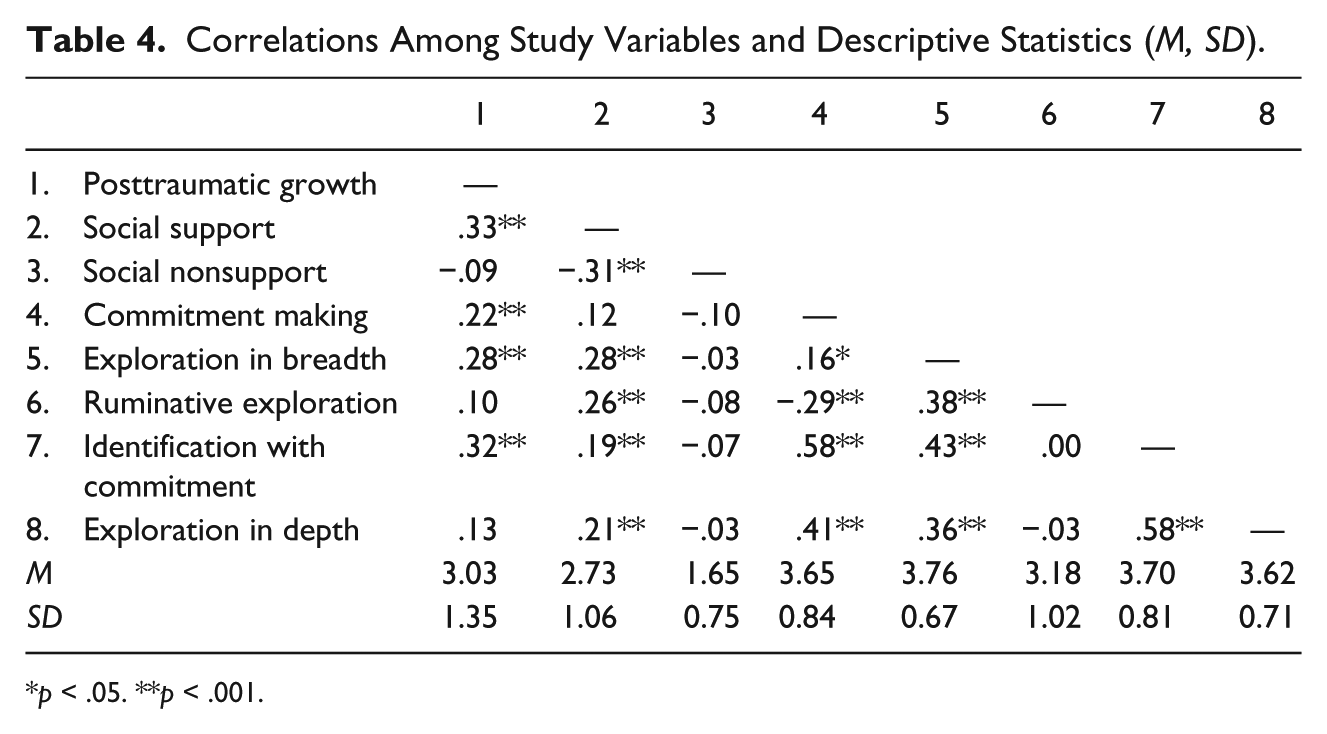
Descriptive statistics and bivariate correlations between the study variables are reported in Table 4. As can be seen, PTG and social support were positively correlated with all identity processes, whereas social nonsupport was related only to social support. Identity processes were intercorrelated in accordance with theoretical expectations, except ruminative exploration that was not related to identification with commitment and exploration in depth.
Correlations Among Study Variables and Descriptive Statistics (M, SD).
p < .05. **p < .001.
Relationship of Social Support With PTG and Identity Processes
The main purpose of this study was to examine the relationship between social support and nonsupport with PTG and identity processes among women victims of IPV. In addition, we controlled for women’s age, education, personal income, place of residence, relationship status with the perpetrator, severity of violence, and time after the last violence incident. To reach this aim, structural equation modeling was conducted in Mplus 7.4 (Muthén & Muthén, 1998-2015) by means of the maximum likelihood robust (MLR) estimator (Satorra & Bentler, 2001).
To investigate the associations between the study variables and the role of control variables for explaining these associations, we explored two structural models (Figure 1). In Model 1, we estimated only associations between social (non)support and PTG and identity processes. The model provided a good fit to the data, χ2(97) = 168.60, TLI = .95, CFI = .96, RMSEA = .06, and the significant coefficients are reported in Figure 2. As can be seen, social support was positively associated with PTG and all identity processes, except commitment making. Social nonsupport was associated only with social support (a negative relationship). Model 1 explained only 14% of the PTG variance.
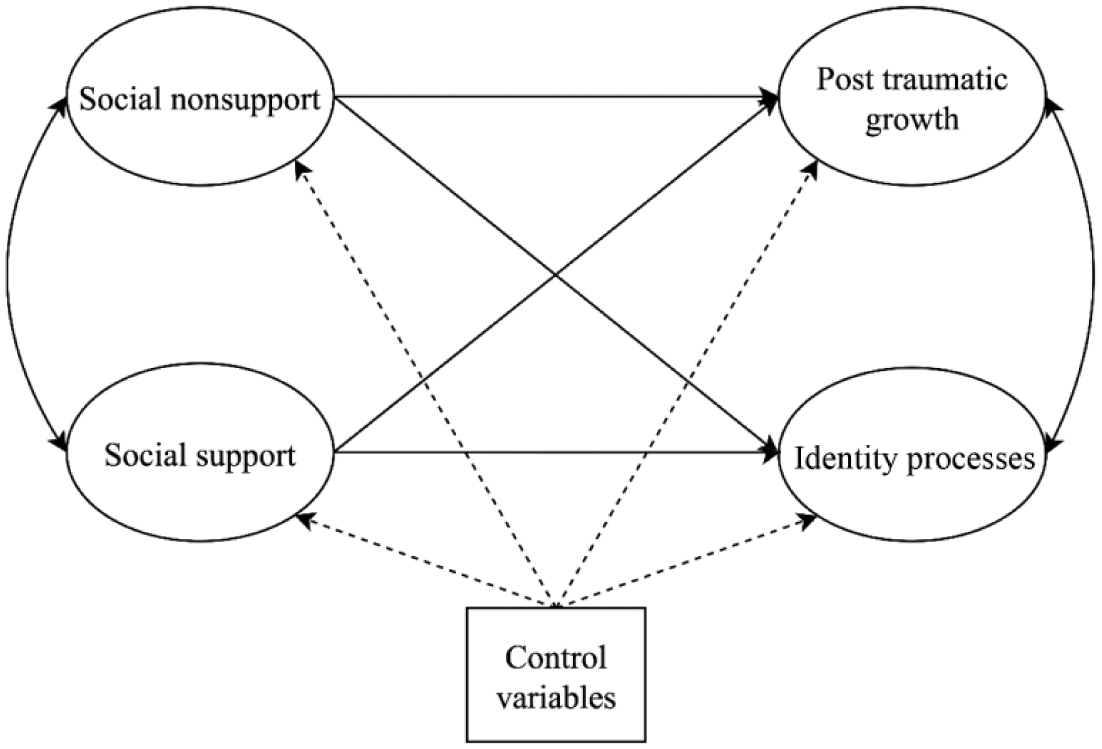
Conceptual model of study variables.
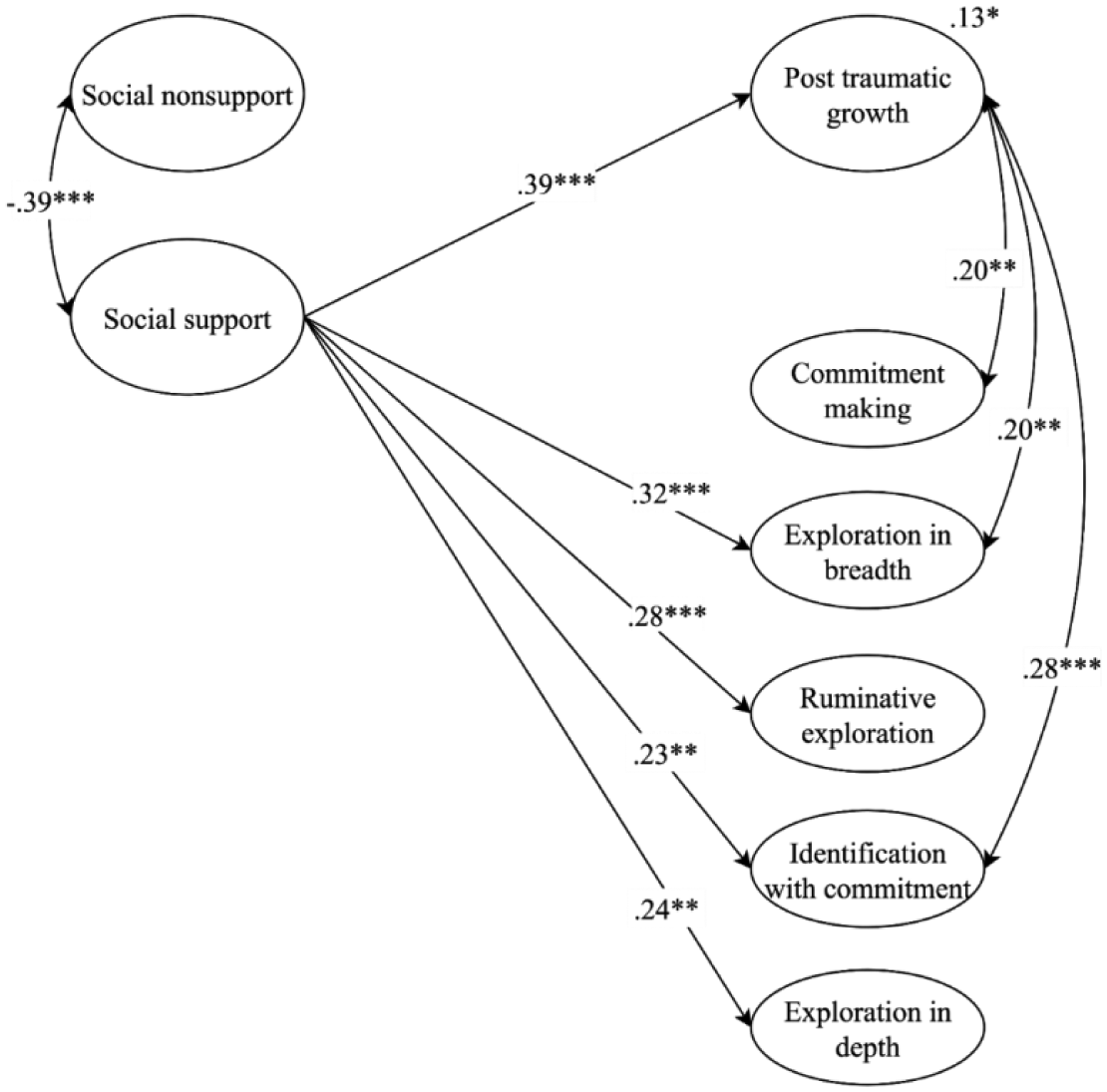
Structural model of study variables—Model 1.
In the next step, we added all control variables to the model (Model 2). It is shown in Figure 3 that this model provided even better fit to the data, χ2(363) = 544.84, TLI = .93, CFI = .95, RMSEA = .05. Moreover, Model 2 explained 36% of the PTG variance. The associations between the study variables were similar to those in Model 1. Concerning the relationships between the control variables and the study variables, we found that time after last violence, severity of violence, and personal income positively predicted PTG. Women with higher income, with more severe experienced violence, and for whom more time had passed after the last incident of IPV experienced higher rates of PTG. Education predicted PTG negatively, meaning that women with higher education experienced lower rates of PTG. Not living with the perpetrator predicted identification with commitment and exploration in depth, meaning that women who had left a violent relationship explored more in depth and had stronger identification with commitment. Women with higher income experienced less ruminative exploration, and women residing in more urban areas of Lithuania or in bigger cities experienced higher rates of exploration in depth. In addition, social nonsupport was positively predicted by education, and social support was negatively predicted by age.

Structural model of study variables—Model 2.
Discussion
The current study aimed at exploring the relationship of social support with PTG as well as with identity processes in a sample of victims of IPV. In line with other studies (Beeble et al., 2009; Cadell et al., 2003; Thornton & Perez, 2006), we found that social support emerged as an important predictor of PTG. Thus, our findings suggest that supportive relationships with others may have a buffering effect against negative consequences of traumatic experiences, help to overcome trauma, and find a meaning in painful life events.
Furthermore, social support was positively associated with the manifestation of all five identity processes, that is, with identification with commitment, commitment making, exploration in breadth, exploration in depth, and ruminative exploration. Our findings suggest that social support may encourage the reconsideration of one’s identity and foster evaluation processes of current identities as well as the formation of new ones. The findings could be interpreted using Bosma and Kunnen’s (2001) model of the process of identity development. According to this model, identity development is affected by person–context transactions which could trigger the identity development. Thus, social support provided to women who have been victims of IPV could be an important resource for their identity development, triggered by traumatic experience.
While highlighting the importance of social support, the results of our study indicate that social nonsupport may not play any role in PTG or the reconsideration of one’s identity. These results are in line with Bhandari et al.’s (2012) findings based on a sample of pregnant IPV survivors. Our results showed that being exposed to negativity of others in relation to a traumatic experience of IPV does not diminish the positive effects of positive social relationships. Therefore, despite negative social interaction, one can find ways to PTG and to reconsideration of one’s identity.
Moreover, the current study revealed positive association between PTG and positive identity processes such as commitment making, identification with commitment, and exploration in breadth. Those findings are in line with the perceived benefits resulting from identity development (Joireman et al., 2002), where self-reflection was positively related to higher levels of personal identity, perspective-taking, and openness, that is, constructs closely related to PTG. It could be that new identity-related choices may influence the processes of PTG. These findings also indicate that PTG can be important in building a new life after experiencing IPV, as it relates to actively looking for new directions and goals in life, making decisions and choices regarding these directions and goals, as well as building up confidence in what the person has decided to seek in life. Therefore, due to the unclear directionality, for future research, we suggest testing the reciprocal relationships between PTG and identity processes using longitudinal data.
Regarding the control variables, the results of our study are in line with previous research (Grubaugh & Resick, 2007; Lerner & Kennedy, 2000) in that they indicate that more time after experiencing the last IPV incident, severity of violence and higher personal income are positively associated with PTG, whereas the level of education is negatively associated with PTG. Taken together, these findings draw the attention to the rather obvious idea that time is an important factor in overcoming the interpersonal trauma, and that the victims of IPV should not be exposed to any time-related pressure regarding the recovery. Also, our study adds weight to the importance of additional support for more educated IPV victims, as a higher level of education may counteract the attainment of a new meaning in life after experiencing IPV-related traumatic events and increase the risk for social nonsupport. In addition, the results of our study support the idea that higher levels of financial independence may improve the chance of building a new life after experiencing IPV. It appears that both emotional and instrumental factors are important for helping IPV victims to cope.
Our study has strengths and limitations. A primary limitation is the cross-sectional study design that cannot inform about the directionality of the relationships between study variables. Another limitation is the heterogeneity of the studied sample that contains women with many different types of IPV. Furthermore, we could not control for relationship reunions with the perpetrators, which may be important in interpreting some study results. Also, it should be noted that to some extent the findings may be culturally specific to a Northern–Eastern European context. Among the strengths of the study are the relatively big IPV sample and that both PTG and identity processes are addressed in the same study, which has not been done before. Also, it is one of few studies investigating identity issues in an IPV sample, in particular, in the use of a quantitative approach for that purpose. A key area for future research includes the longitudinal study of the pathways to PTG and reciprocal relationships between PTG and identity.
Practical Implications
Increased understanding of the importance of social support for the recovery of IPV victims is vital for practitioners and for the development of support systems for this population. Particularly, practitioners should encourage the victims of IPV to actively seek support from friends and family, as the potential nonsupport they might meet appears to have no negative effect, whereas a gain of support can be helpful for the recovery. In addition, our findings can be used for educating bystanders of IPV and the community about the importance of active social support.
Conclusion
In summary, the results of the current study highlight the important role of social support in seeking positive personal resolutions after experiencing traumatic events of IPV. In particular, the findings indicate that social support, but not social nonsupport, predicts higher levels of PTG and the development of new positive identities. In addition, our findings emphasize the importance of contextual factors, such as time after last violent episode, severity of violence, and personal income for supporting PTG. With regard to identity development, important factors were age of the victim, personal income, place of residence, time after last violence, and relationship status with the perpetrator. Psychologists and other practitioners, working with women who have been victims of IPV, should be aware of the importance of these factors for positive growth in the aftermath of the trauma.
Footnotes
Open Practices
The raw data analyzed in this manuscript are not openly available to respect the agreement with participants of the study that their responses to the questionnaire will not be openly shared. These, however, can be obtained from the corresponding author for reanalysis following the completion of a privacy and fair use agreement. The materials (printout of an electronic survey) used in the survey are not openly available but can be obtained from the corresponding author upon a reasonable request.
Declaration of Conflicting Interests
The author(s) declared no potential conflicts of interest with respect to the research, authorship, and/or publication of this article.
Funding
The author(s) disclosed receipt of the following financial support for the research, authorship, and/or publication of this article: This work was supported by grant from the Lithuanian Research Council (P-MIP-17-132).
