



Abstract
The goals of this study were to examine the bidirectional associations between parental harsh discipline and Chinese preschool children’s inhibitory control and to further explore the possible gender differences in these associations. Participants were Chinese preschool children and their parents. At Time 1 (T1) and Time 2 (T2), both fathers and mothers, respectively, reported their use of psychological aggression and corporal punishment, and children’s inhibitory control was assessed by laboratory tasks and maternal rating. Structural equation modeling revealed that child inhibitory control significantly predicted both paternal and maternal psychological aggression and corporal punishment 1 year later, but the predictions from both types of parental harsh discipline to child inhibitory control were nonsignificant. Multiple-group analyses further suggested that boys’ but not girls’ inhibitory control could significantly predict paternal corporal punishment 1 year later, and no child gender differences existed for parental psychological aggression or for maternal corporal punishment. The findings suggest that the longitudinal associations between parental hash discipline and preschool children’s inhibitory control in China may differ according to the types of harsh discipline and parental and children’s gender.
As a core component of executive functions, inhibitory control refers to the ability to inhibit the dominant impulse to respond and engage in subdominant reaction in the service of goal-directed behavior (Diamond, 2016; E. K. Miller & Cohen, 2001). Many studies found that inhibitory control was related to many abilities like intelligence and theory of mind (e.g., Duggan & Garcia-Barrera, 2015), and also played an important role in some key developmental outcomes, such as academic achievement and social adjustment (e.g., Masten et al., 2012; Moffitt et al., 2011).
Associated with the maturation of prefrontal cortex, inhibitory control emerges around 12 months of age and develops rapidly during the preschool years (Garon, Bryson, & Smith, 2008). Despite the findings indicating that individual differences in inhibiting capability were almost genetic (Friedman et al., 2008), environmental factors were also suggested to influence the development of inhibitory control (Matte-Gagné & Bernier, 2011; Moilanen, Shaw, Dishion, Gardner, & Wilson, 2010). Given that family is still the main developmental setting for the young preschool children, parenting behaviors are often considered as good candidates for inhibition growth.
To date, many studies examined the effects of positive parenting on child inhibitory control and suggested that higher responsiveness or warmer autonomy support was associated with more positive change in child inhibitory control (e.g., Merz, Landry, Montroy, & Williams, 2017; Spruijt, Dekker, Ziermans, & Swaab, 2018). Although the effects of negative parenting on child inhibitory control were less studied now, it was suggested that negative and harsh parenting focused on the degree to which parents intrude on children’s interests and behaviors above and beyond the developmental or safety needs of the child, and would disrupt children’s acquisition of adaptive regulatory skills (Blair et al., 2011). Meanwhile, social-cognitive theories also posited that children’s capacities to acquire inhibitory control might be undermined by negative control (Grolnick & Pomerantz, 2009).
Moreover, although limited, the associations between negative parenting and child inhibitory control still received some empirical support. For example, one cross-sectional study found the deleterious effects of parental corporal punishment, a form of harsh discipline, on preschooler’s executive function, including inhibitory control (Xing, Wang, & Wang, 2018). Similarly, longitudinal studies also indicated that negative controlling behaviors such as discipline, harsh punishment, and ignoring could predict poor development of child inhibition control, even after controlling for the baseline of children’s cognitive abilities or behavior problems (Lucassen et al., 2015; Roskam, Stievenart, Meunier, & Noël, 2014).
Nevertheless, it should be noted that most available studies relied on cross-sectional design, and the limited existing longitudinal studies largely restricted to parent-driven effects, while ignoring the child-driven effects, that is, the effects of child inhibitory control on parenting behavior. According to Bell’s (1968) bidirectional theory of parent–child relations and Sameroff’s (1975) transactional models of development, the nature of parent–child relations should be bidirectional and both child and parent effects can be expected. In this regard, Roskam et al. (2014) suggested that, in addition to parental behavior shaping children’s inhibitory control, an increase in children’s inhibition capacities might also lead to fewer behavioral problems and, thus, a decrease in the controlling style of mothers. However, to our knowledge, only one longitudinal study examined the bidirectional associations between parental behavior and child inhibition, but it only focused on parental responsiveness and found that higher Time 1 (T1) parental responsiveness predicted more positive gain in delay inhibition from T1 to Time 2 (T2), and higher delay inhibition also predicted more positive change in parental responsiveness (Merz et al., 2017).
Although the mutual influences between negative parenting and child inhibitory control was less well demonstrated to date, those research focusing on harsh discipline and child externalizing problem behavior, could to some extent provide empirical support for this bidirectional hypothesis given that externalizing symptoms may reflect the developmental deficiency of inhibitory control. It was found that higher harsh discipline would increase children’s aggression, and higher aggressive children would also elicit more physical or psychological aggression from their parents (Baydar & Akcinar, 2017; Wang & Liu, 2018). Nevertheless, given the extreme sparsity of direct empirical evidence, the primary aim of this study was to extend the notion of reciprocity in parent–child relationships to parental harsh discipline and child inhibitory control.
Chinese contexts may be of special theoretical interest to examine the above issue. In Confucian and Taoist philosophies, the importance of instilling self-discipline and inhibiting impulse control in children is highly valued and are encouraged in Chinese societies; thus, the exhibition of impulsive or uncontrollable behavior is perceived by parents to be a sign of social immaturity and incompetence and is considered to bring disgrace and shame to parents and the family. Within such a cultural context, Chinese parents often expect and try to socialize their children to do and act properly, or to avoid doing certain things (Lan et al., 2009). Meanwhile, parental spanking and scolding is often viewed as an indication of parental love and concern in Chinese families; thus, parents have a great tendency to respond physically to the child when he or she displays impulsive behavior (Chao, 1994).
Parental harsh discipline is typically defined as using any physical or psychological force with the intention of causing physical or emotional pain to correct or control the child’s behavior (Hecker, Hermenau, Salmen, Teicher, & Elbert, 2016), and it is often classified into three forms: psychological aggression, corporal punishment, and physical abuse. According to a large sample survey in mainland China (Wang & Liu, 2014), psychological aggression and corporal punishment are commonly used forms of harsh discipline in Chinese families. Given the low occurrence of physical abuse, this study primarily focused on psychological aggression and corporal punishment. Psychological aggression refers to verbal and symbolic acts used by parent intended to cause psychological pain or fear on the part of the child, and corporal punishment refers to the use of physical force with the intention of causing the child to experience pain, but not injury, for the purpose of correcting the child’s undesirable behavior (Straus, 2001; Straus, Hamby, Finkelhor, Moore, & Runyan, 1998).
Notably, prior research on the relations between parental harsh discipline and child developmental outcomes primarily focused on only one type of harsh discipline or treated harsh discipline as a single category (e.g., Lansford et al., 2011). However, the strength or direction of relations between parental harsh discipline and child developmental outcomes were suggested to vary by disciplinary subtypes (Lansford et al., 2010; Wang & Liu, 2018). Thus, by focusing on the above two types of parental harsh discipline, this study aimed to further examine whether the bidirectional associations between parental harsh discipline and child inhibitory control would differ for psychological aggression and corporal punishment.
Besides, another issue considered in this study is the influence of gender on the hypothesized bidirectional associations between parental harsh discipline and child inhibitory control. Many of the studies incorporating parent gender or child gender have examined whether and how the frequency of use of harsh discipline and its relations with children’s developmental outcomes differ across different parent–child dyads (Chang, Schwartz, Dodge, & McBride-Chang, 2003). Much less explored is the possibility that bidirectional parent–child relations may differ depending on both parent and child gender. It would be interesting and valuable to explore this issue within Chinese context. First, Chinese culture has refined the different roles for fathers and mothers in Child rearing. Shek (2005) suggested that the notion of “strict father, kind mother” in the traditional Chinese culture should be changed into the notion of “strict mother, kind father” in the contemporary Chinese culture. Thus, simultaneously including both mothers’ and fathers’ behaviors to explore the potential parental gender differences in the above associations would be very interesting. Second, some child gender differences existed in the inhibitory abilities (e.g., Kloo & Sodian, 2017). Typically, girls often outperformed boys, and boys tended to show more inappropriate or uncontrollable behaviors than girls in daily life. On one hand, boy’s higher level of impulsivity may lead to more harsh discipline. On the other hand, parents may be more likely to use strict strategies to discipline boys even when they exhibited the same misbehavior as girls. Moreover, it has been suggested that fathers often take more responsibility to discipline their sons but leave the parenting of daughters to mothers (Ho, 1986), that is to say, children will spend more time with their same-gender parents. Thus, it was conceivable that parents would have more opportunities to discipline their same-gender children, and meanwhile children’s misbehavior may also be more likely to trigger disciplinary practices from the same-gender parents. Despite these theoretical basis and cultural context, given the relative paucity of research on this issue, we did not generate a priori hypotheses regarding potential gender effects, but sought to conduct exploratory analyses.
In summary, by conducting a two-time points longitudinal study among Chinese preschoolers and their parents, we collected data on paternal and maternal psychological aggression and corporal punishment, and child inhibitory control at T1 and T2. To minimize the effects of shared method variance, we used parental-reports of parental harsh discipline, behavioral experimental assessments, and mother-report of inhibitory control. First, we examined whether the association between parental harsh discipline and child inhibitory control would be bidirectional and whether the bidirectional associations would differ for psychological aggression and corporal punishment. Second, we explored the potential gender differences in the above bidirectional associations by using multiple-group comparison.
Method
Participants
Participants were recruited from three kindergartens in Beijing, China. A total of 322 children and their parents participated at T1, and 294 children and parents participated at T2. The final sample that had complete data of both parents reports and laboratory assessment at two time points consisted of 276 children (50.72% boys, Mage = 4.12, SD = 0.31 at T1) and their fathers (Mage = 36.63, SD = 4.78 at T1) and mothers (Mage = 34.47, SD = 4.08 at T1). No significant differences were found between the analytic sample and the attrited sample.
Approximately 10% of the mothers and 8% of the fathers had an educational level of high school or less, 24% of the mothers and 21% of the fathers had an education of junior college or professional training school, and 66% of the mothers and 71% of the fathers had an education of university undergraduate or graduate. Maternal and paternal median incomes ranged from 6,000RMB to 10,000RMB and 10,000RMB to 15,000RMB per month, respectively. Nearly 74% of the mothers and 80% of the fathers held a professional, managerial, or technical position (e.g., teacher, doctors), 18% of the mothers and fathers were employed at working class jobs (e.g., factory workers), and 8% of the mothers and 2% of the fathers were unemployed.
Procedures
The data were respectively gathered during spring 2015 (T1) and 2016 (T2). Parental written informed consents for all participating children were first obtained. Then two packets (one for the mother and one for the father) containing the parental questionnaires were sent to parents. Parents were instructed to complete the questionnaires separately at home and returned them to the preschool in sealed envelopes. Researchers collected the questionnaires from the teachers. Meanwhile, young children were asked to complete three inhibitory control tasks under the guidance of the researchers in a quiet preschool classroom. The assessment lasted about 15 min. Finally, each child was given a small gift. All procedures for this study were approved by the institutional review board of School of Psychology at Capital Normal University.
Measures
Parental harsh discipline
Parental harsh discipline was measured with the Chinese version of the Parent–Child Conflict Tactics Scales (CTSPC, Straus et al., 1998; Wang & Liu, 2018). Twenty-two items in CTSPC were used to assess the parental disciplinary strategies, which was divided into five subscales: Nonviolent Discipline, Psychological Aggression, Corporal Punishment, Severe Physical Abuse, and Very Severe Physical Abuse. Five items (e.g., “shouting, yelling, or screaming at me”) of Psychology Aggression subscale and six items (e.g., “spanking me on the bottom with hand”) of Corporal Punishment subscale were used in this study. Separately, the fathers and the mothers rated how often they applied specific behaviors toward their children in the past year on a scale from 0 (never) to 6 (more than 20 times a year). Finally, scores for psychological aggression and corporal punishment were obtained separately for mothers and fathers by summing the frequency scores of the corresponding items.
The Chinese version of the CTSPC has demonstrated adequate internal reliability in past research (e.g., Tang, 2006; Wang & Liu, 2014). In this study, the Cronbach’s alpha coefficients of the psychological aggression subscale at two assessments were .68 and .65 for mothers, and .58 and .70 for fathers, respectively, and the alphas of the corporal punishment subscale at two assessments were .68 and .70 for mothers, and .54 and .74 for fathers, respectively. These alphas are consistent with those obtained in previous research.
Laboratory assessment of inhibitory control
Three inhibitory control tasks from Executive Function Touch program developed by Willoughby and his colleagues were used in this study—the Spatial Conflict Arrows, Pig, and Silly Sounds Game (Willoughby, Wirth, & Blair, 2012;, Wirth, & Blair, 2012; Willoughby, Wirth, Blair, & Greenberg, 2010). The brief description of each task is provided below.
The spatial conflict arrow
In this task, two green buttons appear on both sides of the screen for the first time, and then the arrows appear at different locations on the top of the screen. The child was instructed to touch the left button when arrows pointed to the left and to touch the right button when arrows pointed to the right, no matter whether the arrows appeared on the left or right side.
Pig
This is a standard Go-No Go task. The child was instructed to click the button every time when they saw an animal (Go), except when that animal was a pig (No-Go). No-go responses vary in difficulty depending on how many go responses preceded them.
Silly sounds game
This task was a Stroop-Like task. The child was presented a cat picture and a dog picture on the screen and then was instructed to click on the cat picture when they heard the woof sound and to click on the dog picture when they heard the meow sound.
Maternal rating of inhibitory control
The Chinese version of the Behavior Rating Inventory of Executive Function-Preschool version (BRIEF-P) was used to measure children’s inhibitory control (Gioia, Espy, & Isquith, 2003; Lu et al., 2017). Sixty-three items are grouped into five subscales: working memory, plan/organize, inhibition, emotional control, and shifting. Based on our research goal, the inhibition subscale was used as an index of child inhibitory control in home setting. Mothers were asked to rate how often a particular behavior has been a problem during the past 6 months on a 3-point scale (never, sometimes, and often). The Cronbach’s alphas for the inhibition subscale in this study were .84 at T1 and .87 at T2.
Exploratory factor analyses indicated that three laboratory assessments and maternal rating of inhibitory control clustered into a single scale (factor loading ranging from .35 to .76 in 2015 and from .40 to .76 in 2016), we created a composite index by standardizing and averaging children’s scores on the laboratory assessment and maternal rating to derive an omnibus measure of children’s inhibitory control in multiple settings.
Demographic information
Demographic information was collected via mother report. This study included items related to the child’s age, gender, parental education, occupation, and current income. The index of socioeconomic status (SES) was calculated by standardizing and averaging the data about the maternal and paternal education, occupation and income level, with higher scores reflecting higher family SES.
Analytic Strategy
First, descriptive statistics and correlation coefficients were calculated on the main study variable. Second, two cross-lagged structural equation models were used to examine the bidirectional associations between parental harsh discipline (psychological aggression and corporal punishment, respectively) and children inhibitory control in Mplus 7.0. Third, multiple-group analyses were conducted to test the gender differences in the bidirectional associations. Specifically, models were first run with paths free to vary across boys and girls (unconstrained model). Then path coefficients were constrained to be identical all at once (constrained model). Chi-square difference tests were used to compare the relative fit between the above two models, and a series of Wald tests of parameter constraints were further used to assess whether coefficients for boys and girls were significantly different.
Results
Descriptive Statistics
Independent samples t test showed that boys and girls had significant gender differences in paternal corporal punishment (t = 2.79, p < .01 at T1, t = 2.31, p < .05 at T2) and child inhibitory control (t = 3.07, p < .01 at T1, t = 2.58, p < .05 at T2). Specifically, boys were more likely to experience paternal corporal punishment than girls (M = 4.85, SD = 6.91 for boys, M = 2.75, SD = 5.49 for girls at T1; M = 4.32, SD = 8.92 for boys, M = 2.34, SD = 4.83 for girls at T2), and girls performed better on inhibitory control than boys (M = −0.14. SD = 0.83 for boys, M = 0.14, SD = 0.66 for girls at T1; M = −0.11, SD = 0.84 for boys, M = 0.12, SD = 0.63 for girls at T2). Descriptive statistics and correlations among the main variables were presented on Table 1. As shown, child age was positively associated with inhibitory control at T1, r = .14, p < .05, and family SES was positively associated with child inhibitory control, r = .17, p < .01 at T1, r = .14, p < .05 at T2. In addition, the correlations for the full samples also indicated that paternal and maternal harsh discipline (including psychological aggression and corporal punishment) were significantly correlated to child inhibitory control both within and between assessment waves, expect for the correlations between paternal psychological aggression at T1 and child inhibitory control at T2, and between child inhibitory control at T1 and paternal harsh discipline at T2.
Descriptive Statistics and Correlations Among the Main Study Variables.
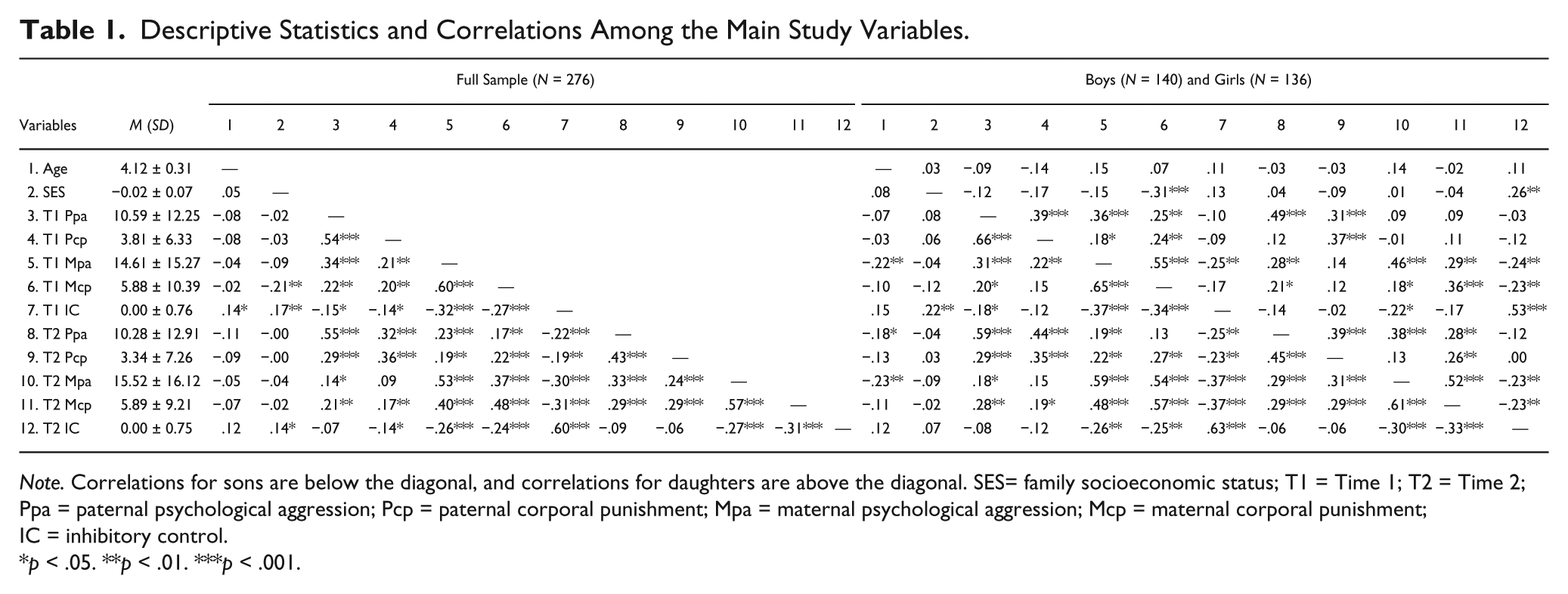
Note. Correlations for sons are below the diagonal, and correlations for daughters are above the diagonal. SES= family socioeconomic status; T1 = Time 1; T2 = Time 2; Ppa = paternal psychological aggression; Pcp = paternal corporal punishment; Mpa = maternal psychological aggression; Mcp = maternal corporal punishment; IC = inhibitory control.
p < .05. **p < .01. ***p < .001.
Cross-Lagged Analysis
Two structural equation models were established to examine the bidirectional relations between harsh discipline and inhibitory control, separately for corporal punishment and psychological aggression. Good-fitting models are traditionally indicated by a nonsignificant chi-square, a value greater than 0.90 for the comparative fit index (CFI) and a value less than .08 for the root mean square error of approximation (RMSEA). In this study, both models for psychological aggression and corporal punishment showed a good fit with the data—psychological aggression model: χ2 = 1.70, df = 4, CFI = 1.00, RMSEA = .00, standardized root mean square residual (SRMR) = .01; corporal punishment model: χ2 = 10.63, df = 4, CFI = .98, RMSEA = .077, SRMR = .03.
Psychological aggression
As shown in Figure 1, paternal psychological aggression, β = .54, p < .001; maternal psychological aggression, β = .48, p < .001; and child inhibitory control, β = .58, p < .001, showed high stabilities from T1 to T2. After controlling family SES, child inhibitory control at T1 could negatively predict paternal psychological aggression, β = −.13, p < .01, and maternal psychological aggression at T2, β = −.15, p < .01, whereas paternal, β = .04, p > .05, and maternal psychological aggression, β = −.08, p > .05, at T1 could not significantly predict child inhibitory control at T2.
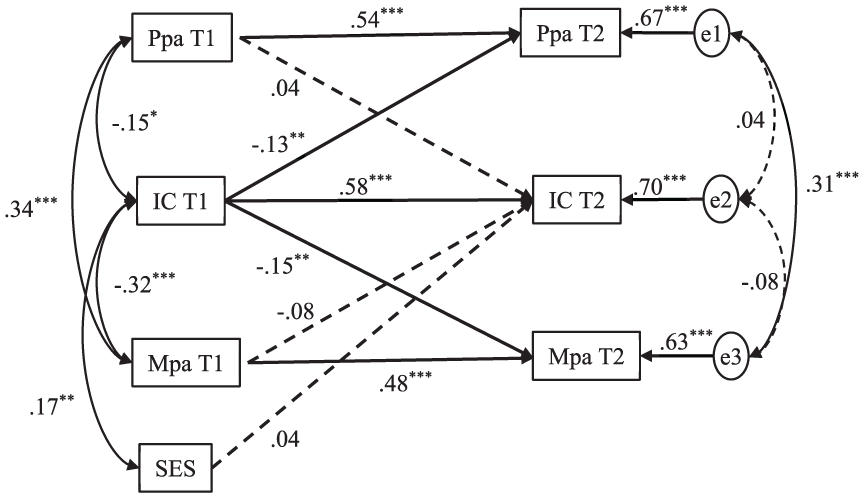
Results of structural equation analysis evaluating the reciprocal effects between parental psychological aggression and child inhibitory control.
Corporal punishment
As shown in Figure 2, paternal corporal punishment, β = .33, p < .001; maternal corporal punishment, β = .41, p < .001; and child inhibitory control, β = .57, p < .001, showed high stabilities from T1 to T2. After controlling family SES, child inhibitory control at T1 could significantly predict paternal, β = −.14, p < .05, and maternal corporal punishment at T2, β = −.20, p < .001, whereas paternal, β = −.04, p > .05, and maternal corporal punishment, β = −.09, p > .05, at T1 could not significantly predict child inhibitory control at T2.
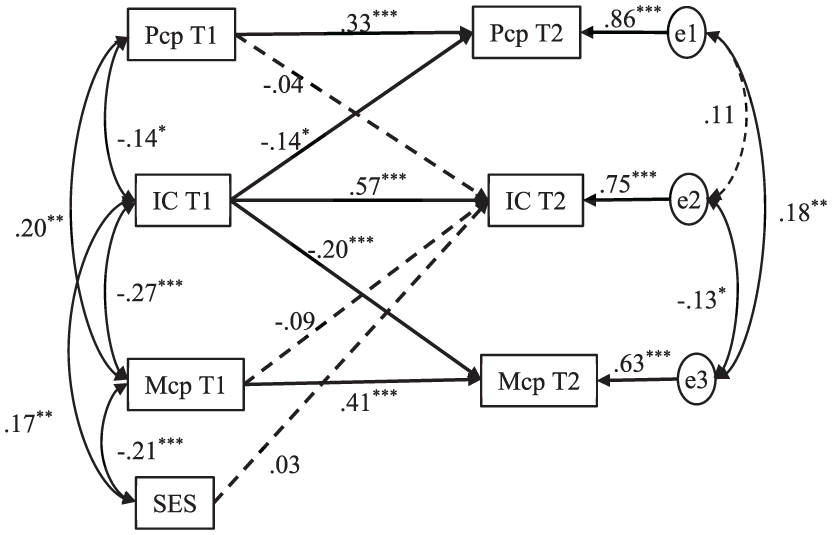
Results of structural equation analysis evaluating the reciprocal effects between parental corporal punishments and child inhibitory control.
Multiple-Group Analyses
Based on the above two models, we further conducted multiple-group analyses to explore the potential gender differences in the cross-lagged effects. Both the unconstrained and constrained models provided good fit to the data, unconstrained models: χ2 = 6.31, df = 8, CFI = 1.00, RMSEA = .00, SRMR = .02 for psychological aggression, χ2 = 7.40, df = 8, CFI = 1.00, RMSEA = .00, SRMR = .03 for corporal punishment; constrained models: χ2 = 13.12, df = 15, CFI = 1.00, RMSEA = .00, SRMR = .04 for psychological aggression, χ2 = 21.68, df = 15, CFI = .96, RMSEA = .06, SRMR = .06 for corporal punishment; significant differences were found for parental corporal punishment model, Δχ2(7) = 15.07, p < .05, but not for parental psychological aggression model, Δχ2(7) = 6.85, p > .05. A series of Wald tests further indicated that only the path from child inhibitory control at T1 to paternal corporal punishment at T2 showed significant gender difference, Wald χ2(1) = 5.50, p < .05, with boys’ but not girls’ inhibitory control significantly predicting paternal corporal punishment, β = −.19, p < .01 for boys, β = .02, p > .05 for girls. Although boys’ but not girls’ inhibitory control at T1 could significantly predict maternal corporal punishment at T2, β = −.21, p < .01 for boys, β = −.11, p > .05 for girls, the gender difference in the path from child inhibitory control to maternal corporal punishment was not significant, Wald χ2(1) = 1.42, p > .05. Besides, there were no significant child gender differences on the stability paths and the paths from paternal/maternal corporal punishment to child inhibitory control, Wald χ2(1) < 2.64, ps > .05. The standard path coefficients were shown on Figure 3.

Results of multigroup structural equation analysis evaluating the cross-lag effects between parental corporal punishment and child’s inhibitory control.
Discussion
Guided by multiple transactional theories from the fields of developmental and family science (Bell, 1968; Sameroff, 1975), this study examined the possible bidirectional associations between maternal and paternal harsh discipline and child inhibitory control, and further explored whether child gender would make difference in the above associations. Contrary to our expectations, the findings did not support the bidirectional associations for the full sample. Specifically, child-driven effects, but not parent-driven effects, appeared in the associations between parental harsh discipline and child inhibitory control, and the effects did not differ by the types of harsh discipline in the full sample. Furthermore, results from multiple-group analyses suggested that boys’ but not girls’ inhibitory control could significantly predict paternal corporal punishment 1 year later. These findings suggest that the associations between parental harsh discipline and child inhibitory control in Chinese preschooler samples are best explained by child-driven effects and these effects may vary according to the types of harsh discipline and parent and child gender.
Results from the cross-lagged models did not support our initial hypothesis and the bidirectional model of parenting and child developmental outcomes postulated by those bidirectional theories (Bell, 1968; Sameroff, 1975), and we found that based on the full sample, child inhibitory control at T1 negatively predicted both paternal and maternal harsh discipline at T2 regardless of the types of harsh discipline, whereas the reverse was not established. That is to say, child-driven effects but not parent-driven effects were supported in Chinese preschooler samples. These results possibly reflect Chinese parental reaction to the impulsive or uncontrolling characteristics of the young children. Typically, compared with children with high inhibitory abilities, children who pose many challenges for their parents because of noncompliance or some other impulsive behaviors tend to make greater demands on parental time and skill, and also challenge parents’ patience. Especially in the Chinese cultural context emphasizing the restraint of impulsive behavior and less accepting children’s noncompliance (Chao, 1994), it is imperative for parents to take immediate action to suppress the child’s uncontrollable behavior. The immediacy of the parenting action as well as the elicited anxious or angry feelings may increase the likelihood that parents would engage in rapid and automatic information processing, which in turn may induce the occurrence of reactive, easily instituted, and parent-centered tactics such as psychological aggression and corporal punishment rather than planful, reasoned out, and child-centered disciplinary tactics (e.g., inductive reasoning) that commonly require greater patience to implement (Grusec & Goodnow, 1994; P. C. Miller, Shim, & Holden, 1998). Overall, by using longitudinal design, our results presented more rigorous evidence suggesting that child characteristics played a significant role in explaining why some parents are more likely than others to use harsh discipline.
In addition, although it has been suggested that there is a sensitive period in the infant and preschool years when genetic and contextual factors (e.g., parenting) influence inhibitory control (Kiff, Lengua, & Zalewski, 2011), our findings did not find significant prediction from parental harsh discipline to child later inhibitory control, which tends not to support the above notion. Despite that, we should be cautious about interpreting the absence of parent-driven effects in our study given the short-term nature of our study; the current findings are consistent with some other longitudinal studies showing that child-driven effects but not parent-driven effects existed at the earlier ages (Tiberio et al., 2016; Verhoeven, Junger, van Aken, Deković, & van Aken, 2010) and also to some extent supported theories regarding evocative gene-environment correlations where differential genetic risks among children are posited to evoke differential parenting (Scarr & McCartney, 1983).
Moreover, it has been suggested that the strength and direction of associations between parenting and child developmental outcomes such as controlling abilities depend on the child’s developmental stage (Tiberio et al., 2016). For example, it has been found that at younger ages (3-7 years old) children’s effortful control influenced parenting, whereas at older child ages, parenting influenced children’s effortful control (Tiberio et al., 2016). During preschool years, the emerge of sophisticated language skills or the maturation of the prefrontal cortex contributes a strong push for the development of inhibitory abilities (Fuhs & Day, 2011). Although at the same time parents begin to impose rules and limits to train children’s self-regulation skills, perhaps changes in individual differences in the levels of inhibitory abilities during preschool period may be more dependent on intrinsic variability within children than on extrinsic variability such as parenting behaviors (Verhoeven et al., 2010). Of course, further examination is needed before conclusions can be made regarding the relative contributions of individual or environmental factors to the development of child inhibitory control across different developmental stages. Besides, the short-term longitudinal nature of our study also limited us to explore whether the bidirectional patterns found by Tiberio et al. (2016) were also applicable to the associations between parental harsh discipline and children’s inhibitory control. This issue await investigation with longitudinal designs that include three (or more) time points, assess parental harsh discipline and child inhibitory control across developmental periods from infancy to adult. Nevertheless, to some extent, these results emphasized the importance of considering the often-overlooked influence that children have on their parents in family studies, and provided additional empirical support for the notion that children’s unique characteristics, at least in preschool years, could provide an important context for parenting, especially given that preschool period is rarely studied compared with adolescence.
As regards to the gender differences in the longitudinal associations between parental harsh discipline and child inhibitory control, it was found that child-driven effects on paternal corporal punishment differed across genders, with boys’ but not girls’ low levels of inhibitory control eliciting more paternal use of corporal punishment. However, no child gender differences were found in the associations between maternal corporal punishment and child inhibitory control or between both parental psychological aggression and child inhibitory control. The possible explanation for the above results may be related to the severity of two types of harsh discipline and the unique roles of Chinese fathers in disciplining boys.
Generally, corporal punishment is often viewed as more aggressive and intrusive than psychological aggression; however, psychological aggression, characterized by threatening, shouting, or yelling, is more likely to occur (Mckee et al., 2007; Straus & Field, 2003). When dealing with children’s impulsive or noncompliant behavior, fathers and mothers might initially tend to use similar levels of less serious disciplinary techniques (e.g., psychological aggression) with boys and girls, but if psychological aggression does not work, parents would further resort to harsher forms of discipline such as corporal punishment (Sheehan & Watson, 2008). As found in our study, compared with girls, boys often show lower levels of inhibitory abilities. Thus, boys may be more likely to challenge parents’ patience and elicit parents’ use of harsher discipline such as corporal punishment. Furthermore, notably, in Chinese families, fathers are believed to be especially responsible for boys’ disciplinary issues (Chang et al., 2003; Ho, 1986). In one study conducted in China, fathers have been found to be more likely to use harsh discipline with sons than with daughters (Chang et al., 2003). In addition, one previous cross-sectional study also demonstrated that fathers were more likely to use harsh physical discipline than mothers with their sons, yet paternal and maternal use of harsh verbal discipline did not vary by gender of their child (Mckee et al., 2007). Given the above, it may be thus understandable that child gender differences existed in the child-driven effects on paternal corporal punishment but not on maternal corporal punishment or parental psychological aggression. Expanding on the previous research by using a longitudinal design, this study provided more rigorous empirical evidence for the suggestion that the associations between parental harsh discipline and Chinese children’s developmental outcomes may differ for two types of harsh discipline and for different parent–child dyads.
It is important to note several limitations of this study. First, all the parents in this study came from Beijing, where the residents were well educated and had a relatively high income compared with other citizens in China (National Bureau of Statistics of China, 2016), which may limit the generalizability of the findings to lower SES populations. Increasing the diversity of the sample and the number of samples from diverse economic and educational backgrounds is needed in the future research. Second, the focus of this study on preschool children from Beijing limited our ability to generalize our findings to younger or older children. Research on samples at different developmental periods is warranted. Third, although two-wave longitudinal study is superior to those cross-sectional study in exploring the directions of associations between parental harsh discipline and child outcomes, longitudinal designs that include more time points would be helpful in testing and understanding the dynamics of the bidirectional processes at different stages of development. Fourth, although we simultaneously used mother-report and behavioral experimental assessment to measure child inhibitory control, parental harsh discipline was measured only by parental self-report, which may result in biases related to social desirability. Fifth, although our study included both fathers and mothers, and also examined psychological aggression and corporal punishment separately, we only focused on one component (inhibitory control) of child self-regulation skills, and it accounted for only a small amount of variance in the measure of paternal and maternal psychological aggression and corporal punishment. This suggests that other child factors not measured in this study may contribute to the risks of Chinese parental use of harsh discipline, such as emotion regulation skills. Finally, the relatively low to modest internal reliabilities of the scales especially the psychological aggression and corporal punishment subscales of CTSPC in this study should be acknowledged. This may have weakened the relations among study variables. The low reliabilities of CTSPC subscales may reflect a broader measurement issue that affects the assessment of parental discipline and may indicate that further refinement of assessment strategies may be required.
Despite these limitations, this study provides an important supplement and extension to the previous research and also has important practical implications. First, by using longitudinal design, this study presented new evidence from Chinese societies for the often-overlooked but important influence of child characteristics on parental harsh discipline, at least during early childhood. These findings also suggested the possibility to decrease parental harsh discipline by promoting children’s regulation skills. Meanwhile, enhancing parents’ knowledge and understanding of young children’s developmental limitations in inhibitory abilities, as well as promoting parents’ coping skills on how to handle children’s uncontrollable behavior in adaptive way might be also effective in decreasing parental harsh discipline. Second, by including both fathers and mothers and both psychological aggression and corporal punishment in the analyses, this study further suggested that the association between parental harsh discipline and child developmental outcomes may differ according to the types of harsh discipline at play and parent and child gender. Finally, by demonstrating that boys’ low inhibitory control could increase the future risk of paternal corporal punishment, this study highlighted the need to provide parenting interventions for those Chinese fathers having sons with poor inhibitory abilities.
Footnotes
Acknowledgements
The authors are grateful to all the children, parents, and teachers who participated or contributed to this project.
Declaration of Conflicting Interests
The author(s) declared no potential conflicts of interest with respect to the research, authorship, and/or publication of this article.
Funding
The author(s) disclosed receipt of the following financial support for the research, authorship, and/or publication of this article: This research was supported by the National Natural Science Foundation of China (grant 31400894) and Capacity Building for Sci-Tech Innovation - Fundamental Scientific Research Funds (19530050157).
