



Abstract
School bullying is a complex social and relational phenomenon with severe consequences for those involved. Most children view bullying as wrong and recognize its harmful consequences; nevertheless, it continues to be a persistent problem within schools. Previous research has shown that children’s engagement in bullying perpetration can be influenced by multiple factors (e.g., different forms of cognitive distortions) and at different ecological levels (e.g., child, peer-group, school, and society). However, the complexity of school bullying warrants further investigation of the interplay between factors, at different levels. Grounded in social cognitive theory, which focuses on both cognitive factors and social processes, this study examined whether children’s bullying perpetration was associated with moral disengagement at the child level and with collective moral disengagement and prevalence of pro-bullying behavior at the classroom level. Cross-level interactions were also tested to examine the effects of classroom-level variables on the association between children’s tendency to morally disengage and bullying perpetration. The study’s analyses were based on cross-sectional self-report questionnaire data from 1,577 Swedish fifth-grade children from 105 classrooms (53.5% girls; Mage = 11.3, SD = 0.3). Multilevel modeling techniques were used to analyze the data. The results showed that bullying perpetration was positively associated with moral disengagement at the child level and with collective moral disengagement and pro-bullying behavior at the classroom level. Furthermore, the effect of individual moral disengagement on bullying was stronger for children in classrooms with higher levels of pro-bullying behaviors. These findings further support the argument that both moral processes and behaviors within classrooms, such as collective moral disengagement and pro-bullying behavior, need to be addressed in schools’ preventive work against bullying.
Keywords
Introduction
School bullying is a multifaceted social and relational phenomenon, influenced by many factors and processes working at different levels (e.g., individual, family, peer group, school, and society; Hong & Espelage, 2012; Lee, 2011; Rodkin, Espelage, & Hanish, 2015; Thornberg, 2018). Being bullied at school is a potentially traumatic experience, with both short-term (Juvonen & Graham, 2014) and long-term damaging consequences (Arseneault, Bowes, & Shakoor, 2010; Gumpel, 2016; Wolke & Lereya, 2015). For example, being a victim of bullying has been linked to poorer academic achievement (Schwartz, Gorman, Nakamoto, & Toblin, 2005), internalizing problems (e.g., depression, anxiety, withdrawal) (Gini, Card, & Pozzoli, 2018; Reijntjes, Kamphuis, Prinzie, & Telch, 2010), low self-esteem (van Geel, Goemans, Zwaanswijk, Gini, & Vedder, 2018), psychosomatic problems such as headaches and sleep difficulties (Beckman, Hagquist, & Hellström, 2012; Gini & Pozzoli, 2013), and suicidal ideation and behaviors (Espelage & Holt, 2013; Takizawa, Maughan, & Arseneault, 2014). Furthermore, those who engage in bullying perpetration at school are also at risk. For example, cross-sectional findings show that those who bully are more likely to report suicidal ideations (e.g., Gereš, Orpinas, Rodin, Štimac-Grbić, & Mujkić, 2021), and longitudinal findings show that children who engage in bullying perpetration are at higher risk of violent behavior in adulthood (Farrington, Lösel, Ttofi, & Theodorakis, 2012) and at higher risk of long-term psychosomatic problems, in comparison with uninvolved children (for a meta-analysis, see Gini & Pozzoli, 2013).
In Sweden, children spend approximately 180 days in school during a school year (Svensk-forfattningssamling, 2011:185). Fifth-grade children (age 11) spend most of this time in the same classroom with the same classmates, supporting the notion that the peer ecology of the classroom plays an important role in the processes of socialization and in shaping behaviors in school. When studying bullying, given the complex social and relational dynamics (Hong & Espelage, 2012), and that bullying may vary both as a function of individual factors and as a function of normative behaviors, moral atmosphere, and other processes at the group level (e.g., Álvarez-García, García, & Núñez, 2015; Espelage, Holt, & Henkel, 2003; Hemphill, Tollit, Kotevski, & Heerde, 2015; Salmivalli, 2010), it is important to adopt a framework that considers both individual factors and the social context (e.g., classrooms) in which bullying emerges.
One such prominent framework is Bandura’s (1986, 1999, 2016) social cognitive theory. This theoretical perspective has its foundations in social learning theory and focuses on both the development of human behavior and processes regulating behavior (Bandura, 1986; Swearer, Wang, Berry, & Myers, 2014). Bandura (1986) argues that we shape our understanding of ourselves and of the world through reciprocal interactions with the wider social environment. Hence, social cognitive theory focuses on the individual child, while taking care not to overlook the social and dynamic aspects of bullying (Swearer et al., 2014). Accordingly, internal factors (e.g., moral cognition and emotions), the behavior per se (e.g., actions, choices, and statements), and environmental influences (e.g., other people’s reactions and behaviors) are all determinants of an individual’s behavior (e.g., bullying).
The social cognitive perspective is also highly congruent with the participant role approach, which conceptualizes bullying as a result of group processes, and affected by the wider social context in which it takes place (Salmivalli, Lagerspetz, Björkqvist, Österman, & Kaukiainen, 1996). How peers tend to act and react (e.g., rewarding the bully, defending the victimized child) when witnessing bullying has an impact on the likelihood of bullying taking place. Peer groups (e.g., classrooms) can also support bullying in more indirect ways, via shared attitudes and beliefs about bullying, which in turn can either decrease or increase individual children’s likelihood of engaging in bullying perpetration (see Ettekal, Kochenderfer-Ladd, & Ladd, 2015). In this respect, Ettekal and colleagues (2015) suggest that peer-group norms (e.g., bullying attitudes, collective moral disengagement [CMD]) influence children’s own social-cognitive processes (e.g., moral disengagement), which in turn have an impact on children’s tendency to engage in bullying perpetration. In addition, perceptions of bullying and shared beliefs within a group may also moderate (suppress or amplify) the association between children’s social-cognitive processing and bullying.
In the current study, we examined whether characteristics of the classroom, in the form of CMD and pro-bullying behaviors (PBBs), were unique predictors of classroom-level bullying, and whether they moderated the association between individual children’s tendency to morally disengage and bullying perpetration.
Individual Moral Disengagement (IMD)
Bullying violates children’s rights, with detrimental consequences for the children involved (Hymel, Schonert-Reichl, Bonanno, Vaillancourt, & Rocke-Henderson, 2010). Accordingly, children tend to judge bullying as a severe moral transgression, regardless of school rules, and they justify their judgment by referring to the harm it causes the victim (Thornberg, Thornberg, Alamaa, & Daud, 2016), although children who do not bully tend to do this more than peers who do bully (Thornberg, Pozzoli, Gini, & Hong, 2017). According to social cognitive theory (Bandura, 1999, 2016), engaging in harmful behavior, such as bullying, will usually result in moral self-sanctions, such as feelings of guilt or shame (Bandura, 1999). Self-regulation is crucial to act in accordance with moral standards. However, to understand harmful or immoral behavior, Bandura (1999, 2016) proposes the concept of moral disengagement as a set of self-serving cognitive distortions by which self-regulated mechanisms can be deactivated and moral self-sanctions can be disengaged, sanctioning individuals to engage in harmful behavior with reduced feelings of remorse or guilt. Moral disengagement can occur through (a) cognitively reconstructing the behavior; (b) minimizing one’s agentive role in the situation; (c) ignoring, minimizing, or distorting the effects and consequences of the behavior; and (d) blaming and dehumanizing the victims (for a full description of each moral disengagement mechanism, see Bandura, 2016). Social cognitive theory suggests a reciprocal interaction in which behavior, personal factors (e.g., cognition), and factors within the social environment are all determinants of each other. Thus, moral disengagement (Bandura, 1999, 2016) and bullying may reciprocally affect each other. Moral disengagement mechanisms loosen self-censoring, increasing the likelihood of engaging in harmful behavior. Behavior may also become habitual processes by which the mechanisms of moral disengagement become more easily accessed, thus strengthening an individual’s tendency to morally disengage (Fida, Tramontano, Paciello, Ghezzi, & Barbaranelli, 2018), and behavior may also escalate as a result of habituation, and thus become more severe over time (Bandura, 2016).
The concept of moral disengagement has been successfully applied in empirical research on school bullying, as well as other areas, to explain how harmful conduct may be morally sanctioned by the individual. The findings of these studies are consistent and support the notion that individuals’ tendency to morally disengage is positively associated with peer aggression and bullying among children and adolescents (for a meta-analyses, see Gini, Pozzoli, & Hymel, 2014; Killer, Bussey, Hawes, & Hunt, 2019). Given the strong support in previous research, we expected to find a positive association between self-reported bullying and IMD in the present study.
CMD
While providing valuable insights into the importance of morally disengaged beliefs in bullying, previous studies have focused mainly on moral disengagement as a psychological process at the individual level (Gini, Pozzoli, & Hymel, 2014). Given that social cognitive theory emphasizes reciprocal interaction between personal factors and the social context, children’s bullying behavior may also be influenced by moral disengagement at the classroom level (Bandura, 2016). A few studies have adopted the concept of class moral disengagement, operationalized by aggregating IMD at the classroom level (i.e., the classroom mean of IMD scores), and found it to be associated with bullying (Pozzoli, Gini, & Vieno, 2012; Thornberg, Wänström, & Pozzoli, 2017). Although class moral disengagement can be considered a group characteristic in terms of prescriptive (or injunctive) norms of the school class (cf. Veenstra, Dijkstra, & Kreager, 2018), it should not be confused with CMD. With reference to social cognitive theory (White, Bandura, & Bero, 2009), CMD has fallen within the scope of the current study.
CMD refers to a group’s beliefs about the extent to which moral disengagement mechanisms, such as justifying harmful actions by referring to higher goals or purposes, blaming the victim, and distorting the effects of bullying, are shared within the group (Gini, Pozzoli, & Bussey, 2014, 2015; White et al., 2009). According to White et al. (2009), “collective moral disengagement is not simply the aggregation of the moral exonerations of its individual members . . . It is an emergent group-level property arising from the interactive, coordinative, and synergistic group dynamics” (p. 43). In the literature, CMD in the classroom has been operationalized by measuring at the individual level, and then aggregating at the classroom level, students’ perceptions of how widespread and shared moral disengagement is among classmates (Gini, Pozzoli, & Bussey, 2014, 2015; Kollerová, Soukup, & Gini, 2018). The procedure of aggregating Level 1 measures to obtain Level 2 measures is commonly used in multilevel modeling, when Level 2 variables reflect characteristics, beliefs, attitudes, and behavior shared by members of the group, and it is based on the suggestions of several authors (e.g., Chang, 2004; Gniewosz & Noack, 2008; Krull & MacKinnon, 2001; Petras, Masyn, Buckley, Ialongo, & Kellam, 2011).
Results from the very few studies examining how CMD at the classroom level might be linked with peer aggression (Gini, Pozzoli, & Bussey, 2015) and bullying (Gini, Pozzoli, & Bussey, 2014; Kollerová et al., 2018) indicate a positive association. That is, peer aggression and bullying were more common in classrooms characterized by higher levels of CMD. Based on these results, we expected to find higher classroom levels of CMD to be associated with higher levels of bullying perpetration. Whether or not CMD at the classroom level affects bullying by moderating the effect of individuals’ tendency to morally disengage is still unknown, but it is certainly worth studying considering that social cognitive theory (Bandura, 2016) assumes an interplay between individual and situational/contextual factors in explaining behaviors.
Classroom PBBs
In line with the view of school bullying as a group phenomenon (Salmivalli, 2010), an important classroom-level variable that has been found to explain variations in bullying is how children who witness bullying respond in these situations (Salmivalli, Voeten, & Poskiparta, 2011). In most cases of school bullying, there are other peers involved: peers who witness, take part in, or know about the bullying (Craig & Pepler, 1998; Craig, Pepler, & Atlas, 2000; Jones, Mitchell, & Turner, 2015). In their participant role approach, and in addition to the participant roles of bully and victim, Salmivalli and colleagues (1996) distinguish between four different roles when witnessing school bullying, namely, defender, outsider, assistant, and reinforcer. Defenders support the victim in different ways, for example, by comforting the victim or standing up to the aggressor, whereas outsiders remain passive or withdraw from the situation. Assistants take part in the bullying and assist the bullies, whereas reinforcers show their approval, for instance, by laughing.
How other peers act (or refrain from acting) during bullying episodes influences the bullying process and plays a significant role in maintaining or reducing bullying (Salmivalli et al., 1996). Previous studies have shown that, in classrooms characterized by higher levels of reinforcing, students are more prone to engage in bullying perpetration in comparison with students in classrooms with lower levels of reinforcing (Kärnä, Voeten, Poskiparta, & Salmivalli, 2010; Menesini, Palladino, & Nocentini, 2015; Nocentini, Menesini, & Salmivalli, 2013; Thornberg & Wänström, 2018). In addition, longitudinal findings indicate that a decrease in reinforcing at the classroom level is associated with a decrease in bullying behaviors (Saarento, Boulton, & Salmivalli, 2015). When students report their involvement as bystanders to bullying, assisting and reinforcing have been found to load on a single factor in factor analyses (e.g., Sutton & Smith, 1999; Thornberg & Jungert, 2013) and are consequently assumed to share some characteristics, under the term pro-bullies (e.g., Nocentini et al., 2013) or pro-bullying (Thornberg & Jungert, 2013). Based on these findings showing a positive association between reinforcing and bullying at the classroom level, we hypothesized bullying to be more prevalent in classrooms characterized by higher levels of PBBs. To our knowledge, no study has yet examined the cross-level effect of classroom PBB and IMD on bullying perpetration. However, Menesini and colleagues (2015) test the moderating role of PBB on the association between emotions of disengagement (e.g., how students felt when bullying others, such as “I felt great”) and bullying, and found a stronger association between emotions of moral disengagement and bullying in classrooms characterized by more students taking on a pro-bully role. Thornberg and Wänström (2018) examine the cross-level interaction between blaming the victim (one of the eight mechanisms of moral disengagement) and classroom prevalence of reinforcing, but the association between blaming the victim and bullying was not significantly affected by the class level of reinforcing. In the present study, based on the interactive social cognitive perspective, we expected the link between IMD and bullying to be significantly affected by the classroom level of PBB.
Present Study
In sum, the present study focused on child- and classroom-level predictors of bullying behavior, in a sample of Swedish fifth-grade children. More specifically, we aimed to examine whether IMD, at the child level, and CMD and the occurrence of PBBs (e.g., reinforcing and assisting), at the classroom level, were associated with bullying perpetration.
At the child level, we hypothesized IMD to be positively associated with bullying perpetration. At the classroom level, it was hypothesized that classroom differences in bullying would be associated with both CMD and PBBs. More specifically, we expected bullying to be more common in classrooms in which children reported to a greater extent that they assist or reinforce bullying behavior and that bullying levels would be higher in classrooms with higher mean levels of CMD. Finally, and in line with social cognitive theory, in which the interplay between individual, behavioral, and environmental factors are highlighted, we expected to find cross-level interactions between IMD, CMD, and PBB, respectively. As this is the first study to test these moderation effects specifically, hypotheses regarding the directionality of these interaction effects are somewhat speculative. However, results from other studies suggest that the association between IMD and bullying might be intensified when CMD is high within classrooms (Gini et al., 2015) and when more students engage in PBBs (Menesini et al., 2015).
Finally, although not the main focus of the present study, we controlled for gender at the child level and examined possible interaction effects between gender and our child- and classroom-level predictors. A vast body of research indicates that boys are more likely than girls to be perpetrators of bullying (for meta-analyses, see Cook, Williams, Guerra, Kim, & Sadek, 2010; Mitsopoulou & Giovazolias, 2015). A range of possible explanations for gender differences in aggression have been suggested in the literature, including evolutionary factors and biological differences (e.g., sex differences in testosterone levels and psychophysiological processes), gender socialization, gender-role stereotypes, gender norms, and social learning (Archer, 2004; Björkqvist, 2018; Branje & Koot, 2018; Dayton & Malone, 2017; Endendijk et al., 2017). Within a social cognitive theoretical framework (Bandura, 1986, 2016), gender differences can be understood as the product of a complex interplay of personal (including biological), behavioral, and environmental influences (the so-called triadic codetermination).
Boys have also been shown to be more prone to endorsing morally disengaged beliefs, although the association between aggressive behavior and moral disengagement does not seem to differ between boys and girls (for a meta-analysis, see Gini, Pozzoli, & Hymel, 2014). However, the number of studies is still low, and Gini, Pozzoli, and Hymel (2014) advise future studies to continue examining the role of gender. Given findings from previous studies showing that the social context of the classroom affects girls and boys differently (e.g., Salmivalli & Voeten, 2004), we were also motivated to include gender as a control variable when examining classroom correlates.
Method
Participants
A total of 2,448 fifth-grade students from 105 classrooms in 64 schools were invited to participate in the current study. The selection of schools was strategic, and our sample included students from socio-geographically diverse sites across Sweden (rural areas, small towns, and middle-sized and big cities). Thirty-two percent (785 children) of the original sample did not hand in written parental consent. Furthermore, 40 students were absent on the day of data collection due to unknown reasons (e.g., sickness). Thus, 1,623 students (51% girls) filled in the questionnaire. Of these, 46 students (2.8%) were excluded prior to the analysis due to different reasons, such as answer missing on gender (one student), or they were missing answers on complete scales due to failing to transmit or store answers online (45 students). This resulted in a final sample of 1,577 Swedish fifth-grade students with a mean age of 11.6 years (SD = 0.3), nested in 105 classrooms in 64 schools (the total participation rate in these 105 classrooms was 66%). Eighty-one percent of the students reported a Swedish ethnic background (born in Sweden with at least one Swedish-born parent).
Procedure and Measures
Data were collected using a web-based self-report questionnaire, which the students answered simultaneously on tablets in their regular classrooms. The students were asked to sit at a distance from one another, or to reduce brightness on the tablets, to avoid other students seeing their answers. In each classroom, one member of the research team or a teacher was present to explain the procedure, assist participants when needed, and answer questions from the students during the session. The students were also informed that they could withdraw their participation at any time, and that no peers, parents, or teachers would have access to their individual answers.
Measures
Child-level variables
Gender
The children answered a question about their gender (i.e., “I am a . . . boy . . .girl”).
Bullying perpetration
We used an 11-item self-report scale to measure students’ involvement in school bullying (Bjärehed, Thornberg, Wänström, & Gini, 2020). Instead of introducing and defining the word bullying, the participants were asked, “Think about the past 3 months: How frequently have you done the following things toward someone who is weaker, less popular, or less powerful in comparison to you?” This overall question, in which power imbalance was inbuilt, was followed by 11 items that included different types of bullying; five items represented physical bullying (e.g., “Beat or kicked someone to hurt him or her”), three items represented verbal bullying (e.g., “Teased and called the person mean names”), and three items represented relational bullying (e.g., “Spread mean rumors or lied about the person”). For each item, the child responded on a 5-point scale from 1 = I have never done that to 5 = several times a week. The mean score of all 11 items was computed as an index for bullying perpetration and Cronbach’s α was .87.
IMD
An 18-item scale was developed for the purpose of the current study to measure the children’s IMD in peer victimization situations. The children were asked to rate, on a 7-point scale, the extent to which they agreed or disagreed (1 = strongly disagree to 7 = strongly agree) with each of the items (e.g., “People who get teased don’t really get too sad about it”; “If my friends begin to tease a classmate, I can’t be blamed for being with them and teasing that person too”; “If you can’t be like everybody else, it’s your own fault if you get bullied or frozen out”). The items included in the scale depicted all four loci of moral disengagement (see Bandura, 2016), but because we were interested in the effect of children’s overall tendency to morally disengage, the mean score of all items was computed as an index for IMD (Cronbach’s α = .87).
Classroom-level variables
CMD
This 18-item scale was devised to measure collective moral disengagement at the classroom level and we adopted the approach proposed by Gini, Pozzoli, and Bussey (2014). To capture the collective dimension of the construct (see Marsh et al., 2012, for a discussion), the students were asked the following question: “In your class, how many students think that . . . ” followed by the very same items as in the IMD scale above, to avoid test effects between the scales due to different items. As in Gini, Pozzoli, and Bussey’s (2014) scale, the students answered each question on a 5-point scale consisting of the alternatives: none, about one quarter, about half, about three quarters, and everyone. To make the interpretation of fractions easier for the children, each alternative was also presented visually with a figure showing a group of people. To illustrate “everyone,” the whole figure was shaded, whereas to illustrate “about three quarters,” three fourth of the people in the figure were shaded. The classroom’s CMD was then obtained by computing the averaging score for each child within the classroom, and then calculating the classroom mean. Cronbach’s alpha was .93.
PBB
We used five items from a modified version of Thornberg and colleagues’ (2017) 15-item bystander scale to measure students’ bystander behavior in the context of peer victimization. The participants were asked, “Try to remember situations in which you have seen one or more students hurting another student (e.g., teasing, mocking, threatening, physically assaulting, or freezing out). What do you usually do?” The 15-item scale included all four bystander participant roles (i.e., assistant, reinforcer, outsider, and defender; Salmivalli, 1999). However, in previous studies, the bystander behaviors of assistant and reinforcer have loaded on the same factor (e.g., Jungert, Piroddi, & Thornberg, 2016; Thornberg & Jungert, 2013). Given these empirical findings, and our theoretical interest, the two participant roles (assistant and reinforcer) were combined to measure PBB. Thus, five items depicted PBB (e.g., “I start to harm the victimized student too,” “I laugh and cheer the peer victimizers on,” Cronbach’s α = .79), five items depicted outsider behavior (e.g., “I just walk away,” Cronbach’s α = .80), and five items depicted defender behavior (e.g., “I help the victimized student,” Cronbach’s α = .81). Responses were given on a 7-point scale for each item (1 = strongly disagree to 7 = strongly agree). In the present study, only the five items measuring PBB were used and PBB was obtained by computing the average score for each individual in the classroom, and then calculating the classroom mean.
Scale transformations
Prior to the analyses, the bullying perpetration variable (M = 1.15, SD = 0.31, skew = 5.1, kurtosis = 41.8) was natural-log transformed to reduce skewness (after transformation: skew = 2.7, kurtosis = 10.2). Although this reduced skewness, it did not entirely solve the issue of non-normality.
Analytical Strategy
Because the children (N = 1,577) were nested within classrooms (M = 105) and we were interested in classroom effects, multilevel modeling techniques were used to analyze the data. The child-level variables examined were IMD and gender (boy = 0, girl = 1). At the classroom level, we examined the effect of CMD and PBB.
First, we fitted an unconditional model (Model 1) that estimated overall classroom-level variance in bullying behavior. Second, we added the two child-level predictors as fixed effects in Model 2, to examine the influence of IMD on bullying perpetration while controlling for gender:

where yij is the natural-log transformed bullying score for the ith child in the jth classroom, β0j is the intercept in classroom j, β1 and β2 are slopes for child-effects, ε ij is a child residual, β0 is the mean intercept across classrooms, and u0j is the residual in classroom j.
Third, we added the classroom-level predictors (Model 3) to examine the contribution of CMD and PBB on bullying perpetration over and above the individual child’s own level of moral disengagement and gender:

where β1 to β2 are child effects and β3 to β4 are the regression slopes for classroom effects.
A fourth model was then analyzed to examine whether the individual effect of IMD on bullying perpetration was different in classrooms with different levels of CMD and PBB (Model 4). In this model, we allowed the intercept and the slope of IMD to vary between classrooms.

where β2j is the regression slope for IMD in classroom j, β2 is the mean regression coefficient across classrooms, β3 to β6 are regression slopes for classroom effects, and u0j and u2j are classroom residuals. Substitution of the bottom equation into the top equation creates two cross-level interaction effects to be estimated (β5 and β6).
In a fifth step (Model 5), we added interactions with gender, to test whether the impact of the predictor variables (IMD, CMD, PBB) on bullying behavior differed for boys and girls. At each step, we examined model-fit improvements to assess the added predictors’ explanatory value for the overall model. There were improvements in model fit between the models in Step 1 to Step 4, whereas the addition of gender interactions in Model 5 did not improve model fit; consequently, Model 4 was considered the final model. All multilevel analyses were conducted in RStudio (Version 1.1.456) using the package nlme and the maximum likelihood (ML) estimator.
Results
Descriptive Statistics and Correlations
Descriptive statistics and correlations of child-level and classroom-level variables are presented in Tables 1 and 2. Gender differences in IMD and natural-log-transformed bullying scores at the child level were tested through t tests, and effect sizes are expressed as Cohen’s d (see Table 1). Boys scored higher than girls on both bullying and IMD, however, with small effect sizes (.22 and .27, respectively). IMD was moderately correlated with bullying perpetration for both boys and girls. The correlation between moral disengagement and natural-log-transformed bullying for the total sample was also moderate (r = .47; p < .001). In other words, greater moral disengagement was associated with higher levels of bullying behaviors at the child level. Furthermore, at the classroom level, CMD, PBBs, and class mean of natural-log-transformed bullying behavior showed moderate to strong, positive, correlations with each other. Thus, both greater CMD and PBBs were associated with higher prevalence of bullying at the classroom level.
Correlations, Means, and Standard Deviations for Child-Level Variables.

Note. Correlations for boys above the diagonal and for girls below the diagonal; number of students = 1,577.
Correlations, t test, and effect size are based on the natural log-transformed scores, whereas means and standard deviations are shown as raw scores.
p < .001.
Correlations, Class Means, and Standard Deviations for Classroom-Level Variables.
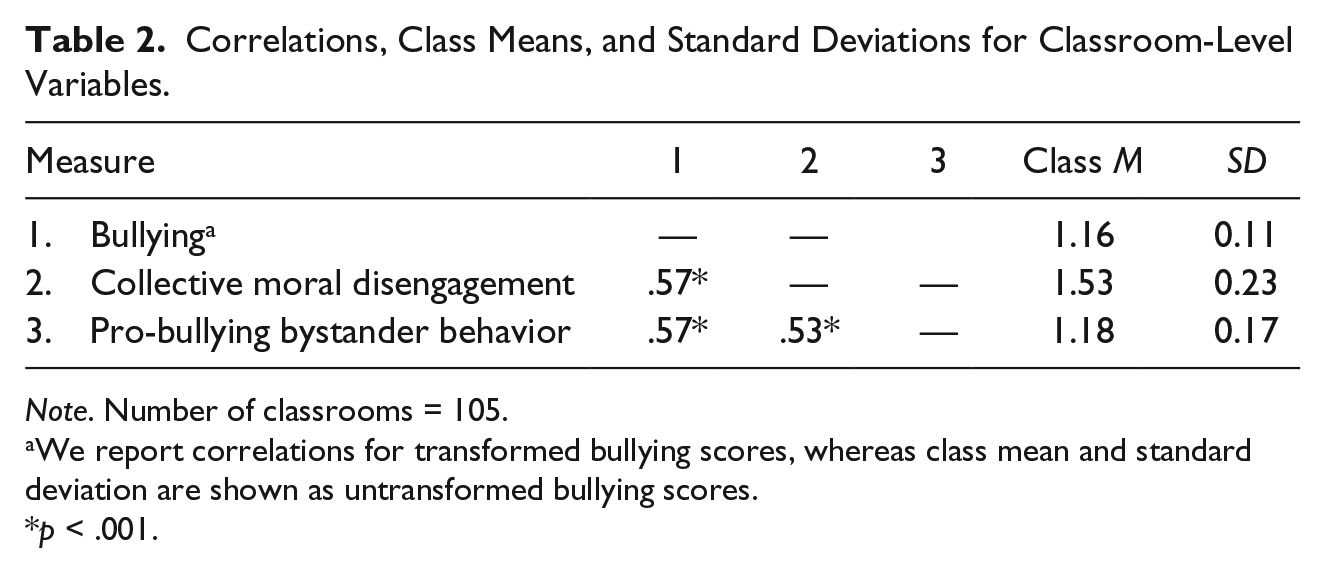
Note. Number of classrooms = 105.
We report correlations for transformed bullying scores, whereas class mean and standard deviation are shown as untransformed bullying scores.
p < .001.
Multilevel Modeling
Results from likelihood ratio tests and Akaike information criterion (AIC) values for Models 1 to 4, together with fixed and random effect parameters, are presented in Table 3. All predictor variables, except gender, were centered around the grand mean. In the initial model (Model 1), with no predictor variables, the predicted average level of bullying was estimated to be 1.13 (exp 0.12). Calculations of the intraclass coefficient (ICC) showed that 8.5% of the total variance in bullying could be explained by differences between classrooms. In Model 2, after the addition of child-level predictors, we found a positive association between bullying and IMD (see Table 3), but no significant association with children’s gender. Model 2 showed a significantly better fit than our intercept-only model (χ2 = 376.7, df = 2, p < .001). Thus, the results indicated that children with higher levels of moral disengagement were more likely to score high on bullying. In Model 3, after the addition of the two classroom-level variables (CMD and PBB), the model fit was further improved (χ2 = 28.7, df = 2, p < .001). The results showed that both CMD and PBB were significantly related to higher levels of bullying. That is, children who belonged to classrooms with higher levels of CMD, and classrooms in which assisting bullies and reinforcing bullying were more prevalent bystander reactions among classmates, scored higher on bullying perpetration. IMD remained significantly associated with bullying at the child level.
Results of Multilevel Linear Regression for Natural Log-Transformed Bullying.
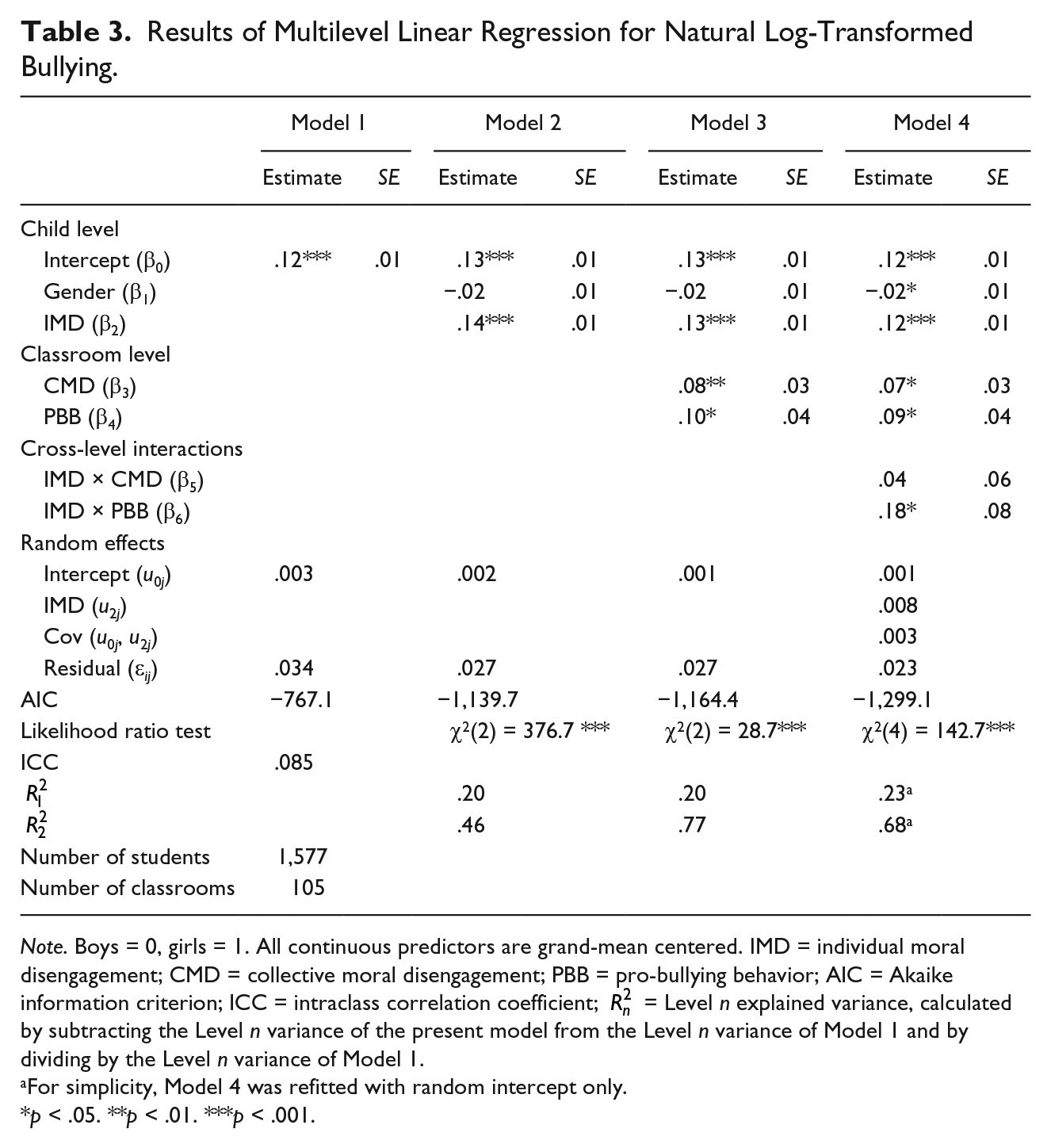
Note. Boys = 0, girls = 1. All continuous predictors are grand-mean centered. IMD = individual moral disengagement; CMD = collective moral disengagement; PBB = pro-bullying behavior; AIC = Akaike information criterion; ICC = intraclass correlation coefficient;
For simplicity, Model 4 was refitted with random intercept only.
p < .05. **p < .01. ***p < .001.
In Step 4 (Model 4), allowing the coefficient of IMD to vary between classrooms, and including the model-implied interaction terms (IMD × CMD, IMD × PBB), the fit of the model was once again improved (χ2 = 142.7, df = 4, p < .001). These results showed that the association between IMD and bullying was significantly affected by classroom-level PBBs, but not by the level of CMD. That is, children who scored higher on IMD were even more prone to engage in bullying when they belonged to a classroom high in PBBs, compared with when they belonged to a classroom with lower levels of PBBs (see Figure 1). Moreover, the control variable gender was a significant predictor at the child level in the final model. That is, girls were somewhat less prone to engage in bullying perpetration than boys.
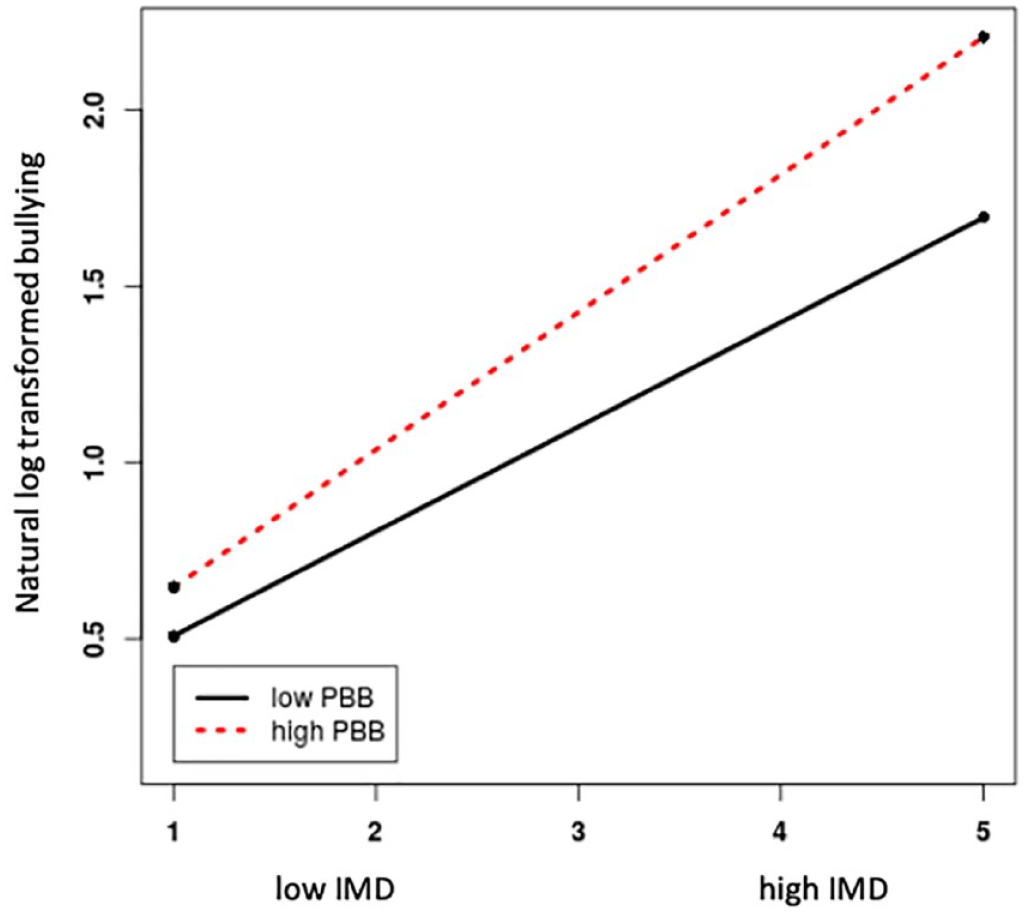
IMD × PBB.
Discussion
In line with social cognitive theory, which emphasizes that personal and environmental factors interact to produce moral and immoral behavior (Bandura, 2016), the current study moves beyond the individual characteristics of the child in terms of moral disengagement by concurrently examining unique and interactive effects of child- and classroom-level moral disengagement, together with PBB, on engagement in bullying perpetration.
As hypothesized, and consistent with previous studies (see Gini, Pozzoli, & Hymel, 2014), we found higher levels of IMD to be positively associated with bullying behavior, even after including all other predictors in the final multilevel model. Thus, the current study provides further support for the notion that children’s tendency to endorse morally disengaged beliefs about peer aggression and bullying is related to their risk of engaging in bullying perpetration. In addition, and in line with our hypothesis and previous studies (Cook et al., 2010), we found girls to be somewhat less prone to bullying peers in school; however, this effect was only significant in the final model (Model 4).
Furthermore, and as hypothesized, the two classroom-level constructs measured in the present study were both unique predictors of bullying. That is, characteristics of the classroom, in the form of CMD and PBBs, helped to explain the variability in bullying, over and above the child-level variables. As discussed by Gini and colleagues (2015), this finding suggests that bullying is more common in classrooms in which justifications for peer victimization, such as diffused responsibility and blaming the victim, are perceived to be shared among classmates (Pozzoli et al., 2012). In addition, our results are also in line with previous research showing that the bullying level in a classroom is linked to the degree of bully supportive bystander behaviors, such as assisting and reinforcing bullying, in that social context (e.g., Nocentini et al., 2013; Salmivalli et al., 2011; Thornberg & Wänström, 2018). It may be that peer groups with higher levels of CMD are at greater risk of supporting bullying (Pozzoli et al., 2012), as the classroom-level correlation between these two variables in the present sample supports, whereas the tendency to defend the victim is lower (Gini et al., 2015). These group dynamics, in turn, may promote bullying (cf. Salmivalli, 2010). However, our results suggest that CMD uniquely predicts bullying, over and above the level of PBBs. Previous findings and our finding showing that bullying tends to be more common in classrooms in which peer aggression is more likely to be rewarded in different ways (e.g., reinforced by other children) can be understood within the social cognitive framework (Bandura, 1986): if PBB is a common way to respond to peer aggression, children learn (both from their own experiences when engaging in bullying in terms of direct reinforcement and also in the form of observational learning in terms of vicarious reinforcement) that a specific behavior (e.g., bullying) tends to bring positive social consequences, and accordingly, there is a likelihood that the behavior will persist and even increase.
Furthermore, beyond the main effects, we found PBBs to moderate the role of IMD in bullying. That is, children who were high in IMD were even more likely to bully others in school if, at the same time, they belonged to a school class where peer bystanders were more prone to reinforce and assist such behavior. The finding that a high level of classroom prevalence of PBBs amplified the effect of IMD on bullying may be understood in the light of social cognitive theory. Bandura (1991, 2016) suggests that moral and immoral behavior produce two different sources of consequences for the individual: self-evaluative sanctions and social sanctions. When moral standards and behavior are in alignment, they produce positive feelings of pride and self-worth, whereas conflicting behavior may evoke aversive emotions such as guilt or shame. In addition, the behavior (e.g., bullying) evokes reactions within the social context (e.g., peer group, family, teachers), and actions and behaviors that are socially approved (e.g., reinforced by peers) are an additional source of positive emotions, as discussed previously. Bandura (1999) suggests that individuals who are less committed to moral standards, or more easily put them aside (e.g., through the processes of moral disengagement), may be more vulnerable to external pressure and social influence.
However, and in contrast to our hypothesis, CMD did not significantly affect the link between IMD and bullying in the current study. Indeed, as far as we know, no study has explicitly examined these two cross-level interactions together and their effect on bullying. For example, Gini and colleagues (2015) examine the direct effect of CMD on peer aggression, but not whether CMD as a classroom characteristic moderated the effect of IMD on peer aggression, although they did examine the effect of perceived CMD (at the individual level) on the link between IMD and peer aggression. In their study, they found that IMD was linked to aggressive behavior only when the individual students perceived higher levels of CMD in the classroom.
Limitations
Some limitations of the current study should be noted. First, the study has a cross-sectional design, as such all findings are correlational, and directionality of the effects should be interpreted with great caution. For example, it is not possible to conclude causality: whether there is, as suggested by social cognitive theory (Bandura, 2016), a reciprocal relation between bullying and the child- and classroom-level variables included in our study. Future research should aim to examine these variables within a longitudinal design. Second, all our measures are based on children’s self-reports, and common method variance, because of this, and self-report biases (e.g., social desirability bias, acquiescence biases, mood state) might have influenced the associations found in the study (Podsakoff, MacKenzie, Lee, & Podsakoff, 2003). Future studies using a multi-method approach (such as including peer and teacher reports together with self-report measures) are needed. Third, our analysis based on gender was assessed only by the options “boy” and “girl.” Children may not identify themselves with the gender assigned to them at birth, and future studies would benefit from including more options for gender identity in questionnaires and analyses.
The data based on the CMD scale might be discussed in terms of how accurate students’ perceptions of their group are. On the contrary, the construct in itself refers to the groups’ collective or shared beliefs on how widespread moral disengagement is in the group ( Gini, Pozzoli, & Bussey, 2014, 2015; White et al., 2009). Thus, CMD is inevitably biased toward the members’ social perceptions of the group as an ongoing result of their social interactions and the group dynamics. One strength of the CMD scale is that all students within the classroom are rating the same aspect of the classroom’s group-level property, in which the classroom is the unit of reference (see Marsh et al., 2012), which made the scale less vulnerable to self-serving biases such as social desirability or self-censuring. In contrast, our measure of PBB at the classroom level is based on aggregation of how individual children respond to questions about how they themselves act in peer-victimization situations. Future studies could benefit from using the classroom as a referent when measuring the prevalence of PBBs, together with complementary methods such as observations or peer nominations. Although we argue for the strength of our CMD measure, it should also be noted that the scale has not yet been validated within a Swedish context. Future studies should therefore conduct more rigorous psychometric analyses of the scale’s validity and reliability.
Furthermore, due to the participation rate of 66% in the 105 classrooms included in the analyses, the present study is vulnerable to selection bias, resulting in possible under- and/or overestimations of associations between the variables. Finally, our sample consisted of only fifth-grade Swedish students, and therefore, the results might not be generalizable to different age groups or cultural contexts.
Practical Implications
Our results support the importance of addressing school bullying as a complex social phenomenon, and not merely as a private concern between a bully and their victim. In our study, 8.5% of the variation in bullying could be attributed to differences between classrooms, which is in line with other studies using a multilevel approach (e.g., Salmivalli et al., 2011; Sentse, Veenstra, Kiuru, & Salmivalli, 2015). Together, these studies indicate that prevention and intervention programs need to consider climate and other social aspects of the classroom context. The importance of how bystanders act and respond in peer-aggression and bullying situations has strong support, not only in the current study. Prevention and intervention programs should therefore aim to reduce assisting and reinforcing behaviors, and to enhance defending behaviors. Our results, together with the few studies exploring the importance of CMD at the classroom level, also suggest that schools may benefit from being aware of and including CMD (e.g., Gini et al., 2015; Kollerová et al., 2018) as part of their moral education policy and practice to reduce bullying in children’s and young people’s everyday school life. Although it might be premature to draw strong conclusions given the paucity of studies conducted on CMD, and how this is related to bullying perpetration, our results suggest that the concept of CMD is of interest when exploring how classroom characteristics and climate influence bullying behavior, even in children as young as 11 years old.
Footnotes
Declaration of Conflicting Interests
The author(s) declared no potential conflicts of interest with respect to the research, authorship, and/or publication of this article.
Funding
The author(s) disclosed receipt of the following financial support for the research, authorship, and/or publication of this article: This research was supported by a grant awarded to Robert Thornberg from the Swedish Research Council (Grant Number D0775301).
