



Abstract
This study evaluates associations between childhood social environments and current intimate partner conflict tactics in early adulthood. The subsample for this study (n = 251 men) were participants in a larger community-based study of men’s mental and behavioral health in semirural Kenya. A survey questionnaire was administered by trained interviewers, including validated recall measures from childhood, collective self-esteem and impulsivity, and the conflict tactics scale short form. Analyses utilized regression and mediation methods. The recall measures evaluated the degree of relational warmth and safety recalled from early childhood and forms of abuse, neglect and dysfunction present in the childhood home. Collective self-esteem assessed the perceived value of one’s social groups and one’s value as a member of these groups. Impulsivity measured the propensity to act without thinking. The conflict tactics scale evaluates the presence and frequency of specific behaviors following intimate partner conflict, which lead to two factors—negotiation-based tactics and violence tactics. More early memories of relational warmth, responsiveness, and safety during childhood predict fewer violent intimate conflict tactics. More adverse childhood experiences predict more violent conflict tactics and fewer negotiation-based conflict tactics. Self-esteem and impulsivity mediated associations between recalled childhood experiences and conflict tactics. Further research is required to explore other predisposing factors, psychological processes, and cultural and social norms surrounding the use of violent and nonviolent intimate partner conflict resolution by young men in Sub-Saharan Africa. Violence prevention strategies and policies should explicitly link intimate partner violence prevention with prevention of violence against boys. Interventions should recognize men who perpetrate intimate partner violence are more likely victims of violent childhoods than men who do not perpetrate intimate partner violence. Promoting collective self-esteem and reducing impulsivity among young men may reduce violence against women.
Keywords
Background
Despite historic legislation in 2015 to protect individuals in domestic partnerships from partner violence (Republic of Kenya, 2015), intimate partner violence is still highly prevalent in Kenya. The 2014 Demographic Health Survey (DHS), a population-based survey administered every 5 years in Kenya, indicated that around 44% of men and women experienced physical violence at least once since they were 15 years of age or older (Kenya National Bureau of Statistics [KNBS], 2015). Of those who have experienced violence, 56.6% of women reported the source was their current male partner, but only 11.2% of men reported the source was their current female partner (KNBS, 2015). Data from the 2014 DHS indicate 14% of women have experienced sexual violence since turning 15 years of age, whereas 5.9% of men reported previous sexual violence victimization (KNBS, 2015). Male partners perpetrate 87% of the sexual violence experienced by Kenyan women. Although men do not exclusively perpetrate intimate partner violence, men are the primary perpetrators of intimate partner violence globally and in Kenya (Carney, Buttell, & Dutton, 2007; Parkes et al., 2013).
Acts of violence are not gender neutral, nor are they culturally ignorant. Globally, many cultures promote gendered relationships described by “hegemonic masculinity” (Connell & Messerschmidt, 2005). Hegemonic masculinity, prevalent in Kenya and through sub-Saharan Africa (Myers, 2002), supports the view that men should maintain power in the household over intimate female partners through the use of violence. Two thirds of Kenyan men justify the use of intimate partner violence to punish a woman for transgressing norms governing gendered domestic roles (Lawoko, 2008). Analyses of representative data from 17 sub-Saharan African countries found women were consistently more likely to endorse a husband’s use of violence to control or punish his wife when she transgresses gendered norms (Uthman, Lawoko, & Moradi, 2010). Examples of norm transgressions sometimes committed by women are as follows: refusing to have sex, burning the food, neglecting the children, or arguing with the man (Lawoko, 2008). Living in a rural area (vs. urban), having less education, being unable to read, and believing that the man alone carries decision-making power in the household are associated with higher odds of justifying the use of violence to punish a woman in Kenya (Lawoko, 2008). Endorsing beliefs that a woman should be punished by her husband for norm transgression is associated with perpetrating violence against women (Hindin, Kishor, & Ansara, 2008). Socialization into the beliefs that a man is justified in hitting his intimate partner begins early, as more than half of Kenyan children (aged 13-17 years) believe it is acceptable for a husband to hit his wife to control her behavior (UNICEF, 2012). Intimate partner violence is transmitted intergenerationally, as one’s propensity to perpetrate violence in adulthood can be predicted by one’s childhood social environment (Abrahams, Jewkes, Laubscher, & Hoffman, 2006).
Intergenerational Violence
Across multiple country contexts, research into intergenerational violence has found that childhood experiences of violence, neglect, and attachment relationships predict later life violent behaviors (Widom & Wilson, 2015). For example, men who witness violence against their mothers are more likely to perpetrate sexual and physical violence in intimate partnerships during adulthood (Abrahams & Jewkes, 2005; Abrahams et al., 2006; Whitfield, Anda, Dube, & Felitti, 2003). Longitudinal data support the theory of cyclical violence (Manchikanti Gomez, 2011), though there is open debate about the mechanisms underlying the intergenerational transmission of violence.
Explanations of observed intergenerational violence tend to focus on norms related to hegemonic masculinity, prior violence perpetration, antisocial peer group influences, and other risk behaviors (Costa et al., 2015; Reitzel-Jaffe & Wolfe, 2001). In this study, we consider two underexplored but potentially relevant theories in exploring mechanisms linking adverse experiences in childhood with intimate partner violence in adulthood: social baseline theory and sociometer theory.
Social Baseline Theory and Impulsivity
Social baseline theory has emerged within the past decade to explain associations between insecure social attachments and reduced emotional regulation more generally (Reeck, Ames, & Ochsner, 2016). Recent neurocognitive research has found decreased threat vigilance in the presence of others with whom one shares greater relational intimacy, which may be explained by one’s assumptions regarding available social support to contend with threats (Beckes & Coan, 2011). Energy is required to regulate emotional reactivity to stressors and is lower in the absence of reliable social support (Beckes & Coan, 2011). Social baseline theory, similar to the better known and established attachment theory, posits that individuals with less predictable, reliable, and familiar attachments are at greater risk of future relational dysfunction. The two theories diverge, however as social baseline theory posits emotional regulation and impulse control are impaired outside of securely attached relationships as a function of limited social support. There has been little application of the social baseline theory to intimate partner violence, but its ability to explain emotional regulatory impairment suggests its relevance to conflict tactics as impulsivity may lead to intimate partner violence (Finkel, DeWall, Slotter, Oaten, & Foshee, 2009; Meyer-Lindenberg et al., 2006). Attachment theory has previously been applied to understanding intimate partner violence within the context of preserving attachment styles through use of physical force (Babcock, Jacobson, Gottman, & Yerington, 2000), though it relies less on neurocognitive mechanisms to explain impulse control than social baseline theory does.
As suggested by social baseline theory, impulsivity may play a role in how childhood exposures to adversity affect conflict tactics in adulthood. Dispositional impulse control is inversely associated with perpetration of intimate partner violence between and within individuals (Finkel et al., 2009). Depletion of self-regulatory resources can increase violence perpetration, and improving self-regulation can decrease violence perpetration (Finkel et al., 2009). As such, men with lower impulse control are at greater risk of engaging in violent conflict than men with higher impulse control. According to social baseline theory, self-regulatory processes are socially mediated and may have roots in early childhood where one forms expectations regarding the availability of predictable, reliable, and familiar social support (Beckes & Coan, 2011). If impulsivity mediates associations between childhood social experiences and young adult intimate partner violence, it may also mediate associations between childhood social experiences and a range of other behaviors requiring impulse control. Impulse control is involved in regulating health and economic behaviors, promoting moderation in consumption of alcohol, drug use, sexual behavior, economic spending, and financial indebtedness in high-income countries (Gathergood, 2012; Hofmann, Friese, & Wiers, 2009). Identifying whether impulsivity is involved in mediating childhood adversities and young adult intimate partner conflict in Kenya will clarify the benefits of ensuring nurturing childhoods in Kenya.
Sociometer Theory and Self-Esteem
In addition to impulsivity, self-esteem may also mediate associations between childhood exposures and conflict tactics in adulthood. Sociometer theory forwards that self-esteem registers one’s value to relational partners (Leary & Baumeister, 2000), with the perception that one is liked and valued resulting in improved self-esteem (Srivastava & Beer, 2005). Globally, self-esteem is strongly associated with quality and quantity of social interactions (Denissen, Penke, Schmitt, & Van Aken, 2008). Longitudinal analysis of a nationally representative sample in the United States showed that self-esteem in early adulthood was predicted by childhood factors: the quality of home environment, quality of parental relationship, maternal depression, and paternal presence (Orth, 2017). Large national studies have found that self-esteem has rank-order stability across the life span; that is, individuals with relatively higher self-esteem in childhood demonstrate relatively higher self-esteem in adulthood (Robins & Trzesniewski, 2005). Children who do not learn they are liked and valued may develop low self-esteem that persists into adulthood. Within intimate relationships, self-esteem facilitates the interpretation of social cues as threatening or harmless to one’s social value. Individuals with lower self-esteem are more prone to interpret ambiguous social cues as personal rejections (Ford & Collins, 2010). Heightened threat vigilance among individuals with lower self-esteem may combine with a diminished reserve of perceived social value, such that real or perceived slights from intimate partners seem more threatening and result in heightened attempts at self-preservation (Murray, Holmes, & Collins, 2006). Self-preservation within intimate partnerships can lead to derogation of one’s romantic partner who is perceived as the source of a social threat, resulting in verbal rejection or physical violence (Murray et al., 2006; Papadakaki, Tzamalouka, Chatzifotiou, & Chliaoutakis, 2009). Conversely, individuals with higher self-esteem are more able to engage in personal sacrifice and compromise in intimate partnerships and are less likely to interpret behavior as socially threatening (Murray et al., 2006). Higher self-esteem may thereby facilitate nonviolent conflict resolution by enabling personal sacrifice and compromise. Selfhood within rural Kenya is primarily understood as a reflection of one’s relationship to close social others (Ma & Schoeneman, 1997), which is consistent with the collective self-esteem model forwarded by Luhtanen and Crocker (1992) and the sociometer theory forwarded by Leary and Baumeister (2000).
Study Aim
In this article, we assess whether adverse childhood experiences (ACEs) and early memories of warmth and safety reported by young Kenyan men predict their use of violence or negotiation tactics in intimate partner conflicts, and whether these associations are mediated by self-esteem and impulsivity. Capaldi, Knoble, Shortt, and Kim (2012) found that age, education, wealth, and number of household children were associated with interpersonal violence. As such, we control for these variables in analyses. We anticipate that any models supporting the role of self-esteem will support the sociometer theory. Models supporting the role of impulsivity will support the social baseline theory.
Negotiation-based conflict tactics
Most literature focuses on the use of violence to resolve intimate partner conflicts. However, given the commonplace presence of conflict in intimate partnerships across cultures (Cummings, Goeke-Morey, & Papp, 2004), identifying factors underlying use of nonviolent tactics to resolve intimate partner conflicts is also essential to promote nonviolent alternatives. Previous research on conflict tactics has shown parental use of violent tactics predict higher aggression and emotional insecurity among children, whereas parental use of nonviolent conflict resolution tactics predict lower aggression and emotional insecurity among children (Cummings et al., 2004; Davies, Martin, & Cicchetti, 2012). Research enabling a better understanding of the life experiences and psychological dynamics underlying use of nonviolent tactics can facilitate the promotion of nonviolent conflict resolution skills. In Kenya, where there is a high prevalence of intimate partner violence, promoting the use of nonviolent conflict resolution skills is crucial; however, a better understanding of how early positive and adverse life experiences of men and their current psychosocial characteristics determine their use of conflict tactics is needed.
Gender perspective
Within sub-Saharan Africa, most research on intimate partner violence focuses on women. As women are more likely to be victims, it is necessary to understand life-course determinants of violent victimization and related consequences. However, as research has shown that men are often perpetrators of violence, and themselves caught in cycles of violence, understanding life-course determinants of violence perpetration by men is also necessary (Manchikanti Gomez, 2011). By better understanding the life-course determinants of conflict tactics used by men, it may be possible to intervene sooner and prevent the perpetration of violence.
Method
Participants
The sample used in the current analysis is taken from a larger survey of young men (aged 18-34 years) from 11 townships in the North Igembe subcounty of Meru County, Kenya. The locations were selected because they are source communities for hospital patients and the hospital maintains some community-based presence in selected communities. A total of 532 participants were interviewed in the larger survey, which included other variables that were excluded from the present study. As the focus of the current analysis was on violence perpetrated within current intimate partnerships, respondents who did not report a current intimate partner, including being single or divorced, were excluded from the sample used in the current analysis. The sample size of the present study is 251 respondents.
Procedure
Kenyan, male nursing students were trained in survey administration of self-reported measures and paid to conduct interviews with selected respondents. The sampling frame included every other household along a predetermined route. Routes were determined based on random number tables prior to the interview day, and interviews were conducted until the end of the interview day. This design is a uniform walk method, a validated method of conducting household surveys when full housing registers are unavailable (Thompson, 2006). Selected households were assessed for the presence of an eligible male (aged 18-34 years). Where more than one eligible male was available, one male was randomly selected. A total of 772 houses were visited and found eligible for the larger study. Of these, 240 (31%) refused and 532 (69%) completed an interview. Interviews were conducted by the interviewer, who read each question aloud and recorded the response on an interview form. All data were entered twice into EpiInfo.
Survey items included in the current study comprised demographic characteristics as well as scales measuring conflict tactics, impulsivity, self-esteem, and experiences during childhood (detailed in the following section). Interviews were conducted in the local language, Kimeru. Interview questionnaires were created in English, translated into Kimeru and back translated for validation and refinement.
Measures
All measures were selected based on prior validation across multiple cultures and languages.
Outcome variable
The primary outcomes of this study are two sub-factors identified by the short form of the conflict tactics scale for adults—violent and nonviolent negotiation-based conflict tactics (CTS2; Straus, Hamby, Boney-McCoy, & Sugarman, 1996). The CTS2 asserts that conflict is common in romantic relationships, and subscales are used to measure different tactics used during conflict. To identify the subscales for the study, we used exploratory factor analysis with items reporting on the respondent as an actor and his partner as the recipient of his actions. Initially, to determine the factorability of the 10-item list of specific behaviors possibly committed by the respondent following intimate partner conflict in the past year, it was observed that 9 of the 10 items correlated at least .3 with at least one other item, suggesting reasonable factorability. The primary purpose of the factor analysis was to identify and compute composite scores for factors underlying the short version of the CTS2, so we used principal components analysis. Initial eigenvalues indicated that the first two factors explained 50% and 16% of the variance, respectively. The third, fourth, and fifth factors had eigenvalues below one, and explained 8%, 6.5%, and 5.6% of the variance, respectively. Screeplot analysis indicated eigenvalues leveled off after two factors. Promax rotation of these two factors revealed all items had primary loadings more than 0.5, and no items had cross-loadings above 0.14. Hence, exploratory factor analysis revealed two primary factors—those that use violence to resolve conflict and those that are based on negotiation and respect. The Violent Conflict Tactics subscale, Items 6, 9, 11, 13, 16, 17, and 19 (current study sample, α = .90), includes statements such as “I had a sprain/bruise/small cut/felt pain the next day because of a fight with my partner,” and “I pushed, shoved or slapped my partner.” The Negotiation-Based Conflict Tactics subscale, Items 1 and 7 in the original short-form scale (current study, α = .63), includes two statements “I explained my side or suggested a compromise for a disagreement with my partner” and “I showed respect for, or showed that I cared about my partner’s feelings about an issue we disagreed on.” A Spearman-Brown correction for test length predicts the alpha of an extended 20-item scale would be .94.
Mediating variables
The short form of the Barratt Impulsivity Scale (BIS-15) was used to measure impulsivity (Spinella, 2007). The BIS has been validated for use in multiple cultures (Stanford et al., 2009), and the short form correlates with objective neuropsychological measures—specifically prefrontal structure and function and central serotonergic function—and impulsivity-related behaviors in healthy individuals (Spinella, 2007). These neuropsychological structures have been associated with social support in social baseline theory research (Beckes & Coan, 2011). The BIS-15 uses 15 items to measure three factors (non-planning, motor impulsivity, and attention impulsivity) on a 4-point Likert-type scale (Spinella, 2007). Items include statements such as “I act on impulse,” and “I don’t pay attention.” A scale score is calculated by adding the scores for the 15 items. Internal consistency of the scale for the current study population was good (α = .82).
Collective self-esteem was assessed using the Collective Self-Esteem (CSE) scale (Luhtanen & Crocker, 1992). The CSE scale is a 16-item scale using 7-point Likert-type responses to assess an individual’s global positive evaluation of his or her collective/social identity (current study sample, α = .88). Scale items include statements such as “overall, my social groups are considered good by others” and “I am a worthy member of the social groups I belong to.” Items are summed to calculate a scale score. The CSE scale has been validated across different countries, cultures, languages, and income groups including Kenya (Kinoti, Jason, & Harper, 2011). We measured collective self-esteem (as opposed to individual) due to the more collectivist and communal worldview and practices in Kenyan society and culture.
Exposure variables
Two exposures were considered in this study. ACEs were assessed using 13 binary statements to self-report the presence of household dysfunction (household presence of violence against women, parental divorce/separation, addiction problems, depression, and suicide attempts), abuse (emotional, physical, and sexual), violence exposure (witnessing community violence, collective violence, or bullying victimization), and physical neglect at any point during the respondent’s childhood. The 13 statements were summed to produce an index ranging from 0 to 13. The ACE does not represent a scale measuring an underlying construct, but rather represents a summation of a variety of adverse exposures a child may have experienced. Due to empirical and theoretical relevance of ACEs to a variety of population-level outcomes, researchers are promoting the use of the ACE index to explore challenges to population health at multiple endpoints (Anda, Butchart, Felitti, & Brown, 2010).
Quality of childhood social conditions was measured using the Early Memories of Warmth and Safeness Scale (EMWSS; Richter, Gilbert, & McEwan, 2009). The EMWSS is a 21-item recall measure assessing early feelings of secure attachment. Respondents are prompted to consider their earliest memories and provide a rating (from 0 = never to 4 = most of the time) of how frequently they felt safe, secure, understood, comfortable, enjoyable, loved, cared for, and as though they belonged. The EMWSS can predict psychopathologies in English-speaking and Portuguese-speaking populations. In the present sample, the scale showed high internal consistency (α = .97). Example items from the EMWSS include “I felt part of those around me,” and “I had feelings of connectedness” during childhood.
All scale scores except for the ACE index score were standardized to facilitate interpretation for bivariate analysis and model testing.
Control variables
Control variables included age, years of completed schooling, household wealth and number of children in the current household of the respondent. Variables were chosen due to their previous associations with interpersonal violence (Capaldi et al., 2012) as well as their significant bivariate associations with the predictor and outcome variables assessed during model development. The wealth index is a sum of the number of household assets in the following list: electricity, radio, television, telephone, refrigerator, land, and number of rooms used for sleeping. The use of household wealth, including number of rooms for sleeping, is a valid way to develop a proxy measure of household wealth (Vyas & Kumaranayake, 2006). Age was included as a continuous measure of years reported. The number of children living in the household was defined as the number of children who slept at least four nights in the household during the previous 6 months. Education was measured as number of formal school years completed.
Analysis Plan
Primary data analysis utilized the PROCESS macro in SPSS v.20, written by Hayes (2012), to determine whether impulsivity and collective self-esteem mediated associations between reported childhood exposures and conflict tactics. As PROCESS allows for only one independent variable, cumulative ACEs were included as a control variable in the models assessing EMWSS and conflict tactics. In models assessing ACEs and conflict tactics, the EMWSS scale was included as a control variable. PROCESS calculates multiple parallel mediators using 5,000 bootstrap replicates to produce empirical standard errors. As there were two conflict tactics identified by the CTS2—negotiation-based (non-violent) tactics and violent tactics—two mediation models were produced. All models control for wealth, age and education. To develop categories of ACEs, we determined the quintiles for cumulative ACEs. We stratified other model variables by each level of cumulative ACEs to demonstrate associations between model variables and level of cumulative ACE. We generated a correlation matrix to show associations between model variables. Significance was set at alpha = .05. We used SPSS v.20 for mediation analyses and STATA v.14 for all other calculations.
Ethical Consideration
The study protocol was approved by an ethics committee at the host hospital, Maua Methodist Hospital, in Kenya. Additional review was provided by the ethics committee at the University of Texas Medical Branch in Galveston, Texas. All data were collected after respondents provided informed consent and were de-identified.
Results
The median age of the 251 men included in the current study was 28 years (interquartile range [IQR] = 24-31 years). There was a median wealth index of 3 (IQR = 2-4), and respondents reported a median 9 years (IQR = 7-12 years) of formal schooling. Approximately 80% of respondents reported perpetration of violent conflict tactics in their current partnership. A slightly smaller percentage (74.4%) reported using negotiation conflict tactics. A mean of 5.7 (95% CI = [5.4, 6.1]) adverse childhood events were reported by young men in the study.
The correlation matrix for respondent characteristics (demographic and scale scores) is provided in Table 1 below. The two mediator variables, collective self-esteem and impulsivity, were significantly correlated with the two predictor variables—cumulative adverse childhood experiences and early memories of warmth and safety. More ACEs predicted lower collective self-esteem and higher impulsivity, whereas higher early memories of warmth and safety predicted higher collective self-esteem and lower impulsivity. Impulsivity and collective self-esteem were significantly inversely correlated, as were adverse childhood experiences and early memories of warmth and safety. The two types of conflict tactics were significantly correlated with ACEs; however, negotiation-based conflict tactics was not statistically significantly associated with early memories of warmth and safety.
Correlation Matrix of Respondent Characteristics (Demographic and Scale Scores; n = 251).

Notes. Correlation matrix of model variables. Bonferroni adjusted Pearson correlation coefficients shown. VCT = Violent Conflict Tactics Scale 2; NCT = Negotiation-Based Conflict Tactics; CSE = Collective Self-Esteem; BIS = Barratt Impulsivity Scale, short form; ACEs = adverse childhood experiences; EMWSS = Early Memories of Warmth and Safeness Scale; WI = wealth index; AGE = age in years; EDUC = years of completed education.
p < .05. **p < .01. ***p < .001.
Figure 1 shows the standardized values of early memories of warmth and safety, collective self-esteem, impulsivity, Negotiation-Based Conflict Tactics and Violent Conflict Tactics scales across quintiles of cumulative ACEs. The numbers of ACEs corresponding to the quintile are shown in the figure. With increased counts of cumulative ACEs, there is an increase in standardized values of violent conflict tactics, impulsivity and decrease in early memories of warmth and safety, collective self-esteem, and negotiation-based conflict tactics. A figure displaying the same standardized values of the above mentioned variables across quintile of early memory of warmth and safety has been provided as well (Supplemental Figure).

Model variables and cumulative adverse childhood experiences.
Figure 2 shows the mediation analysis of negotiation-based conflict tactics, ACEs, and early memories of warmth and safety. Before accounting for potential mediation, more ACEs significantly predicted lower use of negotiation during conflicts with intimate partners. After including collective self-esteem and impulsivity, the direct association between ACEs and negotiation-based conflict tactics disappeared. There was no direct association between early memories of warmth and safety and negotiation-based conflict tactics before or after adjustment for self-esteem and impulsivity. ACEs and early memories of warmth and safety were indirectly associated with negotiation-based conflict tactics through collective self-esteem. Although impulsivity was significantly associated with negotiation-based conflict tactics scores in bivariate analysis, it did not mediate associations of ACEs or early memories of warmth and safety and negotiation-based conflict tactics. Collective self-esteem significantly mediated associations between ACEs and negotiation-based conflict tactics, and mediated associations between early memories of warmth and safety and negotiation-based conflict tactics.
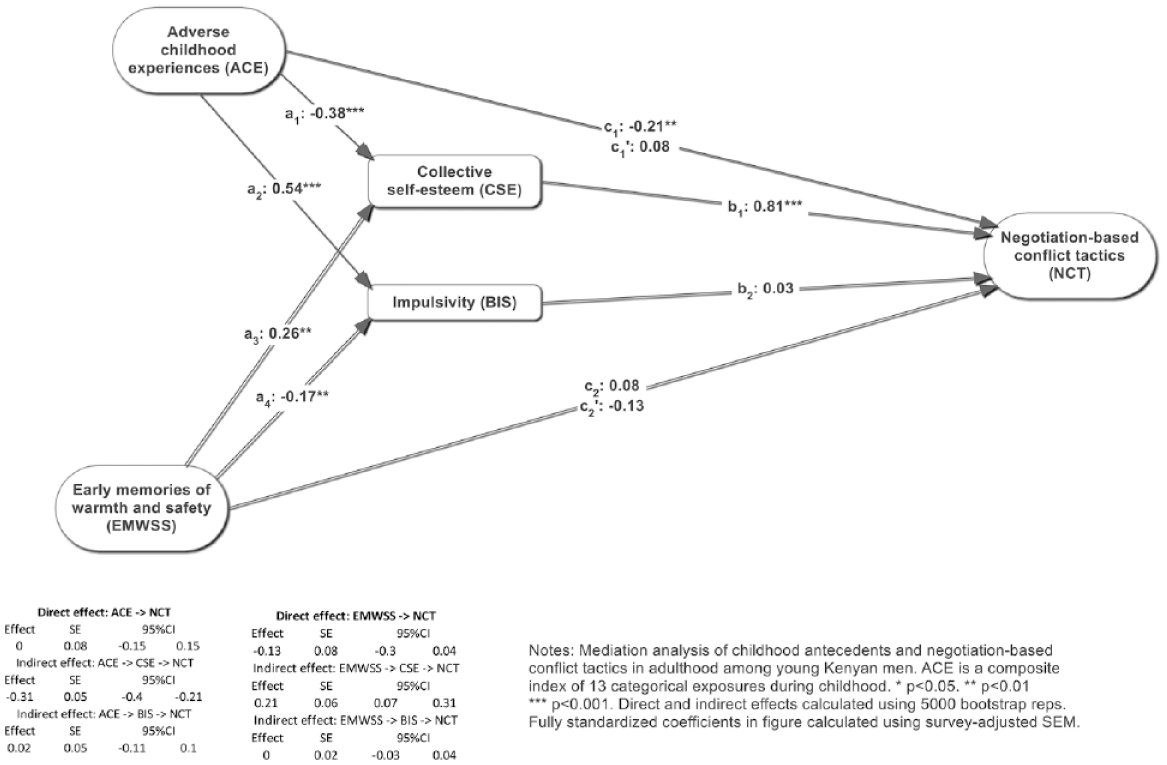
Mediation analysis of negotiation-based conflict tactics and childhood antecedents of adversity and emotional warmth.
Figure 3 shows the mediation analysis of ACEs, early memories of warmth and safety and violent conflict tactics. Before including collective self-esteem and impulsivity in the statistical model, more ACEs predicted signficantly more use of violence in intimate partner conflicts. Conversely, more early memories of warmth and safety predicted significantly less use of violence in intimate partner conflicts. After including mediators, more early memories of warmth and safety predicted significantly less intimate partner violence.

Mediation analysis of violence-based conflict tactics and childhood antecedents of adversity and emotional warmth.
Impulsivity and collective self-esteem significantly mediated associations between recollected childhood experiences and current violence perpetration. Collective self-esteem mediated a larger portion of the associations between both of the measures of childhood exposures and intimate partner violence than did impulsivity—approximately 73% versus 35%, respectively, of the adverse childhood experiences–violent tactics association and approximately 45% versus 10%, respectively, of the early memories of warmth and safety–violent tactics association. The association between adverse childhood experiences and violence-based tactics was completely mediated, whereas only 52% of the association between early memories of warmth and safety and violence-based tactics was explained by the two mediators.
Discussion
In this study, we set out to discover whether childhood adverse experiences and early memories of warmth and safety reported by young Kenyan men predict different types of conflict tactics in their current intimate partnerships. In addition, we explored whether these associations are mediated by self-reported self-esteem and impulsivity. We found that both violent and non-violent negotiation-based conflict tactics in adult intimate partnerships were predicted by the two kinds of childhood exposures. Fewer memories of emotional warmth and safety from early childhood and more adverse childhood experiences predicted significantly more use of violence in intimate partner conflicts. Consistent with previous findings from community-based settings (Smyth, Gardner, Marks, & Moore, 2017), we found that deficiencies in self-regulation (higher impulsivity) mediated the association between adverse childhood experiences and use of violent tactics. However, impulsivity explained a smaller percentage of the association than self-esteem. Similarly, impulsivity explained a significant percentage of the association between early memories of warmth and safety, though self-esteem explained a larger percentage of the association between early warmth and violent tactics than did impulsivity.
These findings demonstrate how sociometer theory and social baseline theory may improve understanding of life-course cycles of violence. Sociometer theory predicts that self-esteem will be lower among persons with past threats to their sense of relational value, and this diminution of self-esteem will predispose persons to higher threat vigilance that may be expressed through violence (Leary, 2005). The empirical observations that associations between childhood experiences that would impact a child’s sense of relational value and later life conflict tactics, and that the majority of this association is mediated by self-esteem are consistent with sociometer theory. Social baseline theory predicts that past social experiences impact present emotional regulation that can be registered as variations in dispositional impulsivity. That dispositional impulsivity mediates some of the association between childhood experiences and intimate partner violence in young adulthood is consistent with social baseline theory.
Sociometer theory may be relevant to interventions to prevent intimate partner violence in a few different ways. As hegemonic masculinity is the prevailing norm for gender relations adhered to by a majority of male and female Kenyans throughout the life span (Goodman et al., 2017), departure from these norms may exact a toll on the self-esteem of young men. Research into the interactions of self-esteem and norm adherence among men is relatively new, and is unexplored in sub-Saharan Africa to our knowledge. As people’s self-esteem is generated in part by conforming to expected social norms (Reilly, Rochlen, & Awad, 2014), those with lower self-esteem may be more motivated to improve self-esteem by adhering to prevailing norms governing gender power dynamics (Witt & Wood, 2010). Alternatively said, men with life-course histories that promote higher self-esteem may have more capacity to engage in gender relations outside of those prescribed by hegemonic masculinity, whereas the opposite may be the case for men with low self-esteem. While further research is required to parse out relationships among self-esteem, norm adherence, and willingness to transform gender power dynamics to prevent violence against women, it may be that providing supportive and nurturing environments for boys who have dysfunctional, violent, or emotionally distant families can help restore self-esteem that reduces risk of intimate violence perpetration in adulthood. These observations regarding the role of self-esteem as a mediator of childhood social environments and adult intimate relationships are consistent with attachment theory (Laible, Carlo, & Roesch, 2004), though the concept of self-esteem is more central to sociometer theory. Future research may consider whether personal or collective self-esteem more strongly predicts conflict tactics, mediates childhood and adult social environments, and how these differences vary between cultures. Due to the collectivist nature of Kenyan culture (Ma & Schoeneman, 1997), we utilized the collective self-esteem measure. The salience of collective versus personal self-esteem measures is likely to differ across cultures, and these differences should be evaluated in cross-cultural research.
This study also contributes to current literature by recognizing there are life-course determinants of negotiation-based tactics. As conflict is ubiquitous to human relations, particularly intimate partner relations, promoting nonviolent resolution of conflicts is essential. Further research is required to investigate how capacities of emotional regulation and interpersonal communication are developed within sub-Saharan Africa. Study data suggest that theories of development of self-esteem, particularly sociometer theory, may be more helpful for understanding the use of both violence and negotiation within intimate partner conflicts, whereas theories of emotional regulation may be helpful for understanding violent conflict tactics. Although this study provides support to an increasingly clear view of the relationship among histories of social neglect, forms of abuse, deficient impulse control, lower self-esteem, and violence (Elison, Garofalo, & Velotti, 2014), there is substantially less consensus and clarity concerning psychological processes behind nonviolent conflict resolution and how these psychological processes may relate to childhood histories.
Social baseline theory adapts and generalizes insights from attachment theory by emphasizing emotional regulation, including impulse control, is connected to attachment histories (Beckes & Coan, 2011). As seen in the present sample, impulsivity may mediate pathways between childhood social histories and harmful behaviors in young adulthood. Early childhood attachment histories have been long known to impact future social attachments (Chris Fraley, 2002). Within sub-Saharan Africa, the observation that early childhood social environments may impact impulsivity in young adulthood is novel and has broad-spanning implications. As impulse control is important for a range of social, health, and economic behaviors (Gathergood, 2012; Hofmann, Friese, & Wiers, 2008), childhood environments may be related to a range of adult health, social, and economic issues by influencing impulse control in Kenya and potentially elsewhere. Conversely, efforts to improve childhood environments in Kenya may bring improvements to adult well-being through improving impulse control. Further research around the longitudinal development or impairment of impulse control in the context of childhood adversities and attachment histories is required in Kenya and sub-Saharan Africa, as is further research on the contributions to ill-health and social dysfunction generated by poor impulse control.
Study findings are helpful for considering intervention development. Collective self-esteem mediated a larger portion of the associations between measures of childhood exposures and conflict tactics than did impulsivity; the relatively higher importance of self-esteem to the models indicates that building men’s collective self-esteem (e.g., through helping young men building positive, productive, and worthwhile membership in social groups) and altering other types of collective ideas and attitudes (e.g., social norms) may reduce the effects of childhood experiences on adult perpetration of violence. In addition, the finding that the association between early memories of warmth and safety and violence-based tactics was only partially explained by the two mediators suggests that when boys experience little to no warmth and feelings of personal safety during childhood, interventions to impact psychosocial characteristics (such as self-esteem and impulsivity) during adulthood may have only marginal effect on the use of violent tactics. From a prevention perspective, the study points to the importance of beginning with boys to provide personal safety, interpersonal warmth, and engage in considering conflict resolution between powerful/powerless agents while they are still children.
This research supports prior work articulating plausible mechanisms for the perpetuation of cycles of interpersonal violence from boyhood to manhood. Cultural theories—notably that of hegemonic masculinity—explain the perpetuation of normative beliefs from childhood to adulthood supporting violence against intimate partners (Jewkes, Flood, & Lang, 2015). Such cultural theories find support from the fact that more than half of children aged 13 to 17 years believe it is acceptable for a husband to beat his wife under one or more circumstance (UNICEF, 2012). Psychosocial theories also explain the perpetuation of violence from childhood to adulthood, as attested by current findings. Theory and empirical data support the need and contents of interventions to break violent cycles. Positive parenting interventions can improve parenting and child behavior, with potential social benefits across the life span (Lachman et al., 2017). Research is needed to assess whether experiences of child abuse lead men to endorse norms of masculine hegemony in Kenya, and how to relate theories relating to self-regulation (e.g., sociometer and social baseline theories) to concerns of relevant cultural theories. Prior empirical research in Spain identified adolescent boys were more likely to have lower self-esteem, justify hegemonic masculine norms, aggression in conflict and perpetrate violence against women if they received more dominance and violence messages from adults in their family environment (Diaz-Aguado & Martinez, 2015). Leading approaches to prevent intimate partner violence call for gender transformation—that is, transforming power dynamics between males and females of all ages (Jewkes et al., 2015). Gender transformation work recognizes the gender inequality in experiences of intimate partner violence, and men who seek to preserve dominance within their relationship often perpetrate intimate partnership violence. Although empowering women socially and economically can reduce the experience of intimate partnership violence, interventions are more effective when they transform notions of masculinity away from men establishing “power over” intimate partners (Jewkes et al., 2015). There has been little to no investigation of psychological characteristics of men who are more willing to engage in gender transformation work in sub-Saharan Africa or the life-course trajectories of those who are more able to re-imagine gender relations outside of prevailing notions of male domination, enforced by violence when necessary. This study suggests that experiences of emotional warmth may predispose men to engage in sharing and receiving information as a mechanism to resolve conflict, which may also influence the ability to re-conceptualize gendered relations away from violence perpetration. If so, it may be higher self-esteem that enables norm nonadherence required to embody alternative, less violent masculinities. Further research is required to understand which men to target as potential champions of less violent and less hierarchical gender relations, as well as the interconnections between life histories and intimate partner violence. Jewkes et al. (2015) proposed engaging with men’s histories of violence to transform gender relations, and the current data show men who perpetrate violence are more likely to recall childhood adversities and less emotional warmth, responsiveness, and safeness. Future research should investigate life-course predictors of adherence to norms of hegemonic masculinity, which may reveal a cognitive mediator between childhood experiences and later life perpetration of intimate partner violence.
Limitations
This study is limited by its design and measures in various ways. Cross-sectional data do not allow for causal inference, though antecedent variables are recalled from childhood suggesting the temporal order assumed in analysis. Mediating variables may be bidirectionally related to outcome variables, and there is very likely some recursion within these pathways. Self-report data are particularly susceptible to social desirability bias (specifically when an interviewer conducts the survey) and recall bias. Recollected childhood experiences tend to favor more positive encounters, which would lead toward null hypotheses (Hardt & Rutter, 2004; Kruijshaar et al., 2005). Social desirability bias may lead to higher reports of self-esteem among those who perceive themselves of lower social value, again leading toward null hypotheses. Because intimate partner violence is very common in the study population and is not highly stigmatized in the culture, responses for the Violent Conflict Tactics scales were unlikely to be influenced as greatly by social desirability bias. Previous meta-analyses found that respondents tend to systematically underreport their perpetration of violence, which would lead toward null hypotheses in the present study (Archer, 1999). The EMWSS is used to operationalize childhood attachment security, but it requires more validation with non-Western cultures and lower income populations as well as with longitudinal samples to assess consistency in responses as individuals age (i.e., from beginning to end of recall period).
Conclusion
Research on the associations between childhood experiences and intimate partner conflict tactics has previously established boys who experience abuse and neglect are more likely to perpetrate violence as adults. In this study, we find a similar pattern from sub-Saharan Africa, a region where there is substantially less life-course research. In addition, the study provides the novel observation that the use of negotiation-based conflict tactics is predicted by fewer adverse childhood exposures (though not more positive exposures). Collective self-esteem mediates pathways between adverse childhood exposures and negotiation-based and violence-based conflict tactics, and impulsivity mediates associations between adverse childhood exposures and use of violence. Further research should explore predisposing factors to use nonviolent tactics, whereas efforts to reduce violence should focus on childhood exposures, specifically exposures to warmth and safety, and approaches that incorporate addressing the negative histories of men who perpetrate violence.
Supplemental Material
supplement_figure – Supplemental material for Childhood Experiences and Intimate Partner Violence Among Kenyan Males: Mediation by Self-Esteem and Impulsivity
Supplemental material, supplement_figure for Childhood Experiences and Intimate Partner Violence Among Kenyan Males: Mediation by Self-Esteem and Impulsivity by Michael Goodman, Salome A. Wangamati, Florence K. N. Maranga, Stanley Gitari, Sarah Seidel and Philip Keiser in Journal of Interpersonal Violence
Footnotes
Declaration of Conflicting Interests
The author(s) declared no potential conflicts of interest with respect to the research, authorship, and/or publication of this article.
Funding
The author(s) received no financial support for the research, authorship, and/or publication of this article.

Supplemental Material
Supplemental material for this article is available online.
Author Biographies
References
Supplementary Material
Please find the following supplemental material available below.
For Open Access articles published under a Creative Commons License, all supplemental material carries the same license as the article it is associated with.
For non-Open Access articles published, all supplemental material carries a non-exclusive license, and permission requests for re-use of supplemental material or any part of supplemental material shall be sent directly to the copyright owner as specified in the copyright notice associated with the article.
