



Abstract
There has been significant research on women’s experiences of domestic violence (DV) as well as on the women’s help-seeking behaviors when living with partner abuse. Most of the Australian literature has focused on nonimmigrant women. We know that help seeking can include informal sources such as family, friends, religious leaders, and colleagues or formal assistance from police, doctors, social workers, counselors, and DV agencies. The current study aims to contribute to the literature on help seeking by looking at what has been found concerning immigrant DV survivors and complementing that with interview material from a sample of 14 Muslim immigrant DV survivors in New South Wales. First, we look at barriers that these women may encounter in seeking help and the non-help-seeking strategies they may employ. We then see what may trigger seeking help (including before and after leaving the abusers). Next, we look at how the two types of help seeking are used to better understand the positives and negatives of these pathways. This article ends with some suggestions for developing more appropriate and targeted strategies to assist abused immigrant DV survivors and their children.
Keywords
Introduction
Domestic violence (DV) survivors in general respond to abuse differently by employing various private or public strategies (Liang, Goodman, Tummala-Narra, & Weintraub, 2005; Rizo & Macy, 2011). Survivors utilize either formal help (e.g., police, doctors, social workers, counselors), informal help (e.g., family, friends, religious leaders and colleagues), or both (Ansara & Hindin, 2010). These two forms of help seeking play different roles in survivors addressing domestic and family violence (Ansara & Hindin, 2010; Suvak, Taft, Goodman, & Dutton, 2013).
We know that help seeking can be influenced by survivors’ demographic characteristics (e.g., gender, race, and income) (Cho, Shamrova, Han, & Levchenko, 2017). This is relevant in the Australian context as it is one of the most multicultural countries in the world with 49% of its population either born overseas or having one or both parents born overseas (Australian Bureau of Statistics, 2016a). Within the Culturally and Linguistically Diverse (CALD) category is a growing minority group—Muslim Australians. Their numbers almost doubled in the decade to 2001, to more than a quarter of a million (281,578), representing approximately 1.5% of the total Australian population (Human Rights and Equal Opportunity Commission, 2004, p. 213). This trend has continued: in 2011, the number of Muslims has increased by 69% to 476,300, which comprises 2.2% of the total population (Australian Bureau of Statistics, 2011). In 2016, they constituted 2.6% of the total Australian population (Australian Bureau of Statistics, 2016b).
Despite evidence that immigration can intensify DV and increase vulnerabilities via social and cultural dislocation, research remains fairly limited in this area (Australian Bureau of Statistics, 2013; Trijbetz, 2013). Low reporting to the police by CALD women found in some research (Allimant & Ostapiej-Piatkowski, 2011; Aly & Gaba, 2007; Bartels, 2010; Fisher, 2013; Flory, 2012; George & Harris, 2014; Gilroy, McFarlane, Nava, & Maddoux, 2014; Morgan & Chadwick, 2009; Ogunsiji, Wilkes, Jackson, & Peters, 2011; Zannettino, 2012) has been interpreted as reflecting intersecting systemic issues such as common immigration and settlement challenges or cultural and other structural barriers (Easteal, 1996a; Ghafournia, 2011; Rees & Pease, 2006; Vaughan et al., 2015a). For example, stereotypes about the Muslim community can shape Muslim women’s experiences of abuse and affect how they can respond to DV (Abu-Ras, 2007; Adelman, Erez, & Shalhoub-Kevorkian, 2003; Aly & Gaba, 2007; Dasgupta, 2007; Sokoloff, 2008). Poynting and Nobel (2004) argue that following the anti-Muslim climate, Muslim immigrant women have been further deterred from seeking help in the case of DV, as they fear it may provoke political harassment and cause a backlash against them and their family members. Also, barriers such as lack of knowledge about support services and legal system, social isolation, language, fear of police, racism and discrimination, and unstable immigration status all contribute to delaying seeking help for immigrant women (Easteal, 1996c; Raj & Silverman, 2007; Vaughan et al., 2015a).
Muslim immigrant women’s experiences of DV and their seeking help behaviors and responses have received little attention. This study aims to shed some additional light on their help seeking. We look first at placating strategies. Then, we turn to two types of help seeking—informal and formal—examining both previous research and our sample of 14 Muslim immigrant DV survivors’ responses to better understand the efficacy of these pathways. There is of course much variation in the category of “Muslim woman,”and this hetertogeneity is reflected in our sample (see Table 1). For example, a Muslim woman can come from different socioeconomic, ethnic, and educational backgrounds. She may or may not be an immigrant. She can be a practicing or nonpracticing Muslim. She may or may not wear the Hijab.
The Sample.
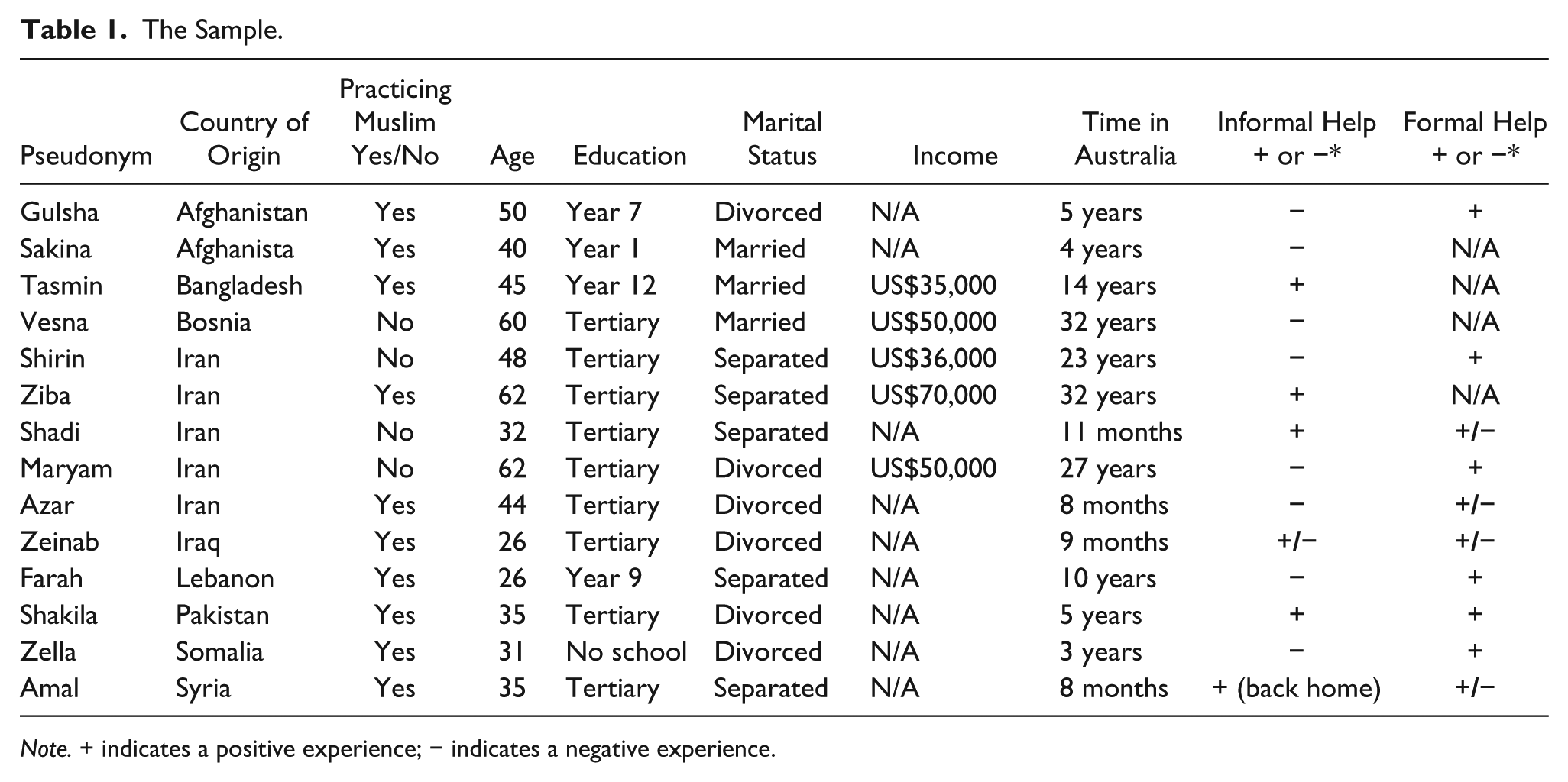
Note. + indicates a positive experience; − indicates a negative experience.
While women in the study responded in different ways to the abuse, they all showed incredible resilience toward the violence. Similar to the mainstream population DV survivors, the women reached out to family, friends, or people in the community first. The majority of survivors in our sample did not feel supported by those to whom they disclosed informally. Most of those who sought formal help did so in the later stages of the relationship. However, the experience of using external services was generally positive particularly if provided with practical help. The first formal port of call for majority of women in the sample were English teachers, GPs, counselors, and social workers. DV hotlines, refuges, and police were usually the last resort and tended to receive a positive assessment. However, four women expressed ambivalence as they experienced some type of discrimination from refuge service providers.
Method
A qualitative methodological design was used as it sought a deeper exploration of Muslim women’s experiences and meanings of seeking help (Morse, 1991; Yin, 2011). This approach ensured that Muslim women were given the opportunity to articulate their feelings and experiences about the help-seeking processes. The interviewing approach allowed for the collection of rich and meaningful data from the lived experiences of those interviewed (Berg, 2007; Creswell, 2009; Marshall & Rossman, 2006).
The women were recruited using a purposeful sampling method. This allowed for the identification of women with first-hand experiences of seeking help for DV (Patton, 2002).
Initially, organizations with direct contact with women who had experienced DV were contacted. Flyers advertising the research were emailed to all of these organizations to be displayed and for distribution to other relevant services. Also face-to-face contact was made with these organizations to clarify the research objectives and the purposes of the interviews. The participants were referred from three organizations: the NSW Women’s Refuge Movement, one community organization, and one Migrant Resource Center. The interviews took place in their premises. Women recruited through organizations then provided information about the study to other women they knew. Three further participants were recruited via this method.
The participants self-identified as “Muslim” had migrated to Australia, were 18 years old and older, lived in Sydney or Newcastle at the time of the study, had experienced abuse in some form from their partners, and were able to speak English with the exception of women who spoke Farsi/Dari (the interviewer’s language). Given the means of recruitment, it is not surprising that each of these women had sought some type of casual or more formal assistance.
Fourteen individual, face-to-face semi-structured interviews were conducted (demographic background variables of the sample are summarized in Table 1).
Before the interviews were conducted, the research aims and objectives were explained and the participants were assured that all their personal information would remain confidential and a pseudonym chosen for each interviewee in the study. At the start of interview, participants were asked to sign a consent form and each interviewee received a participant’s information sheet (PIS). (Note that in their ethics approval, the University of Sydney Research Ethics committee required the design of a safety protocol which included no interviews were to be conducted in private homes, interviews were to take place on weekdays during the normal business hours of the organization, and the researcher was to carry a mobile phone and conduct interviews alone.)
Thematic analysis was employed to elicit major themes from the interview data allowing flexibility during the process (Braun & Clarke, 2006). When analyzing the data, some general themes were initially developed from the literature. Small-scale categories were then merged into the main themes. The transcripts were coded, and finally, the thematic codes were checked to determine whether they were extensive, which led to some revision. All data categories and coding were developed using NVivo 9 software.
Caveats
The interviewees each identified as having experienced DV. Their willingness to participate in the study likely reflects their own self-awareness and resilience. Furthermore, they are a sample of survivors who ultimately sought some sort of help. Therefore, our findings cannot be generalized to Muslim immigrant DV survivors as a general category. Note too that the study is qualitative, and the sample size is too small to identify patterns and only permits preliminary conclusions regarding help seeking.
Placating and Other Coping Strategies
Some researchers have found that some women are more likely to use placating techniques (such as keeping the peace, keeping the house clean, and waiting for partner) or resistance (such as fighting back verbally, refusing to listen to the perpetrator, leaving home temporarily, and ending the relationship), rather than seeking formal or informal support (Davis, Taylor, & Furniss, 2001; Riddell, Ford-Gilboe, & Leipert, 2009; Wendt, Chung, Elder, Hendrick, & Hartwig, 2017).
In the current study although all of the women wanted the abuse to stop and knew that it was wrong and far from a respectful relationship, initially they used palacating techniques as they were afraid of breaking the silence. Both younger and older women, practicing and nonpracticing Muslims, and women with or without children were among those who used passive responses such as silence—particularly in the early stages of the violence: I was silent, I did not talk. I ignored him; I kept all of them inside me and did not speak about it. (Maryam, 62 years, Iran)
However, almost all of those interviewed came to see that silence did not protect them and in some cases being quiet correlated with an escalation of the abuse: Unfortunately, silence doesn’t stop violence, sometimes you need to do what you want to so he understands that you are strong, when you don’t do that he will take advantage of you, he plays with you like a toy, I tried silence but it didn’t work. (Ziba, 62 years, Iran)
Other strategies that women utilized to manage the abuser included trying to understand him, crying, ignoring him and/or trying not to be around him: I said to him I love you. I did for him whatever he wanted. I said to him you have to be kind with your woman, you are good man. I tried a lot of things. (Farah, 26 years, Lebanon)
Some also tried to distract themselves by engaging in activities like reading and singing: When he got angry I tried not to be around him, I got out of home, went to my room. I tried not to do things that upset him. (Ziba, 62 years, Iran) I tried to go for walk early in the morning and mixing with a lot of people. I tried to keep my mind busy . . . and just redirect my mind to birds and blue sky and other things that took me away from there from getting upset. Sometimes I read books. (Maryam, 62 years, Iran)
Before accessing informal or formal help/assistance, eight women in the sample did take some action to end the violence. For example, a few suggested to their partner that he might need to see a counselor or psychologist or attend anger management courses: He cannot control his emotion and he has never learnt to deal with his anger. I believe he should go and learn about anger management. I have told him many times but he didn’t listen. He was very proud and he thought he didn’t have any problem. He didn’t want to go and see a counsellor or do any anger management course. (Shirin, 48 years, Iran)
However, when their words had no effect on the perpetrator, two women stopped trying to change their husbands and instead tried to alter their own behavior to affect the violence: He was crazy and started to break things in the house. I screamed with him to stop him. I said maybe because if I’m loud he would stop but he didn’t. (Amal, 35 years, Syria) I tried to change my husband a lot during this time. I found out that he never changes his behaviour . . . Then I tried to change myself to see if I can put up with him. But I couldn’t. (Zeinab, 26 years, Iraq)
Another three survivors attempted to empower themselves in different ways to feel they had some control in their lives: I wanted to go to English class but my husband and his mother said you are not allowed. So, I taught myself. I turned the radio on while I was cleaning and cooking and tried to remember words. At night, I asked my children. Sometimes I read their books. (Farah, 26 years, Lebanon) I feel better because now. I have a job. If he hits me it doesn’t matter. I’m not dependant on my husband because I work now. I feel better because I’m independent. (Tasnim, 45 years, Bangladesh) My husband wanted to have a baby but at that time I didn’t want a baby at all. My reason was fear of my husband. I tried hard and hid all the contraceptive pills even one by one so he did not know I took pills. I hid some in my pillowcase. (Zeinab, 26 years, Iraq)
Of the 14 women in the study, 10 were actively practicing Islam, three were nonpracticing Muslims but believed in God, and one did not believe in God or in any religion. Some found solace in the belief that they were assisted through God’s will and help. For instance, God was talked about as a significant refuge in their life, particularly when dealing with their partners’ violence. They explained that whenever they were feeling desperate, lonely, and powerless they took refuge with Allah, talked to him, prayed or read the Qur’an. For a few, praying was the only coping strategy they had in dealing with the abuse. They derived strength and resilience from their spiritual beliefs, believing that the help of God would guide them through the hardship of their lives (Ghafournia, 2017): Actually, I pray. When he hit me I straight away go and pray. I talk to my Allah to change him. Then I feel better after that. (Tasnim, 45 years, Bangladesh) I prayed oh my God I’m sad, I’m sick I’m tired help me, give me strength and patience to put up with this life. (Farah, 26 years, Lebanon)
Barriers to Seeking Help
Women from CALD backgrounds may not access assistance for a number of reasons. The current literature notes the various intersecting factors which may hinder immigrant and refugee women’s responses to DV (Gray, Easteal, & Bartels, 2014; Vaughan et al., 2015b). It may be due to cultural beliefs—for example, that it is the duty of the woman to keep the family intact as it is regarded as a central unit (Runner, Yoshihama, & Novick, 2009; Sabri, Barcelona De Mendoza, & Campbell, 2014). There might be pressure to remain in the marriage with the woman seen as the cause of her partner’s abuse (Ahmad, Driver, McNally, & Stewart, 2009). Also, immigration and settlement factors such as social isolation, language barrier, racism, fear of police, lack of knowledge about the legal system, and the availability of support services can be other barriers to seeking help (Fisher, 2013; Ghafournia, 2011; Gray et al., 2014; Rees & Pease, 2006). These reasons were articulated by women in our sample. Examples include: I came with spouse visa, he threatened me every day to cancel my visa, and I was scared. I did not know anything about the law here. (Azar, 44 years, Iran) My husband used to tell me there is nowhere for me to go. I will sleep on the road if I leave him. (Zeinab, 26 years, Iraq)
Some women said the main reason for not seeking help was the fear of their family’s and friends’ responses if they left and community gossip. They also spoke of the belief that their children needed both their father and mother: My family said stay with him don’t worry you have children. I waited, I thought the same. My kids need both father and mother. (Tasnim, 45 years, Bangladesh)
In addition, their partner might have threatened to remove the children. As the woman lacked knowledge of her legal rights, this could be a major obstacle to accessing either informal or formal help: He was telling me that both my daughter and he is Australian not me and my visa will finished in some time. If I leave or divorce he will take my daughter and I go to my country. So many things were in my head. I have to shut my mouth and continue my life because of this. (Amal, 35 years, Syria)
Moreover, stereotypes, xenophobia, and racism remain evident in the attitude of some service providers and policy makers, and this may affect the process of decision making for abused immigrant women (Bograd, 2005). In particular, in the context of this study, the assumptions that Muslim men are inherently violent and Muslim women are innately submissive and passive are common stereotypes.
For these reasons and more, the women in the sample, including the three who remained in the violent relationship, felt silenced for a period of time. As mentioned above, these women demonstrated resilience and survival; and for quite a few of them, this was sourced in their religious beliefs.
Factors That Influence Help Seeking
Something might take place—a turning point—which may act as an impetus to disclosure (Chang et al., 2009; Francis, Loxton, & James, 2016). This may be an incident that increases the victim’s fear of impacts of the abuse on children (Kearney, 2001; Khaw & Hardesty, 2007), escalation of violence, and anger or it can be a realization that the violence is not going to end (Abrahams, 2007). It might be recognition of the availability of external support and resources (Chang et al., 2009).
All 14 women in the sample did reach a point in which they disclosed to a friend, family, or community member or actively accessed assistance from someone externally. Ultimately those who received formal help left the violent home. Three of the respondents who had talked only to someone within the community were still living with their partners at the time of interviews. These women were over 40 years of age with adult children. They talked about their fear that family, friends and their community in general might gossip about them if they applied for a divorce or sought formal help.
One woman, Ziba, who no longer lived with her husband, had never looked for assistance externally. She remained in contact with him. The other 10 women who had left the relationship did so after receiving formal help: I tried to forgive him but it was not helpful. Finally, I decided to leave him I preferred to live separately when the problem is not solved (Amal, 35 years, Syria). The best way was this that I stood up in front of him and told him I want to resist your violence and leave you. (Shadi, 32 years, Iran)
Increased violence and fear for their own or their children’s safety were the primary reasons that the women in the sample broke the silence: I came here (refuge) with bloody mouth and nose, he almost killed me. (Shadi, 32 years, Iran) I was not sure. I thought I will put up with this situation until he had a very bad fight with me. He threatened to kill my daughter. (Azar, 44 years, Iran) We had a big fight. He hit the children as well. After that I saw my children were suffering, we always fought with each other. We had lots of problems. I decided to leave him. (Gulsha, 50 years, Afghanistan)
However, for other women, the turning point was more about recognizing that there was no hope or love in their relationships: I left when it was nothing left from my love. I found out that it’s not love it is stupidity. It was not a real life. (Amal, 35 years, Syria)
In one case, the turning point was an accusation of infidelity with the woman being forced to leave by her husband and father-in-law.
The women were asked about their views on the role of religion in their experiences of DV including whether and how they sought help. The views and interpretations were various and even conflicting. For nearly all of the respondents religiosity did not have an adverse effect on responses to DV, as there was no difference between practicing and nonpracticing Muslim women in dealing with DV. None of the women in the sample named their religiosity as a barrier to leaving the relationship, although a few women blamed Islam as a source of inequality of men and women in general.
Few believed that if their partners were religious, they would never abuse them. A few women with religious partners were more puzzled to see the conflict in their partners’ religious beliefs. Some believed that Islam is a religion of peace and equality but both men and religious leaders interpret it according to their wishes and take advantage of religion to abuse women. Another respondent explained that according to her religion she should have left the abuser many years ago and it was her religious duty to stop the abuse. Two others expressed contradictory views on the role of religion in their experience of abuse. They blamed religion as a main cause of their abuse while neither the women, their families, nor their husbands were religious. In one case, the husband was not even Muslim. And, for another woman, the unhelpful response of a religious leader was a turning point for her to search for formal help.
Informal Help Seeking
Immigrants and non-immigrants usually turn first to informal supports and then eventually to formal supports (Ammar, Couture-Carron, Alvi, & San Antonio, 2014; Bagshaw, Chung, Couch, Lilburn, & Wadham, 2000; Raj & Silverman, 2002; TJaden & Thoennes, 2000). Informal support is “when a woman seeks or receives help from family, friends, or acquaintances” (Wendt et al., 2017, p. 3). Informal social supports can improve abused women’s mental health, their willingness and ability to seek formal help, facilitate their healing and recovery and finally increase their safety (Klein, 2012; Lewis, Henriksen Jr, & Watts, 2015; Liang et al., 2005). Furthermore, social support is essential in regard to women’s practical needs, such as accommodation (Taket, O’Doherty, Valpied, & Hegarty, 2014). Therefore, their responses and actions are important in shaping future coping strategies (Klein, 2012).
Informal help seeking may be more common for some CALD women (George & Harris, 2014; Ogunsiji et al., 2011) with no formal avenues explored (Klein, 2012; Liang et al., 2005). For example, in Aly and Gaba’s (2007) study of the specific needs of Muslim immigrant women in relation to crisis accommodation services, most of the participants preferred to stay with friends or community members. Immigrant Women’s Domestic Violence services (2006) found the same—that immigrant and refugee women in rural Victoria usually did not formally report violence.
In our sample of 14 survivors, most of the women had sought informal help from different sources such as their family including their children, friends, community members, religious leaders, and in-laws. Examples of types of assistance by extended family included confronting the abuser, supporting the woman’s decision to leave, and providing other emotional help: Because I was far from my family I did not tell them at first. But if I told them they would have supported me definitely. I didn’t want to make them worry and always think about me. When I was back home my family particularly my brother and father came and talked to him not to abuse me. He was scared of them and treat me better (Ziba, 62 years, Iran).
Assessment of Informal Help-Seeking Experiences
The women evaluated their experiences of seeking informal help in a variety of ways. A few in the sample did find that the assistance rendered by family, friends, and the community was empowering: I just talk to my friends and my kids then I feel better. (Tasnim, 45, Bangladesh) My family and my friends supported me one hundred percent. They told me come back we support you. (Shadi, 32 years, Iran) My family disagreed my marriage from the beginning they supported me to divorce. (Shakila, 35 years, Pakistan)
Although such informal responses can be helpful and have positive effects such as comforting survivors or providing practical assistance such as accommodation, transportation, and child care, other informal responses may be negative and unsupportive such as shaming, isolating, blame victims, minimizing abuse, anger, or indifference. These latter responses may further harm and damage victims’ future help seeking (Klein, 2012).
Half of those who had informally reached out to someone assessed the experience as entirely negative. For some, family members such as their own parents, siblings, in-laws, and friends were unhelpful: When I went to my mother’s house, she hit me as well and told me why you got out of your husband’s house. It’s a shame. You went with white clothes to your husband’s house and you should get out with white shroud. I told her he himself kicked me out of the house. (Gulsha, 50 years, Afghanistan) I called my dad he said to me I can’t do anything for you. You have to ask your husband. (Farah, 26 years, Lebanon) His family instead of condemning his behaviour told me it is your fault. You answered him back and you made him angry. You need to listen to him. (Shirin, 48 years, Iran)
One woman, Zeinab, had mixed responses from family members: The first time I was in my relative’s for about 2 months. At first, they were so good to me but after a while their behaviour changed. They got rude and I saw they got tired of me that’s why I went back to my husband. (Zeinab, 26 years, Iraq)
Another informal source of help was religious leaders. Two women who sought help from religious leaders reported negative experiences.
1
Both were advised to be patient and to put up with the abuse: I went to imam in the mosque he just advised me to go back to my husband. I didn’t go there anymore. (Shakila, 35 years, Pakistan) My husband and I went to Imam in the mosque. He asked me to be patient and talked to me as if I was abusing my husband. (Amal, 35 years, Syria)
Unsupportive informal sources such as these may lead women to seek help from formal sources such as health professionals, mental health professionals, shelters, and the legal/justice system (Bernardo & Estrellado, 2017; Coker et al., 2002; Decker et al., 2013; Fanslow & Robinson, 2010; Kaukinen, Meyer, & Akers, 2013; Kim & Lee, 2011; Ragusa, 2012).
Formal Help Seeking
Formal support or help can be defined as “when a woman seeks or receives help from police; a specialist domestic and family violence agency; or from a human service agency or organization, either government or non-government or both” (Wendt et al., 2017, p. 3). This support can be provided by health professionals such as doctors and nurses, mental health professionals (psychologists, counselors), social workers, women’s shelters, DV helplines, and legal/justice system (Fanslow & Robinson, 2010; Moe, 2007).
A relationship has been found between the severity of physical abuse and the rate of reaching out to these agencies (Anderson, Renner, & Bloom, 2013; Duterte et al., 2008; Goodkind, Gillum, Bybee, & Sullivan, 2003; Goodman, Dutton, Weinfurt, & Cook, 2003). Indeed, immigrant and refugee women may delay seeking formal help until the violence has escalated to severe levels (Aly & Gaba, 2007; Australian Muslim Women’s Centre for Human Rights, 2011; Easteal, 1996b; InTouch: Multicultural Centre Against Family Violence, 2010) and late in the relationship after enduring abuse for long periods (Abraham, 2000; Ahmad et al., 2009; Gilroy et al., 2014).
The view of immigrant abused women as being passive targets has been challenged in previous literature (Abraham, 2000; Ayyub, 2000; Ho, 2007; Mehrotra, 2010; Narayan, 2000; Sokoloff & Dupont, 2005; Thiara & Gill, 2010) and in our sample. Contrary to the stereotype of immigrant women (in particular Muslim women) being unwilling to approach relevant services, most of the participants went on to access formal help, despite the significant barriers they faced in doing so. Almost all of the women who had sought informal help went on to seek formal help with most doing so in the later stages of the relationship. Some women regretted that they had not acted earlier: I should have left him much earlier. Although I lived with him six or seven months I should not even have waited that long. (Zeinab, 26 years, Iraq) I should have spoken about his behaviour and got help but I didn’t, I regret. (Ziba, 62 years, Iran)
The first formal ports of call were English teachers, GPs, counselors, and social workers. DV hotlines, refuges, and police were usually the last resort. A similar help-seeking chronology has been found for the mainstream population (Ansara & Hindin, 2010; Australian Bureau of Statistics, 2012; Klein, 2012; Liang et al., 2005; Vaughan et al., 2015a; Wendt et al., 2017).
Women’s formal help seeking may be influenced by a number of intersecting factors including immigration and settlement-related factors, culture, religion, age, education, income, being a mother, length of living in the host countries, and length of living with partners. For example, in our sample, younger women accessed external assistance earlier in the violent relationship with older women appearing to be more bound by their traditional cultural beliefs as exemplified by the three respondents still living with their partners at the time of their interviews. Furthermore, the longer that women had lived with their partners and the lengthier their time in Australia, the later they sought formal help. This could correlate with their age. It does seem to contradict the view of some that acculturation plays a positive role in responding to the violence (Glass, Annan, Bhandari, & Fishwick, 2011; Kelly, 2011). Perhaps though despite many years in Australia, these women remained isolated within their ethnic community.
Assessment of Formal Help-Seeking Experiences
Those who did disclose to someone outside of family and the community generally felt that they had been assisted. They were particularly positive about the responses provided by teachers, counselors, nurses, social works, GPs, the DV hotline, and the police. This contrasts with some studies that have found the opposite perspective expressed by immigrant survivors (Ingram et al., 2010; Kulwicki, Aswad, Carmona, & Ballout, 2010; Morgan & Chadwick, 2009; Tually, 2008). In the current sample, there were certainly those who found that the assistance that they received was less than ideal, but this was not the case in their contacts with those employed in the occupations listed above.
The experience of using external services was generally positive particularly if the women were provided with practical help and/or safety for themselves and their children and/or information about available services and the legal system and legal rights. These services, as discussed by one of the interviewees, also could foster the women’s self-esteem if they felt they could trust the support: Before I came here [refuge] I couldn’t trust anyone. No one was honest with me. But the workers here, the counsellor the lawyer they all helped me. I really trust them. (Shadi, 32 years, Iran)
According to the women, some of the most helpful and accessible points of contact were teachers in English classes and Technical and Further Education (TAFE), health professionals including social workers, psychologists, GPs, nurses, community workers in Migrant Resource Centers, Police, and DV services.
Teachers
Among those who sought non-DV specialist sources, five identified teachers in English classes and at TAFE as the most helpful and accessible first points of contact referring them on to an organization or individual in the DV sector. For those women kept socially isolated by their abusers, attending English-language classes could be their only opportunity to leave the home: The last three weeks that we had serious fights I couldn’t go to English class. My friends called me they knew about my problem because I cried there all the time. I told them with my little English that he abused me. They told my teacher and she asked them to tell me to come to class as there are some people who will help me. Then I saw the counsellor. She helped me a lot and explained many things and gave me some numbers. I heard about some before but I was not sure if it is correct. She told me he cannot deport me. It was so assuring. She called some places and told me when you feel you can no longer live with him call this number. . . Just one week before I came here I called them they said they will help me. (Azar, 44 years, Iran) The counsellor in the class knew about my situation. She was supposed to make an appointment for me. She came to my class and told me about the appointment. She explained everything to me. (Shadi, 32 years, Iran)
Health professionals and community workers
Other sources of help included social workers in hospitals and Centrelink (the primary Australian Government welfare organization), psychologists, GPs, nurses, and community workers in Migrant Resource Centers. Four women learned about available DV support services from these individuals: I went to hospital a social worker talked to me and helped me a lot. (Zeinab, 26 years, Iraq) I went to Centrelink I was upset and crying. The social worker talked to me and helped me to come to a refuge. (Shakila, 35 years, Pakistan) I went to hospital. There I understood the law of the hospital. One of the nurses told me that if I want I can refuse to see my husband. This resulted in my separation from my husband because I couldn’t find any way to escape from him. (Zeinab, 26 years, Iraq) I learnt about legal system and the police through migrant resource centre and the workers. I attended different programs. They talked about legal system. Also in English class they told us that we can call the police if our husbands abuse us. I learned many things. (Gulsha, 50 years, Afghanistan)
Police
Six women called the police for help at some point in the violent relationship. In one other case the neighbors called the police. Although seen as the last resort, police were universally described as providing useful support: I tried everything, nothing worked then I called the police . . . The police supported me a lot. For the first time I felt my children and I are safe. I felt so good. (Gulsha, 50 years, Afghanistan)
For another three women, just threatening to call the police was enough to stop the physical abuse. As Ziba describes: He grabbed my neck and he said I will kill you . . . I told him if you stay awake all night and watch me then you might stop me going to the police. I will tell them what you have done to me. Then he started begging me. He knew that in this country this behaviour is not tolerated or accepted. It was the last time he hit me. (Ziba, 62 years, Iran)
DV services
As mentioned above, the women learned about the role of police in DV situations and about the DV hotline through social workers, counselors and teachers at TAFE or through some classes at Migrant Resource Centres. Consequently, five women rang the DV hotline and were referred to refuge staff: After I called domestic violence hotline they sent a taxi for me and took me to a refuge. I couldn’t believe it. It was so quick. They really helped me. They did not just talk to me like others such as my friends and community. (Shadi, 32 years, Iran) Finally, I called the number (DV hotline) they came and picked me up. All of the workers were very nice and supported me. (Farah, 26 years, Lebanon)
The majority of those who contacted DV agencies assessed their services positively. However, four women expressed ambivalence as they had sensed some racism and had experienced discrimination from refuge service providers such as inadequate provision of interpreters, a differentiation made between immigrant and mainstream women in terms of financial assistance and having their dietary and other religious requirements ignored: When I was in a refuge I kept asking them to book an interpreter for me. I had no idea what was happening to me. There was lots of paper work. I was confused. They just provided interpreter once for ten minutes. (Shadi, 32 years, Iran) When I was in a refuge I didn’t have any money as I was not permanent resident. I asked for nappy for my daughter. They gave me one or two. It was hard for me to ask every day. It was an Australian girl who always got boxes of nappies. I felt so bad. (Amal, 35 years, Syria) There [refuge] I had no money because I did not know English and also I was shy to ask for money. No one gave me anything but another Australian girl got money continuously. It was not fair. (Azar, 44 years, Iran) Some of staffs treated me badly. For example, the first day I went to a refuge I had some Halal food with me—the food from my country that I like. They didn’t let me to bring the food with me they said we have food here. We don’t let you. (Zeinab, 26 years, Iraq)
One woman’s time at the refuge was so negative that she left and returned to the violent home: In the other refuge one of the case workers, I don’t know why maybe because of my religion or because I’m not Australian abused me so much. That’s why I couldn’t stay there more than two weeks and went back to my husband. (Zeinab, 26 years, Iraq)
This finding is not unique. Services that target mainstream women may leave immigrant women feeling invisible so that when they do ask for help they may feel unwelcome (Sumter, 2006). Such instances of discrimination could be due to institutional racism from service providers including negative stereotypes concerning the commonness and even acceptability of abuse in certain ethnic and cultural groups (Anitha, 2011). Intentional or unintentional, discriminatory behaviors can contribute to increased isolation and marginalization of these immigrant DV survivors (Adelman et al., 2003; Meetoo & Mirza, 2007; Runner et al., 2009; Sokoloff, 2008).
Conclusion: Improving Responses
The women’s narratives reveal the complexity of Muslim women’s experiences of responding to domestic and family violence. There is no simple cause and effect finding. For example, it would appear that religion did not correlate with a specific means of seeking help in the study. Muslim women in the sample sought either formal or informal help despite whether they identified as a practicing or a nonpracticing Muslim. They did not see being a Muslim as a key contributor in their experiences of abuse or in their formal or informal help-seeking actions. The only negative role of religion reported by several respondents was the role of some religious leaders (Imams) who encouraged women to put up with abuse and be patient. On the contrary, spirituality and religion were seen as empowering forces for the women to respond to the abuse.
Our findings shed light on some relevant concerns for the community, service providers, and policy makers, which need to be addressed in the areas of practice, education, and policy. For example, to better address these women’s needs, there needs to be an understanding of how being a mother can shape women’s help-seeking responses in opposite ways. Some victims did not access or they delayed getting formal help as they believed that their children needed both their father and mother or they were afraid that their partner would remove the children as he had threatened. At the other end of the spectrum though, women were motivated to seek assistance out of concern for their children’s safety and to ameliorate the effects that the DV were having on them.
Family, friends, and community leaders such as Imams are those to whom the CALD victim first turns. If supportive, these experiences can be empowering for immigrant women. Therefore, it is disturbing that the majority of survivors in our sample did not feel supported by those to whom they disclosed informally. For example, the women who chose to confide in their Imam were not provided with contacts to external DV agencies but instead were advised to remain with their violent partner. Furthermore, the responses from family members appear to have been mixed.
We found too that initially, the victims were not familiar with the resources available in Australia such as refuges, the role of the police, and migration legislation, which has evolved over time to offer DV victims some protection with a special visa category. Women in our sample who went to TAFE had positive experiences in receiving such information. But, what about the many immigrant women who remain isolated in their homes and have a serious informational deficit? It is urgent for government to better resource migrant community education programs focused on the complexities of DV and the available pathways for its victims. In this way not only will the survivors learn what services are available but also potential informal help sources such as family, friends, and local religious leaders will be better informed and hopefully better able to understand and assist.
Furthermore, the role of social workers, counselors, and English as a second language (ESL) teachers in this area is also a fundamental consideration. The findings indicate that these people are usually the first external resource to whom the CALD victim discloses. This suggests a critical need to equip these service providers with relevant information and training, as well as enough funds and the authority to refer abused immigrant women to relevant DV services.
Ironically or sadly, the women interviewed had experienced the most adverse help seeking in refuges where they felt the presence of racism and its discriminatory consequences. We recommend that DV services should create more opportunities for their front-line workers to attend cultural competency workshops and training. The need for this is observed in the instances (as described earlier) of a lack of understanding of immigrant women by refuge workers. DV services need to better integrate the immigrant women’s experiences and their cultural needs in service delivery. Hearing their voice is an essential step in combating marginalization of CALD women and ensuring that those who manage to find asylum from battery also find safety from discrimination and racism.
Footnotes
Declaration of Conflicting Interests
The author(s) declared no potential conflicts of interest with respect to the research, authorship, and/or publication of this article.
Funding
The author(s) received no financial support for the research, authorship, and/or publication of this article.
