



Abstract
Māori women (Aotearoa New Zealand’s Indigenous women) experience a high burden of harm and homicide associated with intergenerational family violence, complicated by the ongoing effects of colonialism. Also, the historical, social, and cultural complexities, such as poverty and structural racism, challenge further Māori women seeking help. In this project, we sought to answer two questions: What are Māori women’s sociocultural constructions of “love” within relationships with violent partners? What roles do traditional cultural values play in their relationships? Using Kaupapa Māori (by Māori, for Māori) methodology, we conducted in-depth semi-structured interviews with 27 Māori women and analyzed them using thematic analysis. We identified three core themes that explain how Māori women enter into, stay in, and leave a relationship with a violent partner: (a) it begins with a connection, (b) downplaying the signs, and (c) needing to leave. We found that Māori women’s compassion and caring for their partner was underpinned by their recognition that partners had the potential to be nonviolent and resembled Māori cultural concepts of aroha (compassion, empathy, and respect) and manaakitanga (hospitality, sharing, and caring for others). Through sharing their stories, these women revealed the strength of cultural imperatives that include the importance of whakapapa (genealogy) and whanaungatanga (connections) of which aroha and manaakitanga are integral parts. Our findings highlight the complexity and competing tensions underpinning Māori women’s decision-making when entering and exiting violent relationships. These cultural imperatives are essential for understanding how these influence the decision-making of Māori women, which can position them at odds with those who would tell them they must walk away and not look back.
Keywords
Violence against women and children is a global social and health concern (World Health Organization, 2014) with lifelong physical, psychological, and spiritual consequences, such as posttraumatic stress disorder, depression, intergenerational trauma, suicide, and homicide (Dube, Anda, Felitti, Edwards, & Williamson, 2002; Haqqi, 2008; NZ Family Violence Death Review Committee, 2017; Stockman, Hayashi, & Campbell, 2015). Māori, the Indigenous peoples of Aotearoa New Zealand, experience higher levels of family violence compared with other groups living in New Zealand, with women and children bearing the highest burden of harm (Dawson, 2017; Fanslow, Robinson, Crengle, & Perese, 2010; Wilson, 2017b). The colonization of Māori has been attributed to the introduction of male partner violence into Māori whānau (extended family networks; Mikaere, 1994, 2017) resulting in marked inequities in family violence-related prevalence and homicide (Fanslow et al., 2010; Mikaere, 2011; NZ Family Violence Death Review Committee, 2017). Various reasons are proposed for women remaining with their violent partners, including factors such as deprivation (Campbell & Mannell, 2016), coercive control and entrapment (Crossman, Hardesty, & Raffaelli, 2016; Stark, 2009; Tolmie, Smith, Short, Wilson, & Sach, 2018), racism (Wilson & Webber, 2014), fear, learned helplessness and financial dependency (Kim & Gray, 2008; Pugh, Li, & Sun, 2021), and romantic love. However, these constructions are often informed wholly by Western understandings, including those of love (Fanslow & Robinson, 2010). In this article, we begin by providing an overview of precolonial and contemporary Māori values and the impact of colonization on Māori women’s intimate partner relationships. We then examine Māori women’s sociocultural constructions of “love” in relationships with violent partners and the roles traditional Māori values of aroha (compassion, empathy, and respect) and manaakitanga (hospitality, sharing, and caring for others) play in their relationships.
Precolonial Māori Society
The notion of Māori citizenship is in whanaungatanga (connections) and the collective responsibilities and obligations they have for the well-being of whānau (the extended family networks of Māori), hapū (collections of genealogically related whānau), and iwi (tribal nations) (Tomlins Jahnke, 2011). Whakapapa lays down the relationships and connectedness of people to others and to place, and forms the foundations for reciprocity and collective obligations that promote the mana (spiritual power, authority, and status) of people, whānau and their hapū. Thus, -whakapapa (genealogy) and whanaungatanga, the foundations of Māori society, lay the blueprint for kinship obligations that exist within whānau (Hall, 2013). It establishes enduring connections between people (Kruger et al., 2004; Pihama, Jenkins, & Middleton, 2003). Within the context of intimate partner relationships, love was not the predominate factor influencing decisions about relationships, but rather elders deciding on what was best for the whānau and hapū as a whole (Ruka Te Korako & Ruka Te Korako, 2006). They provide the basis for relationships that promote the mana of all its members and are underpinned by cultural values that guide behaviors, such as aroha and manaakitanga. The mana of Māori women is embedded in whakapapa, the mana of tāne (men), and whānau, tūpuna (ancestors), whenua (land), and ātua (influential spiritual powers). Before colonization, Māori whānau and hapū worked together to promote members’ well-being and safeguarded the mana and integrity of whakapapa (Ruka Te Korako & Ruka Te Korako, 2006).
Māori women’s revered status as te whare tangata (bearers of past, present, and future generations) is embedded in traditional knowledge forms, such as whakapapa, pūrākau (stories), whakataukī (proverbs), and the teachings of ātua (gods), tūpuna (ancestors), and wāhine toa (accomplished women) (Mikaere, 2011). This status signaled Māori women’s pivotal roles in maintaining whakapapa and the survival of the collective whānau, hapū, and iwi. While informal intimate relationships are evident in pūrākau and historical accounts of Māori women, rigorous decisions were made about their marriage by elders based on past and present relationships, patterns, and events, with consideration of the wider whānau and hapū and future interests. Intimate partner relationships, such as marriages, were about safeguarding whakapapa, “. . . the seed and garden of the people . . .” (Ruka Te Korako & Ruka Te Korako, 2006, p. 226), and ensuring the mana, dignity, and strength of whānau and hapū (Ruka Te Korako & Ruka Te Korako, 2006; Salmond, 2018). Importantly, Māori women were not viewed as chattels or subordinate to men (Pihama et al., 2003). A hara (transgression against the spiritual well-being of women and their whānau), such as violence against Māori women within the whānau and hapū, resulted in the whānau elders deciding on the continuance or termination of the relationship and the offender receiving harsh punishments to deter its existence (Kruger et al., 2004; Ruka Te Korako & Ruka Te Korako, 2006), although violence against women did occur outside of their whānau and hapū. Similar to other Indigenous peoples, the status of women and the threat of harsh sanctions functioned to prevent abuse and violence against them and their children (Atkinson, 2002; Browne & Varcoe, 2006; Kruger et al., 2004; Mikaere, 1994, 2017).
New Zealand’s historical records contain numerous written observations by settlers, missionaries, and British Crown agents that confirm the absence of abuse and violence against women and children (E Tū Whānau, 2018). For example, Reverend Samuel Marsden observed between 1765 and 1838 as follows: “I saw no quarreling while I was there. They are kind to their women and children. I never observed either with a mark of violence upon them nor did I ever see a child struck” (Elder, 1932, p. 128). Women, men, grandparents, and wider whānau collectively shared the nurturing of women and children and assisted in the child-rearing because of women’s central roles in Māori society as bearers of future generations (Mikaere, 2011).
The Impacts of Colonization on Māori
Colonization led to loss of land, culture, and language, and socially and economically disenfranchised many Māori. In addition to the dispossession of land, education and urbanization policies aided the assimilation and fragmentation of the protective social structures of Māori whānau and hapū leading to their replacement over time by nuclear families (Pihama et al., 2016). Over generations, many Māori became increasingly disconnected from their cultural identities and protective support systems (Durie, 1997). Furthermore, the label “Māori” attempted to homogenize previously diverse whānau, hapū, and iwi constellations. Colonization brought about widespread social change for Māori; it also resulted in the loss of vital protections embedded within Māori cultural values and practices.
Mainly Protestant and Roman Catholic Christian dogma reinforced patriarchy through education and assimilation, aiding the impacts of colonization on Māori women (Hoeata, Nikora, Li, Young-Hauser, & Robertson, 2011; Mikaere, 1994, 2011, 2017; Simmonds, 2011). Colonization had and continues to have devastating effects on Māori functioning and well-being (Kruger et al., 2004; Pihama et al., 2016). The subsequent subordination of Māori women stripped them of their mana and the equal status they had previously held with Māori men. British social norms further positioned Māori women as men’s chattels on the margins of society and enabled violence to thrive as the public and collective responsibilities and obligations of Māori became replaced by individualism and privacy (Kruger et al., 2004; Mikaere, 1994).
Māori women’s experiences of colonization differed from those of Māori men (Dhunna, Lawton, & Cram, 2021; Mikaere, 2011). The colonizing agenda of imperialism and assimilation has ongoing effects and negated Māori women’s status as te whare tangata (Mikaere, 2017). Patriarchy and the privacy of men’s homes replaced the communal safeguarding and the protective support embedded in everyday whānau and hapū life (Kruger et al., 2004; Mikaere, 1994, 2011, 2017). Despite colonization and the agenda to assimilate Māori to conform to the “new” dominant culture, Māori have shown resilience and through their acts of resistance, collectivity, and rangatiratanga (self-determination and leadership) have retained core cultural values and practices (Penehira, Green, Smith, & Aspin, 2014). This resistance has helped retain essential Māori values and practices that has enabled Māori whānau, hapū, and iwi to rekindle their cultural identities, connections, and practices in contemporary times. Nonetheless, many Māori whānau have struggled, faced with ongoing adversities that affect them in complex ways.
The overrepresentation of Māori in family violence occurs at both victim and offender levels compared with other groups living in New Zealand, with Māori women and their children affected by intimate partner violence (IPV). The New Zealand prevalence of lifetime IPV for women is one in three (Fanslow & Robinson, 2011); however, the lifetime prevalence for Māori women ranges between 57% (Fanslow & Robinson, 2011; Koziol-McLain et al., 2004) and 80% (Koziol-McLain, Rameka, Giddings, Fyfe, & Gardiner, 2007). Of those Māori women reporting lifetime IPV, between 60% and 96%, respectively, had children living at home with them (Koziol-McLain et al., 2004; Koziol-McLain et al., 2007), highlighting the likelihood of IPV coexisting with child abuse and neglect (NZ Family Violence Death Review Committee, 2017). The NZ Family Violence Death Review Committee (2017) reports the need to respond to violence against women and child abuse and neglect together because of their entanglement. Māori women have 3 times greater likelihood than their non-Māori counterparts of being a victim of family violence homicide.
The majority of whānau are socially and economically disenfranchised to the point of poverty, are socially marginalized, subject to racism, and some are living with violence within their whānau (Cormack, Stanley, & Harris, 2018; Ministry of Health, 2015; Pihama et al., 2014). Standard views held about Māori women often disregard the ongoing and harmful effects of colonialism, historical trauma, marginalization, loss of cultural values and practices, and social and political disenfranchisement (Simmonds, 2011; Smith, 2012). Most of all, by casting them in deficit ways, there is a failure to recognize the strengths, autonomy, and agency they possess, and importantly their needs (Campbell & Mannell, 2016). Comprehending family violence for Māori requires responses that are cognizant of the violence that exists beyond intimate partners and wider family members and is inclusive of their distinct historical, social, and cultural complexities (Wilson, 2017b). However, most literature and knowledge tend to privilege dominant cultural understandings of violence against women and children.
Similar pictures of prevalence and homicide exist in the Indigenous peoples in Australia (Cripps, Bennett, Gurrin, & Studdert, 2009), Canada (Miladinovic & Mulligan, 2015), and the United States (Bachman, Zaykowski, Kallmyer, Poteyeva, & Lanier, 2008). Underreporting, a lack of accurate ethnicity data, and research focusing on the developed world obscures a comprehensive and global picture of family violence for Indigenous peoples. Nevertheless, given the additional influences on Māori whānau compared with other groups in New Zealand, such as social disenfranchisement, structural inequities, and racism, further research is required to understand the complexities they face (Wilson, 2016, 2017b). Part of this complexity includes understanding their culturally informed knowledge and practices, such as notions of love and what this means for Māori women in their relationships.
Love and Relationships
Precolonial Māori notions of love are underpinned by manaakitanga, which guides the nurturing of relationships and looking after and treating others with care, compassion, and empathy to uphold individual’s mana and that of the whānau (Barlow, 1994). Integral to manaakitanga is aroha (Barlow, 1994), which extends beyond its simple everyday translation of “love.” Aroha encompasses behaviors that are demonstrated as genuine respect, compassion, empathy, generosity, humility, and affection (http://etuwhanau.org.nz/our-values/aroha/). Aroha derives from aro, to face toward others, while ha is to breathe and is often referred to as the life force (Moorefield, 2011). Aroha is interrelated with tika (correct and right) and pono (true and honest). Metge (1995) explains aroha within the context of whānau and kinship as The warm affection which whānau members are expected to feel for each other . . . in work and play, especially in childhood. . . . Even more important than affectionate feelings, however, are the caring acts expected to be performed towards kinsfolk, especially in times of sickness, need or other trouble. (p. 81)
Together, tika and pono frame aroha and are grounded in reciprocity, the responsibility and obligations to others, and not only exist within current relationships but also continue if a relationship ends. It is the inherent responsibility to act compassionately and empathetically to others that obliges Māori caring for others, which is carried into intimate relationships—not for the benefit of individuals but for the greater good and mana of whānau and hapū.
Mana, tika, pono, aroha, and manaakitanga connect people and inform their behaviors and decisions about responding to and interacting with others. Marsden explained that “To operate in aroha reaped the rewards of social approval, honor, esteem and while this was a motivating factor, equally important was the sense of obligation which could entail sacrifice even unto death upon the part of a member” (cited in Royal, 2003, p. 42). Thus, precolonization intimate relationships embodied the inherent mana of both wāhine and tāne nurtured by aroha and manaakitanga.
Aroha and manaakitanga, when translated into action, drive nurturing responses and strengthen relationships, adding quality and meaning to life, demonstrated by sharing with others. It involves expressing genuine concern for others and acting in their best interests, no matter their state of health and wealth (Barlow, 1994). Aroha, therefore, is a complex interweaving of multiple concepts and values and something difficult to comprehend when viewed from a Western worldview.
Contemporary Māori notions of love most likely blend traditional and contemporary Western understandings that are promulgated by mainstream and popular media. In comparing aroha with love, Metge (1995) identifies English forms of love manifests as affection to others, especially family, sexual forms of love, and altruism. A defining difference is that traditionally aroha was not inclusive of sexual forms of love (Metge, 1995). Modern popular media promotes contemporary Western forms of “romantic love,” as sometimes sexualized and predominately based in heterogeneous relationships. From a Western perspective, the capacity to love defines what it is to be human (Graham, 2011). It is a commitment to the well-being of another person(s) and is evident in varying forms of love: romantic, parental, and compassionate (Hegi & Berhner, 2010). Even within contexts of abuse and violence, love is believed by many to be a key driver for establishing and maintaining enduring relationships (Graham, 2011). Power, Koch, Kralik, and Jackson (2006) contend that “romantic love” occurs within the private domain of couples and how it is constructed and plays out remains largely unseen. While love is a universal concept, the nature of what comprises love appears to be diverse. Graham (2011) describes two forms of romantic love: (a) passionate love, which is essential for establishing relationships and sexual encounters, and (b) companionate love, which serves to establish longer term and platonic relationships and to care for children (Graham, 2011). Given that “love” is a popular explanation proposed as to why Māori women stay in violent relationships, we asked the following: What are Māori women’s sociocultural constructions of “love” within relationships with violent partners? Moreover, what roles do Māori cultural values play in their relationships, within the context of ongoing colonialism?
Method
We used a Kaupapa Maori (by Māori, for Māori) research methodology because it aims to counter Western scientific research that mostly portrays Māori in deficit ways that victim-blame and reinforce negative stereotypes—further colonizing them (Cram, 2017; Smith, 2012). Improving understanding of Māori women’s realities of living with violence is essential to assist them in relevant and meaningful ways. Kaupapa Māori research methodology privileges Māori ways of knowing by creating culturally responsive and safe spaces for research (Cram, 2017; Wilson & Neville, 2009). It draws on a Māori worldview and decolonization and intersectionality theories to inform the analysis and interpretation of the data (Chilisa, 2012; Smith, 2012; Wilson, 2017a). More specifically, we used Mana Wāhine theory because it reclaims the traditional status and authority of Māori women while enabling a critical analysis of the systemic and social structures that contribute to their realities (Pihama, 2001; Simmonds, 2011). Drawing on the oral traditions of Māori and the knowledge embedded in the women’s narratives, we used pūrākau, Indigenous story work (Lee, 2009), for women to share their stories about how they entered into relationships that subsequently became unsafe and why they stayed and left within the context of love. A Kaupapa Māori approach facilitated data collection based on Māori cultural values and practices.
We gained institutional ethical approval (AUTEC 16/19 and 16/146) before recruitment of participants. Ethical approval and the informed consent provided by participants restrict access to the raw data to the research team only.
Participant Recruitment and Selection
We used purposive sampling and whanaungatanga (using established relationships) to recruit 27 participants (Jones, Crengle, & McCreanor, 2006). Inclusion criteria required potential women to identify as Māori, be 16 years and older, had lived in an “unsafe” (abusive or violent) relationship but were currently living violence-free, and were willing to share their stories and thoughts about keeping safe in their past unsafe relationship(s). We screened each woman for risk of harm before participating in the study.
Data Collection
We completed audio-recorded semi-structured interviews from 2017 to 2019 lasting 60 to 120 min, using a conversation-style approach. Interviews began by asking, “Can you tell me your story of keeping safe in your relationship?” The interviews were the women’s pūrākau (story), so they had autonomy over what they shared. All of the women gave a storied longitudinal account of their relationship in a nonlinear way that spanned the beginning to the current situation. Some community presentations by the lead researcher before the interviews enabled women to build trust although the lead researcher did not know about their presence at the time. Some participants indicated that by having an opportunity to share their previously untold story they hoped it would help other women. We started the interviews with karakia (prayer to prepare spiritually) followed by whakawhanaungatanga (establishing connections) before listening to the women’s pūrākau. We inquired, using open questions, about the nature of their relationship, how they felt unsafe, what they did to keep themselves and their tamariki (children) safe, their support networks, and support from agencies to help keep themselves safe. We gave a koha (gift—NZ$50 voucher) in appreciation of their participation. Following transcription of each interview, we checked them for accuracy, removed all identifying features, and then assigned a pseudonym.
Data Analysis
Mahi a Roopū is a collective Indigenous approach that guided the process of identifying themes (Boulton, Gifford, Kauika, & Parata, 2011; Gifford, Wilson, & Boulton, 2014). The process first involved analyzing the data by individual research team members who undertook a preliminary constant comparative analysis of the transcripts to generate open and focused codes in preparation for the next stage. This method of analysis requires researchers to demonstrate humility and respect, and engage in vigorous discussions leading to consensus. Mahi a Roopū strengthens the analysis by (a) involving all researchers’ collective critical input informed by their background; (b) aiding the integrity, reliability, and rigor of the findings; and (c) reaching consensus about emerging codes and themes (Boulton et al., 2011; Gifford et al., 2014).
Four research team members (D.W., A.H., K.C., and K.B.) met for four full-day analysis meetings and two full-day meetings with the full team (including D.J. and J.S.) where we reviewed each transcript using constant comparative analyses to agree upon the open and focused codes. As a group, we then sorted these into themes and their subthemes, ensuring data saturation of each, and continued discussions until we reached consensus. In line with the method, we constructed diagrams and memos to synthesize the data and illustrate the themes, which we checked against the transcripts to ensure they included the necessary contextual elements.
We established validity (Whittemore, Chase, & Mandle, 2001) by ensuring that the findings were credible and authentic by ongoing checking of emerging themes and subthemes against participants’ stories to ensure that we captured the diversity of experiences. Criticality and integrity involved two members (D.J. and J.S.) independently reviewing the analysis against the transcripts. To ensure that the fidelity of the analysis reflected Māori women’s realities, a member working with Māori women, and community presentations, enabled verification that the interpretations reflected the Māori women’s realities.
Findings
Twenty-seven Māori women aged between 18 and 63 years (Table 1) from rural, provincial, and urban regions in the North and South Islands of New Zealand participated. In collaboration with community leaders, we did not specifically ask participants about their education and income levels. Nonetheless, women disclosed education levels ranging from no qualifications to university-level education. Participants also had a range of income sources from none to those with full-time incomes or government benefits. All 27 women had children of varying ages, and 24 maintained contact with their (ex-)partners. Twenty-five participants had experienced physical violence in their relationship; all 27 reported psychological violence, of whom 22 disclosed lasting impacts. The emotional and psychological violence experienced by them were not limited to any age or demographic or generational group. Just under half of the participants had protection orders. One third of participants (n = 9) had been in multiple violent relationships, and a quarter (n = 7) had partners with gang associations. Although same-sex couples were eligible for our study, all participants were in heterosexual relationships. Regardless of the women’s age or geographical location, the patterns of violence were remarkably similar, beginning with no violence, to increasing emotional and psychological violence, to coercive control and entrapment, and to leaving.
Participant Age Ranges.

The following themes represent the process of Māori women getting into their relationship to finally getting out or working on “mending”: it begins with a connection, downplaying the signs, and needing to leave.
It Begins With a Connection
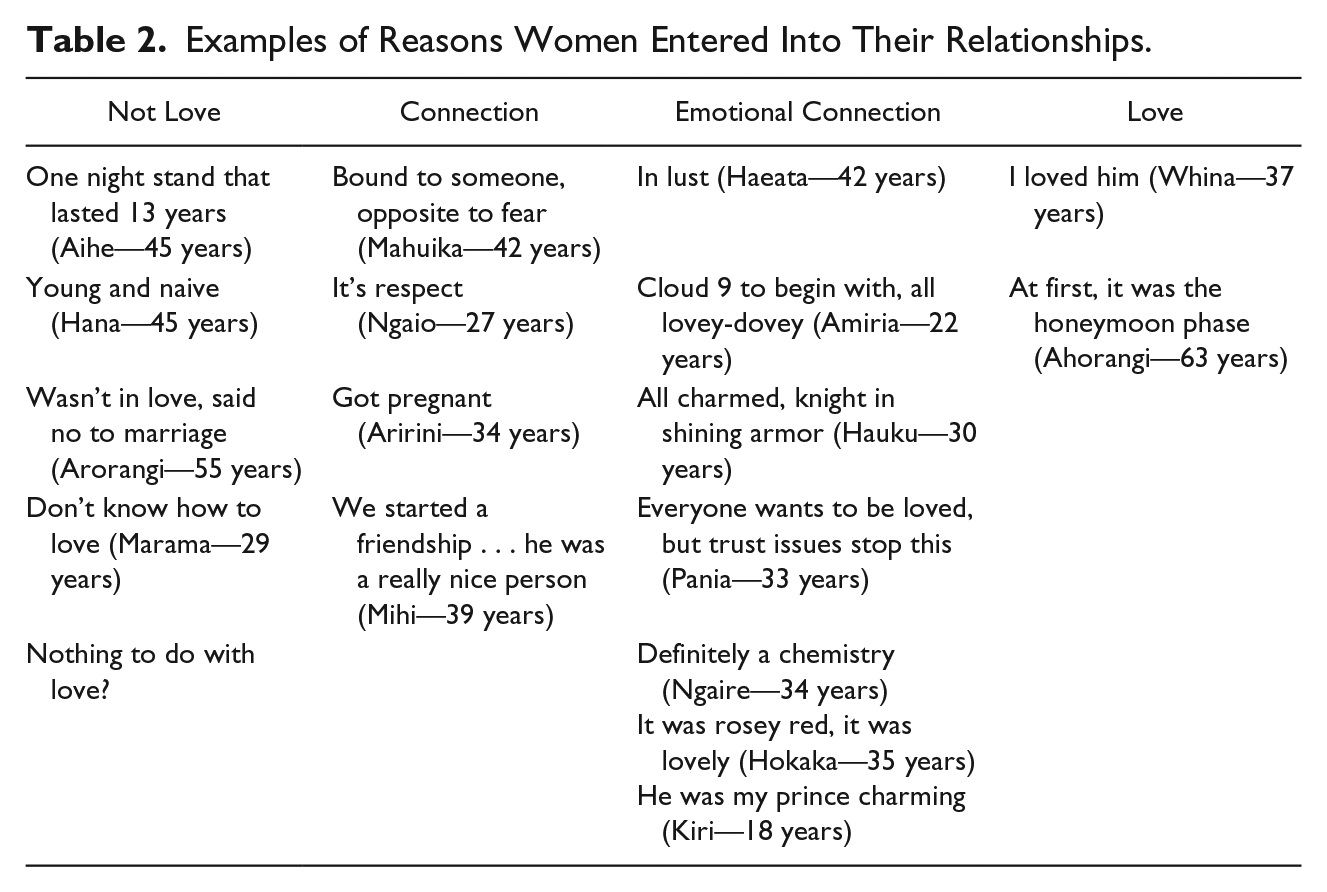
In this study, when all Māori women entered into their relationship, their partner showed no indication they would be abusive or violent toward them. The nature of their attraction to the person who became their violent partner varied and mainly included a fun connection, a chemistry or magic feeling that morphed into a relationship (see Table 2). When elaborating their feelings of love for their partners, most participants talked about a love that featured compassion, empathy, obligation, and caring for their partner; there was little talk of romantic love. Mahuika (42 years) referred to the sense of connection she wanted out of a relationship, grappling with this thing called love:
Examples of Reasons Women Entered Into Their Relationships.
I want good love, and I don’t know what good love is, so yeah, for me it’s not about love anymore. It’s about a partner, in all things.
Looking back at the beginning of their relationships, the women talked about some form of a connection that more closely aligned with aroha. Mihi (39 years) explained how her relationship began as a friendship: We just, sort of, started a friendship. He used to come up to my place, started coming every weekend. He was a really, really nice person. And that’s what I saw.
Ngaire (34 years), however, indicated how her current nonviolent partner’s caring actions and interactions with her children assisted her in developing her feelings of love: . . . he was loving, giving, and supportive in every way. It was like this is what I’ve been wanting, you know? So, I think that helped develop love and especially the way he interacted with my children. That definitely helped.
Being spoilt with material things led Kiri (18 years) to believe she had met her ideal man, who was 10 years her senior: He seemed like he was my prince charming. He was a lovely; he came across as a lovely young man. He used to spoil me rotten. Would buy me lots of nice things, perfumes, bags, and would give me money.
Pregnancy confirmed the formation of a relationship for some women, such as Ngaire (34 years), their baby establishing an enduring connection with their partner: I would not have gone out with them [men] if they were violent, to begin with. With my first partner, the father of my children, we hadn’t been together long before I got pregnant, about four months. . . . that’s kind of when it all started. And I think it [the pregnancy] was more frustration for him. Because I was pregnant, I did have to settle down, and he didn’t. So I guess that’s where the conflict happened because we were on two different pages.
Not knowing how to “love” because of their past experiences challenged some women, which resulted in these women equating being loved with getting “the bash” or being abused. Commonly, these women came from whānau with intergenerational violence and whose parents or peers lived with partners who were violent, normalizing violence. For these participants, their relationships had little to do with love, instead reinforcing negative self-beliefs and their lack of support or control in the relationship. Marama (29 years) explained, I didn’t know how to love. Because to love to me was getting abused, not cheating but getting, getting abused all the time.
Women reflected on the first indications that something may be wrong in their relationship. For all the women, emotional and psychological abuse together with their partners’ gradually increasing control and surveillance occurred over 1 to 6 months in different ways. It was evident that as relationships progressed, the women became increasingly “attached” to their partner, whose belittling of them became a regular occurrence. Physical violence began after 6 months and for one woman after 12 years. Whereas psychological abuse was more continuous, the frequency of physical violence differed significantly—daily, episodic, or as unpredictable occurrences.
Whereas some women hoped for change and improvement, others denied the deterioration in their relationship. The rapidity of the decline in their relationship varied depending on their sense of hope or acceptance and was aided by what Aririni (34 years) referred to as having “downplayed” being unsafe: I can’t really remember feeling unsafe. You know because I was still young, life was about trying to have fun and growing up at the same time, trying to be a parent at a young age. I don’t remember the unsafeness although everyone else probably would have seen it was unsafe. I think, for a while, I probably downplayed it [being unsafe] in my mind.
Downplaying the Signs
Despite recognizing that their partners had some significant issues, these Māori women acknowledged that their partner had a “story.” In doing so, these Māori women believed their partner had potential and needed to be healed because of their histories of abuse and violence, and for some, their drug and alcohol misuse. The women recognized that because of these backgrounds their partner’s “love” looked different, reinforcing their need to be more compassionate, caring, and empathetic toward these men. Ngaire (34 years) claimed, They’re not bad people. They just do stupid things.
Airini (34 years) illustrates the hope and belief that the women have in their partners: I just think that there’s hope for people in these situations, and there’s definitely points where you have to say that’s enough. But I believe that if they have the support they need or mature into who they are, and if they really do love each other and want to, there’s potential for that to happen. But you have to be strong.
Reflecting Aririni’s sentiment, we found other Māori women thought they had to be the strong one to support their partners. Needing to be strong was driven by a belief that their partners’ stories went unheard and their pain went unrecognized and, to become violence-free, their partner had much healing to undergo. Compassion, caring, loving, and needing to give to others drive the women’s concerns about their partner. Nonetheless, they recognized that change was not easy for their partners, so they needed to be strong women. Caring about their partner was evident; for example, Mahuika’s (42 years) concern about her partner’s living conditions after separation is an example: So I Google it [partner’s accommodation], there happened to be a newsflash on that place, disgusting! I cannot believe that my kids’ dad and who he is in the family, is living in a, in a rat hole. And paying $200 a week to be there. It’s disgusting. And at my next opportunity, I will go there, and I just need to plan.
Similar to some women’s backgrounds, childhood experiences of intergenerational violence determined what was reasonable to expect in a relationship, which also influenced their partners’ perceptions of what to expect. Hana (45 years) explains, I think it was a combination of both the drugs, the alcohol; just you know he had so many issues from his childhood he would not deal with. He just wouldn’t deal with it because you know his family, his parents had put him through the same thing. He’d been abused by family members as well. You know. And their way of dealing with things was, through drugs and alcohol.
At some stage, Māori women’s compassion and need to support their partners became balanced with the realization that their relationship was deteriorating along with their inability to influence or curb their partner’s violence. Possible warning signs that their relationships were unhealthy, and that problems may have existed before entering into the relationship became evident. It was obvious these women had not thought about the warning signs and emerging problems, downplaying their partners’ histories of violence and (mis)use of alcohol and drugs and their feeling unsafe. Instead they often engaged in self-blame. Ngaio (27 years) explains how the effects of both intergenerational violence and drug and alcohol use within her whānau and by her partner led her to believe the problem lay in her: I was working full time, he wasn’t. We were flatting, and you know, weekends were parties and drugs and alcohol, and then the working week was work. I would go to work, and he would stay home and smoke weed every day, and that’s just how it was. But you know that was kind of normal. I didn’t see a problem or an issue with that. I was just really mirroring my upbringing. I was the one that came from the gutter. So the problem must of laid in me.
Downplaying the signs occurred within a context that Māori women’s relationships were not always “bad” times. There were also “good” times when partners were loving, kind, and good people. The mixture of good and bad times made it difficult to rationalize partners’ abusive and physically violent outbursts, especially for women whose partners’ violence was sporadic with lengths of time between episodes. Mahuika (42 years) asks, So what am I going to do with him? Because I think, he’s worth the effort. You know. It’s just that him and his sister were just left there. . . . And you know they’re good people in the middle, they’re just very, very hurt.
This compassion and rationalization of partners’ behaviors was layered with deep denial about the consequences of ongoing violence and making excuses for their partner. In the face of increasing verbal abuse, being pushed around, and alcohol and drugs, some women resorted to secretly drinking to cope with their realities, whereas others socially isolated themselves. While Kiri’s (18 years) partner isolated her from friends and family, she also socially isolated herself for her own and her friends’ safety: I mean I was just a young girl wanting to have a little girly time with my friends but I wasn’t allowed that so I had to kind of isolate myself from the world just to keep myself safe.
Despite their partner’s behaviors morphing into frequent psychological and social abuse and violence, some women focused on the “loving and kind” aspects of their partners. Focusing on the loving or kind features of their partner engendered a sense of security and bolstered their beliefs that their partners were fundamentally good people who could change or that the women themselves could manage his behaviors. Others, such as Hauku (30 years), excused their violence based on their partner’s past experiences, for instance, He used to say to me, “Oh you know, I had a hard upbringing.” So I think a lot of the hidings he gave me was caused by that . . . he still had no right to hit anyone you know. That’s how it was with him.
Needing to Leave
Amid the rationalization of their partner’s behaviors, at some point, Māori women came to recognize that their partner had some significant issues and realized a severe problem existed, which their aroha and manaakitanga alone could not address. Discovering that their partners had significant issues and problems occurred over periods of time. They recognized that their partners’ control and surveillance behaviors increased significantly to include harassment and threats to women’s life and well-being. Kiri (18 years) talked about the ultimate control and surveillance she was under: It became so controlling, to the point where he wouldn’t allow me to go to toilet by myself. So, yeah [it] got very out of control. I wasn’t allowed to go shower by myself because he would think that I was trying to escape out the window and leave him. If I did happen to go toilet without him, he would barge in and accuse me of being on the phone and texting someone to come and pick me up or texting another male, which was just ridiculous because I didn’t have a phone, he’d taken that from me.
The intensity and regularity of emotional and psychological abuse diminished the women’s sense of self and self-confidence, whereas physical violence became increasingly present. Just over half of the women reported that this was associated with alcohol and drugs. However, the violence that featured in the women’s lives was often without an identifiable cause, frequently initiated by paranoia and anger that they could neither control nor manage as Anahera (45 years) explained, I would want to go and see family, and he didn’t want me to leave the house. He would pull me back inside the house physically. If I said anything, he would strangle me. Putting, you know, both hands around my neck to the point where I would pass out. Lifting me on to the wall—at that time I was quite small sized, he was a big guy.
Gradually, the women became worn down and, within contexts of manipulation, game playing, and isolation from their whānau and friends, they engaged in self-blame for what was unfolding around them. They also succumbed to the harassment and put-downs by their partners, believing what their partner was saying, which further entrenched their self-blame. Whina (37 years) shared, I closed myself off because he made me think that I was unworthy. I used to sit there and just think, “I’m useless, I’m unworthy, I’m, I’m yeah, everything in the book that he said I was.” [It] was what I believed, I learned to believe for those years.
Despite continually evaluating and responding to the abuse, control, surveillance, and violence, over time, women realized they could no longer manage their and their children’s safety, having exhausted all their strategies for doing so, instead fear for their safety manifested. Amiria (22 years) talks about the process of coming to realize that the situation was not safe for her or her children: The starting of my relationship was all lovey-dovey, as it always is. And then, you get to know them, and it turns into crap. Then after that, you get locked up and then you have to stay in that situation. You’re too scared to leave it—you’re scared for yourself and your children. We were never allowed just to express ourselves and be ourselves. So, it wasn’t safe.
For the majority of women, this was a sad realization that despite the love and compassion they felt for their partner, they had to choose to walk away for the protection of themselves and their children.
Māori women’s connection to their partner is a commitment to and an investment in someone else, which they did not easily give up on. It involved “fighting” for their partner’s attention, love, and respect within contexts of some partners’ addiction, and the unpredictability of their abusive and violent behaviors. Such behaviors reinforced that this continued state was potentially dangerous for both their children and themselves. For those women who did not grow up with intergenerational violence in their whānau, returning to the values of their childhood made this process easier.
However, once they decided to leave, they were faced with difficulties in extracting themselves from their homes and partners, often isolated from friends and families. Instead, they suffered in silence and denial and were forced to cope on their own. Despite living in unsafe relationships, they experienced vulnerability when needing to ask for help from family, friends, or agencies that frequently was unsuccessful. For many, they became entrapped not only by their violent partners but also by agencies whose purpose was to help them, they thought. Hauku (30 years) commented on unhelpful people and agencies: It’s constant abuse. Mentally screwing with my head. But, having a fear, knowing that I couldn’t get out, didn’t know what I could do to get out. How could I get out? And not one of them [social workers or non-government organization workers] could tell me where to go, how to go, and what to do!
It was Māori women’s strength that enabled them to exercise choice and exit their relationship or seek help to repair it. It was an incident that often became the tipping point for women to decide to leave their violent relationship. Ngaio (27 years) shares such a moment: He [partner] raised a fist to her [baby], and I said, “Just, just give me the baby.” And he ended up pushing me into a glass mirror, which shattered all over me. And I got up and took my baby anyway and told him to leave and that was it.
On separating from her partner, Hauku (30 years) experienced severe harassment and threats: Hard out messaging me, ten pages of texts. I used to wake up to like 50, 50 to 60 missed phone calls. Hundred and something 10-page letters of abuse like. “You fucking this, you fucking that.” I want my daughter back. You know I’ll fucking blow yous [sic] all up in that house.
The strength and the support of others helped them to endure the difficulties in leaving. For those women who grew up in violence-free families, their strength was bolstered by returning to their values and beliefs. Regardless, staying strong provided Māori women a platform for healing and reviving their well-being.
Discussion
The Māori women’s sociocultural constructions of “love” provides insights into the rangatiratanga (authority and leadership) that they exercise and their compassion is evident in their manaakitanga for their violent partners under challenging circumstances both within and outside their relationships (Dhunna et al., 2021). In our study, Māori women’s experiences of “love” integrated compassionate caring and concern for others that resembled aroha and manaakitanga. The literature seldom discusses aroha and manaakitanga within the context of interpersonal partner relationships. Merely relying on Western approaches is insufficient to comprehend Māori whānau living with violence, particularly why Māori women enter into, remain in, and decide to leave such relationships. In many Western cultures, love is an essential component of a successful romantic relationship (Graham, 2011). However, aroha and manaakitanga vary, having a greater breadth and depth, underpinned by the unquestioned reciprocity and obligations to others (Barlow, 1994; Metge, 1995).
In these ways, Māori women’s love appears to be more complex and multilayered and should always be considered within their cultural, historical, and colonizing contexts (Dhunna et al., 2021; Grennell & Cram, 2008; Kruger et al., 2004). We identified that, despite evidence of aroha and manaakitanga in Māori women’s compassion and caring for others, being unable to manage their own and their children’s safety signaled the time to leave their partner. The compassion that Māori women had for their partners was evident when they referred to their partners as having their own stories and needing to heal—this meant that they needed to stay strong for this healing to occur. This was not taking responsibility for their partners’ behaviors or for “fixing” them but rather that they cared about them. Their focus on others enmeshes the importance and obligation to provide care and support for others (Cram & Kennedy, 2010). While some could argue that Māori women living with a partner’s violence are positioned similarly to non-Māori women, they are different in that their worldview, cultural values and constructs, experiences of ongoing colonization, and, for some, histories of intergenerational violence guide their patterns of behavior and interactions within whakapapa and non-whakapapa family contexts (Dhunna et al., 2021; Kruger et al., 2004; Wilson, 2016).
The Māori women’s talk about aroha indicated intentional and purposeful acts, while manaakitanga reflected their obligation to care for others—both underpinning their relationships. Aroha and manaakitanga are intrinsically connected to whakapapa and whanaungatanga and do not stand alone. We noted that the majority of women remained in contact with their partner who was part of their children’s whakapapa and thus in an enduring connection in most cases.
Barlow (1994) states, “Aroha in a person is an all-encompassing quality of goodness, expressed by love for people, land, birds and animals, fish and all living things” (p. 8). It is a creative force and divine power derived from ātua (spiritual ancestors). Aroha is expressed as a genuine concern for others, so all actions are driven by the best interest of others, no matter their state of well-being. In this way, aroha adds quality and meaning to life, demonstrated through unconditional sharing with all people. Whakapapa determines for Māori who they are, their relationships, and how they are connected. Whakapapa was an essential determiner in Māori women’s decision-making when there are children from their relationship. More than three quarters of the Māori women in our study claimed that their children connected them to their violent partner for life, leading them to maintain some form of ongoing contact. This complicates the expectation that these women should simply leave their partner—for the majority of our participants, this was not a realistic option.
Ralston (2001) considers that respect and freedom are fundamental to a loving relationship, and that love requires knowledge about their partner. While connected to their partner, Māori women in our study reported not “knowing” their partner (for instance, their violence and other problems) early in their relationships. Over time, they experienced the contradictions of entrapment restricting their freedom despite their acts of resistance while protecting their children and themselves (Tolmie et al., 2018; Wilson, Smith, Tolmie, & de Haan, 2015), something also reported by Wilson et al. (2015). Love, as a manifestation of belonging that connects us to someone, is experienced differently, is based on sharing, and provides a way of communication. The love Māori women had for their violent partner at times lacks sharing and freedom, complicated by cultural imperatives that guided their actions, influenced by popular Western notions of love.
We also found that Māori women’s rangatiratanga enabled active management of the safety and protection of their children and themselves in complex and often volatile situations, something that often goes unrecognized. The dualities of victim and agency in the presence of patriarchy currently informs the discourse about women who remain in violent relationships whereby they are portrayed in ways that they lack agency or control over their lives (Campbell & Mannell, 2016). Campbell and Mannell urge us to examine such portrayals of highly marginalized women because they are unhelpful and ignore the multiple forms of agency (such as “persistence, resistance, and survival”) within their spheres of influence, something that Richardson and Wade (2010) also report. Campbell and Mannell state, “The most significant social struggles may often be equally importantly tackled through small-scale, hidden acts of resistance located in small, often barely visible, cracks in the social order” (p. 14). Simplistic explanations around victimhood, love, and agency do little to account for the complexity of these women’s lives and the cultural imperatives that guide their actions (Richardson and Wade, 2010).
Our findings cast new light on the notion of Māori women’s agency as they exert their rangatiratanga, informed by an assortment of reasons to stay or leave a relationship. For instance, their primary focus was on others, especially their children (the collective), or their level of risk, rather than on themselves (the individual) when deciding to stay or leave. Nonetheless, a perception exists that women remain in violent relationships because they are romantically in love with their partners. Undeniably, aroha and manaakitanga, while being controlled and entrapped similar to what the Māori women in our study experienced, restrict the freedoms associated with love referred to by Ralston (2001). This freedom was further restricted for the majority of the women who could not rely on support or help from whānau, community, or helping services, reporting instead that they were further victimized. Māori women’s freedom is further complicated by varying forms of social and structural entrapment and the social marginalization they encounter (Dunn & Powell-Williams, 2007; Tolmie et al., 2018).
Obsessive love is devoid of the altruistic notion of investing in another person’s well-being (Hegi & Berhner, 2010), which could signal where the relationship deviates for Māori women when their partner, engaging in violence and abuse, contradicts their focus on caring and the belief partners have the potential to be nonviolent. Instead, we found Māori women reported that their partner’s obsession became evident by their increasing control and surveillance of their activities. The notion of the rights of men is embedded in patriarchy introduced to Māori as a result of colonization. However, Graham (2011) noted that those people with insecure attachments within their relationships were likely to possess poor relationship satisfaction and were susceptible to romantic obsession. However, Allison, Bartholomew, Mayseless, and Dutton (2008) found that a person’s control was not motivated by a sense of entitlement or desire to dominate their partner but rather by a desire to regulate closeness to their partner. Thus, they propose that one partner may use violence to close a perceived “emotional gap” with their partner.
Anecdotally, Māori women often claim they did not necessarily want to leave their partner; they just wanted the violence to stop. We found that a tipping point occurred at some point, usually triggered by an event signaling for the women that they needed to exit the relationship, although some ultimately wanted to “fix” their relationship. Nevala (2017) indicates that while entrapment reduces women’s autonomy and freedom, they continue to assess the threats conveyed by their partner, informed by previous episodes of physical or sexual violence. These threats take various forms, such as coercion, surveillance, intimidation, isolation, control, financial control, emotional/psychological intimidation, abuse, and isolation. Increasing coercive control interspersed with violence can lead women to conclude that their situation had become severe, and that remaining in their relationship was no longer a viable option (Nevala, 2017). We found that Māori women continually evaluated and responded to the contexts of their situation and were neither helpless nor driven by romantic attachments (Dunn & Powell-Williams, 2007).
Motivated to keep their children safe, at some point Māori women considered their situation had become untenable and realized they needed to seek assistance from others for their protection, such as the Police or other services. They responded with some degree of agency within complex and sometimes seemingly dangerous contexts despite knowing that people in agencies were likely to impede their requests for help. We argue that the victim–agency binaries (Dunn & Powell-Williams, 2007) are problematic because they disregard the complexities of Māori women’s daily realities and their abilities to appraise and respond to their situation, something Campbell and Mannell (2016) discuss. Furthermore, constructions of women who choose to stay in relationships as helpless and lacking agency (Dunn & Powell-Williams, 2007) discount the responses they do make to resist their partner’s abuse and violence. Coates and Wade (2007) state, . . . victims’ resistance is recognized or treated as significant only when it is successful in stopping or preventing the perpetrators’ violence. . . . Victims resist in a myriad of ways that are not successful in stopping the violence but are profoundly important as expressions of dignity and self-respect. (p. 514)
Limitations
We caution readers in their use of the findings reported in this article beyond the research context. The Māori women participating in our research were all in heterosexual relationships, although it was not our intention to exclude women in same-sex relationships. Furthermore, the women in our research were reflecting on their relationships, which may differ from those currently in violent relationships. This research provides useful contextually and culturally bound insights into Indigenous Māori women in violent relationships. However, while similarities exist across Māori, due to the differences in their colonizing histories, diversity also exists within and between the various subgroups of Māori. While referred to in homogeneous ways, such perspectives of Māori ignore the diversity that exists between each iwi (nation) across the country, including having variations in their cultural beliefs and practices and sociohistorical contexts. The majority of literature overlooks the ongoing intergenerational effects of colonization, historical and contemporary trauma, and social deprivation that continue affecting colonized Indigenous communities. Understanding these nuances in partner and family violence is essential to respond in appropriate and acceptable ways that will make a difference. We recommend the need for further research with Indigenous women, men, and children to understand better violence that did not exist traditionally, but is now endemic.
Major Implications
Our findings have highlighted the complexity and the competing tensions underpinning Māori women’s decision-making when entering and exiting violent relationships. Recognizing these tensions is significant because all too often the popular perception of Māori women is that they might not be serious about wanting to end their violent relationships. The cultural obligations they have to their whānau that includes the father of their children are often not recognized by health and social care staff. Not only does this mean that particularly negative views frame perceptions of Māori women, but also their children are more likely to be removed (Cram, Gulliver, Ota, & Wilson, 2015).
We hope this article helps non-Māori workers have insight into the strengths and cultural obligations that shape decision-making for Māori women, signposting the need to reconsider expectations that Indigenous women, such as Māori, should leave violent relationships and to take culturally responsive approaches when working with them (Wilson, Heaslip, & Jackson, 2018). In the face of popular misconceptions that Māori women are neglectful and complicit in the maltreatment of their children, we found that protecting their children was always at the forefront of their minds and that leaving their partner could lead them to even more precarious situations (Dhunna et al., 2021). Their children created lifelong connections for many of the women in our study with their violent partners. There is a need for culturally informed knowledge and frameworks to guide work with Māori women and to promote the adoption of whānau- or family-centered approaches that include their partner (Pihama et al., 2016; Wilson, 2017b). Regardless of whether Māori women chose to stay in their relationship or not, most maintained some form of relationship with their children’s fathers.
Restoring Māori-informed cultural values and practices for whānau is essential to eliminate postcolonial violence within whānau, as also found by Dhunna et al. (2021). Traditional Māori values and practice privilege the complementary roles of both women and men in Māori society, for instance, and focus on respectful relationships that are about looking after and caring for one another (see, for example, http://etuwhanau.org.nz/). Furthermore, our research indicates the need to recognize and understand Indigenous women’s reasons for staying in their relationships, by taking a strengths-based approach (rather than a deficit focus) to understand better how they keep themselves and their children safe amid the occurrence of coercive control and violence.
Conclusion
Understanding Māori women’s notions of love is crucial to understanding why they entered into a relationship that over time became abusive and violent. Māori cultural concepts of aroha and manaakitanga resemble compassionate forms of love but have embedded cultural imperatives for these women to care for their partners in a more compassionate light and to stay because of their potential to become nonviolent. Furthermore, we found that Māori women continually assess the threats made by their partners and respond to the context that unfolds before them. Nonetheless, at the some point, these women decide they need to leave their relationship and act to make this happen.
Footnotes
Acknowledgements
We sincerely thank the wāhine, rangatahi wāhine, tane, kaumātua, and kuia and key informants who are experts in this area—We are humbled by their generosity, their honesty, and their willingness to participate to improve and eliminate violence that occurs within our whānau. E mihi ana mātou ki ngā kaiuru katoa mō o rātau kōrero nui. We also acknowledge Kay Berryman for her role in the administration of the project and some of the analysis for the research project.
Declaration of Conflicting Interests
The author(s) declared no potential conflicts of interest with respect to the research, authorship, and/or publication of this article.
Funding
The author(s) disclosed receipt of the following financial support for the research, authorship, and/or publication of this article: This research is supported by the Marsden Fund Council from Government funding administered by the Royal Society of New Zealand (15-AUT-024).
