



Abstract
Despite its prevalence, sexual assault remains a vastly underreported crime. Previous research suggests that engagement in certain types of resistance during an assault affects the way in which both victims and others perceive the attack; such perceptions influence victims’ likelihood of reporting the assault to law enforcement as well as the criminal justice system response to reported allegations. Using a fight/flight/freeze theoretical framework, the current study sought to examine how forceful, nonforceful, and freeze responding influenced victim reporting and the extent to which reported assaults were pursued and investigated by law enforcement. Using data from the National Crime Victimization Survey between 2010 and 2016, logistic regression analysis indicated that victims are significantly less likely to report to law enforcement if they froze during the attack. Interestingly, although engagement in forceful resistance increases victims’ likelihood of reporting to law enforcement, it has no bearing on law enforcement response beyond the effect of physical injury. Rather, physical injury (e.g., bruises, cuts, broken bones) is the only predictor of law enforcement response to sexual assault allegations. Findings suggest that whereas fight and freeze responses to sexual victimization influence victims’ willingness to report to law enforcement, resistance is not uniquely predictive of law enforcement response once physical injury is considered.
Introduction
Sexual victimization is thought to affect 20% of women and 1% of men over the course of the lifetime (Black et al., 2011), and has been linked to a variety of adverse mental health outcomes, including posttraumatic stress disorder (PTSD), anxiety, obsessive-compulsive disorder, mood disorders, substance abuse, and suicidality (Dworkin, Menon, Bystrynski, & Allen, 2017). Despite its prevalence, rates of reporting sexual violence to law enforcement have remained consistently low for decades (15.8%; Wolitzky-Taylor et al., 2011). Assaults that involve weapons, physical injury, or are committed by strangers tend to exacerbate posttraumatic symptomatology (Dworkin et al., 2017), and they also predict a greater likelihood of reporting the attack to law enforcement (Golding, Siegel, Sorenson, Burnam, & Stein, 1989). However, victims’ interactions with law enforcement are often unsatisfying at best and, at worst, can lead to secondary victimization, a term used to describe hurtful or traumatic experiences with police and other members of the criminal justice system resulting from negative attributions and judgments, such as victim blame (Campbell, 1998). For example, research suggests that law enforcement officers tend to be suspicious of sexual assault allegations (Lord & Rassel, 2000) and make case processing decisions based on assault and victim characteristics (Kerstetter, 1990; LaFree, 1989). One factor that influences both victim reporting behavior and law enforcement response is victim resistance.
Victim resistance is multidimensional, encompassing four distinct categories: forceful physical resistance (e.g., kicking, hitting, using a weapon, and biting), forceful verbal resistance (e.g., screaming, yelling, and threatening), nonforceful physical resistance (e.g., blocking blows and fleeing), and nonforceful verbal resistance (e.g., crying, pleading, reasoning, and begging; Ullman, 1997). Most victims report using at least one form of resistance, with the most commonly used strategy being forceful physical resistance (used by 55% of completed rape and 69% of attempted rape victims). Rates of any resistance in victims of attempted sexual coercion and attempted rape are notably higher (74% and 92%, respectively) than victims of completed sexual coercion and completed rape (47% and 65%, respectively), suggesting that resistance is effective at reducing the likelihood of a completed attack (Fisher, Daigle, Cullen, & Turner, 2003), yet the use of these strategies is dependent on several offender and assault characteristics. For example, the use of forceful resistance strategies was predicted by being verbally threatened, physically restrained, physically injured (Atkeson, Calhoun, & Morris, 1989), a lack of concern over the offender’s judgments or feelings, less self-blame, greater anger (Nurius, Norris, Macy, & Huang, 2004), greater confidence, and the feeling of being isolated or controlled by the offender (Turchik, Probst, Chau, Nigoff, & Gidycz, 2007). Conversely, nonforceful strategies are predicted by self-consciousness (Nurius, Norris, Young, Graham, & Gaylord, 2000; Turchik et al., 2007), embarrassment, rejection (Norris, Nurius, & Dimeff, 1996), self-blame (Nurius, 2000; Nurius et al., 2004), feelings of sadness rather than anger (Nurius, 2000; Nurius et al., 2000), offender use of verbal threats (Nurius et al., 2000), perceived social threat, concern about the offender’s feelings (Nurius et al., 2004), and concern over losing the relationship with the offender (Nurius et al., 2000; Turchik et al., 2007). Of note, the level of violence used by the offender is generally proportional to the amount and type of resistance displayed by the victim (Atkeson et al., 1989; Balemba, Beauregard, & Mieczkowski, 2012; Gidycz, Van Wynsberghe, & Edwards, 2008; Masters, Norris, Stoner, & George, 2006; Turchik et al., 2007; Ullman, 1998, 2007; Ullman, Karabatsos, & Koss, 1999; Ullman & Knight, 1991, 1992).
Importantly, resistance predicts disclosure to law enforcement. Specifically, victims of more stereotypical assaults are more likely to report, such as those involving stranger perpetrators, weapons, physical force and injury, and victim resistance (DuMont, Miller, & Myhr, 2003; Fisher et al., 2003; Golding et al., 1989; Gunn & Minch, 1988). A national survey of 4,446 randomly selected female college students found that fewer than 5% of college victims of completed or attempted rape filed a report with law enforcement (Fisher et al., 2003). Those who did not file a report often chose not to due to concerns about law enforcement response, such as concerns that the incident would not be perceived as “serious enough” to warrant an investigation. Although unclear, these concerns may reflect victims’ belief that they did not “resist enough” for their complaint to be taken seriously.
Resistance strategies may also affect law enforcement response by influencing judgments about the victim. For example, one study found that male jurors attributed greater fault to rape victims who used nonforceful resistance strategies, suggesting lighter sentencing for rapists in these scenarios (Scroggs, 1976). Rusinko, Bradley, and Miller (2010) found that the resistance strategies of victims were also judged based upon the assertiveness of the observer—assertive female observers tended to judge victims more harshly if victims engaged in nonforceful physical or forceful physical and verbal resistance, although, interestingly, observer assertiveness had no impact on blame judgments toward victims who engaged in nonforceful verbal resistance. The authors surmised that, in the case of the forcefully resistant victim, female observers were judgmental about the time it took the victim to begin to engage in forceful resistance and believed she should have resisted sooner, supporting the concerns that some victims may have about not resisting correctly or enough to be believed. Based on reported sexual assault cases and police records, resistance was found not to be predictive of suspect questioning and referral for charges once assault characteristics—in particular, victim injury—were considered (Frazier & Haney, 1996). It is important to note, however, the authors collapsed resistance strategies into verbal or physical resistance, so the categories included both passive and active forms of resistance. In addition, the study used cases reported in 1991 that may no longer accurately reflect law enforcement perspective and decisions. In general, both men and women attribute less responsibility to the victim when she avoids a completed rape and tend to label sexual assaults correctly more often if the victim resists (Krulewitz & Nash, 1979). Because these and other victim and assault characteristics form the basis for law enforcement response, the effects of which may be emotionally detrimental for victims and dissuade them from reporting future incidents (Patterson, 2011), it is crucial to examine both the factors that influence law enforcement responsiveness and the likelihood that victims will report to law enforcement in the first place.
While prior research suggests that victim resistance predicts victim reporting behavior and law enforcement response, studies have been limited in their assessment of resistance. For example, most studies use dichotomous yes/no variables to ascertain whether a victim resisted, which limits the conclusions that can be drawn from such research and lacks theoretical grounding that could allow for more translational applications. As highlighted by Galatzer-Levy et al. (2014), responses to threat are heterogeneous, and characterizing these responses would allow for more translation between human and animal models. Theories of threat response are typically framed using the fight–flight–freeze response (Cannon, 1927, 1929; Schmidt, Richey, Zvolensky, & Maner, 2008). In the presence of threat, the sympathetic nervous system is activated, resulting in pupil dilation, increased heart rate and blood pressure, and the secretion of adrenaline. Among humans, the biological response is accompanied by certain behavioral responses, such as fight (e.g., hitting or threatening the perpetrator), flight (fleeing, pleading), or freeze (physical and verbal nonresponse). Translational models of threat have significantly affected our understanding of fear, PTSD, and their underlying biological mechanisms (for a review, see Fenster, Lebois, Ressler, & Suh, 2018). They have also informed pharmacological and psychotherapy approaches to disorders such as PTSD (e.g., exposure treatment; Kroes, Schiller, LeDoux, & Phelps, 2016). Thus, studying victim resistance in this manner would allow for more direct comparison with translational models of threat response and may contribute to a growing body of literature that informs personalized treatment approaches (i.e., personalized medicine). Future treatment protocols may be modified if research finds meaningful neurobiological differences between those who demonstrate more active versus passive responses to threat. For example, perhaps those who have passive responses would not gain as much from extinction-based approaches and would have better outcomes with cognitive methods. Although such modifications would require significant empirical basis beyond the scope of this article, framing victim responses to trauma within the translational framework represents an important early step in moving toward personalized medicine.
The current study sought to provide greater theoretical depth to our understanding of the role of victim resistance in both victim reporting behavior and law enforcement response using a national sample of victims across several years. Specifically, we examined the impact of resistance by measuring four types of victim resistance: forceful physical, forceful verbal, nonforceful physical, and nonforceful verbal. To draw a parallel to the neurobiology of the fight–flight–freeze response and allow for better comparison with translational models of threat, we took an exploratory approach of categorizing forceful physical and forceful verbal resistance as a fight response because they reflect moving toward threat. In contrast, nonforceful physical and nonforceful verbal resistance were considered as flight responses because they reflect moving away from threat. Finally, a lack of response was considered a freeze response (which is typically considered an evolutionary response to minimize harm; Gallup, 1977). Given that assaults involving forceful resistance are more likely to result in reporting behavior (DuMont et al., 2003; Fisher et al., 2003) and positive law enforcement response (Scroggs, 1976), we hypothesized that forceful (fight) responses would predict greater likelihood of victim reporting (Hypothesis 1) and law enforcement response (Hypothesis 2) compared with nonforceful (flight) and freeze responses. As no prior studies have categorized resistance in this manner, we cannot make explicit hypotheses regarding how nonforceful (flight) and freeze responses may differ from one another. However, given previous research suggesting that victims may avoid reporting out of concern that their assault was not “serious enough” (Fisher et al., 2003) and because nonforceful (flight) strategies involve an active response to move away from threat whereas freeze responses involve a passive response to threat, we expected that nonforceful (flight) responses would lead to more victim reporting than freeze responses.
Method
Data
Data were collected from 2010 to 2016 using the National Crime Victimization Survey (NCVS), a nationally representative survey authorized by the U.S. Department of Justice and conducted by the U.S. Census Bureau each year (United States Department of Justice, Office of Justice Programs, & Bureau of Justice Statistics, 2010, 2011, 2012, 2013, 2014, 2015, 2016). NCVS data, considered the leading source of information for victimization estimates, characteristics, and consequences in the United States, are collected using a stratified, cluster sample design from a nationally representative sample. Respondents aged 12 years and older are sampled biyearly regarding personal victimization in the last 6 months using a variety of interview methodologies. Households that are randomly selected into the rotating panel are first mailed a letter informing them about the NCVS, after which an interviewer visits to conduct in-person interviews with as many eligible household members age 12 years or older as possible. Any eligible household member not available at the time of the in-person interview is subsequently interviewed over the phone. Respondents who consent to follow-up interviews are interviewed every 6 months over the course of 3 years. Following the seventh and final interview, the household leaves the panel and a new household rotates into the sample.
In the current study, NCVS person-level and incident-level files from 2010 to 2016 were merged and respondents reporting sexual victimization were identified. Specifically, respondents were asked how they were attacked and/or threatened and respondents were coded as victims if they endorsed experiences consistent with rape, attempted rape, “sexual assault other than rape,” or “unwanted sexual contact with or without force.” Out of a total sample of 58,312 respondents, 1% (n = 632) were identified as having experienced sexual assault within the respective year, a rate comparable with yearly victimization estimates (Lauritsen & Rezey, 2013). The victimized sample ranged in age from 12 to 81 years (M = 32.6, SD = 14.1) and identified as 84.7% female (n = 535) and 15.3% male (n = 97). Respondents identified their race as follows: 79.6% White (n = 503), 10.6% Black (n = 67), 1.7% Asian (n = 11), 1.3% American Indian/Alaskan Native (n = 8), 0.9% Hawaiian/Pacific Islander (n = 6), and 5.9% mixed race (n = 37). In addition, 16.6% of the sample identified their ethnicity as Hispanic (n = 105). The victimized sample reported the following types of sexual victimization: 31.5% completed rape (n = 199), 18.7% sexual assault without injury (n = 118), 16.6% attempted rape (n = 105), 8.2% verbal threat of rape (n = 52), 7.9% verbal threat of sexual assault (n = 50), 6.2% unwanted sexual contact without force (n = 39), 5.4% sexual attack with serious assault (n = 34), and 4.0% sexual attack with minor assault (n = 25).
Measures
Dependent variables
The current study consisted of two dependent variables. First, a dichotomous variable reflecting whether the incident was reported to law enforcement (i.e., “Were the police informed or did they find out about this incident in any way?”) was coded as 1 = yes (34.0%, n = 213) or 0 = no (66.0%, n = 413). Second, a count score reflecting the extent of law enforcement’s response was calculated by summing 15 yes (1)/no (0) response items (e.g., took report, questioned witnesses or suspect) both at the initial contact with law enforcement and during follow-up contacts. A count score provides greater depth of information regarding the extent to which law enforcement followed through on the reported incident compared with the information that a single item (e.g., made arrest) could provide. It is pertinent to understand the depth of investigation given that extensive follow-through is more likely to generate important evidence for prosecution and thus lead to a more favorable outcome for the victim. Victims in the sample reported between 0 and 9 law enforcement responses (M = 2.9, SD = 2.0), with the most common response involving taking a report (see Table 1).
Victims’ Reported Law Enforcement Response to Sexual Victimization.
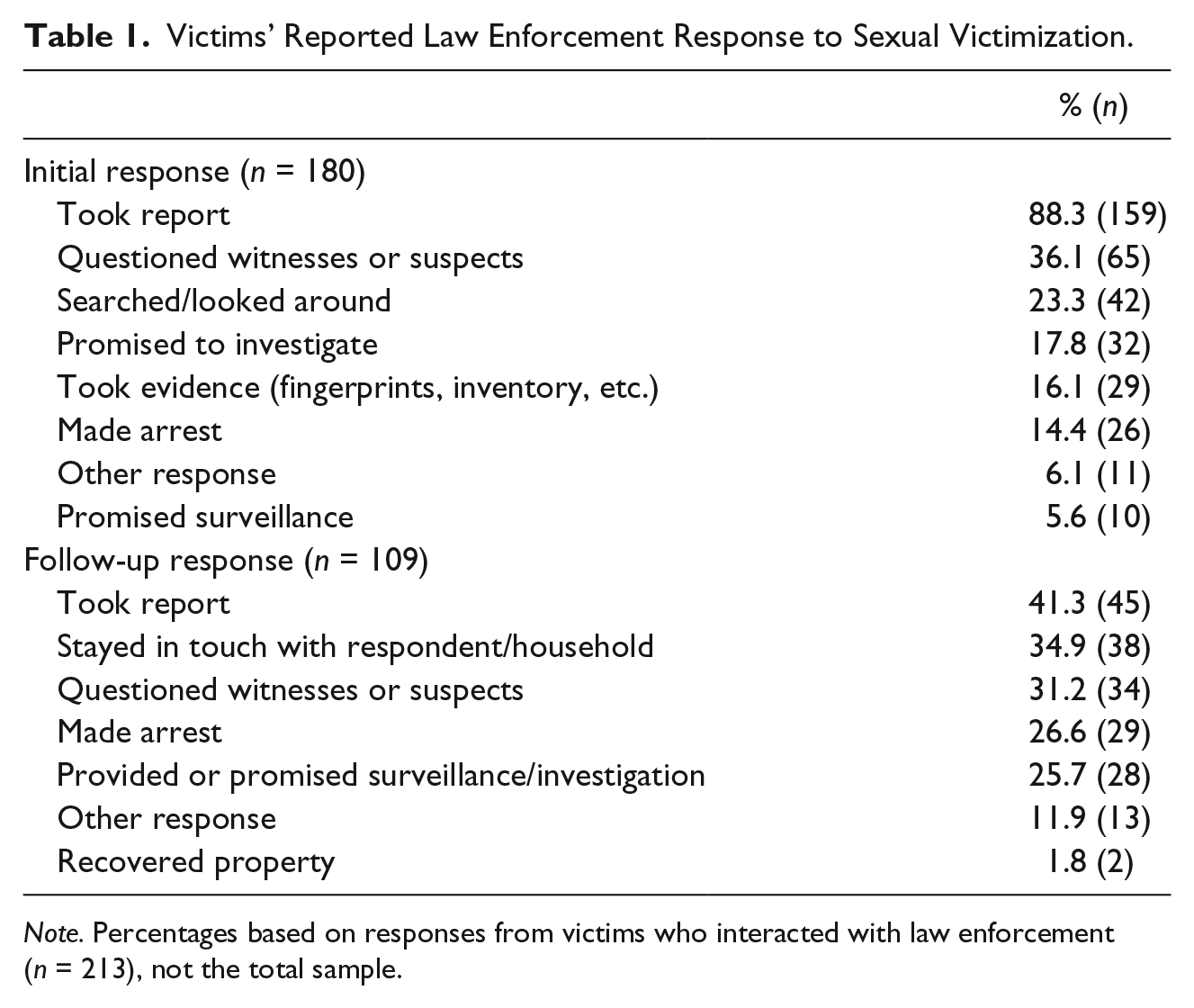
Note. Percentages based on responses from victims who interacted with law enforcement (n = 213), not the total sample.
Independent variables
Victims were asked whether they engaged in any resistance (i.e., “Was there anything you did or tried to do about the incident while it was going on?”). Those who responded “no” were coded as freeze responders (1 = froze during assault [37.8%], 0 = did not freeze during assault [62.2%]). Those who were not freeze responders (i.e., responded “yes” to the screener item) were then asked about specific resistance actions. Resistance strategies used during the assault were divided into forceful (i.e., fight) and nonforceful (i.e., flight) strategies and sum scores of yes (1)/no (0) items were computed. Forceful resistance included 10 behaviors, ranging from verbally scaring or warning off offender (e.g., yelled at offender, threatened to call police) to physical attacks involving weapons. Victims in the sample reported between zero and four forceful resistance strategies (M = 0.45, SD = 0.76), with a modal number of forceful responses of 0 (68.0%). Nonforceful resistance included five behaviors, ranging from stalling and doing what the offender asked to passively defending oneself and property (e.g., blocking blows). Victims reported between zero and four nonforceful resistance strategies (M = 0.67, SD = 0.88), with a modal number of nonforceful responses of 0 (54.6%; see Table 2). Of the sample, 32% reported engaging in any forceful resistance and 45.4% reported engaging in any nonforceful resistance.
Victims’ Reported Resistance Strategies During Sexual Victimization (N = 632).

Note. A total of 32 victims (8.1%) reported using some “other” strategy.
Control variables
Several potential control variables available in the NCVS were selected based on previous research on sexual victimization and law enforcement reporting and response. A dichotomous variable reflecting whether the offender used a weapon during the assault (i.e., “Did the offender have a weapon such as a gun or knife, or something to use as a weapon, such as a bottle or wrench?”) was coded as 1 = yes (9.8%), 0 = no (81.3%) or I don’t know (8.9%). A dichotomous variable reflecting the extent to which the offender was known to the victim (i.e., “Was the offender someone you knew or a stranger you had never seen before?”) was coded as 1 = knew or had seen previously (80.1%), 0 = stranger (19.9%). A count score reflecting the extent to which victims were injured during the event (i.e., “What were the injuries you suffered, if any?”) was calculated by summing 10 yes (1)/no (0) injury items, including bruises/cuts, loss of consciousness, knife or stab wounds, gunshot or bullet wounds, broken bones or teeth, internal injuries, rape or sexual assault injuries, and other injuries. Victims reported between zero and five injuries (M = 0.6, SD = 0.8), with a modal number of injuries of 1 (46.0%). Victim and offender sociodemographics included victim and offender gender (1 = male, 0 = female), victim and offender race (1 = known White race, 0 = known non-White race or race unknown), and victim educational attainment (0 = none/kindergarten, 1-8 = elementary years, 9-12 = high school years, 13 = some college [no degree], 14 = associate’s degree, 15 = bachelor’s degree, 16 = master’s Degree, 17 = professional school degree, 18 = doctorate degree). In the current sample, offenders were 92.6% male and 57.0% White, whereas victims were 84.7% female and 79.6% White. The educational attainment for victims was as follows: 8.1% some elementary, 14.9% some high school, 22.5% high school graduate, 27.6% some college (no degree), 7.3% associate’s degree, 13.4% bachelor’s degree, 5.1% master’s degree, and 1.1% professional school degree. Only 0.2% of victims attained kindergarten only or no formal education.
Data Analysis
Prior to running analyses, data were checked for outliers and missing data. 1 A total of 24 cases were identified as multivariate outliers based on problematic values for multiple indicators and were removed from analyses. 2 Bivariate correlations were run with specific resistance strategies to determine their relationship to dependent variables and completed rape.
The following potential covariates were tested for model inclusion based on bivariate correlations with respective outcomes: victim sex (1 = male, 0 = female), offender sex (1 = male, 0 = female), victim race (1 = White race, 0 = non-White race), offender race (1 = known White race, 0 = known non-White race or unknown race), victim age (continuous score), victim education (continuous score), knowledge of offender (1 = knew/had seen offender, 0 = stranger offender), offender use of weapon (1 = known to have had a weapon, 0 = known to have not had a weapon, or unknown), whether the incident involved completed rape (1 = completed rape, 0 = other sexual assault), and victim injury (continuous score; see Table 3). Covariates were selected separately for each model based on significant relations to the following outcomes: whether victims reported their sexual assault to law enforcement (1 = reported, 0 = did not report), and the extent to which law enforcement responded to the case. Based on significant relations to dependent variables, the model measuring reporting to law enforcement included the covariates of offender race and victim education, whereas the model measuring law enforcement response included only victim injury as a covariate.
Descriptive Statistics and Bivariate Correlations.

Note. Report to law enforcement (1 = reported, 0 = did not report); freeze response (1 = froze during assault, 0 = did not freeze during assault); victim White race (1 = White race, 0 = non-White race); offender White race (1 = White race, 0 = non-White race); victim male sex (1 = male sex, 0 = female sex); offender male sex (1 = male sex, 0 = female sex); known offender (1 = knew/had seen offender, 0 = stranger offender); offender weapon (1 = known to have had a weapon, 0 = known to have not had a weapon, or unknown); completed rape (1 = completed rape, 0 = other sexual assault).
p < .05. **p ≤ .01. ***p < .001.
The NCVS sample is considered complex due to the stratified, cluster sample design used to collect the data. Although this technique allows for more representative samples, homogeneity tends to be inflated within clusters, which can lead to biased standard errors in typical regression analyses. Complex samples analyses are correct for these effects and are more commonly used in complex, large samples (Archer & Lemeshow, 2006). Complex samples analyses were stratified by sample number 3 and weighted using victimization weights, which weights the incident data to count victimizations on a collection-year basis. Complex samples logistic regression (CSLG) was used to model the probability that victims reported their sexual assault to law enforcement based on resistance strategies (i.e., forceful resistance, nonforceful resistance, freeze response [1 = froze during assault, 0 = did not freeze during assault]), above and beyond the influence of offender race, victim education, and victim functional impairment. Complex samples general linear model (CSGLM) was used to model the linear regression predicting the extent to which law enforcement responded to the case based on resistance strategies, above and beyond the influence of victim injury.
Results
Resistance Strategies
Bivariate correlations with dependent variables and specific resistance strategies found that reporting to law enforcement significantly correlated with small effect sizes for attacking offender without a weapon (r = –.12, p < .05), threatening to injure offender without a weapon (r = –.12, p < .05), scaring or warning off offender (r = .10, p < .05), and getting help or giving alarm by calling police or guard (r = .42, p < .001). Law enforcement response was significantly correlated with a small effect size for chasing, trying to catch, or hold offender (r = .26, p < .01). Only scaring or warning off offender significantly correlated with completed rape, and the effect size was small (r = –.10, p < .05).
Reporting to Law Enforcement
The model explained 5% to 9% of the variance in reporting to law enforcement (Cox and Snell pseudo R2 = .07, Nagelkerke pseudo R2 = .09, McFadden pseudo R2 = .05; see Table 4 for results). Victims who froze during the attack were significantly less likely to report the incident to law enforcement compared with those who used resistance strategies (b = –.71, SE = .32, odds ratio [OR] = 0.49, p < .05; design effect = 1.25), and victims who reported engaging in forceful resistance were significantly more likely to report to law enforcement compared with those who did not resist or used nonforceful resistance (b = .68, SE = .19, OR = 1.13, p < .001; design effect = 1.12). Engagement in nonforceful resistance did not significantly predict reporting to law enforcement over and above other effects. In addition, victims who reported that their offender was White were significantly more likely to report to law enforcement (b = .49, SE = .23, OR = 1.62, p < .05; design effect = 1.22). Victim education was marginally predictive of reporting to law enforcement (b = –.11, SE = .05, OR = 0.26, p = .05; design effect = 1.53). Post hoc analysis modeling interaction effects between resistance type and offender race were all nonsignificant. 4
Factors Predicting Victim Reporting and Law Enforcement Response to Sexual Victimization.
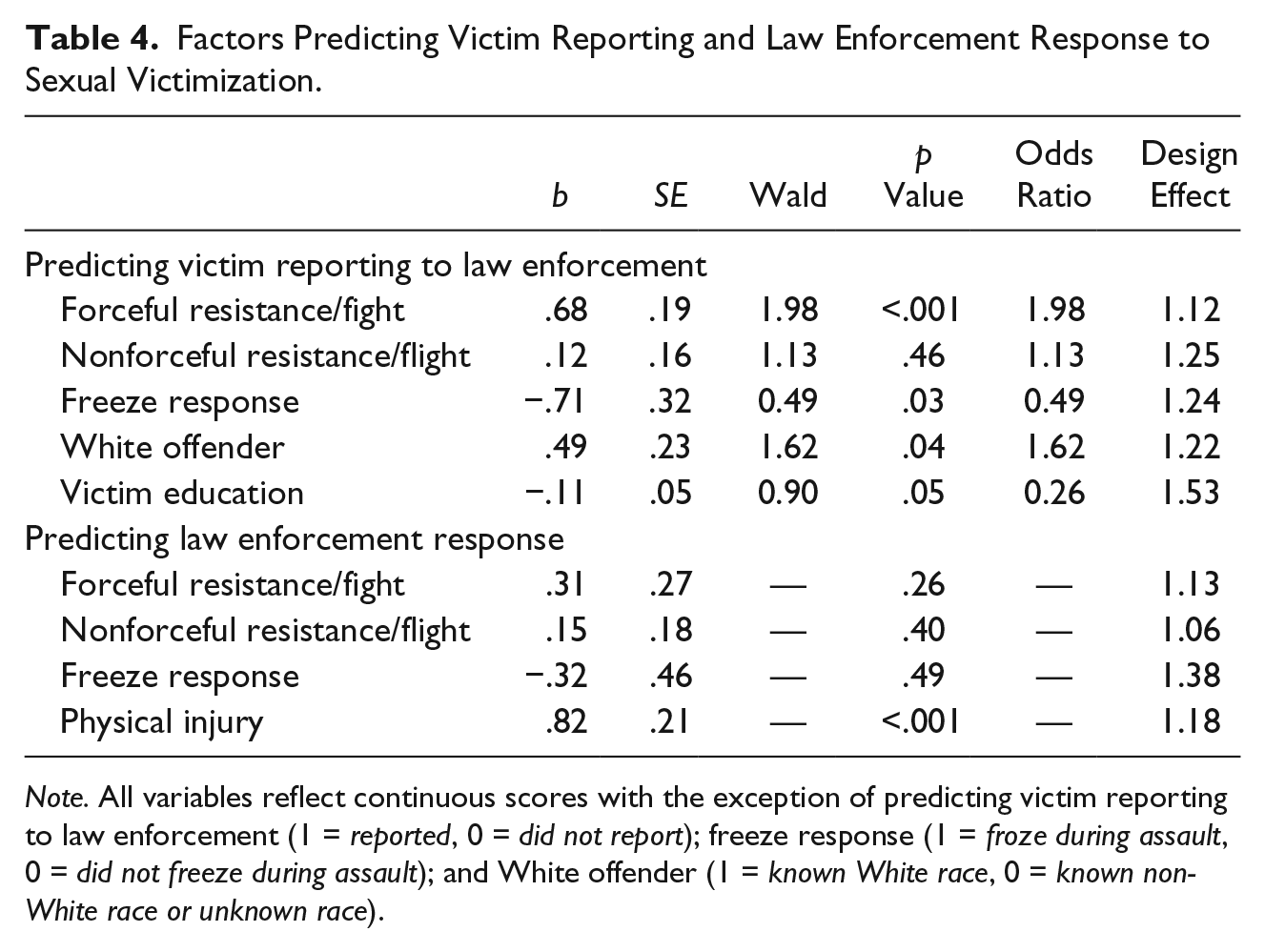
Note. All variables reflect continuous scores with the exception of predicting victim reporting to law enforcement (1 = reported, 0 = did not report); freeze response (1 = froze during assault, 0 = did not freeze during assault); and White offender (1 = known White race, 0 = known non-White race or unknown race).
Law Enforcement Response
The model explained 12% of the variance in law enforcement response. Forceful, nonforceful, and freeze responses did not significantly predict the extent to which law enforcement pursued the case over and above the effect of physical injury; law enforcement took significantly more actions as victims reported more physical injury (b = .82, SE = .21, p < .001; design effect = 1.18). Post hoc analysis modeling interaction effects between resistance and physical injury found a significant Nonforceful Resistance × Injury effect (b = .37, SE = .17, p < .05, design effect = 0.92), with simple slopes suggesting that physical injury increased law enforcement response at medium and high levels of nonforceful actions. Post hoc interaction effects of Forceful Resistance × Injury and Freeze Response × Injury were nonsignificant. 5
Discussion
Despite the prevalence of sexual victimization, less than one in five victims report the experience to law enforcement (Wolitzky-Taylor et al., 2011). Among those who do, many experience disappointing responses and secondary victimization from law enforcement (Campbell, 1998). Given prior research implicating victim resistance in these outcomes, the current study took a multidimensional approach to examine the influence of victim resistance types on victim reporting and law enforcement response.
Our first hypothesis was supported, such that individuals who engaged in forceful resistance strategies (fight response) were more likely to report the assault than those who engaged in nonforceful (flight) or freeze responses. This is consistent with prior research indicating that greater overall resistance leads to greater reporting (Gunn & Minch, 1988). Importantly, our finding that forceful versus nonforceful resistance predicted greater reporting suggests that there are meaningful nuances in this relationship. Specifically, it is not just significant that someone did or did not resist, but how they resisted. Victims who forcefully resist their attack are more likely to label their experience as rape (Bondurant, 2001), and sexual experiences identified as unwanted are intuitively more likely to be reported as a crime. Using translational models of threat, victims who fought rather than fled or froze may feel more certain that their experience was unwanted based on their own interpretation of their automatic biological response during the assault. These victims may experience less self-doubt and blame about the attack because it represented a clear violation against which they actively resisted, whereas victims who do not forcefully resist may question whether they were to blame for not actively trying to stop the attack from occurring. It may also be that the same characteristics underlie the tendency to forcefully resist and subsequently report the attack—perhaps such victims have higher self-efficacy or self-image. Future research may aim to better understand the meaning of this distinction. Future research is also needed to further understand mechanisms that lead to different resistance strategies. For example, there is some research to suggest that verbal threats, physical restraint, physical injury, and increased anger may lead to a greater likelihood of using forceful resistance (Atkeson et al., 1989; Nurius, Norris, Macy, & Hyang, 2004), and that self-defense programs like Rape Aggression Defense lead to increased self-efficacy among women both with and without a history of sexual trauma (Pinciotti & Orcutt, 2018). It is important to note, however, that regardless of victim resistance strategies, greater public understanding is needed to support individuals who experience assault and increase reporting behavior.
Our second hypothesis was not supported, such that resistance strategy did not significantly affect law enforcement response. Prior research has yielded inconsistent results regarding the relationship between victim resistance and law enforcement response; whereas Scroggs (1976) found that potential jurors made judgments contingent on victims’ resistance strategy, Frazier and Haney (1996) found that neither physical nor verbal resistance predicted law enforcement response beyond the effect of victim injury. It is possible that law enforcement officials did make similar judgments as jurors in previous research (e.g., that victims who used nonforceful strategies were more responsible for the assault) but that those judgments did not affect the extent of the action they took once the effect of physical injury was controlled. Physical injury was the only significant predictor of law enforcement response in the current study, a finding consistent with previous literature that law enforcement officials tend to be more diligent in their investigation of assaults that involved more severe physical injury (e.g., Frazier & Haney, 1996). Findings from the current study may suggest that biases held by law enforcement officials regarding victim resistance may, in fact, be subsumed under whether or not the victim was injured. Physical injury may be viewed by law enforcement officials as a clearer indicator of nonconsent and may also lead to increased urgency to apprehend the offender due to risk concerns. Because it is not possible with the NCVS data to parse law enforcement beliefs and biases from actions, future research is needed to understand the thought processes of law enforcement officials when pursuing allegations of sexual violence, and how these beliefs may differ as a function of victim resistance. Regardless, results from the current study suggest that assault characteristics such as physical injury to the victim influence how law enforcement officials respond to sexual assault allegations.
Strengths and Limitations
While a major strength of the current study was its use of a large national sample across several years, there are important limitations to acknowledge. First, although the sample size was quite large and stratified data collection allowed for a nationally represented sample, the racial and ethnic diversity was limited to primarily White and non-Hispanic victims, which limits generalizability to these groups. Given the higher rates of psychopathology among some racial and ethnic minorities (Burnett-Zeigler, Bohnert, & Ilgen, 2013), future research would benefit from including a more diverse sample of assault victims. With respect to perpetrator race and ethnicity, previous research has suggested that the common racial and ethnic disparities that disfavor minorities in the adjudication of crime in the United States are often reversed in cases of sexual violence. Specifically, examination of State Court Processing Statistics for 56,781 defendants between 1990 and 1996 found that defendant race and ethnicity did not influence pretrial detention or likelihood of incarceration, and that White defendants are significantly more likely to be found guilty for sexual assault and receive longer sentences than racial and ethnic minority defendants (Maxwell, Robinson, & Post, 2003). That said, a more racially and ethnically diverse sample of victims and perpetrators would allow deeper examination into potential interaction effects involving victim resistance. This is particularly relevant to resistance strategies because response to sexual violence may differ as a function of culture (e.g., some cultures may condemn women who physically fight off male attackers). Similarly, data on sexual orientation and gender identity are not available in the NCVS; this represents a significant limitation to the NCVS, given rates of psychopathology and violence in this population (Eaton, 2014). Future research would benefit from a representative sample of gender and sexual minorities to better understand resistance behavior, reporting, and law enforcement tendencies in this population.
Another limitation to note is potential selection bias given that our study relied on the reports of victims who were willing to be interviewed. Many assault victims may not be willing to be interviewed for the same reasons that they are not willing to report the assault (e.g., fear that they will not be believed or will be blamed). Thus, future research would benefit from a mailing that is sent out to those who do not wish to be interviewed in person or over the phone. Although the study relied on retrospective self-report of victims, these reports may be considered more reliable than other retrospective studies given that victims are reporting only on assaults that occurred within the last year and are likely better able to remember and report on their resistance behaviors. Conversely, victims may not be able to accurately reflect on law enforcement response, perhaps because law enforcement may be taking investigative actions of which victims are not aware. Despite limitations, the current study is strengthened by its ability to be easily compared with findings from other studies using the NCVS given overlap in methodology and measures. Findings of the current study also strengthen the existing body of literature on sexual assault resistance by examining resistance strategies more specifically. In addition, the current study provides a theoretical framework that is lacking in the body of literature from which response to sexual assault—in terms of both peri-trauma response and post-trauma response by victim and law enforcement—can be better understood.
Conclusions and Implications
In conclusion, the current study supports extant literature demonstrating that sexual assault characteristics influence victim reporting tendencies and law enforcement response. By taking a more nuanced approach to resistance strategy, we were able to demonstrate that forceful resistance strategies (e.g., screaming, kicking)—those reflecting a fight response—were associated with a greater likelihood that victims reported the assault to law enforcement compared with nonforceful (e.g., crying, blocking)—those reflecting a flight response—and freeze responses. Future research would benefit from this categorization of resistance strategies because it considers approach (i.e., fight) versus avoidance (i.e., flight, freeze) responses that appear to have differential influences on reporting tendencies. Although resistance strategy did not significantly predict law enforcement response, physical injury to the victim did and it may be a proxy for some type of forceful response (e.g., a victim who tried to hit their attacker may have suffered lacerations or bruises). In addition, post hoc analysis found a positive interaction between nonforceful resistance and physical injury, suggesting that these assault characteristics, when combined, appear to reflect a stronger perceived legal case that law enforcement officials are more willing to pursue.
Understanding the factors that influence victims’ likelihood of reporting to law enforcement is an important step toward identifying interventions that help make victims feel more comfortable reporting sexual violence. Findings from the current study suggest that victims who engage in nonforceful resistance or who freeze during the attack are less likely to report to law enforcement, suggesting that greater psychoeducation on college campuses and in the media about common trauma responses may be beneficial. Victims whose trauma responses are normalized may over time become more comfortable with labeling their experience as sexual assault and subsequently more likely to report. It is equally important to identify potential sources of bias for law enforcement officials who are tasked with investigating and making important decisions about sexual assault allegations. Although replication of the current study is needed, the findings suggest that law enforcement officials are less affected by victim resistance than by physical injury, despite victims’ concerns about their allegations being taken less seriously if they did not forcefully resist. Psychoeducation and training with law enforcement officials may instead place a heavier focus on consent and physical injury such that the former is not necessarily defined by the latter so that law enforcement officials may treat uninjured victims with the same level of care and concern as injured victims.
Footnotes
Authors’ Note
Caitlin M. Pinciotti is also affiliated with Rogers Behavioral Health, Oconomowoc, WI, USA.
Declaration of Conflicting Interests
The author(s) declared no potential conflicts of interest with respect to the research, authorship, and/or publication of this article.
Funding
The author(s) received no financial support for the research, authorship, and/or publication of this article.
