



Abstract
This study used two theoretical perspectives—coercive power and gender norms—to examine how gender affects victims’ decisions to report physical assaults to the police. The coercive power perspective attributes gender differences in reporting to sex-linked physical coercive power differences that affect the harm of the crime and victims’ personal safety. The gender norm perspective attributes gender differences in reporting to specific gender norms that influence crime reporting decisions. Using a sample of 18,627 nonintimate partner physical assaults from the National Crime Victimization Survey (1993–2015), crime reporting models demonstrated significantly better fit when they included the interaction between the victim’s gender and the offender’s gender than when they included only the main effects. In the sample, (a) female victims were 21.9% more likely to report to the police when the offender was male (vs. female) and (b) male victims were 45.8% more likely to report to the police when the offender was female (vs. male). Victims’ tendency to report an opposite-sex offender to the police was strongest in simple assaults and absent in aggravated assaults. We conclude that male and female victims’ reporting behaviors were most consistent with gender norms that encourage the use of self-help violence and discourage police reporting in intragender assaults. Consistent with this explanation, self-help violence was negatively related to crime reporting in assaults. Victims were more likely to use self-help violence and avoid reporting to the police against a same-sex offender than an opposite-sex offender. Finally, the offender’s gender had a relatively stronger influence on assault victims’ decisions to use self-help violence than on victims’ decisions to take no action against the offender (i.e., not reporting to the police or using self-help violence).
Keywords
Whether a violent crime is reported to the police depends on the severity of the crime and the perceived appropriateness of involving the criminal justice system (Greenberg & Ruback, 1992). Relevant to both factors are the gender of the offender and the gender of the victim. Regarding crime severity, gender is important because physical coercive power differences between males and females affect both the harm of the crime and the personal safety of the victim (Felson, 1996). Regarding decisions to involve the criminal justice system, gender is important because of gender norms related to help-seeking (Eagly & Crowley, 1986), which may encourage or discourage calling the police.
Gender is a key risk factor in violent victimization, which is most often simple assault. Recent estimates suggest that there are 18.4 assault victimizations per 1,000 people in the United States, and more than three fourths of these assaults do not involve a weapon or serious injury to the victim (Morgan & Oudekerk, 2019). In assaults, males are overrepresented among offenders, whereas males and females are about equally likely to be victims (Lauritsen et al., 2009; Morgan & Oudekerk, 2019). Male and female victims are more likely to be attacked by a male than a female, but male victims are more likely than female victims to be attacked by a male (Greenfeld & Snell, 2000). Even though the gender of the offender and the gender of the victim are clearly related to assault victimization, research is unclear about how these factors are linked to victims’ crime reporting decisions.
The link between gender and crime reporting has significant implications for the validity of data provided by police agencies, most prominently the Uniform Crime Reporting Program and the National Incident-Based Reporting System. Researchers rely on these data sets to understand gendered patterns in violent offending and victimization. Yet, studies often ignore the possibility of gender-based selection bias in police data (e.g., Schwartz et al., 2015; Warner, 2010), in that whether a violent crime is known to the police may depend on the gender of the offender, the gender of the victim, or the combination of the two.
Overall, the empirical evidence regarding gender effects on crime reporting is mixed. Regarding the victim’s gender, in a summary of crime reporting predictors across countries, Skogan (1984) argued that it was unrelated to crime reporting outcomes. Subsequently, some studies have found no victim gender effect (Tarling & Morris, 2010), other studies have indicated that female victims are more likely than male victims to report to the police (Spelman & Brown, 1984), and one study even found that male victims are more likely than female victims to report (Goudriaan et al., 2004). Regarding the offender’s gender, most studies have found it has no effect on crime reporting (Baumer, 2002; Bosick et al., 2012), but some countervailing research has found that male offenders are more likely than female offenders to be reported to the police (Baumer & Lauritsen, 2010; Wong & van de Schoot, 2012).
One reason for these inconsistencies is that prior studies may have misspecified the link between gender and crime reporting. Using the National Crime Survey, Hindelang’s (1979) early descriptive analyses of victimization incidents in the United States found that female victims tended to report male more than female offenders, whereas male victims tended to report female more than male offenders. Although these analyses did not control for any other factors, Hindelang’s results implied that the association between gender and crime reporting may be best understood by the interaction between both the victim’s gender and the offender’s gender.
To our knowledge, since Hindelang’s (1979) bivariate analyses, only two studies—both problematic—have explicitly examined gender interaction effects on crime reporting. Weiss et al. (2018) tested the effects of “gender dyads” on crime reporting using the National Crime Victimization Survey (NCVS) data on assaultive violence. They found that female victims were more likely than male victims to report male offenders. However, this study is limited in two respects. First, it did not test crime reporting differences across all victim and offender gender combinations, as the combinations were all compared with one base category: male-on-male violence. Second, there was no effort to test the effect of gender dyads across different types of violence.
Felson and Paré (2005), using data from the 1998 National Violence Against Women Survey, found that female victims of violence were 10% more likely to report a male offender than a female offender to the police, whereas male victims of violence were around 20% more likely to report a female offender than a male offender to the police. However, the study did not indicate whether these differences were statistically significant. More importantly, it gave only a cursory, post hoc explanation of these findings, and there were no tests of gender interaction effects across different types of violence.
In sum, literature has neglected gender interaction effects on crime reporting, and as a result, our understanding of the link between gender and crime reporting remains limited. The present study advances research and theory on crime reporting in three respects. First, this study tests whether the relationship between gender and violent crime reporting is better modeled by only the main effects of the victim’s and the offender’s gender—or by also including their interaction. Second, regarding theory, this study examines whether gender differences in physical coercive power or gender norms related to crime reporting better explain gender effects on victims’ crime reporting decisions. Third, to examine the generalizability of gender interaction effects on violent crime reporting, this study analyzes different types of assaults that vary by severity (i.e., simple and aggravated assault) and victim–offender relationship (i.e., stranger, acquaintance, and family violence). Our findings have implications for understanding how and when gender affects victims’ decisions to report to the police.
Examining the Gender and Crime Reporting Relationship
The coercive power perspective (Felson & Paré, 2005) and the gender normative perspective (Weiss et al., 2018) offer different reasons for the link between gender and crime reporting, but studies have generally treated them as post hoc explanations. This section discusses each of these perspectives and develops explicit hypotheses regarding the potential main effects and interaction effects of the victim’s gender and the offender’s gender on victims’ crime reporting decisions (refer to Table 1 for summary).
Hypothesized Offender Gender Effects on Female and Male Victims’ Crime Reporting Decisions.

Note. Comparisons between gender combinations (e.g., female victim and female offender), within a row, indicate relative differences rather than absolute differences. LO = low; HI = high; MOD = moderate; V.HI = very high; V.LO = very low.
Coercive Power Perspective
Coercive power refers to “the capacity to force change using threats of harm, actual harm, or bodily force” during a violent encounter (Felson, 1996, p. 434). Coercive power directly affects both the likelihood that a victim will be harmed (Felson, 1996) and the likelihood that a victim will report an assault to the police (Gottfredson & Hindelang, 1979). Human males—on average—have greater physical coercive power than females, owing to males’ greater skeletal muscle mass (Janssen et al., 2000), and they are more willing to use physical aggression (Carlo et al., 1999). Assuming that these differences between the sexes are true and coercive power influences crime reporting, then the coercive power perspective has three implications for the link between gender and crime reporting: male dangerousness, female vulnerability, and the interaction of the two.
Male dangerousness hypothesis
As assault offenders, males are more violent and more dangerous than females (Lauritsen et al., 2009). Males commit more serious crime than females (Kruttschnitt et al., 2002), and they tend to do more harm to victims (Schwartz et al., 2015). For example, homicide has been referred to as a “male affair” (Wilson & Daly, 1985), and one report on violence-related injuries in emergency departments found that five in every six victims who received emergency medical care were attacked by a male offender (Rand, 1997). If the perceived dangerousness of the offender influences victims’ crime reporting decisions, then violent male offenders should be more likely than violent female offenders to be reported to the police (i.e., an offender gender main effect).
Female vulnerability hypothesis
Female victims of assault are, on average, more vulnerable to harm than male victims of assault due to their relative coercive power disadvantage (Felson, 1996; Felson et al., 2002; Janssen et al., 2000). National-level studies on assault victimization have also found that female victims are at a higher risk of injury than male victims (Apel et al., 2013; Tjaden & Thoennes, 2000). If female victims’ relative physical vulnerability explains gender differences in assault victims’ crime reporting decisions, then female victims of violence should generally be more likely than male victims of violence to report to the police (i.e., a victim gender main effect).
Female Vulnerability × Male Dangerousness interaction hypothesis
If males are more dangerous as offenders and females are more vulnerable as victims, then the offender’s gender and victim’s gender should interact to affect assault victims’ crime reporting decisions. This interaction—which is predicted by multiplying the two main effect hypotheses presented above—would suggest that female victims of male offenders would face the greatest threat, male victims of female offenders would face the lowest threat, and female victims of female offenders and male victims of male offenders would face an intermediate level of threat. Accordingly, this interaction hypothesis would predict that female victims of male offenders would have the highest rates of reporting, male victims of female offenders would have the lowest rates of reporting, and the rates of reporting for female victims of female offenders and male victims of male offenders would be somewhere in between.
Gender Normative Perspective
A limitation of the coercive power perspective is that it focuses only on the physical differences between females and males and ignores gendered social norms. Social norms are unwritten social expectations that influence people’s beliefs, attitudes, and behaviors because of the potential social costs of violating norms (Elster, 2015). As a subset of social norms, gender norms are more specific social expectations regarding what beliefs, attitudes, and behaviors are appropriate for women and men. Females and males often face significant social pressure to conform to gendered norms, as their “social competence” is evaluated by how well their public behaviors align with them (Chodorow, 2012). At the extreme, West and Zimmerman (1987) even argued that the social consequences of violating gender norms make “doing gender” virtually “unavoidable” (p. 145).
The gender normative perspective focuses on how gender norms socially influence female and male victims’ crime reporting decisions. The underlying assumption is that gender norms dictate when a female or male victim should report to the police, and when a victim should report a female or male offender to the police. There are three specific gender norms that may explain the relationship between gender and crime reporting: evil woman, help-seeking socialization, and self-help violence.
Evil woman hypothesis
Gender is socially organized so that masculinity is consistent with violent behavior (e.g., risk-seeking, being physically dominant, and being aggressive), whereas femininity is inconsistent with violent behavior (e.g., nurturant role obligations, submission, and physical weakness; Steffensmeier & Allan, 1996). When feminine-gendered expectations are violated, women may be more vulnerable than men to social or legal sanctions (Burgess & Borgida, 1999; Rasche, 1974). For instance, victims may be more willing to use legal sanctions against violent female offenders, relative to violent male offenders, because female offenders are “doubly guilty” for violating both the law and gender norms (Chesney-Lind, 1977). Thus, according to the “evil woman” hypothesis, female offenders should be more likely than male offenders to be reported to the police by victims (i.e., an offender gender main effect).
Help-seeking socialization hypothesis
Studies on gender differences in help-seeking have suggested that, compared with men, women are more likely to adopt social roles that encourage help-seeking (Himmelstein & Sanchez, 2016). By contrast, men are less likely to seek help because they are enculturated to be self-reliant (“boys don’t cry”; Goodey, 1997), which is a value that implies a personal toughness and a willingness to stand up for oneself (Galdas et al., 2005). Among victims of bullying, boys are less likely than girls to seek help and also less likely to view social support as the best strategy for stopping bullying (Hunter et al., 2004).
Gendered differences in help-seeking socialization may have direct implications for victims’ crime reporting decisions. Experimental studies have found that people are likely to recommend that a female victim more than a male victim should report a crime to the police (Ruback et al., 1999). If females are more socialized and more expected to seek help than males, then female victims should be more likely than male victims to report to the police (i.e., a victim gender main effect).
Self-help violence hypothesis
According to Black (1983), people may choose to engage in retaliatory aggression, instead of reporting to the police, to exercise social control over those with whom they have a grievance, what we refer to as self-help violence. Black (1983) argued that most violence “involves ordinary citizens who seemingly view their conduct as a perfectly legitimate exercise of social control” (p. 39). Indeed, one of the most common reasons why victims choose not to report to the police is because they handled the situation privately (Langton et al., 2012). Blurring the line between victim and offender, victims may not welcome police intervention once they addressed the conflict privately using self-help violence.
Much like the decision to use violence generally, people’s willingness to use self-help violence and avoid reporting to the police likely varies by the gender of the victim and the gender of their offender (Felson, 2002). For example, a male victim may be more willing to use self-help violence against a male attacker than a female attacker. Qualitative research suggests that men fight back against other men and avoid reporting to the police because reporting both undermines the purpose of “the fight” (Copes et al., 2013) and reduces men’s chances of “getting back” at the attacker (Burcar, 2013). In contrast to gaining status from retaliating against males, male victims of female offenders may prefer to report to the police because, if they choose to retaliate, they “lose face whether they win or lose” (Felson & Paré, 2005, p. 608) because of social norms that discourage men’s violence against women (Simon et al., 2001).
Similar to male-on-male violence, some authors argue that female-on-female violence is partly motivated by intragender rivalries and social status concerns (Campbell, 2004). One ethnographic study even suggested that women perceive that self-help violence has “instrumental value” in violent confrontations with other women (Ness, 2004). Thus, female victims may be more willing to use self-help violence against a female attacker than a male attacker.
In short, both male and female victims may have a tendency to use self-help violence and avoid reporting to the police against a same-sex offender. This self-help hypothesis would imply an interaction effect between the offender’s gender and the victim’s gender on victims’ crime reporting decisions. Specifically, male victims of violence should be more likely to report a female offender than a male offender to the police, whereas female victims of violence should be more likely to report a male offender than a female offender to the police.
Distinguishing Coercive Power Hypotheses From Gender Norm Hypotheses
We summarize the empirical hypotheses of the current study in Table 1. The three coercive power hypotheses and the three gender norm hypotheses generally make different predictions about the gender and crime reporting relationship. However, the female vulnerability hypothesis and help-seeking socialization hypothesis make the same prediction: Female victims are more likely than male victims to report to the police.
One way to determine whether the coercive power perspective or the gender norm perspective is the better explanation is to examine the gender and crime reporting relationship for different types of violence. If gender differences in coercive power explain gender differences in reporting behavior, the relationships between gender and assault reporting should be relatively constant because increasing the threat to victim safety should increase crime reporting (Thompson et al., 2007). Thus, support for the coercive power perspective would be given if gender is a relatively constant predictor of victims’ crime reporting decisions across different types of assaults, net of other factors.
If gender norms explain victims’ reporting behaviors, we expect that gender effects on assault victims’ crime reporting decisions should depend on the likelihood that the norm will be followed (Cialdini & Goldstein, 2004). For assault victims, following norms related to crime reporting depends on whether following the norm affects their personal safety and whether the norm is enforceable by the public. When violence passes a certain threshold of severity, social norms may become less important to violence victims’ reporting decisions because they are focused on ensuring personal safety (Baumer, 2002; Tarling & Morris, 2010). Experimental and observational studies have suggested that, in highly serious crimes, victim/offender characteristics and social norms are less predictive of victims’ reporting behaviors (Baumer, 2002; Ruback, 1994). If victims prioritize personal safety, then gender norms (and thus gender as a variable) should be less predictive of victims’ crime reporting decisions in serious violence.
Another way to test the explanatory power of the two perspectives is to examine the association between gender and violent crime reporting across different victim–offender relationships. Specifically, norms should affect victims’ crime reporting decisions in violent conflicts between family members less than conflicts between strangers and acquaintances because family violence generally occurs “behind closed doors” and away from public scrutiny (Straus et al., 2017). The private nature of family violence may thus reduce the influence of public gender norms on family members’ behaviors. For example, despite norms that supposedly protect women and children from violence (Carpenter, 2016), violence against and among women and children may be more normalized in the family context (Straus, 1973). By contrast, because stranger and acquaintance violence are arguably more public than family violence, victims of stranger and acquaintance violence should be relatively more susceptible to public normative influences.
Method
Data
We analyzed simple assaults and aggravated assaults against nonintimate partners recorded by the NCVS from 1993 to 2015. This sample excludes all assaults where the offender was a spouse, ex-spouse boyfriend/girlfriend, or ex-boyfriend/girlfriend of the victim. Simple assaults are defined as an “attack without a weapon resulting either in no injury, minor injury (e.g., bruises, black eyes, cuts, scratches, or swelling), or an undetermined injury requiring fewer than two days of hospitalization. Also includes attempted assault without a weapon” (Bureau of Justice Statistics [BJS], 2019). Aggravated assaults are defined as an attack or attempted attack with a weapon, regardless of whether an injury occurred, and an attack without a weapon when serious injury results. Serious injury includes broken bones, lost teeth, internal injuries, loss of consciousness, and any unspecified injury requiring two or more days of hospitalization.
No injuries in the study sample were recorded as undetermined.
The NCVS is a nationally representative, diverse data set of households from different racial groups and social classes in the United States, and it is the leading source of self-report victimization data. It uses a stratified, multistage sampling design with counties, groups of counties, and metropolitan areas composing the first stage and segments of households (around four housing units) composing the second stage. All household members who are aged 12 years or older are eligible to participate in an NCVS interview. The NCVS is ongoing and follows up with the households at 6-month intervals for 3 years after they are initially contacted.
We excluded sexual violence, robberies, and intimate partner violence from the analyses for three statistical and substantive reasons. First, females rarely sexually assaulted or robbed a male victim. The standard error of the gender interaction effect estimate was too high to make a statistically reliable conclusion, which made it difficult for the findings to inform our primary research question. Second, we encountered a similar statistical power issue with intimate partner violence, as same-sex couples were relatively rare in the data. Third, gender interaction effects on crime reporting in sexual violence and intimate partner violence could be confounded with potential sexual orientation effects on crime reporting, and our tests were aimed at juxtaposing the coercive power perspective and the gender normative perspective.
Our analyses were also restricted to single-offender incidents where the victim could personally identify the offender. We restricted our sample to single-offender incidents because we wanted to identify the effect of the offender’s gender but could not clearly do so in multiple-offender incidents involving a mixed-sex offender group (see “Limitations” for further discussion of this issue). The sample was restricted to incidents where the victim could identify the offender because it increased the likelihood that victims knew the offender’s gender prior to reporting to the police. We also excluded crime incidents reported by third parties—including on-scene police officers—and incidents reported to other officials. Following Xie and Lauritsen (2012), these restrictions maximized the probability that the victims were the ones who actually reported to the police and knew that their victimization was reported to the police. Finally, we excluded victimization incidents that occurred outside of the United States.
Most of the missing data in our models stemmed from missing demographic information on the offender’s characteristics. Except for the offender’s gender and the dependent variables, we included an “unknown” dummy measure to account for missing data, which occurred in less than 15% of cases in the total sample. We conducted sensitivity analyses by reestimating our models using multiple imputation with chained equations (m = 10) on the general sample. Because our results did not significantly change, we chose the more parsimonious approach. In total, we removed 673 cases from the primary analyses due to missing data on the police notification measure and the offender’s gender measure. After dealing with missing data, our final sample contained 18,627 victimization incidents: 14,784 simple assaults and 3,843 aggravated assaults.
Measures
Our dependent measure—victim crime reporting—was conceptualized as a violence victim reporting her or his victimization to the police. The outcome was coded as 1 if the victim reported to the police and 0 if the violence was not reported to the police. Consistent with our conceptual framing, third-party reporting was excluded from the analyses to focus only on victims’ crime reporting decisions.
Our primary independent variables were the victim’s gender and the offender’s gender. We coded the victim’s gender and the offender’s gender similarly, with females coded as 1 and males coded as 0. We tested the interaction effect between these factors by including both the main effects of the gender variables and their interaction (i.e., Victim’s Gender × Offender’s Gender) in the models.
We included four sets of covariates—incident-level factors, victim-level factors, offender-level factors, and contextual factors—to parse out the gender interaction effects on crime reporting. The five incident-level factors indicated the severity of the violence, which are related to the victim’s gender, the offender’s gender, and whether violence is reported to the police (Baumer & Lauritsen, 2010; Felson et al., 2002). Offender’s weapon use was dummy coded into two separate categories: if the offender used a weapon and if the offender had no weapon (reference group). Completed crime was coded 1 if the crime was completed and coded 0 if the crime was only attempted (e.g., threatening to harm). Repeat victimization was coded 1 if the incident was a repeat victimization by the same offender and coded 0 if the respondent was victimized only once by the offender during the study period. Victim injury was dummy coded into three categories of injury: if the victim experienced severe injury (e.g., gunshot wound or broken bones), if the victim experienced minor injury (e.g., cuts/bruises), and if the victim experienced no injury (reference group). We also included a measure of whether the victim used physical force against the offender during the incident—what we refer to as self-help violence—because decisions to use violence are related to the gender of those involved in a grievance (Felson et al., 2002), and Black (1983) suggested that people may choose to use violence to resolve grievances in lieu of reporting to the police.
We included five measures of the victim’s characteristics to ensure that gender interaction effects were not confounded by other demographic factors related to crime reporting (Goudriaan et al., 2004; Tarling & Morris, 2010). We treated the victim’s age as a continuous variable. We dummy coded the victim’s race/ethnicity into Hispanics, non-Hispanic other race (i.e., Asian, Native American, and Native Hawaiian), non-Hispanic Black, and non-Hispanic White (reference group). The victim’s marital status was dummy coded into married, previously married, and never married (reference group). The victim’s household income was coded for whether the victim lived in a household with a total income above US$50,000 a year, between US$30,000 and US$49,999 a year, between US$20,000 and US$29,999 a year, between US$10,000 and US$19,999 a year, and below $10,000 a year (reference group). We also included whether the victim’s household is owned or rented as an additional measure of the victim’s socioeconomic status.
We also controlled for three offender’s characteristics to examine gender interaction effects net of other offender demographics related to crime reporting. Because juvenile crimes tend to have lower reporting rates (Finkelhor & Wolak, 2003), we treated the offender’s age as a categorical variable that we dummy coded into two categories: whether the offender was an adult (>17 years old) or whether the offender was a juvenile (<18 years old; reference group). To address the influence of the offender’s race on crime reporting (Xie & Lauritsen, 2012), we dummy coded the offender’s race into three categories: if the offender was an “other” race (e.g., Native American or Asian), if the offender was Black, and if the offender was White (reference group). Because there are relationships between gender, victim–offender relationship, and crime reporting (Kaukinen, 2002), we included a dummy measure of the offender’s relationship to the victim that indicated three categories: acquaintance, family, and stranger (reference group).
Finally, we controlled for three contextual factors related to crime reporting. We dummy coded the domain of the incident into three categories (Goudriaan, 2006): private domain (i.e., in or near the victim’s home or the victim’s friend’s home), semipublic domain (e.g., commercial establishments), and public domain (e.g., park, on public street, and other area; reference group). Urbanicity was dummy coded according to whether the victim’s household was located in a rural, suburban, or urban area (Rennison et al., 2013; reference group). We also included a dummy measure of the year the survey was administered (survey year) with 1993 coded as the reference category (survey year fixed effects).
Analytic Strategy
Our primary analyses were conducted in two steps. First, we estimated gender interaction effects on victims’ crime reporting using logit regression models in STATA v15.1. Our strategy was to include the main terms of the victim’s gender and the offender’s gender in the model and then include an interaction term (Victim’s Gender × Offender’s Gender).
The models were estimated with unweighted NCVS data, and because multiple incidents can involve one victim, we adjusted the standard errors to account for clustering on the victim identification number. We reestimated our models using weighted data and derived similar estimates (e.g., Supplemental Appendix A). When parameter estimates are similar between weighted and unweighted multivariate models, it is preferable to use the more parsimonious, unweighted model (Lohr & Liu, 1994) because adding weights would merely increase statistical uncertainty. In addition, given that we controlled for a number of factors that were used to calculate NCVS poststratification weights in the statistical models (e.g., race, income, age, urbanicity, region, gender, and repeat victimization), including survey weights is superfluous and could potentially threaten the consistency of our estimates (Solon et al., 2015).
Second, with the logit model estimates, we conducted postestimation analyses using STATA’s margins command to separately estimate the effects of the offender’s gender on female victims’ and male victims’ conditional predicted probabilities of crime reporting, with the covariates held at their mean values. These results provide a simpler interpretation of gender interaction effects on crime reporting than the coefficients estimated in the logit model. Each predicted probability represents the probability that a “statistically average” incident was reported to the police by the victim. We used pairwise comparisons with a Bonferroni correction for multiple comparisons to compare between these estimated probabilities.
Results
Table 2 provides the descriptive statistics of our study sample. Overall, males were the majority of perpetrators (79.3%), and simple assaults were the majority of nonintimate partner assaults (79.4%). The most common assault involved a male victim and a male offender (54.6%), whereas assaults involving a male victim and a female offender were the least common (3.4%). Regarding the victim–offender relationship, stranger and acquaintance assaults were the most common in our sample (44.7% and 43.5%, respectively), whereas nonintimate family assault was the least common (9.6%).
Descriptive Statistics by Victim Gender and Offender Gender.

Note. NH = non-Hispanic.
We summarize the percentage change (Δ) between mean probabilities of assault victims’ reporting to the police across gender interaction terms. Based on descriptive statistics, female victims of assault were 30.3% more likely to report to the police when the offender was male than when the offender was female. Male victims of assault were 60.9% more likely to report a female offender to the police than a male offender. When the offender was male, female victims were 71.1% more likely than male victims to report to the police. When the offender was female, male victims were 22.6% more likely than female victims to report to the police. Among all gender combinations, male-on-male assault was the least likely to be reported to the police (26.4%).
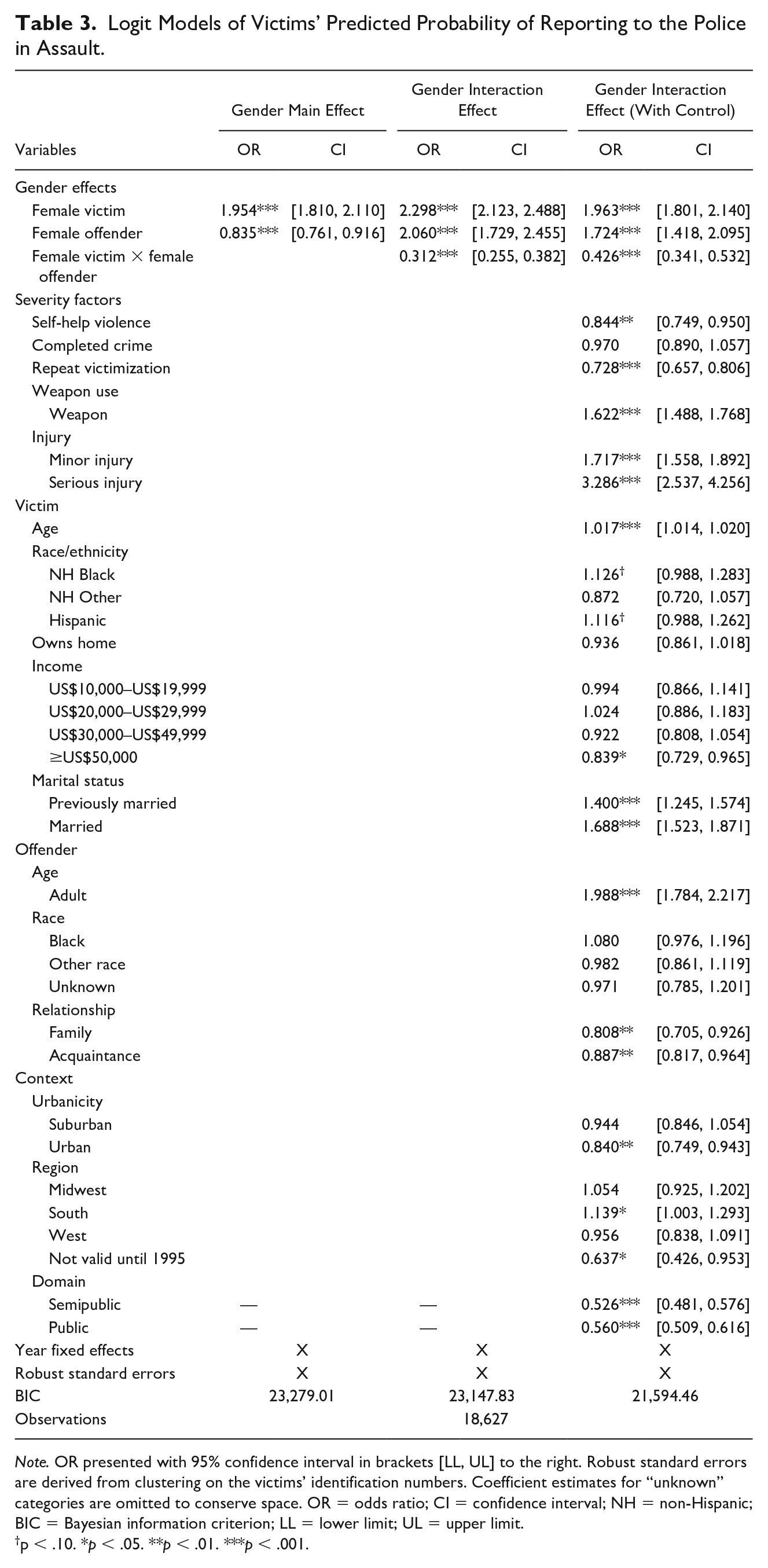
Table 3 summarizes the results from the logit regression model of victims’ crime reporting in assault. Model 1 estimates the gender main effects without the gender interaction term and without control variables. In the gender main effect model, female victims of assault had around 95.4% greater odds than male victims of assault to notify the police (odds ratio [OR] = 1.954, 95% confidence interval [CI] = [1.810, 2.110], p < .001). By contrast, female offenders had a modest 16.5% lower odds than male offenders to be reported to the police by the victim (OR = 0.835, 95% CI = [0.761, 0.916], p < .001).
Logit Models of Victims’ Predicted Probability of Reporting to the Police in Assault.
Note. OR presented with 95% confidence interval in brackets [LL, UL] to the right. Robust standard errors are derived from clustering on the victims’ identification numbers. Coefficient estimates for “unknown” categories are omitted to conserve space. OR = odds ratio; CI = confidence interval; NH = non-Hispanic; BIC = Bayesian information criterion; LL = lower limit; UL = upper limit.
p < .10. *p < .05. **p < .01. ***p < .001.
When the gender interaction term was added to the equation, the model fits the data substantially better than the gender main effect model (Bayesian information criterion [BIC] difference = −113.18). These results shed doubt on the gender main effect hypotheses and provide initial support for gender interaction effects on victims’ crime reporting decisions in assaults. When all the control variables were added to the model, the gender main effect terms and the gender interaction effect terms were significantly related to victims’ crime reporting decisions (p < .001).
Figure 1 summarizes the predicted probabilities of a victim reporting to the police by the different victim gender and offender gender combinations using the logit model of crime reporting. In a statistically average assault, female victims were 21.9% more likely to report a male offender than a female offender (95% CI = [12.53, 31.99], p < .001), whereas male victims were 45.8% more likely to report a female offender than a male offender (95% CI = [26.39, 68.28], p < .001). When an assault involved a male offender, female victims were around 58% more likely than male victims to report a male offender to the police (95% CI = [48.09, 68.67], p < .001). Male-on-male assaults were the least likely to be reported to the police compared with all other gender combinations (25.13%, p values of comparisons < .001). In sum, victims of assault generally reported opposite-sex offenders to the police, which is most consistent with the self-help hypothesis.
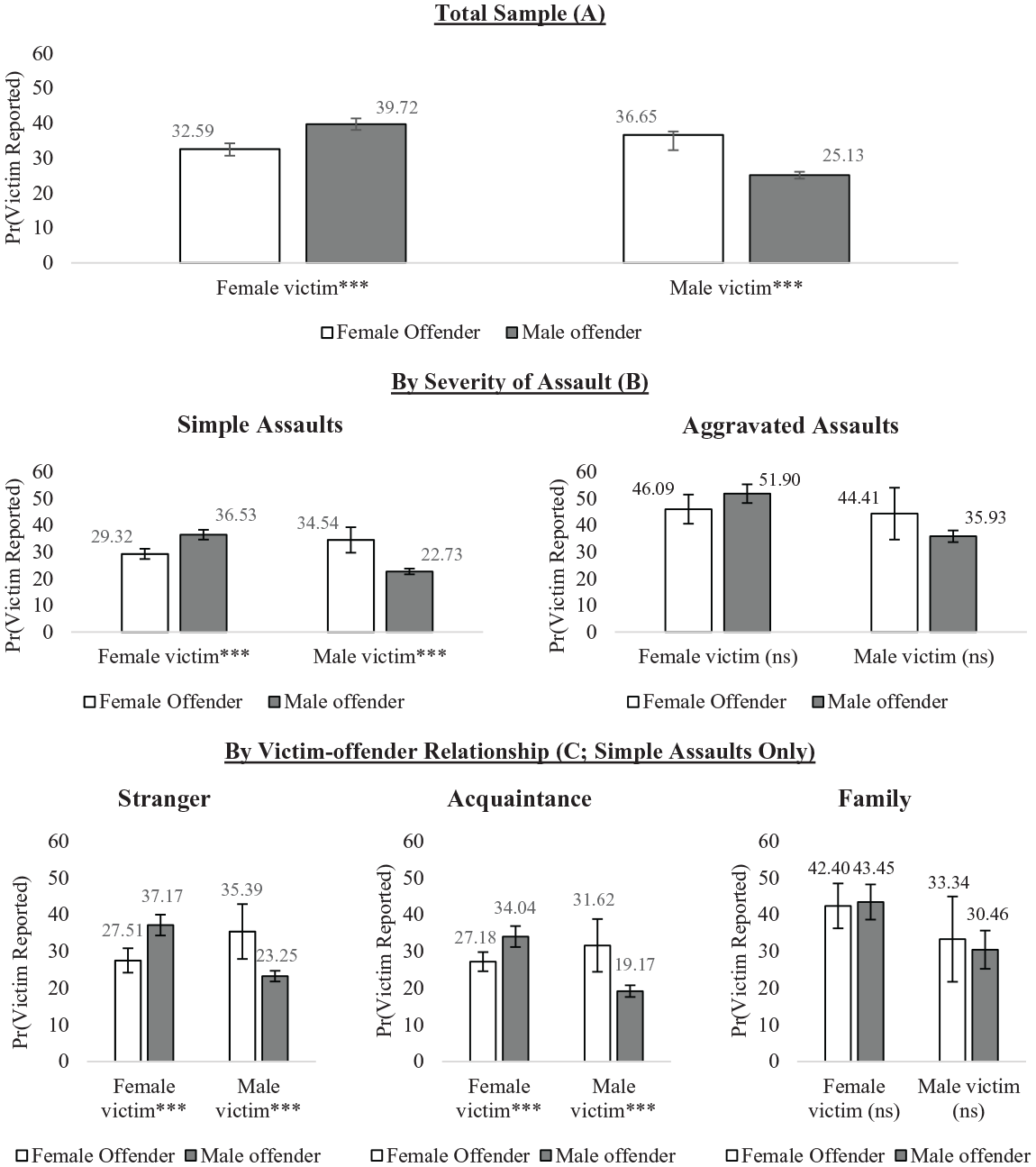
Gender interaction effects on victims’ predicted probability of reporting to the police (A) total sample, (B) by the type of assault, and (C) by victim–offender relationship (simple assaults only).
By Severity of Assault
In subsequent analyses, we tested whether these gender interaction effects were true for both simple and aggravated assault. Figure 2 summarizes the predicted probabilities of victims reporting to the police by the severity of assault (full models reported in Supplemental Appendix B). The tendency of victims to report opposite-sex offenders to the police was most pronounced in simple assaults, whereas this tendency was attenuated in aggravated assaults. Female victims of simple assault were 24.6% more likely to report to the police when the offender was male versus female (95% CI = [13.55, 36.74], p < .001). By contrast, male victims of simple assault were 52% more likely to report a female offender than a male offender to the police (95% CI = [28.69, 79.51], p < .001). In aggravated assault, both female and male victims were not significantly more likely to report opposite-sex offenders than same-sex offenders (p = .176 and p = .154, respectively). Across both types of assault, female victims were significantly more likely than male victims to report a male offender (p < .001). In short, the offender’s gender distinctly influenced male and female victims’ crime reporting only for relatively minor violence, but female victims were consistently more likely than male victims to report a male offender to the police.
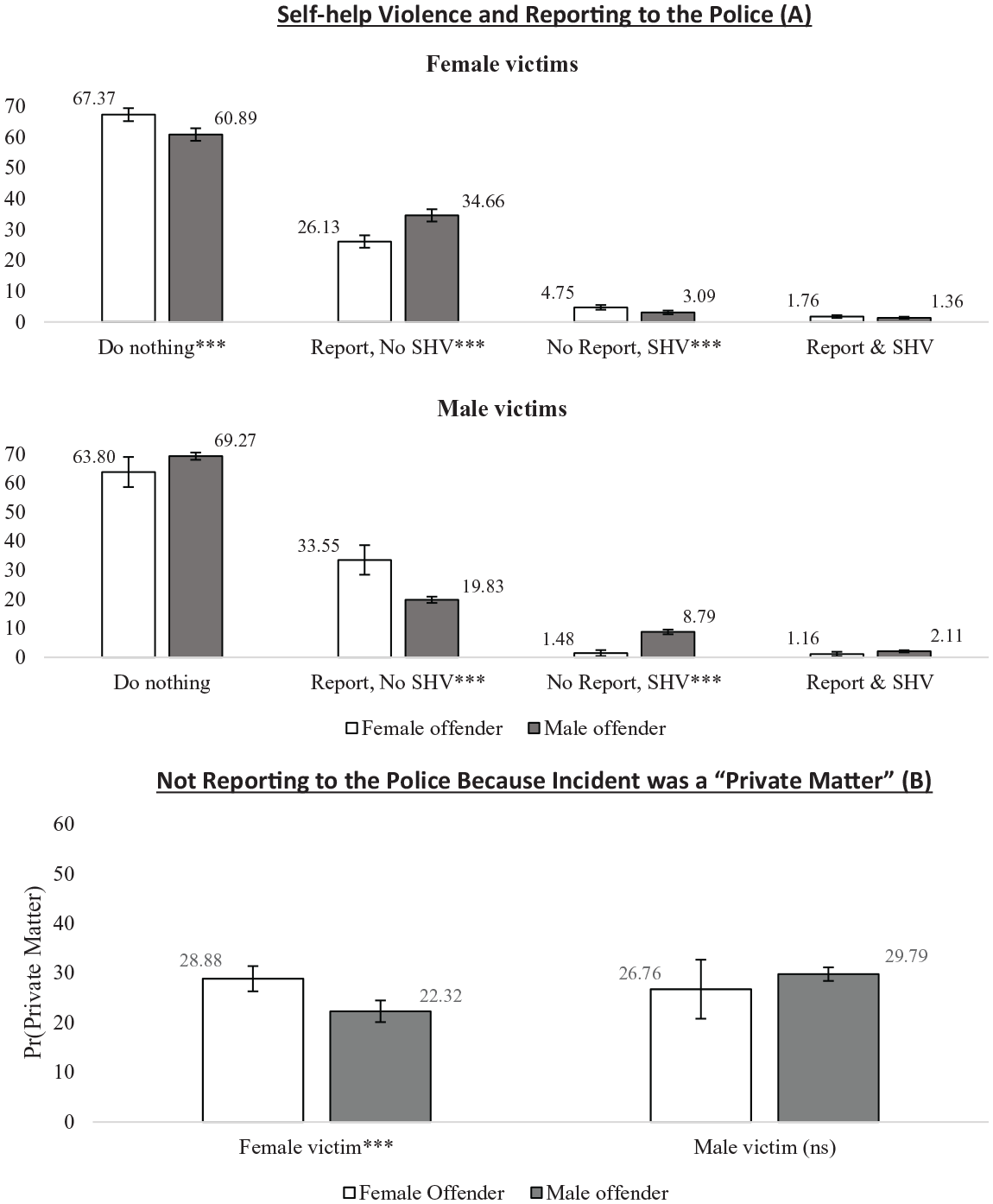
Gender interaction effects on victims using self-help violence (A) and not reporting to the police because incident was a “private matter” (B).
By Victim–Offender Relationship
We next tested whether gender interaction effects on victims’ crime reporting persisted across different victim–offender relationships. Figure 1C summarizes the gender interaction effects on crime reporting in simple assaults involving strangers, acquaintances, and family members (full models in Supplemental Appendix C). In stranger simple assaults, female victims and male victims were 35.1% more likely (CI = [15.03, 58.66], p < .001) and 52.2% more likely (CI = [18.41, 95.65], p < .001), respectively, to report an opposite-sex offender than a same-sex offender. Similarly, in acquaintance simple assaults, female victims and male victims were 25.2% more likely (CI = [8.64, 44.33], p = .001) and 65% more likely (CI = [25.48, 116.84], p < .001), respectively, to report an opposite-sex offender than a same-sex offender.
In family simple assaults, the offender’s gender was unrelated to female victims and male victims’ crime reporting decisions (p > .999, for both). However, regardless of the victim–offender relationship, female victims were significantly more likely than male victims to report a male offender to the police (p < .001 across all comparisons). In sum, simple assault victims tended to report opposite-sex offenders only when the offender was a stranger or acquaintance, but across all relationship types, female victims were more likely than male victims to report a male offender to the police.
Additional Support for the Self-Help Hypothesis
In the primary analyses of victims’ crime reporting decisions, the results were most consistent with the self-help hypothesis. Moreover, we found that self-help violence was negatively related to victims’ crime reporting (Table 3; OR = 0.844, 95% CI = [0.749, 0.950], p = .005). We conducted two additional tests of the validity of the self-help hypothesis using the sample most likely to demonstrate victims’ tendency to report opposite-sex offenders: simple assaults involving strangers and acquaintances. The first test examined gender interaction effects on four possible victim behaviors: (a) doing nothing, (b) only reporting to the police and not using self-help violence, (c) only using self-help violence and not reporting to the police, and (d) reporting to the police and using self-help violence.
The results of the first test are summarized in Figure 2A (full models in Supplemental Appendix D). Similar to the crime reporting models, victims were more likely to report opposite-sex than same-sex offenders to the police (and not use self-help violence). Instead of reporting to the police, victims either did nothing or used only self-help violence against same-sex offenders. Female victims were 10.6% more likely to do nothing against a female offender than a male offender (95% CI = [5.09, 16.48], p < .001), whereas the offender’s gender was unrelated to male victims’ tendency to do nothing (Δ = 8.57, CI = [–1.12, 19.32], p = .103).
Regarding self-help violence, victims were significantly more likely to use only self-help violence (and not report) against same-sex than opposite-sex offenders. Female victims were 53.5% more likely (Δ = 53.53, CI = [15.55, 104], p < .001) to use only self-help violence when the offender was female (vs. male). By contrast, male victims were almost six times more likely (CI = [2.66, 13.16], p < .001) to use only self-help violence when the offender was male (vs. female). For both male and female victims, the offender’s gender was more strongly associated with their tendency to use only self-help violence than their tendency to do nothing (female victims: Δself-help violence = 53.53 vs. Δdo nothing = 10.64; male victims: Δself-help violence = 592.15 vs. Δdo nothing = 8.57).
The second test examined gender interaction effects on victims not reporting to the police because the incident was considered a “private matter” that they handled “personally” (Figure 2B, full models in Supplemental Appendix E). This outcome is separate from victims’ crime reporting, and it was measured in the NCVS using victims’ reasons for not reporting to the police. A private matter was coded as 1 when victims did not report to the police because they indicated it was “a private or personal matter or took care of it myself informally” and 0 if they did not indicate this reason.
Female victims were 29.4% more likely to not report a female offender than a male offender because the incident was considered a private matter (95% CI = [11.59, 50.10], p < .001). Male victims were 11.34% more likely to not report a male offender than a female offender because the incident was a private matter, but this difference was not statistically significant (95% CI = [−16.39, 44.29], p = .706). In short, female victims more often avoided calling the police and handled a violent conflict privately when the offender was female (vs. male), whereas male victims were just as likely to privately handle a violent conflict with a male offender as they were with a female offender.
Discussion
This study’s primary research question was whether the link between gender and crime reporting is best modeled by the victim’s gender, by the offender’s gender, or by their interaction. In addition, we were interested in whether female and male victims make different reporting decisions based on their offender’s gender because of differences in coercive power between the sexes or because of differences in gender norms that influence female and male victims’ crime reporting decisions.
Using NCVS data on simple and aggravated assaults against nonintimate partners, we found that assault victims’ crime reporting decisions were best modeled by including the interaction between the victim’s gender and the offender’s gender. Across most assaults, female victims were more likely to report a male offender to the police, whereas male victims were more likely to report a female offender to the police (see Supplemental Appendix F for a summary of results). Relative to other gender combinations, male-on-male simple assaults were the least likely, relative to other gender combinations, to be reported to the police by the victim. Thus, our analyses revealed an important pattern in the relationship between gender and crime reporting: Assault victims are more likely to report intergender assaults than intragender assaults.
Empirically, our results suggest that future studies of violent crime reporting need to account for the interaction effect between the victim’s gender and the offender’s gender, lest they distort the relationship between gender and victims’ crime reporting decisions. Simple assaults typically compose the majority of violence in crime reporting studies. Thus, without accounting for the victim–offender gender interaction, it is not surprising that some studies have found that female victims are more likely than male victims to report, as most assaults involve male offenders (Morgan & Oudekerk, 2019). In addition, the failure to find offender gender effects in prior research (Baumer, 2002; Kang & Lynch, 2014) is likely an artifact of misspecified models that do not account for the differential effect of the offender’s gender on female victims’ and male victims’ reporting decisions in simple assault.
Self-Help Violence
Conceptually, our findings are most consistent with a gender normative perspective, which posits that victims’ reporting behaviors are the product of gendered social expectations. Under this general perspective, two of the three hypotheses were wrong half of the time, but the self-help violence hypothesis was correct for all four gender combinations. All three hypotheses from the coercive power perspective were wrong.
The self-help violence hypothesis suggests that—in lieu of calling the police—people use aggression to express a grievance and exert social control (Black, 1983). We argued that victims should be more likely to use violence against a same-sex offender than an opposite-sex offender because of gender norms: specifically, those that encourage “fighting back” against an offender and discourage seeking help when the offender is the same gender (Copes et al., 2013; Ness, 2004).
We found three additional points of support for the self-help violence hypothesis. First, assault victims who chose to use self-help violence were generally less likely than victims who did not use self-help violence to report to the police. Furthermore, in simple assaults involving strangers and acquaintances, victims were more likely to use self-help violence instead of reporting when the offender was of the same gender than when the offender was of the opposite gender. This finding provides statistical support for prior qualitative research (Copes et al., 2013; Ness, 2004) that suggested intragender violence may normatively encourage the use of self-help violence and discourage reporting to the police.
Second, the influence of the offender’s gender on victims’ crime reporting decisions depended on the severity of the crime and the victim–offender relationship. Prior research has suggested that in more severe violence, social norms that discourage crime reporting may play less of a role in whether a victim reports to the police because they conflict with victims’ safety priorities (Baumer, 2002; Ruback, 1994). Consistent with this prediction, we found that the gender of the offender did not affect female or male victims’ decisions to report to the police in aggravated assaults. We also argued that gender norms may have less of an effect on victims’ crime reporting decisions in family violence, as this violence typically occurs in situations where public gender norms are unlikely to be enforced (Straus et al., 2017). Consistent with this prediction, we found that the gender of the offender had no influence on male and female victims’ crime reporting decisions in simple assaults involving family members. In sum, gender interaction effects on victims’ crime reporting decisions were strongest in the most common type of violence: stranger and acquaintance simple assault (Morgan & Oudekerk, 2019).
Third, we found that the offender’s gender had a stronger relative impact on victims’ willingness to use violence and avoid reporting to the police than on their willingness to do nothing (i.e., not reporting to the police or using self-help violence). When attacked by a same-sex offender (compared with an opposite-sex offender), victims seem relatively more willing to use aggression.
Still, victims’ tendency to do nothing against same-sex offenders at least partly explains gender interaction effects on crime reporting. In sensitivity analyses not presented, we found that the use of self-help violence particularly reduced the likelihood that male victims reported an offender of the same gender (versus an offender of the opposite gender) to the police, but we did not find this relationship for female victims. When examining the reasons victims gave for their reporting decisions, we found that female victims tended to not report female offenders because the incident was considered a “private matter.” Given that female victims were more likely to do nothing when the simple assault involved a female offender (vs. a male offender), this finding leads us to believe that, instead of reporting to the police, female victims may use other nonviolent strategies to deal with female-perpetrated assaults.
Limitations
This study has three limitations. First, although our findings provide evidence that is fully consistent with only the self-help violence explanation for gender interaction effects on crime reporting, they do not allow us to completely rule out coercive power explanations. We do not have direct measures of the physical size or aggressive tendencies of either the victim or the offender. Gender is, at best, a rough proxy for physical coercive power. The NCVS measures of self-help violence are also temporally limited, as we cannot measure retaliatory violence that may have occurred days or months after the event. Victims may avoid reporting to the police because they plan to get revenge on their attackers later (Burcar, 2013), and this revenge is relevant to the self-help violence hypothesis. Even with these measurement limitations, however, our study provides evidence that examining the role of self-help violence in crime reporting decisions is useful for understanding the association between gender and crime reporting.
Second, our findings are limited to only nonintimate partner, physical assaults committed by single offenders. We omitted intimate partner and sexual violence because of statistical power issues that did not allow us to address the link between gender and reporting for all violent crime types. In general, there was a low number of assaults involving same-sex intimate partners (n = 40 for male-on-male and n = 55 for female-on-female), and in sexual violence, cases involving female offenders were rare (n = 66), particularly when the victim was also female (n = 23). Statistical limitations aside, theoretical issues arise when including these crimes, as it becomes difficult to parse out the effects of sexual preference on victims’ crime reporting decisions.
We removed multiple-offender incidents from our analyses primarily for theoretical reasons. A limitation of gender-based theories on crime reporting is that they are unclear about victims’ reporting decisions in mixed-sex offender groups. For example, a difficult conceptual puzzle is how gender affects victims’ crime reporting decisions when there is an equal number of male and female offenders. While the vast majority of violent crimes involve one offender (e.g., 80% of our sample), further investigation of the gender and crime reporting relationship for multiple-offender groups is clearly needed.
Third, our study is focused only on the interaction effect between the victim’s gender and the offender’s gender on crime reporting, and we did not explore how other demographic factors may influence this relationship. Factors that deserve further examination include victim age, race, socioeconomic status, sexual orientation, urbanicity of household (i.e., rural vs. urban), and marital status. For example, comparing the relationships observed in this study between victimizations in the South versus victimizations in other regions could be fruitful, given the literature regarding the Southern honor culture and norms of violence (Nisbett & Cohen, 2018). Although additional moderating demographic factors are worth investigating, it is important to note that statistical power becomes problematic as more moderating demographic factors are introduced into the model. If future research were to examine these relationships, a larger sample size than the one presented in this study would be necessary.
Conclusion
Gender and victims’ behaviors during violence affect their crime reporting decisions after violence. Our research suggests that these victim behaviors and victims’ reporting decisions depend on the gender of the victim, the gender of the offender, the interaction of the two, and the gender norms that govern interpersonal violence. Consequently, policymakers and researchers must use caution interpreting official police statistics regarding gendered patterns of violence, as intragender assaults (e.g., male assaults male) are likely to be underreported relative to intergender assaults (e.g., male assaults female). Our work also suggests that social norms offer valuable insight into victims’ other behaviors and decisions after violent interactions, such as whether, how, and how much victims seek help from others.
Supplemental Material
HullenaarRuback_Appendix_9_17_1 – Supplemental material for Gender Interaction Effects on Reporting Assaults to the Police
Supplemental material, HullenaarRuback_Appendix_9_17_1 for Gender Interaction Effects on Reporting Assaults to the Police by Keith L. Hullenaar and R. Barry Ruback in Journal of Interpersonal Violence
Footnotes
Acknowledgments
The authors would like to thank Richard B. Felson, Thomas A. Loughran, and Kelsey Cundiff for their feedback on earlier versions of this article.
Declaration of Conflicting Interests
The author(s) declared no potential conflicts of interest with respect to the research, authorship, and/or publication of this article.
Funding
The author(s) disclosed receipt of the following financial support for the research, authorship, and/or publication of this article: This work was supported by the Division of Victimology of the American Society of Criminology under the Larry J. Siegel Graduate Fellowship of Victimology.

Supplementary Material
Supplemental material for this article is available online.
Author Biographies
References
Supplementary Material
Please find the following supplemental material available below.
For Open Access articles published under a Creative Commons License, all supplemental material carries the same license as the article it is associated with.
For non-Open Access articles published, all supplemental material carries a non-exclusive license, and permission requests for re-use of supplemental material or any part of supplemental material shall be sent directly to the copyright owner as specified in the copyright notice associated with the article.
