




Abstract
Greater knowledge on the social complexities of bullying is crucial to reduce actual bullying behavior. Two main approaches have been used to study bullying: the participant role approach and the bullying circle. In this study, we explored bullying through interviewing adults who had been victims of school bullying in the past, investigating how they perceived their experiences, and how they interpreted the bullying context and their surrounding peer relations. We interviewed 20 participants (more than 18 years old), all of whom had experience of being bullied for more than 1 year. The interview data were then analyzed with a thematic analysis. We found that participants had a different definition of bullying compared with the standard definition formulated by researchers. They also confirmed the fluidity of participants’ roles and the changes in behavioral patterns toward victims, depending on the peer context. Most importantly, we revealed a new participant in the bullying circle: the frenemy, whose intervention style changes from pro-victim when alone with the victim to neutral or pro-aggressor when surrounded by members of the bullying circle. This new addition adds to our understanding of the bullying process and the relationships within the bullying circle, which may help with more effective prevention.
School bullying is defined as repeated actions of aggression, harassment, or exclusion characterized by an intention to harm as well as an imbalance of power between the bully and victim (Olweus, 2002; Rivers, Poteat, Noret, & Ashurst, 2009). Bullying appears universal—it is observed in nearly all schools worldwide (Espelage & Swearer, 2003; Gini & Pozzoli, 2009). Previous studies have described various forms of bullying behavior pointing at two significant classifications: direct or overt and relational aggression (Little, Jones, Henrich, & Hawley, 2003). Overt aggression entails direct intent to cause immediate harm by physical or verbal acts, whereas relational aggression refers to victim’s social circle, friendships, and acceptance in a peer group. It is displayed through diverse forms at school or in Internet, for example, by spreading rumors or gossip, exclusion and marginalization, silent treatment, and ignoring (Cheng, 2014). Even more indirect forms refer to inflicting harm to victims via a third party by ruining reputation and destroying friendship networks or by introducing secret codes and collusive communication acts to humiliate the victim (Underwood, 2003; Wójcik, 2018). For all involved students, bullying can have significant negative health and psychosocial consequences (DeLara, 2019; Rivers et al., 2009) and is one of the most stressful experiences for children or adolescents, especially when it occurs over a prolonged period (Delara, 2019; Espelage & Swearer, 2004; Salmivalli, 2010, 2014). Smith and Shu (2000) found that 21% of self-reported victims declared that the harassment had gone for more than a year to several years. They are considered the most serious victims whose quality of interpersonal relationships changes and decreases and who are more likely to suffer internalizing problems (DeLara, 2016).
A recent review of 80 studies showed that the prevalence of involvement in traditional bullying is around 35% and cyberbullying, defined as repeated harm inflicted through the use of computers or electronic devices, 15% (Hinduja & Patchin, 2009; Modecki, Minchin, Harbaugh, Guerra, & Runions, 2014). Peers are present in around 80% of bullying situations (Hawkins, Pepler, & Craig, 2001) and have crucial roles in starting, maintaining, preventing, or ending bullying (Salmivalli, Lagerspetz, Björkqvist, Österman, & Kaukiainen, 1996). Peers only discourage the bullying or act to defend the victim in about a quarter of all bullying situations; however, when they do decide to intervene on behalf of the victim, they do so effectively more than two thirds of the time (Hawkins et al., 2001; Salmivalli & Voeten, 2004). As such, there is a particular need to analyze the school and peer context to understand why some students take on the role of bully or become targets of a bully, and what roles bystanders take and why (Salmivalli, 2014; Thornberg, 2011; Thornberg & Wänström, 2018; Wójcik, 2018; Wójcik & Mondry, 2020).
As the peer group and peer relations become exceedingly important during adolescence (Pronk, Olthof, & Goossens, 2016), and because children and adolescents spend much of their day interacting with classmates, the peer group context is an exceedingly important focal point for bullying research and prevention. To design evidence-based interventions that are effective in changing behavior, it is crucial that we first understand the main determinants of the behavior in question, along with their relative importance and changeability, to select the most appropriate methods of altering, reinforcing, or eliminating the determinants as needed (Wójcik & Hełka, 2019).
There are two main approaches to studying bullying: the participant role approach, which involves socially categorizing participants’ roles (Salmivalli et al., 1996), and the bullying circle, which involves identifying different intervention styles on a continuum surrounding the aggressor and victim (Olweus, 2002; Olweus & Limber, 2010). The participant role approach is an attempt to explain the different ways in which peers can contribute to bullying (Salmivalli et al., 1996), particularly how, in spite of overall anti-bullying attitudes and sympathizing with the victimized student, adolescents act as defenders only in 17% of bullying situations and, in most cases, reinforce, ignore, or even join in the bullying (Salmivalli & Voeten, 2004). Research on the participant role approach has identified five nonvictim bystander roles through self-reports (Thornberg & Jungert, 2013) or peer nomination (Salmivalli et al., 1996; Salmivalli & Voeten, 2004). These roles are defined by three behavioral patterns. The first pattern is pro-aggressor behaviors—that is, behaviors to encourage or directly carry out the aggressor’s ideas or strategies (assistants/henchmen, reinforcers). The second pattern is pro-victim behaviors, which involve confronting the aggressor and trying to comfort the victim (defenders; Salmivalli, 1999). The third pattern is passive or neutral behaviors, such as not getting involved or refraining from active involvement (outsiders or passive bystanders; Salmivalli, 2010). According to Salmivalli and Voeten (2004), between 20% and 30% of students are assistants or reinforcers, 20% are defenders, and between 20% and 30% are outsiders. Although some researchers have found that these roles tend to be constant over time (Salmivalli et al., 1996), others have suggested that they may vary within and between bullying episodes, depending on the social context (DeSmet et al., 2014; Gumpel, Zioni-Koren, & Bekerman, 2014; Huitsing & Veenstra, 2012).
This fluidity of participants’ roles is addressed in bullying circle theory, which describes how bullying intervention styles vary on a continuum surrounding the aggressor–victim dyad (Olweus, 2001; Olweus & Limber, 2010). More specifically, the bullying circle theory portrays participants as actors playing roles based on their different intervention styles (Olweus, 2001). These roles include the bullies, who initiate the attack and direct the aggression; the henchmen, who actively participate in the aggression but never start or plan the attack; the active supporters, who cheer the bully on and openly support the bullying through encouragement; the passive supporters, who enjoy the bullying and side with the aggressor but do not show outward signs of support; the disengaged onlookers, who do not get involved or side with any party and often turn away; the possible defenders, who dislike the bullying and think that they should help the victim but remain passive; and defenders, who actively and openly resist and stand up to the bully. The bullied students are positioned outside this bullying circle and are similarly excluded from the participant role approach (Levy & Gumpel, 2018).
Several studies, embracing the bullying circle (e.g., Huitsing & Veenstra, 2012), have shown that children do not have to be labeled with a fixed role, as they tend to present different behaviors to different classmates. For example, Goossens, Olthof, and Dekker (2006) described the existence of secondary or hybrid roles; students with hybrid roles tend to display a number of different, sometimes contradictory, participant roles (e.g., both bullying and defending). A network approach explains these hybrid roles as the product of how children behave differently toward members of different groups, which suggests that these roles should be considered in terms of an ingroup–outgroup approach which relies on the social context (Nesdale, Milliner, Duffy, & Griffiths, 2009; Ojala & Nesdale, 2004; Tajfel & Turner, 1979). To describe one of those roles, which we decided to examine in this study, we use the term “frenemy” introducing it into the bullying context. The term “frenemy” (also spelled frienemy), an oxymoron and a portmanteau of “friend” and “enemy,” is known within the social context and refers to a person with whom one is friendly, despite an aversion, or a person who combines the characteristics of both a friend and an enemy. In the social context, it is used to describe personal, business, or geopolitical relationships among individuals, institutions, and governments. In the social literature, it has been employed to describe female friendship characterized by toxicity, hostility, and disputes over men and appearance (Kazovsky, 2013) as well as working relationships between minorities and governments (Anderson, 2014). We suggest a definition of “frenemy” in the bullying context in the “Conclusion” section of the article.
Scholars are increasingly emphasizing the importance of considering the social context of bullying (Horton, 2016; Salmivalli, 2014; Thornberg, Landgren, & Wiman, 2018) and analyzing bullying as an interactive social process with its own culture norms and rules, power and interaction patterns, rituals, and exclusion markers. According to this view, bullying is not an isolated interpersonal phenomenon, but a sociocultural one that depends strongly on peers’ and adults’ behaviors in particular social settings (Salmivalli, 2014; Thornberg, 2011; Thornberg & Wänström, 2018; Wójcik & Mondry, 2020). Although there is much research on students’ behaviors in bullying situations (Cappadocia, Pepler, Cummings, & Craig, 2012; Garandeau, Lee, & Salmivalli, 2014; Mazzone, Camodeca, & Salmivalli, 2016; Thornberg & Jungert, 2013; Thornberg & Wänström, 2018), most studies have implemented quantitative methods. Although quantitative studies provide crucial information, they are limited in their ability to discuss bullying from students’ own perspectives. Studies that have adopted a qualitative approach (Forsberg & Thornberg, 2016; Forsberg et al., 2016; Mazzone, Thornberg, Stefanelli, Cadei, & Caravita, 2018; Thornberg, Wänström, & Jungert, 2018) paint a complex picture of how cultural patterns, labeling, and stigma processes, power structures, social hierarchies, parallel cultures of bullying, exclusion and inclusion processes, and the social ordering of belonging can contribute to bullying. Many of these studies interviewed bullies and bystanders, surprisingly few interviewed victims, which is necessary to understand their process of becoming victims and their experiences in being the victim of school bullying (DeLara, 2016, 2018; Thornberg, 2011; Thornberg, Halldin, Bolmsjö, & Petersson, 2013). Therefore, further qualitative studies should be conducted to explore victims’ perspectives on bullying which may shed new light on the bullying process.
The purpose of this study was to explore bullying by listening to the voices of adults who were victims of school bullying in the past. We specifically investigated how they perceive their bullying experiences, their interpretation of the bullying context and culture, their perception of the relationships among their peers, and other students’ behaviors and attitudes toward them when they were bullied. Victims are usually not connected to others within the bullying circle, which might grant them a fuller perspective on the relationships, networks, and alliances operating within the classroom and therefore we hoped to see new roles, links between roles, or relationships coming into view in the bullying context.
Method
Participants
After receiving approval to conduct this study from a university research ethics committee, we recruited participants by posting advertisements on social media and university pages and through snowballing sampling (our participants recruited new participants from among their acquaintances). There were two participant inclusion criteria: One was the experience in being the victim of school bullying for more than 1 year at any stage of their compulsory education (elementary, middle, or secondary); the second one was being at least 18 and out of secondary education. By adopting those criteria, we expected to receive rich, retrospective narrations of victimization experience and long-term collective processes within peer relationship network.
Initially, 51 people volunteered and were sent recruitment questionnaire in which they were asked about (a) their past experience of school bullying (time and duration) and (b) their willingness to participate in an interview. Of them, 15 reported bullying victimization for less than a year, 12 were below 18 and still students in secondary school and were therefore not included in this study, and four changed their mind.
The final sample size was 20 participants (12 females and eight males; age range = 20-46 years; M = 28.3). Thirteen participants were undergraduate and postgraduate students from five universities situated in Southern Poland, whereas five were professionals in different fields (a taxi driver, a social worker, a biology teacher, two nurses), and two currently unemployed.
Informed consent was obtained from all participants in the study.
Procedure
All data were collected via semistructured face-to-face interviews between September 2017 and January 2018. Each participant was informed that the interview would focus on his or her experiences of bullying and intragroup/interpersonal relations in the class in which they had been bullied. They were reminded that the interview would be confidential and would be recorded for analysis purposes only. The interviewer also emphasized that there were no wrong answers and that each respondent was considered an expert in the discussed issue. Although the interviewer used an interview guide, she allowed participants to determine what they wanted to discuss and let their interpretations emerge naturally throughout the course of the conversation. In this way, the emerging themes were not a reflection of the interview scenario. Each interview began with an open-ended question, such as “tell me about your experiences at school,” “what were the most and least favorite aspects of school for you?” or “what are the most pronounced memories from school?” The respondents were also encouraged to talk about their bullying experiences in any way they wanted. These were followed by probing questions to clarify respondents’ descriptions and interpretations of school social life, such as “tell me about your classmates,” “how did other students behave toward you?” and “why, in your opinion, did they behave like that?” At the end of each interview, respondents had time to add anything that they felt they needed to, ask questions, or express any doubts. Each interview was conducted in the university building, lasted for an average of 69.10 min, and was audio-recorded and transcribed verbatim. Participants were encouraged to take any breaks they wanted and were offered water and snacks. As we realized that they might talk about sensitive issues, become upset, or disclose distressing facts for the first time, the interviews were conducted by a qualified psychologist. Moreover, it was arranged for the counselor to be available to support participants if there was the need. Participants received refund of transport costs and a coupon to the bookstore in exchange for their participation in the interview.
Data Analysis
We adopted a qualitative approach because it helped us richly explore participants’ experience, understanding, and meaning making in relation to bullying (Murray & Chamberlain, 1999). Initially, the interview transcripts were analyzed using thematic analysis with NVivo 11 (Braun & Clarke, 2014), with the aim of extracting key concepts and themes from the data. The first stage of the thematic analysis involved reading and re-reading the interview transcripts actively (i.e., searching for meanings and patterns, and noting the initial ideas). Subsequently, we made notes on respondents’ statements concerning their interpretations of and the meaning they assigned to their experience of being bullied. Two researchers then independently coded a select few transcripts looking for an agreed range of broad, inductively developed descriptive themes, thereby generating a list of themes. These themes were then applied to all the remaining transcripts.
In the second stage of the analysis, the inductively derived themes were analyzed deductively using a behavioral analytic approach. Specifically, we examined certain behaviors of peers described and interpreted by our respondents, and generated themes regarding the specific behaviors and intervention styles. We subsequently carefully examined the themes to check whether they were accurate and adequately formulated. Finally, the key themes were ordered.
Results
Several themes emerged from the respondents’ interviews. Those included in this article center on the behaviors and attitudes of other students toward the victim. Notably, we observed that respondents associated particular behavioral patterns with the roles and attitudes of other students as follows: pro-bully, pro-victim, neutral, and hybrid. The key themes in this study were as follows: definition of bullying, peer bullying circle, fluidity of students’ roles in bullying, and frenemies.
Definition of Bullying
Each respondent was encouraged to talk about what made them think they were bullied and to define bullying from their own perspective. Most respondents concentrated on specific bullying incidents in answering these questions, namely, physical or verbal aggression with an emphasis on exclusion behaviors and relational aggression. Those who remembered being bullied in primary school mentioned mainly verbal and physical aggression, such as name-calling, teasing, mocking, pushing, or physical assault. Some of them also said, They were laughing like crazy at my drawings or posters ‘cos they thought I was stupid. (Male, 20) One of the boys called started calling me an eye[because I had face malformation] and then everybody was doing that; they were waiting for me after school, ready to beat me up. (Female, 23)
Middle and secondary school bullying was characterized by relational aggression, including plotting against victims, ganging up on them, and excluding them. Many of the respondents presented detailed reports of complex bullying situations, such as how they were tricked and then laughed at or humiliated, gossiped about, or collectively ignored and excluded. Excluding rituals were common, as were “secret performances” that were understood and interpreted as bullying only within a particular peer group. Indeed, many were able to recall the incidents in great detail, including the time, the names of the students involved, utterances from those students, and their own feelings during and after: I changed school and started attending technical school. They didn’t accept me from the beginning and thought I was weak. There was one boy who was severely and horribly bullied, and they told me to slap him in the face as a kind of initiation. I didn’t and from that moment I was another victim. (Male, 25) Every time I started eating they made this grunting sound. (Female, 46) There was silence, they were looking at me and only I knew what that meant. (Female, 35)
Interestingly, respondents did not mention power distance, which is often present in bullying definitions which state that an aggressive act can be called bullying when it involves real or perceived imbalance of power with the more powerful individual or group abusing those who are less powerful (Olweus, 2002; Rivers et al., 2009).
This accords with studies showing how many students do not share adults’ opinions of what behaviors are considered bullying (DeLara, 2012, 2016; Haltigan & Vaillancourt, 2017; Hellström, Persson, & Hagquist, 2015). The respondents of our study also showed the same tendency as in Vaillancourt et al. (2008) in that they concentrated more on specific incidents than the notions of intentionality and power imbalance. The results are also similar to those presented by Cuadrado-Gordillo (2012). In her studies, aggressors placed especial emphasis on the superiority of power over the victim, but victims did not consider power imbalance as an important factor.
As for the chronicity or repetitiveness of the incidents, most respondents emphasized that they were bullied repeatedly over long periods, as found in DeLara’s (2019) study on young adults’ perceptions of bullying. In talking about the time frame of their bullying experience, many mentioned pervasive feelings of loneliness (as opposed to belonging), fear, and sadness. They also mentioned distinct bullying incidents accompanied by even more intensive negative feelings. These particular incidents seemed to confirm, and even recreate, respondents’ despised position in their class: I remember a constant feeling of distrust and anticipation of what would happen to me today, again. I knew it would and I knew it would be horrible, I just didn’t know what exactly. (Male, 35) [It was a] sad, awful, dark time with even darker moments. And these constant reminders: you are different, you have no friends, nobody likes you. When I think about this now, I feel like fainting. (Female, 33)
A major characteristic of bullying to the respondents was the sense of anticipation and need to adjust their behavior to what could happen to them. Furthermore, the respondents expressed concern about the lack of belonging and were acutely aware of the social processes of fitting and misfitting. In retrospect, they realized that many of the expectations created by their victimization influenced their interpersonal behavior patterns. This was in agreement with Thornberg et al.’s (2013) concept of “double victimization,” which refers to the cyclical interplay between external and internal victimizing. Specifically, external interaction patterns internalized socially constructed images, causing the victim’s behavior to support the bullies’ agenda and conform to their image. This double victimization slowly breaks the victim down in many ways, particularly by separating him or her from other students.
Peer Bullying Circle
All respondents were clearly aware of the class structure, relationship networks, interpersonal interdependence, and alliances. Many could easily recall the bullying context and nominate the participants based on their behavioral patterns and attitudes toward the victims. Indeed, respondents often conceptualized the roles of the bullying participants based on their pro-aggressor, pro-victim, or neutral intervention styles. Seven of the roles described were identical to those depicted in the bullying circle: bully/aggressor, henchmen, active supporters, passive supporters, disengaged onlookers, possible defenders, and defenders (Huitsing & Veenstra, 2012; Levy & Gumpel, 2018; Olweus, 2001; Olweus & Limber, 2010). They also mentioned another role not previously described, which was a combination of two contradictory intervention styles: pro-victim/pro-aggressor or pro-victim/disengaged. Our respondents clearly saw participant roles as fluid behavioral patterns/intervention styles that ranged on a continuum. When discussing their classmates and the way they behaved, aggressors and henchmen were prominently featured. Aggressors were described as leading, influential characters that could manipulate the entire class and who had close assistants (a small, aligned group). In most cases, the aggressors and henchman were of the same gender: She was just the queen, the boss, and I kind of became her victim. For example, I remember one school trip. Before we agreed with some girls that we will be together in the room. But when we got there, she interfered and they took another girl and threw me away. I was terribly sad. (Female, 23) That was this group of boys. They called one girl Shrek and used racist nicknames. They acted together. (Female, 33) He terrorized one boy and called him a “faggot.” Together, of course, with others. Only he was the main one and he somehow attracted the others . . . well, boys, right? (Male, 42)
These results are compatible with findings showing that bullies and their assistants/henchmen are empirically linked to the same intervention style rather than two separate ones, a style called “aggressor-supporter” (Levy & Gumpel, 2018). Furthermore, as in Salmivalli (2010), we also found a link between active and passive supporters: Respondents often viewed both active and passive supporters as a single group with similar pro-bully behavior patterns, which oscillated between cheering the bully and henchmen on, laughing at a victim, using humiliating nicknames, looking at the victim with disgust, merely standing and watching, refusing to sit with or work with the victim (openly or discreetly), and avoiding or ignoring the victim. It is believed that people who passively observe aggression incidents reinforce the aggressor’s behavior and are considered by the aggressor to be giving consent (Menesini et al., 2003).
All respondents identified disengaged onlookers and possible defenders in their classes and denoted them as important peers who from time to time comforted them and showed interest and sympathy. At the same time, they were viewed as not powerful enough to turn things around in the class. Disengaged onlookers were described as neutral, not involved, or indifferent, but decidedly not on the bully’s side: They never reacted but I had quite nice relations with them. (Male, 22) I talked with some people in the class, and later we were even kind of friends, but they never said anything. (Male, 40) People were neutral and so if I was bullied in the corridor they hid their heads in the books, pretending he [the bully] did not exist. (Female, 25) I tried to stay with the neutral ones. But they did not necessarily want that because it would expose them to the bully. (Male, 22)
Several respondents recollected possible defenders who showed a readiness to support the victim in discreet or unnoticeable ways (which was justified by these defenders’ own fear of the bully and henchmen). These possible defenders used to try to intervene by reporting the bullying to the teachers or parents. They were also trying to comfort the victim by being friendly, smiling, or saying kind words: It happened once and it was a shock for me, but it is a very nice memory. Two girls found out that the bullies wanted to wait for me outside the school and beat me. They told school counselor about it and she intervened. (Male, 20) It sometimes happened that somebody said something nice. (Male, 35)
These results confirm an empirical distinction between the disengaged onlooker and the passive bystander noted in previous studies (e.g., Levy & Gumpel, 2018). Both the disengaged onlooker and the passive bystander exhibit passive behaviors and avoid direct involvement in the event; however, only the onlooker refrains from siding with any party (Salmivalli, 1999), with the passive bystander acting as a passive witness to the aggression (Gini, Pozzoli, Borghi, & Franzoni, 2008). In other words, the difference lies in their connection to the pro-victim or pro-aggressor intervention styles. There was also a visible link between the possible defender and the disengaged onlooker—our respondents perceived both as generally pro-victim, with their lack of open intervention stemming from the fear of potential retaliation. The help-seeking and consoling strategies exhibited by these roles did not stop the bullying, but served as an important temporary aid; a similar finding was described in Frisén, Hasselblad, and Holmqvist (2012).
Only four respondents recalled open acts of defense; however, they described these in the same detail as the bullying incidents. For example, one participant said, They defended me showing that I am with them and said “Fuck off Malwina, if you don’t leave her alone you will be in trouble.” (Female, 25)
Other respondents, when asked about defense behaviors, clearly stated that no such situations had ever taken place: If anyone had ever defended me it would have been such a “wow,” such a shock, that I would have remembered for sure. But I don’t. They were just hiding, not taking part at all. (Female, 44)
Interestingly, most respondents understood the lack of defending behavior, stating that peers were afraid of the bullies and henchmen and did not want to expose themselves, or that in general the class climate was not conducive to such behaviors—they were not “the right thing to do.” They consistently stated that defense behaviors were not expected or normative in their peer group, and were seen as a vagary: I don’t remember anyone crazy enough to do it [intervene on the victim’s behalf], they didn’t want to expose themselves to revenge. (Female, 44) Others wouldn’t know how to defend me because I see now that defending wasn’t a thing to do. (Male, 35)
Fluidity of Participants’ Roles/Behavioral Patterns
Our respondents were situated inside the bullying circle but not connected to others within it, which enabled them to reflect on the interpersonal relations being created and recreated around them. From the “middle” of the bullying circle, they were able to observe the fluidity of participants’ roles and changes in behavioral patterns toward them. They reported that many students assumed different roles in different contexts. In the absence of the bully, for instance, students’ attitudes and behavior toward them improved considerably. This often seemed like a strange metamorphosis—they talked and interacted with victims, changing from pro-aggressor or neutral to pro-victim. Even henchmen showed a change in the absence of their leader—although they often stuck together, they became more engaged with the class and more neutral than pro-aggressor: Those who were really mean to me in her [the bully’s] presence became okay when she wasn’t around. Then we were able to sit and talk for hours on the playground. (Female, 33) I still remember this guy Lukas. One day, we were walking together from school talking and laughing. The next day in class when he [the bully] was there, Lukas did not even recognize me. (Female, 21) When she [the bully] was sick, I could get on with everybody. But when she got back it was the end, I had no life there at school. (Female, 46)
Huitsing and Veenstra (2012) similarly reported hybrid, sometimes contradictory participant roles. In their study, some children were nominated for both bullying and defending, with the behaviors depending largely on the groups of classmates. Although some of these children were defenders in their own group, they bullied other children in the classroom. We also identified those who used to be friends and in specific moments became enemies. The transition was recalled in detail by respondents as a sad event, but was still regarded as a normal situation in peer group dynamics: I had a friend in the first grade [of elementary school] but over time he stopped liking me, had other friends who hated and bullied me so he went to their side. (Male, 20) I had a friend in a girls’ scout group but when I moved to her class she became my enemy. I was on her territory, she started making fun of me and ganging up against me. (Female, 31) People started to be afraid of being with me. The pressure was so great that even my friend Mary turned away from me. She said that something broke in her, and she couldn’t stand it and preferred to remain with the majority. From that moment, I was completely alone. (Female, 44)
Although the feeling of being left alone was dominant, it was also accompanied by a fear of the future and feelings of shame that they were not able to keep friends. Concurrently, they faced a need to develop a new survival strategy in a class where no one was on their side and where they had ex-friends, who had access to secrets or specific facts from victims’ lives that could be used against them. They remembered “shutting themselves up; avoiding everybody, becoming invisible and unnoticeable, and hiding in their own world.” As in Thornberg et al. (2013), victims created an inner world that they could survive and protect themselves from their loneliness at school. In the absence of friends, self-isolation became a way of protecting themselves.
In our study, these contradictory intervention styles often depended on the presence of the main bully. The most extreme case of role change identified by a majority of our respondents was the peers they referred to as “frenemies.”
Frenemy
The frenemy was a new participant role (see Figure 1) identified in the bullying circle. Frenemies changed their allegiance every day, or even multiple times per day. These individuals acted like friends to bullied students outside of a peer group context, but became active or passive supporters or disengaged onlookers in the class; in some cases, they even became henchmen. In these cases, they ignored the victim and denied having friendly relations with him or her. Note that the frenemy shifted allegiance only in the presence of bullies, henchman, and other actors in the bullying circle:
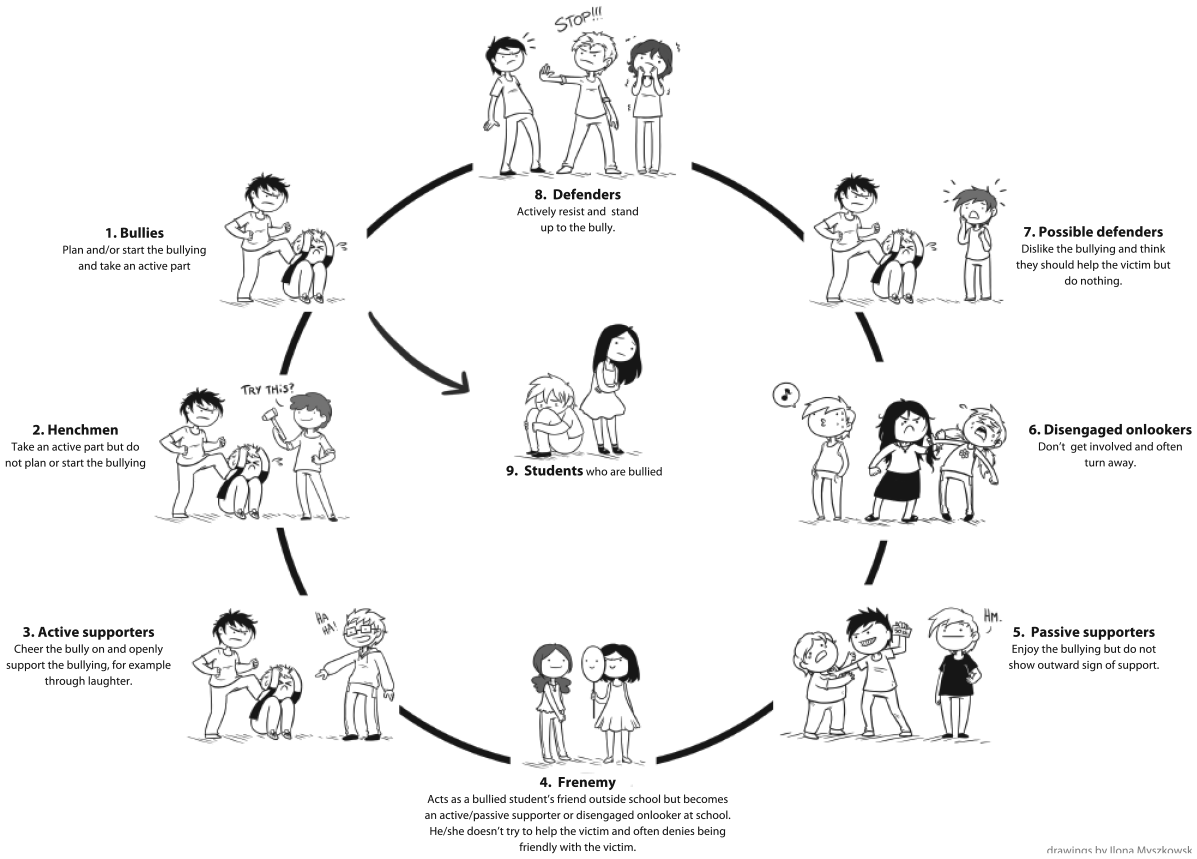
The bullying circle with Frenemy.
It worked like that: I had no friends except for the one who was laughing and teasing me at school. In the afternoon she came to my house, played with me, or we ate dinner together. At my house she was completely different than at school. (Female, 25) So, they were my cousins and when we were alone they were friends but when somebody from the class approached they started abusing me just to show off. And it could change like that a few times a day. (Male, 42) I remember my friend—kind of a friend, I think that way about him now—Piotr. We made models together at his house, [such as] planes and cars. But at school he never even sat with me and pretended he didn’t know me. I don’t quite get why I agreed to that. I just needed a friend, I guess, whatever friend [I could find]. (Male, 35)
This frenemy behavior pattern contradicts earlier findings that individuals have a readiness/inclination to defend bullied friends (Hodges, Boivin, Vitaro, & Bukowski, 1999; Thornberg et al., 2012); however, it accords with theories stating that being friends with victimized youth increases one’s own risk of victimization, which leads many nonvictimized youth to sever their friendships with victimized youth as a form of self-preservation (Bukowski & Sippola, 2001). Friends often move away from victimized youth to preserve their own standing in the social network, given that individuals who do not conform to certain goals of the peer group—including victimization—are forced out through active isolation (Hodges, Malone, & Perry, 1997). Victimization thus influences not only the individual but also the entire social network, particularly the parts of the network most connected to the victim—their personal relationships. Although victimized children can benefit from having strong friends who can protect them from bullies, in reality, they tend to spend time with other victimized peers or those who are in danger of being victimized (Sentse, Dijkstra, Salmivalli, & Cillessen, 2013).
Conclusions
Despite the small scale of this qualitative study, our findings present an interesting picture of the bullying phenomenon from the perspective of former victims. This picture does not, of course, have general applicability; however, it still may assist in broadening our understanding of the phenomenon and encourage further studies.
Participants defined bullying differently than the standard definition (Gini & Pozzoli, 2009; Salmivalli, 2014) formulated by researchers, but they agreed with several studies exploring students’ perceptions of bullying. Those past studies noted that intentionality and power imbalance are rarely included in victims’ definitions of bullying and that students concentrate on incidents and particular bullying behaviors (DeLara, 2016; Thornberg, 2015; Wójcik, 2018). The results also confirmed students’ concern with particular negative incidents (Vaillancourt et al., 2008; Wójcik, 2018) that lead to complex bullying situations, excluding rituals and secret performances. The distinction in bullying definitions might have important implications for anti-bullying program development. Specifically, when providing interventions, researchers and educators must be aware of the need to maximize the inclusion of all affected children. As Hamarus and Kaikkonen (2008) suggested, bullying must not be regarded as a long-standing process, but as a series of small interactive incidents that make up a months-long chain of bullying. Looking at bullying from bullied students’ perspective might help teachers identify and understand these small incidents, which might appear insignificant to them but are in fact the consecutive stages of a long-term process of bullying and exclusion. Teachers should also consider that the perception of power imbalance varies according to students’ roles and should not be taken for granted when analyzing the bullying situation.
We also found a new participant in the bullying circle—the frenemy. The definition of frenemy can be suggested as someone who acts as bullied student’s friend outside school but becomes an active/passive supporter of bully or a disengaged onlooker at school. He or she does not try to help the victim and denies being in a friendly relationship. These individuals’ intervention style changes from pro-victim when alone with the victim to neutral or pro-aggressor when surrounded by other actors of the bullying circle.
Hybrid roles in the bullying circle have been examined before (DeSmet et al., 2014; Levy & Gumpel, 2018), and these roles illustrate the paths leading to and from the pro-victim and pro-aggressor intervention styles. Nevertheless, our study provides a rather extreme case wherein behavioral patterns shift from pro-victim to pro-aggressor for the same peer. This causes several questions to arise. First, why would the victimized student agree to maintain such a relationship? Second, why does the frenemy switch his or her behavior toward the victimized student? Regarding the former question, our participants mentioned that having at least one friend, even a two-faced one, was better than having no friends. This accords with social exclusion anxiety and the fear of social death conceptualized by Søndergaard (2012) and confirmed by Thornberg (2017), who showed that students considered being excluded, bullied, or having no friends as the worst conditions for them at school. Having friends, regardless of their behavior, is crucial for pre-adolescent and adolescent youth and is a normative component of development. Friendships promote social adjustment in youth, and having friends is as an indicator of social adjustment (Hartup & Stevens, 1997). This suggests that friendship is a paradox: You require good social skills to make and keep friends, but you require friends to develop good social skills. Accordingly, not having friends in a formative period can hinder the development of the skills that one needs to make and have friends later in life.
Bukowski and Sippola (2001) argue that victims might have friends at the onset of victimization, but that those friends end their friendships with victims as a form of self-preservation; this might explain the actions of those students who permanently left their friends to become bullies, supporters, or onlookers. In contrast, frenemies who repeatedly changed their allegiance might have been driven by different motives. According to Huitsing and Veenstra (2012), students who report both pro-victim and pro-aggressor intervention styles do so as a result of their vulnerability to ingroup–outgroup processes. In our view, the motives of these frenemies relate to how students’ roles and reactions in bullying situations depend mainly on how they interpret the context and how they judge themselves from the viewpoint of their peer group (Salmivalli, 2014; Thornberg, 2011; Thornberg & Wänström, 2018; Wójcik & Mondry, 2020). If the classroom context allows for vulnerable children to become victims, students are forced to navigate the conflicting demands of being a good person and being accepted by peers. Thus, although people might consider bullying morally wrong (Thornberg et al., 2013) and feel the need to defend a friend (Rigby & Johnson, 2006), they may at the same time understand that group members must behave normatively and the possible danger of rejection if they do not adhere to the norms (Jones, Manstead, & Livingstone, 2011; Ojala & Nesdale, 2004). In effect, frenemies seem to operate in two parallel worlds with different sets of norms and rules for behavior. Wójcik (2018) noted that adolescents create a parallel culture of bullying, which allows them to disapprove and contribute to bullying simultaneously. Potentially, the same mechanism governs frenemies’ behaviors toward victims, which hinder their actions against bullying and serve as moral disengagement strategies (Bandura, 1999). Fully understanding these processes is a matter of further research.
The findings of this study reinforce the salience of the peer group and the strength of peer affiliations (Gini, 2006; Menesini & Salmivalli, 2017; Thornberg, 2017; Thornberg, Wänström, & Jungert, 2018). Although the peer group can promote positive social, emotional, and behavioral characteristics, it can also encourage negative behaviors, such as collective decisions to isolate and bully (Horton, 2011, 2016; Salmivalli, 2010, 2014; Thornberg & Wänström, 2018).
Limitations of the Study
This study has some limitations. First, in qualitative interviews, there is a risk of social desirability bias compared with anonymous questionnaires, especially when respondents are asked to talk about interpersonal relations in their past. Furthermore, there is also a risk of recall bias, especially in cases when questions were asked after the long period of time. Self-reported experience bears potential for misrepresenting experiences as it can be difficult to remember a whole year’s experiences (Berlan, Corliss, Field, Goodman, & Austin, 2010).
Further studies are necessary to gain a fuller understanding of the relations and processes within the bullying circle. In addition, we focused on respondents from Poland, whose experience might differ from those who went to school in other countries because of contextual and cultural variations across countries and educational systems.
Practical Implications
In terms of policy implications, our findings confirm that effective prevention or intervention is possible only after the bullying process and relationships within bullying circle are fully understood. In particular, teachers must not perceive the bullying audience as a homogeneous group, but rather as peers with different, often complex and contradictory attitudes toward the victim and bully. Thorough understanding of those attitudes and the way they change with the context might help in designing interventions, which would equip students with a variety of pro-victim responses and reduce the social reinforcement given to the bully.
At the individual level, it is important to acknowledge that students’ need to establish themselves in the social context and the overall culture of bullying might cause students to feel forced to engage in pro-bullying behavior as a way of preserving their self-image and social position. This highlights the importance of schools implementing early intervention to create and maintain authoritative school climates. An authoritative school climate refers to the degree students feel supported and respected by teachers as well as strict and fair enforcement of school rules. Warm, supportive, inclusive but also controlled, demanding, and cohesive classroom climate should be considered an important protective factor which reduces the risk of bullying victimization. Introducing inclusiveness, mutual respect, understanding, and appreciation of differences as well common goal and common group identity facilitates defending and supporting victims (Thornberg, Wänström, & Jungert, 2018) and reduces aggression (Wang & Degol, 2016).
Footnotes
Declaration of Conflicting Interests
The author(s) declared no potential conflicts of interest with respect to the research, authorship, and/or publication of this article.
Funding
The author(s) received no financial support for the research, authorship, and/or publication of this article.
