



Abstract
Intimate partner violence (IPV) victimization and perpetration are common experiences among incarcerated people. Despite knowledge regarding the challenges of re-integrating post-release from jail or prison, including an increased risk of homicide victimization, there is a dearth of research focused on IPV-related homicides post-release from a correctional facility. To address this gap, the current study used 2003-2015 data from the National Violent Death Reporting System from 27 states to examine the characteristics and circumstances surrounding IPV-related homicides soon after the homicide victim was released from jail or prison. Of the 126 post-release homicides, 13.5% were related to IPV. Post-release homicides involving either a female victim or perpetrator were more likely to be IPV-related. In the case of many of the IPV-related homicides, there was evidence of prior IPV as well as potential bystanders (including formal and informal supports) who were aware of the risk for IPV escalation and possible lethality. Compared with non-IPV post-release homicides, those related to IPV were more likely to occur in the victim’s home, have been immediately preceded by a physical fight, and have occurred by means other than firearm. These findings highlight the importance of enhancing the capacity of correctional facilities and community-based services to assess for and respond to risk of IPV and IPV-related lethality for individuals leaving correctional institutions.
Intimate partner violence (IPV)–related deaths or intimate partner homicide (IPH) include homicide committed by a current or former intimate partner (Carcach & James, 1998), as well as homicide of victims outside the intimate relationship (Carmichael, Jamison, Bol, McIntyre, & Velopulos, 2018). These corollary victims can include children, family members, friends, neighbors, bystanders, and service professionals (e.g., Carmichael et al., 2018; Smith, Fowler, & Niolon, 2014). IPH has been conceptualized as the most severe IPV outcome (Garcia, Soria, & Hurwitz, 2007). As such, there has been a proliferation of research focused on better understanding this particular form of violence to develop appropriate and effective prevention efforts. Research has tended to focus specifically on IPH involving intimate partners, with a smaller body of research focused on IPH involving corollary victims (Meyer & Post, 2013). Related areas of research include (a) examining differences and similarities between IPH and non-IPH homicides, fatal and non-fatal IPV, and male versus female perpetrated IPH (e.g., Addington & Perumean-Chaney, 2014; DeJong, Pizarro, & McGarrell, 2011; Spencer & Stith, 2018); (b) identifying IPH risk factors (e.g., Campbell, Glass, Sharps, Laughon, & Bloom, 2007; Sheehan, Murphy, Moynihan, Dudley-Fennessey, & Stapleton, 2015); and (c) developing and testing instruments to assess lethality in the context of IPV (e.g., Messing & Thaller, 2013; Nicholls, Pritchard, Reeves, & Hilterman, 2013).
Despite the growth of research in this area, there has been limited research focused on IPH following the homicide victim’s criminal justice involvement. Individuals who are released from prison or jail are at increased risk of homicide compared with the general population (Lize et al., 2015). Considering that 30% to 50% of incarcerated men report perpetrating IPV (e.g., Dutton & Hart, 1992) and 70% to 90% of incarcerated women report being victims of IPV (e.g., Lynch, Fritch, & Health, 2012), it is likely that IPV contributes to a number of these violent deaths. To address this knowledge gap, the current study examines the characteristics and circumstances surrounding IPV-related homicides perpetrated against individuals recently released from jail or prison. Better understanding the characteristics and circumstances surrounding post-release homicides related to IPV is critical to the development and delivery of targeted prevention.
Background
Homicides Post-Release From Jail/Prison
Following release from jail or prison, individuals may experience a number of challenges and potential sources of strain as part of their re-integration process (e.g., homelessness, unemployment, substance use, mental and physical illness, and return to criminal activity; Freudenberg, Daniels, Crum, Perkins, & Richie, 2005). An extreme consequence of the multiple challenges experienced by those recently released from jail or prison is post-release homicide (Petersilia, 2003). Individuals released from jail or prison are at an increased risk of mortality compared with the general population (e.g., Binswanger et al., 2007; Kariminia, Butler, et al., 2007; Lim et al., 2012; Lize et al., 2015). For example, Lize and colleagues (2015) found the homicide rate per 100,000 North Carolina prison releases to be more than 13 times higher than the general population of North Carolina residents. Lim and colleagues (2012) found homicide post-release from New York City jails to be 1.7 times higher than among non-incarcerated New York City residents. Factors associated with an increased risk of post-release homicide include being younger, male, and non-White (Kariminia, Law, et al., 2007; Lim et al., 2012; Lize et al., 2015). Despite such research examining homicide post-release from jail or prison, the literature on violent death among those recently released from jail or prison is relatively sparse (Lize et al., 2015). Furthermore, even less is known about post-release homicides related to IPV.
IPV-Related Homicides: Prevalence and Risk Factors
Globally, at least one in seven homicides (13.5%) are committed by an intimate partner, with women being 6 times more likely than men to experience this form of homicide (38.6% vs. 6.3%; Stöckl et al., 2013). In 2015, about 21.5% of all homicides committed in the United States were perpetrated by an intimate partner, and among these homicides, 74.6% included a female victim (Jack et al., 2018). These data found that about 51.4% of women and 7.9% of men were killed by an intimate partner (Jack et al., 2018). Other data suggest that women make up about 80% of all homicides committed by an intimate partner in the Unites States (Kivisto, 2015). In addition to global and national research findings that women are more likely than men to be the victims of IPH, research suggests that men are more likely than women to perpetrate IPH (Stöckl et al., 2013). Applying a more broad view of IPV-related homicides, using 2015 data from the National Violent Death Reporting System (NVDRS), Jack and colleagues (2018) found that IPV was a known contributing factor for approximately 45.4% of all female homicides, and 8.4% of male homicides.
With few exceptions, less is known about the scope of IPV-related deaths involving corollary victims. A British study found that 37% of IPV-related deaths involved corollary victims, which included children, family, friends, neighbors, attorneys of the IPV victim, and new partners (Dobash & Dobash, 2012). Another study conducted in the United States found that corollary victims—including family, friends, new partners, acquaintances, strangers, and law enforcement—made up 20% of IPV-related homicides (Smith et al., 2014). Given challenges determining the nature of the relationship between homicide victims and perpetrator, estimates of IPV-related homicides involving intimate partners and corollary victims likely underestimate the prevalence of this insidious crime (Campbell, Messing, & Williams, 2017; Stöckl et al., 2013).
Although there has been limited attention focused on risk factors for IPH involving corollary victims, research has identified a number of risk factors for IPH involving intimate partners. These include access to firearms, threats to kill or cause severe harm, threats with a weapon or dangerous object, non-fatal strangulation, history of general violence, stalking, jealousy or controlling behavior, separation or estrangement (i.e., loss of control over intimate partner), changes in either the victim’s or perpetrator’s behavior, and barriers to seeking help (Aldridge & Browne, 2003; Campbell et al., 2007; Campbell et al., 2003; Echeburúa, Fernández-Montalvo, de Corral, & López-Goñi, 2009; Garcia et al., 2007; Kivisto, 2015; Sheehan et al., 2015). However, the strongest predictor of experiencing IPH is a history of prior IPV. Research suggests anywhere up to 80% of IPH victims experienced prior IPV victimization (Campbell et al., 2007; Campbell et al., 2003; Messing & Thaller, 2013; Moracco, Runyan, & Butts, 1998; Sharps et al., 2001). Furthermore, regardless of whether the IPH victim identifies as male or female, the majority of cases are preceded by IPV perpetrated against a female partner (Belknap, Larson, Abrams, Garcia, & Anderson-Block, 2012; Campbell et al., 2007; Campbell et al., 2003). Thus, in some instances, IPV escalates and the IPV perpetrator commits IPH; in other instances, the IPV victim commits IPH against a previously abusive partner. Belknap and colleagues (2012) found that among IPH perpetrators and victims, compared with women, men had more extensive histories of IPV perpetration. In particular, men killed by women were more likely to have prior IPV arrests and convictions than women killed by men (Belknap et al., 2012).
Criminal Justice Involvement
Both IPV victims and perpetrators interface with the criminal justice system. Between 15% and 50% of all police calls are related to IPV (Klein, 2009). Furthermore, following the implementation of mandatory and pro-arrest statutes for IPV perpetration, there has been an increase in arrest rates for IPV.
Research suggests that prior to the implementation of these policies, IPV arrests rates ranged from 7% to 15%; however, since their implementation, rates for IPV arrests have risen to anywhere between 30% and 76% (Durfee, 2012; Hall, 2005; Hirschel & Deveau, 2017). In addition to increasing the number of primary perpetrators arrested for IPV, mandatory arrest laws have resulted in a greater proportion of IPV survivors also being arrested (e.g., Li, Levick, Eichman, & Chang, 2015; Rajan & McCloskey, 2007). There are multiple reasons why survivors might become involved in the criminal justice system, including perpetrating violence to protect themselves, defend their children, or in retaliation for prior abuse (e.g., Stuart, Moore, Hellmuth, Ramsey, & Kahler, 2006; Swan & Snow, 2006) as well as accepting blame for the IPV perpetration to avoid retaliation or more severe consequences (e.g., Busch & Rosenberg, 2004; Miller, 2001). Furthermore, given situational ambiguity, police officers responding to an IPV incident may arrest both parties when unable to determine the primary perpetrator—referred to as a dual arrest (e.g., Li et al., 2015; Mignon & Holmes, 1995). Despite wide implementation of IPV pro-arrest statutes, there are mixed findings regarding the impact of IPV arrests on recidivism (e.g., Day, Richardson, Bowen, & Bernardi, 2014; Maxwell, Garner, & Fagan, 2001).
Survivors and perpetrators of IPV may also become involved with the criminal justice system for offenses other than IPV. A growing body of literature has begun to estimate the prevalence of IPV victimization and perpetration among incarcerated people. Studies with women incarcerated in jails and prisons find that the majority have experienced prior IPV victimization (e.g., DeHart, Lynch, Belknap, Dass-Brailsford, & Green, 2014; Green, Miranda, Daroowalla, & Siddique, 2005; Lynch et al., 2012). For instance, in their mixed-methods study with 115 jailed women across five states in the United States, DeHart and colleagues (2014) found that 77% had experienced prior IPV victimization, with 71% reporting prior physical IPV, 48% reporting IPV with the use of a weapon, and 24% reported rape in the context of an intimate relationship. In a study of 102 women incarcerated in a state prison, Lynch and colleagues (2012) found 90% of women had experienced physical and sexual IPV the year prior to their incarceration. Despite research exploring the prevalence of IPV victimization among incarcerated women, less research has examined the prevalence of IPV perpetration among incarcerated people (Day et al., 2014). However, existing research suggests that 30% to 56% of incarcerated men have previously perpetrated IPV (Dutton & Hart, 1992; Robertson & Murachver, 2007; Robinson & Taylor, 1995; Stewart & Power, 2014; White, Gondolf, Robertson, Goodwin, & Caraveo, 2002).
Current Study
Despite extant research on the characteristics and circumstances of IPV-related homicides among the general population, there is a dearth of such research among people recently released from jail or prison. Notably, there may be differences in the characteristics and circumstances of IPV-related homicides among these two groups given the additional stressors and surveillance that accompany post-release (Freudenberg et al., 2005). Given the prevalence of prior IPV victimization and perpetration among incarcerated people as well as the increased risk of homicide post-release from jail or prison, it is important to better understand and contextualize instances of IPV-related homicide that occur shortly after the homicide victim had been released from a correctional facility to ensure prevention efforts are relevant and tailored. To address knowledge gaps regarding IPV-related homicide experienced by people recently released from jail or prison, our research team conducted a preliminary and exploratory, secondary-data analysis using 2003-2015 data collected by the Centers for Disease Control and Prevention’s (CDC) NVDRS. Using NVDRS data, the primary aim of the study was to examine characteristics and circumstances surrounding IPV-related homicides experienced post-release from jail or prison. As such, the study was guided by the following primary research question:
Prior research on IPV-related homicides among the general population has examined and found differences between IPV- and non-IPV-related homicides in terms of characteristics and circumstances (Petrosky et al., 2017; Stöckl et al., 2013; Trojan & Krull, 2012). The current study aims to build on this prior work by examining such differences among homicides that occur post-release from jail or prison given the higher risk of mortality among this population. Therefore, the current study was guided by the following secondary research question:
Method
NVDRS
NVDRS is a state-based surveillance system that compiles information on violent deaths—including homicides, suicides, legal intervention deaths, unintentional firearm deaths, and deaths of undetermined intent—into a comprehensive and anonymous database (National Center for Injury Prevention and Control, Division of Violence Prevention [NCIPC, DVP], 2017). Thus, this database includes every violent death that occurs in participating states during the year. As an incident-based system, all related deaths that are associated with a given incident (e.g., multiple homicides, homicide-suicides) are reported in a single record (Fowler, Jack, Lyons, Betz, & Petrosky, 2018).
To date, 40 states, the District of Columbia, and Puerto Rico are participating in the NVDRS (NCIPC, DVP, 2017). However, NVDRS data for 2003 to 2015 were only available for 27 states (Alaska, Arizona, Colorado, Connecticut, Georgia, Hawaii, Kansas, Kentucky, Maine, Maryland, Massachusetts, Michigan, Minnesota, New Hampshire, New Jersey, New Mexico, New York, North Carolina, Ohio, Oklahoma, Oregon, Rhode Island, South Carolina, Utah, Vermont, Virginia, and Wisconsin). Data on the characteristics and circumstances associated with all violent deaths in participating states are collected via four major sources: (a) death certificates; (b) coroner/medical examiner (CME) records, including toxicology reports; (c) law enforcement reports, including Supplementary Homicide Reports and National Incident-Based Reporting System reports, when available; and (d) data abstractor input (CDC, 2016; Fowler et al., 2018). Participating states may also elect to collect additional or secondary data such as Child Fatality Review team data, IPV expanded data, crime lab data, and hospital data (CDC, 2016; Fowler et al., 2018). Abstractors (i.e., trained data coders in each state) then input data from these various sources into the NVDRS online data entry system (Fowler et al., 2018) such that affirmative responses to an item indicate the presence of a particular variable. However, the absence of an affirmative response does not necessarily mean the variable was absent, just that it was not known to be present with certainty.
Inclusion Criteria and Case Selection
All methods were reviewed by the University of North Carolina at Chapel Hill’s Office of Human Research Ethics and deemed not human subjects research. Based on data from 2003 to 2015, we selected the 58,591 records for which the abstractor determined the manner of death was homicide. Of the 58,591 homicide records, we selected only those cases in which the victim’s death occurred post-release from jail, prison, or a detention facility (n = 126). It is important to note that the NVDRS only identifies post-release homicides that occurred within 1 month of release. The final sample for analysis was 126 records, including 109 non-IPV-related homicides and 17 IPV-related homicides. Homicides were determined to be related to IPV (i.e., immediate or ongoing conflict/violence between current or former intimate partners) based on the abstractor’s coding of the multiple data sources for each violent death.
Variables
The current exploratory study examined characteristics of homicides post-release from jail or prison, and compared IPV- and non-IPV-related homicides on a number of characteristics and circumstances. In particular, we examined victim and perpetrator characteristics, as well as circumstances preceding or related to the homicide.
Victim characteristics
Victim characteristics included age (in years), sex (male = 1, female = 0), race/ethnicity (White = 1, Black or African American = 2, Other = 3), education level (1 = <high school degree/GED [General Educational Development], 2 = ≥high school degree/GED), and marital status (1 = married/civil union/domestic partnership, 0 = all else). Racial/ethnic groups coded as “Other” included American Indian/Native American, multiracial, and Latinx. For marital status, “all else” included victims who were widowed, divorced, separated, never married, or single at the time of their death. Victim mental health and alcohol problems were infrequently endorsed; thus, these variables were excluded from analyses.
Sex of the perpetrator
Perpetrator’s sex (male = 1, female = 0) was the only perpetrator characteristic examined in the current study. Given a substantial amount of missing data, we were not able to examine additional perpetrator characteristics (i.e., race/ethnicity, age, mental illness, substance use, perpetrator–victim relationship).
Circumstances preceding or related to the incident
Circumstances preceding or related to the homicide included the following: (a) victim’s suspected alcohol use hours prior to death (1 = yes); (b) specific argument or conflict led to victim’s death (e.g., argument over money, relationship problem, insult; 1 = yes); (c) physical fight between two individuals resulted in death (i.e., death was unplanned and occurred in the context of a physical confrontation; 1 = yes); (d) drug dealing, trade, or use was suspected to have played a role in the victim’s death (1 = yes); (e) victim’s death was related to gang involvement or motivation (1 = yes); (f) victim’s death was precipitated by another crime (1 = yes; for example, robbery, burglary, motor vehicle theft, assault/homicide); (g) victim used weapon during the homicide incident (1 = yes); (h) location of homicide incident (1 = victim’s home, 0 = elsewhere); (i) victim was seen in the emergency department (ED; 1 = yes); and (j) cause of death (1 = firearm, 0 = other, including hanging, strangulation, suffocation, sharp object, blunt object, other means). Other circumstance variables were excluded from the current study because the construct evidenced either high levels of missingness or low/no endorsement (i.e., jealousy, stalking, prostitution, terrorist attack, walk-by assault, perpetrator/victim of violence in the prior month). Furthermore, the circumstance variables related to violence victimization/perpetration in the prior month did not specify the nature of the violence (e.g., whether related to IPV).
Qualitative data
Qualitative data consisted of law enforcement and CME incident narratives. Law enforcement and CME incident narratives are summary accounts of the incident written by the data abstractor based on law enforcement findings and CME findings, respectively. These narratives tend to include information related to the homicide incident and circumstances preceding the incident (e.g., the nature of the relationship between the victim and perpetrator, precipitating events, how the homicide occurred). Qualitative narrative data were explored to contextualize IPV-related homicides committed recently after the victim was released from jail/prison.
Data Analysis
Quantitative data analysis
Quantitative data analysis included calculating univariate and bivariate statistics. Univariate statistics (i.e., means, standard deviations, range, frequencies, and percentages) were calculated for all victim characteristics, perpetrator characteristics, and circumstances preceding or related to the incident for each of the following groups: (a) all homicides post-release from jail or prison, (b) IPV-related homicides post-release from jail or prison, and (c) non-IPV-related homicides post-release from jail or prison. We conducted bivariate analysis to compare incidents based on whether or not the homicide was related to IPV. For bivariate analyses, significance was tested using t-test and Fisher’s Exact Test (FET). Despite the relatively small sample, bivariate analyses were conducted to gather preliminary and exploratory evidence related to the characteristics and circumstances surrounding post-release homicides and IPV-related homicides in particular using a p-value of .05. All quantitative analyses were conducted using IBM SPSS Statistics 25. According to NVDRS guidelines, small cell sizes were suppressed in the tables and text to avoid deductive disclosure.
Qualitative data analysis
Content analysis was used to analyze narrative data for all IPV-related homicides (Elo & Kyngäs, 2008; Graneheim & Lundman, 2004). Before coding the data, all narratives were reviewed for general content and grounding in the data (Chen & Boore, 2008). Qualitative data were then coded by two analysts using an open-coding approach consisting of line-by-line coding (Strauss & Corbin, 1998). Throughout the coding process, the analysts refined the operational definitions of existing codes, categorized and hierarchically sorted the codes, and added or deleted codes as necessary. Constant comparative procedures were implemented, and narratives were reanalyzed as new codes emerged (Glaser & Strauss, 1967). The coders also engaged in negative case analysis by actively searching for both invalidating and conflicting experiences (Padgett, 2008). There were only three instances of initial coding discrepancies between the two coders that were resolved by reviewing and discussing the narratives until a final determination was made about the appropriate code.
Results
IPV-Related Homicide Characteristics and Circumstances: Quantitative Findings
Table 1 presents demographic characteristics. Among all IPV-related post-release homicides (n = 17), on average victims were approximately 35 years of age at the time of their death (SD = 6.9, range = 24-50). Slightly over half of victims and perpetrators were male (victims = 58.8%; perpetrators = 52.9%). About 40% of the victims were Black or African American, about 30% were White, and another 30% were either American Indian/Alaska Native, multiracial, or Hispanic. Half of the victims had attained a high school diploma, GED equivalent, or greater levels of education. Furthermore, the majority of victims were not married at the time of their death.
Victim and Perpetrator Characteristics (N = 126).
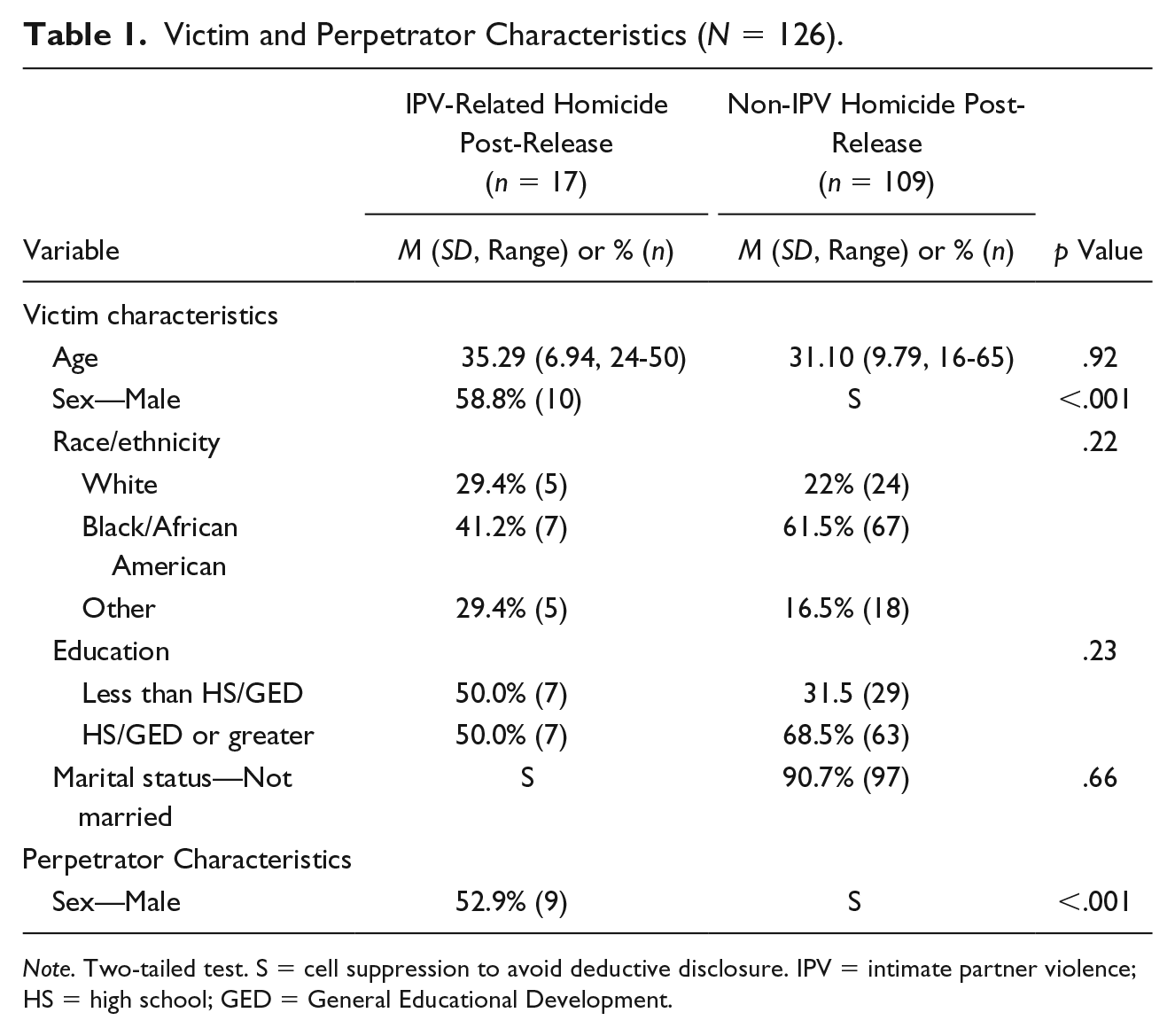
Note. Two-tailed test. S = cell suppression to avoid deductive disclosure. IPV = intimate partner violence; HS = high school; GED = General Educational Development.
Table 2 highlights circumstances surrounding IPV-related homicides post-release. The majority of IPV-related homicides occurred in the victim’s home by means other than firearm (e.g., strangulation, use of sharp or blunt objects). Few incidents were identified as being precipitated by another crime, and the majority of IPV-related homicide victims were reportedly not seen in an ED. Approximately 65% of IPV-related homicides were preceded by an argument or conflict and about 41% were preceded by a physical fight. About half of the IPV-related homicide victims were suspected to have used alcohol hours prior to their death.
Circumstances Preceding or Related to the Incident (N = 126).
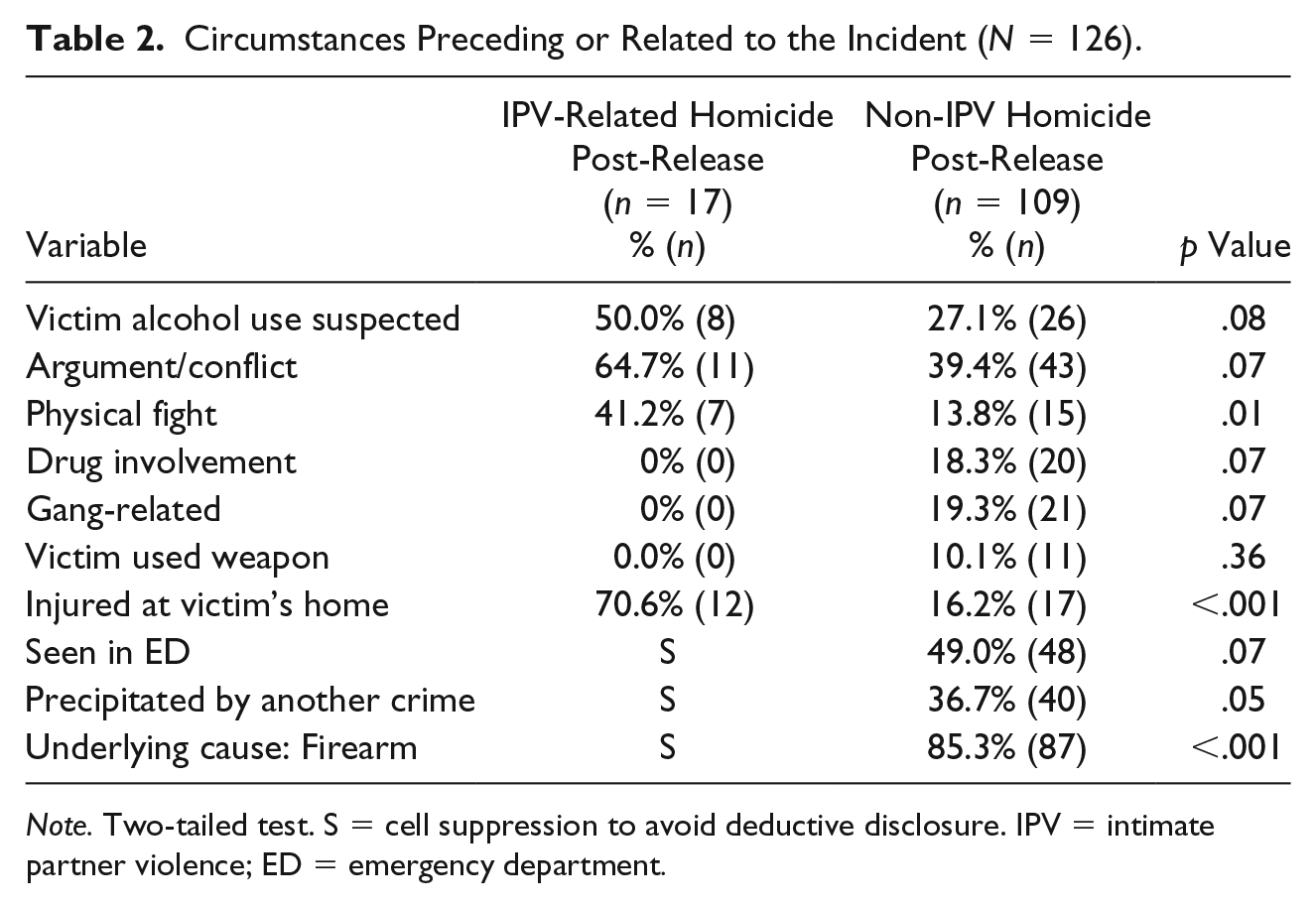
Note. Two-tailed test. S = cell suppression to avoid deductive disclosure. IPV = intimate partner violence; ED = emergency department.
IPV-Related Homicide Characteristics and Circumstances: Qualitative Findings
The qualitative findings provide further insight into the characteristics and circumstances surrounding IPV-related homicide committed against people who had recently been released from jail or prison. The findings are organized around four key areas: (a) victim characteristics, (b) relationship between the victim and perpetrator, (c) incident-related circumstances, and (d) potential bystanders.
Victim characteristics
Victim characteristics that emerged from the narrative data include historical information related to the victim’s substance use, mental health, and criminal justice involvement. The contextual information provided by these descriptions add to the quantitative victim characteristics presented earlier. Specifically, whereas the quantitative data noted the victims’ suspected use of alcohol hours before their violent death, the narratives highlighted that many victims had a history of using or abusing substances (including alcohol and other drugs). About half of the victims had a history of substance use/abuse, including problems with alcohol, methamphetamines, heroin, and cocaine, with a few having a history of polysubstance use. A few victims also had a history of mental illness, primarily consisting of mood disorders. Although all of the victims had a history of criminal justice involvement given that their death occurred within 1 month of being released from jail or prison, the circumstances related to their criminal justice involvement was not always clear from the narratives. However, many of the victims had prior criminal justice involvement related to IPV. This included having previously been arrested for IPV perpetration, having previously taken out a protection order against the perpetrator of the homicide incident, or having a protection order previously taken out on them by the perpetrator of the homicide incident.
Relationship between the victim and perpetrator
The narrative data helped to contextualize the nature of the relationship between homicide victims and perpetrators. The majority of IPV-related homicides involved intimate partners, whereas a handful of the IPV-related homicides involved corollary victims. In particular, these cases involved male homicide victims who were killed post-release from jail or prison by their intimate partner’s new or ex-partner. The narrative data provided minimal additional insight into the IPV context for these cases.
More information could be gleaned about the cases of IPV-related homicides involving intimate partners. For about half of these incidents, it was clear from the narrative that the victim and perpetrator were living together at the time of the incident. Among these incidents, the perpetrator was the victim’s boyfriend in slightly less than half of the incidents, whereas the perpetrator was the victim’s wife, girlfriend, or ex-girlfriend in slightly more than half of the incidents. For the majority of IPV-related incidents involving intimate partners, there was evidence in the narratives of prior IPV; however, the directionality of the prior abuse was not always clear. Among the incidents for which the directionality of prior IPV was discussed in the narratives, there was evidence of instances in which the homicide victim had previously perpetrated IPV, and other instances in which the homicide perpetrator had previously perpetrated IPV.
Incident-related circumstances
Narrative data helped to further illuminate the nature of substance use preceding the IPV-related homicide. Although quantitative data helped to determine the prevalence of suspected alcohol use by the victim hours before the homicide, it did not highlight the likely involvement of any substance use (including alcohol and drugs) by the perpetrator. Narrative data suggest that in addition to the substance use by the victim in the hours preceding the homicide, substance use by the perpetrator was also common. In some instances, this meant that both the victim and perpetrator were under the influence of drugs or alcohol at the time of the homicide. Substances noted in the narratives included alcohol, marijuana, methamphetamine, amphetamine, cocaine, and heroin.
Most of the narratives for IPV-related incidents involving intimate partners described these homicides as occurring in the context of an IPV incident. IPV incidents that escalated into homicide included verbal and physical aggression between partners. Based on the narratives, some of the IPV-related homicides involving intimate partners might have been committed in self-defense. The narratives for these incidents either specifically mentioned self-defense or described the homicide as the culmination of an IPV incident in which the homicide victim was the primary perpetrator. All of these incidents involved female homicide perpetrators and male homicide victims. For IPV-related homicides involving corollary victims, jealousy and/or infidelity precipitated the homicide, and the homicide occurred in the context of a verbal argument and physical altercation between the victim and perpetrator.
Potential bystanders
Potential bystanders was broadly defined to include individuals who witnessed or knew about prior IPV incidents between the homicide victim and perpetrator as well as those who witnessed, heard, or knew about the IPV-related homicide incident. The narratives for most of the incidents described people who either (a) knew about the couple’s violent relationship and had witnessed prior incidents of IPV; (b) were present during at least part of the IPV incident that escalated into homicide; (c) were in earshot of the incident and heard something; and/or (d) were called and alerted during the IPV incident that escalated into homicide. These individuals included family, friends, neighbors, law enforcement/security, and parole officers. Regarding formal supports, many of the incident narratives reported the involvement of parole officers who knew about the ongoing IPV or law enforcement/apartment complex security who had responded to multiple prior IPV incidents, some within 24 hr of the homicide incident.
IPV and Non-IPV Homicides: Bivariate Findings
Victim and perpetrator characteristics
The only two significant findings related to victim and perpetrator characteristics were the sex of the victim and perpetrator (see Table 1). While the majority of non-IPV-related homicide victims were male, about 41% of IPV-related homicide victims were female (p < .001). Overall, women comprised 7% of all post-release homicides victims. Among all post-release homicides involving female victims, 78% were IPV-related. Comparatively, only about 8.5% of all post-release homicides involving male victims were related to IPV. Regarding perpetrator characteristics, the majority of non-IPV-related homicide perpetrators were male, whereas about 47% of the IPV-related homicide perpetrators were female (p < .001).
Circumstances preceding or related to the incident
Three circumstances preceding or related to the incident were statistically significant: physical fight, injured at victim’s home, and underlying cause (see Table 2). Compared with non-IPV-related homicides (13.8%), a greater proportion of IPV-related homicides (41.2%) was the result of a physical fight between two individuals (p < .05). A greater proportion of IPV-related homicides also occurred in the victim’s home (70.6%) than non-IPV-related homicides (16.2%; p < .001). Victims of non-IPV-related homicides were more likely to be killed by firearms than victims of IPV-related homicides, who were more likely to be killed by other means (i.e., blunt trauma to head/body, stabbing, or strangulation; p < .001). To sum, IPV-related homicides were more likely than non-IPV-related homicides to have been preceded by a physical fight between two individuals, to have occurred in the victim’s home, and to have been caused by means other than firearms.
Discussion
The current exploratory study examined characteristics and circumstances surrounding homicides perpetrated against people recently released from jail or prison. Specifically, the study used 2003-2015 NVDRS data from 27 states to better understand IPV-related homicides committed against people recently released from jail or prison, and to examine potential differences between IPV and non-IPV-related homicides. Of the 126 post-release homicides, 13.5% were related to IPV. Similar to prior research on IPH more broadly, the current study found that the majority of IPV-related homicides involved intimate partners, whereas a small handful involved corollary victims (Carmichael et al., 2018; Dobash & Dobash, 2012; Smith et al., 2014). Exploratory comparisons of IPV and non-IPV-related post-release homicides found that a greater proportion of IPV-related homicides were preceded by a physical altercation, occurred in the victim’s home, used means other than firearms, followed an argument or conflict, and were precipitated by the alcohol use.
Notably, this study found a small number of homicides committed against people within a month of being released from jail or prison, few of which were related to IPV. This finding is inconsistent with prior research suggesting that individuals released from jail or prison are at a high risk of homicide (Lize et al., 2015). It is possible that the short, 1-month time frame between release from jail or prison and the homicide incident contributed to this unexpected finding. It is also possible that the initial period of post-release offers some protection from homicide, because of either supervision (probation or parole) or services received while in prison or shortly after release. Clearly, more research is needed to better understand this finding in the context of prior research.
Overall, few post-release homicide victims or perpetrators were women. However, consistent with prior empirical literature focused on the general population, when women were violently murdered, it was more likely to occur in the context of an intimate relationship (e.g., Jack et al., 2018; Kivisto, 2015; Stöckl et al., 2013). The current study also echoed prior research suggesting that when women committed homicide, it was more likely to be perpetrated against an intimate partner (e.g., DeJong et al., 2011). Also consistent with empirical literature, the majority of IPV-related post-release homicides involved prior IPV (e.g., Campbell et al., 2007; Garcia et al., 2007). Thus, many trends evident in the general IPV-related homicide literature are reflected among IPV-related homicides that occur following the homicide victim’s recent release from jail or prison.
Quantitative and qualitative results indicated additional circumstantial factors of IPV-related post-release homicides consistent with the IPH literature, including (a) homicide location (i.e., homicide occurring in the home, which was typically shared by both the homicide victim and homicide perpetrator; Yousuf et al., 2017) and (b) presence of substance use prior to the homicide incident (e.g., Aldridge & Browne, 2003; Campbell et al., 2007). The current study found that many of the homicide victims and perpetrators used substances prior to the incident and about half of the homicide victims had histories of substance use/abuse. Although these findings resonate with a recent meta-analysis that found substance use (including alcohol and drug use) to be associated with IPV victimization and perpetration (Cafferky, Mendez, Anderson, & Stith, 2018), it is important to contextualize these findings with prior research focused on uncovering the reasons behind these associations. For instance, given the stress and multitude of negative physical and mental health consequences of IPV victimization, it is not uncommon for survivors to cope with IPV and its aftermath by using alcohol and drugs (O’Brien et al., 2016; Rizo, 2016). Furthermore, IPV perpetrators sometimes coerce or manipulate their partners to engage in substance use (O’Brien et al., 2016).
Findings regarding several circumstantial factors were not fully supported by prior research, including findings related to the cause of death and precipitating physical altercation. Although the finding that many IPV-related homicides were precipitated by a physical altercation is intuitive given the strong relationship between prior physical IPV and subsequent IPH (Campbell et al., 2007), existing research has not specifically examined the prevalence of a physical altercation immediately resulting in an IPV-related homicide. The current study also found that compared with non-IPV-related homicides, IPV-related homicides post-release were significantly more likely to be caused by means other than the use of a firearm (i.e., blunt trauma to head/body, stabbing, or strangulation). This finding is counter to prior research identifying IPV perpetrators’ access to firearms as an important risk factor for IPH (Campbell et al., 2003), as well as research suggesting that many IPHs involve the use of firearms (Cooper & Smith, 2011; Federal Bureau of Investigation, U.S. Department of Justice, 2015; Puzone, Saltzman, Kresnow, Thompson, & Mercy, 2000; Yousuf et al., 2017). Given this study’s unique focus on homicides post-release from jail or prison, it is possible that policies limiting access to firearms because of felonies, misdemeanor domestic violence (DV) crimes, other violent misdemeanor crimes, or restraining order prohibitions contributed to greater use of homicide means other than firearms among the IPV-related homicides. A growing body of research has begun to examine the association between firearm prohibition laws and IPH. Despite findings that certain firearm prohibition laws are associated with reductions in IPV (Vigdor & Mercy, 2006; Zeoli, Malinski, & Brenner, 2020; Zeoli et al., 2018; Zeoli & Webster, 2010), it is necessary to better understand the relationship between these laws and IPH not involving the use of firearms (both in the general population and post-release).
In addition to these results, there are a number of noteworthy findings from the qualitative data related to bystanders and social supports. In the context of IPV research, bystanders have been broadly defined as individuals who witness an IPV incident or with whom survivors share their experiences, and therefore have the opportunity to provide help (Banyard, 2015). In the current study, bystanders included informal (e.g., family members, friends) and formal (e.g., agency-based) sources of support who were present and/or knew about prior incidents of IPV between the homicide victim and perpetrator. These bystanders had the opportunity to provide support and resource referrals in response to prior IPV and potentially could have played a key role in preventing further IPV and the homicide incident (Banyard, 2015; McMahon & Banyard, 2012). The qualitative findings also showed that some bystanders were present (or within earshot) at the time of the incident and could have interceded by calling law enforcement or engaging in some other form on bystander intervention (e.g., interrupting the fight, confronting the perpetrator, creating a distraction). Presence of bystanders suggests an opportunity for enhanced community-level training to equip bystanders with the appropriate skills to safely intervene before, during, and/or after they either witness or learn about survivors’ experiences of IPV (McMahon & Banyard, 2012). Such skills may include calling law enforcement when IPV is witnessed or heard (particularly in the context of prior and ongoing IPV), directly intervening or creating a distraction to disrupt an escalating event, and offering support and referrals after non-lethal IPV incidents (Banyard, 2015; Frye et al., 2012; McMahon & Banyard, 2012).
Criminal Justice Interventions
During the past several decades, there has been an increase in policies and criminal justice interventions to reduce subsequent IPV and IPV-related homicides (Messing, Ward-Lasher, Thaller, & Bagwell-Gray, 2015). One such intervention is the use of instruments to assess risk of IPV re-assault and lethality within the criminal justice system, with a growing number of states now mandating the use of these tools by police departments (M. E. Johnson, 2010; Ward-Lasher, Messing, Cimino, & Campbell, 2020). Despite the study’s finding that few individuals transitioning out of correctional institutions experienced homicide shortly after post-release in the context of IPV, incorporating such brief assessments into pre- and post-release services has the potential to decrease not only post-release IPV-related homicides but also subsequent non-fatal IPV incidents (Koppa, 2018; Messing et al., 2015). We identify opportunities to enhance screening as part of pre-release planning and community supervision.
Pre-release planning
Release from correctional institutions presents a critical time point for assessing for risk of offending and matching individuals to the appropriate level and types of services. Information gathered from such risk assessments can guide decisions about offender management and the post-release planning process. A guiding framework for offender management is the risk–needs–responsivity (RNR) framework which aims to match offenders to services that target their risk factors for re-offense (Andrews & Bonta, 2010). An essential component of the RNR model is implementing a reliable risk assessment instrument that identifies the factors that predict re-offense. Some of the most widely used risk assessment tools implemented in correctional settings have well-established predictive validity of general re-offending, but are not specific to IPV-related perpetration (Day et al., 2014).
As echoed by other scholars in the field, general risk assessment instruments used in the pre-release planning process should be enhanced by adding validated IPV risk and lethality instruments to assess for both potentially severe IPV victimization and perpetration (Day et al., 2014; Kennedy & Mennicke, 2018). The information gathered from such an assessment, as well as the resulting determination of risk, could help inform the plan for housing as well as the coordination of post-release services and support (e.g., referral to a DV agency). With a release of information, results and recommendations from these assessments can be shared with community corrections officers tasked with implementing the terms of probation or parole and conducting home visits. Integrating lethality assessments into pre-release planning is particularly important for individuals who may leave prison or jail without community supervision requirements and who may not be connected to any type of formal support system that would conduct such an assessment post-release. Without adequate pre-release planning that includes an IPV re-assault/lethality assessment, individuals may be returning to environments in which they perpetrated or experienced IPV and to the same environments that could trigger unhealthy coping (e.g., drug and alcohol use) and lead to conflict and physical fights, all of which are found to be precipitators of IPV-related homicide (Kennedy & Mennicke, 2018). However, more research is needed to determine how best to augment pre-release planning risk assessment instruments with IPV re-assault/lethality instruments (e.g., which instrument to use, mode of administration, administrator).
Community supervision and training
Depending on the nature of the charges (e.g., IPV perpetration), the determination/sentencing of the courts, and the availability of community supervision approaches in a given state’s system, a person released from prison or jail may be assigned to a specialized DV caseload (Babcock et al., 2016; R. R. Johnson, 2001; Klein & Crowe, 2008), a regular or standard caseload, or no community supervision sentence at all. Jurisdictions could consider enhancing existing efforts within the DV caseload models by acknowledging the overlap between IPV perpetration and victimization and including a lethality assessment. Agencies may also consider addressing IPV on standard caseloads (i.e., non-specialty DV probation). Typically, only those with current DV charges would be considered for specialty DV probation (R. R. Johnson, 2001; Klein & Crowe, 2008). Consequently, individuals who are sentenced to probation who perpetrate and/or experience IPV and who do not have DV charges would be assigned to standard caseloads. This is problematic given evidence that many incarcerated men have perpetrated IPV, even if they were incarcerated for a charge other than DV (Dutton & Hart, 1992; Robertson & Murachver, 2007; Robinson & Taylor, 1995; Stewart & Power, 2014). Despite potential challenges (e.g., managing large caseloads, workload; Babcock et al., 2016; DeMichele & Payne, 2018) of including additional officer requirements—such as an IPV re-assault/lethality assessment—within standard models of community supervision, such an approach is worth considering given (a) study findings that parole officers often had contact with either the IPV victim or perpetrator prior to the homicide incident and (b) existing evidence that many incarcerated people have a history of either IPV victimization or perpetration (e.g., DeHart et al., 2014; Dutton & Hart, 1992). Furthermore, given study findings that law enforcement and security guards were often aware of prior IPV and in some cases responded to an IPV-related incident 24 hr before the homicide, there is clearly a need for more law enforcement and security guard training related to IPV and lethality. In particular, it is critical that law enforcement and security guards are trained to identify signs of IPV lethality, use existing lethality assessment tools, and intervene appropriately in situations where there is great risk of IPV-related homicide. Notably, this is already occurring in many states and jurisdictions with promising findings. However, it has yet to be scaled nationally.
Limitations and Future Research
This exploratory study provided preliminary information about the context of IPV-related post-release homicides in the United States. However, findings should be considered with caution in light of study limitations. Notably, based on the manner that NVDRS data are coded, it is possible that cases not coded as being related to IPV were in fact IPV-related homicides, but there was not enough information in the available records to make this determination with certainty. Relatedly, the narrative data consisted of summaries written by the data abstractor based on law enforcement and CME findings. Despite abstractor training and checks for validity and reliability, it is possible that errors were made in summarizing findings pertaining to a given homicide incident. Furthermore, missing data made it difficult to examine homicide perpetrator characteristics.
As mentioned earlier, the NVDRS only captures post-release homicides that occurred within a month of being released from jail, prison, or a detention center. Future research is needed to better understand the time frame of when post-release homicides occur. Is IPV-related homicide more likely to occur initially following release from jail or prison? Or does risk increase the longer that one has left public custody? Future studies should consider using a longer time frame, such as 12 months. There is also a need to distinguish between homicides committed post-release from prison versus jail. These correctional entities operate with very different policies and procedures, so any recommendations that emerge would need to consider the context of the particular correctional facility. Furthermore, the current study was not able to fully contextualize the IPV experiences of victims preceding the homicide. More research is needed to better understand IPV that occurs prior to IPV-related homicides post-release from jail or prison. For instance, research focused on prior IPV experiences is needed to explore the severity and escalation of IPV, types of IPV (e.g., physical, sexual, psychological), IPV directionality over time, legal consequences and interventions (e.g., protection order, arrests), and prior IPV-related help-seeking.
Another limitation to consider is the small number of post-release homicides, and in particular, the small number of post-release IPV-related homicides identified in the dataset. Although this is a potentially promising finding, it is possible that the small number of homicides is an artifact of the restricted time frame or limited available information to determine the role of IPV. The small number of incidents identified for inclusion in the current study limited our statistical power. It is possible that with a greater number of incidents, we would have had more statistically significant findings. Furthermore, given the small number of incidents, we were not able to explore differences by gender. Future research is needed to examine gender differences in IPV-related, post-release homicides.
Conclusion
Individuals who are recently released from prison or jail are at increased risk of death by homicide compared with the general population (Lize et al., 2015). This investigation is one of the first to explore the role of IPV in post-release homicides. While the number of IPV-related post-release homicides was relatively small (n = 17), these homicides had unique characteristics from non-IPV-related post-release homicides that can influence pre- and post-release efforts to increase safety of those transitioning back to the community.
Footnotes
Authors’ Note
This research uses data from National Violent Death Reporting System (NVDRS), a surveillance system designed by the Centers for Disease Control and Prevention’s (CDC) National Center for Injury Prevention and Control. The findings are based, in part, on the contributions of the 42 funded states and territories that collected violent death data and the contributions of the states’ partners, including personnel from law enforcement, vital records, medical examiners/coroners, and crime laboratories. The analyses, results, and conclusions presented here represent those of the authors and not necessarily reflect those of CDC. Persons interested in obtaining data files from NVDRS should contact CDC’s National Center for Injury Prevention and Control, 4770 Buford Hwy., NE, MS F-64, Atlanta, GA 30341-3717, (800) CDC-INFO (232-4636).
Declaration of Conflicting Interests
The author(s) declared no potential conflicts of interest with respect to the research, authorship, and/or publication of this article.
Funding
The author(s) disclosed receipt of the following financial support for the research, authorship, and/or publication of this article: Dr. Rizo’s and Dr. Mennicke’s time and effort for this paper was supported by a National Violence Death Reporting System New Investigator Award from the American Public Health Association. Dr. Van Deinse’s time was supported by The Lifespan/Brown Criminal Justice Research Training Program (R25DA037190).
