



Abstract
Intimate partner violence is a preventable public health problem affecting more than 12 million people in the United States annually. The immense burden of victimization is most often borne by women. Nearly one in two female homicide victims are killed by current or former partners (more than 50% of which involve firearms). Firearm-related morbidity and mortality are concentrated where firearm ownership is most prevalent and firearm laws are least restrictive, indicating the potential for law to serve as an intervention. Understanding intricacies within laws and how they vary is critical to studying their influence on health. This study is the first to use the scientific legal mapping technique of policy surveillance to create legal data by systematically collecting and coding laws that authorize or require courts to prohibit offenders subject to domestic violence restraining orders (DVROs) and temporary restraining orders (TROs) from purchasing and possessing firearms (“firearm prohibitor” laws). These data measure key provisions of federal and state laws from 1991 to 2016, including whether the law includes a firearm prohibition, who qualifies as an intimate partner, notice and hearing requirements, whether the prohibition occurs automatically or through judicial discretion, and if the law permits or requires the relinquishment or removal of firearms. The federal law, enacted in 1994 (and reauthorized in 2022), only protects qualifying victims that obtain final DVROs. States can mirror or go beyond federal measures. From 1991 to 2016, 38 states enacted a firearm prohibitor law through DVROs (37 states), TROs (20 states), or both (19 states). Today, survivors suffer from a sluggish and fragmented legal system leading to the unequal protection of victims based on where they happen to live. This research provides an in-depth descriptive analysis of this complex and nuanced legal system, recommendations to spur policy reform, and longitudinal data for future research.
Background
Intimate Partner Violence in the United States
Intimate partner violence (IPV) is a preventable public health problem that affects more than 12 million people in the United States (U.S.) each year (Smith et al., 2018). IPV describes acts of physical violence, sexual violence, stalking, and psychological abuse or aggression by current or former intimate partners in heterosexual or same-sex relationships and does not require sexual intimacy (Centers for Disease Control and Prevention, 2020). IPV carries significant individual and societal costs. The average individual lifetime cost of IPV is $23,414 for men and $103,767 for women, a population impact estimate of nearly $3.6 trillion in direct and indirect costs, including medical costs, legal services, and lost productivity, among other expenses (Peterson et al., 2018). Both men (1 in 10) and women (1 in 4) experience IPV; however, the female population is disproportionately affected by both economic impacts and prevalence, as well as negative health outcomes that include chronic reproductive problems, depression, posttraumatic stress disorder, health-risk behaviors, serious physical injury, and death (Breiding et al., 2015). Intimate partner homicide (IPH) is the most severe health outcome of IPV, especially for women. Nearly one in two female homicide victims are killed by their current or former partners, and more than half of these homicides involve the use of firearms (Petrosky et al., 2017).
A Deadly Concoction: IPV and Firearms
Each month, an average of 70 women are killed by their partners using a firearm (Everytown for Gun Safety, 2022). Mixing IPV and firearms significantly increases the risk of death—a woman is five times more likely to be killed when an abuser has access to a firearm, and IPV assaults involving firearms are 12 times more likely to result in death than those using other weapons or physical force (Campbell, Webster, Koziol-McLain, Block, Campbell, Curry, Gary, McFarlane, Sachs, Sharps, Ulrich, Wilt, Manganello, et al., 2003). While women of all races can be victims of IPH, non-Hispanic Black and American Indian/Alaska Native women are disproportionately at risk (Association of Women’s Health, Obstetric and Neonatal Nurses, 2019; Cho, 2012; Frattaroli & Vernick, 2006; Petrosky et al., 2017). Data from the National Violent Death Reporting System (2003–2014) indicate that non-Hispanic Black and American Indian/Alaska Native women experience the highest rates of homicide (4.4 and 4.3 per 100,000 population, respectively) compared to non-Hispanic white women (1.5 per 100,000), and more than half of all homicides reported (55.3%) were IPV-related (Petrosky et al., 2017).
After nearly four decades of decline, female IPH rates have increased each year between 2014 and 2017, especially for female IPH firearm victims (Fridel & Fox, 2019; National Coalition Against Domestic Violence, 2020). In 2014, 752 of the 1,321 (56.9%) female IPH victims were killed by firearms and in 2017, 926 of the 1,527 (60.6%) female IPH victims were killed by firearms (Fridel & Fox, 2019). As IPH rates continue to rise, firearm use in these homicides has been associated with a 70.9% increased incidence of additional victimization (Kivisto & Porter, 2020).
Legal Interventions to Safeguard Victims of IPV
Firearm-related morbidity and mortality are concentrated in places where firearm ownership is most prevalent and firearm laws are least restrictive, indicating the potential for law to serve as a layer of protection between IPV and injury or death (Díez et al., 2017; Giffords Law Center, n.d.). Firearms are regulated through a complex patchwork of legislation (e.g., licensing requirements, waiting periods, universal background checks); however, certain laws aim to protect IPV victims by regulating an abuser’s right to purchase and possess firearms and ammunition.
Federal protection
Historically, the legal response to IPV has been controlled and enforced by state and local governments (Fine, 1998). However, three federal laws—the Gun Control Act of 1968, the Violent Crime Control and Law Enforcement Act of 1994, and the Lautenberg Amendment of 1996—provide baseline protections for IPV victims (see Figure 1) (Gun Control Act of 1968, 1968; Omnibus Consolidated Appropriations Act (“Lautenberg Amendment of 1996”), 1997; Violent Crime Control and Law Enforcement Act of 1994, 1994). Together, these laws restrict the purchase and possession of firearms for IPV offenders who have been convicted of a felony or a misdemeanor crime of domestic violence (MCDV), as well as those subject to a final domestic violence restraining order (DVRO). Congress passed the Violence Against Women Act (VAWA) as part of the Violent Crime Control and Law Enforcement Act of 1994, more than 4 years after it was introduced, in response to mounting public pressure and an immense collective effort of advocates from the private and public sector who cited the recurring failures of state governments to address the issue and the severity of violence against women (Fine, 1998; Modi et al., 2014; Violent Crime Control and Law Enforcement Act of 1994, 1994). VAWA not only ignited the national dialogue around power and control cycles, but also sent a message to law enforcement agencies and courts across the country as to the significance of IPV (Fine, 1998). Since its passage in 1994, federal law has prohibited offenders who are subject to final DVROs from purchasing or possessing firearms and ammunition (Gun Control Act of 1968, 1968; Violent Crime Control and Law Enforcement Act of 1994, 1994). On March 16, 2022, President Biden signed the Violence Against Women Reauthorization Act of 2022 (The United States Department of Justice, 2022). The reauthorization provides essential services, support, and funding to VAWA grant programs and survivors from underserved and marginalized communities, among additional provisions that seek to prevent and respond to IPV such as trauma-informed, victim-centered training for law enforcement (The United States Department of Justice, 2022). Although the VAWA reauthorization signals positive progress, federal protection alone remains inadequate in its protection of IPV victims.
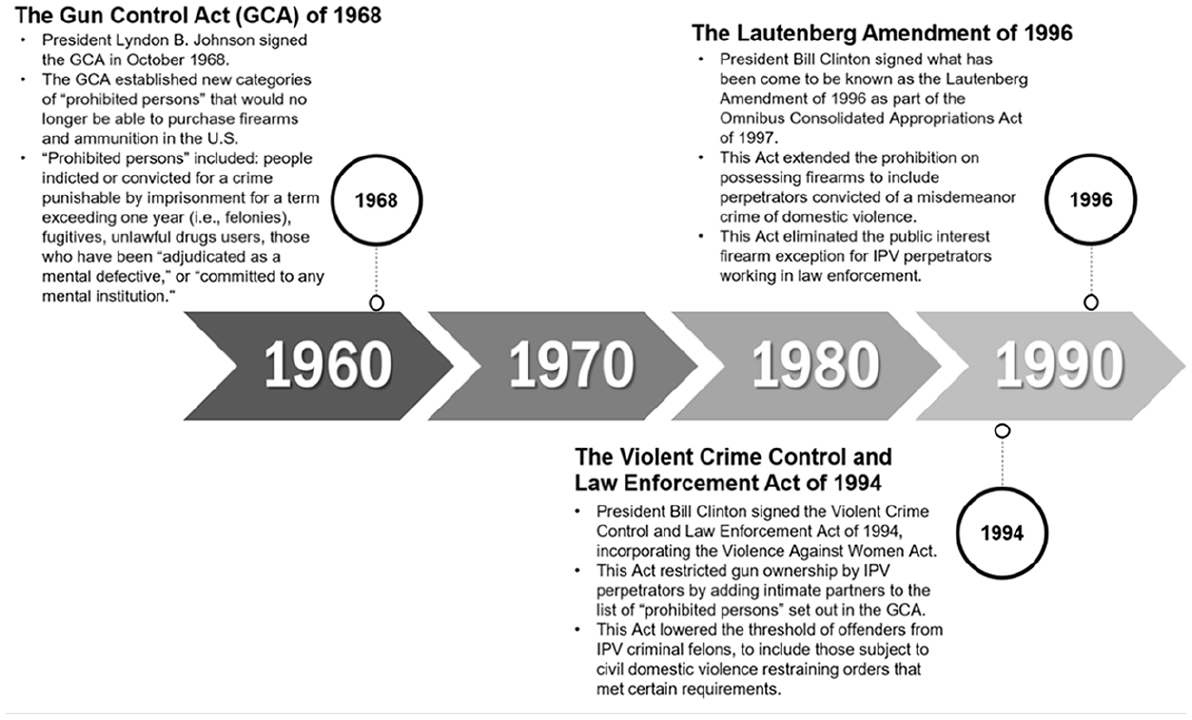
The federal response to IPV and firearms: The evolution of legal protections at a glance.
State protection
State law can explicitly restrict IPV offenders from purchasing or possessing firearms through two types of civil protection orders: final DVROs and temporary restraining orders (TROs) (see Figure 2). Unlike felonies and MCDV orders, which are criminal in nature and brought by the government, DVROs and TROs are most often handled in civil court and initiated by the victims themselves (Bejinariu et al., 2018). Therefore, DVROs and TROs offer victims direct access to garner their own protection from future abuse (Buzawa et al., 2012; Eigenberg et al., 2003; Lucken et al., 2015).

The process of obtaining a firearm prohibition through a civil protection order for victims of IPV.
To petition for a DVRO or TRO, a victim must first qualify as an intimate partner (the definition of which varies widely by law). DVROs, also known as “protection from abuse” or “no contact orders,” are issued by judges to protect individuals against abuse by ordering one or more of the following provisions: cease abuse, stay away, no contact, restitution, prohibition of firearm possession, prohibition of firearm purchasing, child custody, child support, and other relief (“Domestic violence protection order,” n.d.; “Domestic violence restraining orders,” n.d.; Vittes & Sorenson, 2006). Final DVROs take effect after a full court hearing and vary in length by state. TROs, also known as “ex parte orders,” can be issued without notice to the perpetrator, nor require their presence in court, are short term in length (though, generally in effect until the full hearing date), and are often filed in exigent circumstances (Stoever, 2019; Temporary Restraining Order [TRO], n.d.; Vittes & Sorenson, 2006). Both final and temporary orders can trigger the firearm prohibition either automatically through the issuance of the order or through judicial discretion. Once an order is in effect, its enforcement mechanism (such as firearm relinquishment or removal requirements) differs significantly across jurisdictions and over time.
Understanding the impacts of DVRO and TRO laws over time is critical to drafting and passing evidence-based laws and policies that prevent and reduce harm to victims. To measure the impact, it is not enough to capture the presence or absence of a law in a particular jurisdiction, rather scientific measurement of a law(s) requires an exploration into its underlying legal provisions that vary across jurisdictions and over time (Alcorn & Burris, 2016). No prior study has precisely measured the operative provisions of DVRO and TRO laws to create rigorous longitudinal legal data for research. Thus, this present study is novel in being the first to use the scientific legal mapping technique of policy surveillance (Anderson et al., 2013; Burris et al., 2016) to systematically collect, code, and track both federal DVRO protections and state DVRO and TRO firearm prohibitor provisions across the U.S. and over time. The empirical legal data created through this process have gone on to support national reports and power portions of the robust Gun Law Navigator portal, the largest historical database of gun laws in the U.S. (Everytown for Gun Safety, n.d.a.; McClenathan et al., n.d.). This current work adds to the field by analyzing, comparing, and narrating the breadth and granular nuanced provisions of DVRO and TRO laws through an in-depth descriptive analysis with the aim to untangle the complex web of legal regulation for victims, practitioners, researchers, and the public.
Methods
Using scientific legal mapping methods (Anderson et al., 2013), the research team followed the policy surveillance process to develop a longitudinal dataset measuring key features of federal and state laws authorizing or requiring courts to prohibit subjects of DVROs and TROs from purchasing and possessing firearms and oftentimes ammunition (hereinafter referred to as “firearm prohibitor” laws). The jurisdictions selected for measurement included federal law, as well as statutes and regulations for all 50 U.S. states and the District of Columbia in effect from January 1, 1991, to January 1, 2016. In this study, the District of Columbia is included when referring to “states.”
Data Collection
Initial scoping and inclusion/exclusion criteria decisions were determined by conducting background research, reviewing the existing literature, writing legal memoranda, and working with a team of subject matter experts from Everytown for Gun Safety. The research team, consisting of three lawyers (one supervisor and two researchers), began to collect the relevant legal texts (federal law and state statutes and regulations) by formulating and testing search terms. The following search terms were used in Westlaw and HeinOnline to identify relevant laws: “domestic violence,” “firearms,” “domestic violence restraining order,” “domestic violence protective order,” “restraining order,” “protective order,” “domestic violence and firearms,” “domestic violence and weapons,” “firearm prohibition,” “firearm surrender,” “firearm removal,” “weapon prohibition,” “weapon surrender,” “weapon removal,” “family and household member,” “domestic assault,” and “domestic assault and firearms.” Keyword searches were supplemented by examining the table of contents of each relevant chapter and section of the law identified. Full statutory history, including individual effective dates (the date the law takes effect and becomes enforceable), was collected and recorded for each law. After identifying all relevant provisions, researchers used publicly available sources, including government websites, to obtain and build the legal text over time in the LawAtlas Workbench, which was later imported to MonQcle, a cloud-based software system designed for storing and coding law (MonQcle, 2015).
Data Coding
The team created a list of legal variables for inclusion through the background research process. Using the variable list, the researchers developed coding questions to objectively measure key provisions of the DVRO and TRO laws, including whether there is a firearm prohibition, the definition of intimate partners, notice and hearing requirements, whether the firearm prohibition occurs automatically or via judicial discretion, the length of the firearm prohibition, and any firearm relinquishment or removal requirements. The dataset excluded other firearm prohibition laws related to felonies, MCDVs, stalking, mental illness, drug and alcohol use, and extreme risk protection orders (also known as “red flag” laws).
Original and redundant coding occurred in batches of 7–10 jurisdictions at a time. The researchers (working independently) redundantly coded 100% of the first batch of jurisdictions, which consisted of six states and federal law. The coding scheme was refined, and the coding questions were revised and reorganized based on the first batch results. The researchers redundantly coded 20% of the records (records encompass all relevant laws and legal citations for a specific jurisdiction at one point in time) among the remaining 45 states. After each batch of redundant coding was completed, all divergences were reviewed by the supervisor and resolved as a team in consultation with subject matter experts. Final coding conventions were described in a research protocol. Once the coding was finalized, final quality control checks were performed by the supervisor who downloaded the data into Microsoft Excel to review missing answer choices, outliers, effective dates, citations, and crosschecked responses against secondary sources.
The final dataset includes 528 unique records, organized by effective date, capturing every time a relevant federal or state law was enacted or amended within and across jurisdictions and over time. To analyze the results by year, one researcher paneled the data to create records for a snapshot of the law for each jurisdiction, as it existed on January 1 of each year included in the study (26 years from 1991 to 2016). The paneling produced 1,352 records (26 records per jurisdiction). All descriptive analyses were performed using SAS® Studio software.
Results
Federal Law
On September 13, 1994, the federal government added intimate partners to the list of prohibited persons set out in the Gun Control Act of 1968 (Gun Control Act of 1968, 1968). Since then, federal law prohibits all individuals subject to a DVRO from purchasing or possessing firearms and ammunition if the order was issued after formal notice and a hearing; meaning, the federal firearm prohibition applies to final DVROs only, and not to TROs. The federal law protects certain intimate partners including spouses, former spouses, cohabitants, former cohabitants, and individuals with children in common. Dating partners and former dating partners are not included in the federal definition of intimate partners. The federal firearm prohibition applies automatically to all final DVRO subjects, and when the order expires, so does the prohibition of firearms. The federal law requires that state and local courts put offenders on notice of this federal firearm prohibition when issuing a final DVRO. None of these legal provisions have been amended since September 13, 1994, even with the recent March 2022 reauthorization of VAWA.
State Law: DVROs
States began to pass firearm prohibitor provisions as part of DVRO laws in the early 1990s starting with New Jersey on November 12, 1991. By the time the federal law passed in 1994, five states (5/51, 9.8%) already had a law in effect—DE, HI, MA, NJ, and WA. The total number of states with a DVRO firearm prohibitor law has steadily increased over time, from 7 states (7/51, 13.7%) by January 1, 1995, to 22 states (22/51, 43.1%) by January 1, 2002, to 27 states (27/51, 52.9%) by January 1, 2009, and 37 states (37/51, 72.5%) by January 1, 2016. No state has ever repealed its DVRO firearm prohibitor provision once enacted.
Defining intimate partner relationships
Only certain relationships provide victims with the eligibility to file for protection under the legal definition of an intimate partner (see Figure 3). As of January 1, 2016, the most common relationships protected by law are spouses (37/37, 100%), former spouses (37/37, 100%), and individuals with children in common (34/37, 91.9%). On June 30, 1994, Massachusetts became the first state to include dating partners and former dating partners as a protected IPV relationship. Although current and former dating partners are commonly omitted from the legal definition of intimate partners in many states, as of January 1, 2016, dating partners (26/37, 70.3%) and former dating partners (24/37, 64.9%) are protected in 26 and 24 states, respectively. The 11 states that have a DVRO firearm prohibitor law but do not protect dating partners or former dating partners are AL, CO, FL, IA, MD, ME, OR, SC, TN, UT, and WA. The two additional states that protect dating partners but not former dating partners are MN and ND.
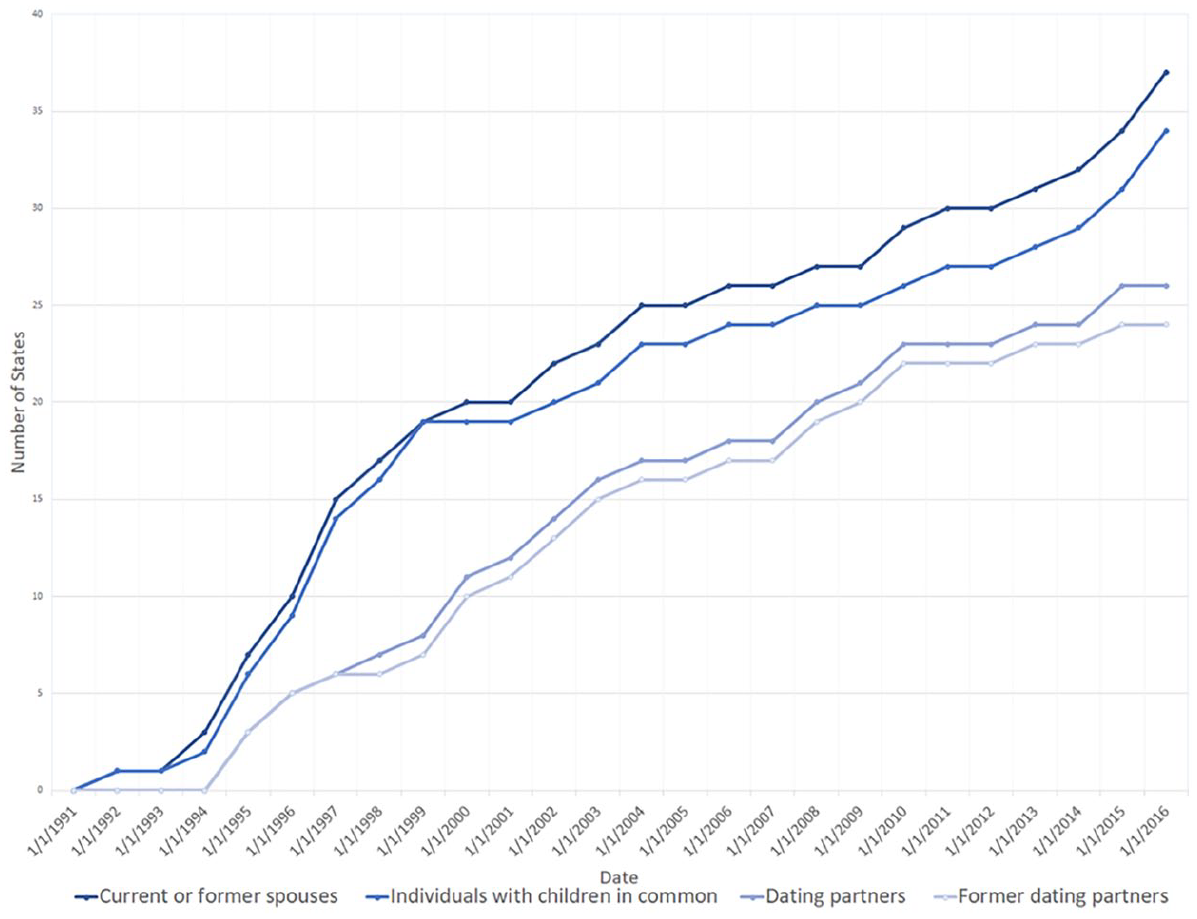
State DVROs: Trends in the legal definition of intimate partners over time, January 1, 1991–January 1, 2016
Notice and hearing requirements
Some states require formal notice and a hearing before a DVRO firearm prohibition can be issued. As of January 1, 2016, 11 states (11/37, 29.7%) require defendants receive notice of a hearing and 13 states (13/37, 35.1%) provide defendants the opportunity to participate in the hearing before a DVRO firearm prohibition applies. Minnesota has a formal notice requirement, but no hearing requirement. South Carolina requires that a defendant must be granted the opportunity to participate in the hearing, but the law does not explicitly require notice.
Automatic prohibition or prohibition via judicial discretion
DVRO firearm prohibitions can occur automatically through the issuance of an order or judicial discretion. On November 12, 1991, New Jersey became the first state to enact a firearm prohibition that applies automatically when a DVRO is issued. On July 16, 1993, Delaware became the first state to grant judges the judicial discretion to limit firearm access for DVRO subjects. As of January 1, 2016, the firearm prohibition applies automatically to all DVRO subjects in 25 states (25/37, 67.6%), whereas the remaining 12 states (12/37, 32.4%) explicitly allow the prohibition through judicial discretion (see Table 1). From 1991 to 2016, only three states (DE on 7/23/1999, CA on 1/1/2000, and WI on 11/13/2015) amended how the firearm prohibition was triggered from judicial discretion to automatic.
State Laws That Regulate Firearms Access for Perpetrators of IPV Through DVROs and TROs, January 1, 1995–January 1, 2016.
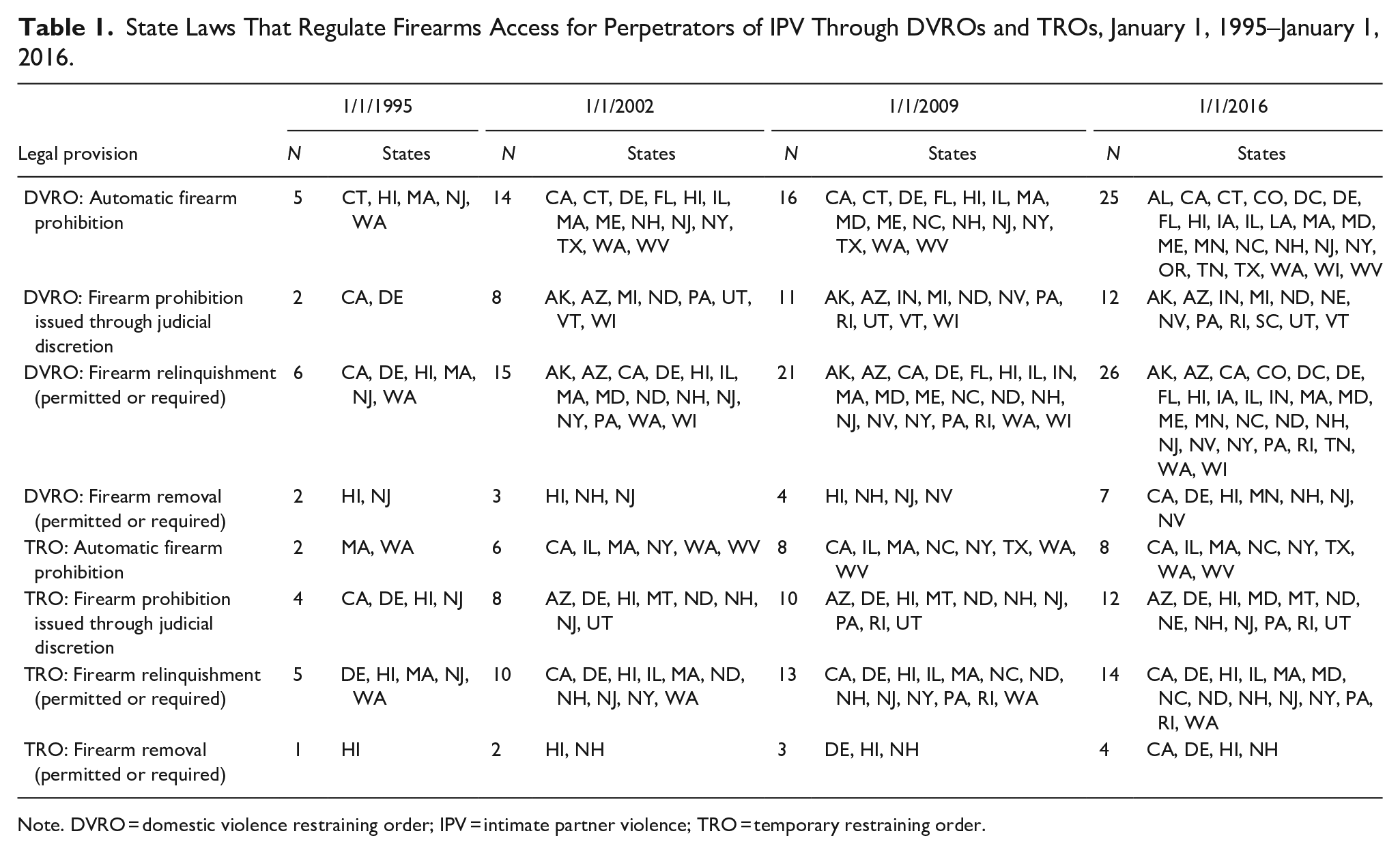
Note. DVRO = domestic violence restraining order; IPV = intimate partner violence; TRO = temporary restraining order.
Once issued in court, the length of the firearm prohibition varies by state. As of January 1, 2016, it expires simultaneously with the DVRO in 29 states (29/37, 78.4%), after 1 year in IA, NC, and NE (3/37, 8.1%), and after 2 years in NJ (1/37, 2.7%). Some states that prohibit firearm access for the duration of the order itself also set a fixed term—for example, New Jersey prohibits firearms for the duration of the DVRO or 2 years, whichever is greater. Seven states, AL, FL, MA, ME, ND, OR, and UT (7/37, 18.9%), do not explicitly quantify when the firearm prohibition will expire.
Relinquishment
Over time, states have enacted legal provisions that require the relinquishment of any firearms in an offender’s possession (see Table 2). As of January 1, 2016, 26 states (26/37, 70.3%) have a firearm relinquishment law, 12 (12/26, 46.2%) of which require subjects to relinquish their firearms automatically upon issuance of the DVRO, while the remaining 14 states (14/26, 53.8%) allow judges to order relinquishment at their discretion. In these states, firearms can be surrendered to law enforcement (26/26, 100%), government authorities (6/26, 23.1%), a licensed dealer (12/26, 46.2%), or a third party (10/26, 38.5%). Only two states (IA and TN) allow relinquishment to any of these four entities.
State Laws That Restrict Firearms Through DVROs and TROs and Regulate Relinquishment or Removal of Firearms Within an Offender’s Possession, January 1, 1995–January 1, 2016.
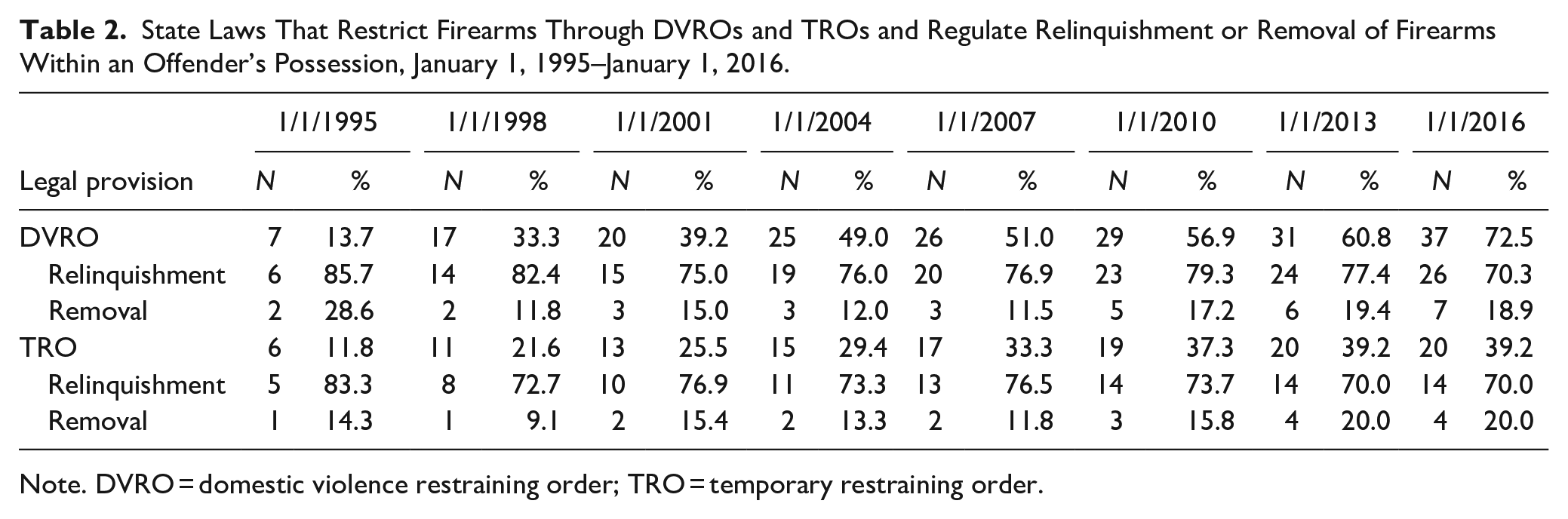
Note. DVRO = domestic violence restraining order; TRO = temporary restraining order.
Removal
Some states permit or require law enforcement to physically remove any firearms in an offender's possession (see Table 2). Hawaii was the first state to pass a firearm removal law on June 30, 1994. By January 1, 2016, seven states (CA, DE, HI, MN, NH, NJ, and NV) (7/37, 18.9%) enacted a removal provision. Of the seven states, five (DE, HI, NH, NJ, and NV) (5/7, 71.4%) grant law enforcement the permissive authority to remove firearms, and two (CA and MN) (2/7, 28.6%) require removal. Nevada is unique in that the law requires an additional finding of probable cause that the subject did not already relinquish their firearms before permitting removal by law enforcement.
State law: TROs
States also began to pass firearm prohibitor provisions as part of TRO laws in the early 1990s starting again with New Jersey on November 12, 1991. The total number of states that prohibit firearms through temporary orders has increased over time from 6 states (6/51, 11.8%) by January 1, 1995, to 14 states (14/51, 27.5%) by January 1, 2002, to 18 states (18/51, 35.3%) by January 1, 2009, and 20 states (20/51, 39.2%) by January 1, 2016. All states that have a TRO firearm prohibitor law, except for Montana, also have a DVRO firearm prohibitor law in effect.
Defining intimate partner relationships
As of January 1, 2016, all TRO firearm prohibitor states include spouses, former spouses, and individuals with children in common as protected intimate partner relationships (20/20, 100%). Dating partners and former dating partners have been added to the legal definition in 17 states (17/20, 85.0%) and 16 states (16/20, 80%), respectively. The three states that have a TRO firearm prohibitor law but do not protect dating partners or former dating partners are MD, UT, and WA. The one state that protects dating partners, but not former dating partners is ND.
Notice and hearing requirements
Unlike DVROs, TROs do not require notice or a full hearing before they go into effect, as they are often issued in exigent circumstances.
Automatic prohibition or prohibition via judicial discretion
TRO firearm prohibitions can occur automatically through the issuance of an order or judicial discretion. As of January 1, 2016, the firearm prohibition applies automatically to all TRO subjects in eight states (8/20, 40%), while the remaining 12 states (12/20, 60%) permit judges to decide whether to order the firearm prohibition upon issuance of a TRO (see Table 1). Regardless of how it is ordered, the firearm prohibition typically expires simultaneously with the length of the TRO, and the length of the TRO varies by state (e.g., 1 day in AZ, 10 days in WV, 24 days in WA).
Relinquishment
Of the 20 states with a TRO law as of January 1, 2016, 14 states (14/20, 70%) order the relinquishment of firearms (see Table 2). Of the states, six (CA, IL, MA, NY, NC, and WA) (6/14, 42.9%) require automatic relinquishment upon issuance of the order and eight (DE, HI, MD, NH, NJ, ND, PA, and RI) (8/14, 57.1%) allow judges to order relinquishment at their discretion.
Removal
Only four states (4/20, 20%) have enacted a firearm removal provision from 1991 to 2016 (HI on 06/30/1994, NH on 01/01/2000, DE on 03/19/2008, and CA on 01/01/2012) (see Table 2). Law enforcement has the permissive authority to remove firearms from TRO subjects in DE, HI, and NH, whereas CA mandates removal.
State law summary: DVROs and TROs
From 1991 to 2016, 38 states enacted a firearm prohibitor law through DVROs (37 states), TROs (20 states), or both (19 states) (see Table 1). As of January 1, 2016, 13 states (AR, GA, ID, KS, KY, MO, MS, NM, OH, OK, SD, VA, and WY) have yet to enact a DVRO or TRO firearm prohibitor law.
Discussion
IPV has lived in the shadows of American households for centuries. Prior to the women’s liberation movement, IPV was considered a family matter that would be handled behind closed doors and certainly outside of the justice system (Ellialti, 2016; Fisher, 2004; Snyder, 2019). Thus, DVRO and TRO firearm prohibitor laws lack an extensive and cohesive past. Instead of a consistent and coordinated approach to grant unified protection, federal law only offers protection to some IPV victims and states vary tremendously as to the level of legal protection they provide—from comprehensive, to minimal, to non-existent.
While federal protection alone is insufficient in its protection of IPV victims, states have both the opportunity and the legal authority to be legislatively innovative in protecting victims through preventative policymaking. A handful of states (including CA, DE, HI, NH, NJ) safeguard their victims by subjecting IPV offenders to multiple legal provisions, forging a comprehensive approach to protection (e.g., California protects all intimate partner relationships and requires mandatory relinquishment and removal of firearms under both DVROs and TROs). Whereas many others have passed minimal protections over time, where some protection exists, but it is limited. For example, AL, OR, and SC have passed a DVRO (but not a TRO) firearm prohibitor law that neither applies to current or former dating partners, nor specifies how the firearm prohibition should be enforced (i.e., no relinquishment or removal requirements). Yet still, minimal protections offer victims more than the 13 states without a DVRO or TRO firearm prohibitor law as of January 1, 2016. Consequently, IPV victims suffer from a slow and fragmented legal system that leads to the unequal protection of victims based on where they happen to live.
By examining the evolution and variation of DVRO and TRO firearm prohibitor laws across jurisdictions and over time, this study exposes gaps in legal protection and therefore offers advocates, lobbyists, and policymakers a roadmap for supporting, drafting, and passing laws that limit the ability of dangerous persons to access firearms. The following policy recommendations are based on analyzing these gaps, which can be filled by passing provisions that are supported by the existing evidence that recommend using law to safeguard IPV victims from firearm-related injury and death:
1. DVRO laws should contain a firearm prohibitor provision that restricts IPV offenders from purchasing and possessing firearms and ammunition. Evidence supports using law to disarm IPV offenders as a preventative safety measure (Díez et al., 2017; Goodyear et al., 2019; Vigdor & Mercy, 2006; Webster & Wintemute, 2015; Zeoli & Webster, 2010). One study that investigated the impact of state firearm prohibitor laws on IPH rates in a regression analysis using outcome data from the Federal Bureau of Investigation’s Supplementary Homicide Reports (1982–2002) found that states that passed DVRO firearm prohibitor laws over time saw an 8% reduction in female IPH rates and a 10% reduction in female firearm IPH rates (Vigdor & Mercy, 2006). Another study that examined both federal and state firearm prohibitor laws on IPH rates using a pooled, cross-sectional, time-series analyses found that the federal law was associated with a 28% reduction in firearm IPH for Black, but not White, victims, while state DVRO laws were associated with an 11% reduction in firearm IPH for White victims only (Wallin et al., 2022).
From January 1991 to 2016, the federal government and 37 states passed a DVRO firearm prohibitor law. Historically, the key DVRO-related provisions of the federal law have remained unchanged since its enactment in 1994, and state progress has ebbed and flowed. Although this legal intervention is associated with a significant reduction in IPH rates, 14 jurisdictions still lack basic DVRO firearm prohibitor protections.
2. TRO laws should contain a firearm prohibitor provision that restricts IPV offenders from purchasing and possessing firearms and ammunition. Disarming IPV offenders (albeit temporarily) through TROs in exigent circumstances can be a primary life-saving intervention for IPV victims (Stoever, 2019). Opponents of TRO firearm prohibitions argue that these orders have the potential to deny firearm owners their right to due process (since the orders are issued in lieu of standard notice and hearing requirements) and require a lower standard of proof than that of criminal cases, which can cause harm to those wrongly accused (RAND Corporation, 2020). Yet, there continues to be strong public support for the passage of TROs among both firearm owners and non-firearm owners to protect the safety of IPV victims (Barry et al., 2018). Furthermore, prompt protection is often necessary since victims are at an increased risk of severe abuse post-separation (Hardesty & Chung, 2006; Hayes, 2012; Krebs et al., 2011). In fact, the risk of IPH is highest when a victim attempts to separate from their perpetrator and it can take weeks between filing an order of protection and scheduling a hearing to obtain a DVRO firearm prohibition—weeks the victim may not have, as leaving is paradoxically the most lethal (and necessary) act victims take to garner safety (Campbell, Webster, Koziol-McLain, Block, Campbell, Curry, Gary, McFarlane, Sachs, Sharps, Ulrich, & Wilt, 2003; Langhinrichsen-Rohling, 2005; Vittes & Sorenson, 2006). One estimate suggests that when a victim leaves a highly controlling abuser after living together, the likelihood that they will be killed increases nine-fold (Campbell, Webster, Koziol-McLain, Block, Campbell, Curry, Gary, McFarlane, Sachs, Sharps, Ulrich, Wilt, Manganello, et al., 2003).
The federal firearm prohibition is only applicable to offenders subject to a final DVRO that is issued after notice and a hearing, which excludes victims seeking relief through temporary orders. From January 1991 to 2016, 20 states passed a firearm prohibitor law through TROs. Therefore, victims in 31 states cannot obtain TROs as a civil remedy for IPV-related firearm protection and must rely on extreme risk protection orders (if available in their state), emergency services, or the criminal justice system for relief. The 19 states with both DVRO and TRO laws not only provide victims with more options for seeking protection, but also the ability to seek immediate protection from imminent danger.
3. The legal definition of intimate partners should protect all intimate partner relationships. In many places, the definition of intimate partners creates a wide gap in protection that is colloquially referred to as the “boyfriend loophole,” in which current or former dating partners are not covered (thus, left unprotected) by federal and state law. The boyfriend loophole has become increasingly deadly given the changing nature of relationships over time (Everytown for Gun Safety, n.d.b.). Not only are marriage rates declining, but people are also getting married later in life. Marriage rates in 2018 were at an all-time low of 6.5 marriages per 1,000 people, a decrease from 2001 when the rate was 8.2 marriages per 1,000 people (Brown & Sheffield, 2020). In 2020, the average age of marriage was 28.1 for women and 30.5 for men, a significant increase from 1980 when the average age of marriage was 22.0 for women and 24.7 for men (United States Census Bureau, 2020). Furthermore, before the U.S. Supreme Court decision of Obergefell v. Hodges in 2015, same-sex marriages were banned in many states, leaving individuals in the LGBTQ+ community without any protection (Obergefell v. Hodges, 2015). Dating partners—whether they are in same-sex relationships or not—do not pose less risk; in fact, the percentage of IPH committed by a spouse (46.7%) is slightly less than the percentage of IPH committed by a dating partner (48.6%) (Cooper & Smith, 2011; Rollè et al., 2018). One study found that the majority (80%) of intimate partner incidents reported to police involved people who were not married, and when isolating the prevalence of firearm use and IPV, researchers found that firearm violence is similar across all types of intimate partner relationships (Sorenson & Spear, 2018). Yet, protection for dating partners and former dating partners continues to lag.
As of January 1, 2016, victims that live in states that do not protect former (not protected in 13 DVRO states and 4 TRO states) or current (not protected in 11 DVRO states and 3 TRO states) dating relationships do not qualify to file for protection since there is no statewide protection nor a federal provision to serve as a safety net for victims seeking to obtain a DVRO or TRO.
4. Provide more uniform protection to victims by enacting automatic firearm provisions. Discretion grants judges the freedom to decide (within legal bounds of precedent and judicial authority) whether to disarm offenders. There are many social, demographic, legal, and abuse factors that contribute to how judges apply the same law to varying facts and circumstances on a case-by-case basis (Lucken et al., 2015). These factors can lead to inconsistencies in protection for IPV victims (DeJong & Burgess-Proctor, 2006; Lucken et al., 2015). Evidence has indicated that judges do not always use their authority to remove firearms from abusers, even when requested by victims (Webster et al., 2010).
The federal firearm prohibition applies automatically to all final DVRO subjects; however, state laws vary as to whether the firearm prohibition is triggered automatically or at the discretion of the judge. It is much more common for a state to automatically prohibit firearms through final DVRO orders (25 states) versus TROs (8 states). States can remove ambiguity and ensure that protection applies uniformly to all victims by following the lead of state legislators in CA, DE, and WI who amended their laws to move from judicial discretion to an automatic trigger.
5. Strengthen enforcement mechanisms within DVRO laws and TRO laws by requiring the relinquishment or removal of firearms and ammunition. A final or temporary order is legally binding, but still just a piece of paper. This means that once an IPV offender leaves the courtroom, their compliance is most often left to the bounds of their moral consciousness. The federal government, and many states that prohibit the purchase or possession of firearms through DVROs and TROs, still do not regulate what the offender must do with firearms and ammunition they already own. Instead, the justice system is putting faith in the IPV offender to discard the firearm in any way they see fit for the duration designated by the order. Other states have been forward-thinking in their prevention efforts by building enforcement processes into the law itself by enacting relinquishment and removal provisions.
Relinquishment laws, which require offenders to surrender all firearms and ammunition to another party set out in the law (such as law enforcement), have been associated with positive health outcomes for IPV victims (Díez et al., 2017; Wallin et al., 2022). Furthermore, evidence suggests that when a perpetrator is subject to multiple legal provisions there are protective associations between the laws and IPV injuries and death (Díez et al., 2017). One study found that states with firearm prohibitor laws that also require relinquishment were associated with firearm-related IPH rates that were 14% lower than states without this combination of legal provisions (Díez et al., 2017). Another study found the inclusion of a relinquishment provision within state DVRO prohibitor laws led to a 16% reduction in firearm-related IPH for White victims (Wallin et al., 2022). Although the evidence demonstrates that victims living in states with relinquishment laws have lower odds of nonfatal injuries, states have been hesitant to pass relinquishment provisions (Willie et al., 2021). Of the 37 states with a DVRO firearm prohibitor law, 11 do not have relinquishment. Of the 20 states with a TRO firearm prohibitor law, six do not have relinquishment. In the states that have passed this evidence-based protection, it is more common for the law to grant judicial discretion as the mode for ordering relinquishment versus automatic relinquishment through the issuance of an order.
Removal provisions take relinquishment a step further by requiring or permitting law enforcement to physically remove firearms or ammunition from offenders for the duration of time described in the order. States have been very slow to pass removal provisions—only seven states (CA, DE, HI, MN, NH, NJ, and NV) have enacted a law, the majority of which are permissive (i.e., law enforcement may remove) versus mandatory (i.e., law enforcement must remove). Even though studies have recommended that mandatory removal should be a part of all orders, only CA and MN have certain mandatory removal provisions (Díez et al., 2017; Moracco et al., 2006). Not only has research supported the removal of firearms, but so has public opinion (Sorenson, 2006).
Ultimately, DVRO and TRO laws should include a firearm prohibitor provision, protect all intimate partner relationships, automatically prohibit firearms through the issuance of the order, and require the relinquishment or removal of firearms and ammunition for a period of time indicated in the order. Public health seeks to prevent morbidity and mortality and these legal provisions are specifically tailored to provide viable policy solutions aimed at saving lives by limiting firearm access for persons deemed dangerous by the courts.
Limitations
First, it is essential to note that just because there is a law on the books it does not mean that law is fully (or even partially) implemented and enforced. The dataset did not include implementation or enforcement mechanisms beyond the four corners of the law itself. Meaning, that if the law itself contained enforcement mechanisms (e.g., law enforcement must remove firearms from IPV offenders), these measures were collected and coded by the researchers. However, if the law was silent as to how the order would be implemented or enforced (e.g., IPV offenders must not purchase or possess guns for the duration of the order with no relinquishment or removal provision), no implementation or enforcement measures were collected. Similar laws can be enforced quite differently from state to state due to judicial discretion, law enforcement processes, and the availability of victims’ services organizations; therefore, these measures can be important for future studies that seek to evaluate the effects of these laws on IPV victim-centered outcomes. Second, the number of laws that regulate firearms goes well beyond DVRO and TRO laws. This means that although this research thoroughly examined the complexity and granular details of these two IPV-specific legal protections, there is a myriad of laws that may affect an IPV offender’s ability to access firearms regardless of whether a DVRO or TRO is in place. Although these tangentially relevant laws—such as extreme risk protection orders, or laws that prohibit firearm purchase and possession due to mental health status, substance use disorder, or criminal activity—were outside of the scope of this research, they can play a critical role in understanding the effects of firearm regulation on access and use. Third, the data presented herein are descriptive, meaning that there was no discussion of association or causality. Future research can build on this work to examine the relationships between these laws and morbidity and mortality-related outcomes. Finally, the legal data for this study are valid through January 1, 2016. Thus, potentially relevant updates to the legal landscape of DVRO and TRO laws that occurred post-2016 are not included in this analysis.
Conclusion
After decades of decline, female IPH rates have been on the rise (Fridel & Fox, 2019; National Coalition Against Domestic Violence, 2020). Mere access to firearms, the most common weapon used in IPH, increases the risk of death for women five-fold (Campbell, Webster, Koziol-McLain, Block, Campbell, Curry, Gary, McFarlane, Sachs, Sharps, Ulrich, Wilt, Manganello, et al., 2003). Although DVRO and TRO firearm prohibitor laws can serve as a life-saving intervention between victims and firearm-related injury and death, much of the country still lacks basic legal protections. Instead of a consistent and coordinated approach to unified protection for victims, federal and state governments have been opposed, hesitant, or slow to pass comprehensive legal provisions, and 13 states provide no DVRO or TRO firearm prohibitor protection at all. In the places that continue to stagnant, the lack of action is a missed opportunity to promote a public health intervention that uses the power of law to limit firearm access for persons a court has deemed dangerous.
By scientifically mapping legal protections (or lack thereof) intended to prohibit IPV offenders from possessing and purchasing firearms across the U.S. from January 1, 1991 to January 1, 2016, this present study adds to the field by increasing the knowledge and awareness of a complicated and multidimensional area of legal regulation for IPV victims, public health practitioners, and the public. Furthermore, providing accessible information about the law and policy recommendations allows advocates, lobbyists, and policymakers to learn from both the triumphs and misfortunes in other states and work together to advance equal protection for all IPV victims by championing and passing laws that prevent harm and mitigate injury and death for those most vulnerable. Finally, this research produces quantitative legal data that capture changes and trends in these laws (and their underlying legal provisions) over time (and since their inception in the U.S.), which enables researchers to conduct rigorous legal evaluations of their effects. This future research can build upon prior studies that have led the way in analyzing law as a factor amidst the unique and deadly relationship between firearms and IPV and IPH (Bridges et al., 2008; Díez et al., 2017; Goodyear et al., 2019; Vigdor & Mercy, 2006; Webster & Wintemute, 2015; Zeoli & Webster, 2010). Robust legal evaluations that identify the most (and least) effective legal interventions can help to ensure that new laws, or amendments to existing laws, are rooted in both evidence and reality.
Footnotes
Acknowledgements
We would like to gratefully acknowledge the team of researchers from the Center for Public Health Law Research at Temple University, Legal Science, LLC, and Everytown for Gun Safety for creating the legal data analyzed herein.
Declaration of Conflicting Interests
The authors declared a potential conflict of interest (e.g. a financial relationship with the commercial organizations or products discussed in this article) as follows: Support for the legal dataset creation was provided by Everytown for Gun Safety. Note: Author, L.K. Cloud, was a part of Temple University’s Center for Public Health Law research team.
Funding
The authors disclosed receipt of the following financial support for the research and/or authorship of this article: Support for the legal dataset creation was provided by Everytown for Gun Safety. The views expressed here do not necessarily reflect the views of Everytown for Gun Safety.
