




Abstract
Perpetration of relational aggression, which is estimated to occur in 60% to 90% of relationships, has been demonstrated to have lasting negative effects both systemically and for its victims. Relational aggression has also been demonstrated to be impacted, in part by impulsivity, stress mind-set, and mindfulness. The present study examined a path analysis model of the relation between mindfulness and relational aggression, utilizing impulsivity as the mediating variable. Furthermore, the present study incorporated an examination of the potential moderating effects of stress mind-set on the relation between impulsivity and relational aggression. Three hundred eighty-three participants were recruited from across the United States, using Facebook ads. Participants completed online questionnaires assessing key study variables. We hypothesized that the negative urgency aspect of impulsivity would mediate the relation between the five facets of mindfulness and relational aggression, and further that this relationship would be moderated by stress mind-set, such that a stress mind-set which conceptualizes stress as negative would make the relation between impulsivity and relational aggression stronger. We hypothesized that the negative urgency aspect of impulsivity would mediate the relation between mindfulness and relational aggression. Furthermore, we hypothesized that the relation between impulsivity and aggression would be moderated by stress mind-set. Results indicated that the negative urgency component of impulsivity mediated the relation between all five facets of mindfulness and perpetration of relational aggression. Furthermore, stress mind-set moderated the relation between negative urgency and relational aggression, such that a lower stress mind-set was related to a stronger association between negative urgency and aggression. Implications for clinical intervention and future research efforts are discussed.
Introduction
Intimate Partner Aggression (IPA)
IPA has been and continues to be a nationwide health concern affecting a large portion of the population. Currently, one in three women and one in four men will experience IPA victimization in their lifetime (National Statistics of Domestic Violence Victimization, 2015). A recent meta-analysis indicated that IPA victimization was associated with physical and psychological complications, such as depression, anxiety, posttraumatic stress disorder (PTSD), and suicidality (Stockman et al., 2015). The most common type of IPA perpetrated is psychological aggression (Office for Victims of Crime on NCJRS, 2018). Indeed, psychological aggression has been reported to occur in 60% to 90% of relationships (Banyard et al., 2000). It is also thought to be just as, if not more, harmful to the health of the victims than physical abuse (Coker et al., 2000; Odgers & Jaffee, 2013). Psychological IPA can include any behavior that negatively impacts a partner’s mental health, their ability to sustain other relationships, or their ability to work (Hoffman, 1984). Psychological aggression might include verbal and behavioral attempts to humiliate, isolate, shame, or intimidate one’s partner (Cascardi et al., 2020; Follingstad et al., 2005). Although a number of different subsections of psychological IPA have been identified, one of the least examined in the literature consists of relational aggression tactics (see Carroll et al., 2010). Relational aggression refers to the tendency of one’s partner to negatively impact relationships (Wright & Benson, 2010). Wright and Benson (2010) stressed that the goal of relational aggression is to damage both the romantic relationships and the victim’s relationships with others in a way that makes the victim feel unwanted, unloved, or isolated. Little is known about the diversity of this under-researched population. Given that relational aggression is an understudied area of psychological IPA, the present study focused on instances of relational aggression in intimate relationships.
Although some interventions have been explored, related to couple IPA perpetration and victimization, only limited support has been identified in the reduction of the frequency and severity of IPA. Indeed, a meta-analysis conducted by Stover et al. (2009) provided only mixed support of recidivism of reports of aggression for various clinical interventions, including cognitive behavioral therapy (CBT) and the commonly utilized Duluth model. Given that these interventions have demonstrated modest efficacy, it is clear that additional research is needed to better understand this phenomenon. The goal of the present study was to better understand the extent to which mindfulness is linked to relational aggression and whether impulsivity and stress mind-set may be implicated in the connection between mindfulness and relational aggression. Better understanding the role of these variables in IPA may have significant clinical implications for the reduction of these harmful behaviors.
Mindfulness
Mindfulness has been a focus of the recent literature, notably for its positive effects on concentration, mental health, and subjective well-being (Baer, 2003). Mindfulness is the process by which an individual consciously attends to their present moment experience, or “paying attention, in a particular way: on purpose, in the present moment, and non-judgmentally” to one’s experience (Brown & Ryan, 2003; Kabat-Zinn, 1994, p. 4). According to Langer (2002), “such a way of being stands opposed to a perpetual automatic processing mode of mindlessness in which one’s sensations, attributions, emotions, and actions—as well as those of others—pass by unnoticed.” (Wachs & Cordova, 2007, p. 465). Theoretically, mindfulness might be utilized in clinical practice to assist with emotion regulation and may be particularly useful in the emotional regulation processes that reduce rumination and avoidance of negative emotion, while increasing appropriate engagement with emotions (A. M. Hayes & Feldman, 2004; Roemer et al., 2009). Wachs and Cordova (2007) suggested that more mindful partners may be more adept at identifying their own emotions, as well as communicating their emotions to others and that this might decrease the elevated stress and the resulting decreased cognitive resources, like those precipitating IPA.
In an early study conducted by Kabat-Zinn (1990), it was found that a short-term mindfulness intervention resulted in a decreased probability of aggressive behavior in response to socially rejecting feedback than was present for individuals who did not receive the mindfulness intervention. Kabat-Zinn suggests that these findings are due to the efficacy of the intervention in providing participants the ability to suppress aggressive impulses with greater accuracy. More specific to intimate relationships, mindfulness has been demonstrated to be strongly associated with relational IPA perpetration. For example, Shorey and colleagues (2014) found that a number of facets of mindfulness were inversely associated with perpetration of relational aggression against an intimate partner. The Describing, Non-Judging, Non-Reactivity, and Acting with Awareness facets of mindfulness were negatively correlated with perpetration of psychological IPA. In a follow-up to this study, Shorey et al. (2014) found that the ability to manage anger mediated the link between trait mindfulness and perpetration of relational IPA. Furthermore, Brem and colleagues (2018) found that distress tolerance mediated the relation between mindfulness and relational aggression in romantic relationships. Although these studies have demonstrated the presence of a mediational link between trait mindfulness and psychological IPA, the relation between these constructs has not yet been fully explained. It seems plausible that both anger and distress tolerance may be subsumed within the broader constructs of impulsivity and stress and that additional research is needed to understand the role of these constructs in the link between mindfulness and relational aggression.
Impulsivity and Relational Aggression
Impulsivity includes actions that “appear poorly conceived, prematurely expressed, unduly risky, or inappropriate to the situation and that often result in undesirable consequences” (Daruna & Barnes, 1993, p. 23). Perpetration of relational aggression has been found to be associated with difficulties with impulse control and difficulties with emotion regulation (Holtzworth-Munroe & Stuart, 1994; Shorey et al., 2011).
The dual systems theory (Hofmann et al., 2009) of impulsivity posits that action is determined by competition between impulsive and reflective systems. This theory suggests that the impulsive system is responsible for generating impulse behavior and is created and strengthened by the temporal coactivation of external stimuli and affective behavioral and emotional activity. This is known as anticipatory activation, as external cues signal the automatic activation of behavioral and emotional processes associated with impulsive action. The reflective system serves regulatory goals, such as “higher order mental operations, executive functioning, deliberate judgment, planning for strategic action, and inhibiting or overriding prepotent responses” (p. 165). Determining the activation of one system and subsequent inhibition of the other is dependent on self-control resources. The dominant behavioral pattern is therefore dependent on the relative strength of one system over the other system. In attempting to bias the system toward reflective, purposeful, self-controlled action, away from impulsive, instinctual action, it is necessary to consciously and purposefully strengthen the reflective system. Finkel (2007) demonstrated that participants were more likely to experience impulses consistent with IPA perpetration than they were to actually engage in IPA, that is, behavioral restraint is associated with decreased probability of IPA perpetration.
Shorey and colleagues (2011) suggested that relational IPA is often precipitated by “gut-level” actions, resulting from violent impulses and failures in self-regulation. This study found that trait impulsivity was significantly positively correlated with perpetration of relational aggression against an intimate partner. A number of studies have identified poor self-control and impulsivity as precipitating factors contributing to aggression. Indeed, in a number of studies, Denson and colleagues (2011) demonstrated that rumination reduced self-control and that increasing self-regulatory resources increased inhibitory self-control on a subsequent task. Poor self-control can contribute to impulsive decision-making, which can lead to relational aggression.
Two components of impulsivity thought to be the most predictive of relational aggression are negative urgency and lack of premeditation (Cyders et al., 2014; Peters et al., 2011, 2017). Negative Urgency is the tendency to engage in impulsive action to dispel negative affect (Cyders & Smith, 2008), whereas Lack of Premeditation refers to a deficit in ability to consider the consequences of an action before completing the action (Whiteside & Lynam, 2001). Previous literature suggests that negative urgency would mediate the relation between the five facets of mindfulness and relational IPA perpetration (Cyders et al., 2014; Peters et al., 2017), as would the Lack of Premeditation facet of impulsivity (Cyders et al., 2014; Peters et al., 2011). That said, these two components of impulsivity might be key targets for intervention toward the reduction of perpetration of relational IPA.
This review of the literature suggests that individuals might strengthen reflective systems and increase ego control, making it more likely that an individual responds to conflict with their partner nonviolently (i.e., less impulsively). The mechanism by which reflective and ego control systems might be strengthened is through the process of mindfulness practices. There has been some preliminary support for mindfulness interventions in increasing couples’ relationship satisfaction (Barnes et al., 2007; Burpee & Langer, 2005). For example, in a study conducted by Friese et al. (2012), it was found that a brief period of mindfulness meditation allowed ego-depleted individuals to participate in a subsequent self-control task, with similar levels of self-control as individuals who were not ego-depleted. That is, mindfulness practice “counteracted the effects of self-control depletion” (p. 1019). Increasing ego-strength can assist individuals in reducing negative responses to repetitive thoughts and in increasing willingness to experience negative affect. In increasing ego-strength, mindfulness may decrease the likelihood of the ego-depletion seen in perpetration of IPA.
Stress Mind-Set
Even in considering the roles of mindfulness and impulsivity in the perpetration of relational aggression, there is still much variance left unaccounted for. Recent research suggests that stress and, more specifically, stress mind-set, may be important in the link between enhancing (i.e., stress is a good thing and assists one in personal growth) or detrimental (i.e., stress is harmful and should be avoided; Crum et al., 2013) outcomes. Crum and colleagues demonstrated that perceived stress was negatively associated with stress mind-set, such that individuals who believed that stress was enhancing perceived less stress in their daily lives. This finding suggests that stress mind-set might be the precursor to perceived stress and its negative effects. Given this finding and research showing that perceived stress is strongly associated with both impulsivity (Kreek et al., 2005) and IPA perpetration (Middlebrooks & Audage, 2008), it may be that stress mind-set is a higher order variable (and the more critical variable) for understanding the associations between impulsivity and perpetration of IPA.
Although there is little information in the literature concerning the effects of stress mind-set on the relation between impulsivity and IPA, perceived stress has been implicated as a factor increasing impulsivity and IPA perpetration (Kreek et al., 2005; Lazarus & Folkman, 1984; Middlebrooks & Audage, 2008). As perceived stress has been associated with stress mind-set (Crum et al., 2013), the present article proposes that stress mind-set may moderate the association between impulsivity and IPA, such that, for individuals with negative stress mind-sets, the relation between impulsivity and relational IPA perpetration will be even stronger. However, no studies have examined this empirically.
In addition, recent research on stress mind-set proposes that stress mind-set is correlated with the perception of a task as either challenging, if one has a stress-enhancing mind-set, but threatening, if one has a stress-depleting mind-set (Kilby & Sherman, 2016). That is, a positive stress mind-set is associated with positive task appraisals, whereas a negative stress mind-set is associated with negative task appraisals. This kind of stress appraisal, presumably through stress mind-set, has been shown to beget positive or negative outcomes (e.g., negative stress appraisal leads to negative outcomes and positive stress appraisal leads to positive outcomes; Lazarus & Folkman, 1984). Considering this literature as a whole, it is hypothesized that, because negative urgency is positively correlated with perpetration of relational IPA and negative stress appraisal, through stress mind-set, is associated with negative outcomes, individuals who demonstrate negative urgency tendencies and a negative stress mind-set will be particularly likely to engage in relational IPA perpetration as a negative outcome.
Rationale
The present study aims to analyze path analyses models to examine mediating and moderating variables contributing to the perpetration of IPA. Based on previous literature, it was hypothesized that the negative urgency aspect of impulsivity (Urgency, Premeditation (lack of), Perseverance (lack of), Sensation Seeking, Positive Urgency, Impulsive Behavior Scale [UPPS-P]; Cyders et al., 2014; Whiteside & Lynam, 2001) would mediate the relation between the five facets of mindfulness (Five Facet Mindfulness Questionnaire [FFMQ]; Baer et al., 2006) and IPA perpetration. It was hypothesized that the lack of the premeditation component of impulsivity would mediate the relation between mindfulness and relational IPA perpetration. Finally, it was hypothesized that the relation between impulsivity and relational IPA would be moderated by stress mind-set (Crum et al., 2013), such that, for individuals with a negative stress mind-set, the relation between impulsivity and perpetration of relational IPA would be stronger. That is, for individuals with a negative stress mind-set, impulsivity will be more likely to lead to perpetration of relational IPA.
Method
Participants
Participants included 604 individuals recruited from across the United States, using Facebook ads. Individuals were included in the study, provided they were aged 18 years or older and had been in their current romantic relationship for at least 1 month. Fifty-five percent of the sample reported that they were seriously dating their partner, 33% reported they were married/partnered, 7% reported they were dating but not serious, and 5% reported they were engaged. Study participants reported a mean age of 38.8 years and a length of relationship of 6.5 years. The participants endorsed the following ethnic demographics: 86.1% Caucasian, 3.2% African American, 4.9% Hispanic, 3.4% Asian American, 0.9% Native/American Indian/Middle Eastern, and 0.9% Other. Eighty percent of the sample was female. The median income for the sample was between US$50,000 and US$75,000.
Measures
The FFMQ (Baer et al., 2006) is a 39-item self-report measure designed to assess five dimensions of trait mindfulness, including ability to observe, describe, act with awareness, non-judging, and non-reactivity. This questionnaire is most closely correlated with the five-factor personality model and is highly correlated with neuroticism (inversely), openness to experience, agreeableness, conscientiousness, and extraversion (Baer et al., 2008). Example items include, “I watch my feelings without getting lost in them” and “In difficult situations, I can pause without immediately reacting,” and are rated on a 5-point Likert-type scale from 1 (never or very rarely true) to 5 (very often or always true). This measure has demonstrated good reliability (Thompson & Waltz, 2007). The present study found good reliability (range = .803–.902).
The short UPPS-P (S-UPPS-P; Cyders et al., 2014) is a 20-item inventory to assess impulsivity. Subscales include urgency, lack of premeditation, lack of perseverance, sensation seeking, and positive urgency, with four items per subscale. Example items include “When I am upset, I often act without thinking” and “when I feel bad, I will often do things I later regret, in order to make myself feel better now.” Items are scored on a 4-point Likert-type scale from 1 (agree strongly) to 4 (disagree strongly). The short-form version of this scale was shown to be comparable with the full-scale version (Cyders et al., 2014) and the full-scale measure has demonstrated good reliability (Whiteside et al., 2005). The present study found poor to fair reliability (Negative Urgency Subscale, α = .789; Lack of Perseverance Subscale, α = –.162; Lack of Premeditation Subscale, α = .026; Sensation Seeking, α = .694; and Positive Urgency Subscale, α = .756).
The Stress Mindset Measure (SMM; Crum et al., 2013) is an eight-item measure of attitudes toward stress, specifically the extent to which individuals believe that the effects of stress are positive or negative. Items are rated on a 5-point Likert-type scale from 0 (not at all) to 4 (all the time). Example items include “the effects of stress are negative and should be avoided” and “experiencing stress enhances my health and vitality.” The SMM has demonstrated good reliability (Kilby & Sherman, 2016). The present study found good reliability (α = .823).
The Conflict in Adolescent Dating Relationships Inventory (CADRI; Wolfe et al., 2001) is a 35-item self-report measure of intimate partner perpetration and victimization. Subscales include physical abuse, threatening behavior, sexual abuse, relational aggression, and emotional and verbal abuse. The present study utilized only the threatening behavior and emotional relational aggression, and verbal abuse subscales (i.e., 17 items utilized). Individuals were asked to respond to the frequency with which they have perpetrated or experienced victimization of IPA in the previous year. Items are rated on a 4-point Likert-type scale from never (1–2 times) to often (more than six times). The CADRI has demonstrated good reliability (Wolfe et al., 2001). The present study examined the perpetration aspect of the Threatening Behavior, Relational Abuse, and Verbal Emotional Abuse subscales. These subscales demonstrated poor to good reliability (Threatening Behavior Subscale, α = .771; Relational Abuse Subscale, α = .675; and Verbal Emotional Abuse Subscale, α = .867)
Procedures
Participants completed online questionnaires by following a link from an ad presented on Facebook. Participation was voluntary and all participants reviewed an informed consent prior to completion of any questionnaires. After completing the informed consent, individuals completed the measures described. Participants were not compensated for their participation. All procedures were approved by the institutional review board of the University of Tennessee.
Data Analysis
The statistical software Mplus 8 (Muthén & Muthén, 2020) was used to complete missing data analyses and data were found to be missing at random. No data were imputed and individuals were excluded from final data analysis if they were not currently in a romantic relationship or declined to respond to included questionnaires. Forty-eight individuals (8%) were excluded after either responding that they were not currently in a romantic relationship lasting at least 1 month or after declining to respond to this question. One hundred ten individuals (18%) were excluded after responding that they were currently single, separated, divorced, or after declining to respond to this question, leaving a final sample size of 446.
Mediation analyses were first completed, utilizing the Mplus statistical program to calculate direct and indirect effects with regression coefficients and, in accordance with Preacher and Hayes (2008), a 10,000 resample bootstrapping technique was employed to estimate standard errors. According to prior research (A. F. Hayes & Preacher, 2010), bootstrapping is a powerful way in which to examine mediation effects, while minimizing the number of statistical tests needed for full examination.
After the mediation analyses were completed, moderated mediation analyses were conducted. The moderated mediation analyses proposed by Preacher et al. (2007) were followed. The Mplus statistical program was again utilized to calculate direct and indirect effects with regression coefficients and a 10,000 resample bootstrapping technique was utilized to determine standard errors. According to previous research (Preacher et al., 2007), this method of examining moderated mediation is an accurate and powerful way of identifying the proposed association between variables.
Results
Data from 402 individuals were utilized in data analyses (data from 44 individuals were missing, such that they were unable to be included in subsequent analyses). Average scores (and standard deviations) on mindfulness, impulsivity, stress mind-sets, and perpetration of relational IPA can be found in Table 1. All variables were normally distributed, with the exception of the relational IPA perpetration subscale of the CADRI. Hypothesis 1 proposed that the negative urgency component of impulsivity would mediate the relation between all five facets of trait mindfulness and perpetration of relational IPA. Simple mediation analyses were utilized to test the relations between each mindfulness facet of the FFMQ and the Negative Urgency subscale of the UPPS-P. Results showed that Negative Urgency successfully mediated the relation between the mindfulness facets of Observing and Describing (see Table 2) and perpetration of relational IPA. Results indicated a trend toward mediation of the Acting with Awareness facet of mindfulness and the Non-Reactivity facet of mindfulness and perpetration of relational IPA, via the Negative Urgency mediator. However, Negative Urgency did not mediate the relation between Non-Judging and relational IPA perpetration.
Means and Standard Deviations of Mindfulness, Impulsivity, Stress Mind-Sets, and Relational IPA Perpetration.
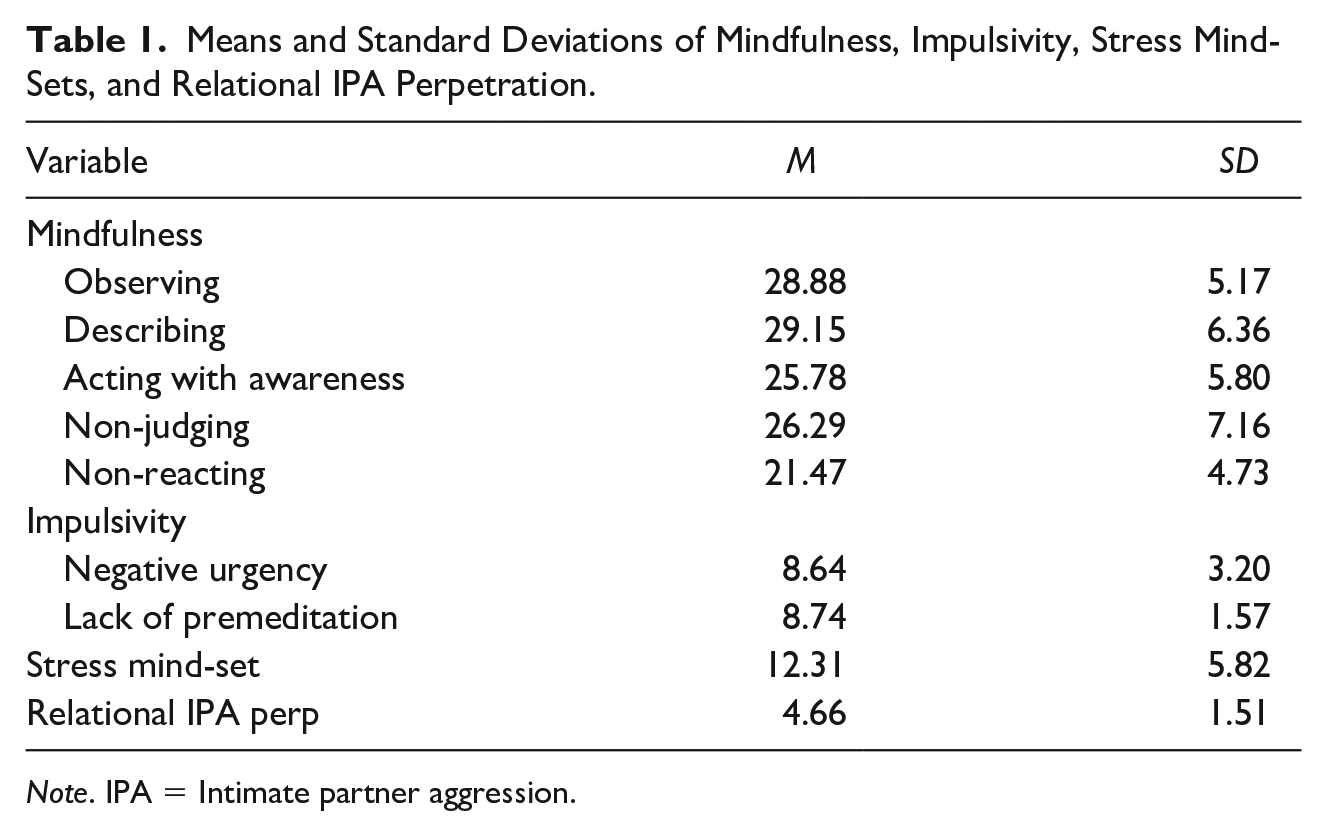
Note. IPA = Intimate partner aggression.
Estimated Model Effects of the Mindfulness, Negative Urgency, and Relational IPA Perpetration.

Note. SEE = standard error of estimate; BCLL = bias-corrected lower limit of 95% confidence interval; BCUL = bias-corrected upper level of 95% confidence interval; IPA = intimate partner aggression.
Hypothesis 2 proposed that the lack of premeditation component of impulsivity would mediate the relation between all five facets of trait mindfulness and perpetration of relational IPA. However, analyses failed to demonstrate mediation for any facet of mindfulness.
Hypothesis 3 proposed that the relation between mindfulness, impulsivity, and relational IPA perpetration would be moderated by stress mind-set, such that impulsivity would mediate the relation between mindfulness and perpetration, but that the relation would be stronger for individuals with a negative stress mind-set (see Figure 1). Concerning models including negative urgency as the mediating variable, moderated mediation was present for the Observing and Describing facets of mindfulness (see Tables 3 and 4). The present study examined the effects of the mediation analysis at different values of stress mind-set. Examination of the tables indicates that, for these facets of mindfulness, individuals with an average or negative stress mind-set (i.e., the mean of stress mind-set or 1 SD below the mean for stress mind-set) were more likely than those with a positive stress mind-set to perpetrate psychological aggression resulting from impulsivity influenced by decreased mindfulness. In addition, results indicated a trend for the Non-Reactivity facet of mindfulness. For this facet, individuals who demonstrated a negative stress mind-set (i.e., 1 SD below the mean for stress mind-set) were more likely to perpetrate relational aggression resulting from impulsivity influenced by decreased mindfulness. Because the sample size decreased from the mediation analyses to the moderated mediation analyses, the trend demonstrated in the mediation analysis was not present in the moderated mediation analysis for the facet of Acting with Awareness. Finally, no mediation was present for the Non-Judging facet of mindfulness and so, moderated mediation was similarly not present. All models demonstrated acceptable model fit (comparative fit indices [CFIs] = .914–.985), with the exception of the model for the Observing facet of mindfulness (CFI = .660). Concerning models including lack of premeditation as the mediating variable, the analyses did not identify moderated mediation for any of the five facets of mindfulness.
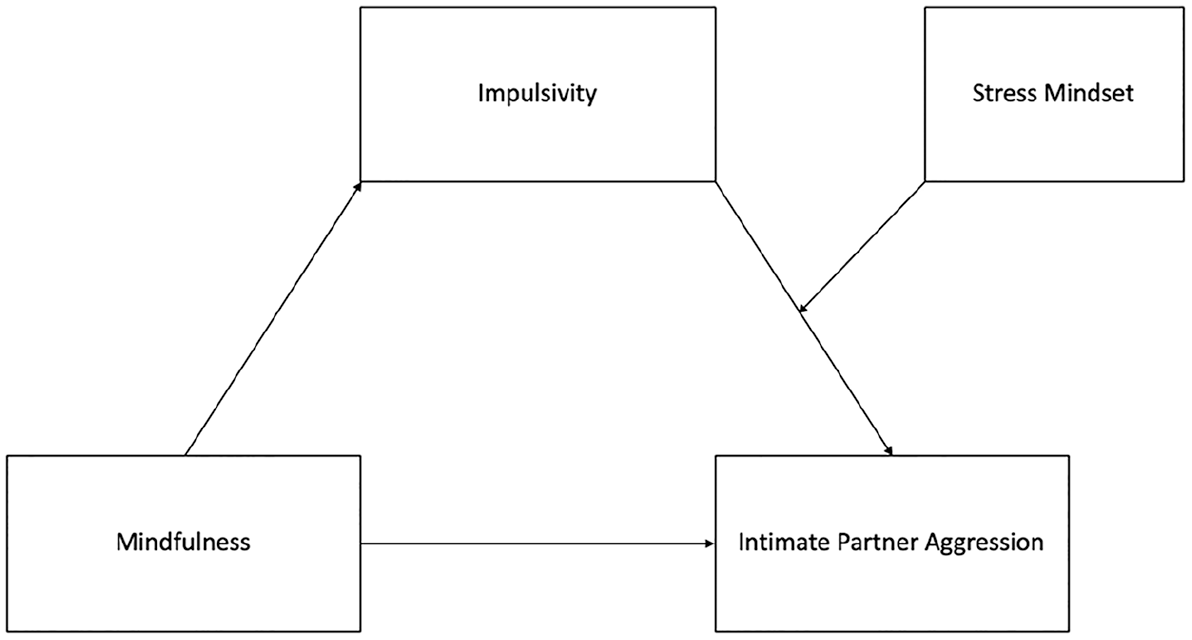
Proposed relationship between mindfulness, impulsivity, stress mind-set, and IPA.
Estimated Model Effects of the Mindfulness, Negative Urgency, Relational IPA Perpetration, and Stress Mind-Set Model.

Note. SEE = standard error of estimate; BCLL = bias-corrected lower level of 95% confidence interval; BCUL = bias-corrected upper level of 95% confidence interval; IPA = intimate partner aggression; AA = acting with awareness; NJ = non-judging; NR = non-reactivity.
Conditional Indirect Effects of Mindfulness on Relational IPA Perpetration on Bias-Corrected Bootstrapping Technique.
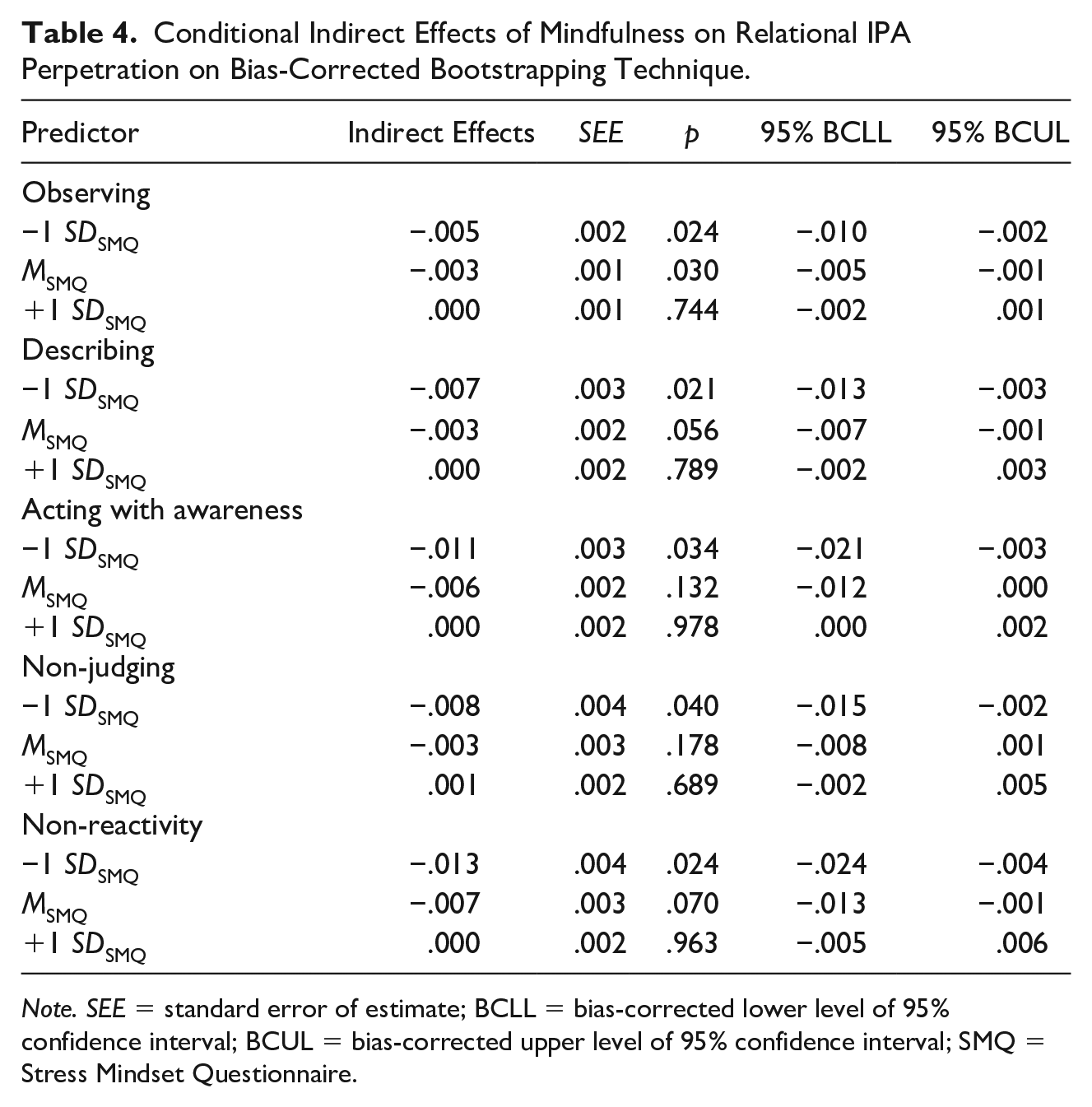
Note. SEE = standard error of estimate; BCLL = bias-corrected lower level of 95% confidence interval; BCUL = bias-corrected upper level of 95% confidence interval; SMQ = Stress Mindset Questionnaire.
Discussion
Relational IPA perpetration has been associated with many health risks and continues to represent a pervasive problem for both the victims of IPA and for the larger society. The present study attempted to identify potential contributing factors increasing the likelihood of relational IPA perpetration. Specifically, the present study first examined a mediation model for a relation between five facets of mindfulness and relational IPA perpetration, utilizing the Negative Urgency facet of impulsivity as the mediator. Results indicated that negative urgency successfully mediated the Observing and Describing facets of mindfulness, with the Acting with Awareness and the Non-Reactivity facets demonstrating trends toward significance. That is, as one’s ability to note one’s internal experience, to label them, to bring focused attention to one’s present-moment activity, and to allow one’s thoughts and emotions to pass is increased, the likelihood of relational IPA perpetration may decrease, through a decrease in the likelihood of impulsivity in the form of acting rashly when distressed. These findings are in line with previous research findings, which suggest that as individuals are more mindful, they may be less likely to respond aggressively in conflict situations (Shorey et al., 2014). The present study, along with prior literature and theory, suggests that mindfulness might work to reduce relational IPA perpetration by strengthening the reflective system over the impulsive system (Wilhelm et al., 2009) and, thereby, reducing the likelihood of relational IPA perpetration.
While the present study demonstrated partial to full mediation with four of the facets of mindfulness, negative urgency did not mediate the association between non-judgment and psychological IPA perpetration. These findings are in contrast to prior research, which found that the non-judging facet of mindfulness was associated with trait impulsivity (Lattimore et al., 2011). The absence of mediation of the relation between the non-judging facet of mindfulness and relational IPA perpetration by negative urgency may be due to the nature of this facet of mindfulness. While the Observing, Describing, Acting with Awareness, and Non-Reactivity facets of mindfulness ask one to take note of one’s thoughts and emotions and proceed with greater knowledge and understanding of those thoughts and emotions, the Non-Judging facet of mindfulness asks one to alter one’s emotions toward thoughts and feelings. Rather than “taking stock” of emotions, non-judgment asks one to approach thoughts and feelings clinically, without emotion. Therefore, it is plausible that negative urgency, which is heavily emotionally based, would fail to mediate the relationship between non-judging and relational IPA perpetration.
This study also examined a mediation model for an association between all facets of mindfulness and relational IPA perpetration, utilizing the Lack of the Premeditation facet of impulsivity as a mediator. However, results failed to demonstrate even partial mediation for this subtype of impulsivity for any of the facets of mindfulness. Lack of premeditation was hypothesized to be a mediator due to previous research concerning the association between mindfulness and lack of premeditation, most of which indicated that mindfulness is negatively associated with lack of premeditation (Cyders et al., 2014; Peters et al., 2011). However, these findings are in agreement with a study showing that relational IPA perpetration was unrelated to performance in an impulsivity task (Schumacher et al., 2013), and findings that lack of premeditation was only associated with one facet of mindfulness (Peters et al., 2011). It is likely that lack of premeditation did not mediate the relation between mindfulness and relational IPA perpetration due to the lack of emotionality present in the Negative Urgency facet (discussed further below).
In an effort to acknowledge that the mediation effects found might not occur in the same way for all individuals, the present study further extended the literature by examining a moderated mediation model concerning associations between mindfulness, impulsivity, stress mind-set, and relational IPA perpetration. It was hypothesized that stress mind-set would moderate the relation between mindfulness and relational aggression, as it is mediated by impulsivity. In regard to the negative urgency subtype of impulsivity, results indicated that moderated mediation was present for the Observing and Describing facets of mindfulness. Furthermore, results indicated a trend for the Non-Reactivity and Acting with Awareness facet of mindfulness. For these facets, individuals with a negative (or average) stress mind-set (i.e., stress is aversive/harmful) tend to have lower mindfulness, contributing to higher instances of relational IPA perpetration, mediated by higher rates of negative urgency. These results are supported by the burgeoning literature on stress mind-set (Crum et al., 2013; Kreek et al., 2005; Lazarus & Folkman, 1984; Middlebrooks & Audage, 2008). Taken together, these findings suggest that individuals who hold a negative stress mind-set may be more likely to act on negative emotion through negative urgency. That is, for individuals who view stress as harmful, lower mindfulness may contribute to higher rates of relational IPA perpetration because they may be more likely to act in such a way as to alleviate negative affect in a quick and rash manner (i.e., negative urgency). The Observing, Describing, and Non-Reactivity facets of mindfulness might be particularly closely associated with negative urgency and stress mind-set as together they ask one to note and label their internal experience and allow thoughts and emotions about the experience to pass more easily from awareness. These facets of mindfulness may have particular bearing on negative urgency as this type of impulsivity tends to be emotionally focused. If individuals are able to reframe negative affect as less harmful and employ the observing, describing, and non-reactivity components of mindfulness, they may be able to reduce the affect associated with conflict situations, thereby reducing the experience of negative urgency and subsequent harmful behaviors aimed to dispel negative affect.
This moderated mediation effect was not present for individuals with a positive stress mind-set (i.e., stress is helpful). That is, for individuals with a positive stress mind-set, impulsivity did not mediate the relationship between mindfulness and relational IPA perpetration. For individuals with a positive stress mind-set, negative urgency was not as likely to lead to relational IPA perpetration. These results might underscore the importance of stress mind-set as a higher order variable in the stress literature. That is, if individuals hold a positive stress mind-set, mindfulness no longer works through negative urgency to reduce relational IPA perpetration.
As mentioned earlier, not all tests of mediation were significant. Results did not indicate a moderated mediation effect for Non-Judging, nor were any facets of mindfulness found to be associated with IPA perpetration through the Lack of Premeditation mediator. This finding may be explained by considering the context in which aggression occurs between partners. It is well recognized that many, if not most, episodes of aggression between partners may be preceded by escalating conflict. The findings of this study suggest that emotionality may be a crucial component to consider in the relation between mindfulness, impulsivity, stress mind-set, and relational IPA perpetration. Whereas the Negative Urgency facet of impulsivity includes a strong negative emotionality component, the Lack of Premeditation facet does not include this affective component. It may be this negative emotionality that contributes to psychological IPA perpetration. Fals-Stewart and colleagues (2005) proposed a theoretical model concerning individual differences in IPA perpetration based on variations in personal thresholds for aggression. In the theoretical model, individual thresholds were lowered (i.e., likelihood of aggression was increased), depending on the type of aggression and other contributing factors. Applied to the present study, it is hypothesized that individual thresholds for relational IPA perpetration are higher (i.e., psychological IPA perpetration is less likely), when considering impulsivity facets like Lack of Premeditation, due to the absence of strong negative emotionality. However, the Negative Urgency facet accounts for negative emotionality, which likely lowers the threshold for relational IPA perpetration. The desire to eliminate negative affect during conflict may be influential in increasing the likelihood of acting aggressively during the conflict. If individuals are able to reduce their negative urgency or alter their stress mind-set, it is likely that instances of IPA will be reduced. This hypothesis would account for the presence of moderated mediation for the Negative Urgency facet but not for lack of premeditation.
Implications
The present study suggests a number of possibilities for interventions aimed at reduction of relational IPA perpetration. First, this study underscores the importance of negative emotionality in resulting relational IPA. Impulsivity and strong negative affect evident in the Negative Urgency facet of impulsivity may be a target for potential clinical interventions. Understanding, reframing and reducing negative urgency, through implementation of other coping mechanisms or emotion regulation strategies would likely increase individual threshold for relational IPA perpetration and decrease the likelihood of relational aggression. Furthermore, the present study underscores the role of stress mind-set as it is associated with the likelihood of IPA perpetration. As the results indicated, impulsivity did not mediate the relation between mindfulness and relational IPA perpetration for individuals with a positive stress mind-set but did for some aspects of mindfulness and negative urgency. According to previous research (see Crum et al., 2017), stress mind-set can be altered. That said, stress mind-set is also a potential target for clinical interventions aimed at reducing IPA perpetration. It is likely that by providing individuals psychoeducation concerning stress mind-set, and how to alter it, the movement toward a more positive stress mind-set could be established, thus reducing the likelihood of relational IPA perpetration.
Limitations and Future Directions
While the present study contributes to the current literature on relational aggression, it is not without limitations. First, the present study was cross-sectional and correlational. Thus, the present findings do not constitute causal data and future research should focus on implementing interventions targeting levels of stress mind-sets and impulsivity to determine the extent to which these constructs may be amenable to change. A treatment study might focus on implementing treatments focused on the potential facets of intervention in couples who have experienced relational IPA perpetration or victimization.
An additional limitation of the present study exists when considering affect during the conflict situations that may lead to relational IPA. That is, the present study did not examine individual affect in temporal connection with IPA perpetration. Therefore, only hypothetical conclusions are able to be drawn concerning how affect might contribute to negative urgency and IPA perpetration. Future studies might consider implementing data collection concerning assessment of affect concurrent with conflict and relational IPA perpetration. Furthermore, the theory behind negative urgency states that negative emotionality necessitates impulsive action toward decreasing negative emotionality. Therefore, future studies should confirm this, through assessing affect both before and after relational IPA perpetration.
Finally, the present study did not measure temporal connections between the variables included. It has been suggested in the literature (Bell & Naugle, 2008) that a contextual framework for the occurrence of IPA is important to consider when attempting to predict the factors contributing to partner aggression. The present study asked participants about their previous experience of partner aggression and did not include examination of the contextual factors causing the event. Future studies should include an examination of contextual factors to provide a more complete representation of the factors contributing to IPA perpetration.
Despite these limitations, this study still contributes to the literature on mindfulness, as it relates to IPA. These findings provide a mechanism by which mindfulness might reduce IPA, by reducing negative urgency. In addition, the present findings provide support for treatment interventions focused on altering stress mind-set toward reducing the likelihood of IPA. It will be important to continue research in these areas to expand our knowledge about available options for treatment to continue to reduce instances of, and impacts of, relational aggression.
Footnotes
Declaration of Conflicting Interests
The author(s) declared no potential conflicts of interest with respect to the research, authorship, and/or publication of this article.
Funding
The author(s) received no financial support for the research, authorship, and/or publication of this article.
