



Abstract
MeToo movement unveiled the high prevalence of sexual assault in Chinese colleges. To create a safer environment, many Chinese universities require students to engage in bystander intervention sessions, which encourages students to assess, identify, and interrupt the harmful situation. Drawing upon health belief model and theory of planned behavior, this study tests the effects of bystander intervention programs, exposure to news reports on MeToo movement, and institutional responses to sexual violence events on bystander intervention intention and behaviors. The results of an online survey (N = 814) indicated that bystander intervention programs were effective in changing attendees’ perceived benefits, subjective norms, and bystander self-efficacy, which, in turn, led to increased bystander intervention intention and actual behaviors. Moreover, exposure to MeToo movement reports and institutional responses to sexual assault events were significant predictors of bystander intervention intention and behaviors via the mediation of perceived benefits, perceived costs, and subjective norms. The results provide valuable implications for developing effective bystander intervention programs in Chinese college communities.
Introduction
MeToo movement is a collective social movement to fight against sexual violence since 2017. Originated from the United States, the hashtag of MeToo spread virtually in many countries on social media (Orgad & Gill, 2019; Rodino-Colocino, 2018). In China, a male dominant society, women often exhibit greater obedience to power and authority figures to avoid potential punishments (Luthar & Luthar, 2008). Due to the fear of losing jobs, delayed graduation, unfair treatments, and social stigma, victims of sexual assault in China often choose not to report such cases to the police (Zhou & Zheng, 2018). This wave of MeToo movement reshaped Chinese people’s perceptions of sexual violence and encouraged female victims to share their negative encounters to the public. A list of powerful male figures in prestigious media companies, nongovernmental organizations, and universities were identified as sexual abusers, which spurred discussions about sexual violence prevention (Lin & Yang, 2019).
Sexual assault in college is central to MeToo movement in China. Many Chinese female students claimed that they were harassed by internship supervisors, professors, and college staff (Wang et al., 2015). A survey in 2016 indicated that about a third of college students have experienced some types of sexual assault during college study (Qian, 2016). Victims are likely to face physical, mental, and sexual health problems and have poorer academic performance (McMahon et al., 2014). Unlike universities in the Western countries providing rich support for sexual violence victims, most Chinese institutions do not have victim support centers. Before MeToo movement, Chinese universities were unwilling to reveal sexual violence events to the public and provided very limited support to the victims (Dong, 2013). The high prevalence of sexual violence on campus in China has been underestimated and ignored in a long period.
The outpouring of news reports on MeToo movement has given momentum to college victims to speak out and pushed Chinese universities to implement programs to end sexual violence on campus. In the early stage of the movement, the state government and universities censored numerous postings on social media with #MeToo hashtag. While the public awareness of sexual assault was on the rise, related higher education institutions came out to fire the accused prominent professors and provided support for the victims. Next, the Ministry of Education of the People’s Republic of China claimed the plan to implement sexual violence prevention mechanisms into college campuses (Repnikova & Zhou, 2018). Recently, some Chinese universities have developed mental health consultation services for victims to address issues that may impact their college life (Zhou & Zheng, 2018). The introduction of bystander program is one of the recent efforts.
Bystander education has been used to encourage students to intervene sexual assault. The idea of bystander intervention is based on a psychological phenomenon—bystander effect, which refers to the observation that individuals are less likely to support victims when they are in a group. People tend to believe that others will respond to the harm and therefore choose not to engage (Hudson & Bruckman, 2004). Bystander intervention programs aim to raise people’s awareness of the issue and lower the bystander effect by framing sexual violence as a community issue and reversing the social norms that tolerate sexual violence (Banyard et al., 2004). A number of research in the United States recorded firm support for the effectiveness of bystander program with results showing a reduction in rape myth acceptance (Banyard & Moynihan, 2011; Coker et al., 2011; Hines & Palm Reed, 2015) and an increase in self-reported bystander intervention attitudes and behaviors (Banyard et al., 2007; McMahon et al., 2015). Previous study categorized China as a high power-distance society, in which the subordinate–superior relationship tends to be polarized. Subordinates are less likely to express any disagreements with superiors and even be tolerant of abuses from individuals with high power (Wu et al., 2012). Chinese student victims of sexual violence are likely to remain silent due to the fears about superiors’ retaliation. Therefore, the engagement of a responsible bystander is of great importance to break the silence and interrupt the harm situations. If everyone express disapproval to violent jokes and problematic behaviors, the harm behaviors, over time, will be considered as unacceptable in college community. The outbreak of MeToo movement abetted by the sexual violence prevention centered programs can potentially influence the younger Chinese attitudes toward bystander intervention; however, little empirical evidence has been documented. The current study fills this literature gap by testing how MeToo movement, bystander education, and institutional responses to victim events influence people’s perceptions of and behaviors toward sexual assault intervention. The findings are expected to illuminate the process of creating prosocial changes.
The Bystander Intervention Approach
Bystander programs involve the education on student bystanders to intervene timely and effectively in the harm situation. In the training program, the first important step is to teach participants to recognize the potential harm situation (Banyard et al., 2009). When people can clearly identify the emergency situation, they are more likely to intervene. The next step for prosocial bystander intervention is to balance the pros and cons of the actions and make a decision on taking actions or not. Another condition for successful intervention is the high degree of self-efficacy. Bystanders need to determine whether they possess sufficient skills to intervene, in which they can stall the harm situation effectively and also protect themselves against potential harms (Banyard et al., 2004, 2007). The bystander intervention approach motivates community members to identify the sexual crime situation and support the victims before, in, or after the perpetration. Also, the training program seeks to increase the discussions against sexual violence, lower the community’s proattitudes toward sexual misconduct, and in the long run, reverse the social norms that tolerate sexual crimes (Banyard et al., 2007).
A number of studies have supported the effectiveness of bystander intervention programs in the United States, with results showing a reduction in rape myth acceptance (Banyard & Moynihan, 2011; Coker et al., 2011; Hines & Palm Reed, 2015) and an increase in self-reported bystander intervention attitudes and behaviors (Banyard et al., 2007; Jouriles et al., 2016; McMahon et al., 2015). For instance, Banyard and her colleagues produced one of the first longitudinal studies that provided empirical evidence of an increase in prosocial bystander attitudes, self-reported bystander intervention behaviors, and bystander efficacy after attending the training program. Coker et al. (2011) found the use of a Peer Opinion Leaders (POL) strategy to be effective in Green Dot bystander training as it was associated with higher self-reported prosocial bystander behaviors. Hines and Palm Reed (2015) conducted a study to estimate the effectiveness of a bystander intervention program. The findings suggested that after a 6-month bystander intervention training, participants who were at higher risk experienced a significant increase in attitudes against dating violence and sexual violence, bystander efficacy, and prosocial bystander behaviors.
Four limitations in previous studies on the evaluation of bystander intervention programs need more attention. First, prior studies focused on the students who participated in bystander intervention programs and examined the effects on their attitudinal and behavioral changes (Banyard et al., 2007; Hines & Palm Reed, 2015). However, in reality, students may receive bystander intervention training information in various ways, which is not limited to face-to-face training. Second, previous studies that addressed the effectiveness of bystander intervention did not consider media use effects on behavioral changes. Issue salience of MeToo movement on social media spurred fierce debates about sexual assault prevention. People who are exposed to such media contents are likely to develop stronger intention to stop sexual violence. Third, very few studies have introduced theories of behavioral change to assess the effectiveness of bystander intervention. Behavioral change theories assume that behavioral changes result from changes in psychological processes (Palmeira et al., 2007), which could contribute to explaining the process of creating prosocial changes regarding preventing sexual violence in college community. Finally, the majority of published studies focused on the American context. Efficacy of bystander programs in Asian countries needs to be further explored.
The Current Study
To address the aforementioned limitations, this study draws upon health belief model (HBM) and theory of planned behavior (TPB), two major theories of behavioral changes, to explicate how bystander intervention training, exposure to MeToo movement reports, and institutional responses influence college students’ motivation to engage in bystander intervention.
HBM is one of the widely used theoretical frameworks in addressing behavioral changes in health campaigns (A. S. Richards, 2014). HBM holds that before people engage in health risk reduction behaviors, people undergo a set of psychological appraisals, including perceived susceptibility and severity of negative health outcomes, perceived benefits of behavioral changes, barriers to actions, self-efficacy, and cues to actions (Champion & Skinner, 2008). HBM assumes that people believe negative health outcomes can be avoided through practicing healthy behaviors. Prior studies have shown that when people possess strong confidence in practicing recommended behaviors, perceive greater benefits than costs in behavioral changes, and perceive high severity and susceptibility of negative health outcomes, they are more likely to engage in behavioral changes (Willis, 2018).
Tailoring HBM to bystander intervention, self-efficacy is operationally defined as one’s confidence in conducting bystander behaviors to stop sexual assault. Perceived benefits and costs are operationally defined as people’s cognitive appraisal of the values and barriers in bystander intervention. Following the logic of HBM, the current study expects that after participating in bystander intervention programs, college students are likely to perceive greater benefits and less costs in deterring harm situations as bystanders. As the training programs aim to equip students with skills and knowledge to proper intervention, student trainees are likely to be more confident in conducting behavioral interventions.
HBM centers on the individual estimations of the threats and calculus of costs and benefits but underestimates the social influence over one’s behavioral decisions. The TPB adds that subjective norms positively predict people’s intention to positive behavioral changes. Subjective norms reflect people’s perceptions about others’ approval/disapproval toward specific behaviors (Abrams et al., 1998; Amjad & Wood, 2009). When people detect that expressing disapproval toward sexual violence is highly recommended, they are more likely to behave as an active bystander.
Changing subjective norms are important for the success of bystander intervention programs. College students live in a highly populated environment with frequent interpersonal encounters. They are at the age of having high risks of sexual and intimate partner violence (Mellins et al., 2017). College students are active viewers of internet pornography and sexually explicit media content (Chen et al., 2015). Prior research indicated that frequent exposure to internet pornography increased people’s intention to engage in sexual harassment, high-risk sexual behaviors, and accepting attitudes toward sexual mistreatment toward women (Braun-Courville & Rojas, 2009 ; Brown & L’Engle, 2009). Students who perceive sexual violence as acceptable are more likely to commit sexual-related crimes (McMahon et al., 2014). The supportive norms on sexual violence were found to increase the occurrence of rape and sexual assault incidents on college campuses (Fabiano et al., 2003). Such subjective norms provide excuses for the perpetrators to justify their offensive behaviors and increase the blame on victims instead of on the perpetrators. To reduce incidence of sexual violence, one of the key solutions is to increase students’ disapproval on sexual violence (Chiroro et al., 2004; O’Donohue et al., 2003). In the current study, subjective norms is operationally defined as people’s perception about others’ approval to bystander intervention. We expect that engagement in bystander intervention training increases students’ bystander subjective norms.
In addition to personal factors, institutional responses to sexual assault cases also influence students’ bystander intervention. Institutional responses refers to the special accommodations offered to student survivors, such as the timely report to police department, efforts in comprehensive investigation of the event, provision of psychological consultation to sexual trauma, and options of extensions on exams and reductions on course loadings (Holland & Barnes, 2019). Previous studies documented that the majority of student victims chose not to report sexual assault to campus counseling service providers (Cantor et al., 2015; Rennison & Addington, 2014). A national survey in the United States indicated that the reporting rate in college community ranged from 1% to 13% (T. N. Richards, 2019). The main reason of low reporting rate was the lack of understandings of institutional resources. Universities should incorporate sponsored verbal training, written contents (such as posters and flyers), on-campus rally, and social media posts to increase students awareness of available resources (T. N. Richards, 2019). In China, the majority of college students have limited information about related institutional resources (Wang et al., 2015) and the stigma attached to sexual assault has lowered victims’ intention to report (Xue et al., 2019). In Chinese universities, one major barrier to bystander intervention is that students who witnessed problematic situations do not know how to behave effectively. If bystanders are aware of the institutional resources to resort to, students who enrolled in the bystander training are more likely to protect the survivor in the right way. The current study expects that hearings about institutional response resources are associated with increased perceived benefits and decreased perceived costs of bystander intervention. Moreover, it expects that students who are familiar with institutional support are more likely to express disapproval to sexual assault.
MeToo movement in China has transformed the younger generation’s attitudes toward sexual violence. As a number of student victims unveiled their experiences, government and university authorities acknowledged that sexual assault should not be tolerated. As issues of sexual violence have become high profile in Chinese college communities, victims are advocated to go public with allegations and seek help from campus or social support providers (Fincher, 2018). After learning MeToo stories, bystanders in college community are likely to be aware of the needs to be active interventionists and are motivated to protect the survivors. In the current study, MeToo exposure is expected to be associated with greater perceived benefits and less perceived costs of bystander intervention as well as increased subjective norms.
Next, consistent with HBM and TPB, the current study expects that the psychological factors (i.e., subjective norms, self-efficacy, and perceived benefits/costs) predict people’s bystander intervention intention, which in turn, leads to actual intervention behaviors. The conceptual framework is displayed in Figure 1.

Conceptual framework of the current study.
Method
Sampling Process
The survey data were collected via SoJump from March 9 to 14, 2019. SoJump is a Chinese online survey platform that has around 2.6 million subscribers, which allows researchers to design survey and recruit quality respondents according to sampling criteria. Respondents were college students and each received 15 CNY (approximate to 2 US$). The responses to the survey were anonymous and voluntary. The original sample size was 912. After dropping invalid responses, namely, those who finished the survey in less than 4 min, filled the survey using the same ID multiple times, or failed in the attention checking test, the final valid sample included 814 respondents. We treated city size, gender, household income, school grade, and parents’ education level as control variables. Regarding the size of the city where the respondents lived in, 18.3% of the respondents came from Beijing/Shanghai/Guangzhou/Shenzhen (four largest cities in China), 23.1% lived in the provincial capital cities, 28.1% lived in prefecture level cities, 24% lived in county-level towns, and the remaining 6.5% lived in small villages, which was representative of city sizes. In terms of gender, 36.1% of the respondents were male and the rest were female. The household monthly income was measured on a 8-point scale: “less than 5,000 CNY” (1), “5,000–10,000 CNY” (2), “10,001–15,000 CNY” (3), “15,001–20,000 CNY” (4), “20,001–30,000 CNY” (5), “30,001–40,000 CNY” (6), “40,001–80,000 CNY” (7), and “above 80,000 CNY” (8). The majority of the respondents reported monthly household income between 5,000 and 15,000 CNY. Considering that familiarity with campus facilities and family background may influence one’s decision to participate in bystander intervention, we treated school grade and parents’ highest degree achieved as control variables. The results indicated that 21.99% of the respondents were freshmen, 33.66% were sophomores, 28.01% were juniors, 15.23% were seniors, and the rest 1.11% were graduate students. Parents education level was as follow: no formal education = 1.11%; elementary school = 6.39%; middle school = 23.83%; high school = 29.61%; associate degree = 15.11%; bachelor’s degree = 20.76%; master’s degree = 2.09%; doctorate or postdoctoral degree = 1.11%. Consistent with previous studies (Cronbach & Shavelson, 2004; Zimmerman, 1972), we used Cronbach’s alpha to measure the reliability of continuous scale.
Measurement
Verbal bystander training
This variable was measured with two yes/no statements about the engagement in sexual assault victim support groups and attendance of verbal bystander training since college enrollment. Respondents who participated in one or two types of the activities mentioned above were coded as 1, whereas the others were coded as 0. More than a third of the respondents (38.21%) reported prior participation in verbal bystander training or victim support activities.
Written bystander training
We used one item asking respondents whether they received any pamphlets about bystander intervention since enrollment to measure written bystander training. More than half of the respondents (52.33%) received written information about bystander intervention.
Institutional responses
Adapted from prior study (Busch-Armendariz et al., 2017), nine items addressing institutional support for victims were measured, including the timely support with formal or informal resources, immediate apology to victims, equal treatments to victims, and satisfactory accommodations to specific needs, and active cooperation with police authorities for detailed investigation. Responses were given by “yes” (1), “no” (0), and “not sure” (−1). Items were summed to compute the score of institutional responses (M = 4.81, SD = 2.51; Cronbach’s α = .76).
Exposure to MeToo movement reports
We measured the degree that people exposed themselves to news reports about MeToo movement with two items. We tested respondents’ frequencies of reading news reports about college students sexually assaulted by faculty/staff members or by internship supervisors since the outbreak of #MeToo (i.e., “Since late 2017, how many times have you read news reports about college students harassed by university faculty or staff member?”). Response options ranged from “never” (0) to “many times” (5). We calculated the mean to create the score (M = 3.61, SD = .93). The reliability for this two-item scale was satisfactory (Cronbach’s α = .73).
Perceived benefits and costs of bystander intervention
Adapted from (Banyard et al., 2007), two items were used to measure perceived benefits (“If I intervene regularly, I can prevent someone from being hurt”) and perceived costs (“People might think I am too sensitive and overacting to the situation”) of bystander intervention. Responses were given through a 5-point scale ranging from “strongly disagree” (1) to “strongly agree” (5).
Bystander self-efficacy
Adapted from prior literature (Banyard et al., 2005, 2007), it used six items to measure people’s confidence in performing bystander intervention effectively. For instance, respondents were asked to estimate their confidence in conducting the flowing behaviors: (a) “Express my discomfort if someone makes a joke about a woman’s body,” (b) “Express my discomfort if someone says that rape victims are to blame for being raped,” (c) “Talk to a friend who I suspect is in an abusive relationship,” (d) “Speak up in class if a professor provides misinformation about sexual assault, dating/domestic violence, sexual harassment, or stalking,” (e) “Do something if I see a woman is surrounded by a group of men at a party who looks very uncomfortable,” and (f) “Contact campus authorities about information I have that might help in a sexual assault case even if pressured by my peers to stay silent.” Responses were given by “not confident at all” (1) to “very confident” (4). Scores of self-efficacy were computed by averaging the six items (M = 2.64, SD = .55, Cronbach’s α = .70).
Subjective norms
Drawing upon previous work (Rimal & Real, 2005), the current study used three items to measure students’ subjective norms about bystander intervention. These items reflect respondents’ perceptions about community members’ support for bystander intervention. Responses ranged from “strongly disagree” (1) to “strongly agree” (5) (M = 3.96, SD = .58). The reliability of the scale was satisfactory (Cronbach’s α = .74).
Bystander intervention intention
Adapted from prior study (McMahon et al., 2014), we used a single item to measure respondents’ bystander intervention intention. Respondents were asked to report their willingness to intervene when they got the opportunity to intervene situations of sexual assault (M = 3.48, SD = .81).
Bystander intervention behaviors
Adapted from the original bystander behavior scale (McMahon et al., 2011), we used a 13-item index scale that measured respondents’ prior bystander behaviors. Responses were given as “yes” (1), “no or wasn’t in the situation” (0). Bystander behaviors examined included the preassault intervention, postassault intervention and the engagement in voluntary groups to support victims. These items were summed up to create the score of bystander intervention behaviors (M = 3.08, SD = 2.36).
Table 1 summarizes the descriptive statistics of the examined variables.
Descriptive Statistics (N = 814).

Represents the frequency of a dichotomous variable.
Analysis Procedure
We used the maximum likelihood estimation to test the proposed four-stage structural equation model. Following the modification indices, we added some covariance paths between same-stage variables that are theoretically justified. To test the effects of Stage 1 variables on Stage 2 and the effects of Stage 2 variables on Stage 3, we held constant for respondents’ gender, school grade, city size, household income, and highest degree achieved by parents. The effects of control variables on endogenous variables are exhibited in Table 2. We reported chi-square, comparative fit index (CFI), and the root mean square error of approximation (RMSEA) to reflect the model fit. According to prior studies, the acceptable benchmarks are .90 or greater for CFI (Kline, 2005) and .06 or less for RMSEA (Hu & Bentler, 1999).
Standardized Effects of Control Variables on Endogenous Variables in SEM.

Note. SEM = structural equation model.
p < .05. **p < .01. ***p < .001.
Results
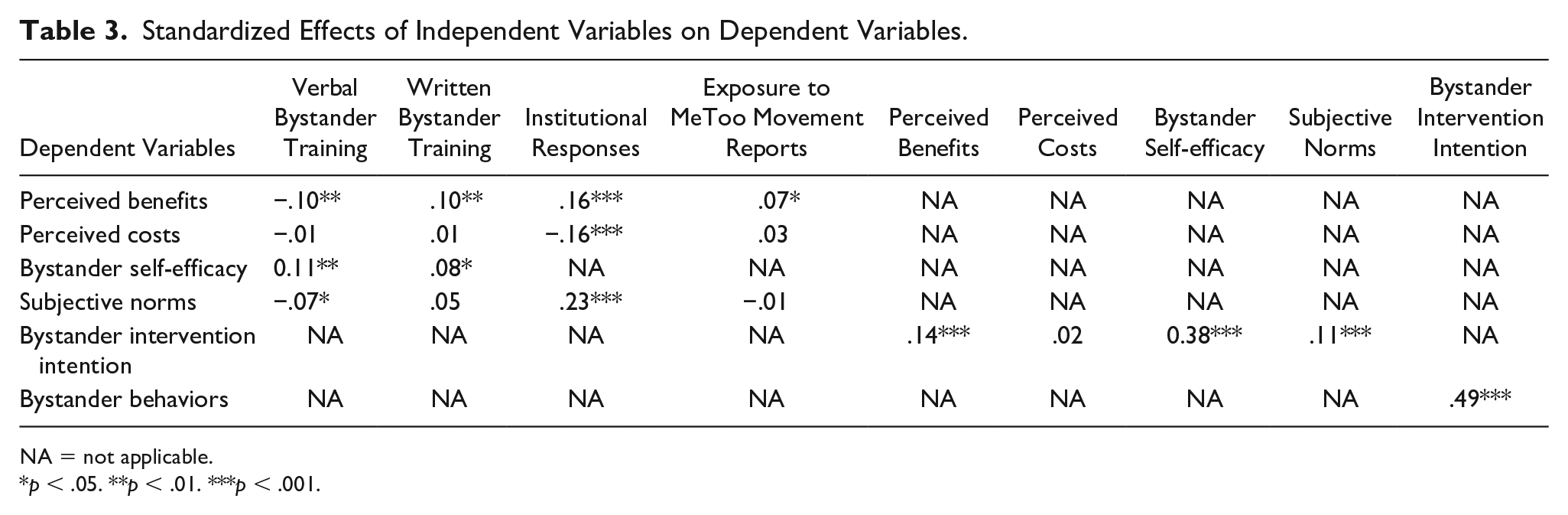
We tested the proposed structural equation model (SEM) using STATA 13.0. The overall structural model fit was good (χ2 = 963.32, p < .001; RMSEA = .059; CFI = .971), providing support for the proposed theoretical framework. After pruning the insignificant paths and holding constant for the control variables, the results of significant SEM paths are displayed in Figure 2. The full results of SEM are presented in Table 3.

Results of the structural equation model.
Standardized Effects of Independent Variables on Dependent Variables.
NA = not applicable.
p < .05. **p < .01. ***p < .001.
H1a and H1b posit that verbal and written bystander training increase one’s perceived benefits of bystander intervention. The results indicated that written bystander training was positively associated with perceived benefits (β = .10, p < .01), while contrary to the prediction, verbal bystander training was negatively associated with perceived benefits (β = −.10, p < .01). Hence, H1b was supported and H1a was rejected.
H2a and H2b assume that verbal and written bystander training increase one’s perceived costs of bystander intervention. The results showed that the effects of verbal (β = −.01, p = .867) and written bystander training (β = .01, p = .943) were not significant in lowering perceived barriers to bystander intervention. Hence, H2a and H2b were rejected.
H3a and H3b predict that the engagement in verbal and written bystander training increases bystander self-efficacy. Both hypotheses received support: verbal bystander training → bystander self-efficacy (β = .11, p < .01); written bystander training → bystander self-efficacy (β = .08, p < .05).
H4a and H4b predict that the bystander training increases subjective norms. The SEM results demonstrated that verbal bystander training was negatively associated with subjective norms (β = .−07, p < .05), whereas the effects of written bystander training was insignificant (β = .05, p = 1.65). Hence, H4a and H4b were rejected.
H5a, H5b, and H5c predict that institutional responses increase one’s perceived benefits of bystander intervention, decrease the perceived costs, and increase subjective norms. The results suggested that all of the hypotheses were supported: institutional responses → perceived benefits (β = .16, p < .001), institutional responses → perceived costs (β = −.16, p < .001), and institutional responses → subjective norms (β = .23, p < .001).
H6a, H6b, and H6c predict that exposure to MeToo movement reports increases one’s perceived benefits of bystander intervention, decrease the perceived costs, and increase subjective norms. H6 received support in the case of perceived benefits of bystander intervention (β = .07, p < .05). Hence, H6a was supported, while H6b and H6c were rejected.
H7 postulates that perceived benefits of bystander intervention positively predict bystander intervention intention. The SEM results indicated that the predicted path was significant (β = .14, p < .001). Hence, H7 was supported.
H8 posits that perceived costs of bystander intervention decrease one’s bystander intervention intention. Contrary to the hypothesis, the effect was found to be insignificant (β = .02, p = .559). H8 was rejected.
H9 and H10 predict that bystander self-efficacy and subjective norms positively predict bystander intervention intention. Both hypotheses were supported (bystander self-efficacy → bystander intervention intention: β = .38, p < .001; subjective norms → bystander intervention intention: β = .11, p < .001).
H11 states that bystander intervention intention positively predicts bystander intervention behaviors. The results supported H11 (bystander intervention intention → bystander behaviors: β = .49, p < .001).
In addition, our theoretical model posited that bystander factors (Stage 1 variables including, verbal bystander training, written bystander training, institutional responses, and exposure to MeToo news report) achieve increased bystander behavioral intention (Stage 3) via the mediation of perceived benefits, costs, self-efficacy, and subjective norms (Stage 2). We tested the mediating effects in SEM. The results indicated that the indirect effect of verbal bystander training was not significant (β = .03, p = .258), whereas the indirect effects of written bystander training (β = .08, p < .01), institutional responses (β = .04, p < .001), and exposure to MeToo news reports (β = .03, p < .10) were significant. The results of mediation tests indicated that perceived costs, bystander self-efficacy, and subjective norms partially mediated the effects of Stage 1 variables on bystander intervention intention.
Discussions
Overall, the current study is consistent with the existing bystander intervention literature (Banyard, 2008), showing that the bystander intervention approach is a valuable means to address sexual assault issues in Chinese college communities. Institutional support and exposure to news reports on MeToo movement also played important roles in facilitating prosocial bystander behaviors. Several theoretical and practical implications can be drawn from the findings. First, the current study provides general support for applying the theoretical models of HBM and TPB to explicate the effectiveness of bystander intervention. Bystander intervention programs were found to be effective in increasing self-efficacy, which results in prosocial outcomes. This finding indicates that intervention skills and familiarity with supporting resources are important aspects of engagement in related behaviors. Respondents received both verbal and written training reported greater self-efficacy, leading to more willingness to stop harmful situations. Such findings provide an empirical base for the design of future bystander intervention programs, suggesting that developing components to increase self-efficacy is pivotal.
The second interesting finding is the mixed effects of verbal and written bystander training on perceptions of behaviors. We found that written bystander training led to increased perceived benefits, while the prediction of verbal bystander training was not supported. Moreover, neither verbal nor written bystander training lowered perceive costs of bystander intervention. The results indicated the weaknesses of the current programs. Successful programs such as Green Dot not only clearly stated the presence of sexual violence uses and the consequences to victims and his or her family members, but also prepared students with knowledge to identify the potential harmful situation and encouraged them to safely and timely address the situation (Coker et al., 2011). The effective programs are likely to make use of face-to-face training, on-campus rally, social media posting, and victim experience demonstration. All forms of activities aim to raise the awareness of sexual violence issues among students. However, in China, the development of sexual violence prevention is disorganized. Some universities issue pamphlets to students in the freshmen orientation (Xiao Xiang Morning News, 2015), while some others provide in-class programs to students (Walker & Towl, 2019). Although widely implemented, the inconsistent organization and the absence of program evaluation lowered the impact on college community. Future programs should utilize the template of existing programs and formalize the education program and supporting agencies.
The third finding is that bystander intervention programs were not significant in changing community subjective norms. Bystander intervention approach is not only about educating individuals to behave while noticing sexual violence, but also aims to change the social norms at the community level (McMahon & Dick, 2011). The goal of college bystander intervention programs is to create a culture at the community level that sexual violence is unacceptable and intolerable. In China, sexual assault victims often choose to stay silent for fear of physical harms, retaliations, unequal treatments in work/study environment, and stigma of being sexual violence victims. The long existing social norms cannot be changed thoroughly in a short run. In the future, bystander practitioners should aim to breakdown the misconceptions of the victims and raise people’s awareness of seeking help from supporting agencies. Educators should adapt bystander intervention programs in Western countries and tailor them to fit with Chinese culture. Future programs should train students to better identify the need to report sexual assault to authorities and police and lower students’ concerns about the disclosure of victim experiences.
Next, we found that institutional responses played an important role in increasing students’ intention to deter harmful situations. Students who are familiar with institutional support for victims are more likely to perceive greater benefits of interventions, less barriers, and disapproval to sexual violence. Given that college students continue to be a high-risk group that is vulnerable to sexual violence, institutional providers need to behave in respectful ways to help victims and deliver the message that the positive outcomes might result from motivated bystander engagement. Universities in China should continue to lower victims’ concerns about being treated differently and assist victims with resources to address the potential posttraumatic stress disorder (PTSD).
Finally, the exposure to news reports on MeToo movement was found to be effective in changing perceived benefits of bystander intervention, which in turn, increased one’s intention to intervene. This finding indicated that the wake of #MeToo enhanced people’s awareness of the large scale prevalence of sexual violence in Chinese college community. Often times, bystanders choose not to intervene because they underestimate the severity and prevalence of sexual violence situaftions in their community and misunderstand the perpetrators’ acts. For example, a sexually explicit joke is often viewed as acceptable if the bystander thinks that the survivor and perpetrator are in a dating relationship. To address this barrier, the open discussions of #MeToo on mass media, social media, and interpersonal conversations are important means to teach about sexuality and contain the escalation of sexual violence in societal level. The striking numbers of survivors and heartbreaking stories presented on media can facilitate honest dialog about providing support for the survivors. The findings of this study indicated that bystander education in Chinese college should not be limited to the instruction of skills, experiences, and available resources in a single session, but should incorporate #MeToo content into the training programs and facilitate informal discussions about ending sexual violence in daily life. As college students often actively engage in social activities and tend to self-disclose to their peers, educators may consider to distribute the program information through students’ social networks, either offline or online.
Limitations and Future Directions
First, we used cross-sectional survey data and therefore could not identify the causal relationships in the bystander intervention process. Future longitudinal study would better permit the assessment of creating changes in prosocial bystander attitudes and behaviors. Second, the current study did not measure the design of bystander intervention programs. Unlike the United States, such programs in China lack consistent template. This study highlights the values of bystander education but the factors that predict effective message design are uncertain. Future research need to examine which types of message design are favored by college students. Moreover, we measured the written bystander training by asking the receipt of related pamphlets, which does not necessarily lead to actual reading. Future study should examine to what extent the pamphlet recipients developed understandings of bystander issues after reading. Third, the self-reported bystander intervention intention and behaviors may be overestimated due to respondents’ social desirability bias. Future studies should consider to examine respondents’ responses in experimental settings. Fourth, the measurements of bystander constructs based on the Western culture are still evolving, which may not fit well with the Chinese context. Due to the differences in education systems, future research should develop scales that are better adapted to explaining sexual violence issues in China. Finally, the current study measured exposure to MeToo movements by asking respondents’ frequency of reading related news articles. However, much of the #MeToo movement happened on social media. The focus of future MeToo exposure measures should shift to the new media platforms.
Conclusion
The emergence of MeToo movement has unveiled the prevalence of sexual violence in Chinese college communities, which highlights that the protection of students from sexual assault and provision of institutional support for victims have become a pressing issue in China. As sexual violence in China continues to be a pressing issue (Leggett, 2017), the current study fills the gap through testing the effectiveness of bystander intervention in China, and contributes to the understanding of key constructs of creating prosocial changes to prevent sexual violence on college campuses. The results demonstrate that the bystander intervention approach is a viable means to prevent sexual assault but the design of related programs should be honed to fit with the Chinese culture. Moreover, the current study documents that the changes resulting from MeToo movement are happening in China, suggesting that future research should address the effect of this social movement on sexual violence prevention on campus over time.
Footnotes
Declaration of Conflicting Interests
The author(s) declared no potential conflicts of interest with respect to the research, authorship, and/or publication of this article.
Funding
The author(s) received no financial support for the research, authorship, and/or publication of this article.
