



Abstract
Recent research has ascertained some risk factors for cyberbullying. However, few studies have investigated the potential influence of difficulties in emotion regulation (DER) on cyberbullying, and there is little knowledge about the mediating mechanisms underlying this association. This study investigated whether DER would be significantly related to adolescent cyberbullying and whether loneliness and depression would sequentially mediate the link between DER and adolescent cyberbullying. A sample of 719 Chinese middle school students completed measures regarding demographics, DER, loneliness, depression, and cyberbullying. After controlling for the demographic covariates, the results showed that (a) DER was positively associated with adolescent cyberbullying; (b) loneliness and depression sequentially mediated the relation between DER and adolescent cyberbullying. This study emphasizes the underlying mediating mechanisms between DER and adolescent cyberbullying, which is of great significance for the prevention and intervention of adolescent cyberbullying in the digital age.
Introduction
Today’s adolescents, often referred to as the “internet generation,” have grown up in the era of rapid development and universal popularization of the internet. As of June 2019, the number of adolescent internet users in China has reached 144 million, with an internet penetration rate of 93.7% (China Internet Network Information Center, 2019). Meanwhile, due to the anonymity and constant availability of the internet, cyberbullying has become a serious social problem worldwide (Buelga et al., 2017), its prevalence rate has reached 3% to 35% among adolescents aged 15 to 17 years in China (Z. Zhou et al., 2013). Cyberbullying is usually defined as repetitive and intentional malicious acts carried out by individuals or groups using internet devices against others who cannot easily defend themselves (Hinduja & Patchin, 2008), such as insulting, threatening, or slandering others through email, instant messaging, and social networking sites (Chu et al., 2018). Most importantly, cyberbullying can have a negative psychological impact on victims, by leading them to low life satisfaction, mental health problems, and even suicidal tendencies or actions (Estévez et al., 2019; Iranzo et al., 2019). Considering the high prevalence rate of cyberbullying and its negative impact on victims, it is necessary to explore the factors associated with cyberbullying.
Prior studies on cyberbullying have shown that narcissism, moral disengagement, self-efficacy, and social relations are positively correlated with cyberbullying perpetration (Braithwaite et al., 2009; Bussey et al., 2015; Festl & Quandt, 2013; X. C. Wang, Zhao, et al., 2021). However, the causes of cyberbullying are complex, and many important influencing factors remain unexplored such as difficulties in emotion regulation (DER), which is defined as the defect of effectively changing emotional experience or expression to the social context (Gross, 1998). In fact, prior studies have shown that DER is an important risk factor for mental health problems and maladaptive behaviors such as anxiety, impulse control disorders, and low psychological well-being (Aldao et al., 2010; Tian et al., 2011; L. Zhang et al., 2018), which in turn, are also positively related to both cyberbullying perpetration and victimization (Chen et al., 2017). Nevertheless, the relationship between DER and cyberbullying has not been examined yet, and the underlying mediating mechanisms within the relationship remain to be explored. Revealing these mechanisms is of great significance to understand the occurrence of cyberbullying, which can inspire future preventions and interventions for adolescent cyberbullying. To fill these gaps, this study adopted a sample of Chinese adolescents to test the effect of DER on cyberbullying and explored whether loneliness and depression could mediate the association between DER and cyberbullying.
DER and Cyberbullying
Emotion regulation (ER) is the ability to effectively change emotional experience or expression to the social context (Gross, 1998). Different from the model of ER, DER is defined as the defect in the following abilities: (a) perception, understanding, and acceptance of emotional responses; (b) engaging in goal-directed behavior and avoidance of impulsive behavior when upset; and (c) engaging in effective emotional regulation strategies (Gratz & Roemer, 2004). Prior research has shown that DER is related to mental health problems, interpersonal problems and adaptability problems among Chinese adolescents (F. Liu, Liu, & Yu, 2019; Y. T. Liu, Ye, & Yang, 2019).
DER may lead to adolescent cyberbullying. According to the process model of emotion regulation, effective emotional regulation could inhibit or reduce ongoing negative emotion-expressive behavior (Gross & John, 2003). Aggressive and hostile behavior is usually the result of managing negative emotions using dysfunctional strategies (Contardi et al., 2016; Kuzucu, 2016). Similarly, deficits in emotion regulation predict subsequent relationship aggressiveness (Bowie, 2010). Those with a high level of DER are more likely to see other people as threatening and comprehend others’ behaviors as aggressive, which then increases their inclination of hostility (Rice et al., 2019). Numerous empirical studies support this point. For example, studies have shown that using ineffective coping or emotion regulation strategies is one of the main predictors of both bullies and victims of bullying (Rieffe et al., 2012). Adolescents show increased levels of bullying overtime when they experience problems in regulating their emotions (Kellerman et al., 2013). However, no prior research has explored the relationship between DER and cyberbullying. Based on the theory and literature above, we predicted that DER would be an important factor associated with adolescents’ cyberbullying.
DER and Loneliness
Loneliness is an aversive feeling which reflects the absence of social connection (Weiss, 1973). Due to tremendous changes in social roles and relationships during adolescence, loneliness is a fairly common experience for adolescents (Qualter et al., 2015). Besides, long-term loneliness has been associated with sadness, anxiety, and even suicide (Sønderby & Wagoner, 2013).
Recent empirical studies have revealed that DER may lead to loneliness (Kearns & Creaven, 2017; Wols et al., 2015). According to the action control theory (Binswanger, 1963), ER serves as a function of action control. Individuals with high emotion regulation ability are action-oriented and tend to experience positive affect, while those with low emotion regulation ability are state-oriented and are more likely to experience negative affect such as loneliness (Kearns & Creaven, 2017; Shi et al., 2016). Specifically, individuals with a higher ability of emotion regulation are more able to control impulsive behavior, obtain more emotional support and establish a better interpersonal relationship (Rubin et al., 1995; J. Zhang et al., 2015). However, lower emotion regulation indicates subsequent relationship aggressiveness, which has a negative impact on the quality and quantity of interpersonal relationships, resulting in more loneliness experienced by adolescents (Roberton et al., 2012). What’s more, individuals with low emotional regulation ability tend to meditate on failure-related situations over a long period, which could not effectively alleviate stress and negative emotions, resulting in a higher risk of mental health problems (Aldao et al., 2010). Some research results support this notion, finding that poor emotion regulation abilities increase loneliness over time, whereas adolescents with high emotion regulation abilities effectively perceive and manage the negative emotions associated with loneliness are more likely to successfully overcome loneliness (Cacioppo & Patrick, 2008; Wols et al., 2015). Taken together, it would be reasonable that DER is an important factor associated with loneliness.
Loneliness and Depression
Depression is a global public mental health problem with symptoms such as self-blame, self-punitive wishes, feelings of worthlessness, indifference, and self-punitive wishes (Beck & Alford, 2009). Given the wide changes in physical, cognitive, and emotional emerging during early adolescence, it is a critical developmental age for the occurrence of depression (Salk et al., 2016).
Prior studies found that loneliness is one of the main forecasting variables for depression (Bodner & Bergman, 2016; Musetti et al., 2018). According to the unsatisfied social needs model (Weiss, 1973), lonely people lack the necessary interpersonal relations or fail to maintain long-term important relations with others, thus the needs of affection and belonging are hard to be satisfied for them (Bernardon et al., 2011). Therefore, it is theoretically reasonable that loneliness will lead to depression. Numerous empirical studies support this point. For example, recent work has inspected the temporal sequence from loneliness to depression, suggesting that loneliness significantly increased depressive symptoms (Hedley et al., 2018). Moreover, a meta-analysis investigated the findings of 33 studies and further confirmed the significant link between depression and loneliness (Mahon et al., 2006). Taken together, we considered loneliness as a significant antecedent variable of depression.
Depression and Cyberbullying
In this digital time, cyberbullying has gradually become a frequent social problem the world over, especially among adolescents. Considering the negative impact of cyberbullying on the victims, a growing number of studies have begun to explore the factors associated with cyberbullying.
Numerous studies have examined the relationship between cyberbullying and depression, indicating that cyberbullying is a positive predictor of depressive symptoms (Chu et al., 2018; W. Wang, Xie, et al., 2019). However, the relationship between cyberbullying and depression may be bidirectional (Busch et al., 2015). According to the cognitive schemas (Tesser & Leone, 1977), distrust schemas relevant to depression often lead to distrust and hostile attribution of other people’s intentions, which could easily trigger aggressive behavior (Calvete, 2014). This relation seems reasonable in theory, because depression-related irritability may manifest itself in interpersonal relationships, leading to problem behavior escalating over time and then represent aggressive behavior (Wolff & Ollensick, 2006). Meanwhile, teenagers with higher levels of depression are more likely to underestimate the acceptance and friendship of their peers, and fail to express nor interpret their emotional changes properly (Spithoven et al., 2017). Several empirical studies support the notion. For example, in a longitudinal study, the temporal sequence between symptoms of depression and aggressive behavior was examined, which further confirmed that depression shared a reciprocal relation with aggression (Blain-Arcaro & Vaillancourt, 2017). Besides, the important point is that depressed adolescents tend to find entertainment in non–social network activities to avoid frustration and humiliation in face-to-face interactions, which leads them to spend more time on electronic screen media (Anderson et al., 2017). In other words, depressive adolescents are more likely to transfer negative emotions through cyberbullying. Therefore, we propose that depression would be positively correlated with adolescent cyberbullying.
A Multiple Mediation Model of Loneliness and Depression
Based on the existing literature, it is feasible to make assumptions about how loneliness and depression play a role in the relationship between DER and cyberbullying. One possibility is the sequential mediation. According to the cognitive bias model, there is a passive cognitive process from loneliness to depression (Levin & Stokes, 1986). Lonely individuals are more likely to be afraid of other’s negative views, which makes them more inclined to reduce social interaction and eventually experience greater depression (Gao et al., 2018). In this sense, DER is positively associated with cyberbullying through loneliness and depression, and loneliness is positively associated with depression. In other words, the relationship between DER and cyberbullying would be mediated by loneliness and depression sequentially. Thus, we proposed that loneliness and depression sequentially mediate the link between DER and adolescent cyberbullying.
The Present Study
Taken together, the purpose of this study is to examine the multiple mediating roles of loneliness and depression in the link between DER and cyberbullying by adopting a sample of Chinese adolescents. As far as we know, no prior studies have explored the underlying mechanism of the relationship between DER and cyberbullying. Besides, the use of multiple mediation models allows for the simultaneous inspection of various mechanisms from the dependent variable to the outcome variable (Hayes, 2013), which can provide a deeper understanding of how DER relates to cyberbullying. Based on the literature review, we proposed the following hypotheses:
Method
Participants
A convenience sample of 728 students from two middle schools in Hebei Province, China, were invited to participate in this offline survey in their classrooms. Nine invalid questionnaires were discarded due to the lack of most information; thus, the final sample includes 719 students. Among them, 50% were male adolescents, 95.3% came from urban areas, and 76.8% were one-child. The average age was 13.36 (SDage = 1.36), with age ranging from 12 to 17 years.
Measures
Difficulties in emotion regulation
Adolescent difficulties in regulating emotions were assessed by the Difficulties in Emotion Regulation Scale–Short Form (DERS-SF; Kaufman et al., 2016), which has been used in Chinese subjects (Fu et al., 2020, Cronbach’s α was .92). This scale consists of 18 items (e.g., “When I’m upset, I have difficulty controlling my behavior”) and each item was rated on a 5-point scale (1 = almost never, 5 = almost always). Six factors of DER were measured in this scale (regulation strategies, nonacceptance of emotional responses, impulse control difficulties, goal-directed difficulties, awareness difficulties, emotional clarity difficulties). The scores for each item were summed, with higher composite scores meaning a higher level of DER. Cronbach’s α for the DERS-SF was .92 in this study.
Loneliness
Adolescent loneliness was assessed by the Three-Item Loneliness Scale (Hughes et al., 2004), which has been used in Chinese subjects (Y. Zhou et al., 2016, Cronbach’s α was .83). This scale consists of three items (e.g., “I lack companionship”) and each item was rated on a 7-point scale (1 = almost never, 7 = almost always). The scores for each item were summed, with higher composite scores meaning a stronger tendency to loneliness. Cronbach’s α for the Three-Item Loneliness Scale was .88 in this study.
Depression
Adolescent depression was measured by the Center for Epidemiological Studies–Depression Scale (CES-D; Radloff, 1977), which has been used in Chinese subjects (P. Wang et al., 2018, Cronbach’s α was .89; P. C. Wang, Liu, et al., 2019, Cronbach’s α was α .93). This scale consists of 20 items (e.g., “I felt depressed”) and each item was rated on a 4-point scale (1 = rarely or none of the time, 4 = most or all of the time). The scores for each item were summed, with higher composite scores meaning a stronger tendency to depression. Cronbach’s α for the CES-D was .96 in this study.
Cyberbullying
Adolescent cyberbullying was measured by the Cyberbullying Scale (Wright et al., 2015), which has been used in Chinese subjects (P. Wang et al., 2017, Cronbach’s α was .91; W. Wang, Xie, et al., 2019, Cronbach’s α was .90). This scale consists of nine items (e.g., “How often do you ignore another peer online or through text messages”) and each item was rated on a 5-point scale (1 = never, 5 = all the time). The scores for each item were summed, with higher composite scores meaning a stronger tendency to cyberbully. Cronbach’s α for the Cyberbullying Scale was .93 in this study.
Covariates
Biological sex and age were both controlled throughout the statistical analyses because previous studies have found that they were associated with cyberbullying (Francisco et al., 2015; P. Wang, Wang, & Lei, 2021). The age of participants was measured in years. The biological sex of participants was measured by the dichotomous variable (male = 1, female = 0).
Procedure
All materials and processes in this study were approved by the first author’s University Ethics Committee. We obtained the informed consent of the students and their teachers before data collection. Considering the low risk of the survey and the informed consent of the teacher is more practicable, this survey did not obtain parental content (Santelli et al., 2003; P. Wang, Wang, & Lei, 2021). Experienced psychology graduate students took charge of this survey and the entire data collection process is conducted in strict accordance with the procedure manual. Students participated in the survey anonymously, and students were emphasized to complete all items truly, independently, and integrally. The survey lasted for about half an hour, and participants could opt out at any time.
Data Analysis
We first used SPSS 25.0 to conduct preliminary analyses including descriptive statistics and Pearson correlations among variables in this study. Then, the sequential mediation model of loneliness and depression in the relationship between DER and cyberbullying was analyzed by Hayes’s (2013) PROCESS macro for SPSS (Model 6) in Figure 1. That is, all possible paths from DER to adolescent cyberbullying were tested by Model 6. Meanwhile, we used 95% confidence intervals (CIs) to determine whether the direct and indirect effects are significant or not. If the 95% CIs do not include zero indicating the according mediation effect will be significant.
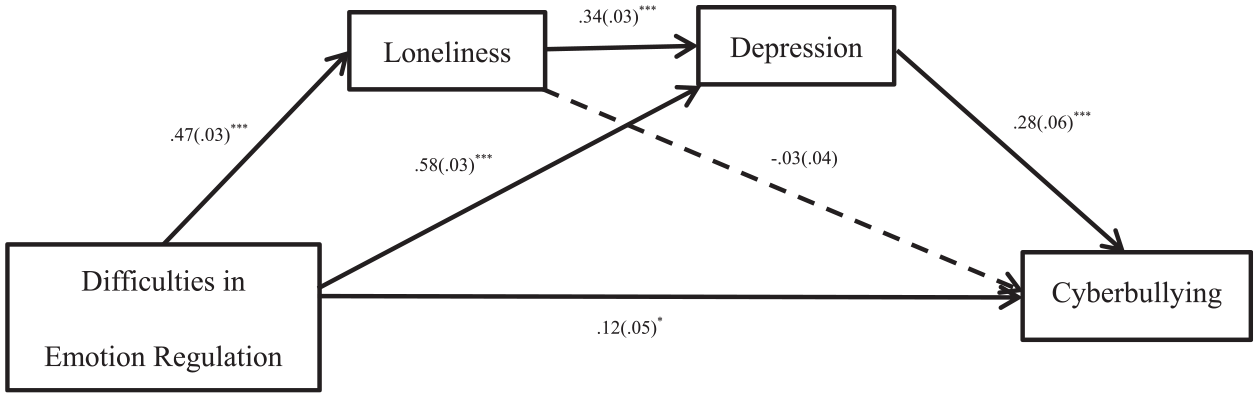
The sequential mediation model.
Results
Preliminary Analyses
Descriptive statistics and Pearson correlations matrix of these four variables are presented for the primary measure in Table 1. As expected, all variables are significantly positively correlated with each other in this study. To be specific, DER was positively associated with loneliness (r = .48, p < .001), depression (r = .74, p < .001), and cyberbullying (r = .30, p < .001). Loneliness was positively associated with depression (r = .61, p < .001) and cyberbullying (r = .18, p < .001). In addition, depression was positively associated with cyberbullying (r = .33, p < .001).
Descriptive Statistics and Correlations for Variables (N = 719).
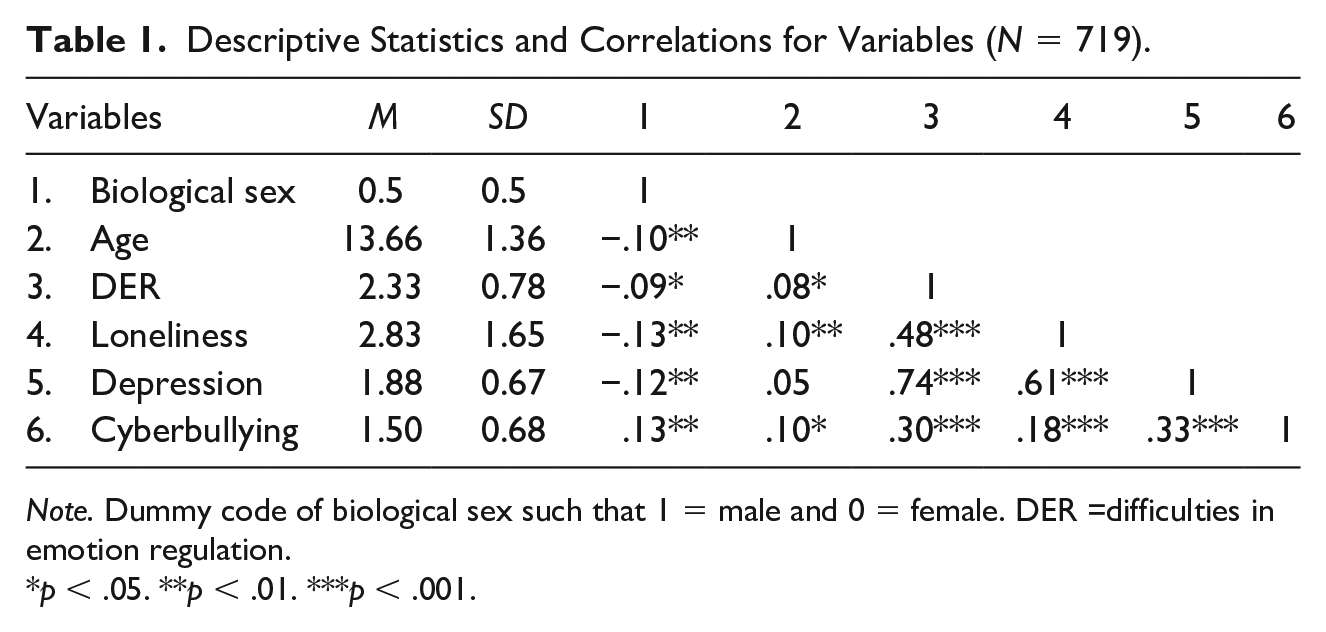
Note. Dummy code of biological sex such that 1 = male and 0 = female. DER =difficulties in emotion regulation.
p < .05. **p < .01. ***p < .001.
The Sequential Mediation Model
The total indirect effects of the DER on cyberbullying through loneliness and depression were tested by Model 6 of the PROCESS macro (Hayes, 2013). Just as revealed in Figure 1 and Table 2, a notable amount of variance in cyberbullying (R2 = .16) was explained by the sequential mediation model. To be specific, the pathway of “DER → loneliness → cyberbullying” was not significant (95% CI = [−.06, .04]). On the other side, the pathway of “DER → depression → cyberbullying” was significant (95% CI = [.07, .26]). The difference between the two pathways suggested that loneliness and depression played different roles in the relationship between DER and cyberbullying. Besides, the sequential pathway of “DER → loneliness → depression → cyberbullying” was significant (95% CI = [.02, .08]). Therefore, DER was orderly associated with loneliness (b = .47, p < .001), depression (b = −.58, p < .001), and eventually adolescent cyberbullying (b = .12, p < .05). At the same time, the residual direct pathway of “DER → cyberbullying” was still significant after controlling the impacts of loneliness and depression (95% CI = [.02, .22]), which means that loneliness and depression partially mediated the relation between DER and cyberbullying.
Testing the Pathways of the Sequential Mediation Model (N = 719).
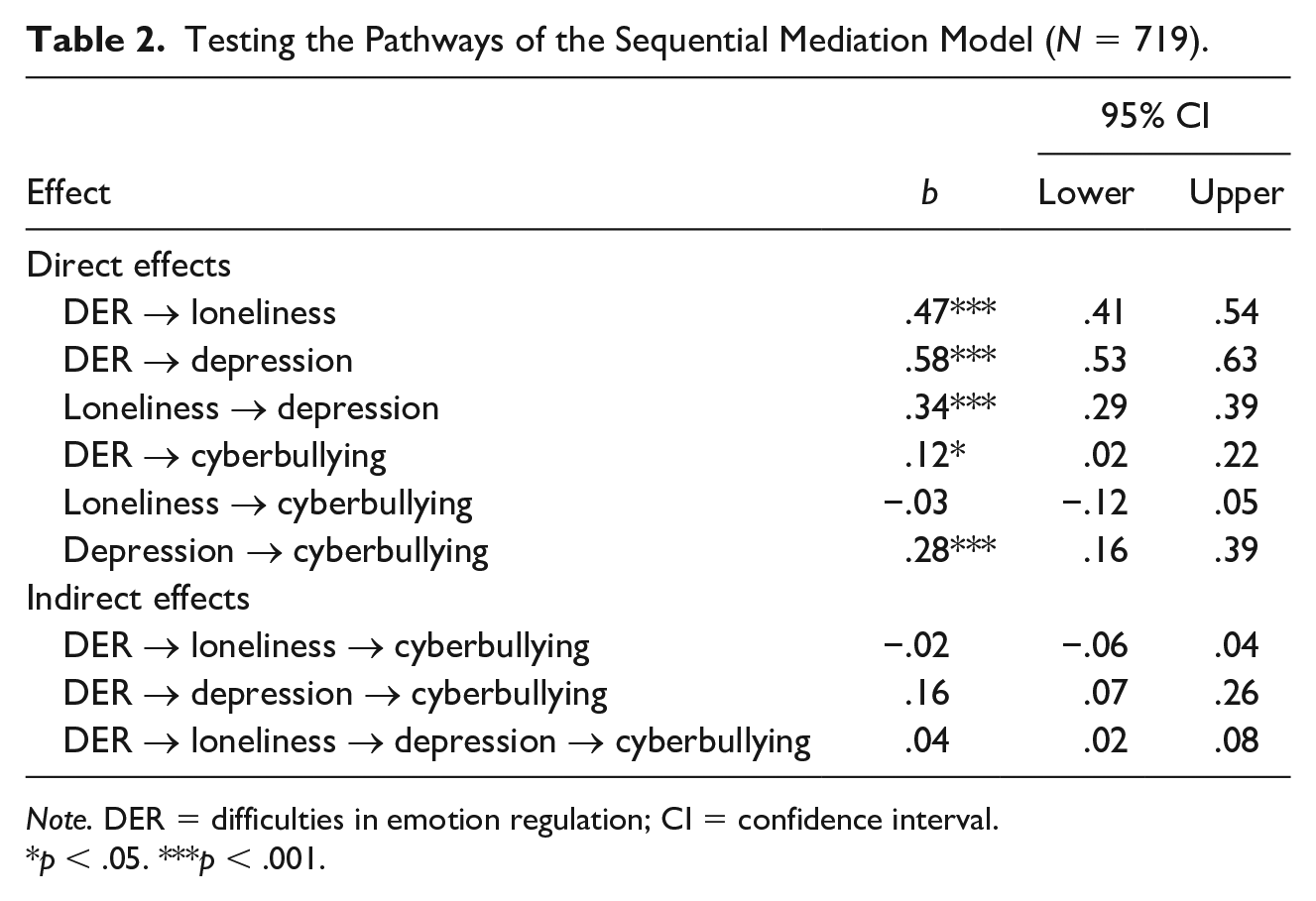
Note. DER = difficulties in emotion regulation; CI = confidence interval.
p < .05. ***p < .001.
Discussion
No prior studies have investigated the potential impact of DER on cyberbullying, and there is little knowledge about the mediating mechanisms underlying this association. Based on the process model of emotion regulation (Gross & John, 2003), the unsatisfied social needs model (Weiss, 1973), and the cognitive schemas assumption (Tesser & Leone, 1977), this study explored whether DER would be positively associated with adolescent cyberbullying, and the mediating role of loneliness and depression in the association between DER and adolescent cyberbullying. The results showed that DER was positively associated with adolescent cyberbullying, and this association was sequentially mediated by loneliness and depression. All of the findings will be discussed in the following sections.
DER and Adolescent Cyberbullying
Previous studies have focused on the association of DER with hostility and aggression behavior, which found that adolescents who are poor negative emotion regulating had difficulties in controlling hostility and aggressive behavior (Contardi et al., 2016). Individuals may use aggressive behaviors as a dysfunctional coping style to get rid of this unpleasant state and/or unregulated emotions (Contardi et al., 2016). However, few studies have focused on the relationship between DER and adolescent cyberbullying. As expected, this study indicated that DER was positively associated with cyberbullying among adolescents. This result is consistent with the process model of emotion regulation, which posits that ineffective emotion regulation is related to internalizing and externalizing problems (Gross & John, 2003). One possible explanation is that individuals with poor emotional regulation are unable to maintain normal mental health status in the face of attack or injury, such as learning difficulties, poor family conditions, disharmonious interpersonal relationships, ridiculed and discriminated by classmates, low social status, and so on, so they vent their dissatisfaction through cyberbullying (Espelage & Hong, 2017). Therefore, the ability of emotion regulation is closely related to internet misconduct among adolescents. To reduce the occurrence of cyberbullying, it is important for adolescents to learn effective ways of emotion regulation, which can help individuals view difficulties and negative events reasonably, use the right way to vent dissatisfaction and release pressure, and reduce their misconduct such as cyberbullying.
The Multiple Mediation Role of Loneliness and Depression
As predicted, we found that loneliness and depression mediate the relation between DER and adolescent cyberbullying sequentially. To be specific, this finding demonstrates that adolescents with a higher level of DER are more likely to have a higher level of loneliness, which in turn leads to a higher level of depression, and eventually results in an increased risk of cyberbullying. The finding reminds us the importance of emotion regulation on adolescents’ development. Ineffective emotion regulation is not only related to behavioral problems (Gross & John, 2003) but also related to mental health problems (Diamantopoulou et al., 2007). Adaptive emotion regulation strategies such as seeking help, transferring attention, and changing cognition are positively correlated with the positive interpersonal relationship and psychological state (Espelage & Hong, 2017). In turn, it is difficult for individuals with emotional regulation difficulties to maintain a long-term close friendship with their peers, which ultimately increases loneliness over time (Den Hamer & Konijn, 2016). Besides, consistent with the unsatisfied social needs model, lonely individuals are prone to depression because the needs of affection and belonging could not be satisfied due to the lack of necessary social connection (Weiss, 1973). Meanwhile, depressed adolescents may experience some degree of cognitive disorder, which leads to the tendency to make distrust and hostile attribution to other people’s intentions (Tesser & Leone, 1977), and eventually results in an increased risk of cyberbullying.
In addition, it is important to note that two pathways go through depression in this model, and both of them are significant. Hence, one can see that depression plays an irreplaceable role in the sequential mediation model of this study. The depressive experience among adolescents makes them more self-enclosed, passive, and often accompanied by interpersonal dysfunction and anxiety response styles (Moitra et al., 2008). In addition, fear of being negatively evaluated by others and other distorted cognitions closely related to depression may extend to the social field (Beck & Rush, 1978), which leads to the construction of dysfunctional patterns in handling social relationships, and distorts the beliefs that people view themselves and the world (e.g., holding the belief that people can intentionally harm others) (Calvete, 2014). This kind of negative emotions that cannot be resolved in real life increases the risk of transferring them to others through the internet (Franke et al., 2019). Therefore, reducing depression and other mental health problems is of great significance to prevent and reduce cyberbullying among adolescents.
Implications
Our findings are of great significance in preventing and intervening in adolescent cyberbullying. First, this is the first study concentrated on the relation between DER and cyberbullying among Chinese adolescents, which suggests that DER is a risk factor for adolescent cyberbullying. According to the China Youth Development Report, about 30 million children and adolescents under the age of 17 years are plagued by various emotional disorders and mental health problems in China. Meanwhile, cyberbullying has become a serious social problem in China, which has a wide range of negative effects on adolescents’ mental health (Zhu et al., 2021). Therefore, it is of great practical value to pay attention to the cultivation of adolescents’ emotional regulation ability in family and school education to reduce the occurrence of cyberbullying. Second, this study indicates that loneliness and depression are two of the explanatory factors for how DER contribute to adolescent cyberbullying, and depression can be a proximal factor in adolescent cyberbullying, which positively predicts maladaptive attitudes toward aggression (Barnes et al., 2017). These findings remind that families and schools should attach importance to the mental health of adolescents and reduce the negative emotional experience of loneliness and depression. Third, previous studies have often focused on the psychological well-being of the victims of cyberbullying and found that the experience of being cyberbullied leads to higher levels of loneliness and depression (Varghese & Pistole, 2017). However, it is likely to overlook that individuals may carry out network attacks because they feel disconnected from the other person and environment around them. In other words, adolescents with mental problems are more likely to implement cyberbullying. Eventually, our findings suggest that there is a sequential mediation in the relation between DER and adolescent cyberbullying, and the synchronous intervention of two mediators is probably more effective than any single mediator intervention.
Limitations and Future Directions
There are still several important limitations that should be considered in future studies. First, due to the cross-sectional design, we cannot deduce causality based on the results of this study. Future studies need to consider longitudinal designs or experimental methods to test the effectiveness of the sequential mediation model examined in this study. Second, we adopted a convenience sample, including only middle school students in the mainland of China, and most of them came from the cities. Therefore, the generalization of the results of this study is limited. Future studies may validate the results of this study by collecting data from different age and cultural background groups. Third, all the data in this study were obtained only through adolescent self-report. Future research should use multi-informant data with multi-trait multimethod to assure the validity and to control methodological deviations and social expectations in the measurement. At last, the factors that lead to cyberbullying are complex and diverse, it is hard to test all these factors in one single study. Meanwhile, this study only focused on the individual variables affecting the relationship between DER and adolescent cyberbullying and did not examine interpersonal or environmental variables. Therefore, more potential variables should be considered in future research to deepen the understanding of the causes of cyberbullying as well as the relationship between DER and cyberbullying.
Conclusion
To summarize, this study contributes to the literature by establishing a sequential mediation model, which provides an elaborate understanding of how DER is related to adolescent cyberbullying. To be specific, we find that DER is a risk factor for adolescent cyberbullying. In addition, loneliness and depression play a sequential mediator role in the link between DER and adolescent cyberbullying, which means that adolescent DER can increase the level of loneliness and depression in sequence, and ultimately lead to a higher risk of cyberbullying.
Footnotes
Declaration of Conflicting Interests
The author(s) declared no potential conflicts of interest with respect to the research, authorship, and/or publication of this article.
Funding
The author(s) disclosed receipt of the following financial support for the research, authorship, and/or publication of this article: The authors would like to thank the fund for building word-class universities(disciplines) of Renmin University of China (Project No. 2019), Research Institute in Humanities and Social Sciences of the Ministry of Education (19YJC190031), Social Science Planning Project of Henan Province (2019CSH022) and Humanity and Social Science Research Project in Education Department of Henan Province (2020-ZDJH-412) for funding this research.
