



Abstract
In consideration of the adverse societal, physical, and psychological impacts of bullying on a child’s development and future, many studies have developed anti-bullying programs and educational interventions to curb bullying occurrences. Therefore, this systematic review aimed to examine the effectiveness of such educational interventions at reducing the frequencies of traditional bullying or cyberbullying and cybervictimization among adolescents. A comprehensive search was conducted using PubMed, Embase, PsycINFO, Cumulative Index to Nursing and Allied Health Literature, Google Scholar, and ProQuest Dissertations and Theses. Only quantitative studies that reported the effects of educational interventions on reducing the frequencies of traditional bullying or cyberbullying victimization and perpetration were included. Seventeen studies (Ntotal = 35,694 adolescents, Rangechild age = 10–18 years) were finalized, and meta-analyses were conducted using a random effect model. Overall, the existing educational interventions had very small to small effect sizes on traditional bullying and cyberbullying perpetration (traditional: standardized mean differences [SMD] = −.30 and cyber: SMD = −.16) and victimization (traditional: SMD = −18 and cyber: SMD = −.13) among adolescents. Type of intervention (i.e., whole school–based or classroom-based), program duration, and presence of parental involvement did not moderate program effectiveness, but cyberbullying programs were more effective when delivered by technology-savvy content experts compared to teachers. Since existing educational interventions were marginally effective in reducing bullying frequencies, further research is needed to identify key moderators that enhance educational programs or develop alternative forms of anti-bullying interventions.
Background
The bullying behavior is defined by three core characteristics: intentional harm, behavior repetition, and power imbalance (Olweus, 1993). It can assume a direct form, such as hitting, making threats, and name-calling, or occur in an indirect form, such as rumor spreading and social exclusion (Björkqvist et al., 1992; Ericson, 2001). Depending on the type of informant assessed (e.g., victims, parents, or teachers), definition, and the type of instrument used, the prevalence of bullying varies across countries and studies, ranging from 9% to 98% (von Marées & Petermann, 2012). However, a meta-analysis of 80 studies reported a mean prevalence of 35% for traditional bullying (perpetuation and victimization) and 15% for cyberbullying involvement (perpetuation and victimization) among 12- to 18-year-old students (Modecki et al., 2014).
Sharing overlapping characteristics with traditional bullying, cyberbullying involves the use of electronic communication devices, with mobile phones (calls and text messages), social media, and instant messaging on the internet being the most frequent platforms for cyberbullying (Kowalski et al., 2014; Smith et al., 2008). However, the ability to grant perpetrators anonymity and the ease of dissemination of materials online distinctly differentiate cyberbullying from traditional bullying (Cross et al., 2015; Zuckerman, 2016). Given the increased accessibility and usage of information and communication technology, cyberbullying has become more frequent, with the percentages of individuals who had experienced cyberbullying at some point of their lives nearly doubling from 18% (2007) to 34% (Patchin & Hinduja, 2016).
Traditional bullying and cyberbullying are known to have not only long-term detrimental consequences on children’s physical and mental health but also on social and financial outcomes in the future (Takizawa et al., 2014). Traditional and cyberbully perpetrators tend to have poorer social adjustments and are more likely to engage in delinquent behaviors and dating violence, abuse alcohol and drugs, and drop out of school (Wolke & Lereya, 2015). The mental health of bully perpetrators is not well-examined; studies have shown slight increases in risks of suicide or self-harm, and increased prevalence of psychotic experiences during adolescence (Kaltiala-Heino et al., 2010; Winsper et al., 2012; Wolke et al., 2014). On the other hand, adolescent victims of traditional bullying and cyberbullying have higher susceptibility to somatic (e.g., flu), psychosomatic (e.g., sleeping disorders), and psychological (e.g., anxiety, depression) disorders (Beckman et al., 2012; Gini & Pozzoli, 2013; Schneider et al., 2012). They are also more likely to have higher risks of self-harm and suicide, poorer internalization skills, poor academic achievements, and school absenteeism (Kumpulainen & Räsänen, 2000; Wolke & Lereya, 2015).
In consideration of the adverse societal, physical, and psychological impacts of traditional and cyberbullying on a child’s development and future, many studies have developed anti-bullying programs to curb bullying occurrences (Nocentini & Menesini, 2016; Trip et al., 2015). Studies have developed anti-bullying and cyberbullying interventions, which include cognitive behavioral programs (Go¨kkaya, 2017), educational programs (Limber, 2003; Nocentini & Menesini, 2016; Trip et al., 2015), and peer support schemes (Tzani-Pepelasi et al., 2019). Peer support schemes make use of the buddy approach to foster friendship, belonging, protection, and a sense of responsibility (Tzani-Pepelasi et al., 2019), whereas cognitive behavioral programs are derived from cognitive behavioral therapy focused on teaching children how to alter their negative bullying-related cognitions with positive thoughts or alternatives and to plan various actions against bullying (Doll & Swearer, 2006). Additionally, facilitation of cognitive behavioral programs requires specialized training or higher qualifications and is usually conducted by psychologists or school counselors (Mennuti et al., 2006). According to the Organization for Economic Co-operation and Development (2004), an educational program is defined as a program that involves a set of activities and curriculum with a predetermined aim of imparting knowledge to adolescents at the end of it. It can be easily facilitated by educators without need for specialized qualifications or expert trainings. Through imparting knowledge and deeper understanding to adolescents, educational programs have the ability to change their attitudes for the better, leading to more sustainable outcomes (Parankimalil, 2012). Apart from increasing the knowledge and understanding of the problem, education programs can help to raise awareness and perhaps increase motivation for bystanders to intervene (Limber, 2003). Given the heterogeneity of intervention types, the methods of assessment, and the specialized requirements or qualifications of program facilitators, we have decided to focus on educational programs due to its relative ease in facilitation and proceed to systematically consolidate and evaluate the general effectiveness of such programs in reducing incidences of traditional and cyberbullying and victimization.
Existing Literature
Many systematic reviews have been conducted in the recent years to analyze the effectiveness of traditional and cyberbullying interventions, but the current reviews were either outdated (Ferguson et al., 2007; Merrell et al., 2008; Smith et al., 2003; Vreeman & Carroll, 2007), did not focus specifically on adolescents (Cantone et al., 2015; Gaffney, Farrington, & Ttofi, 2019; Gaffney, Ttofi, & Farrington, 2019), focused on either traditional or cyberbullying only (Ferguson et al., 2007; Jimenez-Barbero et al., 2016; Lee et al., 2015; Merrell et al., 2008), focused on minority and disadvantaged groups (i.e., individuals with chronic conditions, disabilities, and neurodevelopmental disorders; Alhaboby et al., 2017; Beckman et al., 2019), or did not include meta-analyses to quantify their effectiveness, which disallowed adequately quantifying and judging the objective effectiveness of the programs (Cantone et al., 2015; Hutson et al., 2018; Tanrikulu, 2018; Vreeman & Carroll, 2007).
Currently, the most thorough meta-analysis was done by Ttofi and Farrington (2011), which evaluated the effectiveness of 44 school-based programs in reducing traditional bullying and reported averages of 20%–23% decrease in bullying perpetuation and 17%–20% decrease in bullying victimization. These effects were more prominent in age-cohort study designs than randomized experiments, and the review recommended bullying programs to target children aged 11 years and older. The review also revealed that the most important program elements to reduce bullying perpetuation were the intensity of the intervention, parent training or meetings, and disciplinary methods, whereas important program elements to decrease victimization were the duration of the program, videos, lesser work with peers, and disciplinary methods. A recently published meta-analysis by Gaffney, Ttofi, and Farrington (2019), which was built on Farrington and Ttofi’s (2009) review, presented more updated results on school-bullying prevention programs by including new studies that were conducted between 2009 and 2016, resulting in a total of 100 studies, and similar findings were reported. Due to the high heterogeneity of the included studies, the subsequent follow-up meta-analysis by Gaffney, Farrington, and Ttofi (2019) did a country-specific and intervention-specific evaluation on the effectiveness of school bullying interventions. However, these reviews did not include cyberbullying interventions; did not focus on a specific type of intervention program (e.g., educational cognitive behavioral program); included self-reported, peer-reported, and teacher-reported measurements; and included interventions that were targeted at the general school-aged population with an age range of 4–18 years. The diverse study characteristics included may have led to a highly heterogeneous result that may not be generalized to the entire school-aged population. Therefore, a more specific review is required.
Existing reviews have found mixed effects in intervention effectiveness among primary and secondary schoolchildren (da Silva et al., 2017; Smith, 2010; Ttofi & Farrington, 2011). One review reported less effectiveness in interventions among younger children (Vreeman & Carroll, 2007), whereas another reported a decline in the efficacy of anti-bullying programs among older adolescents (Yeager et al., 2015). During pubertal years, adolescents undergo many changes related to their bodies, minds, and personalities. They struggle particularly hard to form their identities, placing their self-esteem at tenuous stages (Luyckx et al., 2013). This puts them at risks of bullying others and being bullied themselves as both bullying victimization and bullying perpetration have shown to be negatively correlated to self-esteem, even though the relationship of the latter is weaker than the former (Tsaousis, 2016). Therefore, narrowing the scope to educational interventions that were targeted at adolescents may provide a clearer age-group-specific evaluation of program effectiveness compared to examining a broader age group. Hence, this review has decided to focus on adolescents as they are more prone to bear the brunt of bullying.
Moreover, studies have revealed significant correlations between cyberbullies being bullies in person, which is likewise for cyberbullying victims. Hence, it is important to investigate the effectiveness of educational interventions that target both cyberbullying and traditional bullying (Beran & Li, 2008; Erdur-Baker, 2010; Li, 2010). Due to the significant overlap of offline and online bullying behaviors, Gaffney, Ttofi, and Farrington (2019) have also highlighted the necessity for future reviews to assess the effectiveness of intervention programs that target online and offline bullying concurrently. Currently, Cantone and colleagues’ (2015) review is the only one that compared the effectiveness of different types of traditional and cyberbullying intervention programs. The review (Cantone et al., 2015) reported whole school programs to be the most effective, but current programs do not have long-term positive impacts on reducing bullying. However, quantifiable results on the reductions of bullying perpetuation and victimization were lacking, and the review had a short time frame limit of the literature searches (2000–2013). Moreover, the inclusion of intervention studies on aggressive behaviors, with most included studies targeting primary schoolchildren, suggests a need for a more robust and rigorous meta-analytic review.
Additionally, measuring both traditional bullying or cyberbullying victimization and perpetration frequencies will allow the viewpoints of both victims and perpetrators to be assessed, resulting in a more holistic assessment regarding the effectiveness of educational bullying interventions in decreasing bullying incidence. Therefore, this systematic review aims to examine the effectiveness of educational interventions at reducing the frequencies of traditional or cyberbullying or victimization among adolescents by comparing pre- and postintervention bullying and victimization frequencies.
Method
Protocol, Registration, and Reporting Methods
A protocol had been submitted to the International Prospective Register of Systematic Reviews (PROSPERO) registry for systematic reviews with the frequencies of traditional bullying and cyberbullying incidences among adolescents as a primary outcome. This systematic review followed the Preferred Reporting Items for Systematic Reviews and Meta-Analyses (PRISMA) statement, comprising a checklist and a flow diagram. The PRISMA statement is commonly used to ensure a transparent and complete reporting of results. It is not a quality assessment tool for systematic reviews, but it provides specific reporting guidelines and indicates essential components to be reported in each section of the manuscript (Liberati et al., 2009; Online Appendix A).
Search Strategy
Six electronic databases were searched for relevant studies from their respective inception dates to June 30, 2019: PubMed, Embase, PsycINFO, Cumulative Index to Nursing and Allied Health Literature, Google Scholar, and ProQuest Dissertations and Theses. ProQuest Dissertations and Theses was searched for unpublished dissertations. Backward searching was conducted, whereby the reference lists of relevant reviews and the included articles were also reviewed for additional included articles. When the full texts of promising studies were not available, the authors were contacted to obtain them. The key search terms used were variations of (“child” OR “adolescent” OR “teen” OR “youth”) AND (“bully” OR “cyberbully”) AND (“randomized controlled trial” OR “crossover procedure” OR “single-blind procedure” OR “double-blind procedure”). A sample search strategy for Embase is available in Online Appendix B. Only quantitative studies written in or translated to the English language were included. Both published peer-reviewed primary journal articles and unpublished dissertations were included to reduce publication bias and to provide a balanced picture of available evidence (Paez, 2017). Other forms of grey literature, such as conference proceedings and other types of unpublished data, were not included, as they are usually presented in the forms of abstracts or brief summaries and hence lack detailed findings.
Eligibility Criteria
A list of inclusion and exclusion criteria was generated prior to identifying relevant studies. According to the World Health Organization (WHO, 2019), adolescent refers to persons aged 10 (Grade 5)–19 years, which was used as a criterion for this review. The study inclusion criteria were (i) a randomized controlled trial (RCT); (ii) involve study samples of adolescents who assumed the roles of bullies, victims, or bystanders; (iii) face-to-face or online educational interventions targeting middle or high school adolescents; (iv) educational programs with a set curricula focused on bullying prevention (e.g., not social and emotional skills); (v) control groups received usual lessons, treatment-as-usual bullying prevention programs, placebo interventions, or wait-list control; and (vi) measures both traditional bullying victimization and perpetration frequencies or cyberbullying victimization and perpetration frequencies pre- and postintervention. Studies that consisted of mixed-age samples but reported data separately for adolescents or students who were in Grade 5 and above were included.
On the other hand, studies were excluded if (i) it involved children younger than 10 years, (ii) interventions were conducted on adolescent minority groups (cognitively impaired, autistic, adolescents with mental health issues, adolescents who stutter, or sexual minority groups), (iii) it did not have a control group, (iv) the control group received bullying prevention interventions that were not evidence-based or peer-reviewed (e.g., new ways to prevent bullying thought up by the schools themselves, such as a play with an anti-bullying message), or (v) it involved noneducational interventions (e.g., cognitive behavioral curricula). Noneducational interventions were those that did not have set curricula and were delivered to participants by facilitators, such as programs involving online games without accompanying curricula or peer support systems.
Study Selection
The study selection process was guided by the four-stage PRISMA flow diagram (Moher et al., 2009). In the identification stage, all search results were exported to Endnote Version X8 (Clarivate Analytics, 2019) and categorized according to their databases, and duplicates were removed. Next, the titles and abstracts of all studies were screened against the eligibility criteria. Full texts of the selected studies were examined further to determine their inclusion statuses. The study screening process was performed independently by two trained reviewers who maintained constant communication and met twice a week to discuss, update, and resolve all discrepancies.
Data Extraction
Important characteristics related to each study’s sample, design, data management, outcomes measured, and intervention were extracted using a data extraction form. Data extraction was performed independently by two trained researchers, whereby the data were later compared and discrepancies were resolved upon discussion until a mutual consensus was reached. Immediate postintervention values were of primary interest as not all studies conducted follow-up measurements. Any follow-up measurements were regarded secondarily. For studies that reported outcomes using continuous data, the mean and standard deviation values of the review’s outcomes were extracted. Conversely, for studies that reported outcomes using dichotomous data, the event and total values of the review’s outcomes were extracted. When these specific values were not provided, data transformation was done using relevant formulas to obtain them (Higgins & Green, 2011). The names of the psychometric scales used by all studies were recorded as well.
Quality Appraisal
The risks of bias of all included studies were assessed independently by the first and second reviewers using the Cochrane risk-of-bias tool, which judges five types of biases in seven domains: random sequence generation (selection bias), allocation concealment (selection bias), blinding of participants and personnel (performance bias), blinding of outcome assessment (detection bias), incomplete outcome data (attrition bias), selective reporting (reporting bias), and other sources of bias (Higgins & Green, 2011). Each domain was graded a “low” or “high” risk depending on each study’s details, and an “unclear” risk was accorded when insufficient details were provided. Publication bias was assessed using funnel plots when there were close to 10 studies included in a forest plot as a minimum of 10 studies was advised for a meaningful plot (Sterne et al., 2011).
The quality of the overall body of evidence was rated as high, “moderate,” low, or “very low” according to the Grades of Recommendation, Assessment, Development, and Evaluation (GRADE) approach. RCTs were initially accorded high quality, and this rating dropped when any of the five factors were compromised: risk of bias of individual studies, inconsistency, directness of evidence, precision of effect estimates, and publication bias (Higgins & Green, 2011). All outcomes were rated separately using the online GRADEpro software version 1.0 (GRADEpro, 2015). The ratings were conducted independently by two trained reviewers, and discrepancies were resolved through discussions.
Data Synthesis
The characteristics of the included studies were summarized narratively. Meta-analyses were conducted to pool data regarding the same outcomes using RevMan Version 5.3 under the random effect model. For studies that reported outcomes using continuous data, standardized mean differences (SMD) and 95% confidence intervals (CIs) were used as the effect measure under the inverse-variance method, as each outcome was measured by various scales (Higgins & Green, 2011). Effect sizes were defined accordingly: very small (0.1), small (0.2), medium (0.5), large (0.8), very large (1.2), and huge (2.0; Sawilowsky, 2009). Conversely, for studies that reported outcomes using dichotomous data, risk ratio and 95% CI were used as the effect measure under the Mantel–Haenszel method −0.44, d (Higgins & Green, 2011).
Heterogeneity refers to the extent of variation among the study characteristics and was measured using the I2 statistic and Cochran’s Q χ2 test. These methods seek to ascertain whether variations in the studies’ findings were due to genuine underlying study differences (heterogeneity) or explained by chance alone (homogeneity; Higgins et al., 2003). I2 values were interpreted as low, moderate, “substantial,” or “considerate” importance according to their values of ≤40%, 30%–60%, 50%–90%, or 75%–00%, respectively. For the χ2 test, statistically significant heterogeneity was identified when its corresponding p value was <.10 (Higgins & Green, 2011).
Tests for heterogeneity to assess the consistency of effects across studies play crucial roles in meta-analyses, as the generalizability of the findings of the meta-analyses is determined by the consistency of the results of the included studies. Moreover, an inconsistency of the studies’ results in a meta-analysis will reduce the credibility of treatment or intervention recommendations; hence, outliers affecting the overall consistency should be excluded (Higgins et al., 2003)
Outliers—studies that significantly differed from the other studies based on participants’ characteristics, intervention type, or psychometric scale—were identified via sensitivity analyses (Higgins & Green, 2011). They were excluded from the meta-analyses to reduce heterogeneity and were narratively summarized. When outliers could not be identified to reduce heterogeneity, subgroup analyses were conducted (Sedgwick, 2013). Subgroup analyses also helped to examine the effect of certain variables on the outcomes investigated (Higgins & Green, 2011). The variables examined were personnel delivering intervention, location of the intervention, and intervention duration.
Results
Search Outcomes
A total of 5,283 articles were found from the five listed electronic databases and relevant reference lists. After removing duplicates and articles based on their titles and abstracts, 184 articles were left for full-text screening. The full-text screening excluded another 167 articles, leaving 17 relevant articles to be included in this review. Fourteen were peer-reviewed primary studies, while three were unpublished dissertations. Figure 1 details the Consolidated Standards for Reporting of Trials flow diagram.

Preferred Reporting Items for Systematic Reviews and Meta-Analyses flow chart.
Quality Appraisal
The Cochrane risk-of-bias tool was used to assess the risks of bias for all included trials. Interrater agreement among both reviewers was approximately 98%. The risk of bias summary and graph are available in Figure 2.
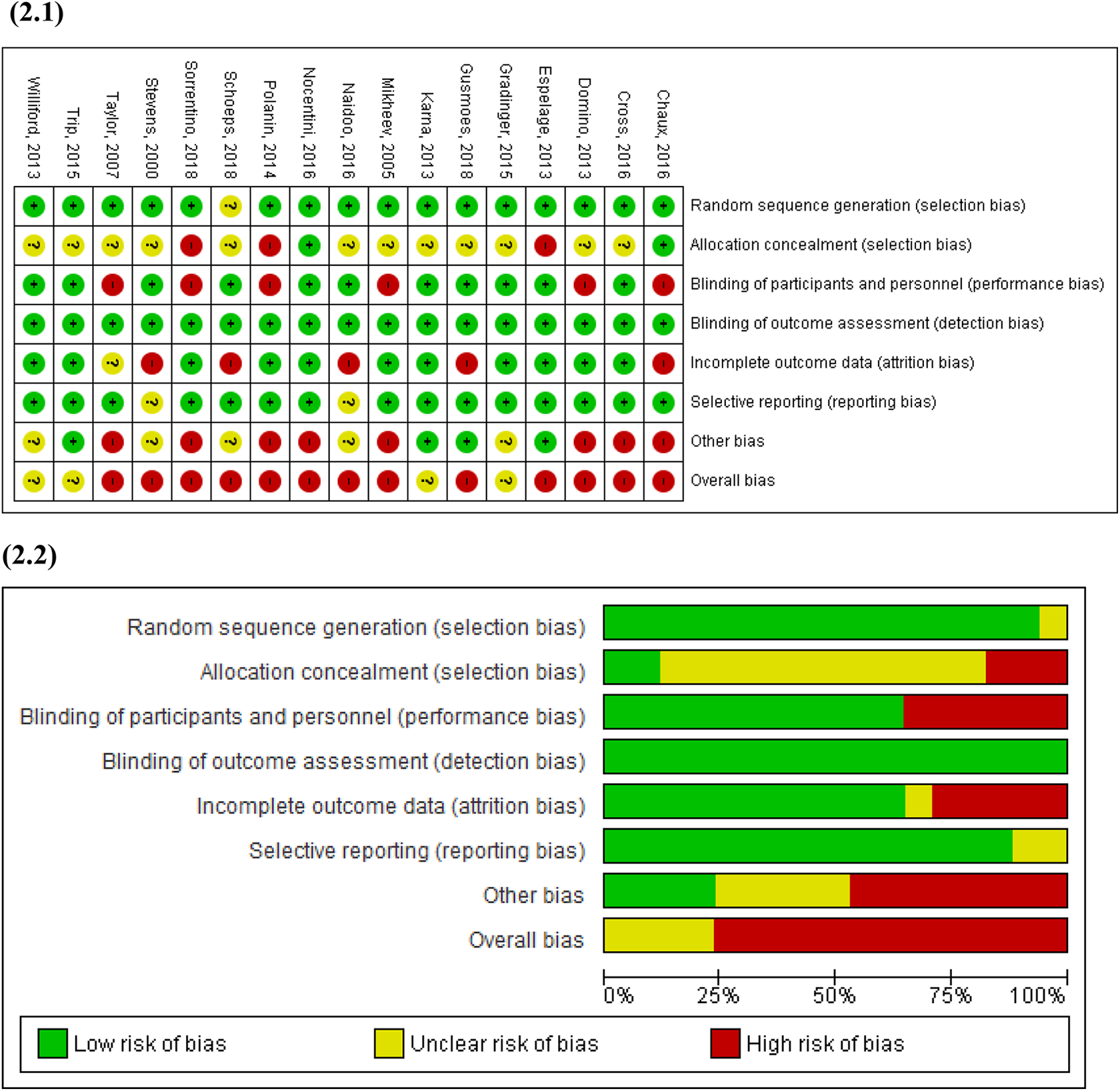
Risk of bias (A) summary and (B) graph.
A funnel plot of SE against SMD was generated for two outcomes with close to 10 studies (n = 9): bullying victimization frequency and bullying perpetration frequency reporting continuous data. A visual inspection of both plots revealed a lack of studies that reported negative results (Online Appendix C), suggesting the presence of publication bias.
The overall quality of the body of evidence was assessed using the GRADE approach. Traditional bullying victimization frequencies that were reported using dichotomous data were rated as low quality, while traditional bullying victimization frequencies that were reported using continuous data were rated as very low quality. Traditional bullying perpetration frequencies that were reported using dichotomous and continuous data were rated as very low quality. Cyberbullying victimization and perpetration frequencies that were reported using continuous data were rated as very low quality. The GRADE summary of the evidence table is presented in Online Appendix D.
Study Characteristics
The 17 studies analyzed 35,694 adolescents from 11 different locations: Italy (n = 2), Belgium (n = 1), Romania (n = 1), Finland (n = 2), United States (n = 5), Spain (n = 1), Germany (n = 1), South Africa (n = 1), Brazil (n = 1), Austria (n = 1), and Australia (n = 1). There were 2 RCTs and 15 cluster RCTs with schools or classes used as common clusters. The sample sizes ranged from 43 to 9,099 adolescents, with an age range of 10–18 years. Detailed study characteristics are presented in Table 1.
Summary of the Included Studies.
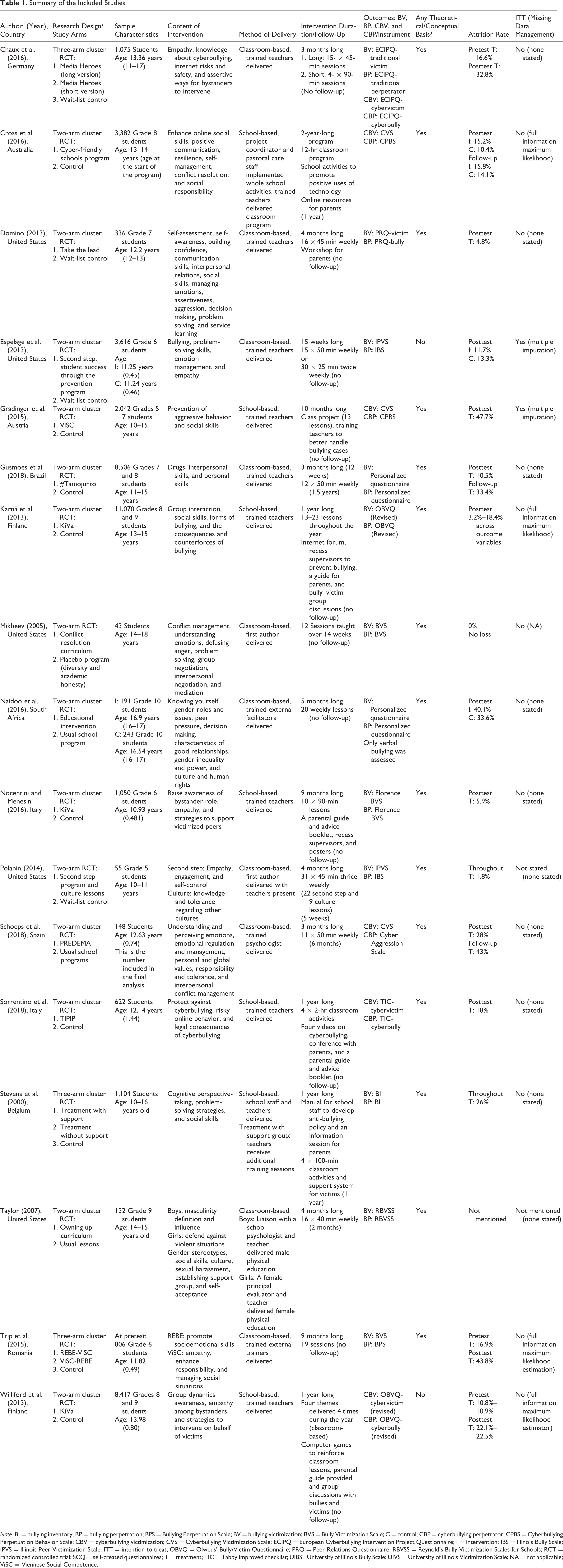
Note. BI = bullying inventory; BP = bullying perpetration; BPS = Bullying Perpetuation Scale; BV = bullying victimization; BVS = Bully Victimization Scale; C = control; CBP = cyberbullying perpetrator; CPBS = Cyberbullying Perpetuation Behavior Scale; CBV = cyberbullying victimization; CVS = Cyberbullying Victimization Scale; ECIPQ = European Cyberbullying Intervention Project Questionnaire; I = intervention; IBS = Illinois Bully Scale; IPVS = Illinois Peer Victimization Scale; ITT = intention to treat; OBVQ = Olweus’ Bully/Victim Questionnaire; PRQ = Peer Relations Questionnaire; RBVSS = Reynold’s Bully Victimization Scales for Schools; RCT = randomized controlled trial; SCQ = self-created questionnaires; T = treatment; TIC = Tabby Improved checklist; UIBS=University of Illinois Bully Scale; UIVS = University of Illinois Victimization Scale; NA = not applicable; ViSC = Viennese Social Competence.
Overview of Traditional Bullying and Cyberbullying Interventions for Adolescents
Across the 17 studies, there were seven intervention programs that were designed to reduce traditional bullying (a conflict resolution curriculum, an educational intervention based on the integrated model for behavior change, Take The Lead, Second Step, Owning Up, #Tamojunto, and a Flemish school–based anti-bullying program) and five programs targeted at reducing cyberbullying (Media Heroes Medienhelden, Cyber Friendly Schools, Viennese Social Competence (ViSC) program, PREDEMA, and Tabby Improved Prevention and Intervention Program). The KiVa program is rooted in the belief that a bystander’s behavior is expected to have a direct impact on the behaviors of bullies, thus focusing on encouraging bystanders to support and protect victimized peers. Its effectiveness in countering both traditional and cyberbullying is the most widely published (Karna, 2013; Nocentini & Menesini, 2016; Williford et al., 2013). The Second Step program, a skill-based (e.g., problem-solving skills, emotion management, and empathy) educational intervention, was used in two studies to reduce traditional bullying (Espelage et al., 2013; Polanin, 2014), with one of them combining the program with an additional cultural awareness training (Polanin, 2014). The ViSC program, originally designed to reduce cyberbullying, was also implemented in two studies (Gradinger et al., 2015; Trip et al., 2015); however, it was used in conjunction with rational emotive behavioral therapy to examine its effectiveness on traditional bullying (Trip et al., 2015). The majority of the intervention programs were grounded in theories such as the social cognitive theory, the theory of planned behavior, the ecological systems theory, and the social learning theory. All programs involved educators and school staff, except for the educational intervention based on the integrated model for behavior change (Naidoo et al., 2016), which was conducted by external facilitators. However, educators’ levels of involvement differed; most programs offered workshops and trainings on intervention implementation, while some included additional information sessions, online resources, or manual guides. Only eight programs involved parents by providing information letters, manuals, guides, online materials, educational workshops, and even a school conference. All educational programs were classroom-based and utilized interactive teaching methods to engage students (i.e., group discussions, group projects, videos, role-playing, games, quizzes, and activity worksheets). Further details of each intervention program can be found in Online Appendix E.
Bullying Victimization and Perpetuation Frequencies
Bullying victimization frequency (dichotomous data)
A meta-analysis of the two studies that assessed bullying victimization frequency using dichotomous data at postintervention showed that although not statistically significant, the intervention group had a .02 less chance of being bullied compared to the control group (RR = .98, 95% CI [0.94, 1.04], Z = 0.61, p = .54), with low statistical heterogeneity (I2 = 0%, p = .81; Figure 3).
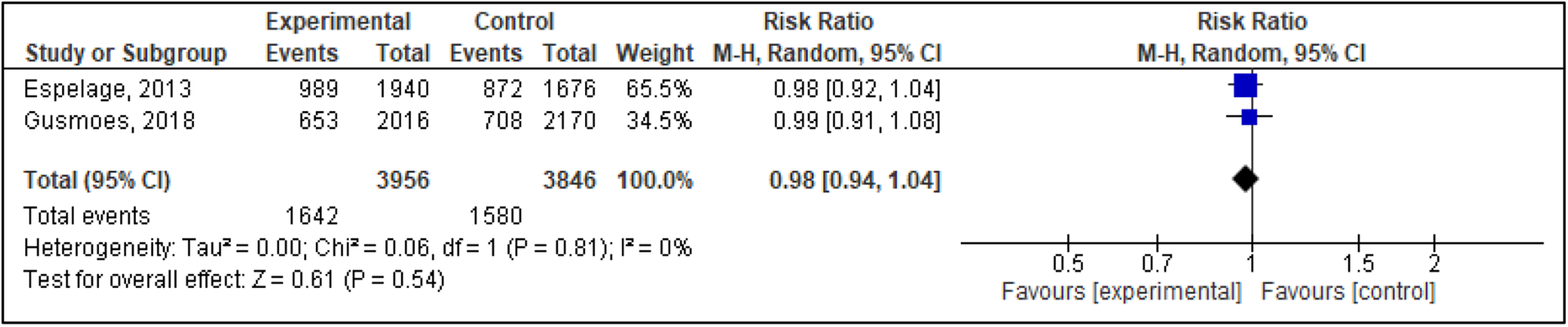
Forest plot of bullying victimization frequency at postintervention among two included studies reporting dichotomous data.
Bullying victimization frequency (continuous data)
A meta-analysis of the 10 studies that assessed bullying victimization frequency using continuous data at postintervention showed a very small statistically significant effect favoring the intervention group, with significant substantial statistical heterogeneity (I2 = 71%, p = .0002; Online Appendix F). A sensitivity analysis identified an outlier (Kärnä et al., 2013) because it used a single-item psychometric scale compared to other studies that used multiple-item psychometric scales. Excluding this study lowered the heterogeneity to a low level (I2 = 29%, p = .19) and showed a very small statistically significant effect (SMD = −.18, 95% CI [−0.26, −0.10], Z = 4.24, p < .0001) among 4,043 participants (Figure 4). Hence, Karna et al. (2013) were excluded from all subsequent meta-analyses.

Forest plot of bullying victimization frequency at postintervention among nine included studies reporting continuous data.
Bullying victimization frequency was not affected by personnel delivering the intervention, location of the intervention, intervention duration, and presence of parental involvement, as the subgroup analyses for these factors revealed statistically nonsignificant subgroup differences (p ≥ .05; Online Appendix G).
Follow-up measurement was only conducted by three studies and showed a very small statistically insignificant effect (SMD = −.11, 95% CI [−0.26, 0.03], Z = 1.57, p = .12), with low statistical heterogeneity (I2 = 0%, p = .51) among 994 participants (Online Appendix H).
Bullying perpetration frequency (dichotomous data)
A meta-analysis of the two studies that assessed bullying perpetration frequency using dichotomous data at postintervention showed that although not statistically significant, those in the intervention group had a .02 less chance of bullying others compared to those in the control group (RR = .98, 95% CI [0.89, 1.08], Z = 0.41, p = .68), with moderate statistical heterogeneity (I2 = 41%, p = .19; Figure 5).

Forest plot of bullying perpetration frequency at postintervention among two included studies reporting dichotomous data.
Bullying perpetration frequency (continuous data)
A meta-analysis of the nine studies that assessed bullying perpetration frequency using continuous data at postintervention showed a small statistically significant effect favoring the intervention group (SMD = −.30, 95% CI [−0.44, −0.15], Z = 4.01, p < .0001), with statistically substantial to moderately significant heterogeneity (I2 = 75%, p < .0001) among 4,033 participants (Figure 6).

Forest plot of bullying perpetration frequency at postintervention among nine included studies reporting continuous data.
Bullying perpetration frequency was not affected by personnel delivering the intervention, location of the intervention, intervention duration, and presence of parental involvement, as the subgroup analyses for these factors revealed statistically nonsignificant subgroup differences (p ≥ .05; Online Appendix I).
Follow-up measurement was only conducted by three studies and showed a small statistically significant effect (SMD = −.22, 95% CI [−0.37, −0.08], Z = 3.07, p = .002), with low statistical heterogeneity (I2 = 0%, p = .58) among 994 participants (Online Appendix J).
Cyberbullying Victimization and Perpetuation Frequency
Cyberbullying victimization frequency (continuous data)
A meta-analysis of the five studies that assessed cyberbullying victimization frequency using continuous data at post-intervention showed a very small statistically significant effect favoring the intervention group (SMD = −.13, 95% CI [−0.25, −0.02], Z = 2.36, p = .02), with significant substantial statistical heterogeneity (I2 = 73%, p = .005) among 6,419 participants (Figure 7). A sensitivity analysis identified no outliers; hence, subgroup analyses were conducted to reduce heterogeneity. Cyberbullying victimization frequency was not affected by location of the intervention, intervention duration, and presence of parental involvement, as the subgroup analyses for these factors revealed statistically nonsignificant subgroup differences (p ≥ .05; Online Appendix K).

Forest plot of cyberbullying victimization frequency at postintervention among five included studies reporting continuous data.
A subgroup analysis according to personnel delivering intervention showed statistically significant subgroup differences (I2 = 81.9%, p = .02), as shown in Online Appendix K. The heterogeneity level remained substantial for the teachers/school staff subgroup (I2 = 64%, p = .04), while the content expert subgroup had only one study, and, hence, there was no heterogeneity. The content expert subgroup had a medium significant effect, while the teachers/school staff subgroup reported insignificant results.
Follow-up measurement was only conducted by two studies and showed a negligible statistically significant effect (SMD = −.08, 95% CI [−0.16, −0.01], Z = 2.26, p = .02), with low statistical heterogeneity (I2 = 0%, p = .39) among 2,987 participants (Online Appendix L).
Cyberbullying perpetration frequency (continuous data)
A meta-analysis of the five studies that assessed cyberbullying perpetration frequency using continuous data at postintervention showed a very small statistically significant effect favoring the intervention group (SMD = −.16, 95% CI [−0.29, −0.03], Z = 2.47, p = .01), with significant substantial to considerable statistical heterogeneity (I2 = 80%, p = .0005) among 6,366 participants (Figure 8). A sensitivity analysis identified no outliers; hence, subgroup analyses were conducted to reduce heterogeneity. Cyberbullying perpetration frequency was not affected by location of the intervention, intervention duration, and presence of parental involvement, as the subgroup analyses for these factors revealed statistically nonsignificant subgroup differences (p ≥ .05; Online Appendix M).
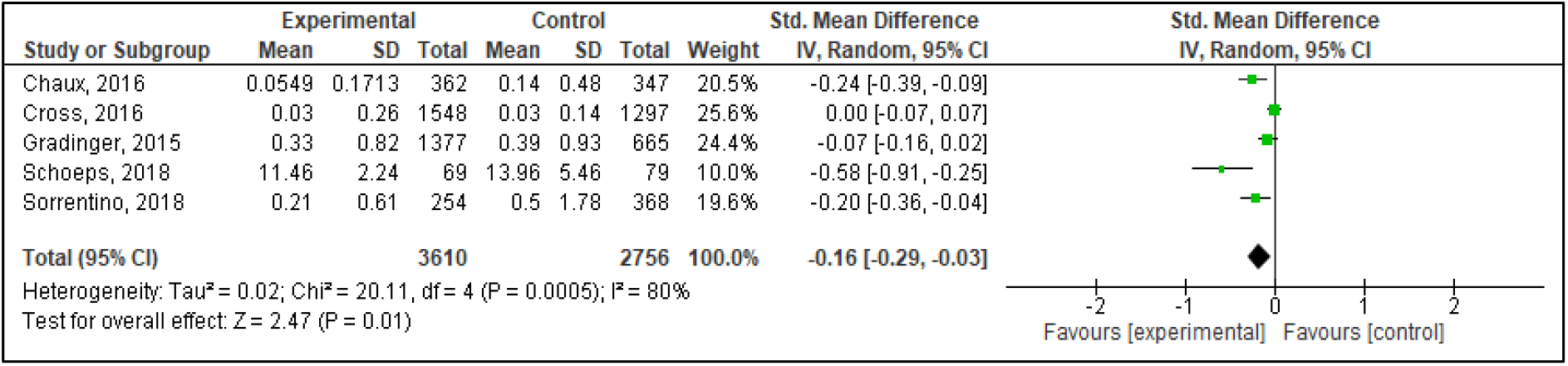
Continuous: Forest plot of cyberbullying perpetration frequency at postintervention (n = 5).
A subgroup analysis according to personnel delivering intervention showed statistically significant subgroup differences (I2 = 85.9%, p = .008), as shown in Online Appendix M. The heterogeneity level remained substantial for the teachers/school staff subgroup (I2 = 73%, p = .01), while the content expert subgroup had only one study. The content expert subgroup had a medium significant effect, while the teachers/school staff subgroup reported insignificant results.
Follow-up measurement was only conducted by two studies and showed a very small statistically insignificant effect (SMD = −.15, 95% CI [−0.50, 0.20], Z = 0.82, p = .41), with substantial to considerable statistical heterogeneity (I2 = 78%, p = .03) among 2,932 participants (Online Appendix N).
Narrative Synthesis
An outlier was identified in the traditional bullying victimization and perpetration frequency meta-analysis due to it being the only study that utilized a single-item psychometric scale (Kärnä et al., 2013). The intervention group showed no statistically significant improvements in self-reported traditional bullying victimization and perpetration frequency scores compared to the control group at postintervention.
Only one study reported cyberbullying victimization and perpetration frequency using dichotomous data; hence, a meta-analysis could not be carried out (Williford et al., 2013). The intervention group reported no statistically significant improvement in cyberbullying perpetration frequency scores compared to the control group at postintervention. For cyberbullying victimization frequency, the difference between the scores of the intervention and control groups at postintervention was not reported.
Discussion
Summary of Evidence
The current systematic review aims to assess the effectiveness of current educational interventions in reducing the frequencies of traditional bullying or cyberbullying victimization and perpetration. Overall, the evidence suggested that educational interventions were effective in reducing traditional bullying and cyberbullying victimization and perpetration. Despite the effect sizes being small or very small, this result is generally consistent with previous reviews, which has also reported effectiveness of such programs (Cantone et al., 2015; Gaffney, Ttofi, and Farrington, 2019; Ttofi & Farrington, 2011). However, due to differences in analytical methods, direct comparison of effect sizes could not be drawn with past reviews.
In the follow-up studies that ranged from 5 weeks to 1.5 years, bullying interventions were shown to reduce traditional bullying perpetration in the long term, but not traditional bullying victimization. However, cyberbullying interventions showed a significant but negligible effect for long-term reduction in cyberbullying victimization, but not cyberbullying perpetration. These findings mirror those of Cantone and colleague’s (2015) review, in which most studies did not show long-term positive effects on cyberbullying and traditional bullying victimization and perpetration. The discrepancy in the number of self-reported perpetration and victimization in this review could be attributed to age, ethnicity, and gender differences (Jetelina et al., 2019). On the other hand, due to long follow-up periods and increased age, adolescents are more likely to express increased discomfort in labeling their own behaviors as bullying, and their urges for social desirability may cause them to edit their actual perpetration behaviors, therefore reducing the frequencies of self-reported perpetration and victimization (Bosworth et al., 1999).
The lack of significant results demonstrating the long-term effectiveness of educational programs in reducing traditional bullying victimization and cyberbullying perpetration also highlights the issue of sustainability and continuity of such educational programs. In order to ensure long-term effectiveness in curbing and preventing recurrences of traditional bullying and cyberbullying, schools should maintain their focus on preventing bullying even after interventions end. However, with many social and academic aims to achieve, the continuity of educational anti-bully programs in schools is a problem, and teachers find it hard to commit to long-term anti-bullying strategies (Hargreaves, 2001).
Our findings revealed that the type of personnel delivery (via school staff or experts) had no effect on the effectiveness of traditional bullying interventions. The lack of difference in personnel delivery for traditional bullying interventions can be attributed to the long-standing problem of traditional bullying and the experiences of seasoned school staff in handling bullying cases and educating students on anti-bullying. Furthermore, traditional bullying interventions usually have training courses or resources for teachers before an intervention’s implementation, which can also signify the adequacies of such trainings such that teachers are as well-equipped as content experts of the program (Domino, 2013; Espelage et al., 2013; Karna et al., 2013). However, for cyberbullying programs, technology-savvy content experts were discovered to be more effective at implementing a program than teachers. Cyberbullying is a relatively new type of bullying and a form of harassment that is difficult to control and can easily escape the supervision of adults as it requires one to be technologically savvy. Therefore, technology-savvy content experts may be more adequate at implementing cyberbullying programs. Research (Smith, 2011) has shown that young people are “digital natives,” and it is necessary for adults or teachers to be continuously up-to-date on cyberbullying’s nature, its effects, and how to deal with it. Therefore, given the unfamiliarity and broad nature of cyberbullying, teachers may not be as well-equipped as technology-savvy content experts with program implementation skills even after receiving a short training session. However, as there is a lack of studies involving technology-savvy content experts, this finding should not be generalized, and more research in this area will be required to verify this finding.
Although many studies adopted the socioecological approach toward bullying, which emphasizes the roles of wider systematic factors, such as parental involvement in preventing traditional bullying (Limber et al., 2018; Ttofi & Farrington, 2011), our review did not reveal any significance in program effectiveness regardless of parental involvement. This may be attributed to the types of parental involvement in our review, which were mostly information sessions and provisions of online resources or materials. It also suggests the inadequacies of such passive approaches in involving parents. A systematic review by Ttofi and Farrington (2011) reported that parent–teacher meetings were significantly related to decreases in traditional bullying perpetration and victimization. Olweus and Limber (2010) also encouraged parent involvement in bullying interventions at school, classroom, community, and individual levels. In the Olweus Bullying Prevention Program (OBPP), parents were even included as important stakeholders of the Bullying Prevention Coordinating Committee to ensure fidelity and a proper implementation of the anti-bullying program (Olweus & Limber, 2010). Therefore, adopting a more active approach (i.e., involving parents) and having constant teacher–parent updates can potentially better reduce the frequencies of traditional bullying. Furthermore, the lack of significant findings in our review could be due to the lack of parental authority or influential power on adolescents (Kobak et al., 2017; Valizadeh et al., 2018). The adolescent stage is where adolescents experiment with their autonomy in decision making, which is facilitated by their social reorientation toward their peers (Nelson et al., 2016); hence, peer influence may be more dominant at this stage, rendering the role parental involvement in anti-bullying programs to be insignificant.
When segregated into durations of the intervention programs, there were no significant differences in program effectiveness between intervention periods of less than 3 months, 3–6 months, and more than 6 months. Conversely, Ttofi and Farrington’s (2011) review revealed a direct link between the duration (9 months and above) and intensity (20 hr or more) of a program to its effectiveness. This dose–response relationship was also mirrored in previous studies (Olweus, 2005; Smith, 1997), in which program effectiveness on traditional bullying was linked to the number of components of a program. The lack of significant findings in this review could be due to the small period segregation compared to the larger period segregation (i.e., 8 months and below and 9 months and above) in Ttofi and Farrington’s (2011) review.
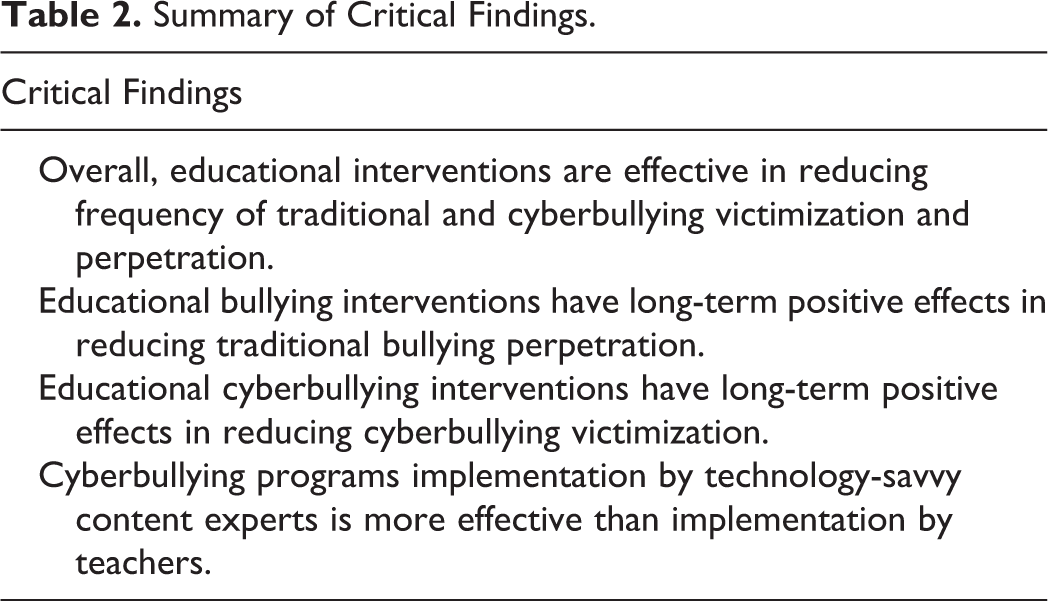
Since this review only included educational bullying interventions, educational programs were either whole school–based or classroom-based. However, in this review, no difference was found in program effectiveness with regard to the type of intervention. This differs from Cantone’s (2015) findings, in which whole school–focused interventions were more effective in reducing bullying than interventions delivered through classroom curricula or social skills training alone. In Vreeman and Carroll’s (2007) review, whole school–based interventions that included a combination of school rules and sanctions, teacher trainings, classroom activities, and individual counseling were also reportedly more effective than curricula-based interventions. However, Vreeman and Carroll’s (2007) review did not include recent studies, did not limit their inclusion criteria to RCTs only, which is the gold standard for interventional studies and lastly, and did not conduct meta-analysis, compromising the strength of their findings (Impellizzeri & Bizzini, 2012). All these reasons could account for the difference between our results and theirs. In view of this discrepancy in findings, further studies are required to examine the effectiveness of various types of anti-bullying interventions on adolescents. A summary of our critical findings is provided in Table 2.
Summary of Critical Findings.
Limitations
A key limitation of this review was that only English language studies were included, and they were highly diversified with varying assessment methods that were not standardized, which resulted in the high heterogeneity between the studies. The lack of Asian and African studies on educational interventions that targeted bullying and cyberbullying interventions among adolescents may have also reduced the generalizability of the results. Another limitation of the included studies was the paucity of follow-up assessments in adolescents. Very few studies provided findings beyond their postintervention assessments, which limit the examination of the durability of the intervention effects. Studies related to the well-known OBPP were also not included in our review due to lack of access to full texts or failure to meet the inclusion criteria. Additionally, due to adherence to WHO age criteria for adolescents, our review excluded studies with mixed samples of fourth to sixth graders, although the fifth and sixth graders comprised the majority of the sample. This may have led to relevant findings being left out; therefore, future reviews could consider adopting an education level–based sample criterion instead of an age-based cutoff. In terms of personnel delivery of intervention, our review examined the difference between school staff delivery against expert delivery of the program. However, future studies should explicitly identify and clarify the various roles of school staff (e.g., educators, counselors, nonteaching staff) in the implementation of the intervention, especially for whole-school programs.
Conclusion
Although this review reaffirms the effectiveness of educational interventions on reducing bullying and cyberbullying among adolescents, it highlights the research gaps in existing literature, sets the stage for future research on the development of educational interventions, and also urges school policy makers, administrators, and educators to implement stricter rules and be strong advocates of anti-bullying.
Implications for Research, Policy, and Practice
This review has provided valuable insights on the effectiveness of educational interventions in reducing bullying and cyberbullying perpetration and victimization among adolescents. Current educational programs can be improved by engaging parents more by conducting parent–teacher meetings or organizing more sessions for parents to attend together with their children. Although the data presented regarding content experts being more suited to conduct sessions on cyberbullying prevention instead of schoolteachers are not conclusive, schools will still benefit from engaging technology-savvy content experts to conduct more training sessions for teachers to better equip these teachers with how to manage cyberbullying more effectively. Future studies should consider examining the cost-effectiveness and clinical significance of the educational interventions before these programs can be implemented as standard support for the adolescents. Future studies can also look into conducting three-armed RCTs to compare a set curriculum that is delivered by schoolteachers and technology-savvy content experts and to a control group in order to explore the benefits of educational programs delivered by experts. Moreover, similar educational programs of varying durations and intensities should also be compared in order to glean more information about such programs’ optimal durations and intensities in order to improve them further.
Future studies should be conducted in Africa and Asia, as this review found that studies in those regions are lacking. The use of consistent definitions and standardized tools to measure bullying victimization and perpetration in future studies will also be helpful for future reviews to compile more concrete evidence based on more homogenous studies.
Supplemental Material
Supplemental Material, Appendices_29-5-2020_Copy - The Effectiveness of Educational Interventions on Traditional Bullying and Cyberbullying Among Adolescents: A Systematic Review and Meta-Analysis
Supplemental Material, Appendices_29-5-2020_Copy for The Effectiveness of Educational Interventions on Traditional Bullying and Cyberbullying Among Adolescents: A Systematic Review and Meta-Analysis by Esperanza Debby Ng, Joelle Yan Xin Chua and Shefaly Shorey in Trauma, Violence, & Abuse
Footnotes
Acknowledgments
The authors would like to thank the National University Health System, Medical Research Support Unit, for assistance in the language editing of this article.
Declaration of Conflicting Interests
The author(s) declared no potential conflicts of interest with respect to the research, authorship, and/or publication of this article.
Funding
The author(s) received no financial support for the research, authorship, and/or publication of this article.

Supplemental Material
The supplemental material for this article is available online.
References
Supplementary Material
Please find the following supplemental material available below.
For Open Access articles published under a Creative Commons License, all supplemental material carries the same license as the article it is associated with.
For non-Open Access articles published, all supplemental material carries a non-exclusive license, and permission requests for re-use of supplemental material or any part of supplemental material shall be sent directly to the copyright owner as specified in the copyright notice associated with the article.
