



Abstract
The purpose of this study was to examine reactions to participating in trauma and addiction research among women in a sober living home. Participants were 59 women who completed a comprehensive survey battery while living in the sober living home. The survey assessed women’s victimization and addiction history along with current psychological and behavioral health symptoms and resilience characteristics. At the end of the survey, women were asked about their reactions to participating in the survey. Results suggested that whereas 40.7% (n = 24) of women reported being upset immediately after completing the survey, 96.6% (n = 56) of women reported that they personally benefited from being in the research study. Women who reported being upset, compared with those who were not upset, had higher levels of depressive and posttraumatic stress disorder (PTSD) symptoms and housing and financial instability and lower levels of empowerment, posttraumatic growth, and sense of purpose. We also asked women to tell us, in their own words, their reasons for being upset (e.g., questions about victimization experiences, loss of children), as well as their reasons for benefiting (e.g., catharsis/venting, learning something new about oneself, the chance to meet the researcher who had nice qualities). In general, the research was well tolerated by most of the participants, and almost all women, including those who were initially upset, reported personal benefits. These data shed light on the factors associated with positive and negative emotional reactions to research participation, which could be important information to include in consent forms in future research with this population.
Experiences of domestic and sexual violence (DSV) and addiction co-occur at high rates (Covington, 2008; Devries et al., 2014; Edwards et al., 2016), and research is critical to better understanding these phenomena to inform prevention and intervention efforts. However, institutional review boards sometimes express concern that asking participants about traumatic experiences will cause distress (Jaffe et al., 2015). As a result of these concerns, there has been a growing body of research examining participants’ reactions to being involved in research studies that examine sensitive topics, such as DSV (Edwards et al., 2017; Jaffe et al., 2015).
In general, research suggests that trauma-related research leads to low to moderate levels of distress in participants but that this distress is generally minimal and transient (Edwards et al., 2013; Jaffe et al., 2015). Research suggests that research-related distress is generally higher in individuals with posttraumatic stress and depressive symptoms compared with individuals without these symptoms (Edwards et al., 2014; Jaffe et al., 2015). However, most participants report positive experiences associated with their research participation even among participants who report initial distress (Edwards et al., 2009; Jaffe et al., 2015).
Although our understanding of reactions to research has increased over the past two decades, there is a dearth of research examining reactions to participating in DSV and addiction research among women in a sober living home. Given that many of the women who are in sober living homes come to these environments directly from prison, inpatient facilities, human trafficking situations, or other circumstances that may render them more emotionally vulnerable, it is critical to examine these women’s reactions to participating in sensitive research. Indeed, research suggests that distress levels are generally high among shelter-seeking women (Jones et al., 2001; Wolford-Clevenger & Smith, 2015), and thus they may experience more negative social reactions than other populations (e.g., college students). Moreover, the extent to which reactions to research relate to stressors in life (e.g., housing instability, financial instability) and resilience (e.g., empowerment, purpose) has not been explored. Finally, very rarely do studies specifically ask women, in their own words, to describe what specifically about the research made them upset and what specifically about the research made them benefit. The purpose of this study was to examine these gaps in the literature. Specific aims were as follows:
Assess the extent to which women with histories of addiction and victimization residing in a sober living home report being upset by the research in addition to benefiting from the research.
Examine the psychosocial correlates of reactions to research.
Elucidate women’s reasons for being upset and their reasons for benefiting.
Method
Participants
Participants were 59 women living in a sober living home with histories of domestic and/or sexual violence. The mean age of participants was 41.6 (SD = 12.0; range = 22–67). The majority of participants were White non-Hispanic (n = 47; 79.7%) and the majority of participants identified as heterosexual (n = 51; 86.4%). At the time of the survey, approximately half of the participants were unemployed (n = 32; 54.2%), whereas the rest were working, either part of full time (n = 27; 45.8%). The household income reported by most participants was below US$20,000 (n = 47; 79.7%).
Procedures
Women were invited over a 28-month project period (March 2017–July 2019) within 1 week of their arrival to the SEEDs [Support, Education, Empowerment, and Directions] program to participate in the study. At the commencement of data collection, all women currently living in one of two SEEDs homes were also invited to participate in the study (n = 16). During the study period, 69 women entered the SEEDs program and the majority (85.5%) took part in the study. Of note, nine women were invited to participate in the project, agreed, but then moved out of the SEEDs homes before baseline data collection could be completed, and one participant was excluded from the study for failing to sign the consent form. To participate, individuals had to be at least 18 years old, able to read and speak English, identify as a female, and be able to provide consent to participate in the study. Upon entering the SEEDs program (and for women living in a SEEDs home when the study commenced), the house manager provided women with a recruitment letter from the research team describing the study. If the participant indicated that they wanted to participate, the house manager or the executive director of SEEDs notified the project team and a trained research assistant would meet with eligible participants to explain the study and collect baseline data. Women had the option of having the research assistant administer the survey or completing the survey on their own via a computer or paper and pencil. Monetary compensation was offered to participants in the form of a US$50 gift card for each survey. This study was approved by the University of New Hampshire’s Institutional Review Board.
Measures
Reaction to research
Modeled after previous research (Edwards et al., 2017; Edwards & Sylaska, 2015), reaction to research was assessed by asking “Did anything we asked you about today make you feel upset” and “Do you feel like you gained or benefited anything positive from participating today.” The “yes” responses were coded as 1 and “no” responses were coded as zero. If participants responded yes, that something made them feel upset, they received an open-ended follow-up question asking them to describe what made them upset. If participants responded that they felt like they gained or benefited from their survey participation, they received an open-ended follow-up question asking what they felt they gained.
Posttraumatic stress
Posttraumatic stress was measured using the PTSD Checklist—Civilian Version (PCL-C; Weathers et al., 1993) that consists of 17 items assessing experiences of posttraumatic stress disorder (PTSD) in the past 6 months. Participants were instructed to think about their most stressful life experience and the symptoms they experienced relative to that experience over the past 6 months. Respondents were asked to rate 17 symptoms on a five-point Likert-type scale, ranging from 1 (not at all) to 5 (extremely). Responses were summed so that higher scores indicated higher PTSD symptomatology. Internal consistency was high among indicators (α = .925)
Depression
The Center for Epidemiological Studies Depression Scale (CES-D; Radloff, 1977) 20-item self-report measure was used to capture the level of depressive symptomology among participants. Respondents were asked to report the frequency of each item during the previous 6 months on a four-point Likert-type scale ranging from 0 (rarely or none of the time [less than 1 day]) to 3 (most or all of the time [5–7 days]). Responses were summed to produce an overall score with higher values indicative of more severe depressive symptoms. Internal consistency was high among indicators (α = .949).
Housing instability
Housing instability was assessed using the Housing Instability Index (Rollins et al., 2012), a 10-item scale developed specifically for use with survivors of domestic violence. Participants answered all 10 items to capture their experiences of housing instability over the past 6 months. Participants were asked to indicate how many times they have moved in the past 6 months (0 = less than three moves and 1 = more than three moves) and how likely it is that they will be able to pay for their housing this month (0 = likely, 1 = unlikely). The remaining eight items of the index elicited a yes (1) or no (0) response. Items included (but are not limited to) “In the past 6 months, have you had to borrow money or ask friends/family or others for money to pay your rent/mortgage payment.” Responses were summed across the 10 items, with higher scores indicating higher levels of housing instability. Internal consistency was fair among indicators (α = .728).
Financial worries
Financial worries were assessed through eight items inquiring about whether the participant had enough money in the past 6 months to pay for items like food, rent, and transportation (Mowbray et al., 2005). The responses to the eight questions were reverse coded and summed with higher scores indicating more financial worries. Internal consistency was high among indicators (α = .864).
Empowerment
Self-perceptions of empowerment were assessed using 12 items from the Personal Progress Scale Revised (PPS-R; Johnson et al., 2005). These items measured self-perceptions of empowerment via perceived control, efficacy, and competence (Hunter et al., 2013). Item responses were summed with higher scores indicating greater self-perceptions of empowerment. Internal consistency was high among indicators (α = .818).
Purpose
The degree to which participants felt a sense of purpose was derived from three items taken from the Meaning of Life Questionnaire (Steger et al., 2006) and Life Orientation Test (Scheier et al., 1994). The three items included in the study were as follows: “My life has a clear sense of purpose,” “I have a good sense of what makes my life meaningful,” and “Overall, I expect more food things to happen to me than bad.” Participants were asked to respond to the items in relation to themselves within the past 6 months, on a four-point Likert-type scale from 1 (not true about me) to 4 (mostly true about me). All items were summed with higher scores indicating increased perceptions of purpose. Internal consistency was high among items (α = .884).
Data Analysis
For Aim 1, we report raw frequencies for the being upset and benefiting variables. For Aim 2, we conducted t tests with the grouping variable being upset versus not upset and the dependent variables being psychosocial correlates. Finally, for Aim 3, we engaged in content analytic procedures (Bauer, 2000). Content analysis includes first reading through the open-ended responses to obtain an overall sense of the data. Next, all possible categories of responses to each of the questions were identified. Then, the first and second authors met to discuss and finalize the coding categories for each question. After independently coding the responses, the researchers meet again to finalize the codes. The agreement between raters was high (97.0% for codes specific to upset and 96.9% for codes specific to benefits).
Results
Aim 1
Results showed that whereas 40.7% (n = 24) of women reported being upset immediately after completing the survey, 96.6% (n = 56) of women reported that they personally benefited from being in the research study.
Aim 2
Because only a few women reported not benefiting from the research study, we only examined the correlates of being upset. Results (see Table 1) showed that, compared with women who were not upset, women who were upset reported greater PTSD symptoms, depression symptoms, financial worries, and housing instability. Women who were upset also reported lower feelings of a sense of purpose and personal empowerment compared with women who were not upset.
Differences in Psychosocial Variables as a Function of Being Upset by the Research.
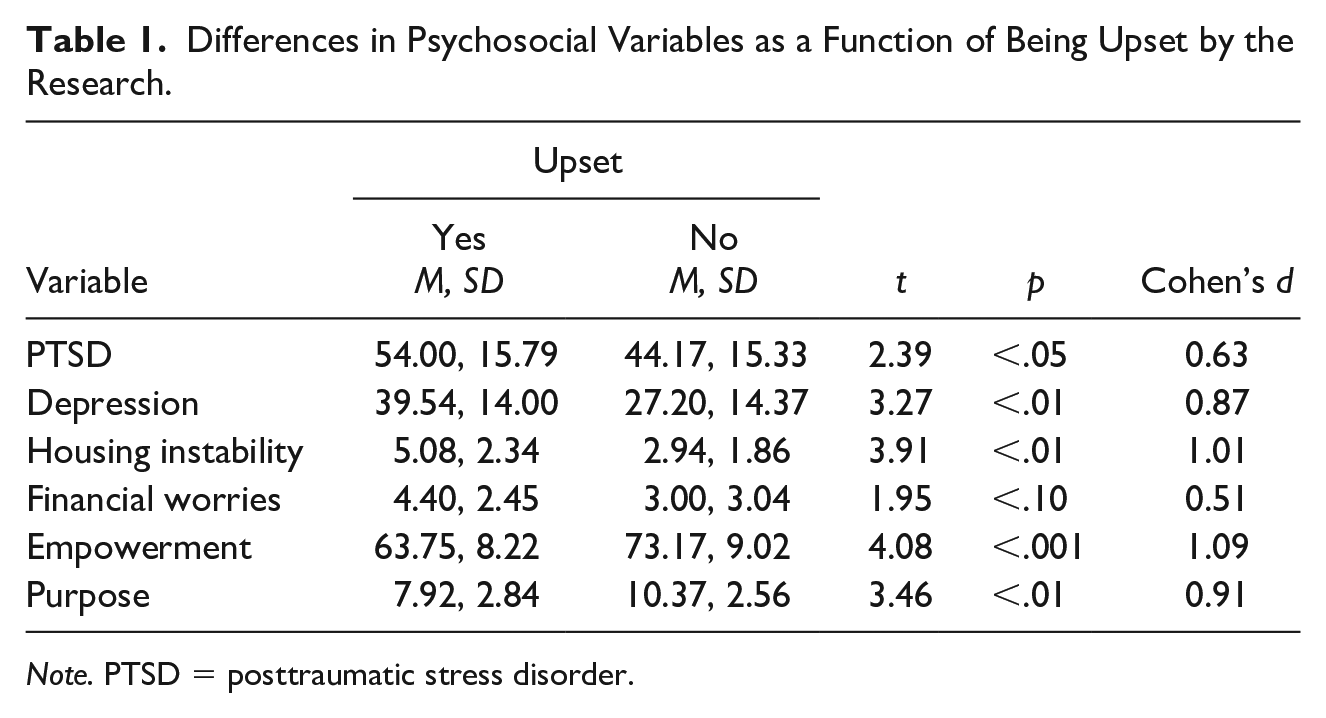
Note. PTSD = posttraumatic stress disorder.
Aim 3
Among women who reported being upset, 16.7% (n = 4) were upset about questions regarding their most stressful life event (without specifying what the event was). In addition, 20.8% (n = 5) were upset about questions about sexual assault, 12.5% (n = 3) were upset about questions about domestic violence, 20.8% (n = 5) were upset about questions about childhood abuse, 45.8% (n = 11) were upset about questions about children (e.g., losing custody, accident, or death), and 16.7% (n = 4) were upset about questions that inquired about the loss of a family member (other than children). Several participants also reported feeling self-blame (n = 3; 12.5%) and/or commented about general feelings of sadness/helplessness (n = 4; 16.7%). Percentages exceed 100% because some women had more than one response.
Among women who reported benefiting, 21.4% (n = 12) said that they benefited because the research would help others (more generally) and 16.1% (n = 9) said that they benefited because the research would help other women (specifically). Twenty-five percent (n = 14) said that they benefited for reasons specific to catharsis, venting, or “getting it off [their] chest.” One in five women (n = 12; 21.4%) said that they benefited because the research gave them the chance to self-reflect and gain awareness, often in reference to something they still need to work on or something they had overcome. Ten percent (n = 6; 10.7%) of women said that they benefited because they had a nice interaction with the researcher. A few women noted benefiting was specific to obtaining a gift card (n = 3; 5.4%), that the survey made them feel hopeful (n = 3; 5.4%), and/or that the survey helped them overcome their fear of talking about the trauma (n = 2; 3.6%).
Discussion
Findings suggested that close to half of women reported being initially upset by the research. Reasons for being upset varied but mostly had to do with questions about past traumas and the loss of one’s children. Also, consistent with previous research (Jaffe et al., 2015), women who were upset had higher levels of psychological distress symptoms than women who were not upset. Extending previous research, we found that women who were upset were higher in financial worries and housing instability than women who were not upset suggesting that these questions may have provoked a negative reaction in women and/or the fact that as women’s stressors in life increase, so too do their negative emotional reactions to research participation. Interestingly, women who had higher levels of empowerment and sense of purpose were less likely to be upset than women who were lower on these indicators. Although speculative, it could be that answering questions about empowerment and purpose mitigated the effects of questions about trauma, especially for women who are more well adjusted and positive about themselves.
Almost all of the women in this study reported that they benefited from the research, including women who were upset which is consistent with previous research (Jaffe et al., 2015). The reasons for benefiting varied but were most often centered around helping others/helping other women in addition to venting/catharsis and gaining insight/awareness. These findings are very assuring and suggest that, despite experiencing some distress following research participation, women are articulating reasons for why they also directly benefited from research participation. It is important to note that being upset by research participation is not necessarily an adverse or undesirable event. For some individuals, it may highlight that there are unresolved issues, for example, that need to be addressed, as was echoed by some women in our study.
Despite the important information gleaned from this study, several limitations need to be mentioned. First, we had a small sample size, although effect sizes were large. Second, our sample was not particularly diverse. Thus, future research should replicate these findings in larger, more diverse samples of shelter-seeking women. In addition, our data are cross-sectional and thus we cannot comment on the extent to which women’s feelings of distress lingered. However, based on previous research (Edwards et al., 2013) and the fact that we have high retention at follow-ups in this study, feelings of distress were likely minimal and transient. A final limitation is that we used an older version of the PCL-C.
These findings have important implications. First, the research was generally well tolerated even for women with extensive trauma and addiction histories. These findings should reassure researchers and practitioners that benefits to this type of research outweigh risks to participants. Second, given that women who were experiencing more distress and life stressors were more at risk for being upset by research participation, researchers may wish to consider disclosing this information to participants during the informed consent process. Finally, it may be helpful during the informed consent process to make participants aware of why other participants feel like they benefit from research participation. Together, this type of factual, rather than value-based, information can help participants make an informed decision about if they wish to participate or not in research examining addition and victimization experiences. In sum, we believe that the voices of participants should be at the core of our understanding of reactions to research participation, and we hope that this study contributes to that dialogue.
Footnotes
Authors’ Note
The authors have the utmost gratitude to the SEEDs program staff and to the women who so graciously gave their time and self to us. Without them, this project would not be possible.
Declaration of Conflicting Interests
The author(s) declared no potential conflicts of interest with respect to the research, authorship, and/or publication of this article.
Funding
The author(s) disclosed receipt of the following financial support for the research, authorship, and/or publication of this article: This research was funded by the Office of Violence Against Women (OVW), grant number 2016-SI-AX-0003. Opinions, findings, and conclusions or recommendations expressed in this presentation are those of the author(s) and do not necessarily reflect those of the OVW.
