



Abstract
Abstract
The study of intimate partner violence (IPV) has evolved into more complex and integrative models to better understand the explanatory mechanisms of IPV perpetration. Nevertheless, integrative models rarely permit an in-depth analysis of a large number of relevant variables, and more specific approximations are required as basis of them. In this sense, the individual approach is the most productive research line. From the individual perspective and using data from imprisoned male offenders, the present study aimed to analyze the potential mediating role of alcohol dependence in the association of Cluster B personality traits and psychological IPV. The sample included 196 male inmates of the Penitentiary Center of Villabona (Asturias, Spain). Structural equation modeling was used to test the hypothetical and alternative models. First, model results only showed an indirect effect of antisocial and borderline personalities mediated by alcohol dependence. Nevertheless, fitting of the model to the data was poor. Second, a fully saturated model was calculated, revealing a direct effect of histrionic personality on psychological IPV. Finally, an alternative model was tested adding to first model the direct effect of histrionic personality on psychological IPV. The fitting of the alternative model to the data was good. Antisocial and borderline personalities predicted psychological IPV when mediated by alcohol dependence, while histrionic personality had a direct effect on psychological IPV. Narcissistic personality did not affect psychological IPV. These results support the hypothesis regarding the use of alcohol as a coping mechanism in antisocial and borderline individuals, acting as a disinhibitory factor which increases the likelihood of psychological IPV occurrence. Contrary to previous research, a clear direct effect of histrionic personality and psychological IPV was obtained. This association can be explained by the necessity of attention of histrionic individuals and the type (psychological) of violence studied.
Psychological intimate partner violence (IPV) is the most prevalent form of IPV and has been frequently misrepresented in scientific literature in proportion to its relevance (Jewkes, 2010). Psychological IPV often precedes physical and sexual IPV, but it is also a unique form of IPV which can appear independently of other forms (there is no physical or sexual IPV without psychological IPV) and it can often appear during everyday interactions more easily than other forms of IPV. Furthermore, it has been thoroughly demonstrated that psychological IPV has psychologically and physically harmful consequences to its victims (see, for example, Heise et al., 2019). In this sense, understanding the explanatory mechanisms of psychological IPV is pivotal.
Recent studies have demonstrated the importance of considering integrative (or ecological) approaches to better understand the explanatory mechanisms of IPV (see Juarros-Basterretxea et al., 2018, 2019). Nevertheless, ecological models rarely permit an in-depth analysis of a large number of variables in each level (e.g., individual) and are usually based on previous specific studies focused on one of the relevant areas. In this sense, an individual perspective is one of the most productive research lines.
The empirical study of violent men—both in general and against their female partners—has produced abundant empirical evidence on their main psychological characteristics. An important part of these studies has given special attention to the analysis of the role of psychopathological personality traits and personality disorders (PDs) in the explanation of both general violence (see Bayes & Parker, 2017; Coid et al., 2017) and IPV (see Cascardi et al., 2018; Sesar et al., 2018). The analysis of the potential explanatory role of Cluster B personality traits (antisocial, borderline, histrionic, and narcissistic) in IPV is remarkable. The results, however, have not been consistent probably due to the different methodological strategies used by researchers in this field.
Cluster B Personality Traits and IPV
As Sesar et al. (2018) indicated in their recent review of studies, antisocial and borderline personality traits are strongly related to IPV (see also Spencer et al., 2019), while the relation between narcissistic personality traits and IPV is less consistent, and there are limited studies on the link between this form of violence and histrionic personality traits (see also Lowenstein et al., 2016). More specifically, antisocial and borderline personality traits have been associated with moderate and severe forms of IPV (Sesar et al., 2018), but differentially. Empirical findings suggest that men with borderline PDs displayed reactive IPV tendencies (characterized by emotional volatility; Armenti & Babcock, 2018; Cascardi et al., 2018; Peters et al., 2017; Ross & Babcock, 2009), whereas those with antisocial PDs displayed both reactive and proactive IPV tendencies (premeditated and instrumentally; see Cascardi et al., 2018; Ross & Babcock, 2009). Regarding the link between narcissistic personality traits and IPV perpetration, some authors have pointed out that the presence of such traits is related to IPV perpetration (Blinkhorn et al., 2019; Coid et al., 2017; Ménard et al., 2018); however, other researchers have questioned these results. Once a psychopathic personality is considered, there is mixed empirical evidence on the narcissism–IPV link, identifying a specific association with restrictive emotional abuse (Carton & Egan, 2017), or absence of association between narcissistic traits and IPV (Kiire, 2017). These findings rather suggest that the effect of narcissistic traits on IPV is better explained by the comorbidity with other personality traits or PDs (e.g., antisocial and/or psychopathic personality; see Fernández-Suárez et al., 2018, for a review of debate between antisocial traits and psychopathy) which have usually been associated with narcissism (see Lowenstein et al., 2016). Finally, histrionic personality traits have been anecdotally associated with IPV through comorbidity with other psychopathological personality traits (Boira & Jordá, 2010; Esbec & Echeburúa, 2010).
Despite the fact that research on the specific effect of each Cluster B personality traits has contributed to a better understanding of their role in IPV perpetration, there may be an empirical overlap between different psychopathological traits and PDs. The consideration of this overlap could allow researchers to improve their understanding on how Cluster B personality traits affect IPV perpetration.
Large survey empirical data have shown that antisocial–borderline comorbidity rates oscillate between 18.3% and 19.4%, antisocial–narcissistic between 14.4% and 18.7%, and borderline–narcissistic between 34.2% and 47%. Lower comorbidity rates were detected between histrionic and borderline PDs (10.3%), and histrionic and narcissistic PDs (9.9%) (National Epidemiologic Survey on Alcohol and Related Conditions [NESARC]; Grant et al., 2008; Stinson et al., 2008). However, less scientific attention has been given to the study of comorbidity between histrionic and antisocial PDs.
Even though the comorbidity rates were analyzed in pairs, they highlighted the necessity to study Cluster B personality traits all together. This integrative approach of Cluster B personality traits has been supported by studies of batterer typologies (see, for example, Hamberger et al., 1996; Herrero et al., 2016), showing that Cluster B symptoms significantly increased the risk of IPV perpetration. Furthermore, these symptoms were more stable in participants who later perpetrated IPV as compared with those who did not (Ehrensaft et al., 2006).
Alcohol (Ab)use and IPV
Alcohol is the most studied substance in relation to violence in general and male-to-female IPV in particular (Cafferky et al., 2018; Leonard & Quigley, 2017; Robitaille et al., 2017; Sesar et al., 2018). The links between substance use and abuse, and IPV have been thoroughly studied and strongly established in scientific literature (Cafferky et al., 2018; Crane et al., 2016; Jennings et al., 2017; Leonard & Quigley, 2017; Okuda et al., 2015; Sesar et al., 2018). As Cafferky et al. (2018) have shown in their meta-analytic review, not only problematic alcohol use (e.g., abuse, dependence, or drinking problems) but also alcohol consumption (e.g., alcohol use or frequency) have been significantly related to higher rates of IPV perpetration. This relation between alcohol use and abuse has been empirically found on both clinical and non-clinical populations (Cafferky et al., 2018; Sesar et al., 2018). In fact, there is evidence that the effect size of that influence is similar across different populations (i.e., clinical and non-clinical; Cafferky et al., 2018).
Furthermore, the influence of alcohol use and abuse, and IPV perpetration have also been experimentally supported. As Crane et al. (2016) have shown in their meta-analytic review of experiments, alcohol is an important explanation of aggressive behavior against a partner. Nevertheless, alcohol use and abuse does not fully explain IPV perpetration. Alcohol use and abuse might increase the likelihood of perpetrating IPV, along with other potential risk factors that should be considered for a better understanding of IPV occurrence.
Of special interest is the analysis of the relationship between the personality of the aggressor and their patterns of use and abuse of alcohol in the perpetration of IPV. Although the potential relevance of mediational variables to clarify the link between substance use (especially alcohol) and IPV has been addressed (see Cafferky et al., 2018; Eckhardt et al., 2015), the mediating role of alcohol use and abuse has, to a large extent, been neglected in the literature.
Cluster B Personality Traits, Alcohol (Ab)use, and IPV
Cluster B personality traits, and alcohol use and abuse are among the most studied individual-level IPV explanatory variables. However, there is limited analysis on how the influence of both Cluster B personality traits and alcohol use or abuse on IPV co-occur (Armenti et al., 2018). This is especially relevant because empirical evidence indicates that these PDs often lead to alcohol use and abuse (e.g., Hasin et al., 2007, 2011; Lenzenweger et al., 2007; Long et al., 2017). Empirical studies have found that Cluster B personality traits and alcohol dependence might co-occur. For instance, Trull et al. (2010) found that among over 40,000 individuals, approximately 40% to 50% of participants with a Cluster B–related PD also displayed alcohol dependence.
Theoretically, this co-occurrence of Cluster B PDs and alcohol use and abuse has been explained by the tendency of people with such PDs to have dysfunctional regulation of negative emotions, using alcohol as a coping mechanism (Brem et al., 2017; see also Brem et al., 2019) and, thus, promoting disinhibition and facilitating violent behaviors (Eckhardt et al., 2015; Keulen-de Vos et al., 2016). Thus, alcohol use and abuse is a potential explanatory mechanism of the psychopathological personality traits–IPV link (Trull et al., 2000).
There is empirical evidence in this area that suggests that some Cluster B personality traits could in fact influence IPV perpetration as long as they are also related to alcohol use and abuse. Brem et al. (2017) have recently shown, for instance, that antisocial personality traits are associated with frequent psychological aggression perpetration, but that this association is mediated by alcohol problems. In a similar fashion, other researchers have shown that alcohol use mediates (together with borderline-related features as anger and rejection sensitivity) borderline–psychological IPV link (see Cuenca & Graña, 2016). Similar explanations have been proposed to clarify the association between narcissistic personality traits and IPV, but not considering the relationship between alcohol and a narcissistic personality in spite of their significant relation (see Ménard et al., 2018). Finally, regarding histrionic personality traits, lack of specific research only indicates that an anecdotal relation between them and alcohol use has been detected (see Maclean & French, 2014); however, to the best of our knowledge, no rigorous research has been carried out considering either comorbidity or association with alcohol regarding IPV perpetration. These results support the hypothesis, at least in part, of the mediating role of alcohol between psychopathological personality traits and psychological IPV perpetration due to the association between these psychopathological personality aspects related to the tendency of alcohol (mis)use.
This type of research, however, has some limitations that current research should overcome. First, although there is empirical evidence of the relationship between antisocial PD, the use and abuse of alcohol, and IPV perpetration, the same research effort has not been devoted to the remaining features of Cluster B personality traits (borderline, narcissistic, and histrionic; see Cuenca & Graña, 2016; Maclean & French, 2014; Ménard et al., 2018, for some exceptions). In addition, research on this subject rarely considers the comorbidity of Cluster B personality traits.
Current Research
The current study aims to investigate the mediating effect of Cluster B personality traits (antisocial, borderline, narcissistic, and histrionic) via alcohol dependence on psychological IPV. This approach overcomes the potential limitations of prior studies which focused on one of Cluster B PDs by considering the associations between antisocial, borderline, narcissistic, and histrionic features when examining the effect of these psychopathological personality traits on psychological IPV.
This research also sought to investigate the mediating role of alcohol use and abuse in the link between Cluster B personality traits and IPV perpetration. Theoretical approaches, such as schema therapy theory (see Keulen-de Vos et al., 2016), propose that psychological IPV can be explained as the progression of schema modes where an initial negative emotional situation (e.g., argument with intimate partner) triggers negative feelings (e.g., anger). As a consequence of emotional dysregulation problems linked with Cluster B personality traits, these feelings occur as a result of self-soothing behaviors (e.g., alcohol consumption) that, because of their disinhibitory effect, promote an escalation of negative emotions (e.g., anger) and impulsivity, thus creating the conditions for perpetration of aggression. Similarly, from I3 theory (see Eckhardt et al., 2015), the same behavior can be explained as the conjunction of impelling and instigating factors: When impelling factors (e.g., psychopathological Cluster B personality traits) interact with instigating factors (e.g., argument with intimate partner), they promote an aggressive behavior. The likelihood of aggressive behavior would be increased by the lack of inhibitory factors because of the influence of disinhibiting factors (e.g., alcohol use). The higher presence of disinhibiting factors could be related to impelling factors (e.g., emotional dysregulation derived from Cluster B personality traits).
Based on this conceptual overview, we hypothesized that alcohol would serve as a mediator of the positive association between antisocial and borderline personality traits and psychological aggression against an intimate partner. In addition, we hypothesized that no indirect effect of narcissistic and histrionic personality traits on psychological IPV via alcohol dependence would exist.
Method
Participants
The sample included 196 male inmates of the Penitentiary Center of Villabona (Asturias, Spain). Participants were between 19 and 66 years old (M = 36.55, SD = 9.85). Inmates were sentenced for a variety of crimes: 43.40% (n = 85) with crimes related to IPV (gender violence according to Spanish law system), 36.20% (n = 71) with violent crimes not related to IPV (i.e., homicide, aggressions), and 20.40% (n = 40) with non-violent crimes (i.e., fraud). All participants had been in at least one relationship prior to being imprisoned.
Procedure
First, the researchers approached the Governmental and Penitentiary authorities to explain the study objectives and obtain official permission to evaluate inmates. Once official access was granted, the researchers asked for voluntary participants from a list provided by the penitentiary center. The recruitment rate was high (only 2% of inmates approached declined to participate) and once there was acceptance to participate, each participant signed an informed consent and completed a set of self-reported questionnaires. In the present study, only questionnaires pertinent to the aims of the study are considered.
Materials
Outcome variable
Psychological aggression against an intimate partner
The Psychological Aggression subscale of the Revised Conflict Tactic Scales (CTS2; Straus et al., 1996) was used to evaluate the frequency of psychological aggression perpetration against intimate partners during the participants’ last year of relationship with their last partner before imprisonment. The subscale consisted of eight items (e.g., “insulted or swore at my partner”). The items were rated on an 8-point Likert-type scale: 0 (this never happened) to 6 (happened more than 20 times) referred to the frequency of violence during the last year of the relationship, and 7 referred to violence before the last year (not in the past year, but it did happen before). The present study focused on the last year of the relationship to provide uniform assessment across participants and to cohere with the way the CTS2 is typically used (aggression across the past year). Thus, Category Response 7 was coded as 0, and subsequently, the items were summed to construct overall scores of psychological aggressions against intimate partners over the last year prior to imprisonment (α = .93).
Predictor
Cluster B personality traits
Cluster B personality traits were measured by Millon’s Clinical Multiaxial Inventory–III (Cardenal & Sánchez, 2007); to do that, Antisocial (APD: 17 items, Cronbach’s α = .76), Borderline (BPD: 16 items, Cronbach’s α = .82), Narcissistic (NPD: 24 items, Cronbach’s α = .70), and Histrionic (HPD: 17 items, Cronbach’s α = .80) subscales were used. All subscales consist of true–false items. Although cutoff scores exist to identify specific categories (prevalence ≥75, syndrome; prevalence ≥85, disorder; Cardenal & Sánchez, 2007), we focused on varying levels across the total scores to provide more sensitive tests across levels of antisocial, borderline, narcissistic, and histrionic personalities, and to produce more interpretable results in the context of the overall models. Thus, we summed the scores of each subscale obtaining four scores, where higher scores represent greater levels of antisocial, borderline, narcissistic, and histrionic personalities.
Mediator variable
Alcohol dependence
Alcohol dependence was measured by Millon’s Clinical Multiaxial Inventory–III (Cardenal & Sánchez, 2007) Alcohol Dependence subscale (15 true–false items, Cronbach’s α = .71). As in the case of Cluster B personality traits, cutoff scores exist to identify specific categories (prevalence ≥75, syndrome; prevalence ≥85, disorder; Cardenal & Sánchez, 2007); however, we summed the scores so that higher scores represent greater alcohol dependence with the aim of providing more sensitive tests across levels of alcohol dependence and produce more interpretable results in the context of the overall models.
Covariate
Social desirability
Social desirability was measured by Millon’s Clinical Multiaxial Inventory–III (Cardenal & Sánchez, 2007) Social Desirability subscale (21 true–false items, Cronbach’s α = .80). As in the case of predictor and mediator variables, we did not use cutoff scores (prevalence ≥75 indicates a tendency to show themselves as favorable or attractive; Cardenal & Sánchez, 2007); we summed the item scores so that higher scores represent greater social desirability to provide a more sensitive measure.
Data Analysis
Structural equation modeling was used to analyze the direct, indirect, and total effects between Cluster B personality traits and psychological aggression against intimate partners. This was done by evaluating a set of alternative models. We first tested a model that predicted fully mediational effects of alcohol dependence in the personality traits—psychological IPV relationship (Model 1). In this model, all predictor covariations were freely estimated. We estimated a second alternative model that proposed the existence of both direct and indirect effects of Cluster B personality traits on psychological IPV via alcohol dependence. As this second model estimated all direct and indirect relationships, it was completely saturated (with zero degrees of freedom). Finally, a third alternative model was generated based on results of the previous two models. Model fit to the data was tested by Satorra–Bentler’s scaled chi-square test (S-Bχ2). As all models are nested, the models ere compared with each other through the likelihood ratio test.
EQS 6.3 structural equation program (Bentler, 1995) was used to test the models, while IBM SPSS 22 package was used to calculate means and standard deviations as well as Pearson’s bivariate correlations.
Results
Table 1 presents the descriptive statistics and Pearson’s correlations across all variables. Cluster B personality traits displayed a varied pattern of correlations. There were significant correlations between antisocial and borderline personalities (r = .54, p < .001), and both these personalities were significantly related to histrionic personality (r = –.19, p ≤ .01, and r = –.29, p ≤ .001, respectively), but not to narcissistic personality (r = .11, ns, and r = –.02, ns, respectively). Only histrionic personality was significantly related to narcissistic personality (r = .41, p ≤ .001). As expected, antisocial and borderline personalities were positively associated with alcohol dependence (r = .60, p ≤ .001, and r = .55, p ≤ .001, respectively) and psychological aggression (r = .18, p ≤ .01, and r = .17, p ≤ .01, respectively). However, histrionic personality was negatively related to alcohol dependence (r = –.25, p ≤ .001) and was not related to psychological aggression (r = –.06, ns). Narcissistic personality was not related to alcohol dependence (r = –.04, ns) nor psychological aggression (r = .03, ns).
Means, Standard Deviations, and Zero-Order Correlations Across All Variables
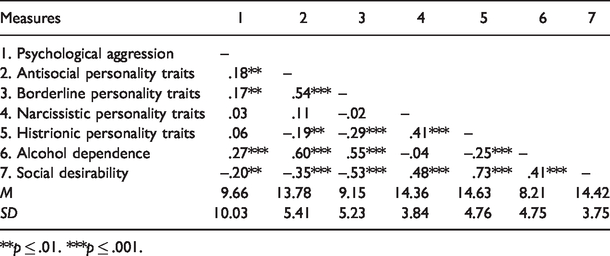
**p ≤ .01. ***p ≤ .001.
Model 1 (see Figure 1) showed poor fit to the data according to both chi-square and root mean square error of approximation (RMSEA): S-Bχ2 = 21.3424, df = 4, p ≤ .001, comparative fit index (CFI) = .96, RMSEA = .15, 90% confidence interval [CI] = [.09, .21]. Close inspection of Model 1 results showed that antisocial personality (β = .42, p ≤ .001) and borderline personality traits (β = .26, p ≤ .001) were associated with higher levels of alcohol dependence, which in turn predicted greater psychological aggression (β = .22, p ≤ .01). The indirect effects of antisocial (β = .09, p ≤ .01) and borderline personalities (β = .06, p ≤ .05) on psychological aggression via alcohol dependence were also significant. Narcissistic (β = –.03, ns) and histrionic personalities (β = .01, ns) were not statistically associated with alcohol dependence. In this model, all the influence of Cluster B personality traits on psychological IPV perpetration was fully mediated by alcohol dependence. As this model was not statistically tenable with our data, we tested an alternative fully saturated model (Model 2) where both direct and indirect influences of Cluster B personality traits on IPV perpetration were hypothesized).
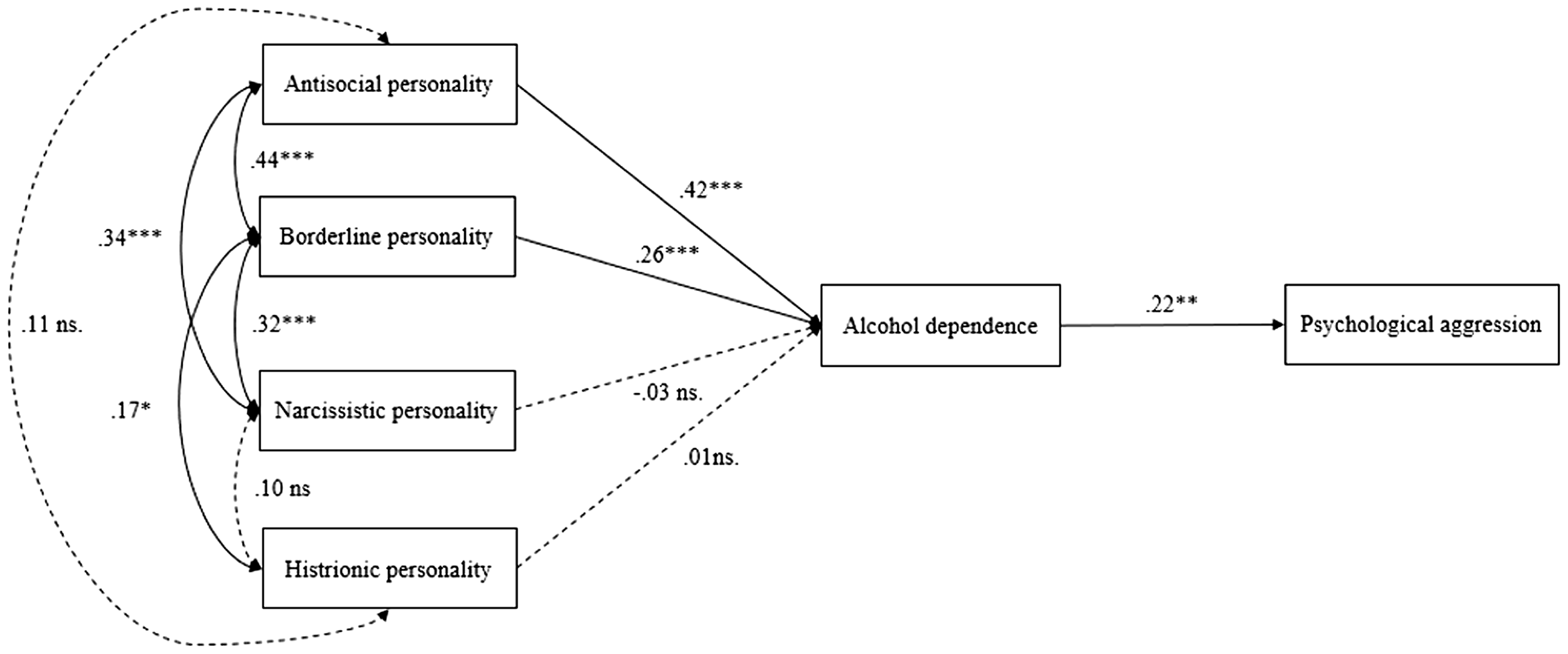
Model 1: The effect of Cluster B personality traits on psychological aggression, mediated by alcohol dependence.
Results of Model 2 revealed one significant direct effect of histrionic personality on psychological aggression in addition to indirect effects (via alcohol dependence) of antisocial and borderline personalities on psychological aggression.
Based on the previous theory, a third final model (Model 3) was tested. In this model, we hypothesized that alcohol use and abuse would mediate the influence of antisocial and borderline personality traits on IPV perpetration, and that histrionic personality would display a direct influence on IPV perpetration.
The results of the alternative model are displayed in Figure 2. Model 3 showed an appropriate fit to the data (S-Bχ2 = 3.0389, df = 3, ns), being also more parsimonious than the fully saturated model. In this Model 3, higher levels of antisocial (β = .42, p ≤ .001) and borderline personality traits (β = .26, p ≤ .001) were associated with higher levels of alcohol dependence, which in turn predicted greater psychological aggression (β = .20, p ≤ .01). These indirect effects of antisocial (β = .08, p ≤ .05) and borderline personality traits (β = .05, p ≤ .05) on IPV perpetration via alcohol dependence were still significant. A direct significant association between histrionic personality traits and psychological aggression against an intimate partner (β = .43, p ≤ .001) was found in this model. Narcissistic (β = –.03, ns) and histrionic personality traits (β = .01, ns) were not associated with alcohol dependence. Rather, narcissistic personality showed no statistical association with IPV perpetration once the effects of the remaining Cluster B personality traits were considered.
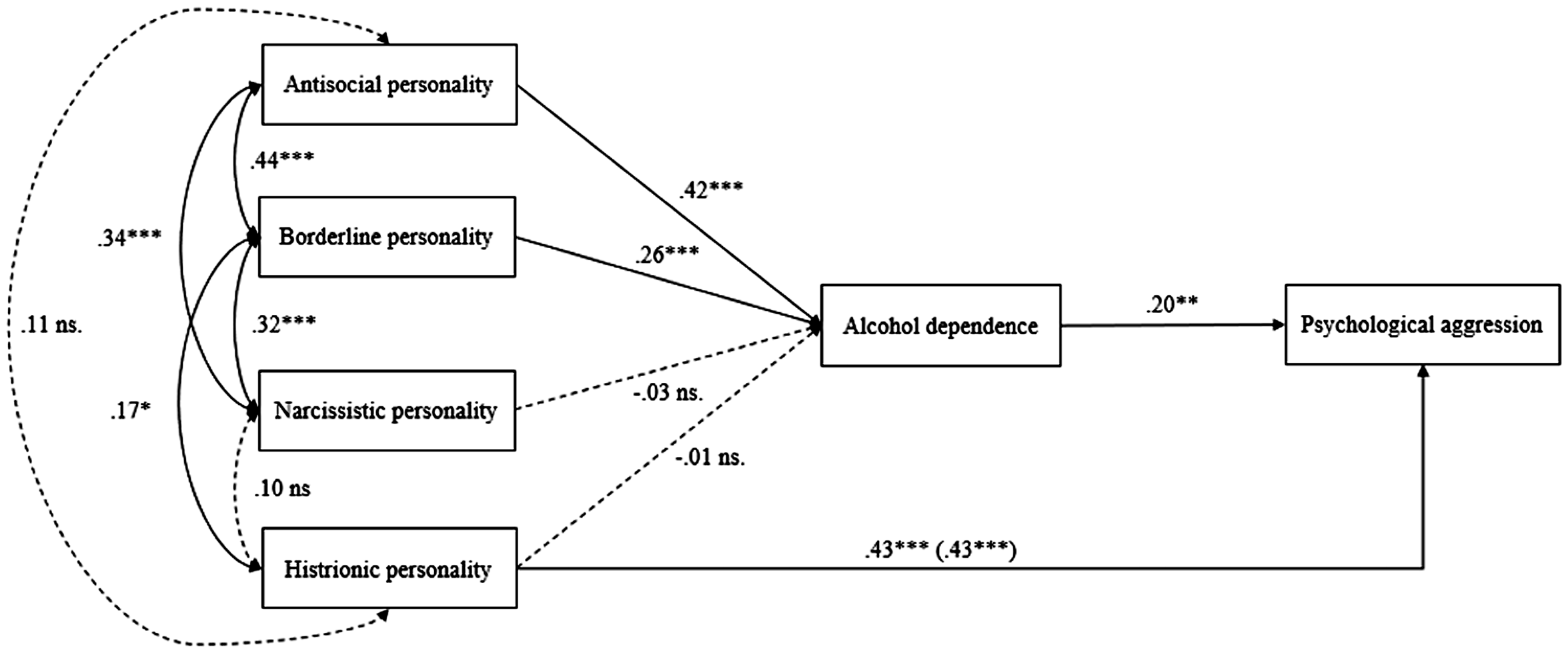
Model 3: The effect of Cluster B personality traits on psychological aggression, mediated by alcohol dependence, and direct effect of histrionic personality on psychological aggression.
This model explained the 16.40% of the variance of psychological aggression against an intimate partner.
Discussion
Using data from 196 inmates of the Penitentiary Center of Villabona (Asturias, Spain), this study examined the mediating role of alcohol dependence on the association between Cluster B personality traits and psychological IPV perpetration. To analyze the mediated effect of Cluster B personality traits on psychological IPV, the association between different dimensions (antisocial, borderline, narcissistic, and histrionic) was considered.
The results supported the hypothesis regarding the full mediational role of alcohol dependence on the association between antisocial and borderline personality traits and psychological IPV perpetration. The results also support the hypothesis of the absence of mediated effects of narcissistic and histrionic personality traits on psychological IPV. Thus, participants’ antisocial and borderline personality scores predicted higher levels of alcohol dependence, which, in turn, predicted higher psychological IPV against female partners. Nevertheless, a non-expected direct association between histrionic personality traits and psychological IPV remained significant.
These results suggest that individual-level research on how personality traits shape psychological IPV should consider a more integrative approach within an individual level. Specifically, to identify the specific influence of each Cluster B trait on IPV, researchers should consider a joint assessment of all four Cluster B traits to account for the individual contribution of each trait on IPV, excluding the influences of all other traits. In addition, the mediational effect of alcohol use on the link between Cluster B personality traits and IPV should be considered. In this regard, our results suggest that only the effects of antisocial and borderline personality traits on psychological IPV are mediated by alcohol dependence, while narcissistic and histrionic traits do not have any mediated effects on psychological IPV. These results can be explained by consumption motivations and patterns of persons with antisocial and borderline personality traits as well as comorbidity rates of Cluster B personality traits.
Antisocial and borderline personality traits showed an indirect effect on psychological IPV via alcohol dependence. These findings are in accordance with research suggesting that antisocial and borderline personality traits might result in greater alcohol use and abuse due to the emotional dysregulation inherent to them. Thus, the tendency of such individuals to consume alcohol as a soothing or coping mechanism (in relation to antisocial and borderline personality traits) may account for this mediational effect (Brem et al., 2017; Keulen-de Vos et al., 2016). Furthermore, while alcohol acts as a disinhibiting rather than calming mechanism (Crane et al., 2016; Eckhardt et al., 2015; Keulen-de Vos et al., 2016), the disinhibition of previous predispositions to aggression facilitated by alcohol use increases the likelihood of psychological IPV occurrence instead of a more prosocial conflict resolution (Crane et al., 2016). The degree to which the interplay of antisocial/borderline personality traits and alcohol use and abuse result in violence probably depends on predisposing traits and other precipitating factors as well (Lowenstein et al., 2016).
This pattern might explain how antisocial and borderline personality traits are associated with psychological IPV perpetration through alcohol dependence. For example, an individual with predisposing antisocial and/or borderline personality traits may experience chronic interpersonal difficulties in an intimate relationship that may have the potential to precipitate violence, without the occurrence of violence. Violence may occur when the precipitating effect of alcohol interplays with such predisposing traits. In other words, alcohol use and abuse triggers psychological IPV when interacting with a predisposition to violence linked to antisocial and borderline personality traits. Following Lowenstein et al. (2016), how each Cluster B psychopathological personality trait may independently as well as collectively result in violence should be considered when the mediating role of alcohol is taken into account.
We did not find any mediational effect of alcohol dependence on the link between narcissistic and histrionic personality traits and psychological IPV perpetration. This result may be explained by the well-known comorbidity rates of Cluster B personality traits (Grant et al., 2008; Stinson et al., 2008). Some researchers have shown anecdotal associations between narcissistic (Blinkhorn et al., 2019; Coid et al., 2017; Ménard et al., 2018) and histrionic (Boira & Jordá, 2010; Esbec & Echeburúa, 2010) personality traits with IPV, but only when the associations with other Cluster B personality traits were not taken into account. Our results from Model 1 suggest that the effects of narcissistic and histrionic personality traits found in other studies could be explained by comorbidity with antisocial or borderline personality traits. For example, it has been found that the association between narcissistic personality traits and IPV perpetration disappeared when psychopathic traits were considered (Kiire, 2017).
Contrary to our expectations and the majority of previous research about Cluster B–IPV association, results of Model 2 suggest a direct association of histrionic personality traits and IPV as well as an indirect association of antisocial and borderline personality traits via alcohol dependence. This apparent contradictory result could be explained by the nature of histrionic personality and the type of IPV (psychological) measured in our study. Histrionic individuals are characterized by the continuous search of stimulation, attention, and affection from others; they mask their fear of autonomy and necessity of approval behind simulated self-confidence and security (Cardenal & Sánchez, 2007). This kind of individuals try to obtain maximum attention and favor from others, and this can be related to exaggerated manifestations of disappointment (e.g., slam of the door when leaving the room) or causing partners annoyance voluntarily (e.g., saying something about her knowing that it is annoying to her), which reflects psychological IPV. Other types of IPV (sexual, physical) might not be related to histrionic personality; consequently, the relation between histrionic personality traits and IPV could be dependent on the type of violence.
The consideration of associations between antisocial, borderline, narcissistic, and histrionic dimensions in the exploration of their effects on psychological IPV via alcohol dependence helped to rule out potentially spurious relationships between narcissistic personality traits and psychological IPV. According to our results, this relationship has accounted for antisocial and borderline personality traits. An association between histrionic personality traits and psychological IPV was found, thus pointing out to the potential role of approval seeking on psychological IPV perpetration. This finding also has important implications for intervention and treatment programs. In the same way that psychologists should focus part of the intervention on aspects related to antisocial and borderline personality traits (e.g., emotional regulation problems, impulsivity, or aggressiveness; Spencer et al., 2019), professionals should pay attention to how these aspects predict more alcohol use and abuse as a soothing mechanism, and intervene in this association between antisocial and borderline traits to reduce psychological IPV perpetration. In addition, these programs should work to reduce the necessity of others’ approval and attention (characteristics of histrionic personality), and in dealing with situations where expected external stimulation is not obtained.
Strengths and Limitations
The current study had both strengths and limitations. The strengths include both the participants of the study and the integrative view of a psychopathological-based individual approach. The use of data from prison inmates allows researchers to extend the existing empirical evidence from most common community and clinical samples to a relevant population at risk of first IPV perpetration or relapse. In addition, the results obtained from prison inmates allow for the development of more accurate intervention programs to achieve better reintegration and reduce the risk of future psychological IPV perpetration. As per our integrative view followed in the analysis, the mediated effects of antisocial and borderline personality traits on psychological IPV via alcohol dependence (and the absence of this effect for narcissistic and histrionic personality traits) statistically control the influence of each Cluster B personality dimension on the others and add accuracy to the model. These two potential strengths add generalizability to the results of the study (Ehrensaft et al., 2006).
However, the study also had some potential limitations. First, while the integrative model of Cluster B psychopathological personality traits and alcohol dependence provides relevant information and it is useful to answer specific-level research questions (see Eckhardt et al., 2015), it does not fully capture the complex nature of IPV perpetration. On one hand, the model should be tested in relation to other forms of IPV perpetration (e.g., physical) to allow a deeper understanding of the specific paths tested in our study. On the other hand, IPV perpetration could be better understood using ecological approaches (see Juarros-Basterretxea et al., 2019). In this sense, future research should follow an ecological approach to better account for IPV perpetration’s explanatory mechanisms. Second, the information on psychological IPV perpetration was obtained through self-reports, which can provide biased information probably due to the sensitivity and reactivity inherent to this topic. In future research, information from the other dyad member that would allow the identification of mutual aggressions should be collected (Herrero et al., 2020; Low et al., 2016), and, thus, the instigating factors (e.g., conflict with the partner) that could be interacting with psychopathological traits and their causalities in alcohol consumption should be comprehensively explored. Third, and related to the above, the correlational nature of the study did not allow for the establishment of causality among the variables. A longitudinal assessment of the model proposed here would permit the assessment of the causal mechanisms and would provide stronger evidence of conclusions offered here as well as a better understanding for psychologists to accurately intervene (see Brem et al., 2019).
Finally, the results of the study should be generalized to other populations with caution. The fact that participants of the study belonged to a male prison population with a heterosexual orientation limits the generalization of the results to other populations with different sexual orientation (same-sex couples, for example). Future research should aim to verify the results of our study in populations with greater diversity.
Footnotes
Declaration of Conflicting Interests
The author(s) declared no potential conflicts of interest with respect to the research, authorship, and/or publication of this article.
Funding
The author(s) disclosed receipt of the following financial support for the research, authorship, and/or publication of this article: Support for this research was provided by the Spanish Ministry of Economy and Competitiveness (MINECO-17-PSI2016-77484-P).
