



Abstract
Although Title IX prohibits sex-based discrimination, including sexual harassment in institutions of higher education (IHEs), in the era of #MeToo, consensual faculty–student relationships have elicited significant attention. While some IHEs have developed consensual sexual relationship policies (CSRPs), little research to date has examined the content of such policies or whether IHEs have changed their policies as societal awareness regarding sexual harassment has increased. This study examined a stratified sample of IHEs, including state flagship, regional, and Ivy League schools (n = 56), to compare the type of CSRPs in 2011 and 2018 as well as changes in the content of such policies over the 7-year study period. Findings suggested that IHEs are becoming more restrictive in their CSRPs with movement toward limited bans and prohibitions; most policies discuss power differentials, include reporting requirements, and identify the use of sanctions for policy violations. Innovations in CSRPs include nuanced discussions of consent, placing the burden of proof on faculty to prove consent in allegations of sexual harassment, and including graduate students in CSRPs. Implications inform the debate regarding policies and procedures on campus sexual misconduct and advance the literature on evolving responses.
Whenever a faculty-student sexual relationship causes a student to drop a class, or a thesis, or school, that student has suffered a serious harm. Universities cannot simply answer that the student consented to the relationship and should handle the consequences. A university without a well-established and promulgated policy . . . seriously fails the students.
—Mack (1999, p. 85).
In recent years, the #MeToo and Times Up movements have called for, and led to, large-scale changes regarding sexual harassment across a range of private industries and public institutions. Likewise, the 2014 White House Task Force to Protect Students from Sexual Assault and student-led movements such as “Know Your IX” have generated momentum regarding the policies and responses to sexual harassment within institutions of higher education (IHEs). Taken together, there has been an increased interest regarding sexual harassment, and on college campuses, this has included interest in policies regulating consensual sexual relationships (CSRs) between faculty and students (see, for example, media reports from Flaherty, 2018; Karlin, 2018; Fernandes, 2018). While faculty-to-student sexual harassment falls clearly outside the bounds of acceptable behavior in academia, faculty-to-student CSRs may not be so easily distinguished—as many continue to debate whether these policies “police adult relationships” or protect students from the inherent power differentials that exist between faculty and students (Bellas & Gossett, 2001).
At present, little systematic research has been conducted regarding the current scope of IHE’s policies regarding faculty-to-student CSRs or whether recent social movements have been associated with changes in IHE policies. The present analysis seeks to extend previous research by comparing faculty-to-student CSR policies from 2011 and 2018 for a stratified, random sample of IHEs (n = 55) and, for IHE’s that have made changes, examine the scope and content of these changes. Understanding these issues is key to informing the development of policies to best protect both students and faculty—including those who might engage in these relationships—as well as fostering a safe learning environment for other students (e.g., third parties) who might be adversely affected. Findings provide guidance and direction for strengthening existing policies as well as for creating new ones.
Sexual Harassment and Social Movements
In 2006, Tarana Burke first used the twitter hashtag “#MeToo” to provide support for the primarily Black and Brown victims of sexual harassment and assault in her community—the hashtag was meant to “empower through empathy” (Johnson & Hawbaker, 2019; Ohlheiser, 2017). Nearly 10 years later, in 2017, the New York Times published an article that investigated alleged widespread and systemic sexual harassment in the film industry. The article alleged multiple complaints against film industry executives, industry awareness of the alleged conduct, and repeated cover-ups at the executive and network levels (Kantor & Twohey, 2017). Actress Alyssa Milano tweeted #MeToo in support of those who had come forward to expose the culture of sexual harassment in Hollywood and the hashtag quickly went viral—with more than 19 million uses from October 15, 2017, to September 30, 2018—bringing life to the #MeToo movement (Anderson & Toor, 2018). Then, in January 2018, more than 300 women in Hollywood launched the Times Up campaign, a movement inspired by #MeToo, but with the specific goal of creating tangible changes that lead to greater safety and equality in the workplace (Johnson & Hawbaker, 2019; Timesupnow, 2019). The central goal of Times Up is to create a cultural shift regarding what is and is not acceptable behavior in the workplace, and the world at large.
As societal support for #MeToo and Times Up spread, it became clear that the culture of harassment was not confined to Hollywood. Prominent figures, including politicians, corporate executives, news anchors, and a potential Supreme Court justice, came under scrutiny for their alleged sexually assaultive behavior, with some losing their positions or being sentenced to jail time. Academia has not escaped the scrutiny of the #MeToo and Times Up movements with professors—including some well-known, powerful scholars at elite universities—being terminated or resigning after allegations of sexual harassment against students (Gluckman, Read, Mangan, & Quilantan, 2018). For example, a recent article in the Chronicle of Higher Education (Gluckman et al., 2018) details a series of allegations against faculty at IHEs spanning institutional sectors and U.S regions: Spellman, Liberty, San Jose State, Columbia, LeHigh, Dartmouth, and many, many more. The article notes that “the new wave of revelations and accusations has raised the stakes, and the fury the #Me Too movement has tapped into could have a long-standing impact on higher education” (Gluckman et al., 2018, n.p.).
Sexual Harassment and CSRs in Academia
In recent years, both social movements and legal changes have brought the prevalence and consequence of sexual harassment at IHEs in to sharp focus. However, federal legislation has prohibited sexual harassment as a form of sex discrimination at IHEs for nearly five decades: Title IX of the Education Amendments of 1972 to the Civil Rights Act of 1964 (i.e., Title IX) states, “No person in the United States shall, on the basis of sex, be excluded from participation in, be denied the benefits of, or be subjected to discrimination under, any education program or activity receiving Federal financial assistance” (para. 1). Civil case precedent (e.g., Alexander v. Yale, 1980) further solidified the legal recognition of sexual harassment as sex discrimination, and in 1997, the Office for Civil Rights first issued guidance on IHE’s obligations to respond to sexual harassment under Title IX (U.S. Department of Education & Office for Civil Rights, 1997). And, in 2006, a “Dear Colleague Letter on Sexual Harassment” was released which aimed to “increase awareness of sexual harassment” and remind schools of the “principles that a school should use to recognize and effectively respond to the sexual harassment of students in its programs and activities” (U.S. Department of Education & Office for Civil Rights, 1997, p. 1).
Sexual harassment commonly exists as quid pro quo harassment or behavior that creates a hostile work environment. Quid pro quo harassment is defined by the Equal Employment Opportunity Commission (EEOC, 1990) as occurring when an individual experiences unwelcome sexual advances, requests for sexual favors, and/or verbal or physical sexual conduct when the submission to such conduct is made a condition of a person’s employment or is used as a basis of advancement or demotion decisions for the person toward which the conduct is directed.
Faculty-to-student sexual harassment has been well documented (Cantalupo & Kidder, 2017; Huerta et al., 2006; Kalof et al., 2001; Kelley & Parsons, 2000), but less is known regarding CSRs between faculty and students. Historically, relationships which involve a consenting adult student and faculty member were considered private matters that were outside of the institutions’ bounds to regulate. However, IHEs have an inherent hierarchy that affords faculty members significant control over students—and not just during a specific course, but potentially throughout a student’s academic and professional career—and this calls into question whether a relationship with such inherent inequality can truly be consensual (Blevins-Khabe, 1992). Bellas and Gossett (2001) further note that even when a student does not report feeling that any pressure has been exerted on them by the faculty member, there may have been subtle or even unintentional pressure simply by the virtue of the professor having more power or authority than the student.
While concerns about faculty–student power differentials in the context of sexual harassment often focus on the risks to undergraduate students, #MeToo-era allegations of sexual harassment by faculty members against graduate students at Princeton, University of Rochester, Boston University, and others (Gluckman et al., 2018) demonstrate their potential vulnerability. Graduate students are often highly dependent on faculty members for intense, one-on-one mentorship and personal letters of recommendation for advanced studies and employment applications. Furthermore, graduate students, especially doctoral candidates, often maintain relationships with their major professors throughout their career, leveraging the reputations of their mentors for continued career advancement long after their graduation.
Policies Governing Faculty-to-Student CSRs
Although anti-sex discrimination policies have become ubiquitous on college campuses (Richards, 2019), the unique “grey area” created by the power differentials between students and faculty suggests the need for additional policies (Rhode, 2006). As noted by Richards et al. (2014) “a consensual sex policy may function as a prudent extension to the sexual harassment policy or as a supplement to the existing policy so there is no gap in protection” (p. 340). Consensual sexual relationship policies (CSRPs) can also protect the interests of third parties. As Mack (1999) suggests, third-party students may experience real or perceived negative consequences (e.g., differential grading) by CSRs between their professor and another student. Furthermore, the university’s overall reputation for fostering a safe, fair, and professional learning environment may also be at risk when unchecked faculty-to-student sexual relationships exist.
A complete CSRP should provide a clear outline of an institution’s perspective on faculty-to-student CSRs, any reporting requirements for parties involved in these relationships, potential professional risks, and the potential sanctions so that individual faculty members are protected from arbitrary or capricious treatment by administrators and/or institutions. CSRPs have been in effect at some IHEs since 1984 (Mack, 1999), and prior research has identified four broad types of faculty-to-student CSRPs used by institutions: advisory policies, limited bans, combinations of advisory and limited ban policies, and outright prohibitions (Mack, 1999).
First, advisory policies, the most relaxed policy type, generally discourage sexual relationships between faculty and students but do not disallow such relationships. Second, limited bans on faculty/student relationships disallow such relationships, but only when the faculty member has direct academic responsibility for the student such as teaching them in a course or evaluating their thesis. Next, there are policies that combine the advisory and limited ban policies in that they prohibit relationships where the faculty is in a supervisory role and discourage the relationship when the faculty is not in a supervisory role. Finally, prohibitory policies ban consensual relationships between faculty and students outright irrespective of any teaching, grading, or supervisory role held by the faculty member.
The Richards Et Al. (2014) Study
In 2014, Richards and colleagues published a study that examined the characteristics of faculty-to-student CSRPs. Specifically, they examined a stratified random sample of 56 IHEs—including public flagship/landgrant, regional, and Ivy League schools—regarding their 2011 CSRPs for (a) IHE acceptability of faculty-to-student CSRs, (b) identification of power differentials in faculty-to-student CSRs, (c) reporting requirements, (d) identification of sanctions, and (e) identification of third-party liability.
Richards et al. first found that 16% of the schools they sampled had no CSRP. Of the IHEs that had a CSRP, the majority of IHE policies (82%) prohibited consensual relationships between faculty and students over which they had supervisory power (i.e., limited bans), whereas another 15% discouraged such relationships (i.e., advisory policies). They identified only one school in their sample, Yale, which prohibited relationships between all (undergraduate) students and faculty members no matter whether the faculty member had supervisory power over the student (i.e., prohibitory policy); Yale’s policy also banned relationships between faculty and graduate students over which they had direct supervisory control (i.e., merging the advisory and limited ban policies types).
Furthermore, the majority (98%) of CSRPs identified the role of power differentials in CSRs and liability issues were discussed in 38% of the policies, and concerns about “third party” complaints were often noted. While most policies had no reporting requirements, 44% of the samples’ policies required faculty to report the relationship to university administrators to attempt to remedy conflicts of interest. Few CSRPs included language regarding sanctions for CSRP violations, and when sanctions were noted, the language was most often ambiguous or indicated that there would be some type of penalty but was unclear as to specific consequences for faculty who violated the CSRP (Richards et al., 2014).
The Present Study
As previously discussed, CSRPs may extend or supplement an IHE’s sexual harassment policy to ensure that campus community members are clear regarding the IHE’s norms and expectations for consensual relationships. Prior literature suggests that a complete CSRP should provide (a) a clear outline of an institution’s perspective on faculty-to-student CSRs through advisory policies, limited bans, combinations of advisory and limited ban policies, and outright prohibitions; (b) any reporting requirements; (c) the potential risks; and (d) the potential sanctions for parties involved in these relationships.
This research aims to assess the current state of CSRPs as well as changes in CSRPs since the inception of the #MeToo and Times Up campaigns—social movements which have heightened societal awareness of sexual harassment in institutions from politics to academia. Specifically, this study extends Richards et al.’s (2014) previous work by reexamining their sample of IHEs’ 2011 and 2018 CSRPs, and comparing policies over this 7-year study period regarding changes in policy type. Then, among IHEs that have made changes to their CSRP, policy components, including discussion of power differentials, reporting requirements, sanctions, and concerns around risks/liability, were assessed. Finally, keeping in mind the potential impact of the #MeToo and Times Up movements, this study examined CSRPs for discussions of consent and protections for student-victims as well as the application of CSRPs to graduate students.
Method
Sample
The sample used here is drawn from prior research by Richards et al. (2014). The sample comprised a stratified sample of IHEs based on U.S. Census Region: Northeast, Midwest, West, and South, with the Southern region further divided into the Southwest and Southeast regions. Five randomly selected flagship/land grant schools and five regional IHEs from each Census Region as well as six Ivy League IHEs (n = 56) were included. As noted in Richards et al.’s study, after an exhaustive search of policies for the flagship/land grant IHEs in Louisiana and New Mexico, it was determined that neither states’ IHEs had CSRPs in place in 2011, so these data were considered missing. For this study, the University of North Carolina was added as a replacement for the missing flagship/land grant IHE from the Southeast region (i.e., Louisiana State University). As such, this research uses a near-replication of Richards and colleague’s sample; a final list of the sampled schools used for this research organized by Census Region and IHE type is included in the appendix (n = 55).
The IHE websites for all sampled schools were reviewed by a research assistant, and the CSRP in use by each IHE in 2018 was identified and saved for data analysis. The policies in use in 2011 were obtained from Richards with the exception of the policy for the University of North Carolina (UNC) as described above; UNC's policy was developed in 2007 and was still in effect in 2018, so the same policy was used for the 2011 and 2018 datasets.
Analytic Technique
Atlas.ti (8.0), a qualitative data management suite, was used to organize and code the data. Each IHE’s policy for 2011 and 2018 was uploaded to Atlas.ti (8.0) and then subjected to content analysis. Content analysis requires careful consideration of data to link codes with words or passages within the text to explore overarching themes and/or patterns. As noted by Berg (2004), content analysis can be a useful method for “identifying, organizing, indexing, and retrieving data” (p. 225). Content analysis often depends on a set of codes developed a priori (Denzin & Lincoln, 2003) and a series of codes stemming from Richards et al.’s (2014) research was used here. In addition, concepts from the #MeToo and Times Up movements were used to identify several emergent codes focused on consent, implications for graduate students, and protections for students.
Content analysis may encompass the investigation of manifest (i.e., actual words or phrases) and/or latent content (i.e., symbolism or meaning behind words or phrases), and the current analysis made use of both types of content. For example, when coding CSRP type, manifest content was sufficient to identify “prohibitions” and “limited bans” given that they used the word prohibited to describe the IHE’s perspective on CSRPs. However, latent content was important for identifying advisory policies given that in these policies, IHEs would “discourage” CSRs, “caution” faculty against CSRs, or note that CSRs “are unwise” which required the coder to assess the underlying meaning of the language used.
Policies were first coded by one (of two) researchers using a coding scheme based on the aforementioned literature. After all policies were coded, a second researcher recoded 10% of policies to establish a rate of interrater reliability. Perfect coding agreement between researchers one and two was established.
Results
CSRP Type
To begin, IHE’s 2011 and 2018 policies were compared to identify which IHEs made changes to their CSRP during the 7-year study period (i.e., during the #MeToo era). Results revealed that 21 IHEs (38%) made no changes to their CSRP between 2011 and 2018, while 34 IHEs (62%) revised their CSRP. Further examination of these 34 IHEs’ CSRPs uncovered that 18 (44%) IHEs had changed their policy type (i.e., advisory, limited ban, hybrid advisory and limited ban, or full prohibition). We begin by outlining the 2011 CSRP types for these 18 IHEs and then discuss changes in CSRP types over the study period as reflected in their 2018 CSRPs.
In 2011, 10 of these 18 IHEs (56%) had “advisory” policies regarding CSRs that “strongly discouraged,” “cautioned,” or “noted that such relationships were inappropriate”; however, these relationships were not prohibited by the IHE. For example, the University of Connecticut’s policy stated, “The University strongly discourages romantic and sexual relationships between faculty and student . . . even when such relationships appear, or are believed to be, consensual” (University of Connecticut, n.d.a). Another six IHEs (33%) had polices that were categorized as “limited bans” in that they explicitly prohibited CSRs, but only in the case of a relationship between a faculty and a student they were directly supervising. The University of Oklahoma’s limited ban stated that, “Consensual sexual relationships between staff and students are prohibited in cases in which the staff member has authority or control over the student” (University of Oklahoma, n.d.). An additional two IHEs (11%) used hybrid policies that included a limited ban regarding CSRs between faculty and a “supervised” student as well as an advisory policy (i.e., discouragement, but not prohibition) regarding CSRs between faculty and students, generally. For example, in 2011 the University of Pennsylvania’s CSRP first noted that “Any sexual relations between a teacher and a student during the period of the teacher/student relationship are prohibited” and then further noted that “although this policy prohibits consensual sexual relations only between a teacher/supervisor and that individual’s student, the University strongly discourages any sexual relations between members of the faculty (or administration) and undergraduates” (University of Pennsylvania, n.d.). In 2011, none of these 18 IHEs used a prohibitory policy.
A comparison of 2011 and 2018 polices for these 18 IHEs demonstrated that in 15 of these 18 cases, IHEs adopted “more restrictive” policies, by, for example, moving from an advisory policy to an advisory/limited ban, hybrid, or prohibition policy or from a limited ban or hybrid policy to a prohibition (see Figure 1). More specifically, in 2011, a total of 10 of these IHEs had an advisory policy (vs. two in 2018), six IHEs had a limited ban (vs. six in 2018), and two had a hybrid advisory/limited ban policy (vs. three in 2018). While none of these 18 IHEs used a prohibitory policy in 2011, in 2018, six of these IHEs: Princeton, Stanford, University of Connecticut, University of Pennsylvania, University of Texas, and University of Puget Sound had adopted a “prohibition” against faculty–student consensual relationships. However, it should be noted that five of these six prohibitory policies (at Stanford, University of Connecticut, University of Pennsylvania, Princeton, and University of Texas) prohibited CSRs between faculty members and any undergraduate student, but only between faculty members and graduate students over whom the faculty member has teaching or supervisory authority. For example, University of Pennsylvania’s 2018 policy first indicates, “Any sexual relations or dating relationships between a faculty member and an undergraduate student enrolled at the University are prohibited” but later states that “. . . Sexual relations or dating relationships between a faculty member and a graduate or professional student during the period of the faculty/student relationship are prohibited.” Conversely, the University of Puget Sound’s 2018 policy does not explicitly note that the complete prohibition only pertained to undergraduate students, but instead prohibited any intimate relationship between a faculty member and “a student” enrolled at the university.
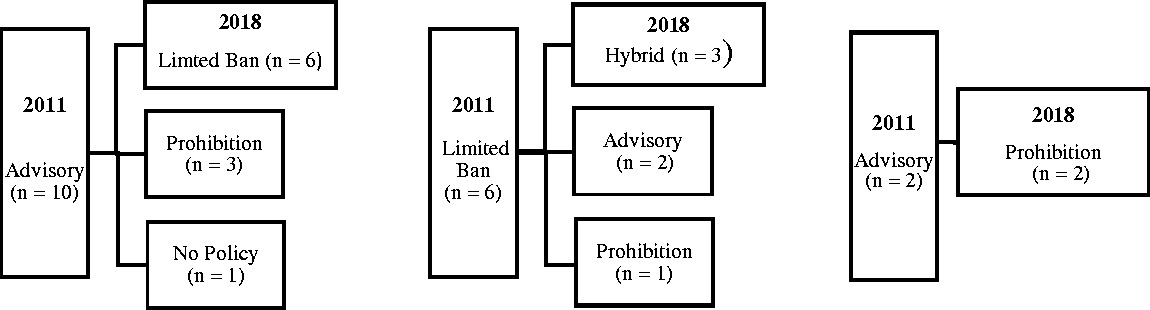
Changes in CSRP type from 2011 to 2018.
Outside of the overwhelming trend to move to more restrictive policies, the University of Oklahoma and the University of Southern Maine moved from a limited ban in 2011 to a less restrictive advisory policy in 2018. Finally, we completed an exhaustive review of Eastern Kentucky University’s policies and could not locate a CSRP for 2018.
Policy Components
As indicated above, over the 7-year study period, 18 of the sampled IHEs changed their CSRP type; for one of these IHEs, Eastern Kentucky University, no CSRP could be located in 2018. As a result, 17 CSRPs from 2018 were available for further analysis. The next step in analysis focused on examining policy components among CSRPs. First, following the coding scheme developed by Richards et al. (2014), 2018 policies were reviewed and compared with 2011 policies regarding their discussion of power differentials, reporting requirements, sanctions, and liability. Given the potential impact of #MeToo and Times Up, policies were also examined regarding discussions of consent and protections for student-victims; again, 2018 policies were assessed, and potential changes over the 7-year study period were documented.
Power differentials
All but one IHE's 2018 CSRP (94%) specifically discussed power differentials between faculty members and students and how this power imbalance may impact a student’s ability to consent to a sexual or romantic relationship; six of these IHEs added this language over the study period. For example, in 2018, Coastal Carolina University’s (n.d.) limited ban policy stated that Relationships between faculty and students are particularly susceptible to exploitation. The respect and trust accorded a member of the faculty by a student, as well as the power exercised by faculty in giving grades, approvals or recommendations for future study and employment, make voluntary consent by the student suspect.
The lone university that did not invoke power differentials as the foundation for their CSRP—in 2011 and/or in 2018—was the University of Pennsylvania. Instead, its prohibitory policy focused on the negative impact that CSRs may have on teaching and learning generally, and on third parties. Specifically, the 2018 University of Pennsylvania policy stated that “Consensual sexual relations between faculty and student can adversely affect the academic enterprise, distorting judgments, or appearing to do so to others, and providing incentives or disincentives for student-faculty contact that are inappropriate.”
Reporting and disciplinary action
More than half of these IHEs’ 2018 policies (n = 10; 59%) required that faculty report any consensual relationships; four of these IHEs had added this requirement since 2011. For example, in 2018 Southern Utah University's, policy indicated that the party in the evaluative position (i.e., faculty member) “has an obligation to disclose the relationship to his or her administrative superior.” (Southern Utah University, 2017). Reporting requirements were included across policy types, including limited bans and full prohibitions—ostensibly in recognition that faculty-student relationships would occur—even with a CSRP. To that end, in 2018 the University of Pittsburgh’s limited ban advisory policy notes that “in the event such a situation is imminent or develops, the faculty or staff member must disclose the existence of the Consensual Relationship immediately to his or her supervisor, department chair, dean, or, where appropriate, higher administration” (University of Pittsburgh, 2017).
Reporting requirements often mandated that when CSRs developed, any supervisory or evaluative responsibilities by the faculty member over that student be severed. For example, policies indicated that the student may be obliged to transfer out of the faculty member’s class or the faculty member may have to recuse herself from the student’s thesis. In 2018, the University of Texas’s policy called for the development of a “mitigation plan” and provided step-by-step instructions for how the mitigation plan would be developed, the components that would be covered in the plan, and a timeline for continual assessment of the plan (University of Texas, 2017).
Relatedly, the potential for disciplinary action for policy violations was mentioned in more than half of these 2018 policies (n = 9; 53%); in 2011, six of these IHEs included such language. For example, the University of Tennessee’s revisions to their limited ban/advisory policy for 2018 indicate that “when a faculty member is found to have violated this policy, an appropriate sanction, up to and including termination will be imposed” (University of Tennessee, 2016). Comparatively, in 2018 the University of Texas’s prohibitory policy includes a statement that “Disciplinary actions may include, but are not limited to, written reprimands, the imposition of conditions, reassignment, suspension, and dismissal” (University of Texas, 2017).
Liability
Over half of these IHEs (n = 9; 53%) discussed the potential for legal liability stemming from faculty–student CSRs in their 2018 policies; five of these IHEs did not include such language in their 2011 policies. Discussions of legal liability included the potential for direct liability against the faculty member or the IHE from the student in the CSR or from third parties. Third-party liability was most concerned with the potential that other students could be negatively impacted by a relationship between their professor and a classmate. For example, in 2018 the University of Southern Indiana’s (n.d.) policy indicates the following about third parties: . . . other students and faculty members may be affected by such unprofessional behavior because it places the faculty member in a position to advance or favor one student’s interests at the expense of others, and implicitly makes obtaining benefits contingent on sexual favors. a perception by students or employees that a fellow student or coworker who is involved in a romantic relationship with his or her supervisor or professor will receive an unfair advantage; either or both of the parties engaging in behavior destructive to the other or their academic or working environments if the relationship ends; and the potential that University/state resources are used inappropriately to further the romantic relationship (University of Oklahoma, 2012).
Consent
More than one third of these IHEs’ 2018 policies (n = 7; 41%) also specifically recognized problems with voluntary or mutual consent in relationships where power differentials exist (i.e., faculty–student relationships) and cited this as one of the underpinnings for their policy; three of these IHEs added this language during the study period. For example, in 2018 the University of Southern Indiana’s policy indicates that “Given the fundamentally asymmetric nature of and the ‘power differential’ inherent in such relationships, any appearance of voluntary consent on the part of the student is suspect” (University of Southern Indiana, n.d.).
Four (24%) of these IHEs’ 2018 policies went on to discuss the potential withdrawal of consent by students over time; three of these IHEs did not include this language in their 2011 policy. For example, over the study period, the University of Tennessee revised their policy to acknowledge that conduct that begins as consensual can become non-consensual at any time. Even when both parties initially consent to particular conduct, past consent does not preclude a finding of sexual harassment if the conduct was unwelcome (the standard for sexual harassment) or if later conduct was unwelcome (University of Tennessee, 2016). A consenting relationship is one between two adults, both of whom appear to freely choose to enter into and continue a romantic or sexual relationship . . . The University discourages such consenting relationships because the power differential creates a strong possibility that the relationship may not be truly consensual, or if consensual may not permit a later decision by the person with less power to discontinue the relationship out of concern for the possible effect on his or her employment or educational status (University of Southern Maine, 2014).
Protections for student-victims
Finally, 24% of these 2018 policies (n = 4) specified that it would be the party with the power advantage—the faculty member—that would bear the “burden” if a student brought forward a claim of sexual harassment resulting from a CSR; three of these IHEs added this language to their CSRP over the study period. For example, Princeton’s 2018 policy reads, Even when both parties have consented at the outset to a romantic or sexual relationship, the person in the position of greater authority, by virtue of his or her special responsibility and role in the core educational mission of the University, bears responsibility for any adverse professional consequences that arise. In the event of a charge of Sexual Harassment arising from such circumstances [CSR], the University will in general be unsympathetic to a defense based upon consent when the facts establish that a faculty-student or staff-student power differential existed within the relationship (n.d.b).
Discussion
This research examined the status of CSRPs for a stratified sample of IHEs and assessed changes in CSRPs over the period of 2011 to 2018—during the evolution and proliferation of the “MeToo” and “Times Up” movements. The presence of previously established CSRP components, including discussions of power differentials, legal liability, reporting requirements, and sanctions, were examined, and additional components aligned with this “#MeToo era” related to consent—the role of mutual consent and the withdrawal of consent in CSRs—policy applications for graduate students, and student protections were assessed.
First, we found that the majority of IHEs made changes to their CSRPs during the study period, and further, that most IHEs changed their policy type. Findings indicated that IHEs are moving in the direction of more conservative CSRP types with more IHEs adopting restrictive policies that prohibit CSRs when there is a supervisory relationship between the faculty member and the student or that ban CSRs outright. These changes are consistent with the #MeToo and Times Up movements that have highlighted the need for policies that protect subordinates (i.e., students) from sexual harassment by those in power (i.e., faculty). While prohibitions against CSRs between faculty and students in and of themselves will not prevent sexual harassment, they do provide a unified campus-wide standard by which faculty should conduct their relationships with students, possibly deterring some faculty from pursuing or engaging in relationships with students, and providing potential recourse to students who are victimized.
At the same time, the prohibition policies uncovered here almost exclusively focused on undergraduate students, while graduate student–faculty relationships were only banned when the faculty member had direct teaching or supervisory power. Such policies do not account for realities of the graduate school experience where success relies heavily on the development of close relationships with faculty members, and where faculty mentors may not always “teach” or “supervise” students in an official capacity. Graduate students are particularly vulnerable to direct abuse by faculty members as well as harassment/discrimination as third parties; the use of “limited bans” provides a potential “loop hole” for would-be perpetrators. Furthermore, the faculty members who are often most sought after as mentors by graduate students are also often those who enjoy the most power and prestige at their institution and in their disciplinary field. Taken together, graduate student-victims may struggle with the immediate loss of opportunity they will experience as well as the potential long-term harm done to their career when considering reporting harassment by a faculty member. Recent media coverage of sexual harassment by faculty members against graduate students noted that “criticizing a prominent scholar in their field, long before they’ve built their own reputation, can have long-term consequences” to graduate students (Kingkade, 2016). Considering the unique risks faced by graduate students, IHEs should consider whether their CSRP adequately protects them.
In addition to changes in policy types, changes in policy components were also assessed. Over the study period, IHEs revised their policies to include language about power differentials between faculty and students, added reporting requirements for CSRs, and amended policies to include language regarding the disciplinary actions for faculty who violate the CSRP. These revisions are important given the increased numbers of students coming forward with allegations of sexual harassment against faculty members (Cantalupo & Kidder, 2017; Gluckman et al., 2018). As such, CSRPs should provide a clear rationale for the policy—for the majority of IHEs it was power differentials—and outline strategies for mitigating potential harm to students as both direct and third-party victims. Likewise, potential disciplinary actions should be included in the CSRP to encourage consistent sanctions for faculty who violate the policy. Similarly, the number of IHEs that discussed potential legal liability as a product of a faculty–student CSR more than doubled from 2011 to 2018. This focus on legal liability among IHEs is likely a byproduct of the increased scrutiny IHEs feel regarding sexual harassment and misconduct in this #MeToo era. Indeed, survivors have utilized #MeToo and social media platforms more generally to “share their experiences and engage in a ‘call out culture’ regarding sexual harassment and assault” (Mendes et al., 2018, p. 236). Legal liability has been identified as a theme in other recent research on IHEs’ responses to sexual assault and misconduct such as compliance with Title IX guidance (Richards, 2019) and their development and implementation of prevention programming (Kafonek & Richards, 2017).
Over the study period, CSRPs were also revised to include discussions of the challenges in achieving mutual consent in faculty–student sexual relationships, given the power differentials between the two parties (Blevins-Khabe, 1992). More policies in 2018 also acknowledged that such power differentials may make withdrawing consent difficult for students who decide to sever a relationship with a faculty member. Recognizing these challenges, some 2018 policies were also explicit in that the faculty member would bear the burden of proving that sexual harassment had not occurred, and that any claim that the relationship was consensual would not generally be enough proof. These nuanced discussions regarding power and consent are consistent with other trends in IHE sexual harassment and misconduct policies during the evolution of #MeToo and Times Up (e.g., affirmative consent policies) and should become standard in CSRPs.
In addition to the policy type and included components, the ease in which one might locate and decipher CSRPs likely affects their efficacy. During data collection, it became apparent that there is no single location where one might find a CSRP. Some were clearly labeled in the faculty handbook while others were in a subsection of a sexual harassment policy and still others were located in general policy libraries that were meant to inform the entire population of the campus. Policy names also varied greatly. They were sometimes referred to as “consensual relationship policies,” “amorous relationships policies,” or “nonfraternization policies,” and some were not clearly labeled. Furthermore, policies ranged in clarity, and in length, from several sentences to several pages. CSRPs will only be effective when they are easily understood and widely disseminated. As such, CSRPs should include clear and concise language, and should be disseminated through new faculty orientations and on-going faculty senate messaging. Furthermore, consistent reminders by administrative leaders (i.e., Chairs, Deans, and IHE Presidents) are key.
Policies must also be consistently applied, and where possible, within the limits of confidentiality, violations and sanctions must be made known to the campus community. IHEs that are considering implementing a CSRP or making changes to an existing CSRP are encouraged to follow best practices for creating holistic responses to sexual misconduct (see White House Task Force to Protect Students From Sexual Assault, 2014), by convening diverse campus stakeholders to discuss the needs of the IHE’s campus community. In addition, IHEs must adhere to expectations regarding faculty governance and, where possible, engage with faculty senates. Developing CSRPs in collaboration with the policy’s target population encourages the formulation of sound policy and is important for achieving buy-in. Fostering diverse perspectives on the front end of policy formulation will also likely shed light on any potential unintended consequences before policy implementation.
Future research should examine whether faculty (and students) know about and can locate their IHE’s policy regarding CSRs, and whether they understand the content of those policies. In addition, while the current sampling strategy allowed for the review of policies at two time points, the sample is small and not nationally representative, which limits the generalizability of the findings. Further work might address this by identifying a nationally representative sample of IHEs prospectively and following their CSRPs over time. Likewise, it is important to note that while this research examined policies in 2011 and 2018 and identified changes during this time period, it did not identify when changes occurred. For example, changes identified in the 2018 policy could have been implemented anytime from 2012 to 2018. Finally, while this work posits that #MeToo and Times Up affected the ways in which IHEs revised and enforced their CSRPs, it was beyond the scope of this work to provide a direct test of this hypothesis. Future research might test these relationships by examining media coverage, campus/administrative statements, and/or publicized claims of sexual harassment in the time period leading up to policy changes.
Conclusion
In the wake of #MeToo and Times Up, many institutions find themselves embroiled in high-profile allegations of sexual harassment, and IHEs are no different. Now is the time to review policies and procedures aimed at preventing and responding to sexual harassment and to troubleshoot potential issues in dissemination and implementation of such policies. Although IHEs may be reticent to “police” adult's behavior, a clearly defined and widely disseminated CSRP provides the opportunity for a campus community to standardize expectations and norms between campus actors with disparate access to power, and to encourage consistent sanctions for policy violations.
Footnotes
Declaration of Conflicting Interests
The author(s) declared no potential conflicts of interest with respect to the research, authorship, and/or publication of this article.
Funding
The author(s) received no financial support for the research, authorship, and/or publication of this article.
