




Abstract
People who are anxiously attached, distrustful and jealous of their partners, and suspect infidelity are more likely to use psychological dating violence. Is this also true for cyber dating abuse perpetration (CDAP)? This study investigated the prevalence of and gender differences in self-reported CDAP and whether trust, anticipated partner infidelity, and jealousy serially mediated the association between anxious attachment and CDAP in a sample of Turkish college students. College students (N = 390) completed the Cyber Dating Violence Inventory, Anxious Attachment subscale of the Experiences in Close Relationship Scale-Short Form, Dyadic Trust Scale, Cognitive Jealousy subscale of the Multidimensional Jealousy Scale, Partners’ Intentions Towards Infidelity Scale, and a Demographic Information Form. A total of 67% of the sample used at least one cyber abusive behavior with their partner over the last 6 months. A multiple serial mediation model indicated that greater anxious attachment was related to more dyadic distrust, the anticipation of partner infidelity, and jealousy, and, in turn, to the use of cyber dating abuse. Overall, results show that the prevalence of CDAP is high and that attachment theory offers a promising framework for identifying predictors of CDAP in emerging adults. These findings have implications for research, intervention, and prevention of CDAP by identifying potential risk factors for perpetrating cyber abuse.
Keywords
Imagine that a person feels insecure about his or her romantic relationship. She or he wants more closeness with their romantic partner but does not get the affection and care she or he needs. Triggered by insecurity and distrust, she or he begins to suspect infidelity and becomes jealous. Driven by feelings of insecurity and jealousy, she or he makes posts using social media to make the partner feel jealous and spreads rumors about him or her. How likely is this scenario?
A systematic review suggests that when we want more closeness and do not get the affection and care we need from our partners, we are more likely to engage in psychological dating violence (Velotti et al., 2018). Indeed, a large body of research shows that when we do not trust our partners (e.g., Rodriguez et al., 2015), are suspicious of partner infidelity (Brem et al., 2018), and are jealous of our partners (e.g., Madsen et al., 2012), we are more likely to use psychological and/or physical dating violence. Although these effects are robust, do they apply to cyber dating abuse, a relatively new form of dating violence? Technology has dramatically changed the way we communicate and in doing so has, inter alia, provided a medium for abuse between romantic partners, that is, cyber abuse. Along with many other forms of dating violence, cyber abuse peaks among emerging adults (Johnson et al., 2014). Despite growing interest, cyber dating abuse is still underresearched in relation to its prevalence, gender differences, and mechanisms that might explain its occurrence.
Turkey provides a unique opportunity to study cyber dating abuse perpetration among emerging adults in several respects. First, the average age of Turks in 2019 was 30.8 years (We are social, 2019), which is quite young compared with Western counterparts such as the United Kingdom (40.8), Italy (47.9), Germany (46.6), and the United States (38.3). Moreover, Turkey has a 72% internet penetration rate, whereas the worldwide average for internet use is 57%. Of 52 million social media users in Turkey, nearly 30 million are between the ages of 18 and 34 (We are social, 2019). Social media–facilitated dating partner availability is a potential major threat to both perceived infidelity and jealousy. Such high percentages likely put Turkish emerging adults in a unique position regarding both cyber dating abuse perpetration (CDAP) and victimization.
Second, in Turkey, infidelity occurs in a culture that promotes a collective yet differential consciousness among women and men. Third, the infidelity of Turkish men is mostly viewed as a natural consequence of masculinity, whereas for Turkish women, it is a very stigmatized and harshly censured act. Although Islam, the prominent religious orientation in Turkey, clearly forbids infidelity, there is a culturally constructed double standard in regard to infidelity. Accordingly, the social and psychological consequences of infidelity differ for men and women. Jealousy is triggered by perceived infidelity and expression of jealousy likely reflects the double standard in the country. Not surprisingly, both attitudes and intentions to commit infidelity are more favorable among men than women in Turkey (Dursun & Özkan, 2019; Toplu-Demirtaş & Fincham, 2018), and males value premarital sexual experience more than female emerging adults (Evcili et al., 2013). In sum, gender inequality, a robust predictor of dating abuse of any kind (Ozaki & Otis, 2017; Qu et al., 2018), might bring about unique payoffs regarding all types of dating abuse in Turkey.
The present study, therefore, investigates the prevalence of cyber abuse among emerging adult college students in Turkey, examines potential gender differences, and how feeling insecure in the relationship might give rise to cyber abuse perpetration via distrust, suspected infidelity, and jealousy.
Cyber Dating Abuse Defined
With the increased use of smartphones and social networking websites/apps, cyber dating violence has received increased attention. Terms such as cyber dating aggression, cyber partner abuse, cyber dating abuse, cyber dating violence (and so on) have been utilized interchangeably, and definitions vary considerably. In the current study, we use the term cyber dating abuse to refer to the range of harmful behaviors perpetrated via technological means, including cell phones, social media, electronic mail, and online accounts. The term cyber abuse is aptly defined by Wolford-Clevenger et al. (2016) as “harassing, threatening, monitoring, impersonating, humiliating, or verbally abusing one’s current partner through the use of technology” (p. 2).
Cyber Dating Abuse: Prevalence and Gender Differences
The nascent literature on CDAP suggests that it is ubiquitous among young adults (Borrajo et al., 2015b; Brem et al., 2019; Burke et al., 2011; Kellerman et al., 2013; Leisring & Giumetti, 2014; Morelli et al., 2018; Watkins et al., 2018). For example, 93.7% of dating college students in Leisring and Giumetti’s (2014) sample of 271 participants reported perpetration of at least one act of minor cyber abuse. In a larger sample (N = 788) of dating college students, Borrajo et al. (2015b) obtained a similar rate; the prevalence of cyber control perpetration was 82%. In a more recent study, 75.3% of daters admitted to perpetrating some form of cyber abuse (Brem et al., 2019).
No gender difference has been found in the overall perpetration of cyber abuse (Borrajo et al., 2015b; Leisring & Giumetti, 2014; Reed et al., 2016; Zapor et al., 2017). However, there may be a gender difference in preferred abusive behaviors. For example, Burke et al. (2011) found females made more excessive phone calls and checked call histories and monitored partners’ Facebook sites more often, whereas males used global positioning system (GPS) devices, hidden cams, and partners’ passwords more often to monitor their partners.
Why Study Cyber Dating Abuse?
Cyber abuse can be harmful. Victims of cyber dating abuse suffer from mental health problems such as depression, anxiety, and stress (Borrajo & Gámez-Guadix, 2016; Leisring & Giumetti, 2014; Schnurr et al., 2013; Watkins et al., 2018; Wolford-Clevenger et al., 2016), and physical health problems, such as alcohol use and risky sexual behaviors (Van Ouytsel et al., 2016). Cyber abuse is also associated with relationship problems such as decreased satisfaction, increased relational conflict, and heightened jealousy (Borrajo & Gámez-Guadix, 2016; Deans & Bhogal, 2019; Rueda et al., 2015; Watkins et al., 2018).
Importantly, CDAP is strongly associated with in-person forms of physical, sexual, and psychological dating abuse perpetration (i.e., Borrajo et al., 2015b; Brem et al., 2019; Bui & Pasalich, 2018; Leisring & Giumetti, 2014; Menard & Pincus, 2012; Schnurr et al., 2013; Watkins et al., 2018). Schnurr et al. (2013) found that the use of cyber dating aggression influenced one’s own and partner’s use of psychological and physical dating violence. Importantly, Brem et al. (2019) showed that cyber dating violence perpetration was a precursor to psychological, physical, and further CDAP.
Certain characteristics of cyber dating abuse make it particularly hazardous. Specifically, the victim is always accessible, the audience for the abuse is potentially large as the abusive behavior can be copied for broader circulation, and the digital posts might not be erased (Melander, 2010). Thus, “abuse is so quick and easy” and “private becomes public,” according to college students (Melander, 2010). Nevertheless, students tend to de-emphasize the severity of cyber dating abuse and may, instead, justify it as proof of love (Borrajo et al., 2015a).
In short, due to its alarmingly high rates, its adverse outcomes, and its association with in-person dating violence, CDAP warrants further investigation. In the present study, we use attachment theory to inform our investigation of predictors of CDAP.
Theoretical Framework: Attachment Theory
Bowlby’s (1969) attachment theory proposed that expectations about and behaviors toward close others are based on the availability of caregivers and the quality of interactions between the infant and their primary caregiver. According to Bowlby, people develop either secure or insecure attachments based on this early experience with their caregivers. Attachment security results in maintaining an optimistic perspective regarding stressful events and having self-representations of value, worth, and competence as well as positive beliefs and expectations about others (Mikulincer & Shaver, 2005). Accordingly, attachment security allows people to develop secure romantic relationships in adulthood. In contrast, attachment insecurity, conceptualized in terms of avoidance and anxiety (Brennan et al., 1998), puts partners in a vulnerable position in their later relationships. Attachment avoidance is described as a fear of closeness, preference for self-reliance, and emotional distance from a partner, whereas attachment anxiety is characterized by a person’s fear and worry that the partner will not be available when needed (Hazan & Shaver, 1987).
Insecure attachment triggers negative thoughts, emotions, and motives toward the partner and relationship, leading to dysfunctional interpersonal strategies and behaviors. However, researchers have indicated that individuals with avoidant and anxious attachment orientations should follow different practices in their romantic relationships. Highly avoidant people are expected to convey their need for comfort by isolating themselves from their own emotions, reducing their expectations from their partners, and not acting out with aggression (N. L. Collins et al., 2002; Simpson et al., 1996). In contrast, anxious partner attachment, which makes individuals perceive more discomfort about having an inaccessible partner, is considered to make individuals feel more anger and hostility toward their partners and choose bad resolution strategies (Simpson et al., 1996) such as aggression and violence. In other words, elevated levels of attachment anxiety, a response to the perceived unavailability of a partner, can lead to the perpetration of violence, a dysfunctional way of meeting relational concerns and proximity maintenance (Park, 2016). Moreover, anxiously attached individuals have learned that in order for them to draw attention from significant others, they are expected to show their negative emotions in a heightened way, especially on occasions where their needs are not met as they wish (Cassidy, 1994). In this context, anxious attachment is assumed to be particularly likely to give rise to the perpetration of psychological and cyber abuse in romantic relationships (e.g., Goncy & Van Dulmen, 2016; Gormley & Lopez, 2010).
In line with this theoretical perspective, there is a documented relationship between attachment anxiety and perpetration of intimate partner violence (e.g., Goncy & Van Dulmen, 2016; Gormley & Lopez, 2010; Roberts & Noller, 1998; Sommer et al., 2017; Toplu-Demirtaş et al., 2018, 2019). Although most research explored in-person forms of psychological intimate partner violence, several studies show that the same relationship exists with cyber dating aggression perpetration in samples of adolescents and college students (e.g., Bui & Pasalich, 2018; Menard & Pincus, 2012; Reed et al., 2015, 2016; Wright, 2015, 2017). What underlies the link between attachment anxiety and cyber abuse perpetration?
Mediators: Dyadic Trust, Anticipated Partner Infidelity, and Jealousy
As anxiously attached people have a negative view of self and positive view of the other (Hazan & Shaver, 1987), they are likely to distrust a partner who is not meeting their strong needs for closeness. Trust has, in turn, been related to increased CDAP. For example, positive relationships have been found between dyadic distrust and Facebook-related partner monitoring (Darvell et al., 2011; Marshall et al., 2013). Similarly, Fox and Warber (2014) found that college students with insecure attachment styles were more uncertain about their relationships and reported more partner surveillance on Facebook.
Having little trust in the partner can lead to suspicion of infidelity and attendant jealousy. Infidelity and jealousy are associated with an increased likelihood of CDAP (Cousins & Gangestad, 2007; Marshall et al., 2013; Watkins et al., 2018; Wright, 2017). Dijkstra and Buunk (2002) note that the most jealousy prompting partner behavior is an actual report of infidelity. Interestingly, however, Cousins and Gangestad (2007) found that the perception of partner infidelity could become a more important predictor of violence perpetration than partners’ actual interest in others. Therefore, it is important to investigate anticipation of partner infidelity on abusive behaviors.
About half of women and one third of men report jealousy/insecurity as the most common motivation for cyber abuse perpetration (Kellerman et al., 2013). Close examination, however, shows that this motivation included elements of distrust and suspicion of infidelity as revealed in the narratives coded to reflect this motivation (e.g., “I know my boyfriend’s Facebook password, and I can’t help but check to make sure he is not being deceitful”; Kellerman et al., 2013, p. 298). In light of this observation, the present study measures trust, suspicion of infidelity, and jealousy separately.
To our knowledge, no study has examined the role of anticipated partner infidelity, specifically in predicting cyber abuse perpetration. Anticipation of infidelity and cognitive jealousy are often confounded. The former refers to hypothetical beliefs about the partner engaging in infidelity (i.e., beliefs regarding how likely my partner is to be unfaithful to me). However, according to Pfeiffer and Wong (1989), cognitive jealousy encompasses either a cognitive appraisal of a real or perceived threat or a conditioned response to a stimulus and can be triggered by perceptions or cues to a partner’s infidelity (Buss, 2000). For example, Arnocky et al. (2015) treated anticipated partner infidelity as the antecedent of jealousy and found that anticipated partner infidelity mediated the associations between health and jealousy. Therefore, cognitive jealousy is a broader construct than perceived infidelity, and it is not always automatically evoked by perceived infidelity.
Current Study
The documentation of an association between anxious attachment and CDAP raises the question of what gives rise to this association. What mechanism(s) link these two variables? We have argued that anxious attachment is related to dyadic trust, which is, in turn, related to suspected infidelity and jealousy. Although researchers have begun to focus on the unique associations of dyadic trust, anticipated partner infidelity, and jealousy with dating abuse perpetration, they have ignored the sequential relations among them. This is important because knowing their sequential relations has implications for the development of evidence-based prevention and intervention programs.
The current study had two main purposes. The first was to explore the prevalence of CDAP among dating college students in Turkey. Based on prior research using Western samples, we expected high rates of perpetration with no significant gender differences (Hypothesis 1). The second was to investigate mechanisms that might account for an association between anxious attachment and CDAP. We predicted that distrust, suspected partner infidelity, and jealousy would serially mediate the association between anxious attachment and CDAP (Hypothesis 2).
Figure 1 shows possible pathways for anxious attachment to indirectly affect CDAP.

Dyadic trust, anticipated partner infidelity, and jealousy serially mediating the relationship between anxious attachment and cyber dating abuse perpetration.
Method
Participants
College students (N = 390) were recruited from three urban private universities in three different cities of Turkey, from the Northwest, Southeast, and Central Anatolia. The convenience sampling method was utilized in the selection of universities and participants. Instructors within the social networks of the researchers were contacted to request collaboration in the data collection process. To be eligible for the study, students needed to be between 18 and 30 years of age and in a current dating relationship. Excluding 13 students who were married, and nine who were over 30 years old resulted in a sample of 368 participants (249 women, 67.7%). Two participants identified as gender other. A majority (94.0%) identified as heterosexual, with one identifying as lesbian, four as gay, 14 as bisexual, and three as other (asexual, queer). Participants averaged 22.68 years of age (SD = 2.55), and defined their relationships as dating (87.0%), cohabiting (9.8%), and engaged (3.3%). The average relationship length was 21.94 months (SD = 21.47 months; min = 1 and max = 108 months).
Data Collection Instruments
Demographics
Demographic data collected included gender, sexual orientation, age, education, relationship status, and relationship length.
Cyber dating abuse perpetration
To assess CDAP, we used the Turkish version (Erdem et al., 2018) of the Cyber Dating Violence Inventory (Morelli et al., 2018). The inventory has two subscales, Psychological Violence (six items; e.g., “I wrote things via SMS/email/social media just to make my partner angry”) and Relational Violence (four items; e.g., “I tried to turn my partner’s friends against him/her using SMS/email/social media”). The Psychological Violence subscale refers to verbal and emotional violence in cyber settings, and Relational Violence points to destroying the partner’s relational networks. Participants’ responses were collected on a 4-point frequency scale for the past 6 months (from never = 0 to 3 = six times and more). A total score was computed by summing the item responses so that higher scores reflected more frequent use of CDAP. In the current sample, Cronbach’s alpha was .76.
Anxious attachment
We measured anxious attachment using the Turkish adaptation (Savcı & Aysan, 2016) of the six-item (e.g., “I need a lot of reassurance that I am loved by my partner”; “My desire to be very close sometimes scares people away”) Anxious Attachment subscale of the Experiences in Close Relationship Scale-Short Form (Wei et al., 2007). Responses are given on a 7-point Likert-type scale (1 = disagree strongly to 7 = agree strongly) with higher scores indicating more anxious attachment. In the present sample, Cronbach’s alpha was .61.
Dyadic trust
We measured dyadic trust by using the Turkish adaptation (Çetinkaya et al., 2008) of the Dyadic Trust Scale (DTS; Larzelere & Huston, 1980). It comprised eight items (e.g., “My partner is perfectly honest and truthful with me”; “My partner is truly sincere in his (her) promises”). In the Turkish adaptation of the DTS, Item 6 in the original scale (“I feel that my partner does not show me enough consideration”) was omitted due to a poor factor loading (.22). The DTS is rated on a 7-point Likert-type scale (1 = Never to 7 = Always) with higher scores reflecting greater dyadic trust. In our sample, Cronbach’s alpha was .88.
Jealousy
We employed the Turkish adaptation (Karakurt, 2001) of the eight-item Cognitive Jealousy subscale (“I suspect that my partner is secretly seeing someone of the opposite sex”; “I suspect that my partner may be attracted to someone else”) of the Multidimensional Jealousy Scale (Pfeiffer & Wong, 1989) to evaluate participants’ jealousy. The subscale is rated on a 7-point Likert-type scale (1 = Never to 7 = All the time) with higher scores reflecting more thoughts of jealousy. Cronbach’s alpha was .83.
Anticipated partner infidelity
We developed a new instrument—the Partner Intentions Towards Infidelity Scale (P-ITIS)—to gauge perception of the partner’s extra-dyadic involvement intentions. Four steps were used in developing this instrument. Construction of the construct, content validation, cognitive interview, and construct validity and reliability analyses.
Construction of construct and content validation
We modified the Turkish version (Toplu-Demirtaş & Tezer, 2013) of the Intentions Toward Infidelity Scale (ITIS; Jones et al., 2011), which is a seven-item scale initially developed to measure one’s intentions of infidelity. A sample item from the original scale is, “How likely are you to be unfaithful to a partner if you knew you would not get caught?” In our modified version, we changed the subject of inquiry to “my partner” (“How likely is your partner to be unfaithful to you if s/he knew s/he would not get caught?”). Once modified, we independently reviewed the draft version. We agreed to the deletion of one item, “How likely do you think your partner is to be unfaithful to his/her future partners?” as it sounded out of context.
We then consulted three experts in the areas of Turkish language, counseling, and measurement and evaluation for content validity. We consulted (a) a teacher of Turkish for grammar and fluency, (b) a couple counselor for appropriateness of the items for the target group (emerging adult students in relationships) and the intended construct, and (c) an expert in measurement and evaluation who recommended the deletion of a reverse-scored item (Item 3). We accepted this recommendation and finalized the five-item scale for cognitive reviewing. As in the original measure, responses were given on a 7-point Likert-type scale (1 = Not likely at all and 7 = Extremely likely).
Cognitive interviewing
The first author conducted cognitive interviewing (D. Collins, 2003) individually with four undergraduates—two men and women—to assess the scale for appearance, clarity of instructions, response scale, item appropriateness, and length. She received no meaningful feedback and, thus, finalized the instrument for data collection.
Assumptions of factor analysis
To determine the factor structure of the P-ITIS, we first checked the necessary assumptions of exploratory factor analysis (EFA). To do so, we created a dataset, in which we randomly selected approximately 15% of all cases through SPSS 18 (n = 64). According to the “minimum observation number per variable is 10” ratio proposed, the sample size was big enough (Hair et al., 2006). To further evaluate the data, we checked (a) the strengths of intercorrelations among items via a correlation matrix and (b) two statistical measures: Bartlett’s Test of Sphericity and Kaiser Mayer Olkin (KMO). The correlation coefficients were higher than .30 (Tabachnick & Fidell, 2007), Bartlett’s Test of Sphericity was significant: χ2(10) = 155.50, p = .00, and the KMO value (.77) exceeded the recommended minimum (.60), which ensured factorability of the data (Hair et al., 2006). We selected principal axis factoring for factor extraction as it is robust to the violation of multivariate normality (Fabrigar et al., 1999) and direct oblimin for rotation method as we expect our factors, if any, to be correlated (Preacher & MacCallum, 2003). We used different methods such as Kaiser’s criterion (eigenvalues greater than 1) and Catell’s scree test to decide on the number of factors.
Factor analysis
The results of the EFA indicated a single factor solution (eigenvalue for Factor 1 = 3.188 explaining 63.70% of the total variance). As seen in Table 1, all five items had factor loadings that ranged between .52 and .88.
Factor Loadings of the Scale Items, Percentage of the Variance, Eigenvalue, and Cronbach Alpha.
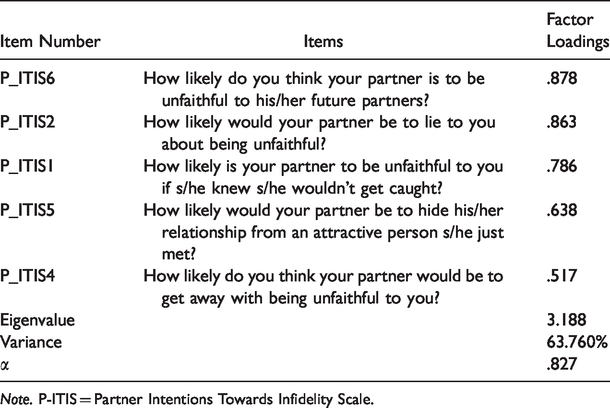
Note. P-ITIS = Partner Intentions Towards Infidelity Scale.
Reliability
Cronbach’s alpha was .827, indicating acceptable reliability (Nunnally, 1978). Examination of Cronbach’s alpha if item deleted implied no deletion of any item.
Validity
As evidence for construct validity, we ran an ANOVA to test whether the scale discriminated between men’s and women’s perceptions of anticipated partner infidelity. There was a significant main effect of gender, F(1, 301) = 7.465, p < .007, h2 = .024. Women anticipated that their partners would be more willing to engage in infidelity (Mmen = 8.74, SDmen = 4.56; Mwomen = 10.58, SDwomen = 5.78).
Data Collection Procedure
We received ethical approval from the Human Subjects Ethics Committee before data collection and collected the data through Google Survey. Students were recruited from classes in which instructors offered opportunities to earn extra credit. Potential participants received the survey link via email. Those who chose to participate received a small amount of extra credit. The survey took 10 to 15 min to complete.
Results
Frequency Analysis
Using the larger sample (n = 303; one gender-other deleted), we first investigated the prevalence of CDAP. To calculate prevalence, we constructed a dichotomous score in which participants who reported at least one act in the past 6 months were categorized as 1, and participants who reported no acts were categorized as 0. Of the 208 dating women in the sample, 146 (70.2%) were categorized as 1, and of the 95 dating men, 57 (60.0%) were categorized as 1. No significant gender difference emerged in the prevalence, χ2(1, n = 303) = 3.06, p = .08, Φ = .10. Overall, the majority of the sample (67.0%) perpetrated at least one cyber abusive behavior in their relationship over the last 6 months.
Correlation Analyses
The zero-order correlations among the study variables appear in Table 2. Cyber dating violence was significantly correlated with anxious attachment (r = .286, p < .001) and with all mediator variables, trust (r = –.204, p < .001), anticipated partner infidelity (r = .242, p < .001), and jealousy (r = .398, p < .001). The relationships from anxious attachment to trust (r = –.270, p < .001), anticipated partner infidelity (r = .236, p < .001), and jealousy (r = .381, p < .001) were also significant. The association between trust and the two other mediators was r = –.615, p < .001 (anticipated partner infidelity) and r = –.346, p < .001 (jealousy). As expected, anticipated partner infidelity was positively related to jealousy, r = .365, p < .001. In addition, we found significant links between gender and cyber dating violence (r = .117, p < .05), trust (r = –.134, p < .05), and anticipated partner infidelity (r = .156, p < .05). Thus, we treated gender as a covariate in the model.
Cronbach Alphas, Means, Standard Deviations, and Intercorrelations Among Study Variables.
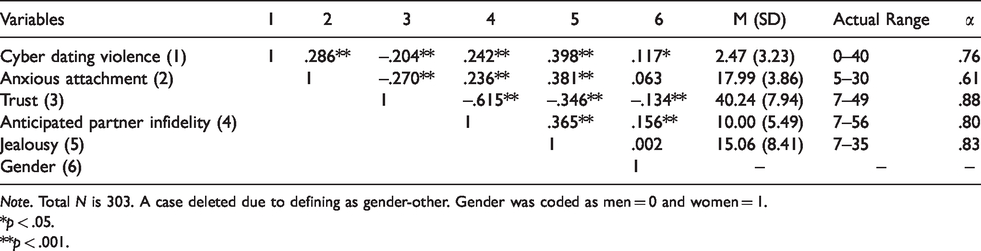
Note. Total N is 303. A case deleted due to defining as gender-other. Gender was coded as men = 0 and women = 1.
*p < .05.
**p < .001.
Mediation Analysis
We tested our hypothesis regarding multiple serial mediation (Model 6, serial mediation with three mediators) via PROCESS (Version 2.041; Hayes, 2013). Using 10,000 bootstrap samples, we tested each path of the meditation model, which entailed the use of four separate regression models, one for each of the outcomes, mediator 1 (dyadic trust), mediator 2 (anticipated partner infidelity), mediator 3 (jealousy), and the dependent variable (CDAP). The first estimated model included the relationship between anxious attachment and dyadic trust. Second, anticipated partner infidelity was regressed on anxious attachment and dyadic trust. Third, jealousy was regressed on anxious attachment, dyadic trust, and anticipated partner infidelity. Finally, anxious attachment, dyadic trust, anticipated partner infidelity, and jealousy were all included as predictors of CDAP. The model controlled for gender.
In the first model (Table 3), a significant negative association between anxious attachment and dyadic trust was found, β = –.55, t(299) = 74.82, p =.000. In Model 2, there was a negative association between dyadic trust and anticipated partner infidelity, β = –.40, t(298) = –12.21, p = .000. In Model 3, which regressed jealousy on anxious attachment, dyadic trust, and anticipated partner infidelity, a significant relationship emerged between anxious attachment and jealousy, β = .64, t(297) = 5.73, p = .000; between dyadic trust and jealousy, β = –.15, t(297) = –2.20, p < .05; and between anticipated partner infidelity and jealousy, β = .34, t(297) = 3.35, p = .000. Finally, in Model 4, anxious attachment, β = .12, t(296) = 2.43, p < .05; and jealousy, β = .12, t(296) = 5.26, p < = .000, were significant predictors of CDAP. In summary, the four paths of interest in serial mediation were all significant.
Multiple Regression Models With Regard to the Significance Test of Serial Mediation With Three Mediators.
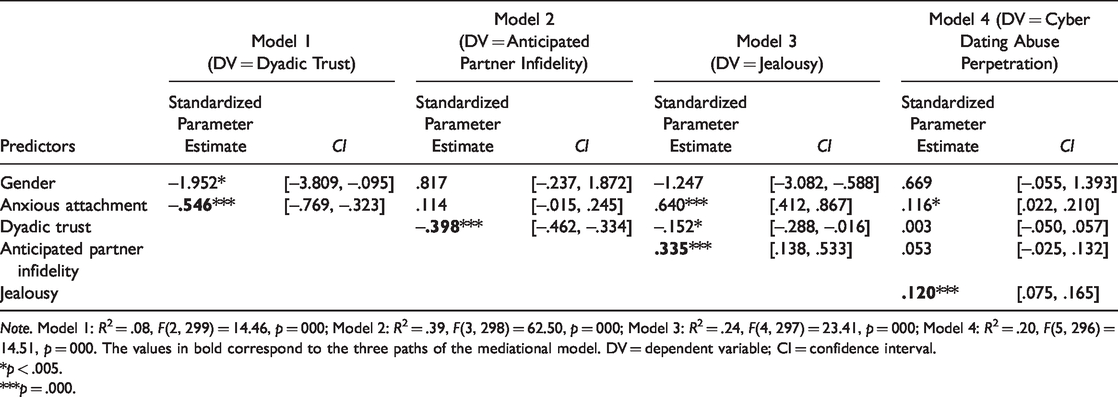
Note. Model 1: R2 = .08, F(2, 299) = 14.46, p = 000; Model 2: R2 = .39, F(3, 298) = 62.50, p = 000; Model 3: R2 = .24, F(4, 297) = 23.41, p = 000; Model 4: R2 = .20, F(5, 296) = 14.51, p = 000. The values in bold correspond to the three paths of the mediational model. DV = dependent variable; CI = confidence interval.
*p < .005.
***p = .000.
The total effect of anxious attachment on cyber dating violence was significant in the model controlling for gender, β = .23, t(299) = 5.04; p = .000. The indirect effect (i.e., anxious attachment → dyadic trust → anticipated partner infidelity→ jealousy → cyber dating violence perpetration) was also significant, 95% confidence interval (CI) = [.0118, .0271], providing evidence for serial mediation (Table 4). The other indirect paths [(anxious attachment → dyadic trust → jealousy → cyber dating violence perpetration), (anxious attachment → anticipated partner infidelity → jealousy → cyber dating violence perpetration), and (anxious attachment → jealousy → cyber dating violence perpetration)] were also significant.
Bootstrapped Results of Indirect Effects.

Note. Reported BC intervals are the bias-corrected 95% CI of estimates resulting from bootstrap analysis; 10,000 bootstrapped samples. Total N is 302. One case was deleted due to missing data. CI = confidence interval; LL = lower level; UC = upper level.
Although the hypothesized serial mediation model yielded significant indirect effects, it is possible that other serial mediation models might yield similar results. To examine this possibility, we tested two alternative models. The first (anxious attachment → anticipated partner infidelity → jealousy → dyadic trust → CDAP), did not yield a significant overall indirect effect, β = –.001; 95% CI = [–.0014, .0009]. The second (anxious attachment → jealousy → dyadic trust → anticipated partner infidelity
In summary, consistent with our hypothesis, greater anxious attachment was related, serially, to more dyadic distrust, the anticipation of partner infidelity, and jealousy and, in turn, to the use of cyber dating abuse in college students.
Discussion
The formation and maintenance of a romantic relationship is a developmental hallmark of emerging adulthood (Arnett, 2004). Doing so may be more challenging for emerging adults in the digital era as the increasing popularization and usage of communication technologies in romantic relationships (Pettigrew, 2009) seems to offer a convenient way of committing abuse in dating relationships. Indeed, cyber dating abuse is widespread in such relationships. Thus, studying cyber abuse may provide unique insights into emerging adults’ abusive relationships. The current study, therefore, first examined the frequency of CDAP with a focus on potential gender differences. Then, relying on attachment theory, the roles of dyadic trust, the perceived susceptibility of the partner to infidelity, and jealousy were investigated as serial mediators in the relationship between anxious attachment and CDAP among emerging adults in dating relationships.
Regardless of gender, 67.0% of the dating college students in the sample stated that they used at least one cyber abusive behavior toward their partners in the last 6 months. Compared with other studies (i.e., Borrajo et al., 2015a; Leisring & Giumetti, 2014), which obtained rates as high as 95%, our findings appeared more moderate. However, estimated perpetration rates fluctuate significantly, depending on the instruments utilized. Using the same tool as we did, for example, Morelli et al. (2018) found a comparable rate, 64.0%. Although not as high as in many other studies, the frequency is still high, which adds to the growing literature showing that cyber dating abuse is prevalent in emerging adults.
Regarding gender, in support of our hypothesis, we found no significant gender difference in CDAP, although women (70.2%) reported slightly more perpetration than men (60.0%). This finding is consistent with those from other recent studies (i.e., Borrajo et al., 2015a; Leisring & Giumetti, 2014; Reed et al., 2016; Zapor et al., 2017). Consistent with in-person psychological dating violence, the lack of a gender difference suggests that cyber dating violence might be reciprocal (Leisring & Giumetti, 2014; Watkins et al., 2018). This is an important finding as it points to the need to develop cyber dating violence prevention programs that target both genders as perpetrators and victims.
Also noteworthy are the correlations among study variables, which both replicated results of prior studies and offered novel findings. College students with higher anxious attachment reported more perpetration of cyber dating abuse, which is consistent with previous results (Bui & Pasalich, 2018; Marshall et al., 2013; Menard & Pincus, 2012; Wright, 2017). The correlations also document relationships between anxious attachment and dyadic distrust, suspicion of partner infidelity, and jealousy. We replicated a finding obtained in recent studies that anxiously attached young adults tended to mistrust their partners (Marshall et al., 2013; Rodriguez et al., 2015). In a similar vein, anxiously attached young adults were also more prone to be suspicious of infidelity and jealous of their partners. The relationship between anxious attachment and jealousy has emerged in some previous studies (Marshall et al., 2013; Rodriguez et al., 2015; Watkins et al., 2018; Wright, 2017). However, the relationship of anxious attachment to the anticipation of partner infidelity is novel.
We also explored the relationships of dyadic distrust, anticipation of partner infidelity, and jealousy to CDAP, which unveiled more novel findings. Although previous studies revealed an association between distrust and Facebook-related partner monitoring (Darvell et al., 2011; Marshall et al., 2013) or psychological dating aggression (Rodriguez et al., 2015), our finding further suggests that one’s lack of trust of the partner and relationship may impact cyber abusive behaviors. In addition, we found that dating college students who were more suspicious of partner infidelity engaged in more cyber abuse behaviors, an association that has not previously been explored and is, therefore, a novel finding in the cyber abuse literature.
Turning to our hypothesis regarding mediation, we found a significant indirect effect from anxious attachment to CDAP with dyadic trust, perceived risk of partner infidelity, and jealousy as mediators. The results obtained for the proposed model suggest that anxiously attached emerging adults upon experiencing dyadic distrust are more likely to anticipate partner infidelity and become jealous of their partners and, thus, commit more cyber abusive behaviors toward their dating partners. It appears that distrust of the partner and relationship have a cascading impact on cognitions (such as perception of the partner’s risk of infidelity and cognitive jealousy) and behavior (cyber abuse perpetration).
Considering that individuals higher in anxious attachment have more negative views of themselves and positive views of their partners (Hazan & Shaver, 1987), they would be more likely to experience low self-esteem. In suspecting infidelity, this might also induce thoughts such as “my partner could easily find a dating partner other than me,” “I should control her or him so that possible rivals are eliminated,” and so on. Feeling unworthy and unloved, along with being distrustful of the partner, seem to raise doubts about partner faithfulness and heighten jealousy, which, in turn, may increase the likelihood of engagement in cyber abusive behaviors toward the dating partner to seek proximity. Such mistrust, doubt, and jealousy may lead to a vicious cycle in the insecure person. To mitigate insecurity, she or he may engage in tactics such as writing things via text message (SMS)/email/social media to make the partner angry or jealous and may try to turn the partner’s friends against the partner via SMS/email/social media. The findings emphasize the critical role of trust issues (trust of self, other, and relationship), particularly for anxiously attached individuals, to establish and sustain safe and satisfying dating relationships. Overall, current theories of in-person psychological dating violence, such as attachment theory, may also apply to cyber dating abuse. Indeed, attachment theory seems to offer a solid foundation for advancing the understanding of cyber abuse in dating relationships.
Several other interesting mediation effects emerged. As shown in Table 4, all the indirect effects in which jealousy played a mediating role were significant. This is consistent with Wright’s (2017) report that jealousy mediated the relationship between anxious attachment and cyber privacy invasion. Moreover, we replicated and extended a recent finding reported by Marshall et al. (2013) in that anxious individuals trusted their partners less, experienced greater jealousy, and thus checked the romantic partner’s Facebook page. In their thorough review of the relationship between feelings of jealousy and monitoring behaviors through social networking sites, Muscanell and Guadagno (2016) concluded that there was a close relationship between the two and that anxiously attached people were more prone to jealousy and, thus, monitoring behaviors owing to their insecurities. We also found that anxious attachment indirectly related to a higher likelihood of CDAP via anticipated partner infidelity and jealousy, a link that has not been previously documented. The findings suggest that college students may become cyber violent in response to suspicion of partner infidelity and jealousy. In sum, the present findings, together with previous results reported in the literature, suggest that the relationship of jealousy with cyber violence is likely to be universal rather than culture-specific.
Limitations, Strengths, and Further Directions
Our study has several limitations that should be considered when interpreting the results. First, the sample was predominantly female (67.7%). Second, although we included college students from three different regions of Turkey (Northwest, Southeast, and Central Anatolia), the selection and sample size do not allow generalizing the results to the population of the three areas studied. Third, our results pertain to heterosexual romantic relationships as only 22 students identified as gay, lesbian, bisexual, or “other.” These limitations point to the need for replication with more diverse samples. In this regard, different relationship types such as married and cohabiting partners are also worth investigating, given that cyber abuse perpetration could exist in any form of close relationships. Fourth, the direction of effects in this study is based on theoretical considerations alone as the cross-sectional design does not support causal inferences. Evidence for such inferences requires longitudinal research to demonstrate that the proposed causes precede their putative effects. A final limitation is that we utilized self-report measures of all constructs, which raises concerns about potential reporting bias and social desirability. Further research should also consider utilizing multiple methods such as gathering dyadic data to be able to gauge each partner’s perceptions and identify both actor and partner effects.
Despite these limitations, the current study advances understanding of the occurrence and predictors of CDAP among dating college students in Turkey. It is, to the authors’ knowledge, the first attempt to investigate trust, perceptions of infidelity, and jealousy in the prediction of perpetration of cyber dating abuse and is among the first to examine serial mediators of CDAP. Finally, the development of a valid and reliable measure of anticipated partner infidelity is a valuable contribution to the dating abuse literature.
Implications for Further Research and Practice
The newly developed P-ITIS provided promising results in this study. Nonetheless, we need further research to flesh out its nomological network and to document its utility with different and diverse samples, such as married persons and those who identify as Lesbian, Gay, Bisexual, Transgender, and Queer (LGBTQ). In addition, it would be valuable to assess measurement invariance of the P-ITIS across cultures. Finally, even though numerous studies reveal a strong relationship between suspicion of partner infidelity and psychological dating violence (e.g., Cousins & Gangestad, 2007), future research is needed to investigate this construct, along with its triggers, in the prediction of cyber dating abuse.
A second implication for future research concerns jealousy. Jealousy is a strong predictor of relationship conflict that involves cognitive, behavioral, and emotional dimensions. In the current study, we only explored cognitive jealousy. Still, both behavioral and emotional jealousy have the potential to be destructive and could, therefore, lead to the perpetration of cyber violence in romantic relationships (e.g., Deans & Bhogal, 2019). Thus, the behavioral and emotional jealousy of romantic partners also deserves attention in further research.
Cyber dating abuse is now considered as an umbrella term that includes a wide variety of types. A question that needs to be addressed is how the model we offered will work with different types of cyber abuse, such as cyber-stalking and cyber-controlling. In addition, we only examined cyber abuse from the perspective of the perpetrator. However, perpetration of cyber dating abuse requires a victim, and investigation of the victimization experience is needed. In doing so, it will be essential to determine the extent to which victims reciprocate cyber abuse.
This study also has implications for mental health professionals who work with perpetrators and victims of abuse in clinical settings. Considering the role of attachment anxiety in the perpetration of cyber abuse, practitioners would do well to assess for insecure attachment styles and, when found to be present, work to strengthen the client’s comfort and feelings of security in their relationship. Clients assisted to worry less about their partners’ availability would feel more trustful and less suspicious of their partners. In addition, practitioners can work with college students, especially those with higher levels of attachment anxiety, to make them aware of the dark side of technology use in romantic relationships and to help them learn effective strategies to calm their anxiety and change unhealthy expectations regarding their partners/relationships. Because expectations, especially those that remain implicit, can be especially deleterious, it will also be important to assess client beliefs and expectations. For instance, a college student who believes that “people in love should be jealous of each other” or “if one writes things via use of technology to his/her partner to make him/her angry, it is an acceptable behavior” could be guided to reconsider these unhealthy beliefs and their potential consequences.
Given the high rates of cyber abuse perpetration identified both in previous research and the current study, there is an evident need for preventive intervention. Mental health practitioners, especially those who work in college counseling centers, might disseminate information about the impact of distrustful, jealous, and suspicious acts and characteristics of insecure attachment, abusive behaviors, and healthy relationships via informative brochures, seminars, events, and psychoeducation groups.
Concluding Remarks
This study extends our understanding of factors that contribute to the perpetration of cyber dating abuse in several ways. It provided information on the prevalence of cyber abuse perpetration among college students in Turkey and revealed that many participants subjected their partner to at least one cyber abusive behavior over the last 6 months. The study also revealed the utility of attachment theory as a guiding framework for researching and understanding CDAP. In summary, this study provided evidence that college students who reported greater anxious attachment were more likely to distrust the partner, suspect partner infidelity, experience jealousy, and, in turn, use more cyber dating abuse.
Footnotes
Acknowledgments
The first author is thankful for the financial support provided by the Fulbright Postdoctoral Research Grant from the Turkish Fulbright Commission, while this article was written.
The first author is also grateful to Dr. Frank D. Fincham for his support and to the Family and Child Sciences at Florida State University for the hospitality during the postdoc.
Declaration of Conflicting Interests
The author(s) declared no potential conflicts of interest with respect to the research, authorship, and/or publication of this article.
Funding
The author(s) disclosed receipt of the following financial support for the research, authorship, and/or publication of this article: Financial support was provided to the first author by the Fulbright Postdoctoral Research Grant from the Turkish Fulbright Commission while part of this article was being written (Grant No. FY-2019-TR-PD-10).
