




Abstract
The current study sought to examine how heavy-drinking college men describe communication of sexual interest and sexual consent. Thematic analysis of semi-structured interviews with 12 heavy-drinking college men identified three themes. Themes included: (a) expectations about parties and sexual activity, (b) observing and communicating sexual interest, and (c) communication of sexual consent. Men reported visiting drinking environments to locate women who they assumed would be open to sexual advances. In these environments, sexual interest was inferred indirectly through shared alcohol use. Anticipating token resistance men reported “trying and trying again” to pursue escalating types of sexual activity. Consent was inferred when participants did not hear “no” from a sexual partner, highlighting the importance of continued education on verbal consent in the context of sexual assault prevention programs.
Introduction
Rates of campus-based sexual assault are high, with one in five college women experiencing forced sexual intercourse (Martin et al., 2011; Muehlenhard et al., 2017). Although there are no universally accepted definitions of consent, many college sexual misconduct policies provide definitions of what constitutes consensual sexual behavior (Muehlenhard et al., 2016). Complying with state legislation requiring an “Affirmative Consent Standard,” some campus policies stipulate that consent is an affirmative, conscious, and voluntary agreement to engage in sexual activity (De León et al., 2014). Under these guidelines, consent involves the presence of a “yes” rather than the absence of a “no.” In contrast, some policies specify that consent can be communicated through non-verbal cues (Dougherty, 2015). However, expressions and perceptions of agreement to sexual activity vary widely (for a review see Muehlenhard et al., 2016); often by gender (Jozkowski & Peterson, 2013) and relationship status (Humphreys, 2007). Further, many college students report sexual scripts that do not align with guidelines taught in educational programs (Borges et al., 2008; O’Byrne et al., 2008).
Sexual scripts are cognitive schemas that develop as a result of socialization (Jackson, 2018; Simon & Gagnon, 1986), and operate unconsciously to guide our interpretation of experiences (McCormick, 2010; Schank & Abelson, 1977). Expectations for sexual activity are likely shaped by television and cinema content, which commonly depict power inequalities, sexual double standards, stereotypical gender roles, and male dominance (Jozkowski et al., 2017; Kim et al., 2007). These representations contribute to cultural norms that facilitate sexual assault, including the belief that men possess more sex drive than women (Kim et al., 2007), the expectation that men will initiate sexual activity (Murray, 2018), and the belief that women say “no” to sex when they really mean “yes” or “I need to be convinced” (Muehlenhard, 2011). Finally, television and cinema frequently depict sexual activity that occurs under the influence of alcohol (Abbey, 2017; Morgenstern et al., 2015). These pairings create automatic associations between alcohol use and sex (Bargh & Ferguson, 2000) which influence how people expect alcohol to influence their behavior (Tyler et al., 2017; Lindgren et al., 2009).
Associations between alcohol use and sexual activity are crucial to understanding sexual assault on college campuses. Sexual activity among college students often involves alcohol use (Simons et al., 2018). Approximately half of sexual assaults involve alcohol use by the victim and/or perpetrator (Abbey 2002; Abbey et al., 2014), and perpetrators of sexual violence report deliberately providing women with alcohol to reduce their ability to resist an assault (Struckman-Johnson et al., 2003). Given the cognitive, behavioral, pharmacological, and affective consequences of alcohol use, it is reasonable to hypothesize that alcohol impacts men’s ability to notice both verbal and non-verbal cues related to their partner’s interest in engaging in sexual activity. Understanding this through the lens of Alcohol Myopia Theory (Steele & Josephs, 1990), which asserts that attentional focus is shifted to the most salient cues within one’s environment, partially helps to explain how alcohol might facilitate misunderstanding cues of sexual interest. Due to expectancies in drinking environments, women who consume even a small amount of alcohol are assumed to be interested in sexual activity and may be targeted for unwanted sexual advances (Graham et al., 2014; Testa & Livingston, 2009; Pino & Johnson-Johns, 2009; Parks & Scheidt, 2000). Further, after consuming a small amount of alcohol, men are also more likely to misinterpret women’s friendliness as sexual interest (Abbey et al., 2000; Farris et al., 2010).
Whereas definitions of sexual assault and rape stipulate that an individual cannot consent to sexual activity when incapacitated (Koss et al., 2007), there is no consensus about what level of alcohol use or of impairment renders someone unable to consent (Muehlenhard et al., 2016). Individuals experience a range of cognitive processing deficits when consuming alcohol (Steele & Josephs, 1990). The effects of alcohol also vary from person to person and depend on numerous factors (Baraona et al., 2001), and it can be difficult to gauge when an individual is intoxicated, and unable to provide consent (Hess et al., 2015).
Despite the literature documenting associations between alcohol use and sexual violence, limited studies have examined the intersection of alcohol use and sexual consent (Jozkowski & Wiersma, 2015; MacNeela et al., 2014; Ward et al., 2012). MacNeela et al. (2014) found that alcohol allowed college men greater ease in acting on their sexual urges, whereas alcohol allowed college women to pursue sexual desires that would otherwise be out of character. Jozkowski and Wiersma (2015) found that when intoxicated, individuals in non-committed relationships were less likely to offer direct non-verbal expressions of sexual consent. Given the intersection of alcohol use and consent, additional research addressing these topics is clearly warranted.
Investigating how heavy-drinking men conceptualize consent is important. Patterns of alcohol consumption vary among men with and without a history of sexual aggression (Zawacki et al., 2003). Compared to non-sexually aggressive men, men who perpetrate engage in heavy drinking more often (Neal & Fromme, 2007), and men who drink heavily are at greater risk of misperceiving sexual interest from women (Abbey & Harnish, 1995; George et al., 1995) and commonly endorse attitudes associated with sexual aggression (Locke & Mahalik, 2005). Thus, further understanding of how heavy-drinking college men conceptualize consent is therefore vital for prevention efforts (Orchowski et al., 2018).
The present study utilized thematic analyses to examine perceptions of sexual consent among heavy-drinking college men. Men responded to a series of open-ended interview questions regarding strategies for gauging and communicating sexual interest and consent. Questions also examined the intersection of alcohol and sexual activity. Analyses addressed three main research questions, including: (a) what are heavy college drinking men’s expectations about parties and sexual activity? (b) how do heavy-drinking college men gauge sexual interest? and (c) how do heavy-drinking college men gauge sexual consent?
Methods
Procedure
Participants were recruited from a large Northeastern University. At the time this study was conducted, the college sexual misconduct policy did not include a definition of sexual consent. Students were offered 60 minutes of “Sexual Assault 101” training during their freshman year, but it did not include specific information on consent. Men were eligible if they were between ages 18 and 22, consumed 5 or more drinks in one sitting on more than one occasion in the past month (Dawson, 2000), and reported engaging in oral, vaginal, or anal sex with a female partner in the past 2 months. Men were excluded if they reported a serious mental health condition (i.e., suicidal ideation, symptoms of current alcohol withdrawal) or characteristics consistent with antisocial personality disorder (ASPD).
All study procedures were approved by the Institutional Review Board. The university registrar provided a list of over 5,000 undergraduate male students ages 18–22. A random sample of 400 students received a study invitation via email for a telephone screening to determine eligibility for a study addressing social and dating behaviors among college men. Of the men who were emailed, 24 called the laboratory and completed the telephone screening. Participants provided verbal consent for the screening and provided their age, race, and ethnicity. Past-month alcohol use was assessed with the Graduated Frequency Measure (Hilton, 1989), and participants were asked whether they engaged in anal, oral, and/or vaginal sexual intercourse with a female partner in the past two months. The ASPD module on the Structured Interview for the Diagnosis of Personality Disorders (Pfohl et al., 1997) was administered. Men were excluded from the study if they indicated “yes” to 3 or more of the categories (e.g., failing to meet financial obligations, criminal behavior) and failed to indicate remorse; indicative of an ASPD diagnosis. Given that the findings from this interview were intended to aid in the development of a multi-session prevention program for college men, we were not expecting to see changes among men meeting these criteria within a limited number of sessions, which is why they were excluded. One item from the Beck Depression Inventory (Beck et al., 1996) assessed suicidal ideation. One item assessed current homicidal ideation. Since the content discussed in this interview may have been particularly triggering for men with severe psychopathology and those experiencing suicidal or homicidal ideation, men endorsing either of those items were excluded. Participants completed the Alcohol Withdrawal Symptom Checklist (Pittman et al., 2007), and men who scored 23 or higher were excluded from the study. Although unlikely, it is possible that if men experiencing active alcohol withdrawal were to change their drinking abruptly as a result of participating in this interview, it could lead to severe health repercussions, which is why participants scoring 23 or greater on this scale were excluded from participation.
Of the men who completed the screening, 14 met the inclusion criteria. Of the 14 men who were eligible for the study, one chose not to participate, and one participant did not present for the interview, resulting in 12 completed interviews. Those participating in the interview were compensated $30 for their time. After preliminary coding was completed, it was determined that the sample was sufficient for saturation of themes, and study recruitment was discontinued.
Participants
Men were 20.4 years old on average (SD = 0.90). The majority self-identified as “Caucasian” (83.3%; n = 10), 8.33% self-identified as “African American” (n = 1), and 8.3% as “Multiracial” (n = 1). All identified as non-Hispanic/non-Latino. Men reported consuming 5 or more drinks in one sitting on 6.3 occasions (SD = 4.62), on average, in the past 30 days. The lowest number of past-month heavy-drinking episodes was 2 and the highest number was 15. On average, men reported consuming 10.7 (SD = 3.69) drinks on one occasion in the past 30 days.
Interview Structure and Analytic Approach
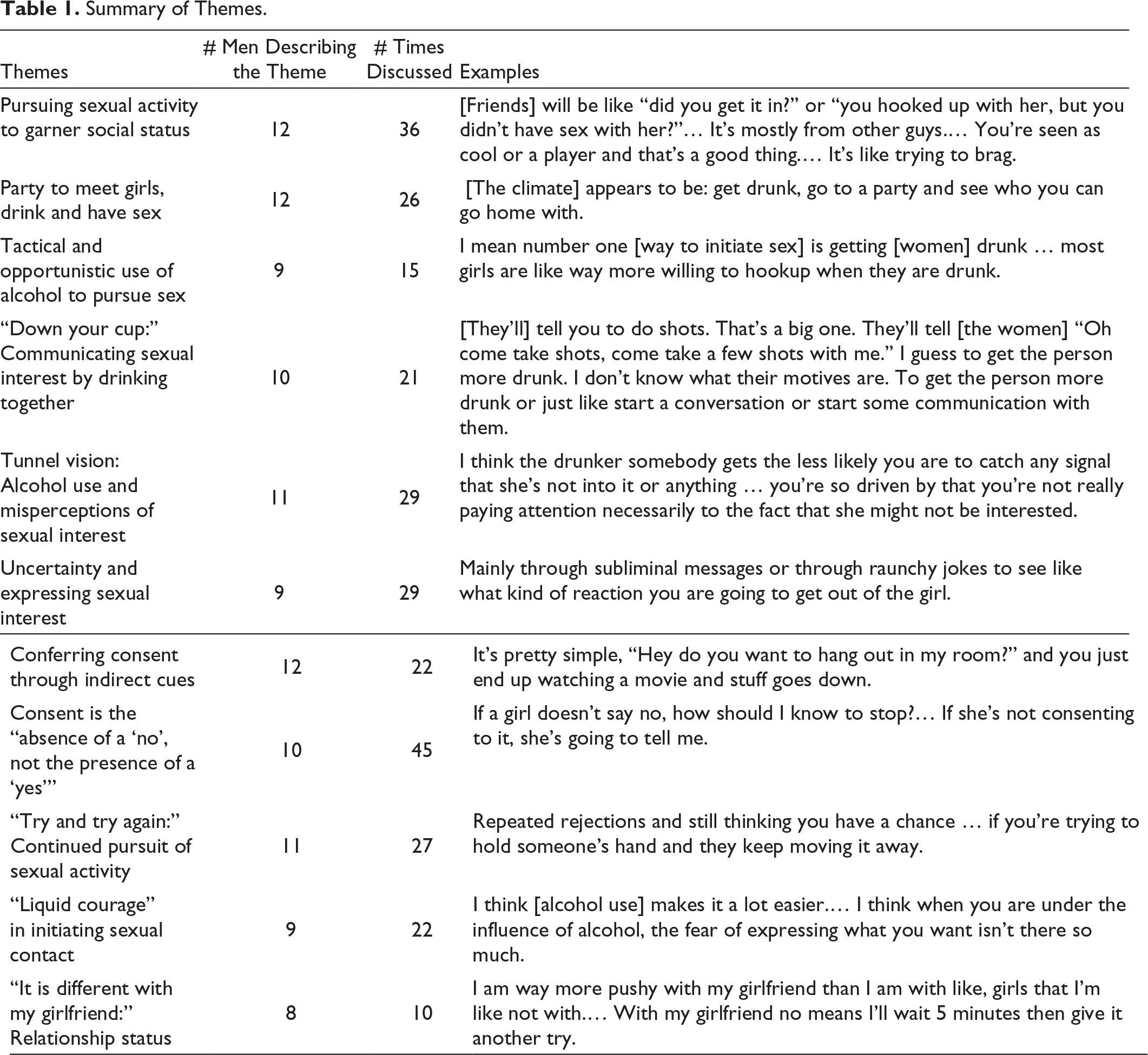
The 90-minute individual interview was semi-structured and administered by 1 of 2 male research assistants (RAs). The interview utilized open-ended questions (see Appendix A) and non-specific probes (e.g., “could you tell me more about that”). All sessions were audio-recorded and transcribed by an RA. NVIVO (QSR International, 2008) was utilized for thematic analysis to identify, analyze, and report patterns and themes (Braun & Clarke, 2006). Using analytic triangulation, four study team members (2 males and 2 females) independently coded the data and compared their findings in weekly meetings. During meetings, the coders reviewed their self-generated codes as a group. The codes were organized under the three main research foci, which aligned with the structure of the interview. Specifically: (a) what are men’s expectations about parties and sexual activity? (b) how do men gauge sexual interest? and (c) how do men gauge sexual consent? When similar codes were generated among coders, they were grouped together as a theme. Discrepancies were discussed until consensus was reached, and the most substantiated codes and themes were identified. When needed, the team reviewed the digital audio file together to determine the best interpretation of the data. After establishing the set of codes, focused coding was applied to the full set of transcripts (Bogdan & Biklen, 2007; Patton, 2014). The team discussed coding discrepancies until consensus was reached. Coding is summarized in Table 1.
Results
Research Focus #1: Expectations about Parties and Sexual Activity
“Go and get yours:” Pursuing sexual activity to garner social status.
Most men described partying as an opportunity to pursue sexual activity. College parties and bar environments were described as “sexually charged.” For example, when asked about the social environment at his school, one participant stated:
It’s their intention to hookup—it’s in the back of most people’s heads…. Girls and guys just trying to find a hookup … almost like the jungle … it’s your primal conscious. Basically, everyone is trying to find a hookup.
Men assumed that women at parties or bars were also there with the intention of finding a sexual partner. College parties were described as a setting where students would “let loose,” engaging in behavior that might otherwise be considered socially unacceptable. These assumptions reduce the importance of ensuring consent because the men assume that it has been “pre-given” based on a women’s presence at the event.
Men also described the pressure and expectation of engaging in sexual activity when attending parties or other social outings. When asked to describe pressures related to having sex, one man stated:
I’d say the pressure comes for those who don’t have sex a lot or that there are always certain guys in a group that you know will have sex, if not this week then maybe next week. And I’d say that the pressure comes for the guys who every party they go to, if that they don’t have sex then they start to feel pressured, like they have to have sex soon and have to become more aggressive.
This statement implies that men perceive that there is an expectation to engage in sexual activity when in certain environments such as at a party or bar. With that, this example also highlights the pressure that men experience to garner social status with other men in their group who are regularly engaging in sexual activity by also having sex, even if it is obtained through sexual aggression.
Men also described the process of hooking up as a “game,” where the end goal was to engage in sexual activity, ideally with as many partners as possible. For example, when asked to describe the pressures men face in social settings, participants indicated the following:
It’s kind of typical—oh I’m going to a party, let me see how many girls I could take home or if last week you took a girl home, let’s see if you can do it again this week with a different girl or something like that.
Men also reported an expectation to have sex, especially if sexual activity occurred before.
“Party to meet girls, drink, and have sex.”
Men described consuming alcohol (and encouraging alcohol use among women) as way to facilitate sexual activity. For example:
When I drink with my friends we’re like, “Oh, yeah we’re gonna drink, we’re gonna go to this party, we’re gonna have sex.” It’s almost implied that when you’re drinking you’re gonna have sex after.
[Men] go to a party to get drunk and then to hookup. It’s like a means to an end, the alcohol is.
Although all participants discussed the intersection of drinking and sex, only some men noted that sexual activity might also occur in the absence of alcohol. Our research team therefore raised the question of whether heavy-drinking college men were aware of how often their peers engage in sexual activity when sober.
Based on the articulated assumption that women at parties had a shared interest in meeting a sexual partner, men described seeking out drinking environments to meet women who might also be interested in sex. For example, one participant noted:
I feel like when I go out to get drunk, I would like to have sex. I do go out to get drunk and hang out with my friends and stuff—I’ll just hang out and drink with my friends, stay in and grab a couple of beers, a couple of bottles of alcohol and drink at home relatively cheaply. I go to the bar—not to pay 9 dollars for a drink—but so I can meet new girls, not to meet new guys. Especially since she’s at the same bar, you hope you’re there for the same reason … for the most part if she’s at a bar then she’s on the prowl.
As highlighted earlier, men assumed that women were also visiting these drinking environments with the intention of locating a sexual partner.
“Blame it on the alcohol:” Tactical & opportunistic use of alcohol to pursue sex.
Men endorsed the belief that both men and women are less responsible for their behavior when drinking. This belief was used to rationalize sexual experiences that might otherwise incur shame, guilt, or remorse. For example, when asked about how alcohol plays a role in students’ sexual experiences, one participant responded:
[T]he way I see it, [alcohol] is like a crutch for most people, where things would happen and people would blame it on the alcohol. I’ve had a girl tell me “yeah I drink so I don’t feel guilty after I have sex.”
As shown earlier, some men expressed that college women consume alcohol to transgress conservative socio-cultural expectations. Specifically, women who were drinking were interested in sex and could get around societal norms by “blaming it on the alcohol.” Other men described seeking out intoxicated women as sexual partners or encouraging women to drink because they assumed that intoxicated women would be more open to sexual activity. For example, when asked about ways that men initiate sex, participants noted:
Because once, as a guy, you know that, that she’s [drinking] and she’s vulnerable you can kind of manipulate the situation … it’s easier for her or for you to basically be able to get what you want out of whatever the situation is.
I mean number one [way to initiate sex] is getting [women] drunk., most girls are like way more willing to hookup when they are drunk.
In light of the aforementioned, men could exploit women’s alcohol use to increase their chances of engaging in sexual activity. These findings highlight the fact that some college men use alcohol to manipulate a woman into sexual activity. One participant noted that alcohol may make women more vulnerable, while the other explicitly invoked alcohol to ensure partner acquiescence to sexual demands. Notably, the other participant did not use the term “drinking with women” as a means to initiate sex. Rather, he talks about “getting [women] drunk;” implying that alcohol use is utilized deliberately as a seduction technique without considering the presence of consent.
Research Focus #2: How Men Gauge Sexual Interest
“Down your cup:” Shared alcohol use is perceived as communicating sexual interest.
Shared alcohol use was described as a way to express interest in having sex. Some men described drinking alcohol to attract attention. When asked what a man might do to show a woman he is interested in sexual activity, one participant responded:
Sometimes at parties, people will try and show that they can drink a lot. It might be something that they might try and show a girl. Like, “oh I can drink more than anybody else.”
Other men also spoke to the competitive nature of alcohol use between men, highlighting how consuming large amounts of alcohol was linked to masculinity and virility. Men also described shared alcohol use as a sign of sexual interest, and to facilitate sexual activity. For example, when asked how men show women sexual interest, one participant noted:
[They’ll] tell you to do shots. That’s a big one. They’ll tell [the women] “Oh come take shots, come take a few shots with me.” I guess to get the person more drunk. I don’t know what their motives are. To get the person more drunk or just like start a conversation or start some communication with them.
Thus, these men viewed women’s agreement to shared alcohol use as a sign of sexual interest. For example, accepting a drink from a man was a perceived as reciprocating interest in sex.
Tunnel vision: Alcohol use and misperceptions of sexual interest.
Mirroring existing research on the misperception of sexual intent (see Farris, Treat, Viken, & McFall, 2008), men believed they would be more likely to perceive women’s behavior as a sign of sexual interest when they were intoxicated. For example, when asked about alcohol and communication, one participant noted:
It is called liquid confidence. It overly hypes up people’s perceptions of their partner’s attractions [to them] … if a guy is drunk, he’ll take little cues from a girl and turn them into big cues and start hyping it up … being like “oh my god she definitely wants me.”
Some participants also acknowledged that they would be less fearful of rejection when drinking, and thus more likely to express sexual interest when intoxicated. When asked how alcohol influences the ability to know you are on the same page with a partner, one participant replied:
It probably decreases it; you are less likely to know if you are on the same page. Like when you are drunk your perception of things, your understanding is altered. So, you are not going to be able to read the person as well as if you were sober.
Although men recognized that alcohol use impaired recognition of sexual cues, they nonetheless believed that they would be able to accurately gauge whether a partner had consumed too much alcohol to provide sexual consent. When discussing how he gauges sexual consent when a partner is intoxicated, one man noted:
[Y]ou can tell when someone is drunk. By facial expressions, the way they act, the way they walk. I mean some people can hold their composure, but if somebody is holding composure, they have the ability to make consent.
In general, despite the aforementioned assumptions about women and alcohol, men reported that sex should be avoided if the woman appeared to be more intoxicated than they were themselves. Some men said they would be unlikely to pursue sexual activity with a woman who was intoxicated due to difficulties inferring and giving sexual consent, and some men also indicated that sex with an intoxicated partner would be considered “sexual assault” or “rape.” Some men also noted that sexual activity with an intoxicated partner should be avoided due to sexual misconduct policies (i.e., “they tell us not to do that”).
Uncertainty and the expression of sexual interest.
Most men expressed a high level of confusion regarding how women show that they are interested in sexual activity. When asked to describe how they know when a woman is interested in sexual activity, one participant noted:
Like, oh my god, I don’t even … this is a mystery to me.… If I knew, I could totally take advantage of the system.
It was not clear how to interpret what this participant meant when he utilized the word “system.” The participant may be referring to perceived social scripts that exist between men and women in dating or sexual situations. Regardless, many men expressed a desire for direct information about what women wanted in social and sexual situations.
Men reported using a range of non-verbal gestures to convey their sexual interest to a potential partner. For example, when asked how men communicate what they want in a sexual situation, the communication was described as symbolic, non-verbal, and indirect:
Even if you go into verbal communication, you might send signals by saying something completely unrelated to sex … like a hint. Like she might be drinking and something and she looks at her boyfriend or whoever and she’s like, “Jeez I’m really drunk” or something like that. That right there is like “We should go have sex.”… You could even use verbal communication and just not be so straight up about it. It’s more symbolic almost.
As noted earlier, men described “testing the waters” and gauging women’s reactions to infer their interest in sex. Direct verbal communication of sexual interest was rarely discussed in this sample of heavy-drinking college men. For example, participants noted:
I would never say “I want to have sex with you.” I feel like for most guys [pursuing sexual activity] is like continually taking liberties with the girl. Like first getting close to her, talking to her, maybe establishing physical contact, just getting close and trying to take her into the other room. It is just a lot of non-verbal cues that people can pick up on.
You kind of beat around the bush a little bit, you’re not too straightforward. At the same time, you want to try to hint at what you want. Cause they’re not stupid. They know what you want out of a certain situation. They’re not going to be totally oblivious to that. But you just don’t want to be direct about what your intentions are.
These quotes reflect men’s efforts to mask their intentions when interacting with a potential sexual partner, which may increase the likelihood of an assault. Men’s hesitancy to directly communicate sexual interest and the goal of “getting away with something” reflected an assumption that direct sexual communication made men vulnerable to rejection and could “ruin” their chances of a sexual experience. A further justification, as shown in the assertion women aren’t “stupid, they know what you want,” is that some men assumed that women were aware of their goal of pursuing sexual activity.
Research Focus #3: Gauging Sexual Consent
“Want to go back to my place?” Conferring consent through indirect cues.
When asked to describe how men understand presence of consent, they provided a range of indirect non-verbal and verbal cues. They often inferred consent through cues, such as accepting an offer to go to a more private location (i.e., apartment, dorm room, bedroom, or home). For example, when asked to describe how men communicate their sexual interest, one participant noted:
You don’t directly say, “Hey I want to have sex with you.” You rather say, “You know, do you want to go back to my place” or something like that…. If she comes back to your place, then that’s consent.
Expressions of sexual interest were perceived as consent for sexual activity. Shared social activities that involved alcohol (i.e., drinking games, doing shots) set the stage for a potential sexual encounter such that if a woman later agrees to a change in location, albeit for non-sexual reasons (e.g., “hang out;” “watching a movie”), it was perceived as consent for sexual activity.
Consent is the “absence of a ‘no’, not the presence of a ‘yes’”
Men perceived that consent was present if a partner failed to offer a clear “no” in response to sexual activity, and men endorsed a belief that women may engage in token resistance to comply with societal standards of not appearing “too easy.” Aligning with traditional heterosexual sexual scripts, men inferred consent if a woman did not refuse or resist a sexual advance. For example:
Usually the guy will initiate [sexual contact], and if the girl lets it go, the guy knows they are on the same page.
You just try (laughs). And if she wants to, she lets you hookup with her and that’s consent right there.
Generally, men assumed that a woman would say “no” if they did not want to engage in sexual activity. The reliance on indirect indicators of sexual consent was consistent in this sample of heavy-drinking college men. For example, when asked how men know that they have consent in a sexual encounter, one participant noted:
I think there is a lot more assumption of consent. I mean, she’s here, she wants that sort of thing. Not so much asking but assuming.
Men tended to assume that consent was present if a woman was engaging in the sexual interaction, despite no verbal expression of a “yes.” For example, when asked whether a man would ask a woman for consent for sex, one participant noted “None of my friends would.” Responsibility was placed on women to resist unwanted sexual advances through verbal cues.
Rather than asking women what type of sexual activity a partner might be interested in taking part in, men described attempting increasingly more intimate sexual activity until they met resistance. One participant explained this “act and then see” method of inferring consent:
When you’re first hooking up with a girl there is always those trademarks; first base, second base, third base kind of thing. But you’re testing, those waters, so when you’re hooking up with a girl, I feel like it would be awkward if we were making out and I go “Hey, can I put my hand down your pants?” You don’t say that; it would be weird. So, you just try. If she pulls your hand out, she doesn’t want you there. I mean when it comes down to the point, while you are hooking up and you think you can try for it again, and then try for it again.
Here, participants described how sexual activity would gradually escalate until refusal. Some men also expected to repeatedly engage in sexual activity even after a refusal.
“Try and try again:” Continued pursuit of sexual activity.
Men reported “trying and trying again” to pursue a sexual encounter. Participants did not frame multiple attempts through physical contact as harmful or coercive. Instead, most participants described that an advance should be stopped only after repeated attempts at sexual contact. When asked about how men know they have consent, one man noted:
You just badger them (laughs). You keep trying to flirt with them. You keep trying to make them think highly of you.
Participants expected that they would need to express their interest in sex several times to overcome women’s initial resistance. Some men believed that women would engage in initial “token resistance,” despite interest in sex.
Alcohol gives men “liquid courage” to initiate sexual contact.
Aligning with heterosexual scripts whereby men are expected to initiate sexual activity and wait for a woman’s response, participants described how alcohol facilitated their confidence in initiating sexual contact. When asked to describe how alcohol influences sexual interactions, one man noted:
The alcohol makes it more instinctual. I want to touch this girl so I’m going to, and I don’t really care because I’m drunk.
As highlighted earlier, for some men “getting what you want” was a central focus of the social interaction with women. Although attempting sexual activity may not “pay off,” participants noted the possibility that women may “let it happen.” Thus, the sexual interaction was akin to a lottery that one needed to play to “win.” In this context, alcohol use increased men’s courage in attempting escalating forms of sexual interaction, thus increasing their chances of “success.” Little concern was expressed for how an unwanted sexual contact would impact a female partner. The potential to violate a woman was not raised as a risk of attempting sexual activity without verbal consent. Men’s comfort with the “try and try again” method for pursuing sexual activity even in the presence of resistance from a partner highlights how women are not considered to be equal collaborative partners in a sexual interaction, or that they are assumed to be “collaborating” based on their not actively resisting or verbalizing a “no.”
“It is different with my girlfriend:” Relationship status and consent.
The interviews reflected a belief that consent for sexual activity was assumed when interacting with an established sexual partner. When asked how gauging sexual consent changed in the context of a relationship, participants noted the following:
[O]nce sex happens, I feel like a lot of guys make it their mission to keep getting it. They want to just keep it going. And–and if it’s a partner that you’ve had before, you don’t see the signs that maybe she doesn’t want you. Because you’ve already confirmed in your head that she does. So, you are blind to some of the red flags that she can give you, and that causes problems too.
Men’s understanding of how alcohol use influences their ability to gauge sexual interest and consent also varied when they discussed experiences with committed partners. For example, when asked how men know they are on the same page as a partner, one participant notes:
[I]f she’s my girlfriend that is one thing. She gets shit-faced and wants to have sex, I’m going to have sex with my girlfriend. She’s my girlfriend. But I am not raping my girlfriend.
Although men noted that they would be less likely to be intoxicated when engaging in sexual activity with an established partner, they were less hesitant about the risks of sexual activity with an established partner who had consumed high levels of alcohol. Men reported that prior sexual activity with an established partner conferred consent for future sexual encounters, and sexual activity with an established partner who was intoxicated would not be considered “rape.”
Discussion
The present findings advance our knowledge of how heavy-drinking college men conceptualize sexual consent; confirming that they represent a group at high risk to perpetrate sexual assault. To our knowledge, this is the first study to explicitly target this high-risk subgroup in a qualitative analysis of sexual consent. Many beliefs of heavy-drinking college men regarding sexual interest and consent aligned with other studies highlighting the persistence of traditional heterosexual scripts (see Jozkowski et al., 2017). For example, men believed they were personally responsible for initiating sexual behavior and assumed that women would resist an unwanted sexual advance (Bay-Cheng & Eliseo-Arras, 2008). Men reported the presence of consent when a partner “allowed” sexual activity to occur; in direct contrast to sexual consent being “the presence of a yes and not the absence of a no” (McGregor, 1996). Even when their advances are resisted, men reported continued attempts to engage in sexual activity, viewing it as a game (or lottery) that included overcoming the “token” resistance (Muehlenhard, 2011). Findings also highlighted the existing myth that for sexual victimization to occur, women must “fight back” via persistent refusal of sexual activity (Estrich, 1988). These assumptions are problematic, as women describe “giving in” to unwanted sexual activity after repeated attempts at sexual contact; including in the context of a committed relationship (Edwards et al., 2014). Furthermore, the finding that men did not commonly check in with a partner during sexual activity is concerning, as women—particularly those with a trauma history—may freeze in response to an unwanted advance (Marx et al., 2008). Men also did not recognize that repeatedly attempting sexual activity without verbal consent could be considered a crime.
Aligning with prior research (e.g., Flood, 2008; Jozkowski et al., 2017), men viewed sexual activity as a pathway to garnering social capital with other men. This transactional approach to sexual activity—whereby a sexual experience is seen as something to “win” or “achieve”—aligns with traditional notions of masculinity that value virility and sexual conquest (Pleck et al., 1993), and emphasizes casual sexual encounters with multiple partners as a way of gaining respect from other men (Jonason, 2007). This internal and external pressure to pursue sex may result in men engaging in escalating forms of sexual activity until the recognize repeated signs of resistance.
Aligning with Bay-Cheng and Eliseo-Arras’ (2008) description of undergraduate students’ “Once Yes, Always Yes” construal of sexual consent, men also indicated that prior sexual activity conferred consent for subsequent sexual activity. In addition, consistent with prior research (Freetly & Kane, 1995), men reported that sex with an intoxicated partner would not be considered sexual assault if it occurred with one’s girlfriend. Finally, Norona et al. (2018) found that men in committed relationships who drank frequently during sexual encounters engaged in more sexually aggressive behaviors compared to those who were single or in casual relationships. Cumulatively, present and prior findings suggest the value of examining how existing sexual assault prevention program can address risks for sexual violence among heavy-drinking men in established relationships.
Like previous studies highlighting high levels of non-verbal communication of sexual interest and consent (Beres, 2010; Beres et al., 2004; Hickman & Muehlenhard, 1999), heavy-drinking men also reported utilizing indirect non-verbal cues or forward physical advances, and rarely reported directly communicating sexual interest verbally. In addition to replicating these findings, the current interviews offered insight into why some men may prefer non-verbal sexual communication strategies. Specifically, men spoke to how they believed that indirect expression of sexual interest was more successful in pursuing sexual activity and protected against rejection.
Men also discussed how alcohol use influenced how they pursued sexual activity and gauged sexual interest and consent. Consistent with prior research (Graham et al., 2014; Grazian, 2007; Laumann et al., 2004; Lindgren et al., 2009; Parks & Scheidt, 2000), men reported seeking out drinking environments to locate a sexual partner. The present study added to these findings by highlighting the role of risky drinking behaviors—such as taking shots—as a sign of sexual interest, and for some men, even consent. Of note, the accuracy of men’s assumptions about women in drinking environments is unclear. For example, men may be overestimating the extent to which women in drinking environments are interested in sexual activity.
Data also highlighted men’s instrumental use of alcohol to pursue sexual activity. This included seeking out intoxicated women who were perceived to be more open to sexual advances, as well as providing women with alcohol to increase receptivity to sexual advances. Consistent with MacNeela et al.’s (2014) findings, men discussed a gendered intersection of alcohol use and sexual interest. Specifically, alcohol use provided men with liquid courage to act on their “instinctual” sexual impulses and allowed women to transgress societal expectations, as they could both “blame it on the alcohol.” These findings align with prior research suggesting how alcohol use serves to decrease personal responsibility for initiating unwanted sexual advances (MacAndrew & Edgerton, 1969; Montemurro & McClure, 2005).
Despite identifying that alcohol use could cloud judgment of sexual interest, some men believed they might be able to accurately gauge whether a woman was “too drunk to consent.” Findings also underscored men’s beliefs that alcohol would provide “liquid courage” in expressing sexual interest; most often by physically attempting sexual contact. These findings suggest that education on cognitive effects of alcohol is important to sexual assault prevention. Further, men generally felt confused regarding how women express sexual interest and feared making an unreciprocated sexual advance. Thus, it may be useful for sexual assault prevention programs to provide men with information from women regarding how they view and express sexual interest.
Limitations and Future Directions
Whereas the present study replicates prior findings and provides new insights regarding alcohol use, sexual interest, and consent, it is important to note several limitations. First, a small number of the men who received the screening email replied, and only half of those who replied met study inclusion criteria. The low response rate may be attributed to the limited detail regarding the study in the recruitment email. Future recruitment attempts may utilize a combination of mail and email contacts (Dillman et al., 2014). Additionally, despite the widespread use of electronic survey methodology, it remains unclear what an acceptable response rate is when participants receive screening invitations (Draugalis & Plaza, 2009). It also should be noted that although the sample size used for this study allowed for sufficient saturation of qualitative themes during our interview, our sample size was relatively small. Given that the sample consisted solely of heavy-drinking college men that reported recent sexual activity with a female partner, the present findings cannot be generalized to all college students. Although research documents a clear and robust association between heavy-episodic drinking and propensity to perpetrate sexual assault (Dir et al., 2018), future research could examine how non-heavy-drinking men conceptualize consent, in an effort to have more generalizable results. Men’s own history of perpetrating sexual aggression and relationship status was also not assessed and would be useful in further contextualizing the results. Consistent with the university demographics, the sample was predominantly Caucasian, warranting follow-up research with more racially and ethnically diverse samples. Interestingly, college students identifying as sexual and gender minorities are most at risk to experience sexual assault, yet little is known about perpetrators of sexual assault among this population (Cantor et al., 2015). To address this gap within the literature, future studies can also focus on conceptualizations of consent and alcohol use among men who have sex with men, and bisexual men—who may have been included in the present study but were not explicitly identified. Further, it is unclear whether the men in this study received any education about sexual consent, as the sexual misconduct policy at the college did not include a definition of sexual consent. Finally, participants in this study were not screened for other drug and substance use, nor was this queried specifically during the interview. Future work exploring the role of alcohol and sexual consent should also consider how drug and substance use, in addition to alcohol use, impacts how this population conceptualizes consent.
Implications for Prevention
The present findings highlight confusion regarding what constitutes consent among heavy-drinking men. While this group is at high risk for perpetrating sexual aggression, few prevention efforts have been developed or tested that specifically target this sub-population of men. Of note, the heavy-drinking men in this study revealed beliefs that were generally normative—aligning with prior studies that included college students regardless of heavy-drinking status. However, the present investigation highlighted several ways in which college drinking environment influenced how men gauged and/or expressed sexual interest and communicated and/or inferred consent. Targeting heavy-drinking men in sexual assault prevention efforts is crucial (Orchowski et al., 2018) and the present findings may help to further tailor interventions. For example, some men expressed ambivalence regarding the accuracy of their perceptions of women’s sexual interest and whether to avoid women who were consuming alcohol. Some men also expressed fear and avoidance of being involved in a sexual assault. Targeting these points of ambivalence may help drive changes in the attitudes and behaviors preceding sexual assault.
The present findings also highlight the importance of educating men that they maintain responsibility for their own actions when intoxicated and that nothing justifies an unwanted sexual advance. It is also important to shift societal norms that position intoxicated women as “fair game” for sexual advances drinking environments. The present findings also underscore the need to educate youth regarding sexual agency and consensual sexual activity. Given that most prevention programs can be considered to be one-dimensional, primarily being administered in specific environments such as universities and colleges (DeGue et al., 2014), future efforts could include more comprehensive strategies to engage men at earlier developmental stages in a variety of settings. As illustrated throughout our results, men detailed many problematic conceptualizations of sexual consent, including the perceived acceptability of repeated attempts to obtain sex and lack of affirmative consent. Prevention programs on college campuses specifically may benefit from creating group dialogue using Social Norms Theory (Berkowitz, 2010; Berkowitz, 2002) to debunk these widespread beliefs, while simultaneously highlighting that most men do not use or support use of these sexually aggressive tactics. Movies, television, and social media are saturated with representations of alcohol-related sexual activity, and these depictions rarely provide appropriate examples of sexual consent (see Abbey, 2017 for a discussion). Whereas it is unrealistic to expect college sexual assault prevention efforts to undo years of problematic socialization, few efforts are geared towards thwarting the development of problematic sexual norms among youth (DeGue et al., 2014). Parents can also educate their children on the characteristics of healthy relationships (Testa et al., 2010).
It is important to utilize research findings to continually refine and enhance sexual assault prevention efforts. The present data emphasize the importance of discussing how alcohol use intersects with traditional heterosexual scripts when educating men on consent. Addressing how alcohol use influences men’s understanding of sexual interest and consent is particularly Table 1. important when engaging heavy-drinking men in prevention.
Summary of Themes.
Footnotes
Authors’ Note
Daniel W. Oesterle is also affiliated with Department of Psychological Sciences, Purdue University, West Lafayette, IN.
Declaration of Conflicting Interests
The author(s) declared no potential conflicts of interest with respect to the research, authorship, and/or publication of this article.
Funding
The author(s) disclosed receipt of the following financial support for the research, authorship, and/or publication of this article: This research was supported in part by Research Grant 1 R34 AA020852 from the National Institute on Alcohol Abuse and Alcoholism to Lindsay Orchowski, PhD.
