




Abstract
This study analyzed the relationships between exposure to interparental violence and adolescents’ adjustment problems. It also explored the mediating role of emotional insecurity and the moderating role of parental warmth in these relationships. Five hundred and seventy-eight early adolescents from three migrant primary schools and one public school in Beijing participated in this survey, reporting on their perceived interparental violence, emotional insecurity, post-traumatic stress symptoms (PTSS), and internalizing and externalizing behavioral problems. The results revealed that emotional insecurity partially mediated the association between interparental violence and all three indicators of adjustment problems, with stronger mediating effects on PTSS and internalizing problems than on externalizing problems; parental warmth buffered the association between emotional insecurity and internalizing/externalizing problems. This study adds insights to present literature on how interparental violence contributes to different aspects of adolescents’ adjustment problems in the Chinese context.
Introduction
Exposure to intimate partner violence between parents (IPV) has been identified as a risk factor for children’s adjustment in numerous studies (Artz et al., 2014; Vu et al., 2016). A few meta-analyses also demonstrated that IPV may have different effects on different aspects of adjustment. For example, Evans et al.’s (2008) meta-analysis revealed that IPV had moderate effects on internalizing (e.g., anxiety and depressive symptoms, social withdrawn; d-value = 0.48) and externalizing symptoms (e.g., aggression, antisocial, and impulsive behaviors; d = 0.47), but it had much larger effects on trauma symptoms (d = 1.54). Similarly, Chan and Yeung (2009) divided children’s adjustment into five domains, they found that family violence had the largest association with post-traumatic stress disorder (PTSD), followed by internalizing and externalizing problems, while the correlations of family violence with the other two domains (cognition and interpersonal competence) were smaller.
Despite ample evidence supporting the association between interparental violence and child psychopathology, few studies have examined the underlying processes of this association, and even less has compared the differential impacts of these underlying mechanisms on different aspects of psychopathology. Emotional security theory (EST) is an established explanatory framework for the relationship between destructive family conflict and child psychopathology (Harold & Sellers, 2018). This study aims to use this theory to explain the relation between interparental violence and three aspects of adolescents’ adjustment problems: post-traumatic stress disorder symptoms (PTSS), internalizing problems and externalizing problems. As showed in the literatures reviewed earlier, these three adjustment domains were the most heavily influenced by IPV. Furthermore, this study also explored whether the indirect associations between IPV and adolescents’ adjustment problems would be moderated by parental warmth. It is expected that an exploration of the mediating and moderating mechanisms between interparental violence and children’s psychopathology can help us understand how adverse family context impedes children’s development, and such information can further contribute to informing the design and content of family interventions.
Emotional Insecurity as a Mediator
Emotional security theory (EST) was first proposed by Davies and Cummings (1994) to explain the mechanism on how marital conflict influences child adjustment. It postulates that, within the emotion-laden context of interparental conflict, a prominent goal for children is to maintain a sense of protection, safety, and security. Repeated exposure to parental conflict containing hostility, violence, and anger undermines a child’s sense of emotional security, which in turn increases his/her vulnerability to poor adjustment and psychopathology. The mediating effect of emotional insecurity on the relation between exposure to interparental conflict and different aspects of children’s adjustment has received substantial empirical support. In a review, Davies et al. (2016) found 16 of 17 empirical studies supported a significant mediational effect of emotional insecurity in the associations between destructive interparental conflict and child psychopathology. They also observed a larger effect size in studies, which utilized prospective lagged analyses compared to cross-sectional designs, which hints that the impact of emotional insecurity might have long-lasting effects not adequately captured in cross-sectional studies.
Furthermore, Davies et al. (2016) pointed out that emotional insecurity seemed to be a stronger predictor of internalizing problems than externalizing problems. But studies which have directly compared the relative effect of emotional insecurity on different adjustment outcomes are scarce. Moreover, PTSD has seldom been included as adjustment indicators, although it is reported to be the most strongly influenced by IPV (see El-Sheikh et al., 2008; Levendosky et al., 2013; Telman et al., 2016). In addition, much of previous research on the mediating role of emotion insecurity had focused on marital conflict, few studies cared about the more severe and extreme instance of marital conflict—interparental violence (Cummings & Millergraff, 2015). To the author’s knowledge, till now only three studies had provided direct support for the mediational role of emotional insecurity between interparental violence and children’s adjustment: El-Sheikh et al. (2008) found children’s (7–9 years old) emotional insecurity mediated the relation between marital aggression and children’s internalizing problem, externalizing problem, and PTSD; Kelly and El-Sheikh’ s (2013) longitudinal study followed children from 8 to 14 years old, and revealed that emotional insecurity mediated the relation between marital aggression and sleep, while Bergman et al. (2014) confirmed that emotional insecurity mediated the relationship between marital aggression and adolescents’ depression and anxiety. However, all these three studies are based on U.S. samples, and it is unclear whether these results can be replicated in non-Western countries. Moreover, with the exception of El-Sheikh, the other two studies had either focused on internalizing problem or sleep, and none have compared the association of emotional insecurity with different adjustment indicators.
In the current study, we intended to further validate emotional security as a mediator between interparental violence and children’s adjustment in the Chinese context and test if emotional insecurity has different associations with various indicators of adjustment problems; What’s more, we would also focus on a unique developmental stage—early adolescence (mainly between 10 and 13 years old), thus complementing the studies of El-Sheikh et al. (2008) and Bergman et al. (2014), which focused on 7–9 years old and adolescents (between 12 and 16 years old) respectively.
Parental Warmth as a Protective Factor
Although the mediational effect of emotional insecurity is widely reported, there is substantial heterogeneity in children’s reactivity to conflict, so theorists emphasized the importance of embedding children’s emotional security within the broader familial contexts as children derive emotional security from multiple family relationships. Davies et al. (2002) pointed out that family characteristics in three different domains of the family system—broad family-level, interparental relationship, and parent–child processes can be either protective or potentiating factors in the association between parental conflict and child functioning, and they proposed that these family characteristics may moderate the relation between family conflict and child adjustment through two pathways: (a) from interparental conflict to child insecurity and (b) from child insecurity to a child’s psychological symptoms. For example, if family conflicts occurred in the context of warm, well-regulated family relationships, children may believe that the adverse effects caused by interparental conflict are short-lived and well-managed by the parents, thus it may not substantially undermine children’s emotional security; by the same token, parents’ positive involvement in the child’s activities and expressions of affection towards the child may facilitate his/her coping with insecurity, and then, weakens the link between child emotional insecurity and psychological problems.
However, despite family factors has been pointed out as playing a vital role in assisting children coping and adjusting to interparental conflict (Davies et al., 2016; Paul, 2019), research directly examining it as moderators of the mediating impact of emotional insecurity in the interparental conflict—child adjustment association is scarce (Davies et al., 2013). This study focused on one parent–child processes factor—parental warmth. As pointed out by Levendosky et al. (2003), although partner violence often caused problems in parenting, some parents nevertheless tried to compensate for the violence by becoming more involved and effective, and this kind of positive parenting can serve a protective function for children exposed to marital conflict. We speculated this may also happen to Chinese parents. It is well-known that traditional Chinese families are child-centered rather than couple-centered (Xu et al., 2007), and the only-child policy heightened this trend in emphasizing parent–child relations, so parents may overlook their conflict but try to prevent the harm to their children by providing more parenting support.
The Present Study
To sum up, the present study aims to examine the mechanism of interparental violence on adolescents’ adjustment problem in China, especially the mediating role of emotional insecurity and the moderating role of parental warmth in this association (Figure 1). Based on the literature reviewed previously, we proposed the following two hypotheses:
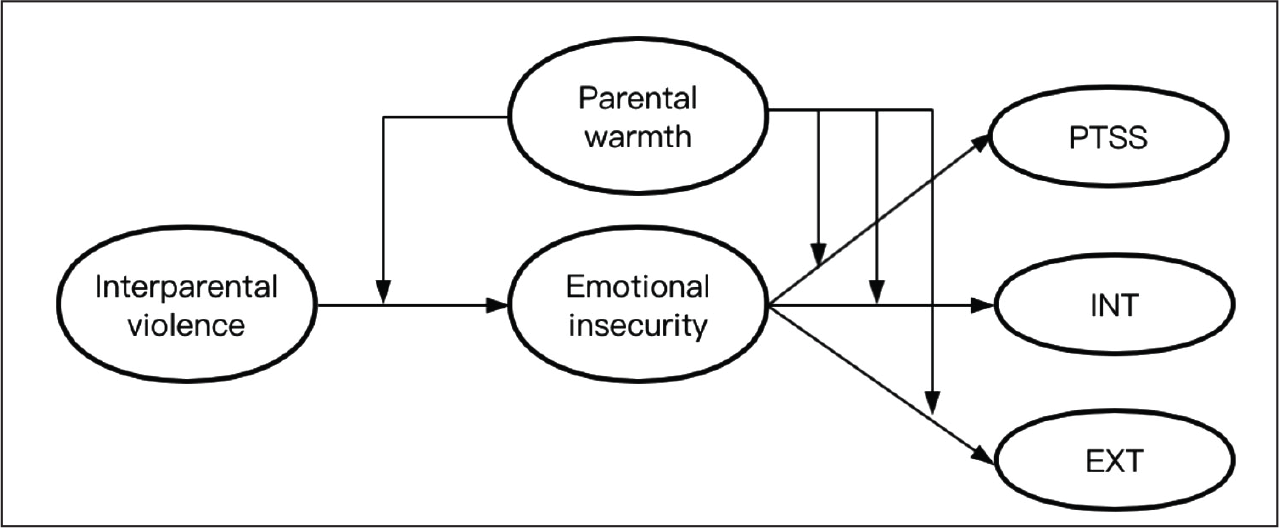
Note. PTSS = post-traumatic stress disorder symptoms; INT = internalizing behavior problems; EXT = externalizing behavior problems.
Research Method
Participants and Procedures
This was a cross-sectional study conducted in a suburban district (Fangshan) of Beijing from April to May in 2016. To make the sample more diversified, four classes (two Grade 5 and two Grade 6) of students from a public school and six classes (three Grade 5 and three Grade 6) from three migrant schools were recruited. Students in the public school were mostly from middle-class families, and that in the migrant schools were mostly from underprivileged families. Because migrant children often faced problems of drop out and school transfer, they are often older than students of the same grade in public schools (Wang, 2008), so two classes of seventh grade students from the public school were also chosen to make students from the two types of school more comparable in age.
Materials and procedures were approved by the Research Ethics Committee of the first author’s institution. All the students who attended school during the investigation day were invited to participate in the study. Students who agreed to participate completed the survey packet in their classrooms under the supervision and guidance of a trained research assistant. Around 620 questionnaires were distributed and 607 were returned, but 29 were dropped because of a large percentage of missing data. Thus, 578 inventories were kept, with 288 from migrant schools and 290 were of male students. The ages of the participants ranged from 10 to 16 years, with a mean of 12.33 (SD = 1.11). Students from the public school and migrant schools were similar in the proportion of males and females and in age, but migrant school students were of lower family SES compared to public school students.
Research Instruments
Interparental violence (IPV). Adolescents’ exposure to interparental violence was assessed using the Chinese version of the Revised Conflict Tactics Scale (CTS2) (Xiang & Zhang, 2018). The CTS was developed by Straus et al. (1998) and has been one of the most widely used self-report measures to assess intimate partner violence. The original inventory has five subscales, but the present study focused on the 20 items that compose the physical assault subscale (e.g., kicked, bit, or punched partner) and psychological aggression subscale (e.g., shouted at partner), each subscale has a minor and severe dimension. The respondents reported frequencies for each CTS2 item indicating how often their mother/father engaged in each strategy toward each other over their lifetime. The items were assessed on a seven-point Likert scale from 1 (never) to 7 (almost daily). The internal consistency reliability of the physical assault and psychological aggression subscales were good (Cronbach’s α = 0.763 and 0.862, respectively). Since some researchers suggested that a four-factor structure which distinguished minor and severe aggression has a better model fit (Connelly et al., 2005; Newton et al., 2001), we used confirmatory factor analysis to test the two-factor model and four-factor model respectively. The maximum likelihood parameter estimation (MLM) was used due to the skewness and kurtosis of some items. Results showed that the four-factor model fitted the data much better (χ2/df = 1.54, p < .001, RMSEA = 0.031, CFI = 0.900, TLI = 0.880, SRMR = 0.071) than the two-factor model (χ2/df = 2.34, p < .001, RMSEA = 0.049, CFI = 0.734, TLI = 0.701, SRMR = 0.090). Thus, we used the four-factor structure (minor physical assault, severe physical assault, minor psychological aggression, severe psychological aggression) in subsequent analysis.
Emotional insecurity. Emotional insecurity was assessed by the Security in the Interparental Subsystem Scale (SISS) developed by Davies et al. (2010). The original scale includes seven subscales. Wang et al. (2014) validated this scale among a group of Chinese high school students and found that three subscales (behavioral dysregulation, involvement, avoidance) were not very stable while constructive family representations did not directly measure emotional insecurity; thus, they only kept three subscales—emotional reactivity (e.g., “I can’t calm myself down”), destructive family representations (e.g., “I worry about family’s future”), and conflict spillover representations (e.g., “I feel like it’s my fault”). This study used M.Z. Wang’s validated Chinese version, which has 17 items. Participants were asked to rate each item during the past year on a four-point Likert scale ranging from 1 (never) to 4 (always), high scores indicating high insecurity. Cronbach’s α for the three subscales in the present study was 0.860, 0.821, and 0.697, respectively. Confirmatory factor analysis revealed that the three-factor structure showed a good fit: χ2/df = 4.37, p < .001, RMSEA = 0.077, CFI = 0.905, TLI = 0.887, SRMR = 0.050, and factor loadings varied from 0.411 to 0.819.
Parental warmth. Parental warmth was measured by Leeuwen and Vermulst’s (2004) Ghent Parental Behavior Scale—the Chinese version validated by Liu et al. (2012). It includes 37 items and seven subscales which form two secondary dimensions, “involvement/warmth” and “discipline/punish.” The present study has only used the “involvement/warmth” dimension, which includes the first four subscales (rules, support and companionship, autonomy, monitoring), and has 21 items (a = 0.948). Items in this scale (e.g., “My parents teach me to obey rules,” “When I have a disagreement with my parents, we talk it over and we look together for a solution,” “My parents teach me to make my own decisions,” “My parents keep track of my friends”) were rated on a five-point Likert scale ranging from 1 (never) to 5 (always). Confirmatory factor analysis revealed that the four-factor structure showed a good fit: χ2/df = 3.42, p < .001, RMSEA = 0.066, CFI = 0.935, TLI = 0.927, SRMR = 0.046. Factor loadings for all items were above 0.650.
Post-traumatic stress symptoms (PTSS). Adolescents’ trauma symptoms were measured with the Chinese version of the PTSD Checklist-Civilian Version (PCL-C). According to Wilkins’s (2011) recent literature review, the PTSD checklist has been one of the most commonly used self-report measures of PTSD, and its psychometric validity is well established. The PCL-C anchors items to “stressful experiences” not specific to any traumatic event or experiences. Yang et al. (2007) had validated the PCL-C in Chinese college students and Wang et al. (2009) further validated it among a group of Chinese middle school students. The PCL-C has 17 items which is composed of four subscales—reexperiencing, avoidance, dysphoria, and hyperarousal. Participants used a five-point Likert scale (from 0 = “never” to 5 = “severe”) to rate the frequency of experience of each symptom within the past 6 months. Sample items of the scale include “repeated, disturbing dreams of a stressful experience from the past,” “having physical reactions (e.g., heart pounding, trouble breathing, or sweating) when something reminded you of a stressful experience from the past.” Confirmatory factor analysis revealed that the four-factor structure showed a good fit: χ2/df = 4.34, p < .001, RMSEA = 0.077, CFI = 0.921, TLI = 0.905, SRMR = 0.051. Factor loadings varied from 0.588 to 0.607. Cronbach’s α for the whole scale was 0.921, and for the four subscales were 0.854, 0.770, 0.836, and 0.769, respectively.
Internalizing and externalizing behavioral problems. This study used the Chinese version of the Achenbach’s Child Behavior Checklist (CBCL). CBCL is one of the mostly widely used inventories to measure behavior problems and had been well-validated in China. However, the full version has 113 items and takes a long time to finish, so Chi and Xin (2003) had shortened it to 45 items, and Li et al. (2009) had used it among a group of migrant students and further reduced it to 40 items, with 20 items measuring internalizing problems (anxiety, depression, and withdraw) and 20 items measuring externalizing problems (intrusiveness, aggression, delinquency, and over-activity). This study adopted Li’s version. Individuals rated how often they had experienced each item within the past six months on a four-point Likert scale ranging from 1 (never/not true) to 4 (always/very true). Higher scores indicated more severe symptomatology. The reliability of the internalizing and the externalizing problem subscale in the sample was 0.882 and 0.894, respectively.
Demographic form. We controlled the following demographic variables: gender (0 = male, 1 = female), age (in years), school type (0 = migrant school, 1 = public school), and subjective family SES (with one item “How would you rank your family’s economical level in your locality?” 1 = bad, 2 = average, 3 = good).
Data Analysis Strategy
Three steps were conducted to test the hypothetical mediation and moderation effects. First descriptive statistics were presented to help understand the subsequent results. Second, a simple mediation model was established using structural equation model to investigate the mediation role of emotional insecurity in the relationship between interparental violence and three indicators of adjustment problems. All variables, except for control variables, were latent structural. Thus, before testing the mediating effect, the measurement model was tested to assess whether each of the latent variables was represented by its indicators. Third, a moderated mediation model was established to examine the moderating role of parental warmth. When any interaction effect was significant, the simple effect analysis was conducted to understand the nature of the interaction.
Structural equation models were conducted using the MLR estimator of Mplus 8, which utilizes full information maximum likelihood estimation to handle missing data and provides robust standard errors for non-normal data. All indicators were standardized before modeling. The moderating role of parental warmth was tested using distribution analysis approaches with the XWITH command in Mplus. Since Mplus software does not provide required fitting indices to assess the validity of model with the latent interaction term, the model fitting was assessed using the method proposed by Maslowsky et al. (2015). Specifically, the first step is to ensure that the model without latent interaction term has qualified fitting. Next, the value of D was computed by comparing the log-likelihood values of models with (M1) and without (M0) latent interaction term (D = –2 [(log-likelihood for M0) – (log-likelihood for M1)]). According to Maslowsky, the values of D can be compared to a chi-square distribution. If the loglikelihood ratio test is significant, it can be said that the model with the latent interaction term is a well-fitted model.
Results
Descriptive Statistics
Table 1 summarizes the means, standard deviations, and zero-order correlations for the study variables. Although 75.6% of the adolescents had witnessed at least one incidence of interparental psychological aggression, and 43.1% witnessed at least one incidence of interparental physical aggression, the frequency of both physical and psychological interparental violence was quite low, with physical interparental violence (Mminor = 1.30, SD = 0.58; Msevere = 1.11, SD = 0.37) lower than psychological interparental violence (Mminor = 1.74, SD = 0.89; Msevere = 1.31, SD = 0.53). The scores of internalizing problems, externalizing problems, PTSS, and emotional insecurity were also low compared to the possible range, and parental warmth was moderate to high compared to its range.
Descriptive statistics and bivariate correlations (N = 578).
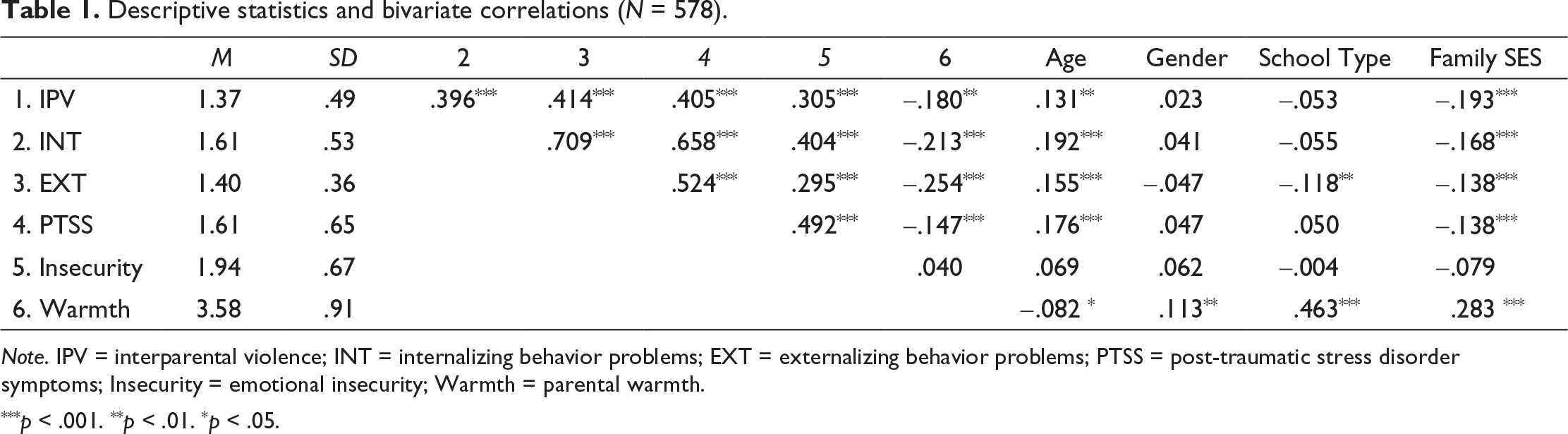
Note. IPV = interparental violence; INT = internalizing behavior problems; EXT = externalizing behavior problems; PTSS = post-traumatic stress disorder symptoms; Insecurity = emotional insecurity; Warmth = parental warmth.
***p < .001. **p < .01. *p < .05.
Correlation analysis revealed that interparental violence and emotional insecurity were significantly related to all three indicators of adolescents’ adjustment problems, and the three indicators of adjustment were significantly related to each other. Interparental violence was positively related to insecurity and negatively related to parental warmth. However, the relationship between parental warmth and emotional insecurity was nonsignificant. Regarding sociodemographic factors, age and subjective family SES were significantly related to all continuous variables except emotional insecurity; gender was positively related to parental warmth, school type was negatively related to externalizing problems and positively related to parental warmth. Hence, all the four sociodemographic factors (age, subjective family SES, gender, school type) were included as control variables in subsequent analysis.
Simple Mediation Analysis
Before testing the mediation model, the measurement model was tested. To control inflated measurement errors, item parcels were created for all unidimensional variables, that is, internalizing problems and externalizing problems. The item parcels were created by matching similar loadings, and the average scores of items were used (Wu & Wen, 2011). For the rest three multidimensional variables, average scores of each dimension were used as indicators of the latent variable, including interparental violence (minor physical assault, severe physical assault, minor psychological aggression, severe psychological aggression), emotional insecurity (emotional reactivity, destructive family representations, conflict spillover representations), and PTSS (reexperiencing, avoidance, dysphoria, and hyperarousal). This model fitted the data well: χ2/df = 2.76, p < .001, RMSEA = 0.056, SRMR = 0.070, CFI = 0.921, TLI = 0.909, and all factor loadings were above 0.577.
The mediation model was then tested after controlling for sociodemographic factors (subjective family SES, age, gender, and school type). As a result, the model fit was good (χ2/df = 2.30, p < .001, RMSEA = 0.048, SRMR = 0.044, CFI = 0.948, TLI = 0.934). Results revealed that interparental violence (β = 0.355, t = 6.433, p < .001) was positively related to emotional insecurity, and emotional insecurity was associated with higher levels of PTSS (β = 0.457, t = 9.030, p < .001), internalizing problems (β = 0.337, t = 7.377, p < .001), and externalizing problems (β = 0.206, t = 4.600, p < .001). Model indirect analysis showed that the indirect effects of interparental violence on adolescent’s PTSS was 0.162, with 95% CI [0.102, 0.222], on internalizing problems was 0.120, with 95% CI [0.068, 0.171], and on externalizing problems was 0.073, with 95% [0.033, 0.113]. The three were all significantly different from zero, indicating that the three indirect effects were all confirmed. Besides, the direct effect of interparental violence on adolescent’s PTSS (β = 0.271, t = 4.722, p < .001), internalizing problems (β = 0.296, t = 4.865, p < .001), and externalizing problems (β = 0.385, t = 6.068, p < .001) were still significant, supporting partial mediational models of emotional insecurity (Figure 2). In sum, the indirect effect accounted for 37.41%, 28.85%, 15.94%, respectively, of the total effect, and the variance in adolescent’s PTSS, internalizing problems, and externalizing problems had been explained 41.0%, 34.5%, and 29.6%, respectively.
In order to reveal the distinct predictive effects of emotional insecurity on the three dependent variables, model test was conducted using the Wald test. Results showed that emotional insecurity was a significantly stronger predictor of PTSS (χ 2 (1) = 16.394, p < .001) and internalizing problems (χ 2 (1) = 8.541, p = .004) than externalizing problems. The difference in the association between emotional insecurity and PTSS versus internalizing problems was insignificant (Wald test: χ 2 (1) = 3.153, p = .076). Further analysis indicated that similar difference results were presented in the magnitude of the indirect effect, where the indirect effects of interparental violence on adolescent’s PTSS (χ 2 (1) = 13.185, p < .001) and internalizing problems (χ 2 (1) = 7.385, p = .007) were greater than on externalizing problems, but that on PTSS and internalizing problems was insignificant (Wald test: χ 2 (1) = 3.054, p = .081).
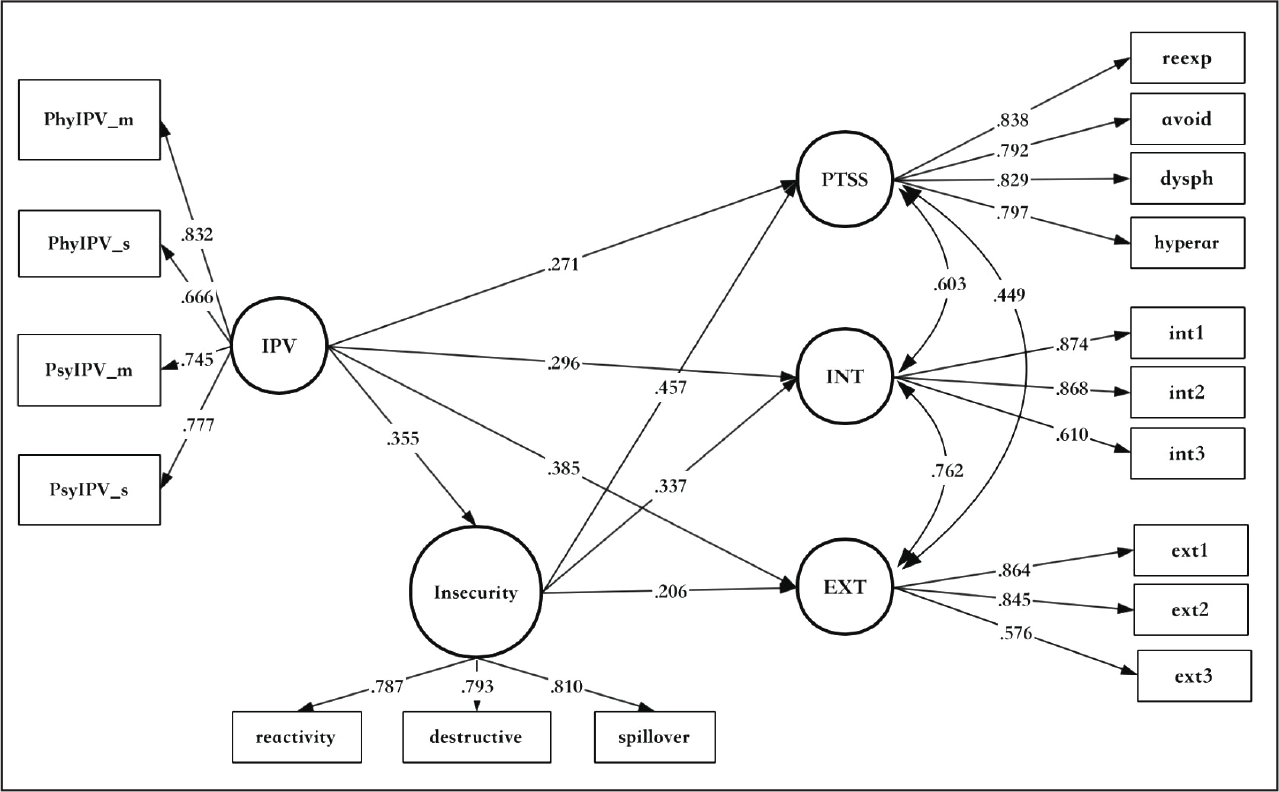
Note. Control variables (age, gender, school type, and SES) were included in the model but are not shown in the figure. All path coefficients are standardized. Only significant path coefficients are shown.
Moderated Mediation Analysis
Next, Hypothesis 2 was tested, which examined the moderation effect of parental warmth on the relationship between interparental violence and emotional insecurity, and associations between insecurity and three dependent variables. To ensure qualified fitting, a model without latent interaction term was tested and this model had a good fit, χ2/df = 2.48, p < .001, RMSEA = 0.052, SRMR = 0.053, CFI = 0.933, TLI = 0.917, log-likelihood value = –13343.150. Then, the model with latent interaction terms was tested, and the likelihood value was –13332.219. Thus, the log-likelihood ratio test demonstrated that the moderated mediation model fitted the data well, D = 10.931, df = 4, D/df = 2.733, p < .05. As expected, parental warmth positively predicted insecurity (β = 0.118, t = 2.050, p = .040) and negatively predicted PTSS (β = –0.209, t = –2.932, p = .005), internalizing problems (β = –0.277, t = –3.711, p < .001), and externalizing problems (β = –0.301, t = –4.144, p < .001). As for the moderating effects of parental warmth, the interaction term between interparental violence and parental warmth was not significantly associated with emotional insecurity (β = –0.011, t = –0.097, p = .923). The interaction term between emotional insecurity and parental warmth was significantly associated with internalizing problems (β = –0.240, t = –3.084, p = .002) and externalizing problems (β = –0.223, t = –3.125, p = .002), but not with PTSS (β = –0.005, t = –0.040, p = .968).
To further understand the nature of the interaction, simple effect analysis was conducted using the pick-a-point approach, where the associations between the mediating variable and dependent variables were plotted when parental warmth was low (1 standard deviation below the mean) and high (1 standard deviation above the mean), respectively. Results showed that for adolescents with low parental warmth, emotional insecurity was more strongly associated with internalizing problems (bsimple = 0.712, p < .001), compared with high parental warmth (bsimple = 0.371, p < .001); similarly, emotional insecurity can promote externalizing problems more when adolescents reported low parental warmth (bsimple = 0.563, p < .001) than high parental warmth (bsimple = 0.232, p < .001). This shows that the higher the adolescents’ perceived parental warmth, the less emotional insecurity is associated with internalizing and externalizing problems (Figure 3).
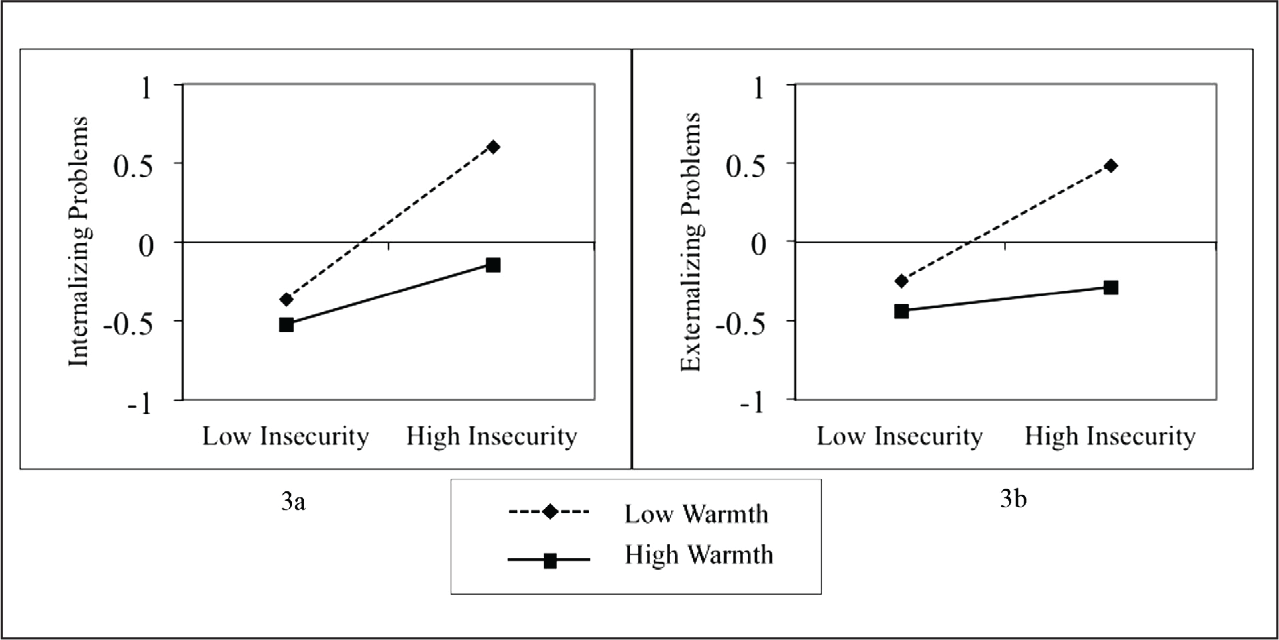
3a: Internalizing problems as outcomes of emotional insecurity and parental warmth;
Discussion
The current study explored the mediating role of adolescents’ emotional insecurity in the relation between interparental violence and adjustment problems, as well as the moderating role of parental warmth in this indirect relationship. Our findings confirmed that the contribution of interparental violence to adolescents’ adjustment problems was partially explained by emotional insecurity. Moreover, the indirect relationships between interparental violence and internalizing and externalizing problems were stronger for adolescents with low parental warmth than for those with high parental warmth.
The Mediating Role of Emotional Insecurity
Guided by EST, the present study tested the role of emotional security in the relation between interparental violence and adjustment among Chinese early adolescents. The findings showed that emotional insecurity partially mediated the association between interparental violence and adolescents’ adjustment problems. Thus, it provided further support to EST by showing that it can be extended to the Chinese cultural context as well as the developmental stage of early adolescence. EST maintains that repeated exposure to parental conflicts containing hostility, violence, and escalating anger undermine children’s abilities to preserve emotional security and activate their social defense system (SDS) to defend against interpersonal threat (Davies & Woitach, 2008). Although this SDS can be adaptive in the short term, prolonged operation of SDS depletes the adolescent’s resources needed for other interactions; it also produces changes in neurobiological, neuropsychological, psychological and attention processes that ultimately undermine children’s mental and behavioral health (Davies & Martin, 2014).
Moreover, a comparison of the indirect effect of emotional insecurity from IPV to the three indicators of adjustment problem revealed that the relation between emotional insecurity and the three adjustment outcomes differed: emotional insecurity had a larger association with PTSS and internalizing problem, than it was with externalizing problem. This adds support to Davies et al.’s (2016) observation that emotional insecurity more strongly predicted children’s internalizing symptoms than externalizing symptoms. In another meta-analysis, Rhoades (2008) examined three aspects of child responses to interparental conflict—cognitions, emotional, and behavioral responses, which closely resembled the three components of emotional insecurity, and found the effect sizes were larger for relations with internalizing problems than for relations with externalizing problems. We speculated that this difference is related to the way emotional insecurity works. Davies et al. (2012, 2006) has pointed out that central in the pathways between interparental conflict and children’s adjustment problems is children’s negative affections, especially fearful reactivity. As mainly emotional problems, internalizing problems and PTSS may be more heavily influenced by negative emotion reactivity than externalizing problems.
On the other hand, we also note that the direct path from IPV to externalizing problems (β = 0.385) seems larger than it is to internalizing problems (β = 0.296) and PTSS (β = 0.271), this suggests that IPV may have a larger direct effect on externalizing problems, or there are other meditational mechanism (such as social learning or pro-violent beliefs) not captured in this study (Morris et al., 2015).
The Moderating Role of Parental Warmth
Since children derive emotional security from multiple relationships in the family, the study also hypothesized that parental warmth would moderate the link between interparental violence and child adjustment, through two pathways—from interparental conflict to emotional insecurity, and from emotional insecurity to psychological symptoms. The findings revealed that the first pathway was not significant, that is, parental support didn’t diminish the impact of IPV on early adolescents’ emotional insecurity. This makes sense as parental warmth only captures parent–child relation, and supportive parenting may not relieve adolescents’ worries over their parents’ relationships.
However, parental warmth did moderate the association between emotional insecurity and children’s adjustment, but only the path between emotional insecurity and internalizing problems and between emotional insecurity and externalizing problems was significant. Specifically, the relationship between emotional insecurity and adolescents’ internalizing and externalizing problems was weaker for adolescents with high parental warmth than for those with low parental warmth. That is, for adolescents who felt emotionally insecure, if they perceived high warmth from their parents, they were less likely to present internalizing and externalizing problems. Several hypotheses can be offered to help explain the moderating effect of parental warmth: on one hand, parents with high warmth would try to make their children feel loved and cared for by providing support and companionship, which helped limit adolescents’ need to over-activate emotional and behavioral reactions and foster their abilities to regulate negative affect caused by emotional insecurity (Alegre et al., 2013; Davies et al., 2006); on the other hand, parents highly involved in children’s lives would also restrict their children’s acting out behaviors (such as aggression and delinquent behaviors) through rules and monitoring (Skopp et al., 2007). Overall, although emotional insecurity caused by interparental conflict could promote adolescents’ internalizing and externalizing problems, this harmful effect can be mitigated to some extent by parental support and warmth. This is consistent with previous literature, which showed that warm and supportive parenting can be served as sources of support and protection, thus, can provide adolescents with the psychological strengths necessary to successfully cope with emotional insecurity (Davies et al., 2002).
But we also note that parental warmth didn’t moderate the association between emotional insecurity and PTSS, which means that parental warmth can’t mitigate the negative impact of emotional insecurity on PTSS, although the main effect of parental warmth on PTSS was significant. Previous studies showed that for relatively severe and complicated psychological problems as PTSS/PTSD, mere availability of general parental support is not enough (Hiller et al., 2018; Williamson et al., 2017). Further, it is pointed out that PTSS/PTSD caused by interpersonal trauma such as domestic violence is more destructive than single traumatic events such as natural disasters or accidents, because it is often chronic and involves family perpetrators (Pinto et al., 2017). So to deal with emotional insecurity caused by interparental violence, more trauma-specific parental responses such as timely recognition of traumatic symptoms, intentional alleviation of distrust and fear, and effective communication are required.
Diversity
This study complements previous studies on the meditational role of emotional security on the association between IPV and adjustment by adopting a Chinese sample. What’s more, the study sample included both local public and migrant school students in Beijing, which differed in social economic status. The results revealed that migrant students reported more externalizing problems and lower parental warmth compared to normal public-school students. Furthermore, it is also found out that subjective family SES were significantly related to all continuous variables except emotional insecurity. However, because of a high percentage of missing data on migrant students’ reports of their father/mother’s occupation and education, the present study only used participants’ subjective SES as an indicator; future research may benefit from including both subjective and objective aspects of SES and explore in more detail the impact of SES. Lastly, although previous studies have found gender differences in outcomes for early adolescents, no such patterns were identified within the current data set. Gender was only positively and significantly related to parental warmth, with females reported more warmth than males.
Limitations and Future Directions
Our findings must be interpreted in the context of study limitations. First, the cross-sectional design of this study precluded examination of causality or directionality; second, this study has adopted self-report measures from the adolescents, which are subject to recall bias and single-reporter bias, future studies would benefit from using multiple reporting sources to assess the variables, which can provide more accurate information. Furthermore, the participants of the study are of a relative small, nonrandom sample from only one city (Beijing) in China, future research should amplify and diversify the research sample to verify the findings; lastly, we focused only on early adolescents, and the pattern of relationships may not apply to the other stages of life. Future research should extend these findings with longitudinal data to further establish marital aggression and emotional insecurity as risk factors for a wide range of mental and physical health problems in children and adolescence.
Conclusions and Implications
Despite these limitations, this study is the first attempt to test the role of emotional insecurity in the relation between interparental violence and adjustment among Chinese early adolescents; it also advances existing knowledge by comparing the mediating effect of emotional insecurity on various indicators of adjustment problems. The results indicated that emotional insecurity had a larger association with emotional problems such as internalizing problems and PTSS compared to externalizing problems. In addition, the mediated moderation analysis showed that parental warmth moderated the association between emotional insecurity and internalizing/externalizing problems, but it neither moderated the association between emotional insecurity and PTSS, nor the association between interparental violence and emotional insecurity.
These results underline the complex and complicated ways family risk and protective factors worked on adolescents’ adjustment and provide several recommendations for future research and practice. First, the findings imply that decreasing adolescents’ emotional insecurity about interparental violence may be a possible avenue for targeted interventions; it also points out that future research needs to pay more attention to the differentiation of the mediating factors/mechanisms for different aspects of adjustment, and these findings can help guide more targeted and efficient intervention strategies. Second, the large association between IPV and PTSS also pinpoints to the need for increased awareness among practitioners and policy makers regarding the potential negative consequence of exposure to PTSS. Despite being influenced strongly, PTSD is still one of the least studied consequences of IPV (Telman et al., 2016), and more studies are needed to explore the mediating and moderating mechanism between IPV and PTSD. Moreover, the findings on the protective effects of parental warmth also clarifies that to help adolescents deal with PTSS, some brief training for caregivers such as child and family traumatic stress intervention may be needed.
Footnotes
Authors’ Note
Chaoyue Wu is now a PhD candidate in the Luskin School of Public Affairs, the University of California Los Angeles, USA.
Declaration of Conflicting Interests
The author(s) declared no potential conflicts of interest with respect to the research, authorship, and/or publication of this article.
Funding
The author(s) disclosed receipt of the following financial support for the research, authorship, and/or publication of this article: This research was partially supported by Beijing Philosophy and Social Science Research Foundation (17SRC023).
