



Abstract
Sexual violence is a prevalent crime but vastly underreported and with serious long-term health consequences for survivors. Disclosure of sexual violence represents a social experience that may offer support towards healing or further traumatization depending on the response received. Although current research suggests that process of disclosure itself is important, as are social responses, there is a dearth of research examining the perceived impact of initial responses to disclosure on healing and relationships, particularly over time. The current study used data from nine focus groups with 45 survivors to explore the impact of initial disclosure reactions on recovery, from the survivors’ perspectives. Constant comparative analysis identified several themes, including subtypes of positive and negative responses to disclosure and long-term impacts on healing and relationships. Survivors disclosed to informal and formal support persons and although many identified responses as positive or negative, some also experienced mixed responses. Survivors identified perceived long-term impacts on healing, interpersonal relationships, and social justice. Our findings suggest disclosures are a critical point for potential intervention after sexual violence. It is through the disclosure process that survivors can be supported and empowered to connect with others and move further along in their journey towards healing and recovery. Public awareness and promotion of positive responses could be designed to reach children and youth, so that the next generation is equipped with the tools to support each other in difficult times, particularly in the aftermath of sexual violence.
Keywords
Sexual violence is a critical public health concern that affects individuals across the lifespan. US epidemiological estimates suggest that 18.3% of women and 1.4% of men will experience rape (Smith et al., 2015). When expanded to include other types of sexual violence, nearly 1 in 2 women, 1 in 2 transgender persons, and 1 in 5 men are estimated to experience these crimes (Smith et al., 2015). The 2015 and 2019 waves of the Campus Climate Survey Validation Study found that between the two surveys, the rate of nonconsensual sexual contact increased 3% for undergraduate women, 2.4% for graduate and professional women, and 1.4% for undergraduate men. The prevalence estimates for 2019 was 13%–30% in a sample of 181,752 participants across multiple colleges (Cantor et al., 2020). Research into child sexual abuse (CSA) prevalence suggests that 1 in 10 children will be sexually abused before age 18 (1 in 7 girls and 1 in 25 boys; Finkelhor et al., 2015). Regardless of the gender or age of the victim, sexual crimes are grossly underreported and seldomly pursued within the criminal justice system (Lonsway & Archambault, 2012).
To understand underreporting, it is important to delve into disclosure processes. In the current study, we define disclosure as the act of discussing a sexual violence experience with another person. This could be to a formal support person, such as a therapist or to an informal support person, such as a friend. Reporting, in contrast, refers to when a disclosure is recorded formally for official purposes, such as to law enforcement or a medical professional (e.g., a sexual assault nurse examiner [SANE]). In cases of childhood abuse, disclosure may be prompted or elicited by a third party, may be a purposeful choice by the child, or may be accidental (Alaggia, 2004). Additionally, many children do not disclose in childhood. These patterns of disclosure are echoed in adulthood; for some, disclosure may occur in the context of seeking help immediately after the violent experience. In these cases, an initial disclosure may become a formal report to law enforcement or medical personnel. In contrast, disclosure may occur after a survivor makes a conscious choice to tell their story to a trusted other, either in the context of a social relationship with that person, or a therapeutic relationship with an advocate or mental health professional. However, it is not uncommon for survivors to wait years before disclosing sexual assault to someone else. The decision not to disclose may be influenced by shame, fear of retaliation, and fear of not being believed (Ahrens et al., 2010). Many adult survivors choose not to disclose, although most survivors tell at least three people over their lifetime (Filipas & Ullman, 2001). Our sample focuses on adult survivors, who reflect back on disclosure experiences across the life course (in childhood and/or adulthood) and the impact these experiences had on their healing and relationships.
Disclosure: Social Interaction, in a Social Context
Since disclosure is a social experience that often occurs within a social network, social ties within that network may determine the magnitude of impact a supportive or unsupportive reaction may have on a survivor. Specifically, social support network members can provide material support, help with problem solving, challenge unhealthy coping strategies or model healthy coping, and facilitate emotional expression. In this way, social support may also be involved in trauma appraisal (Guay et al., 2006). Limited research suggests that social support plays a key role in preserving self-worth following trauma and enhancing adaptive coping and has been linked to posttraumatic stress disorder (PTSD) and depressive symptoms following sexual assault in cross-sectional analyses (Littleton, 2010). However, further research is needed to understand the nuanced relationship between the social experience of disclosure, subsequent social support, and health outcomes.
Sexual violence disclosure processes have been identified as critical components for recovery after sexual assault. For example, trauma-focused treatments for sexual assault survivors sometimes use disclosure as a treatment element, including Prolonged Exposure (Hembree et al., 2004), cognitive processing therapy (Resick et al., 1992), STAIR-NST (Cloitre et al., 2002), and phase-based processing models (Mendelsohn et al., 2011). From research specifically focused on children and adolescents, we know that adolescents who disclose their history of CSA may be at lower risk of revictimization than adolescents who do not disclose (Kogan, 2005). In a study of male survivors, delaying disclosure contributed to more mental health symptoms and distress in adulthood (Easton, 2014). In trauma-focused therapies with children, such as trauma-focused cognitive behavioral therapy (TF-CBT), part of the treatment involves the child sharing details of the trauma with their parent to both facilitate communication between parent and child but also to enhance the caregiver’s ongoing support of their child (Wamser-Nanney & Sager, 2018). Some literature suggests that perceived parental caring after CSA may mitigate some of its negative impacts and help to prevent future victimization (Jankowski et al., 2002; Wilson et al., 2015).
Responses to Disclosure: Knowledge and Gaps
Research suggests that survivors experience a range of responses to their disclosures, and studies have characterized reactions as positive, negative, or mixed. In 2000, Ullman posited seven different types of reactions, which were developed into the Social Reactions Questionnaire. These seven reaction types included: blaming, controlling, distracting, treating differently, egocentric, emotional support, and tangible aid. The final two are the only positive types. Subcategories within negative reactions to disclosure such as blaming and controlling reactions have been associated with increased negative coping strategies, increased mental health symptoms, specifically PTSD and depression symptoms, and lower self-esteem and self-worth (Littleton et al., 2006; Orchowski et al., 2013; Ullman et al., 2007).
Negative initial reactions may lead survivors to choose not to disclose to others in the future, which may mean a loss of positive social support experiences that could enhance their recovery. Disclosure may be an iterative experience, and while most survivors disclose to someone within their social network first (Campbell et al., 2012), rather than a formal responder, each new experience of disclosure may have an impact on the survivor. In the context of the #MeToo movement (Mendes et al., 2018), the disclosure experience may also be a digital and largely impersonal one if survivors disclose on social media, to a far-reaching audience which might include individuals within the survivor’s personal social network and outside of it. Research into the impacts of this new type of disclosure experience is also needed.
Previous research has suggested that negative responses are more detrimental to survivors’ health than positive responses are beneficial (Dworkin et al., 2019; Orchowski & Gidycz, 2015). This is consistent with the social negativity hypothesis (Major et al., 1997) that suggests negative reactions to disclosure may have a greater impact on mental health than positive reactions. They posit that negative information can be more salient, produce stronger emotional responses within the survivor, and may be internalized.
Blaming reactions or stigma related to disclosure is distinct from the literature base focusing on stigma, in that these reactions are occurring within a relational context- where a survivor is choosing to disclose personal information with someone else for seeking support. This is true whether the survivor is disclosing to a close personal contact, or to a formal service provider, who they may not know personally. In this way, such reactions to disclosure have been characterized as “turning against” reactions (Gottman & Driver, 2005). Studies suggest that turning against reactions are particularly harmful to survivors and may result in further isolation, self-blame and maladaptive coping strategies. Another type of negative reaction, “unsupportive acknowledgment” may incur benefit from the acknowledgment but harm from a lack of support offered in response to the disclosure (Relyea & Ullman, 2015). Some other identified reactions have included reactions of aggression towards the perpetrator, impromptu disclosure of similar personal traumas, reactions of feeling betrayed by the survivor, and parentification- in cases where survivors disclosed to their children (Lorenz et al., 2018). Notably, survivors report consideration of the person they disclose to when interpreting reactions they receive and frequently either appraise reactions as more positive than the researcher deems them, or focus on only the positive aspects of the reaction (Ahrens & Aldana, 2012; Littleton, 2010).
Recent research has noted that there may be a mismatch between researcher categorizations of responses and survivor perceptions (Dworkin et al., 2019) and that survivor perceptions may be influenced by the relationship with the recipient of disclosure, gender of both individuals, expectations about the response, and whether both positive and negative elements exist within the response (Ahrens et al., 2009; Wagner et al., 2016). A recent systematic review and meta-analysis (Dworkin et al., 2019) suggested that previous research in this area overrepresents the voices of white women, both as survivors and recipients of disclosure. The review also highlighted that there is little research examining survivors’ perceptions of the range of disclosure reactions, as measurement effects of the widely used SRQ may be present and research exploring how survivors perceive the impact of these reactions on their personal healing processes is needed.
Current Study
Through qualitative thematic analysis, our study seeks to fill critical gaps in understanding survivors’ perspectives on the impacts initial disclosure responses had on them, and their perception of how disclosures influenced their healing and interpersonal functioning. We used guiding questions to understand the nuanced meanings and mechanisms related to disclosure response and survivor recovery: In what ways do processes of disclosure of sexual violence impact healing and recovery? Specifically, (a) who do survivors choose to disclose to? (b) how do survivors perceive responses to disclosure? and (c) how do survivors make meaning and understand these responses in relation to healing and recovery?
Methods
The current study is an analysis of data collected as part of a larger qualitative study focusing on the role of justice in healing after sexual violence and funded by an internal grant at a university in the Northeast United States.
Procedures
This larger study used purposive sampling to identify key informants at statewide organizations that interface with sexual assault survivors (including district attorney’s offices, police departments, rape crisis centers, college-based prevention programs, and the SANE program). Following qualitative interviews with key informants (termed sexual violence responders [SVRs]) from 15 sites (Scoglio et al., 2021), 7 of the sites agreed to host 1–2 focus groups with survivors. The sites assisted the research team in recruitment by sharing electronic and paper flyers with survivors at their organization. Interested survivors reached out to the research team to learn more about the study and schedule the focus group at their respective site. Potential participants were informed that the study would query about their experiences related to healing and justice following sexual violence.
Nine focus groups (N = 45) with survivors of sexual violence were conducted at 7 sites (which included 3 rape crisis centers, 3 college campuses, and 1 hospital-based program). Eight of the groups were conducted in English and 1 group was conducted in Spanish. The mean number of participants per focus group was 5.1 (range: 2–14), with the majority of survivors participating in groups at rape crisis centers (5 focus groups, 33 participants). Focus groups were facilitated by 1–2 members of the research team (depending on focus group size—larger groups were co-facilitated). Focus group facilitators were trained in qualitative research and were not known to the survivors before they expressed interest in the study. Survivors who participated in the focus group were each offered a $50 gift card to compensate them for their time and participation. Participants were also offered a printed sheet of local resources to take with them and were notified at the start of the group that a clinician (from the hosting organization) would be available to speak with them after the group if they felt like they needed or wanted support.
The study was approved by the Institutional Review Board at the first author’s institution and all participants provided voluntary informed consent. During focus group, two questions about disclosure experiences were asked of all focus group participants: (a) Without giving names, can you tell us the relationship you had to the first person you told about a sexual assault? And what was their response like? What was the impact of their response on you? (b) Have you had other people be supportive to you in the process of seeking healing? What did this support look like? Specific trauma histories of participants were not formally queried of participants as traumatic details were not the focus of this investigation and the research team wanted to reduce the risk of triggering focus group members. Generally, participants referenced varied experiences, including childhood sexual abuse, sex trafficking, adolescent sexual assault, and adult rape by an acquaintance, romantic partner, or stranger. Most participants had experienced more than one incidence of sexual violence. Consistent with previous research, questions which framed or characterized potential reactions were not used. To allow survivors to highlight interactions they deemed most salient, we did not use the SRQ with participants (Dworkin et al., 2018).
Participants
Of the 45 survivors who participated, most were women, which likely reflects both the higher rate of sexual victimization seen in women and the significant stigma present for male survivors around both disclosure and seeking services related to trauma. Our focus group sample consisted of 42 women, 2 men, and 1 non-binary person. Ages ranged from 18 to 62 years of age, with a mean age of 33.3 years. For race/ethnicity, 48.9% of focus group participants identified as white (n = 22), 13.3% identified as Latinx (n = 6), 11.1% as Black (n = 5), 11.1% as Asian (n = 5), and 8.9% as 2 or more races (n = 4). There was a wide range of educational attainment in the sample, ranging from 5th grade to a master’s degree as the highest attainment. The majority of the sample reported some college, and 15 (33.3%) identified as current students. Regarding employment, 51% (n = 23) of the sample were working, either part-time or full-time and 22% (n = 10) were not working or unable to work.
Data Analysis
We used constant comparative analysis (Boeije, 2002) to identify key themes related to disclosure experiences and social support and NVivo (QSRI, 2018) for coding. Our coding analysis process included several steps. First, two researchers reviewed and cleaned all manuscripts. Next, responses to disclosure were categorized as positive or negative responses based the participants’ perception given in the transcripts. Some responses were mixed, and researchers categorized these based on the valence of the survivors’ perception as mostly negative or positive even if they identified elements of the experience fitting the other category. The two researchers met and compared these codes to ensure mutual consensus. Once consensus on positive and negative valence of responses was achieved, open, axial (groupings of similar codes into categories) and selective coding were used to identify emerging subthemes within the positive and negative categories (Boeije, 2002). Data on the perceived impact of disclosure responses were also categorized into separate themes evident in the transcripts, namely related to relationships, healing, and activism. As relevant categories and themes emerged, we refined them through the process of axial coding. In addition, salient excerpts from the transcripts that fit particular themes were identified during the process of coding, for the purpose of later quotation in the final manuscript. We used memo writing in the coding process to assist in identification of specific constructs that warranted further exploration, to record patterns, or to further expand on specific categories and themes. After coding independently, the two researchers met to compare codes, discuss disparate coding choices and resolve differences in codes based on mutual consensus. Differences in coding were minimal and revealed slight differences in perspectives. The process of developing codes was iterative and in cases of disagreement, new codes emerged which combined perspectives.
Results
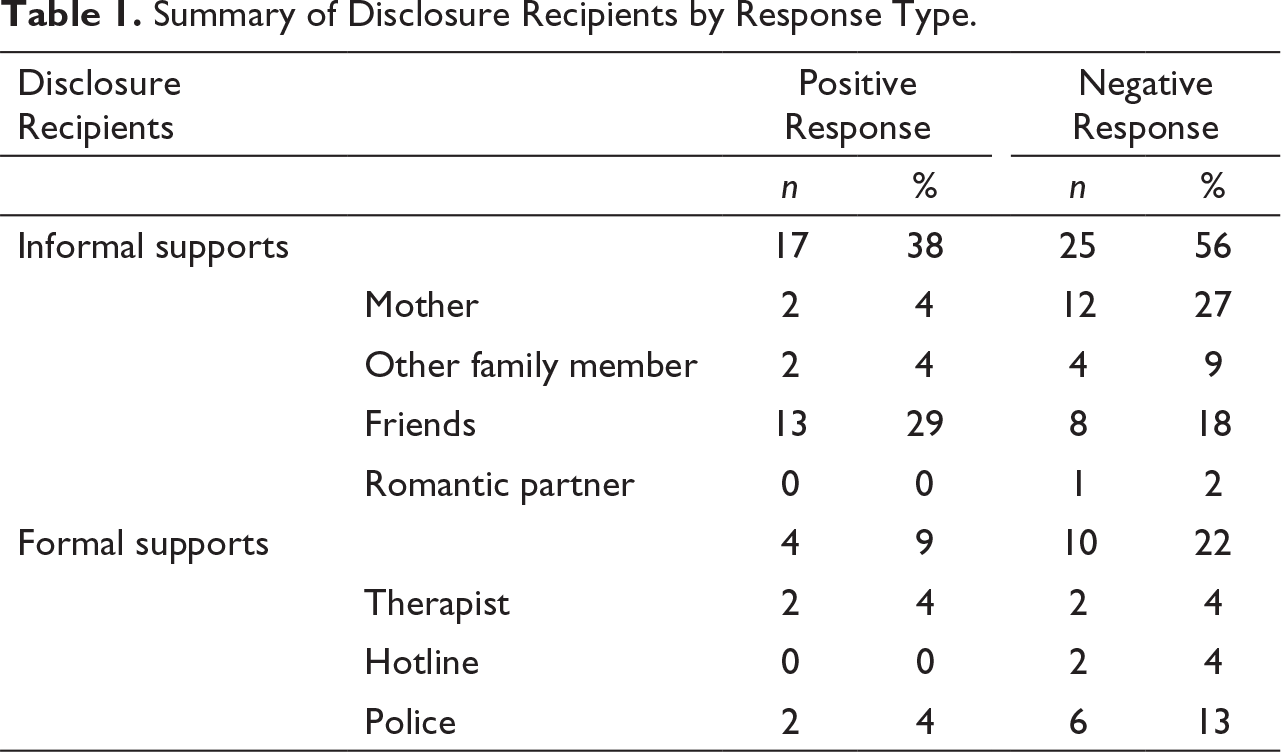
Although the focus group questions on disclosure focused on initial experiences with disclosure, participants frequently discussed more than one experience of disclosure- suggesting that each had its own impact. For some survivors, their first experience of disclosure was recent, and for others it had been years prior. Both negative and positive responses to disclosure were described. Survivors often described a disclosure experience to have a combination of supportive and non-supportive responses, highlighting the complexity of this social experience, even within one conversation. Survivors also discussed the impact they perceived responses to have on their healing, relationships, and future disclosure over time. Survivors described disclosure experiences with both informal and formal support persons; some disclosure experiences discussed (such as with law enforcement) were formal reports but still represented the first time the survivor told another person about their experience. The types of individuals that survivors in this sample disclosed to are summarized in Table 1 by whether they described it as a mostly positive or negative experience. In Table 2, types and subtypes of responses to disclosure are summarized and example quotations for each are provided. When possible, these subcategories have been mapped onto subscales of the Social Reactions Questionnaire (Ullman, 2000).
Summary of Disclosure Recipients by Response Type.
Summary of Response Subthemes and Example Quotations.
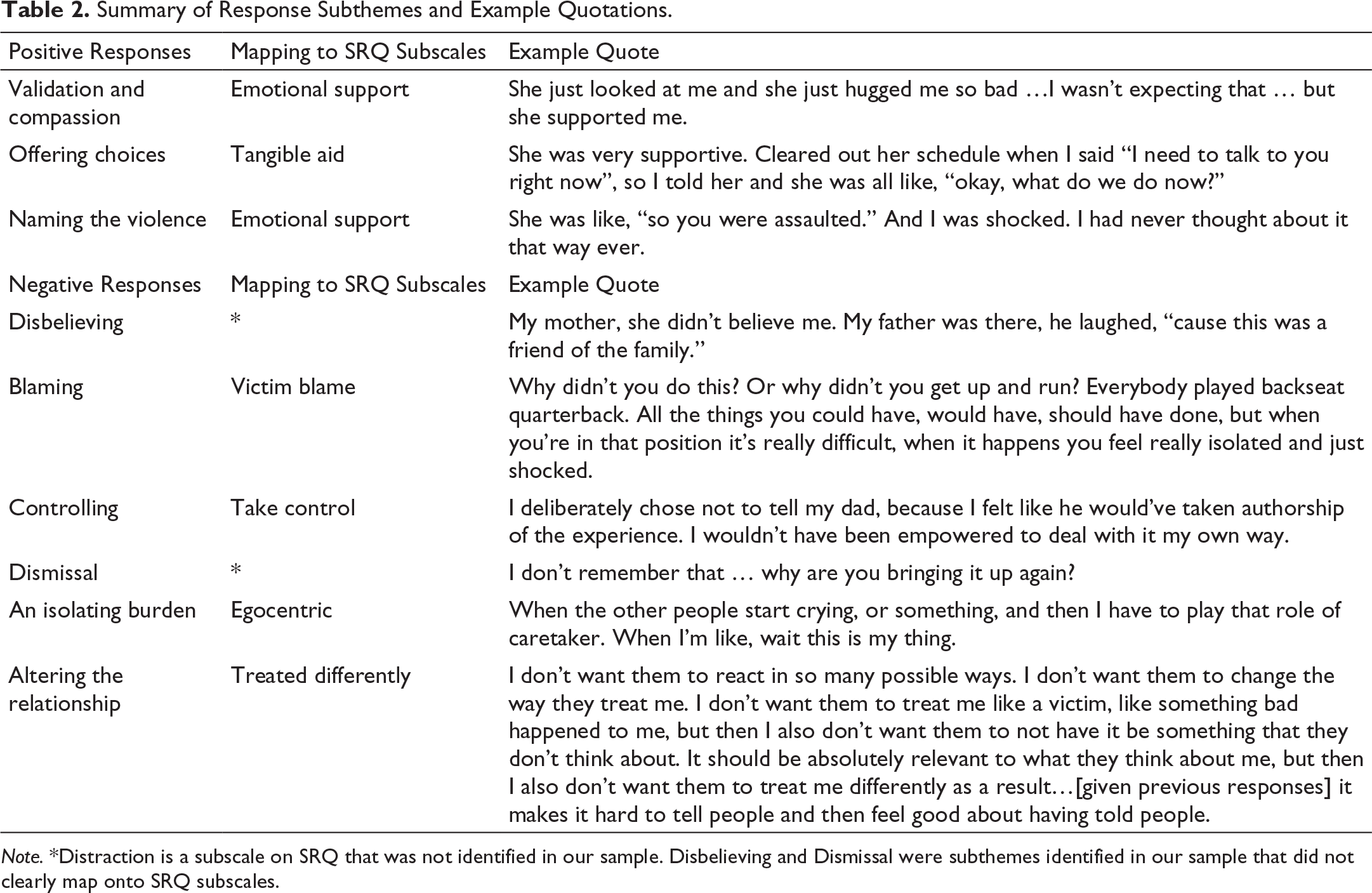
Note. *Distraction is a subscale on SRQ that was not identified in our sample. Disbelieving and Dismissal were subthemes identified in our sample that did not clearly map onto SRQ subscales.
Survivor Perspectives: Positive Responses to Disclosure
Positive responses fit into three main themes: (a) validation and compassion, (b) offering choices, and (c) naming the violence. Survivors who reported positive responses most frequently identified friends (n = 11) as the disclosure recipients, followed by family (n = 6). A minority of positive responses came from professional responders, either therapists or law enforcement personnel (n = 4). The three main positive responses themes are described below which also include exemplar quotes from participants.
Validation and compassion.
Repeatedly, we heard from survivors about the importance of having someone to believe them and validate their experience when they disclosed. Whether disclosing to a friend, family member or formal service provider, having that person show compassion and believe their experience was critical; it made them feel more comfortable to share additional information, and to seek help if needed. One survivor at a college campus described the reaction of her two roommates when she told them about her experience with sexual violence, “[they said] ‘I’m really sorry this happened to you’ … and they really helped me through it and then both of them were like ‘okay, you should see someone’, and I just didn’t”. This particular survivor did eventually seek help in the form of mental health counseling and a student survivor support group, but only after a period of using substances to cope with her symptoms and isolating herself from her social network. Another survivor shared, “my mother told me, ‘no, it’s not your fault’”.
Some survivors felt most supported by individuals who were able to sit with the discomfort and pain of sexual violence. One survivor stated, “the people who reacted best were the people who still saw you as their friend … I want you to tell me ‘that really sucks. It shouldn’t have happened and it sucks’ and I want the bluntness in some capacity.” This survivor speaks to the support that comes with acknowledgment of the pain of sexual violence and simultaneously, the acknowledgment that this experience does not define the survivor. Individuals who could validate the experience and sit with the discomfort, but also show that this disclosure did not change the way they viewed their friend or loved one, were viewed as most supportive and healing by the survivor.
Survivors who received positive reactions to disclosure discussed a feeling of relief of not carrying the burden of this horrific memory alone. One survivor of childhood sexual abuse spoke eloquently about the isolation that comes with carrying such a secret, It was like sitting in a cell by myself for 24 years with nobody to talk to about it. Just keeping it to myself. I’m not in that cell anymore. I went out with a friend about a year ago and I had no idea about him and I just told him about what I was doing and what happened to me and I got the famous, “Me Too” [from the friend].
Although this survivor was saddened that his friend had experienced abuse as well, knowing that he was not alone was incredibly healing to him.
Offering choices.
Survivors discussed feeling supported by others when they allowed the survivor to decide next steps and offered help but did not try to control the survivor’s actions related to disclosure. One survivor discussed disclosing to her mother, and her mother responded, “‘What do you want to do?’ Extremely supportive, I mean she kind of let me guide it. She gave me those options, which was really nice.” While some in their support networks were able to stay calm and allow survivors to guide the next course of action, others had difficulty doing so. One survivor talked about disclosing to her best friend,
She was like, alright well I know where we’re going, police station. And then after [a while] she pulled over and was like, wait is that something that you wanna do? And we just went to her house … she was good.
This survivor appreciated her friend’s concern and desire to spring into action to help, but it was important that her friend was able to slow down and ask her what she wanted in that moment. Giving her the choice was the difference between feeling supported and feeling controlled. Survivors became emotional thinking about how friends and family listened to their stories and responded with calm, care, and openness to multiple outcomes. In this way the confidant joined with the survivor and made the new information something that they could deal with together, but with the survivor leading the way.
Naming the violence.
Another aspect of the disclosure experience that was perceived as supportive by survivors was having the other person accurately name the violence that occurred. Traumatic events often do not fit in and individual’s view of the world, safety, and the trustworthiness of others (Janoff-Bulman, 2010). Because these events can disrupt long-held schemas, it is sometimes challenging for survivors to accept that the sexual violence has occurred. It may feel “easier” to believe that they themselves were at fault, or to minimize the violent experience in order to cope and continue on in life. Naming the experience accurately can further validate the survivor’s feelings about how wrong what happened to them was and can offer support in finding the courage to try to integrate this experience with one’s worldview, although they clash. Experiences of sexual violence can be very confusing, especially for younger individuals and memories of the experience may also be unclear and confusing. One student survivor described disclosing to her roommate,
I didn’t have a lot of language to put to it at the time because it was like the day of and so I was in shock …. So she got me to the hospital. She took me … out of town so I could get off campus to stay with her family.
In this situation, the survivor needed help in acting and obtaining safety and distance from her assailant. Her friend was able to verbally identify what had happened to her, get her needed medical attention, and then provide a safe place to go that allowed her to gain some physical distance from the place and perpetrator of the assault.
Survivor Perspectives: Negative Responses to Disclosure
Survivors’ perceptions of negative responses to disclosure fell into four main categories: (a) disbelieving, (b) blaming, (c) controlling, and (d) dismissal; two additional themes emerged about the process of disclosure: (a) it is an isolating burden and (b) disclosure altered the relationship. Survivors who reported negative reactions to disclosure most frequently disclosed to their mother (n = 12), followed by friends (n = 8), police (n = 6), other family members (n = 4), therapist or hotline (n = 4), and one survivor reported disclosing to a romantic partner, another to her children.
Disbelieving responses.
Unfortunately, many survivors in the focus groups reported experiences of disclosing sexual violence to a trusted other or a formal support person and not being believed. Survivors said people responded with things like, “Don’t make stuff up” or “Look where you are, that stuff doesn’t happen here”. Several survivors reported being told they were lying (n = 3). Some survivors who disclosed to their mothers as children or adolescents reported that their mother “took the side” of the perpetrator, “she hands me a piece of paper and a pencil and … she goes I want you to write I’m sorry to him 500 times.” Another respondent reported, “my mom’s like, no he’s not no he’s not, he’s not having sex with you … always said I was lying or I’m bad … didn’t even listen to me.” These types of responses were hurtful to survivors, who felt their experience had been invalidated, and that their feelings and pain were not seen as valid to those to whom they trusted to disclose. Another survivor said of this kind of response, “to be honest, it was like being raped again”. This language echoes literature suggesting that experiences with systems after sexual violence can be as damaging as the trauma itself (Campbell et al., 2001).
For others who reported not being believed upon disclosure, the reaction ended with disbelief and inaction. For example, “I told my aunt and I was ignored. Nobody did anything … I think it still lingers.” Inaction following disclosure, especially in cases where a child is disclosing an experience of CSA to an adult can have a multitude of deleterious consequences, including the continuation of abuse and discouragement of disclosure in the future.
Blaming responses.
Some survivors reported that although the person they disclosed to may have believed them that the sexual violence had occurred, blame was placed on the survivor rather than the perpetrator for the assault. Some survivors described being met with anger when they disclosed to family members, “My sisters, they said you probably caused it.” Blaming responses were also reported in disclosure experiences with formal responders. One survivor relayed that after reporting a rape to police personnel, they told her, “you’re a prostitute, you got what you deserve.” Another survivor reported to a hotline and was told that, “I was responsible for what happened because I let him in.” In some cases, disclosure was met with violent responses: “the first person I told was my mom and I got beaten for it.” This response is so intensely negative, that the act of disclosing to a trusted other triggered an immediate second trauma, physical abuse. When speaking of a traumatic experience causes another to occur, it only makes sense that a child would view traumatic memories as unspeakable and perhaps feel responsible for the violent acts perpetrated against them.
Some survivors reported blaming responses in the form of detailed questions. People they disclosed the trauma to responded by asking questions about why or how the violence could have been prevented by the victim (see Table 2 for example quotation). One survivor stated, “I felt judged because the person was like, oh you were too trusting…and it was just kind of like how are these things turning around on me?”
Controlling responses and survivor attributions.
While survivors felt supported by those who offered choices and allowed them to decide next steps, survivors who received negative responses to their disclosure brought up feeling bulldozed over or controlled by the trusted person to whom they had disclosed. For example, one survivor described, “she convinced me to talk to the police … I didn’t want to … she was trying to support me.” This survivor notes that she believes her friend was trying to be supportive in her response, even though she took control over subsequent actions without listening to the needs of the survivor. Frequently, survivors tried to take the perspective of the person they disclosed to and expressed compassion and forgiveness for some unsupportive responses. One survivor explained that her parents, “tried to do what they could but they really didn’t give me any real help.” Another reflected,
I think I was unfairly holding some of their reactions against them … some time has passed and now I’ve been trying to be more fair of how I look at it and not hold it against them as much, but just also not have the same expectations so I protect myself a little bit more.
Dismissal.
Some survivors described receiving very dismissive reactions to disclosure, particularly from family members. These responses were not necessarily disbelieving or blaming, but instead aimed at shutting down discussion and silencing the survivor. For example, survivors reported receiving responses such as, “I don’t know what you were expecting” and “what do you want me to do about it?” These types of responses, similar to disbelieving and blaming responses, invalidate the survivor’s experience, do not offer them any support, and may discourage them from disclosure to others in the future. In addition, dismissive responses send negative messages to the survivor- they are silencing and may even be perceived as attempts to erase the survivors’ experience. Although these responses aren’t actively blaming, they tell survivors that their experiences will not be heard and/or are not worthy of a response.
An isolating burden.
A recurring theme among survivors was that this information about the violence they had endured was a burden they carried with them, one which others could not handle. Feeling unable to share this information with others may be related to multiple factors, including feelings of shame, perception that the other person cannot tolerate this information, or perception that the other person cannot relate or understand their experience. Some survivors described feeling like if they disclosed to someone, they then were required to take care of that person (see Table 2 for example quote). Others discussed making a decision not to disclose to certain people because of the perceived response, “I felt as if it was too much for her so I didn’t feel like I wanted to speak to her, I didn’t want to drag her into that,” or regretting disclosing because they felt the knowledge had hurt those they disclosed to, “[my children] did not handle it very well, … it was very hurtful for them to hear that. It was very painful for them.” The expectation of caretaking that comes with disclosure came from female survivors in the sample. One possibility is that gendered social expectations play a role here, limiting women’s ability to disclose a violent experience and expect support from others, rather than expecting to have to provide support to others. Another survivor described regretting disclosing because she felt it precluded her from continued support from her friends that she had told, “then that meant that down the line, I felt like I couldn’t reach out to them I guess. When I needed them, if that makes sense, I felt like I had already burned them out”. In this example, the survivor was concerned about possible compassion fatigue present in her friends. Compassion fatigue can be described as one type of secondary traumatic stress response, which comes from being worn out from repeated empathic responses to and absorbing the trauma and distress of others (Figley, 1995; Molnar et al., 2017).
Survivors also perceived that those they disclosed to could not understand what they were feeling or their experiences. One survivor called a hotline and said that, “I remember calling … I just felt like they couldn’t understand. This whole time I’ve just been searching for someone that can understand.” With this feeling of not being understood also came unpredictable responses, because survivors perceived people to not understand their experience they also could not predict what kind of response they would receive. For some, “everybody panicked … people don’t know what to do,” and for others, “people just, I don’t know if they don’t know how to handle it? They don’t know what to say, just no response.” Receiving a panicked response and a passive inactive response are distinct, and may affect a survivor in different ways, but both are not perceived as helpful to the survivor. One survivor lamented about how unsatisfying disclosure could feel when met with these kinds of responses. She described, “when people get uncomfortable and then they are like, I’m really uncomfortable, well me too, so am I—welcome to my life. You get to walk away from the discomfort, I don’t.” The memory of sexual violence is a burden the survivor carries, but this burden could be lessened by being able to speak of it with trusted others. However, if these others respond in ways which reinforce the notion that the information is too painful to bear, then survivors will feel discouraged from future disclosure and may begin to think that they-themselves are a burden too difficult for others to bear.
Altering the relationship.
Some survivors, particularly those on college campuses, discussed an experience of feeling that disclosure altered the relationship they had with the person to whom they chose to disclose. This complex experience of feeling like the person being disclosed to should respond in a way that acknowledges the survivor’s pain, validates their experience, but also doesn’t lead to that person treating the survivor or thinking of the survivor as less than before, or defined by the trauma that they have endured. is not out of reach but is also not the norm. One survivor alluded to the feeling of regret after disclosure, about “not feeling good about having told people.” This seems to be something that follows survivors as they navigate through multiple disclosure experiences over time. One survivor described,
I still have a large fear of telling people not because of how I think they’ll react, but how they’ll be in the future because I’ve told people and I’ve watched them not care, not acknowledge it, not be supportive or act like nothing happened. And so I have a hard time telling because I feel it’s easier when people just don’t know.
This survivor articulates what we have heard indirectly in earlier sections, that initial responses a survivor receives have on impact on whether or not they feel safe disclosing in the future, and on whether or not they feel that disclosure to others is worthwhile. One survivor showcased her resilience and insight in describing how she desired trusted others to respond to disclosure,
I like my metaphor and I view it as the people who respond the best are the ones who see you as you see yourself. I view myself in the context like I’m a whole teacup but it’s the people who respond poorly who see you as a chipped teacup.
Impact of Disclosure Response on Relationships and Healing
Survivors specifically spoke to the impact they perceived responses to have had on their life, healing and relationships. These subthemes are summarized in Table 3 with exemplary quotations. Some survivors either consciously used or later found that disclosure was a way to determine the strength of a relationship. For example, one survivor explained,
Perceived Long-Term Impacts of Disclosure Responses.

I think I [choose to tell] as a way of screening people and their ability to cope with this information. Just be like this is my life. If you want to know my life, this is my life. And if you can’t handle that, then go away.
Other survivors may not have used the disclosure to consciously assess relationships but found that the responses they received did impact their ability to continue the relationship: “I did kind of let some friendships go that weren’t as supportive” and “It’s the people, who you have to comfort them, or that treat you, delicately. They don’t know what they can say around you … those friendships don’t stay.” Some survivors talked about how disclosing changed their relationships with others.
Survivors also discussed the ways disclosure or the decision to disclose or not impacted their healing. One survivor explained that she has not disclosed to any of her friends, she said,
My friends know me, but they also still don’t really know the full me because of that … it has presented a problem with intimate relationships … I think part of what healing might look like in the future is if I am able to trust somebody in that way, but I honestly don’t think that I am there.
Another survivor explained the ways that a friend’s response to her disclosure negatively impacted her healing,
I think that affected me negatively, because it took me longer to be able to validate my experience …. When they’re shutting me down, I take that as the truth, because I need something to hold onto in that moment. That’s what I took in as the immediate understanding. I was like, “Okay, they said it’s not a big deal, so I must be overreacting.”
One survivor explained that before disclosing to anyone about her rape she felt the need to compile evidence, and research that outlined consent and how it was violated in her experience. She felt that without this, she might not be believed or supported. However, when she chose to tell someone and they did not require that evidence to believe and support her, she felt that enhanced her ability to heal.
It almost became an obsessive thing where if I didn’t have all of the evidence I was afraid that it wouldn’t be enough … I feel like I need to have all the evidence in order for somebody to believe me. Then, the people who I told, who wouldn’t ask me for that evidence, were ultimately the most healing.
Just as survivors discussed negative responses sticking with them long after the experience, or impacting their decision to report the crime, some survivors also discussed the long-term healing power of positive responses. For example, “there are just some things that she said that really resonated with me. They’re just always in the back of my head, which is really helpful.”
Finally, some survivors (n = 4) viewed public and structured disclosure as a form of activism and collective healing. For example, some survivors told their stories at events for rape crisis centers or at activist events such as Take Back the Night (takebackthenight.org). One survivor explained, “I think telling my story does help other people. It doesn’t necessarily have to be a victim in the room, it could be a parent in the room.” Some talked about gaining social support from survivor communities but noted the rewards and complexity that comes with these relationships: “Talking to other survivors in general has been extremely healing …. At the same time, I think there’s a boundary. You don't want to re-trigger your friend. It's hard …. There’s a bit of guilt, I guess.” Another survivor reflected, “at some point I’ve gained a lot of really good friends later from it. Not necessarily people I was friends with before, more of us through the network …. It’s very rewarding.”
Discussion
In our focus group sample of 45 survivors, respondents frequently chose to disclose to someone close to them, such as a parent, other family member, or friend. Formal service providers were less frequently chosen for initial disclosure. In our analyses, we saw that survivors experience varied responses to disclosure, and that the meanings survivors make of those responses is also diverse. Although positive responses to disclosure fell into three main thematic categories, the responses that were received as most positive and most influential in healing were those which held elements of all three: validation/compassion, offering choices, and naming the violence. These three identified positive responses map onto Ullman’s positive reaction categories: Emotional Support and Tangible Aid (Ullman, 2000). Survivors in our sample perceived that these caring responses helped to put them on the long, non-linear path towards healing. Since sexual violence frequently is accompanied by shame, hearing from someone close to you that this crime was not your fault may begin to break through a shame barrier and help survivors to move forward. Similarly, being met with support and comfort when expecting to be dismissed or have one’s experience minimized, was particularly healing. For survivors who may not have a great deal of emotional support in life, being met with a compassionate response to disclosure can serve to show survivors that they are worthy of compassion and kindness. Even if a positive response did not immediately lead a survivor to take some action towards healing, they still perceived that response to have a healing impact on them in the long term. In addition, for some survivors, experiencing a positive response initially empowered them to share their stories in more public and structured activism venues- to promote awareness and send the message to other survivors that they are not alone and that their voice matters. These experiences also often led to additional social support, forming new relationships through survivor networks or formal mental health supports.
In contrast, survivors who received negative responses to disclosure had varied perceptions of the impact that response had on their healing and mental health. Survivors described ways that these negative responses, whether they fell into the disbelieving, blaming, controlling, dismissing categories, impacted their healing by making their path to recovery longer or preventing them from beginning it earlier. These responses also had impacts on survivor relationships, causing them to decide to let certain friendships go, or to not disclose to others in the future. These categories of responses are consistent with many of those identified in previous literature. As noted in Table 2, distraction responses were not seen in our sample but disbelieving and dismissing responses emerged as separate categories, in contrast to those categories identified in the SRQ (Ullman, 2000). Some negative responses, particularly those received in childhood, had a chilling and lasting effect on survivors such that they either chose not to disclose to anyone else for many years, or chose not to disclose at all the next time they were victimized. In this way, such responses served to further silence survivors, put them at even higher risk of re-victimization (Brenner & Ben-Amitay, 2015; Herman, 2011) and prevent them from seeking help or justice. Other negative responses were internalized by survivors, creating a path towards healing that was full of obstacles and isolation. Many survivors expressed regretting their initial disclosure, even if subsequent disclosure experiences had more favorable outcomes. As previous qualitative inquiries have noted, survivors showcase their incredible resilience by finding positive or supportive elements within generally negative responses (Dworkin et al., 2018). Overall, our findings extend this to suggest that disclosure interactions, their perceptions, and their impacts are complex and multifaceted.
Given that sexual violence is vastly underreported, and that delaying disclosure for long periods of time may contribute to negative health outcomes (Easton, 2014), it is critical to create environments which support survivors’ decision to disclose and ensure that they do not come to regret making that decision. Education to teach peers and others who might receive disclosures to validate the experiences of survivors, offer them compassion and choices, and explicitly name the violence that occurred could support survivors in their recovery and bolster social support in the aftermath of sexual violence.
Limitations
Our sampling method was not random and so our findings may not be generalizable to all survivors in this region. Specifically in discussing disclosure, it is possible that survivors who volunteered to participate in a focus group on healing and justice after sexual violence were more likely to have disclosed and to feel comfortable talking about their experiences in a group setting. In addition, few men and non-binary persons participated in our study and so our findings may not be generalizable to these groups. This highlights the need to reach survivors who do not identify as women, as the shame and stigma they experience may preclude them from seeking help. Still, our sample was quite diverse in both demographic makeup and trauma histories. Our decision to conduct focus groups with survivors, rather than one-on-one interviews may have affected what survivors shared with the research team and may have made findings vulnerable to social desirability biases. This decision was made in part because previous research has found that groups of survivors facilitate self-compassion and reduce shame (Mendelsohn et al., 2011). We sought to make participation in this study as beneficial to the survivor as possible, acknowledging that discussing these very painful topics could dredge up challenging emotions, memories, and symptoms. In analysis, the decision to code positive and negative responses first and then allow sub-codes to emerge within those broad categories, may have been limiting, as some participants categorized responses as mixed. Assessing details of sexual violence experiences was outside the scope of this study, however future studies may assess differences in disclosure experiences between CSA and adult assault survivors.
Implications and Future Research
Our findings have direct implications for intervention, response, and prevention efforts in the sexual violence field. Even with societal movements towards gender equality and disclosure of gender-based discrimination and violence (#MeToo; Mendes et al., 2018), research suggests that most survivors do not formally report (Lonsway & Archambault, 2012) and up to 75% of women who disclose sexual violence experience reactions are left feeling blamed, hurt, or not believed (Campbell et al., 2001). This study allowed for nuanced exploration of survivors’ experiences with disclosure, how they perceive the responses, and how they believe those responses impact their healing from sexual violence, whether that violence occurred recently or in childhood.
Identification of these processes can help to inform clinical intervention and public health prevention work in the sexual violence field. Specifically, it may be useful for providers to assess support networks of survivors and provide psychoeducation about negative disclosure reactions. This additional knowledge can be used to bolster survivors’ capacity to cope with them. If survivors understand the costs and benefits of disclosing and can engage in healthy coping despite influences of complicated or negative reactions, this may aid in their recovery (Dworkin et al., 2019). There was a subset of survivors in our study who experienced mixed responses to disclosure (responses that they were able to glean both positive and negative elements from). This is important not only in highlighting survivor resilience but also in transparency with survivors that the responses they receive may be complicated. In addition, a majority of survivors in this sample perceived the response to their initial disclosure as having a substantive impact on their healing trajectory. Further research into understanding how positive responses support recovery can help identify how best to support survivors on both an individual basis and at a larger scale.
Although cultural shifts towards believing survivors and empowering disclosure have begun, education of formal responders and the general public on how to provide consistently empathic, validating responses to disclosures of sexual violence is still largely lacking. According to survivors in our sample, who are not often directly asked in previous research, responses to disclosure have a long-lasting impact on healing from sexual violence and may impede or encourage survivors to seek needed help. Negative responses to disclosure serve to further silence and isolate people who will likely endure negative health consequences if they remain silent and isolated. On the other hand, positive responses can represent a first step towards healing, social connection and trust, and finding a way to “live my best new life”, as one survivor put it. Public awareness and promotion of aspects of positive responses could be developed to reach universal audiences of children and youth, so that the next generation is equipped with the tools to support each other in difficult times, particularly in the aftermath of sexual violence. Recent research suggests that some universities are sharing resources and scripts for appropriate responses to disclosure (Bogen et al., 2019), but further work is required to ensure that these are evidence-driven.
This study represents an important contribution to research on disclosure responses and sexual violence. By utilizing perspectives of survivors, which are often neglected, we gained a deeper understanding the complexity of their disclosure experiences and how they believe it impacts their lives. Disclosure experiences are also a point where things can go wrong, and a survivor may be further victimized by harmful responses, leading to further health consequences, revictimization and distrust of others. As many rape crisis centers teach, survivors are the experts of their experiences, and it is critical we hear from them about their needs in the healing process. Our findings add to the evidence base that disclosure experiences are a critical point of intervention after sexual violence. It is through the disclosure process, when done with supportive people, that survivors can be supported and empowered to connect with others, seek health or legal services, and move further along in their path towards healing and recovery.
Footnotes
Declaration of Conflicting Interests
The author(s) declared no potential conflicts of interest with respect to the research, authorship, and/or publication of this article.
Funding
The author(s) received no financial support for the research, authorship, and/or publication of this article.
