



Abstract
Young women who experience intimate partner violence (IPV) are most likely to turn to their friends for help. Although friends can play a critical role in providing support, there is little research that examines friends’ experiences. In this qualitative study, we explored how friends of young women experiencing IPV perceived their role in responding to IPV in the context of friendship. We held in-depth interviews with 15 friends of young women who had experienced IPV and used reflexive thematic analysis to develop key themes from the data. We developed two overarching themes that reflected participants’ perceptions of the roles they had played or considered as a friend in responding to IPV: “taking action” (which included “providing an outsider’s view,” “being an advisor or coach,” “being a protector,” and “taking a stand”); and “being there” (which included “being a listener,” “being a companion” and “being an ally”). Their perceptions were shaped by friendship expectations, as well as by understandings of IPV. However, deciding what role to play in supporting their friend was constructed as challenging due to conflicting expectations that arose in the context of friendship. It involved balancing a perceived responsibility to do what they thought was best for their friend’s well-being, a need to promote honesty and mutuality in the friendship, along with a competing obligation to respect their friend’s choices, maintain her trust and ensure equality in the friendship. Being friends with the abuser as well as with the victim created additional complexities. Based on our findings, we identify key areas to address in developing interventions to assist friends to respond to young women experiencing IPV. These could guide friends on how to play an effective support role while also maintaining the friendship and managing the significant emotional impacts of providing help.
Introduction
Young women typically begin to engage in more committed intimate or dating relationships in mid-adolescence and early adulthood (Lenhart et al., 2015; Warren & Swami, 2019). Within these relationships, experiences of abuse or violence are not uncommon (Australian Institute of Health and Welfare, 2019; Stöckl et al., 2014). For young women who experience intimate partner violence (IPV), friends play a critical role as they are their main source of support (Bundock et al., 2018; Sylaska & Edwards, 2014). How friends and other informal supporters respond to a victim’s disclosure of IPV can significantly affect their psychological well-being, quality of life, further help-seeking, and intentions to leave the relationship (Dworkin et al., 2019; Edwards et al., 2015; Sylaska & Edwards, 2014).
Young women who have disclosed IPV have reported that they perceived their friends to be helpful if they offered the opportunity to talk, emotional support, and “good advice” (Edwards et al., 2011; Mahlstedt & Keeny, 1993). They have reported that unhelpful responses include a lack of understanding, blaming, and pressure to end the relationship (Edwards et al., 2011; Mahlstedt & Keeny, 1993). The ways in which friends respond has been found to affect young women’s psychological well-being, with negative or stigmatizing reactions (such as blaming the victim or overriding her wishes) associated with psychological distress (Dworkin et al., 2019; Edwards et al., 2015; Overstreet & Quinn, 2013). These findings highlight the significant impact friends’ responses can have on young women. Therefore, it is important for practitioners to understand friends’ experiences in order to support them to provide effective responses to IPV.
Friends’ Responses to Young Women’s Experiences of IPV
Researchers (predominantly in the United States) have examined the ways in which friends respond to IPV and the factors associated with their responses. They have found that when friends witness or notice IPV, they report offering help to the victim or confronting the abuser (Casey et al., 2018; Debnam & Mauer, 2019). For example, Fry et al. (2014) surveyed 1,312 U.S. high-school students (of which 22% had a friend in an abusive relationship) and found that 79% had talked to the friend and 80% had told their friend to leave the relationship. They also found that gender influenced their responses, with female students more likely to have offered help. Similarly, Debnam & Mauer’s (2019) review of the research on bystander responses to IPV identified gender differences, with female friends more likely to have offered emotional support to the victim and male friends more likely to have confronted the abuser. However, other researchers who have surveyed U.S. college students (N = 743) about their responses to disclosures of IPV have found that the closeness of the friendship was more influential than gender in predicting the type of response they offered (Edwards & Dardis, 2016). Additionally, Edwards & Dardis (2016) found supportive responses were more likely to have been offered by those who did not condone IPV or by those who had personal experiences of it. However, researchers have not investigated friends’ experiences or how they perceive their role in the context of friendship.
A more detailed picture of the experiences of friends has begun to emerge through qualitative studies with friends and other supporters of adult women experiencing IPV. These suggest that they frequently feel uncertain about what role they should play and ineffective when they try to help (Gregory et al., 2017; Latta & Goodman, 2011). Further, the difficulty of trying to provide assistance can have a significant negative impact on their health and well-being (Gregory et al., 2016; Sigurvinsdottir et al., 2016). However, those studies have included a range of informal supporters and have not specifically focused on friends. Additionally, it is unclear whether such findings reflect the experiences of friends of younger women (Sylaska & Edwards, 2014).
Taken together, the literature indicates that friends are critical sources of support for young women experiencing IPV and how they respond can have a significant positive or negative impact. However, in order to develop effective interventions to guide friends on how to support young women experiencing IPV, practitioners need more information on how friends perceive their role and the challenges they face in the context of friendship.
The Ethics and Expectations of Friendship
Across cultures, friendships are idealized relationships (Rawlins, 2009). They provide intimacy, belonging, and social support (Hojjat et al., 2016) and have been found to play a key role in promoting mental well-being (King et al., 2016) and physical health (Holt-Lunstad, 2016). Some suggest the importance of friends in people’s lives has increased in recent years, particularly in Western cultures, due to social changes such as delaying parenthood and marriage until later in life (Perlman, 2016).
Friendships are different to familial or workplace relationships, as they tend to be based on choice rather than obligation. Scholars argue that the voluntariness of friendship enhances its significance in developing our moral identities and shaping our perceptions of who we are (Friedman, 1993; Rawlins, 2009). As a freely chosen relationship, friendships can be prone to dissolution. It is argued that this promotes ethical behavior; earning and maintaining a friend’s affection requires making a consistent effort and meeting each other’s expectations (Oswald, 2016; Rawlins, 2009). Developing closeness in a friendship also requires honesty and trusting that the friend will keep our secrets and cares about our needs and interests (Friedman, 1993).
At the same time, friendships lack the formality of marital, workplace, or kinship relationships and are grounded in unwritten codes of conduct (Rawlins, 2009). One of these social codes commonly associated with friendship is egalitarianism. Friendship is expected to be “a relationship among equals” (Helm, 2017), based on “an overall equivalence of status and authority” (Friedman, 1993, p. 210). Researchers who have studied U.S. college students have found the behaviors they expected in their friendships included positivity (for example, offering encouragement or showing appreciation), mutuality of effort in maintaining the friendship, supportiveness (such as giving emotional or practical support), regular interaction (for example, doing activities together), and openness (such as sharing private information; Oswald, 2016).
However, it is important to acknowledge that friendship expectations reflect gender and cultural norms. For example, although men and women have been found to have similar ideas about the behaviors that are important within friendships, women typically hold higher standards for friendship maintenance and emphasize intimacy and self-disclosure, while men focus on shared activities (Felmlee et al., 2012; Hall, 2010). These gendered constructions of friendship are also evident in cross-cultural research (Baumgarte, 2016). Friendship expectations are also influenced by cultural norms. Researchers have found that people from “collectivist” cultures are found to express a stronger sense of obligation to intervene for the sake of a friend’s welfare, compared to those from “individualistic” cultures, such as the United States (Baumgarte, 2016). For instance, such differences have been observed through research with Chinese international students studying in the United States (Brunson, 2018).
Researchers suggest that ethical tensions are common in friendships because friends have intertwined and conflicting needs and motivations (Rawlins, 2009). These include a tension between expressiveness and protectiveness (for example, needing to speak honestly while also needing to protect a friend’s feelings); a tension between affection and instrumentality (needing to show care for the friend for their own sake while also considering one’s own interests); and a tension between judgment or acceptance (for example, whether to offer potentially useful advice or to accept the friend as they are; Rawlins, 2009).
For friends of young women who are experiencing IPV, the dynamics and cultural norms of friendship may influence how they construct their role in responding to IPV. A role may be defined as “the function assumed or part played by a person in a particular situation” (Oxford University Press, 2019). With this in mind, in this study we address two research questions: (a) how do friends of young women experiencing IPV perceive their role?; and (b) how do friendship expectations and considerations influence their perceptions?
Method
Considering the lack of in-depth data in existing research on the topic, we used a qualitative, exploratory design. This was in order to collect detailed data about participants' experiences and perceptions of responding to IPV and how these were shaped in the context of friendship. Our analysis was informed by a socio-constructionist theoretical position (Burr, 2002). This recognized that social and cultural processes inevitably shaped the accounts participants provided, as well as how we interpreted them (Burr, 2002). These processes include the interactions within interviews, the social locations of participants and ourselves as researchers, and broader culturally constructed understandings of friendship and of IPV.
Recruitment and Procedures
Ethics approval for the research was granted by the University of Melbourne Human Research Ethics Committee. We recruited 13 participants via an online advertisement on the University’s student portal and screened them via an online form. We used purposive sampling (Patton, 2002) to select participants who identified they had a female friend who had experienced IPV between the age of 16–24 years. An additional two participants were included from an earlier phase of our study, in which we had interviewed young women who had experienced IPV about how their friends had responded. Both had spoken at length about their own experiences of supporting a female friend in an abusive relationship. Considering that the methods were consistent with the current study, we undertook a secondary analysis of this data to include in this study.
The first author conducted in-depth interviews with participants in person at the University or by phone. These began with a broad question: (“Can you tell me about when you first became aware about problems in your friend’s relationship?”) and used probes, which facilitated a detailed exploration of participants’ stories of responding to a friend in an abusive relationship. Interviews lasted between 55 and 80 minutes, were audio recorded, then transcribed verbatim. We replaced all names with pseudonyms.
Participants
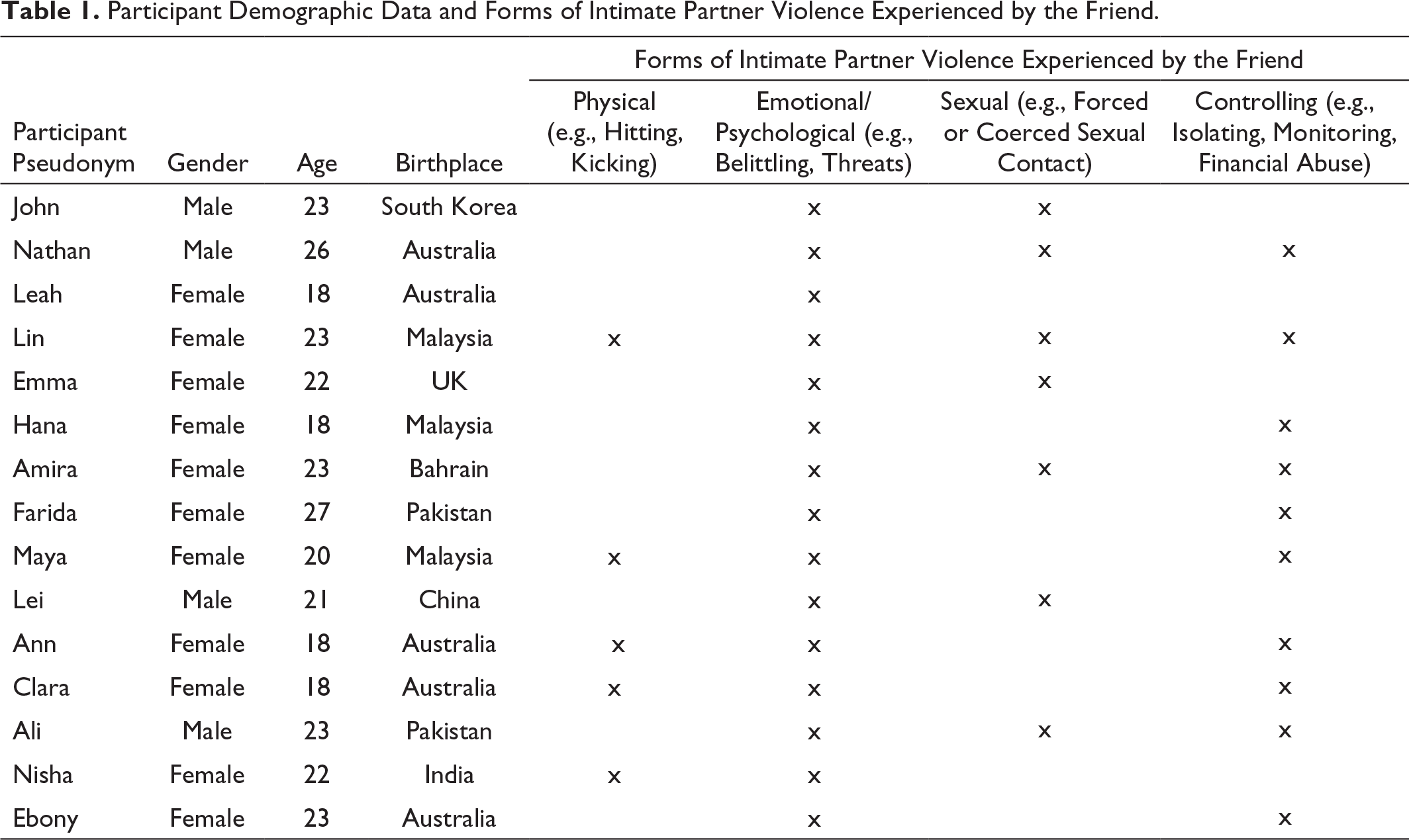
Of the total of 15 participants, 11 were women and 4 were men. All were students and most were born in Australia or had lived in Australia since childhood. Five were international students studying in Australia. All identified that the friend that they had supported had experienced abuse from a male partner. In six of the cases, the friend was reported to be still in the abusive relationship. All had known their friend for two or more years. Table 1 provides demographic data on participants. It also identifies the forms of IPV they reported that their friend had experienced. We identified these by applying the World Health Organization’s (2013) definition of IPV to the descriptions provided by participants.
Participant Demographic Data and Forms of Intimate Partner Violence Experienced by the Friend.
Data Analysis
We used “reflexive” thematic analysis as it can provide a rich overview of patterns in the data and was a method that was consistent with our socio-constructionist theoretical orientation (Braun & Clarke, 2019). Unlike other approaches to thematic analysis that emphasize the reliability and accuracy of coding, a “reflexive” approach sees codes and themes as interpretive stories; they are a product of the data, the analytic process, and the researcher’s theoretical assumptions (Braun & Clarke, 2019).
Considering the lack of existing research, we worked inductively to identify descriptive and latent themes in the interview transcripts. We used NVivo 11 to manage the coding process. First, we coded data related to participants’ descriptions and perceptions of the roles they had played or considered in responding to IPV. Second, we re-read and coded transcripts to identify the friendship-related themes and assumptions about IPV that underpinned how they explained or described their role. We named each role-related theme, then grouped these into two overarching themes based on their underlying friendship themes. We then visually mapped the themes identified. Our analysis developed iteratively through a recursive process of moving between the transcripts, codes, and proposed themes, in order to ensure themes were coherent and grounded in the data (Braun & Clarke, 2006). Consistent with common approaches to thematic analysis (Braun & Clarke, 2006), we did not quantify themes but used terms such as “some” and “many” to indicate the extent to which they were represented across the participants. The first author undertook the initial coding and theme development, which was reviewed regularly by the research team.
Trustworthiness
We used a variety of processes to help ensure the trustworthiness of the study, based on criteria (i.e., credibility, transferability, confirmability, and dependability). These were consistent with our underlying socio-constructionist paradigm (Guba & Lincoln, 1994; Nowell et al., 2017). The first author had prolonged engagement with the data through repeated reading of transcripts and kept an audit trail to help ensure transparency and record analytic decisions. To help confirm the credibility of our interpretations, we included verbatim quotations from interview transcriptions.
A key aspect of reflexive thematic analysis is critical reflection on the researcher’s role in knowledge production (Braun & Clarke, 2019). The first author had worked for many years as a social worker in services for women experiencing IPV and was influenced by feminist theorizing that recognizes connections between gender inequality and IPV. To promote reflexive bracketing to consider where pre-conceptions and biases potentially shaped the analysis (Ahern, 1999), the first author maintained a journal and met fortnightly for discussion with the research team. All of the team were experienced in qualitative research and came from different disciplines (applied ethics, sociology, and health sciences). This allowed for the analysis to be considered from different perspectives.
Findings
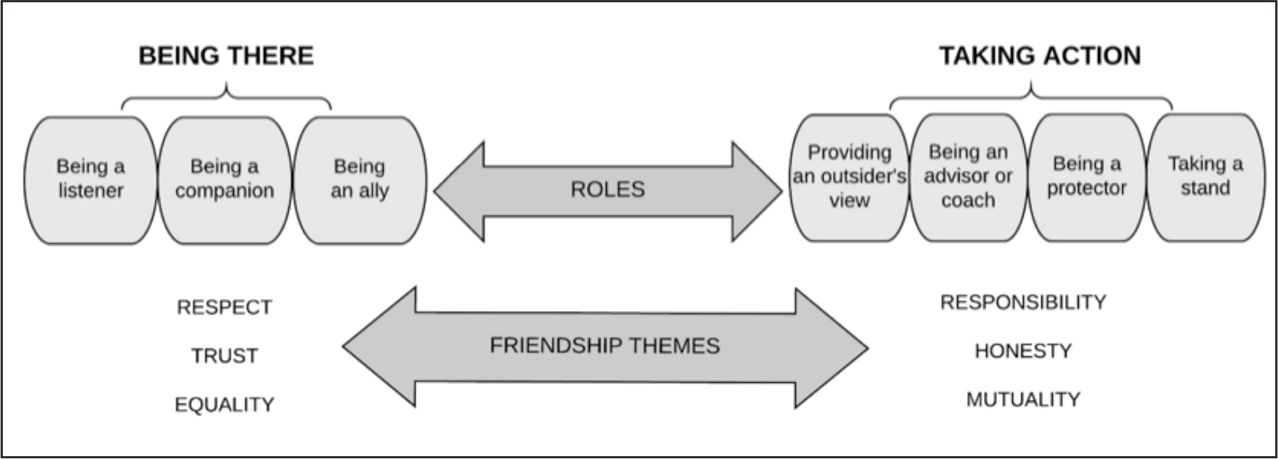
Based on a thematic analysis we identified seven themes in relation to participants’ perceptions of their role: “providing an outsider’s view,” “being an advisor or coach,” “being a protector,” “taking a stand,” “being a listener,” “being a companion” and “being an ally.” These themes reflected participants’ descriptions and explanations of the approach they took and what they did, tried, or considered doing in relation to their friend’s experiences of IPV. We identified six friendship-related themes that underpinned these roles: responsibility, honesty, mutuality, respect, equality, and trust. We grouped the role-related themes into two overarching themes. Each of these overarching themes had different friendship themes associated with them:
There were some overlaps in the friendship themes that underpinned these overarching themes. For instance, to some extent participants associated a sense of responsibility with the roles associated with the “being there” theme. However, a sense of responsibility to do what they thought was best for their friend’s safety and well-being was consistently associated with roles related to the “taking action” theme.
Our analysis suggested that participants played and considered different roles at different times. As we will discuss, almost every role presented tensions and dilemmas in the context of friendship. Deciding what role to play was difficult because it meant constantly weighing up different friendship considerations. As one participant (Clara) said, trying to help was like having to “walk on eggshells … around everything you do.”
We begin our findings with the overarching theme “taking action” and discuss its four role-related sub-themes. Following this, we explore the overarching theme “being there” and its three role-related sub-themes. Within each sub-theme, we consider participants’ experiences, explanations, and perceptions of adopting the role, as well as the friendship considerations and tensions associated with the role.
Taking Action
Providing an outsider’s view: Helping her to recognize the IPV.
The majority of participants suggested an important role they could play was to help their friend to recognize that her partner’s behavior was abusive. Participants described becoming aware of the IPV after their friend told them about concerning behavior, or after they witnessed or noticed signs of IPV (for example, seeing their friend being upset or having bruises). They suggested that for the sake of their friend’s well-being, they had a responsibility to share their insights into the behavior. As Hana asserted:
The main thing is to make them see what you see as an outsider. Because you may not see it when you’re in the relationship, because you’re caught up in emotions.
Underpinning this role was a belief that as they were not emotionally involved, they could provide an objective view of their friend’s relationship, while their friend was “blinded” by love and by the abuser’s manipulative behavior. Further, male participants positioned themselves as being able to offer their female friend insights into the motives of other men. For example, John suggested that “as a guy” he could see that his friend’s partner was just using her for sex, while his friend did not realize it.
However, they expressed that helping their friend to recognize the abusive behavior was far from straightforward. Although they suggested they felt comfortable validating their friend’s concerns about her partner’s problematic behavior, they struggled to respond when she excused the behavior or expressed positive feelings about the relationship. For example, Maya said:
I highlight how much stress it’s caused her and how I don’t see any positives that he’s given her … [But] she goes, “Well, he loves me a lot and he has reasons.” I recognize that’s a response to abuse, but I don’t know what I can do about it.
The difficulty of offering their own view of the abusive behavior related to a discomfort in disrespecting their friend’s perspective. As Maya asserted: “it’s her relationship.” Similarly, Emma said, “I didn’t want to do what [the abuser] does and invalidate her feelings.”
On the other hand, participants suggested that offering their perspective on the abuse was important because it helped to maintain honesty and authenticity within the friendship. Some felt that silencing their concerns had made their friendship interactions feel false. For instance, Emma suggested a lack of honesty was damaging the friendship:
It’s like we don’t have anything to say [and] there’s this big blocker between us.… She’ll want to say something about [her boyfriend] and either she won’t because she knows that I don’t really like him or I’ll then try and respond nicely to it … but I don’t ever want to make him seem good.
Being an advisor or coach: Getting her to stand up to or leave the abuser.
A theme evident in many of the participants’ accounts was a belief that their friend needed to stand up to her partner or end the relationship, and their role was to encourage and advise her to do so. They described trying various responses to promote assertive action. Several directly told their friend to leave her partner. Some took a less direct approach, describing it as “coaching”. This included helping the friend to stand up to her partner by assisting her to draft messages to him, trying to build her confidence and self-worth, and demonstrating assertiveness in their own relationships. For example, Emma said that in front of her friend “I’ll say things to [my boyfriend] like: ‘I didn’t like it when you did this’ … I think … it normalizes how a relationship could be.”
A perceived responsibility for their friend’s well-being was a key friendship theme associated with a coaching or advice-giving role. Participants suggested that the usual norm of friendship was to respect and accept each other’s relationship choices—as Ann said, “being a friend you want to be supporting her in everything.” However, Ann said because her friend was being harmed, she “needed to be a bit forward … and tell her what she should do”—even if it wasn’t necessarily the role her friend wanted her to play.
Underlying this response was an assumption that standing up to the abuser or ending the relationship was an effective and logical solution. For instance, Clara said:
She would tell us she was scared of him. And like, the only thing I could think of was to tell her “Why are you seeing him still? Why would you go to his house? You need to stop seeing him” Cos, for me, the common sense thing is to leave that situation.
Like Clara, many spoke at length about their struggle to understand why their friend continued to “put up with” the IPV. To explain this, participants referred to psychological factors such as their friend’s “insecurities”, “self-esteem issues”, or “dependent” personality. Considering that they felt their friend’s perceptions were impaired, participants perceived that their responsibility as a caring friend was to be honest about the need to take action—even if this advice was difficult for their friend to hear. For example, Amira narrated that she had an obligation to give her friend “tough love” and tell her to leave:
She needed to know, I felt like if I didn’t say that, then I would be the worst friend in the world. If I’m just like, “Yeah it’s okay”—No it’s not okay. Leave him. Whether you want to hear it or not.
Age-related factors and the norms of younger people’s friendships contributed to participants’ sense of responsibility. Participants framed themselves as the only ones who could assist their friend. This was because in young people’s lives, discussing relationship troubles was constructed as “a friend thing” and not something to share with parents or adults. As Clara explained: “It’s easier to talk to your friends, ‘cos they’re the same age and they can kind of have the same perspective.” Friends understood, while parents could overreact or be disapproving or unhelpful. For instance, Maya said: “You wouldn’t talk to your parents about how you’re having sex … [So] friends are pretty much all they have.”
The fact that their friend had chosen them to confide in amplified this responsibility. For example, Ann said being the “only one” her friend had told about the IPV had “made our friendship stronger, in that she is aware that I’m there for her no matter what.” Although Ann depicted being relied upon as something that strengthened the friendship, she also suggested it had created anxiety. Ann said if she did not encourage her friend to take action, she would feel responsible if her friend was physically harmed: “What if something went wrong and I didn’t push her enough?”
Advising their friend to end the relationship was also linked to the frustration and distress they experienced. As friends, they had regular contact and were part of the same social circles, so they frequently witnessed or heard about incidents of abuse. In response, they depicted simultaneously feeling responsible and helpless. As Emma described, it was “very exhausting and upsetting” because “you’re seeing one of your friends not being treated well but … [they] can’t really see it or won’t do anything about it.” Some suggested the emotional turmoil this created prompted them to tell their friend to act even when they knew it may not be helpful. Leah admitted:
Sometimes I was so frustrated with the situation so I just said: “You know what, you should just break up with him.” Because saying that was probably the easiest option … [though] I’ve probably learnt that it isn’t the best option.
Participants also suggested that they had adopted an advice-giving role for the sake of the friendship. For example, Hana said her friend’s boyfriend “started controlling where she could go and who she could go with … [which] put a real strain on the friendship”. Hana narrated her friend was “neglecting the friendship” by prioritizing his needs. She told her friend: “we just want to hang out with you on your own” and advised her that she “needed to go out more and not ask [her boyfriend] for permission”. Thus, telling the friend to stand up for herself not only reflected care for their friend’s well-being, but also a desire to preserve the mutuality of effort and interaction expected within the friendship.
Being a protector: Telling others.
Several participants spoke of wondering whether to inform others who may be able to intervene to stop the IPV. This was particularly the case when the friend was experiencing physical abuse. For instance, Lin’s friend was living with her abusive partner, and Lin said when she saw bruises on her friend, she wondered whether she should inform her friend’s parents. Similarly, Ann considered going “above her wishes” and reporting the friend’s abuse to police. This suggested a desire to shift the burden of responsibility for their friend’s safety from themselves. For instance, Clara said she considered telling her friend’s parents because “You feel very alone … and you don’t know what to do to protect her”. In this way, they suggested they may have a role to play as their friend’s protector when they considered she was unable or unwilling to protect herself.
However, all said they decided that they could not take such action unless there was an immediate threat. Firstly, they suggested there was a risk that involving adults would make things worse, because they may not intervene in helpful ways. For example, Clara decided not to tell her friend’s parents about the abuse because “they would have cracked it … and contacted [her boyfriend’s] parents … it would be messy [and] she wouldn’t have wanted that at all.” Secondly, even though they might be acting with good intentions, their friend may feel that by telling others, they had breached her confidentiality. For example, Leah said she decided: “I don’t want to go behind her back … I don’t want to invade her privacy. She trusted me.” Betraying the trust their friend had placed in them was depicted as a significant concern, not only because it could harm the friendship, but also because without their support their friend could become less safe. For instance, Clara said: “she’d get pushed away and then, like, she would just spend more time with him”.
Taking a stand: Confronting the abuser.
A perceived responsibility to stand up for their friend motivated some participants to consider telling her partner that his behavior was “not okay” and he needed to stop it or to “stay away” from their friend. Several described concerns that by not taking a stand against the abuser’s behavior, they were being complicit in the abuse. For example, Maya wondered whether she and her friends should “shun” the abuser. He was physically and emotionally abusive to her friend, and she worried socializing with him as though nothing was wrong may communicate that his behavior was “okay:”
I’m worried it’s sort of legitimized what he’s doing.… We’ve met him, we’ve talked to him, like it seems … like it’s normal and legitimate.… So I think she might have sort of come to accept it.
However, when they did not know the abuser separately, participants decided their interactions with him should be consistent with their friend’s wishes. They said confronting him would only upset their friend and could damage the friendship.
In contrast, those who were friends with both the abuser and the victim (mostly male participants) narrated a greater sense of obligation to confront the abuser. This reflected a responsibility and loyalty to the victim and a perception that maintaining a friendship with the abuser but not taking a stand against the IPV implied that they supported his behavior. For example, Ali said that after his friend Sarah disclosed that his other friend Matt had repeatedly raped her during their relationship, he was compelled to confront Matt. Ali suggested this was because he felt complicit. He said Matt constantly complained to him about “all the injustice” Sarah had done to him during their relationship and “probably expected me to agree.” However, Sarah had asked Ali not to say anything to Matt about the abuse. Ali said: “I didn’t know what to do … I didn’t want to jeopardize my relationship with him, but I also cared about her.” Ultimately Ali said he decided he could no longer “tolerate” staying silent. In confronting Matt, Ali described trying to protect Sarah’s confidentiality and safety by giving minimal details of what he knew about the abuse: “I told him. I said, ‘Do you know what? She told me stuff. I’m not going to repeat it, but, like, I know that you mistreated her’.” Matt denied the abuse and threatened to confront Sarah for “spreading rumors” about him. However, Ali described speaking up as “the right decision”, suggesting that it accorded with his responsibility not to collude with his friend’s abusive behavior.
Being There
Three roles were associated with the overarching theme of “being there” for the friend. As discussed later, the friendship themes underlying these roles were a need to show respect for their friend’s choices and to maintain a trusting and equal friendship.
Being a listener: Letting her “vent.”
Many participants said they had adopted the role of a “listener” after they had realized that their friend did not seem prepared to act on their advice. For instance, Ann said:
She’d agree things were wrong, but when I offered things that she could do, like talk directly to him … she would kind of go back to the issue itself. She wanted someone to vent to rather than hear that something should be done.
Participants suggested that to some extent being a listener could be psychologically beneficial for their friend, as having their attention could help her to feel less alone. Yet almost all constructed listening while their friend remained in the abusive relationship as an inadequate and potentially irresponsible role. This was reflected by the passive way in which participants portrayed themselves in this role: they spoke of “just” being “a listener” while their friend “poured out” her problems or “vented” about distressing incidents of abuse. Many worried that “just” being a listener was not in their friend’s interests because it was not helping to address the IPV. For instance, Lin said:
I’m just listening to her—all her worries … instead of me giving advice. I think she might find it helpful … but in the long run, she’s constantly being abused … That didn’t actually solve her problem.
In order to feel more comfortable in “just” listening and accepting their friend staying in the abusive relationship, participants referred to an expectation that friends should respect each other’s freedom of choice—even if they felt the choices their friend was making were not good ones. For example, Maya suggested, “If someone wants to do something, even if it’s bad for them or stupid or whatever, that it’s their freedom.” Similarly, John said, “I do feel she can make better choices but ultimately it’s her decision.” Drawing on discourses of free choice and personal responsibility appeared to assist participants to detach themselves from their own perceived responsibility for their friend’s well-being.
Listening was also framed as a way of maintaining equality in the friendship. For example, Emma said she let her friend “vent” because she worried that repeatedly offering advice or pointing out abuse had “put a power play on it [the friendship] … maybe she thinks that I’m looking down on her relationship like I think I’m a voice of authority on her relationship.” Similarly, Nathan said he tried to listen because he did not want to treat his friend “like a project” by constantly offering advice. This suggested that situating themselves as an expert or advisor on their friend’s relationship issues was an uncomfortable position to take while listening to the friend’s perspective supported an egalitarian friendship dynamic.
Yet, although being available as a listener could help to maintain equality in the friendship, it could also undermine its mutuality. Women participants in particular portrayed themselves as regularly listening to their friend’s problems for hours on end. This was described as “emotionally draining”, “overwhelming”, and “exhausting”. A further concern was a loss of mutual emotional support. Several said the friendship had become “one-sided” because the abuse took up much of the conversational focus. Despite having invested so much of their energy in listening and trying to support their friend, they said they felt unable to ask her to reciprocate. For example, Maya said “I don’t feel she’s in a position to give me any support. I don’t want to be more stress on her.” Although continuing to “be there” to listen to their friend came at a considerable personal cost, they also depicted feeling unable to disengage. This was because of a perception that they alone carried the responsibility for helping their friend. As Clara said: “You just want to distance yourself … but you can’t because there’s no one else and she needs people around her right now.”
Being a companion: Spending time with her.
All participants constructed offering companionship as a comfortable role for them to play a friend. This was not only because it could help to sustain the friendship, but also it could also help to address the impact of the IPV. Being physically present and keeping their friend company was something male participants highlighted. For example, John said, “you don’t have to verbally comfort them, you just have to be there physically, whatever makes them feel calmer.” Like others, he suggested that making an effort to spend time with his friend showed her he cared. This could counter the negative impact of being treated badly:
Maybe it gives her the feeling that at least one person is here for me. If one person is treating you like trash, there’s one person that cares about you.
A further benefit was that keeping their friend busy could reduce her reliance on the abuser. For instance, Lei said he: “tried to distract her. I would take her to nice restaurants, to the movies. I tried to get her to think of something else apart from this guy.”
Being an ally: Understanding her perspective and being “on her side.”
Participants who had themselves experienced IPV (three female participants) offered a distinctly different understanding of their role compared to those who had not. They framed their role as being an ally to their friend, reflected in their use of phrases like “being on her side” or putting themselves “in her shoes”. They constructed this role as seeing the situation from their friend’s perspective and respecting her decisions rather than judging them. This was illustrated by Nisha’s comment that when her friend tells her she wants to contact her abusive ex-boyfriend: “I say ‘if you pick up the phone, just take care of yourself’.”
Participants suggested listening was a valuable process that supported this role. They constructed it as purposeful, in contrast to how it was depicted in the theme “being a listener.” Participants suggested that they listened in order to understand their friend’s perspective, to help her weigh up how to address the IPV, and to demonstrate that they would respect her decisions. For instance, Farida said: “I was a good listener all the time just to make her feel that ‘Okay, I am here. I understand and I am ready to support whatever you do’”. Similarly, Ebony depicted listening as beneficial in helping her friend to “reflect” on the situation. To facilitate this, she said she had asked her friend “questions that aren’t about judgment but more like ‘How does that make you feel?’”
In explaining why they had adopted this role, participants highlighted the challenges of dealing with an abusive partner. This meant it was important to understand the friend’s situation, rather than to make assumptions about what was best for her. As Ebony said: “You need to understand the complexity of it … if you try and push someone to leave it’s like you don’t fully understand the situation.” Participants normalized their friend’s ambivalence about ending the relationship as something any woman could experience. In doing so, they positioned themselves and their friend as equals; as Farida said: “If there is one thing I would say, don’t be judgmental. You could be in her position. You never know.” While each acknowledged that supporting the friend had been emotionally taxing and difficult, they also constructed it as satisfying because it had deepened their friendship and they were confident that they were playing a helpful role. For instance, Ebony said: “Whilst other friends were saying to her ‘Just leave’ … I was able to support her because I knew how to.”
In our discussion, we provide a conceptual model to illustrate the relationships between the role-related and friendship themes we identified. We also consider the implications for developing interventions for friends.
Discussion
Based on interviews with young people attending university, we explored how they perceived their role in supporting a female friend who had experienced IPV. Consistent with studies of friends and other informal supporters of adult women experiencing IPV (Gregory et al., 2017; Latta & Goodman, 2011), participants narrated that they struggled to decide what role they should play. Our findings illuminate how the context of friendship contributed to this difficulty and influenced responses to IPV.
The two overarching themes we identified that related to participants’ perceptions of their role (“taking action” and “being there”) reflected different expectations associated with friendship, as well as differences in how participants understood IPV. These understandings and friendship expectations intersected and conflicted with each other, making it difficult for participants to decide what role to play.
Our conceptual model (Figure 1) illustrates this. Beneath each of the two overarching themes are the associated themes that related to participants’ perceptions of their role. Underneath these are the friendship themes that underpinned them.
Conceptual model of participant’s perceptions of their role in relation to their friend’s experiences of intimate partner violence and the associated friendship themes.
To a large extent, the difficulties experienced by many participants in deciding what role to play reflect some of the tensions inherent in everyday friendship interactions, such as whether one should simply respect a friend’s decisions or whether one has a responsibility to be honest and offer potentially useful feedback (Rawlins, 2009). However, in participants’ narratives, these tensions were exacerbated by their anxieties about their responsibilities for their friend’s safety. As a result, many depicted trying to offer support as like “walking on eggshells.” They framed the risk of upsetting the friend and pushing her away as a major concern. This was because damaging the friendship would not only mean the loss of a valuable relationship, but it could also result in their friend being more isolated in her relationship with the abuser.
Many participants acknowledged that “being there” by being a listener, a companion or an ally was beneficial for sustaining the friendship and their communication about the IPV. These roles were depicted as demonstrating a respect for their friend’s wishes and helped to maintain equality and trust. These values and behaviors are commonly perceived as important in sustaining friendships (Friedman, 1993; Oswald, 2016). The benefits of offering physical companionship were highlighted by male participants, while female participants emphasized being a listener. This is in accordance with studies of gender differences in friendship expectations (Felmlee et al., 2012; Hall, 2010).
Participants also indicated that being a listener, a companion and an ally were roles that were consistent with what their friend wanted from them. This accords with studies on what young women experiencing IPV find helpful from friends (Edwards et al., 2011; Mahlstedt & Keeny, 1993). Such an approach is similar to best-practice professional approaches to responding to IPV, such as the LIVES approach (“Listen, Inquire, Validate, Enhance safety, Support”) for front-line health professionals (World Health Organization, 2013). These “victim-centered” approaches highlight a need for supporters to listen to the victim’s wishes and to put her understandings of her own situation at the center of their approach (Davies & Lyon, 2014; Goodman et al., 2016).
But at the same time, many participants suggested that listening to and accepting their friend’s wishes and perceptions were extremely difficult when their friend remained in the abusive relationship. They depicted themselves as having an “objective” view of the problems in their friend’s relationship and suggested they had a responsibility to share their concerns and to encourage their friend to take action. Additionally, male participants positioned themselves as able to offer insights into the behavior of other men, which is consistent with research on young people’s expectations of cross-gender friendships (Monsour, 2016; Rawlins, 2009).
Consistent with other research on friends’ responses to young women experiencing IPV (Casey et al., 2018; Edwards et al., 2011; Fry et al., 2014; Mahlstedt & Keeny, 1993), many participants focused on advising or coaching their friend to stand up to or leave the abuser. Our findings help to illuminate why this was the case. A key factor that influenced participants to adopt an advisory or coaching role was how they conceptualized effective responses to IPV. Many constructed standing up to the abuser or ending the relationship as a rational and effective solution. This finding accords with Australian surveys of young people, which indicate that most find it hard to understand why women stay in abusive relationships (Harris et al., 2015). It also echoes culturally dominant assumptions that women who stay with abusive partners lack self-esteem or assertiveness (Dunn, 2005; Overstreet & Quinn, 2013).
From this perspective, participants associated advising their friend to assert herself with a perceived responsibility to do what they thought was best for the sake of her safety and well-being. Additionally, being honest in expressing their opinions and concerns was constructed as important in maintaining the friendship. This accords with the expectations commonly perceived to be part of a caring friendship (Rawlins, 2009).
A different understanding and approach were evident from participants who had personal experiences of IPV. Recognizing the challenges their friend faced in leaving the abusive relationship, they framed their role as an ally; it involved being “on her side,” understanding their friend’s struggles and respecting her decisions. This is consistent with other research, which indicates that friends who have personal experiences of IPV frequently provide empathic and supportive responses (Edwards & Dardis, 2016).
At the same time, all of the participants in our study narrated that they had experienced significant emotional impacts in trying to support their friends. Similar to other studies with friends and other informal supporters of adult women experiencing IPV (Gregory et al., 2017; Latta & Goodman, 2011), participants described an overwhelming burden of responsibility for their friend’s well-being. This was associated with the perceived expectations of friendship, as well as with the young woman’s age. Most participants said their friend did not want to involve her parents or adults due to a fear that they would be disapproving or would forcefully intervene. Similar concerns about involving adults have been identified by others who have studied young women experiencing IPV (Mahlstedt & Keeny, 1993). As a result, participants in our study suggested that they were the only ones in the young woman’s social network who knew about the IPV. This knowledge created intense anxiety and a fear that they would feel responsible if their friend was seriously harmed. This made it emotionally challenging for them to accept their friend’s wishes to stay in the abusive relationship. This suggests that, compared to professionals, it may be harder for friends to maintain a “victim-centered” approach (Davies & Lyon, 2014; Goodman et al., 2016).
An additional difficulty was deciding what their role was in their interactions with their friend’s abusive partner. This was particularly a concern for participants who were also friends with the abuser, who struggled to find a way to demonstrate to him that they did not condone his behavior while also trying to protect the victim’s confidentiality and safety.
We explore the implications of these findings after discussing the study’s limitations.
Strengths, Limitations, and Recommendations for Further Research
To our knowledge, this is the first study to examine how friends of young women experiencing IPV perceived their role. The qualitative design and small sample size facilitated an in-depth and nuanced exploration of participants’ perceptions (Braun & Clarke, 2019). The sample included some variation in gender, though participants were mainly female. Some researchers have found gender differences in how friends respond to IPV (Debnam & Mauer, 2018; Edwards et al., 2011; Mahlstedt & Keeny, 1993) and in their expectations of friendship (Felmlee et al., 2012; Hall, 2010). Some gender differences were evident in our study, but research with larger samples would help to identify how constructions of gender and friendship influence friends’ perceptions of their role in responding to IPV.
Similarly, researchers have identified culturally based differences in friendship expectations (Baumgarte, 2016). There was considerable diversity in the birthplaces of participants in our study. We acknowledge that our interpretations are likely to reflect our own cultural biases and theoretical orientations, as researchers working within an Anglo-Australian context. Further research is needed to explore how different sociocultural contexts influence the ways in which friends construct their role in responding to young women experiencing IPV.
Implications
The findings of this study expand understandings of help-giving responses to young women experiencing IPV. For the participants in our study, friendship expectations and ideas about IPV influenced how they perceived their role and created dilemmas in knowing how to respond to IPV. This highlights a need for interventions to assist friends to provide effective responses. These could include websites and other resources to guide friends on how to respond to IPV, or education programs in schools, universities, or community settings. It could also include individual advice services to support friends with the challenges and personal impacts they may experience in offering help.
Based on our findings, we suggest that in order to encourage friends to take a “victim-centered” role (Davies & Lyon, 2014; Goodman et al., 2016) and to respond in ways that young women report is helpful (Edwards et al., 2011; Mahlstedt & Keeny, 1993), such interventions need to educate friends to understand the challenges young women face in ending abusive relationships. This understanding may assist friends to recognize the value of being an ally, a listener, and a companion. It could also help to sustain respect, trust, and equality between friends, consistent with friendship norms.
It is also crucial that interventions provide guidance regarding potential dilemmas that can arise as friends navigate their role in the context of friendship. For participants in our study, these included:
Addressing dilemmas such as these could assist friends of young women experiencing IPV to play an effective role, while also balancing their own needs and maintaining the friendship.
Footnotes
Declaration of Conflicting Interests
The author(s) declared no potential conflicts of interest with respect to the research, authorship, and/or publication of this article.
Funding
The author(s) disclosed receipt of the following financial support for the research, authorship, and/or publication of this article: The first author was supported by an Australian Government Research Training Program Scholarship, as well as funding from the Melbourne Networked Society Institute (2009–2019), to conduct this study as part of her doctoral research.
